
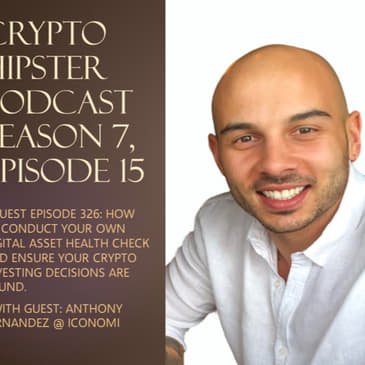

Anthony Fernandez stands at the forefront of the evolving cryptocurrency landscape as the Head of Business Development and Sales at ICONOMI, an FCA-registered digital asset portfolio management firm. With a rich background in asset management, foreign exchange, and cryptocurrency mining & trading, Anthony has become a leading authority in blockchain technology, including DeFi, derivatives trading, and cross-chain solutions.
With over 8 years in fintech and wealth management, Anthony has transitioned into the alternative investment space, specializing in Bitcoin and various digital assets. Before his role at ICONOMI, he honed his expertise leading a Bitcoin mining team, helping both professional and retail investors to earn passive income.
A sought-after speaker, Anthony illuminates financial seminars with his deep understanding of macroeconomics and the crypto ecosystem. His practical insights guide investors through the intricacies of blockchain investments and the ever-changing digital economy.
[00:00:00] Hello everybody and welcome to the Crypto Hipster podcast. This is your host Jamil Hasan, the Crypto Hipster where I bring you founders, entrepreneurs, executives, thought leaders, artists, you name it all over the world, crypto and blockchain globally.
[00:00:17] And I have another amazing guest. All my guests are amazing, but I have an amazing guest this morning. He is the head of business development at Economy. His name is Anthony Fernandez. Anthony, welcome to the show.
[00:00:33] Jamil, thank you very much for having me and thanks for a very kind welcome onto the show as well.
[00:00:39] You're very welcome. So ready to kick things off? I am.
[00:00:43] Let's go. Hopefully I can provide some value to your listeners.
[00:00:47] Awesome, awesome. So let me ask you the first question is about your background. What is your background and is it a logical background for what you're doing now?
[00:00:57] Yeah, okay. Great. Great first question. So long story short, you know, I've worked in the financial markets now for eight years. I started my career in traditional wealth management, you know, fund management, moved across into the FX market and for the past six years, I've worked directly in the cryptocurrency market.
[00:01:16] My first role in the cryptocurrency market was actually working for a startup company in Australia, which was a Bitcoin mining company. We essentially grew that to a global presence across the EU, America, obviously Australia.
[00:01:30] We had a facility in China before they banned Bitcoin mining. Fast forward to today over the past year and a half. I've been working at Iconomy, which is a digital asset portfolio management platform here in the UK.
[00:01:44] So we essentially have a range of, you know, index, quant discretionary managed portfolios for investors to access if they don't have the skill set and knowledge or know how to actually invest and manage their own portfolio in the cryptocurrency space.
[00:02:01] Got it. So yeah, my question next question is economy. What's it all about? How does it work? Why should we view you guys as an authority in this industry?
[00:02:13] Yeah, that's I guess when you're looking across the cryptocurrency market is hard to find, you know, sometimes it's hard to find who the good players and the bad players are now.
[00:02:21] Iconomy has been around in the space since 2016 was one of the top 10 ICOs in the world at the time. And since then we we now have more than 120 million pounds invested across our portfolios.
[00:02:34] We have a large audience across the UK and Europe as well. And our portfolios when you actually take a look at their performance, not only do they have risk management attached to them so limited drawdown potential, but they've also consistently outperform Bitcoin over a long period of time.
[00:02:52] So over the past five to six years. So Bitcoin is our measure in terms of our performance and a range of our portfolios have consistently outperformed Bitcoin over the past number of years.
[00:03:06] That's impressive.
[00:03:10] So the tokens are outperforming Bitcoin right now they're called mean points but other than that, you know, and we're going to talk about that because, you know, we're talking about retail investors, right?
[00:03:22] You don't know retail investor can't afford a buy full Bitcoin, right.
[00:03:27] But they can make informed crypto non emotional investments how can they do that.
[00:03:34] Yeah, I just catch on one thing you said so you know outperforming Bitcoin. It's not necessarily just picking tokens that are going to outperform Bitcoin.
[00:03:42] It's also limiting downside potential so knowing when to potentially trim down exposure and then when to increase exposure as well.
[00:03:50] So, you know, not necessarily just holding and sitting and holding forever but sometimes the portfolios because they can be discretionary managed a lot of the portfolio managers are reducing exposure during times of downside pressure and then increasing on the upside.
[00:04:03] And yeah, I guess coming back to your question so you know how can retail investors make informed crypto non emotional investments.
[00:04:11] I think firstly it comes down to you know your personal goals and ambitions every investor is different.
[00:04:17] So how much risk are you willing to take. Can you stop drawdown do you have a 10 year investment horizon or a one year investment horizon.
[00:04:25] So building a strategy and sticking to that strategy will help you remove the emotions from investing.
[00:04:32] So you really want to kind of automate this and remove the emotions from investing in the cryptocurrency space which can be very hard because it is obviously highly volatile.
[00:04:41] Now, in terms of what does informed me, it doesn't necessarily mean reading the mainstream news, you know, these kind of news events are just short term volatility events.
[00:04:54] They very rarely establish a long term trend in the market.
[00:04:58] So, you know, for a retail investor it's quite hard sometimes to switch off from the mainstream news and seeing these major headlines that Bitcoin is going to 1 million or you know dodge coins going to 1 million so try to switch off from those mainstream news events and to become informed.
[00:05:15] You know you want to start looking at high quality data and information so looking at institutional inflows and outflows into particular projects understanding bitcoins four year cycle understanding Bitcoin spiral charts which takes a look at the
[00:05:31] halving event and the different bull markets and bear markets so I'm looking at on chain data as well.
[00:05:37] So remove the junk noise and the junk news and look for more high quality data to make investment decisions.
[00:05:45] And where are working people on to that data.
[00:05:48] Tough one there's so many data providers you know that you can look at out there high quality ones as well so for myself.
[00:05:56] If I'm looking at the total value locked, I'm going to websites like defile armor.
[00:06:03] So that indicates the total value of assets that have been locked in different staking protocols.
[00:06:09] So for example this will indicate the confidence in a certain project if more investors are staking and locking their assets up for a period of time.
[00:06:17] It indicates more of a positive sentiment around that particular project which indicates possibly a good time to start looking at investing in that project as well.
[00:06:26] And vice versa if the TVL is dropping it indicates investors are trimming down their exposure.
[00:06:32] They don't want to be invested for a period of time so that indicates probably a reducing positive sentiment in that particular token.
[00:06:38] So that's you know TVL but then you can also look at you know glass node into the block Queen gecko.
[00:06:44] These types of platforms provide valuable on chain data to make investment decisions.
[00:06:50] And for looking at you know inflows and outflows at the institutional level, you know I personally go to a company called coin shares.
[00:06:58] You know if we take a look at 23 was looking at the inflows and outflows into different projects.
[00:07:06] Solana was the second highest project to receive institutional inflows behind Bitcoin.
[00:07:12] So for me that was you know I was actually investing into Solana fairly heavily and in 23 it did over 1000% return on investment being driven by those institutional inflows.
[00:07:22] So just understanding liquidity going into and out of different projects really help you direct your capital as well in the market.
[00:07:30] Okay that's from an institutional perspective right.
[00:07:34] That's being informed as far as data, but there's also something else going on right now.
[00:07:40] And that's being informed regarding.
[00:07:43] I guess what's the word narrative or you know which is nothing nothing to do with fundamentals.
[00:07:50] Yeah themes you know there's a lot of themes that do take obviously the Bitcoin ETF was a major theme over the past year.
[00:07:56] And for me personally, you know I'm now taking a look at the Ethereum ETF theme and narrative.
[00:08:02] So earlier this year I know we're having a bit of downside pressure over the past week or so which we can touch on later as to why that's happening.
[00:08:10] A major narrative now is investors at the institutional level are trying to front run the Ethereum ETF narrative.
[00:08:18] So liquidity is actually flowing into Ethereum on the assumption that an Ethereum ETF may be approved over the next few months, whether or not it does gets approved or rejected or pushed back.
[00:08:30] Is it relevant because these investors are actually just trading that particular narrative at the moment.
[00:08:37] Got it. Yeah.
[00:08:39] So,
[00:08:42] trying to front run I see that.
[00:08:47] You are a proponent of developing a well curated selection of assets that hedge against volatility and not to say Bitcoin's a hedge against volatility but having like portfolio right.
[00:08:58] What is the what is any talk about strategy right what is having a well balanced strategy mean.
[00:09:04] What is that.
[00:09:06] Yeah this you know this is a tough one I think personally it's impossible to have solely a cryptocurrency portfolio that's that's well balanced you know you need to have other assets in there as well you know whether it's
[00:09:16] gold equities bonds you know because crypto you know looking at crypto and Bitcoin and what they actually are they're probably a mixture between gold.
[00:09:26] Thea currency and also tech stocks, you know which thrive in a low interest rate environment.
[00:09:32] Now in terms of you know diversifying your digital asset portfolio for me Bitcoin is the leader you know I come from the Bitcoin mining industry but I also understand that there's opportunity for return investment outside of Bitcoin so
[00:09:45] for me I have a large allocation in my portfolio to Bitcoin and what I would then want to do is diversify via the different segments in the cryptocurrency market.
[00:09:55] So for example allocating into the defy space you know looking at maybe chain link or uniswap and then diversifying into AI so bit sensor maybe render the graph diversifying by a proof of work and proof of stake.
[00:10:10] Looking at layer one like atom a vax looking at layer two like arbitra and maybe polygon so you're not fully exposed to one segment.
[00:10:19] But you're also in some of the hot topics at the moment like AI.
[00:10:24] Now one strategy that we do see which is fairly popular amongst our portfolio managers is always having a small allocation to stable coins or to fiat currency.
[00:10:37] So for example you know you could have 90% allocated to different projects in the market and 10% remaining in stable coin.
[00:10:46] And essentially what that means is if the market decreases in value your weighting of stable coin is going to increase in value because the rest of your portfolio is decreased.
[00:10:56] So when you rebalance your portfolio you're going to be allocating your stable coin into these projects that have gone down in value so you're essentially buying on the way down whilst maintaining a 10% allocation in stable coin.
[00:11:08] So you're essentially dollar cost averaging on the way down and vice versa on the way up your weighting in terms of crypto is going to grow and you're waiting in terms of stable coins going to decrease.
[00:11:20] So you're then essentially trimming down a bit of your exposure and putting it back into stable coin as well to reduce exposure during these extreme runs to the upside.
[00:11:28] So essentially what this strategy means is you always have capital on the side to deploy if the market does correct by 10 15 20 or 30%, which is highly likely in the cryptocurrency space.
[00:11:41] So one area didn't just mention there was was means right.
[00:11:47] You know, people are making some people are getting insanely rich.
[00:11:53] And a lot of people are not.
[00:11:55] But what's your appetite as far as what you say is the appetite as far as institutions and VCs regarding these means.
[00:12:03] You know, I see you know means they do what they say, you know, they do what they say on the team essentially, you know, they're a bit of a joke.
[00:12:11] For me personally and our economy, we don't really kind of get too heavy into the meme coins so we have a strict asset listing policy.
[00:12:19] So we we tend to only list the top 150 tokens or some of the new tokens with credentials coming up come into the market just to protect our investors.
[00:12:29] And I'm just to say there's no opportunity to make money in the meme coin market that there definitely is but I wouldn't say it's an investment strategy.
[00:12:36] It's it's a gamble.
[00:12:37] It's a pun.
[00:12:38] It's a bit of fun.
[00:12:39] So you know, if you have your core holdings in some of the main tokens and you're happy to play around with a few thousand pounds or a few thousand dollars that you don't mind losing.
[00:12:51] Definitely that's that could be a bit of fun.
[00:12:53] I think it's a good idea to make your substantial amount of money, but long term investing into mean coins can be a very high risk strategy.
[00:13:01] Yeah, I'm just worried about the emotional side because we're talking about emotional investing right in it.
[00:13:07] You're in a few and if you invest in conservative I say the blue chips are conservative.
[00:13:12] Yeah, you know, cryptos and you're like okay guys sound strategies all based on fundamentals.
[00:13:18] You see some kid over here turn $2,000 and $200,000.
[00:13:22] Isn't it easy to get emotionally wrapped up and trade your trade your what you got build up and dive into something and get and get punted?
[00:13:31] Well, you know, you look at these meme coins those guys that make that kind of money there's someone at the top who has lost that kind of money because they've bought in at the very top as well so it is you know the early again to those mean coins obviously the higher probability of you making making a game.
[00:13:45] The ones getting in late to the party obviously are holding a losing bag at the top so it's a very tough.
[00:13:51] I personally don't get too involved in the mean coin market but I understand there's a lot of gains potentially to be made there as well.
[00:13:57] Got it got it.
[00:13:59] So that brings me to my next question then is digital asset health check.
[00:14:04] You know, how we each conduct our own digital asset health check.
[00:14:09] And what are your and what are your criteria for selecting those digital assets for a good good health checker report.
[00:14:18] Yeah, I think I touched on a couple of the different platforms that we use to kind of do a bit of a health check but I think you know there's so many different tools you can use to check the underlying value of a particular potential token.
[00:14:30] I guess I want to kind of look at more of the broader view of the market.
[00:14:34] So for me myself when I'm analyzing my portfolio, the first thing I do is actually take a look at the macro view of the global economy because generally Bitcoin is the leader if Bitcoin wins the overall market wins tend to generally speaking if Bitcoin goes down generally
[00:14:50] the overall market goes down so understanding what you know central banks are doing in terms of monetary policy.
[00:14:58] Are they in a, are they reducing liquidity from the system or are they increasing liquidity.
[00:15:04] Are they raising interest rates or decreasing interest rates.
[00:15:07] You know that in particular will give you a direction of how Bitcoin is going to perform.
[00:15:12] Now unfortunately we're not on a system where I can show you a few charts maybe we can do that next time but there's a very strong chart showing the price of Bitcoin plotted against the global M2 growth rate.
[00:15:24] So essentially what this looks at is it looks at liquidity provided by the Federal Reserve, the Bank of Japan, the Bank of China, the Bank of England and the ECB and when these central banks globally are increasing liquidity, Bitcoin performs extremely well.
[00:15:41] And when they're reducing liquidity and removing money from the system, Bitcoin tends to go into a bear market.
[00:15:47] And the last three bear markets have coincided with a tightening cycle of these central banks.
[00:15:54] Okay, so what essentially Bitcoin is there for Bitcoin is a hedge against fiat currency devaluation which over time takes place.
[00:16:04] So understanding from my point of view, yes you can you know analyze all of these different tokens and go through a digital asset health check.
[00:16:13] The number one thing for myself is to understand what central banks are potentially going to be doing over the next one to two years.
[00:16:19] And I guess you know if we look at the market over the past week, we can see the US inflation numbers have actually increased.
[00:16:26] And this is now putting down side pressure on equities and cryptocurrencies.
[00:16:31] So there's now questions around whether the Federal Reserve this year are going to reduce interest rates like they anticipated because inflation is actually coming back and rebounding a bit now.
[00:16:42] So the market is wobbling, we're getting interest rates are running a bit higher, and that's putting some downside pressure on the cryptocurrency market.
[00:16:49] So my kind of analysis, I'm generally look at the macro sort of things before going down into the underlying assets and you know stock picking essentially in the crypto market.
[00:17:01] That's smart. That's smart.
[00:17:05] So I'm looking at the let's look at macro for a little bit.
[00:17:08] Yes, you know, there are countries, there are going to be, I think 30 major elections coming up this fall.
[00:17:17] Right.
[00:17:18] In the world, including US, there's going to be these banks are looking at central bank digital currencies and each have their own look and spin on them.
[00:17:28] So it's kind of like, you know, what is the, what's the trend there?
[00:17:32] What's the trend with the upcoming political cycle?
[00:17:35] How is that going to have an impact on the crypto market?
[00:17:38] What do you see?
[00:17:40] That's a difficult one to ask, you know, in the US in particular, I believe they've agreed not to create a central bank digital currency.
[00:17:49] But yes, you're right, you know, coming up to obviously the election cycle, the Federal Reserve of central banks are meant to be neutral in terms of the party they're supporting.
[00:17:59] However, you know, at the moment, the Federal Reserve has been suggesting over the past six months that or I guess two or three months that we're potentially at the top, you know, at the top end of the rate hiking cycle and interest rates should be coming lower.
[00:18:14] But the market simply doesn't believe them at the moment. You know, we actually have yields running higher. The bond market is dropping this week.
[00:18:22] Stocks, especially tech stocks have had a pullback and crypto currencies are having a pullback as well. So we actually are seeing the market kind of diverging from what the Federal Reserve has been saying.
[00:18:35] So we're now in a position where the market is probably going to push back their forecast of reduced interest rates towards the middle or back end of this year. We may stay at this kind of level for a longer period than what the market initially anticipated.
[00:18:51] In terms of central bank digital currencies, obviously we have the rise of the BRICS nations at the moment and that's probably the main trading block which is causing some friction with the US.
[00:19:03] Now the BRICS nations have actually been selling and de-dolarizing over the past, you know, five years or so. And they've actually been stockpiling gold. So there's a lot of talk that they may create a gold backed digital currency.
[00:19:19] Whether or not that's true, the main point I'm getting across is these kind of nations now which are actually growing, they're essentially going through a phase of de-dolarization.
[00:19:31] And that de-dolarization will put selling pressure on the dollar and that actually is good for Bitcoin and digital assets because Bitcoin tends to move with the inverse correlation to the DXY, which is the US dollar index.
[00:19:46] So the US dollar, the de-dolarization theme, I'm expecting this to pick up momentum. Long term, I think that's great for Bitcoin but obviously for anyone that doesn't have any exposure to Bitcoin, not so good for the local currency and fiat currencies as a whole.
[00:20:04] I had to keep an eye on that.
[00:20:10] Fiat currency devaluation has been going on for obviously decades and decades. It's nothing new but now there's an asset that can potentially protect us from that fiat currency devaluation.
[00:20:24] Sounds good.
[00:20:25] So moving into some of the pitfalls about crypto, right? There have been hacks, there have been rugs, there have been money grabs, there have been all kinds of stuff in addition to really great utility tokens and cryptos.
[00:20:46] So what do you see as some of the pitfalls of some of these scam-prone cryptos and illiquid investments?
[00:20:54] Yeah, you know, when you look at these types of investments, like I mentioned, the way we actually protect our investors is we have a pretty strict asset listing policy.
[00:21:06] So I can't go into the details too much but the cryptocurrency token must be listed on multiple major exchanges.
[00:21:14] So looking at Binance, Qcoin, Coinbase for example. And before we actually consider listing this token, it must have a minimum market cap or a stable market cap and it also must have a minimum threshold of a 24-hour trading volume.
[00:21:29] So essentially what you're doing is you're vetting these tokens to make sure number one, the market cap is stable.
[00:21:35] Number two is listed on multiple exchanges so that I can potentially sell my token if it gets delisted from one exchange.
[00:21:42] Number three, it has a minimum 24-hour volume so that I don't get stuck in this token if liquidity does dry up.
[00:21:51] And I think if you as an investor stick to those three kind of principles and watch those as well, that will prevent you going into a lot of these scam tokens because if you go onto the chart, you see a thousand percent X and you're like, yes, I want some of that.
[00:22:06] But then liquidity dries up and it's a pump and dump scheme. It's only listed on one exchange and again you're stuck holding that losing bag.
[00:22:15] So try and protect yourself a bit, put in some risk measures for yourself and that should help you prevent or that should prevent you going into a lot of these kind of scam tokens and pump and dump schemes as well.
[00:22:25] But again, that's touching on the meme kind of coin market craze at the moment which is obviously huge.
[00:22:30] And yeah, we don't have too much involvement in that particular area.
[00:22:35] What are some of the protective measures that you do? I'll tell you what in mind.
[00:22:41] When I buy a crypto, I put everything in the vault and the vault has a 48-hour lockup.
[00:22:47] So if I want to emotionally take my money out, I can't.
[00:22:51] And then usually what happens is the next morning I'm like, what was I thinking?
[00:22:56] I can't access that. Is there any protective measures you offer your clients or that you do yourself that help you with the trading and investing?
[00:23:06] Yeah, we try to get our investors to automate their investing as much as possible so they're not emotional about it.
[00:23:13] So whether they're setting up reoccurring investment plans into their portfolios,
[00:23:18] whether that's setting up partial stock losses at certain price points
[00:23:24] and setting up partial take profits at certain price points as well.
[00:23:28] So if our investor sets up their account correctly, they very rarely need to monitor their portfolio because it's almost automated
[00:23:37] because they have the portfolio manager managing the investments
[00:23:40] and then they have their automated tools either reducing their exposure or increasing their exposure at certain price points.
[00:23:46] So when they do see a big spike, they haven't necessarily got to do anything because the system is hopefully taking care of itself.
[00:23:57] Yeah, that makes sense to me.
[00:24:00] The vault was a good idea though. I like that. So yeah, maybe we should take a look at the vault as well.
[00:24:05] Yeah. I had a forced vault on me. I was a Celsius customer.
[00:24:11] Okay. That was 600 days of something I don't want to experience again.
[00:24:18] So you know, assuring your clients that you are an exchange and not a hedge fund, right?
[00:24:28] It's something that's important I think.
[00:24:31] I'll actually just touch on that because it is a very important topic that you just kind of come across which is exchange risk.
[00:24:38] So you know, economy, we are classed as an exchange but the way we actually work, we actually minimise third party exchange risk because we actually spread investments across 14, 15 different exchanges.
[00:24:55] So what that means is no one client is exposed to only one exchange. They're diversified across multiple exchanges and then we always keep a portion of our assets in cold storage.
[00:25:05] So if we look at that £120 million that's under management on our platform at the moment, we have a large portion in cold storage for security and then we also diversify across 15 different exchanges.
[00:25:17] So you know, as a retail investor, what can you do? You can get yourself a cold storage device. You can get yourself multiple wallets and never hold your core holdings just on one particular exchange trying to diversify across, you know, maybe two, three, four exchanges as well as your cold storage device as well.
[00:25:36] That's excellent. Thank you.
[00:25:40] So let's shift back into Bitcoin a bit, right?
[00:25:44] This past year, January we saw BlackRock show up although they've been on the sidelines for a long time waiting and you know, there's ETFs and then you have more companies like MicroStrategy, so who's balance sheet is all Bitcoin, right?
[00:25:58] We have companies incorporating Bitcoin into the corporate treasuries, right? What are all these moves telling you, telling us about the future of Bitcoin?
[00:26:10] Well, you know, the ETFs in particular are really democratizing investing in Bitcoin at the institutional level.
[00:26:19] I'll just touch on corporate treasuries because our economy part of my role is working directly with business owners in Europe and the UK who are looking to hold Bitcoin on their balance sheet.
[00:26:30] And I'll definitely say over the past six months, this particular area of the market, the demand is growing dramatically.
[00:26:37] I'm seeing more and more business owners reach out to me to explore holding, you know, maybe two, three, four, five percent of their balance sheet in Bitcoin.
[00:26:47] So they want to diversify away from fiat currency.
[00:26:51] And in the UK in particular over the past 10 or 11 years, I believe the inflation has been over 30 odd percent in that time frame.
[00:26:59] So the pounds purchasing power has decreased dramatically in just a 10 year period.
[00:27:05] And that's going to continue because it always has done.
[00:27:08] I think I saw a chart the other day, it was the US dollar had lost 96 or 98 percent of its purchasing power since World War Two.
[00:27:17] And that theme is going to continue because nothing's changing at the monetary level in terms of the central bank policy.
[00:27:23] They're continuing to print money out of thin air.
[00:27:26] So when we come, when we go back to a business owner who whose margins are being squeezed, what can they do to protect their business?
[00:27:34] Well, they can possibly hold a portion of their balance sheet in Bitcoin, which may provide some upside potential if their fiat currency devalues.
[00:27:44] If the fiat currency strengthens great, they've got 95 percent of their balance sheet in fiat currency.
[00:27:50] But if it devalues, they have Bitcoin there helping to offset that decrease in their purchasing power.
[00:27:55] So this is, you know, for us, it's a big area we're looking to focus on in the UK and Europe.
[00:28:02] We're seeing more business owners kind of exploring this opportunity.
[00:28:06] And I think it's just the start.
[00:28:08] I think more and more companies are going to want to explore holding Bitcoin and other digital assets on their balance sheet over the next one to two years.
[00:28:15] So I think this is just the start of a new trend.
[00:28:20] And that's the start of a new trend.
[00:28:23] And because of the new trend, what do you see is happening five, ten years down the road?
[00:28:29] Because of it, do you see the reversal of the fiat devaluation or do you see a new paradigm?
[00:28:34] And if so, what is that?
[00:28:36] I see a continuation as is.
[00:28:39] I don't see any major changes at the macro level.
[00:28:45] I think fiat currencies are going to continue, but I continue to see them devaluing over the next five years.
[00:28:51] Five to ten years, I'm expecting to see a continuation of a de-dolarization across nations outside of the West in particular.
[00:28:59] We may go into a bit of a more divided world between the BRICS nations and the West.
[00:29:05] You know, that is obviously a scary narrative to think about.
[00:29:10] But I think in terms of Bitcoin, we've already seen more than 10 to 15 billion flow into these ETFs in the first two months of trading.
[00:29:20] I'm expecting that over the next five years to definitely reach more than 100 billion next two years, sorry, over 100 billion, which would be huge for the Bitcoin market.
[00:29:31] These ETFs, they're good, but then they also pose a lot of downside risk because if the ETFs start dumping their holdings, we're all now kind of in the hands of the ETF issuers who are selling Bitcoin or buying Bitcoin.
[00:29:45] There's a very strong correlation between the price of Bitcoin and the daily growth rate of these ETFs.
[00:29:52] If they increase their holdings, Bitcoin tends to rise in value.
[00:29:55] If they decrease their holdings, it will decrease in value.
[00:29:58] So these ETFs are great, but also they can potentially pose some risks on the downside if they do start to sell their assets as well.
[00:30:09] And I know that Bitcoin ETFs have been here.
[00:30:12] There's something else coming up soon that people are speculating about.
[00:30:17] Ethereum ETFs and other potential ETFs like a Solana or a Lyco and ETF.
[00:30:23] What do you see would be the personal benefits of that or downside of that?
[00:30:29] So, we're seeing Ethereum catch up to the rest of the market early 2024 because it had a pretty average return in 23.
[00:30:38] And we're seeing a bit more upside now and that's because of speculation about the ETFs.
[00:30:44] So, if the ETFs do go live for Ethereum, I think that's going to open the floodgates to multiple ETFs across the cryptocurrency market.
[00:30:54] If it gets pushed back or delayed, I'm expecting it to be pushed back and delayed until the very last deadline is due.
[00:31:01] If that continues, we may see some kind of nervousness, but I still expect Ethereum and the rest of the market to thrive this bull market.
[00:31:11] I don't think it's dependent on the ETFs. I don't think it's kind of like a do or die. Will they go into a bull market?
[00:31:17] If the ETFs don't get approved, I think they will do as long as Bitcoin thrives and the market conditions are good.
[00:31:23] But if the ETFs do come to the market, I think it's going to be exponential growth from here.
[00:31:29] I think it'll be a very exciting time for the cryptocurrency market.
[00:31:34] I'm looking forward to the exciting time.
[00:31:36] It's been pretty lackluster in the altcoin market.
[00:31:44] Bitcoin has dominated. There's been a few green shoots across the altcoin market, but I think everyone's kind of waiting for that liquidity to start flowing down to the rest of the tokens later on in the cycle.
[00:31:57] I saw a metric and it was crazy, but I understand it.
[00:32:01] I see sentiment where we are in a bull market, we're starting in a bull market, but the sentiment is at an all-time low.
[00:32:12] Lower than it was during bear markets, the whole bear markets.
[00:32:17] That's why I asked you about the meme coins. You see a very small subset of the market doing well and everybody else is lackluster.
[00:32:28] That's why I think it's important that people not give up hope.
[00:32:37] This cycle has also been very different to previous cycles.
[00:32:41] It's the first time we're at record highs before a halving event in a couple of weeks.
[00:32:46] I think people are probably expecting some downside now because of where we are in the cycle already.
[00:32:55] I think a lot of people are on the sidelines waiting for this pullback.
[00:33:00] If they didn't allocate when Bitcoin was at $17,000 or $20,000 or $30,000 or $40,000, we're now at $70,000, when are they going to get into the market?
[00:33:10] I think probably a lot of liquidity is on the sidelines waiting for a substantial pullback as well.
[00:33:16] I forgot that halving isn't two weeks.
[00:33:18] Yeah, exactly.
[00:33:20] What are your words of wisdom where we're headed the rest of the year because of this halving?
[00:33:27] Rather than giving an opinion, I'd rather just give some facts based on previous bull and bear market data.
[00:33:35] The average bull market peak occurs 1.5 years after a halving event.
[00:33:42] If we use that metric, it would suggest that mid to end 25 could potentially be the next bull market peak.
[00:33:49] The last three bull market peaks have all occurred in the last quarter of the year, so between October and November, December after a halving event as well.
[00:34:01] I think we're early in this cycle.
[00:34:04] We could have a 10, 20, 30% correction, but I'm still allocating into this space based on the fact that Bitcoin doesn't tend to peak until 1.5 years after a halving event.
[00:34:16] For me, we are at $70,000 at the moment.
[00:34:21] There could be pullbacks, but I've been allocating over the past year and I'll continue to do so every month until we get early 25.
[00:34:29] Then I'll start to maybe reduce some exposure and see where the market lays.
[00:34:35] That's a good fact a year and a half, so when people say, when are they going to get in, they should get it now for the next 1.5 years.
[00:34:42] If you haven't got in now, when can you buy in?
[00:34:46] The only effective strategy is to buy every week or buy every month.
[00:34:50] Buy a small amount every week or every month, so if the market goes down, great, you're buying some more.
[00:34:55] If it goes up, you're still allocating as well.
[00:34:57] So remove the emotions and try and have an automated investment strategy going forward.
[00:35:03] Awesome. I like it. Thank you very much.
[00:35:07] I want to thank you very much for your time today. This has been an amazing conversation.
[00:35:11] I have one last question. It's really easy.
[00:35:13] How can people find more information about you, about economy?
[00:35:16] How can they become clients, users of your platform? How can they do that?
[00:35:19] Thanks for having me, Jim. If you go to Economy, number 1, you can search for Anthony Fernandez at Iconomy.
[00:35:26] Iconomy is ICONOMI.
[00:35:29] We run a free monthly newsletter on our LinkedIn page going through some tokenomics, technical analysis, fundamental analysis.
[00:35:37] Feel free to subscribe there. You can reach out to me on LinkedIn and you can go to Iconomy.com to get some more information on the portfolios as well.
[00:35:46] Awesome. Thank you very much for your time today.
[00:35:49] Thanks for having me. Hopefully we can do this again at some point in the future, Jim.