
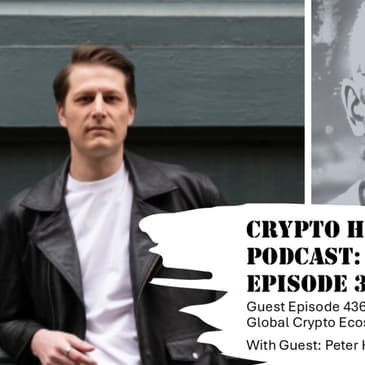

Peter Kris is Co-Founder and CEO of Gasp. He is a DeFi / MEV / L2s / Eigenlayer / AMM maxi.
Check @ https://gasp.xyzhttps://twitter.com/uPeterKris
[00:00:01] Hello, everybody, and welcome to the Crypto Hipster Podcast. This is your host, Jamil Hasan, the Crypto Hipster, where I interview founders, entrepreneurs, executives, thought leaders, you name it, amazing people all over the world of crypto and blockchain. And today I have another amazing guest. I'm looking forward to this because this man was in the industry when I joined the industry in 2017.
[00:00:27] He is the founder of Gasp. His name is Peter Kris. Peter, welcome to the show.
[00:00:35] Hi, everyone. Hi, Jamil. It's great to be here.
[00:00:39] Thank you for the opportunity to interview you. I'm looking forward to this.
[00:00:44] So the first question I have for you is this. What is your background? And is it a logical background for what you're doing now?
[00:00:54] That's a compelling question. It's definitely very logical. I've started in crypto very soon, around 2012. So I witnessed the early Bitcoin community.
[00:01:04] You know, at the time I was compelled by the vision of building a new parallel financial system.
[00:01:11] And I think we can still see that happening today on other networks like Ethereum.
[00:01:18] And at the time I was a software engineer. So I got attracted to an idea of smart contracts on Ethereum, something like a platform for running the unstoppable code.
[00:01:30] And since those times, I went through several phases. We've established a consultancy and software development studio with my co-founder Gleb, which is now the CTO of Gasp.
[00:01:45] We went through a few years of developing smart contracts. We've done a lot of ICOs for clients, but we've always had some of our own ideas for our own products.
[00:01:56] And at the time we were developing trading bots on Ethereum. So let's say in 2020, we were running one of the top trading bots on early DEXs.
[00:02:07] And that has led us to an idea of how would the best decentralized trading platform look like?
[00:02:17] And that has led us to Gasp. So now we're building Gasp. It's the first consolidated asset platform for digital assets.
[00:02:27] And what I've described in my recent narrative piece is that we have witnessed a growth of different approaches in crypto.
[00:02:39] You know, you have many languages, you have many blockchains, you have many crypto tokens, centralized exchanges, bridges, aggregators.
[00:02:48] It's like it's a huge landscape of so many solutions that are trying to tackle the same problem.
[00:02:54] And at the same time, you have players that are coming up with these interoperability protocols.
[00:03:00] Like how can we make all these things speak to each other?
[00:03:05] And that's a big problem.
[00:03:08] So we have looked very deeply into this area and we have came up with, in our opinion, the best approach,
[00:03:16] which is this layer two roll-up solution on top of Ethereum,
[00:03:21] which is at the same time simultaneously a roll-up on other networks at the same time.
[00:03:26] So we're something like a omni-chain type of roll-up.
[00:03:30] It's a very unique approach, hasn't been done by no one in industry.
[00:03:33] So we have pushed the forefront of innovation, of blockchain design, or let's say roll-up design.
[00:03:40] And we are releasing that in very shortly in coming days.
[00:03:46] And we have decided to tap into security of Agen layer.
[00:03:51] Now, if you look at similar solutions, let's say there is Uniswap,
[00:03:56] which is allowing you to trade any token being deployed on Ethereum.
[00:04:01] But the problem of Uniswap is that the liquidity is still siloed.
[00:04:05] It's still isolated, right?
[00:04:07] Uniswap has to copy their smart contracts from one place to another.
[00:04:12] And you have no way how to unite the liquidity in between different roll-ups
[00:04:17] or in between different blockchains.
[00:04:18] So it's a great power of Uniswap to have the permissionless listing.
[00:04:22] You can just come on Uniswap and you can create any token that you like,
[00:04:25] any meme coin, DSI, or whatever token you like,
[00:04:28] and you can just deploy the liquidity there.
[00:04:30] But the communication is missing.
[00:04:33] Now, if you look at ThorChain, we really like ThorChain.
[00:04:36] It was a pioneering project back in the day.
[00:04:40] ThorChain's power is the connectivity, right?
[00:04:43] Because they can connect Bitcoin with Ethereum,
[00:04:46] with Solana, with other projects.
[00:04:48] So they have this flexible blockchain that is able to connect.
[00:04:52] But the problem of ThorChain is that you don't have so easy access for permissionless listing.
[00:04:57] It's like you don't have 1,000 tokens there.
[00:05:00] You cannot just come and deploy in seconds any type of token.
[00:05:03] So we took the best of both worlds and combined it into one.
[00:05:09] Uniswap permissionless listing combined with multi-chain connectivity of ThorChain.
[00:05:15] And this is Gasp.
[00:05:16] And I'm very excited to launch it in several days.
[00:05:21] Interesting.
[00:05:22] A couple of years ago, three years ago, I interviewed somebody from ThorChain.
[00:05:27] I forget the man's name, but it seemed like a really interesting concept at the time.
[00:05:31] And, of course, I went to ConsenSys this past year and listened to the Eigenlayer founder speak.
[00:05:35] And I was like, this is really interesting.
[00:05:38] Really exciting stuff.
[00:05:39] So why did you choose Eigenlayer?
[00:05:42] I'm sort of those other options, right?
[00:05:44] But what's the benefit?
[00:05:46] How does it help you?
[00:05:47] How does it help the community with what you're building?
[00:05:51] Anytime you're building a cross-chain solution, be it a bridge, be it a cross-chain exchange,
[00:05:58] or something like ThorChain, you are relying on your own security.
[00:06:02] So you are relying either on multi-signature set of contracts,
[00:06:07] or you're relying on the economic security of your token, which is the case of ThorChain.
[00:06:13] We wanted to be the most secure platform as technologically possible.
[00:06:19] And that has led us to decision that we do not want to rely on the security of our own token.
[00:06:26] We want to tap into Ethereum security.
[00:06:29] So we want to use Ethereum as the validation layer for all the transactions that are happening on GASP.
[00:06:36] There are several approaches how to achieve that, but actually Eigenlayer gives us the power to take our solution
[00:06:44] and very easily connect it to Ethereum stake.
[00:06:47] So Ethereum stakers are restaking and providing a security for validation of all the operations on GASP.
[00:06:54] Got it.
[00:06:55] So you mentioned a piece that you just published, right?
[00:07:02] I want to take a couple of components of that and explore them a little further.
[00:07:09] Building a consolidated platform, right?
[00:07:12] Why is that critical to the expansion and adoption, mass adoption, of crypto at this time?
[00:07:22] Because if you look at what people are doing, I know that DeFi is now growing and I know that certain decentralized exchanges are growing.
[00:07:32] But if you really look at what most of the people are doing, they are using centralized exchanges.
[00:07:38] And if you ask them why, it's a very simple answer because most of the tokens are just on Binance.
[00:07:44] Most of the tokens are on some exchanges.
[00:07:47] It's very convenient.
[00:07:48] It's very easy.
[00:07:49] And if they have to go on-chain, they have to suddenly use multiple wallets.
[00:07:54] They have to now bridge tokens from one chain to another.
[00:07:58] So I think right now at this phase of industry, it's very much needed that there is this central hub
[00:08:05] that can easily connect to all the blockchains out there and unite the liquidity from all the blockchains or rollups
[00:08:13] where you can easily connect any type of wallet that you might think of.
[00:08:17] So say we connect all the liquidity, which sounds pretty exciting.
[00:08:25] What's possible with that?
[00:08:28] What would be possible that we don't have today?
[00:08:33] You can think of taking tokens from base and connecting it with tokens from Solana.
[00:08:37] So you can easily make a deposit from base.
[00:08:41] Then you make a deposit from Solana.
[00:08:42] And then you create very simple automated market maker pools on GASP and you can start trading.
[00:08:48] And I haven't even touched on points like GAS or MEV or fixed fees, right?
[00:08:54] On any DAX that you're trading, you have unpredictable costs.
[00:08:58] So if you're a market maker or HFT trader or algorithmic trader, the costs are a pretty big chunk of your cost structure.
[00:09:06] So we have developed our solution in a gas-free manner.
[00:09:11] So you're paying only fixed fee.
[00:09:13] So it's very much mirroring to what is happening on centralized exchanges like Binance, but it's all decentralized.
[00:09:23] So let's talk about MEV.
[00:09:25] A few months ago, MEV was a major problem.
[00:09:30] You know, there's the, I don't, and I don't know if there's been any advancement in that area, any, you know, fixes in that area.
[00:09:38] Like what, what's the current state of MEV, the problems and how are you, how should we fix it?
[00:09:48] That's a big topic.
[00:09:49] MEV.
[00:09:51] MEV right now, there are a lot of solutions to MEV.
[00:09:57] But as time is progressing, I think it's fair to say that there is no ultimate solution to MEV.
[00:10:06] And you have roughly two approaches.
[00:10:08] One is MEV redistribution, which is working on Ethereum right now.
[00:10:13] So if you're trading and if you're losing money to MEV bots, the system or the solutions will give you money back as a user.
[00:10:22] We took a different approach.
[00:10:24] So we think it's better to minimize MEV in the first place.
[00:10:28] So the bots cannot extort value from users.
[00:10:35] And I think there will still be a lot of solutions in the future, but we are one of the first that has taken this approach.
[00:10:45] Interesting.
[00:10:46] So aggregation really is a strength to combat MEV and use gas fees as well.
[00:10:53] I would say, just to be more precise, the aggregation itself is not helping with the MEV.
[00:11:01] That's a separate topic.
[00:11:04] What is helping with the MEV is we have developed a system of encrypted transactions in the mempool.
[00:11:11] And at the same time, we developed a system where no player on the network can affect the final ordering.
[00:11:21] So no one can predict the final order.
[00:11:24] Thus, it's really hard to extract MEV.
[00:11:27] Of course, there are always attack vectors.
[00:11:29] You know, even by definition, if I'm very scientifically precise, there is no ultimate solution to MEV.
[00:11:39] It's very likely it's an unsolvable problem, but that problem can be mitigated to a reasonable extent.
[00:11:47] So we took a very pragmatic approach of minimizing the MEV as much as possible.
[00:11:51] And then as we progress along into the future, we will be coming up with new versions and updating our solution to MEV.
[00:12:00] Interesting.
[00:12:02] I want to get into what your natives are.
[00:12:05] You said a couple words there together.
[00:12:09] You said attack vectors, right?
[00:12:12] There are still attack vectors out there, right?
[00:12:17] What are some technical and what are some at a higher macroeconomic level that might impact the ability to have liquidity on a more grand scale?
[00:12:30] Let's say the attack vectors are economic.
[00:12:34] So if someone would take over the capitalization of certain token, or let's say rune token on Torchain, they could perform a certain attack that could, let's say, withdraw some liquidity.
[00:12:49] Or if someone would take over the multi-signature parts of their solution.
[00:12:55] So there are always attack vectors in blockchains.
[00:12:59] There is no blockchain without attack vectors.
[00:13:02] It's always about your design of the system and how it's minimizing the risks.
[00:13:09] So we have taken an approach like how can we minimize those risks as much as possible?
[00:13:15] So that was one of the reasons why we're tapping into the security of Ethereum.
[00:13:20] Now, roughly speaking, imagine that there is a TVL on GASP, which is 100 million.
[00:13:27] Very roughly speaking, we need at least 100 million of Ethereum security supporting us through Eigenlayer.
[00:14:04] Right.
[00:14:06] Okay.
[00:14:07] So let's talk about natives.
[00:14:10] GASP natives.
[00:14:11] What are they all about?
[00:14:13] And what are the benefits that are natives?
[00:14:14] I saw a couple of really cool natives.
[00:14:16] So I'm interested in finding out how you came up with that and what the response has been and how it works.
[00:14:24] Natives is an idea of native transactions in between blockchains.
[00:14:29] We're saying that we're enabling native cross-chain swaps because we're using a roll-up technology.
[00:14:35] Now, I know I'm a bit technical right now.
[00:14:37] So hopefully that will not be too much for listeners.
[00:14:43] But every time you're using a roll-up, you are getting the security of the layer one.
[00:14:49] Right.
[00:14:49] If you're an arbitrum, you are ultimately using the security of Ethereum.
[00:14:55] Right.
[00:14:56] Because we have this roll-up that is communicating with all the other blockchains, all the assets that are being deployed on GASP, they are protected by the security of its origin layer ones.
[00:15:10] Now, on top of it, we have implemented so-called escape hatches.
[00:15:16] What does it mean?
[00:15:16] If the GASP would go down completely or for whatever reason, either technical problem or there is some regulatory problem, people have always guaranteed to withdraw their assets or withdraw their liquidity from GASP.
[00:15:31] So the liquidity and deposits are, you can say, almost 100% protected because they are always relying on their native security.
[00:15:42] And this was our idea of creating natives because all the people that are trading on GASP, they are essentially trading native assets or native liquidity on GASP.
[00:15:59] Interesting.
[00:16:01] So I want to go back.
[00:16:04] I want to go back to your statement.
[00:16:06] You say that you believe we are at an intermediate state of the industry.
[00:16:13] Right.
[00:16:14] What does that mean exactly?
[00:16:16] And then how can we shift toward a more consolidated future?
[00:16:22] The intermediary state right now is that we're seeing so many approaches and solutions and products and irreconcilable standards.
[00:16:33] Right.
[00:16:33] Solana cannot easily talk to Ethereum.
[00:16:36] Roll-ups cannot easily talk to each other on top of Ethereum.
[00:16:39] And there are so many teams and people right now tackling this problem.
[00:16:43] We are one of them.
[00:16:45] And it's the same thing like early days of Internet.
[00:16:49] Right.
[00:16:50] When there was an Internet wave in the 90s, you have seen so many solutions, so many standards.
[00:16:56] But it took some time to develop email, basic email protocol.
[00:17:01] It took some time to come up with the first encryption mechanisms.
[00:17:08] Right.
[00:17:09] And we are now something crypto right now is something like Internet in the 90s.
[00:17:16] And now we have to come up with a new wave of solutions that would be able to unite all that big complex network that is happening right now in crypto.
[00:17:29] And we will see a lot of solutions in coming, I would say, one to two years.
[00:17:37] Got it.
[00:17:37] So when I think of intermediate state, I think of the ICO days to now.
[00:17:45] Right.
[00:17:46] I think of, you know, how far we've come.
[00:17:49] But then you still have, like yesterday, South Korea almost declared martial law or they did for half a day.
[00:17:58] And then they rescinded it.
[00:18:00] Right.
[00:18:01] You still have those you still have those macroeconomic, you know, and some people, if you ask the XRP people will say that that was intentional.
[00:18:10] I don't think there's any correlation.
[00:18:12] Right.
[00:18:13] You still have the ability to be affected by political, geopolitical, all kinds of events.
[00:18:21] Right.
[00:18:21] From an immediate perspective, how can we diminish those things, if at all?
[00:18:29] How can we help countries move forward?
[00:18:32] Where do we go so that we can go from this intermediate state, not just technology, but intermediate state of the industry and bring it more mainstream?
[00:18:41] This might be an unpopular opinion, but I think crypto has to communicate more with regulators and finding a compromise or finding middle ground.
[00:18:56] Because a lot of people, they and even institutions and big capital, they won't touch an industry unless there are clear guidelines.
[00:19:06] How can you approach that industry?
[00:19:10] And for that, you need more clear regulatory frameworks.
[00:19:13] I'm not saying the regulations should be like fierce and too much, but there should be certain limitations outlined for the industry.
[00:19:22] And that's where all the institutional players, they will feel safe engaging with the industry.
[00:19:27] So this is definitely one of the blockers.
[00:19:29] And for that, we would need to have governments that are, in general, more friendly to crypto.
[00:19:35] They are more open.
[00:19:36] And I think we can see that already in the US and with the results of current elections.
[00:19:45] I've even seen governors of Fed, FED, from the central bank, that they were more positive on DeFi and more positive on crypto because they see certain benefits to DeFi being something like an extension of a traditional finance.
[00:20:03] So they don't necessarily see it clashing.
[00:20:06] They see it as an extension, something that will make the finance more global, more efficient and more faster and cheaper.
[00:20:15] So this is what we should be striving for all over the globe, whether it's EU or Asia or Korea or United States.
[00:20:28] So as an extension to crypto, crypto as an extension to TradFi will bring more TradFi into the industry to embrace the crypto for their business going forward.
[00:20:39] Exactly.
[00:20:39] You know, it's like Internet.
[00:20:41] Internet was an extension of media, right?
[00:20:43] We have some, we had a lot of content.
[00:20:47] We had a lot of media content in the 80s.
[00:20:50] We had a lot of music.
[00:20:51] But what has Internet done in the 90s, it essentially did a 10x to, let's say, media creation.
[00:21:01] It enabled people to create value on their own and become the media houses by themselves, right?
[00:21:09] So it sort of exponentially accelerated the media space.
[00:21:15] And this is what crypto is doing to the world of finance.
[00:21:18] So it will just exponentially accelerate the finance globally.
[00:21:23] And yes, the traditional finance like dollar will exist.
[00:21:27] But we will have a new category that will grow in parallel, which will be native cryptos like Bitcoin or Ethereum or plenty of other tokens.
[00:21:37] That makes a lot of sense.
[00:21:39] And let's strive for that, I think.
[00:21:40] That's the path to bringing the billions.
[00:21:44] Yeah.
[00:21:44] For sure.
[00:21:45] Definitely.
[00:21:45] Well, you know what, if you look at countries like, you know, I was recently in Turkey.
[00:21:50] And I was very, very surprised that a lot of people told me that they are using USDT.
[00:21:58] Because it's one of their ways how to preserve value.
[00:22:01] And they're using a lot of DeFi and a lot of crypto exchanges.
[00:22:05] They are all over the place.
[00:22:07] So I was very much surprised that they are very, very positive on crypto.
[00:22:11] And same is happening in Ukraine.
[00:22:13] Same is happening in Argentina as well.
[00:22:16] So those are very, very positive signals for the industry.
[00:22:21] Awesome.
[00:22:22] Some people don't know what Tether is.
[00:22:24] But Tether is a good way.
[00:22:25] Once the market has gone up, do you think it's going to fall back?
[00:22:28] Right?
[00:22:28] To trade into Tether.
[00:22:30] Like, okay, I'm preserving this amount.
[00:22:31] And then let's, you know, wait for the next cycle to go up.
[00:22:34] Right?
[00:22:37] Yeah.
[00:22:39] So in that article you wrote, you said also, you know, you said third parties remain in the industry.
[00:22:45] There are a lot of third parties.
[00:22:47] From a media side, the middleman is the PR firm.
[00:22:51] Right?
[00:22:51] The banks are still there.
[00:22:52] Right?
[00:22:53] What could be the best path forward for third parties and either removing them from the industry or working with them so that collaboratively instead of maybe being hawkish against the industry?
[00:23:07] Right?
[00:23:08] How do you see the role of third parties going forward?
[00:23:11] I don't think it's so black and white.
[00:23:14] And I don't fully buy into this distinction because there are different types of people.
[00:23:22] Someone is very comfortable in using third parties because it gives you convenience and it gives you comfort.
[00:23:31] Right?
[00:23:31] You're just, let's say, you're delegating your money to your bank and you are willing to lose control of your money just for the sake of convenience.
[00:23:41] But the problem of current system is that you have no other option.
[00:23:47] The only option you have is to go through a third party.
[00:23:51] I think a better world is a world that gives you options.
[00:23:55] You can go through a third party or you can go with self-custody or self-serenity.
[00:24:01] Right?
[00:24:02] So it's a more open and more free world.
[00:24:04] And I think both will coexist at the same time, even when crypto will be successful.
[00:24:10] But the world in net will be more positive.
[00:24:16] Right?
[00:24:17] So people still trust the third parties.
[00:24:20] Right?
[00:24:20] They don't trust the technology or they don't trust themselves to use technology correctly.
[00:24:27] What do you think it is?
[00:24:28] Which one of those two do you think it is?
[00:24:30] I think it can be actually both.
[00:24:33] You know, some people don't trust the technology.
[00:24:36] Some people don't trust themselves.
[00:24:37] Right?
[00:24:38] You know, think of it in a very common sense.
[00:24:42] Right?
[00:24:42] Would you be comfortable in having $200,000 hidden under your bed?
[00:24:50] You probably would not.
[00:24:53] So that's why you go to a certain maybe custodian or maybe you go to a bank and where you store
[00:25:00] your money.
[00:25:01] So it's a spectrum.
[00:25:02] There is a trade-off what you're comfortable holding by yourself and what you would rather
[00:25:06] trust someone else that would do that on your behalf.
[00:25:11] Yeah.
[00:25:12] I see that.
[00:25:14] So as we advance the ball, you know, globally.
[00:25:20] So you mentioned Turkey.
[00:25:22] You mentioned Ukraine.
[00:25:24] Argentina.
[00:25:24] What do you see as the greatest driving force for these countries being able to keep up with
[00:25:33] the rest of the Western world?
[00:25:36] Is it crypto, blockchain?
[00:25:37] Is it what aspect of it?
[00:25:40] I know Ukraine has built a pretty much strong digital economy under the scenes.
[00:25:47] You know, what are your thoughts on that?
[00:25:53] I'm not sure if I understand the question fully.
[00:25:56] Could you maybe rephrase?
[00:25:58] Yeah.
[00:25:59] Some countries that are trying to keep up with the Western, like Bitcoin is not really needed
[00:26:03] in the US, right?
[00:26:05] I mean, it's great to have.
[00:26:06] We have other countries around the world where it is necessary, where it's definitely necessary.
[00:26:10] And in addition, you know, your technology to consolidation to be able to aggregate.
[00:26:14] What benefits can these countries achieve by being able to use your solution?
[00:26:20] Yeah.
[00:26:21] So imagine there are mobile wallets.
[00:26:24] And now I think 7 billion people, like 90% of the world's population have a cell phone.
[00:26:32] I'm not exactly sure what's the percentage about the smartphones, but it's growing.
[00:26:37] And all those people can very quickly access a global digital economy through crypto.
[00:26:44] But it's impossible to access that through traditional banking services, right?
[00:26:51] It's a global, to some extent, it's even a political problem that you don't have this
[00:26:56] united financial infrastructure where you can easily send money in seconds from, let's
[00:27:03] say, US to China or from US to India.
[00:27:06] You always have to wait several days.
[00:27:08] But in crypto, you can just send stablecoins literally in seconds.
[00:27:13] And it's very easy.
[00:27:15] So this is where I think traditional finance won't catch up very soon.
[00:27:22] And not because it's a technological problem.
[00:27:26] It's not even that much of a technological problem for them.
[00:27:29] It's more of a business and political problem that they will not solve very quickly.
[00:27:35] But crypto is solving this today.
[00:27:38] And that's why we're seeing this upsurge of adoption in plenty of countries in the world.
[00:27:46] Awesome.
[00:27:47] So I want to find out.
[00:27:48] I want to thank you.
[00:27:50] I want to find out your roadmap, you know, going forward over the next year, how you fit into
[00:27:57] the how you fit in really, or help drive this next bull run, because I think it just started.
[00:28:03] You know, we're only like a month into the bull run.
[00:28:06] How long that's going to go?
[00:28:07] What your roadmap is?
[00:28:08] What do you see your role going forward for the next year or so?
[00:28:12] Two years?
[00:28:13] The biggest priority for us is to have as much tokens as possible from as many chains
[00:28:18] as possible.
[00:28:19] This is one of our strengths.
[00:28:20] We can very easily connect to other blockchains and rollups.
[00:28:23] So we are starting with base and with Arbitrum.
[00:28:26] But very soon after, there will be Optimism, maybe Tyco, maybe some other rollup or other
[00:28:34] alternative EVMs, maybe Solana, maybe Bitcoin.
[00:28:38] So we will be adding as much as possible.
[00:28:42] And we will be having campaigns where we motivate, incentivize people to bring as much liquidity
[00:28:48] as possible to GASP.
[00:28:50] So there is thing to be traded, right?
[00:28:54] So there is stuff.
[00:28:55] And if you see any new token that is emerging in an ecosystem, you can be sure that you can
[00:29:04] go to GASP and you can find it there because it's going to be available, right?
[00:29:08] And you can access it through Metamask.
[00:29:10] You can access it through your hardware wallet very, very simply.
[00:29:13] So that's one of our big priorities.
[00:29:16] At the same time, on the more, let's say, technical level or let's say B2B level, we're
[00:29:24] building this solution for solvers, which is about cross-chain lending.
[00:29:29] So solvers are this group of algorithmic traders that are helping people to trade across blockchains
[00:29:39] on solutions like Jumper Exchange or maybe Uniswap X.
[00:29:43] And we are specifically building a feature of lending for them to help them make better
[00:29:50] fulfillment times for the end users.
[00:29:55] So many things are happening in parallel.
[00:29:58] And I'm very excited that next year will be very strong.
[00:30:02] Awesome.
[00:30:03] So I'm excited.
[00:30:06] It sounds great to me.
[00:30:07] So I want to thank you very much for talking to me today.
[00:30:12] I enjoyed speaking with you.
[00:30:13] And I want to find out how people can find out more information about you, about GASP.
[00:30:19] How can they become clients, customers?
[00:30:21] How can they use your platform to trade, earn, any of that?
[00:30:25] Thank you very much for having me.
[00:30:26] It was a great pleasure talking to you.
[00:30:28] You can always reach us.
[00:30:30] You can find us, you know, obviously our website.
[00:30:33] We have a pretty active Discord.
[00:30:35] Our Twitter is pretty active.
[00:30:38] So feel free to reach any of our community managers or even me directly.
[00:30:44] I'm trying to be as much responsive on all the channels as possible.
[00:30:48] So I'm happy for every new member of our community.
[00:30:52] Awesome.
[00:30:53] Awesome.
[00:30:53] Thank you very much for your time today.
[00:30:55] Thank you very much.
[00:30:57] Bye.