
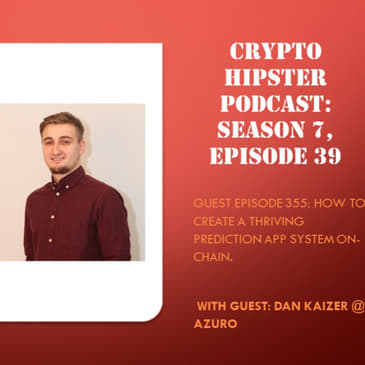

Dan Kaizer is a decentralized application architect, and Solidity expert. He is an early blockchain enthusiast, frequent public speaker and hackathon judge. Well known in international Solidity developers community, one of the leading persons in the Russian blockchain community, Dan participated in developing smart-contracts and token economy concepts for a wide range of an international blockchain projects. He is also the author of scientific work "Decentralized Reputation Assessment System in Oracles Networks".
Notable hackathons experience includes: ETHWaterloo Canada 2017 by Ethereum Foundation Overall Winner; BlockchainHack Russia 2017 awarded by Qtum. WINNER of the SICTIC Blockchain Challenge and Crypto Valley Association Blockchain Awards 2018, Early Stage Category, with project Forseti.
His Twitter: https://twitter.com/DanKaizer
[00:00:00] Hello everybody and welcome to the Crypto Hipster podcast. This is your host
[00:00:05] Jamil Hasan where I bring you the I am the crypto hipster and I bring you founders entrepreneurs
[00:00:11] executives thought leaders
[00:00:13] artists amazing people in the world of crypto and blockchain all around the world and today I have another amazing guest
[00:00:21] I'm looking forward to this interview and I assure you it's gonna be a really good one
[00:00:26] I have the chief technology officer of a Zorro
[00:00:31] Dan Kaiser has joined me today then welcome
[00:00:34] Hi. Hi, Jamil. Hi guys. I'm very glad to be here. Thank you. Jamil. You're very welcome. I'm happy you're here
[00:00:43] So yes, we're gonna kick we're gonna we're gonna talk about some exciting topics today
[00:00:46] And I'm gonna kick things off by asking first about your background
[00:00:50] You know, what is your background and is it a logical background for what you're doing now?
[00:00:56] Mmm. Yeah, so absolutely to be honest Azura is
[00:01:00] Is really a project that combines all my lifelong interest and experience
[00:01:07] All together really perfectly. So because before getting in crypto
[00:01:13] when I was student, I was deeply interested in the betting and
[00:01:18] Probability theory etc. And during my university years, I even developed some
[00:01:23] Some strategies to make sports betting profitable for me. So actually it was
[00:01:31] So I can say it was the first money that they are
[00:01:34] First real money that I earned by my own it was
[00:01:39] through professional betting I
[00:01:41] Had some special systems that I developed myself is my friend
[00:01:45] So actually this friend working in Azura as well, so he is responsible for risk management in our team
[00:01:51] So
[00:01:52] however bookies often blocked my accounts
[00:01:56] So I had to because if you are profitable books web to book is usually a block you so I had to use
[00:02:03] accounts under my friends
[00:02:06] Relatives names my grandmas names, you know, etc. So and they create the numerous of accounts
[00:02:13] It was quite annoying to be honest
[00:02:16] But then then I discovered cryptocurrency
[00:02:19] First of all, it was BTC obviously it was
[00:02:23] 2016 I believe
[00:02:25] then I
[00:02:27] Attended that some hackathons at some conferences about his area
[00:02:34] So and I got completely
[00:02:36] excited about it so I forgot for a while about betting about everything else so I was I
[00:02:43] Was working on the encryptor?
[00:02:45] since this day so and
[00:02:48] once
[00:02:49] It was
[00:02:51] 2021st year
[00:02:53] When my future asura partners came came up to came to me with this idea of Azura of creating some
[00:03:01] decentralized betting platform
[00:03:03] for predictions
[00:03:06] So the compass so I just understood that it's really a perfect match because I love
[00:03:12] I
[00:03:14] Love probability theory I love betting and I love crypt. It's like all together
[00:03:18] so because of that without any doubts I I agreed to
[00:03:23] to continue this project so and
[00:03:27] It was like clear for me is that we had the right mix of skills and vision
[00:03:32] To create something that can really
[00:03:35] be a
[00:03:37] Game changer to balance. Yeah, what country you went again?
[00:03:43] Hmm, what country are you in?
[00:03:46] It was in it was in the Russian so now I'm in Portugal
[00:03:50] Portugal okay, that's right. You're in Portugal
[00:03:52] my wife and I went to our honeymoon in Greece and
[00:03:57] In Santorini, there's this bakery shop the guy makes leuka modest and he makes chocolate and flu use
[00:04:05] Lucca modest which are donut balls, but what it is the bakery is a front for
[00:04:10] Soccer betting practice the guy has very profitable
[00:04:16] So it was just made an interesting what you said to me the web two bookies block you if you win
[00:04:23] Yeah, if you do it like on a regular base
[00:04:27] So bookies can easily understand if you just a better who try to guess
[00:04:33] Just because you I don't know because you really know a lot about football for example
[00:04:38] And sometimes you can guess the results. Sometimes you can guess outcome
[00:04:44] Or if you just make bets like a robot like a bot
[00:04:49] It's usually pretty clear because if you have some special system
[00:04:54] it's completely obvious for for bookies so and
[00:04:59] They can block you
[00:05:03] So I want to find a little bit more about a zero and then I want to get into the into the probability
[00:05:08] Theory in the prediction markets, but what is Azura all about and you guys want some awards?
[00:05:14] So what makes you an award-winning?
[00:05:16] in the
[00:05:17] winner in the space
[00:05:20] Yeah, good question. So I think the main secret of Azura success
[00:05:25] so I
[00:05:27] Think it's it's our team first of all because
[00:05:30] as I mentioned previously, it's a perfect match of different skills and expertises and
[00:05:38] In our team it consists not only of crypto experts live
[00:05:42] I mean web three experts with three builders, etc. But also
[00:05:46] some professionals in betting and also just some
[00:05:52] Interpreters with a very impressive backgrounds. So we have pretty grown-up team. It's not
[00:05:58] Young as a lot of other web three startups
[00:06:03] And they see I think yeah, I think this combination allow us to find the perfect formula for our project
[00:06:10] When we have designed Azura as I mean Azura
[00:06:15] Structures or architecture
[00:06:17] We designed it to be fully compatible first of all this web two analogs
[00:06:25] And even more advanced at once because we are using with three advantages
[00:06:31] So if we will dive into
[00:06:33] the details
[00:06:34] There are two main features that set us apart a part of all others. I mean first of all
[00:06:40] It's our unique peer-to-pool approach
[00:06:43] What does it mean previously most of other
[00:06:49] Decentralized prediction markets was based on
[00:06:54] On approach where every where each
[00:07:01] Separate
[00:07:03] Event let's say some football match or something like this some football game
[00:07:09] It's a separate pool
[00:07:11] Separate liquidity pool where liquidity providers provide liquidity
[00:07:16] In our case, we have general liquidity pool for all events all together
[00:07:22] So and it's very important
[00:07:26] This become possible because of our self-made solution
[00:07:32] Liquidity tree so I think we can talk about
[00:07:36] Liquidity tree a bit later in more details
[00:07:39] But
[00:07:42] But
[00:07:45] Long long story short
[00:07:47] this model liquidity tree allows us
[00:07:50] for a more efficient and scalable liquidity pool, so because it's
[00:07:55] I will explain later. But yeah, it
[00:07:59] Allowed to make some calculation
[00:08:02] Incredibly efficient like for example you can make one billion you can make a calculation under
[00:08:11] Under a range of 1 billion elements
[00:08:14] Using only 20 directions something like this. It's a logarithm complexity
[00:08:20] So yeah, first of all, it's our peer-to-pool approach as I mentioned and the second part that
[00:08:28] Is really unique now now team. I think it's our risk management approach
[00:08:34] It's mentioned approach I mean
[00:08:37] The way how we work with odds with probabilities, etc. So yeah, I think
[00:08:45] This
[00:08:46] Something that really set us apart of all other
[00:08:50] Sounds good. So when again, I want to get into a little bit more into the risk management approach
[00:08:57] First actually what I want to talk about this. I want to find out
[00:09:00] you know how prediction markets work and
[00:09:02] How can people partner with you to create create a thriving prediction app system on chain
[00:09:11] Which includes the risk management discussion, right?
[00:09:15] Yeah, so
[00:09:18] Let's start with risk management
[00:09:22] first of all
[00:09:25] It's managed the main part of risk management in predictions
[00:09:29] Obviously it's an odds odds odds is
[00:09:34] Is some kind of indicators of probability
[00:09:38] Lower odds mean a higher probability of the outcome so higher probability that it will happen
[00:09:45] While higher odds mean lower probability. So pretty easy
[00:09:51] For example, if we are speaking about let's say
[00:09:54] The most simple game ever it's head or tail right with this coin
[00:10:00] in this case
[00:10:02] Normal probability is 50 50 50 right 50 percent that it will be head and 50 percent that it will be tail
[00:10:10] And if we are speaking about odds
[00:10:13] Clear odds clear odds. It means odds without margin
[00:10:17] Clear odds will be 2.0
[00:10:20] Clear odds will be 2.0 on the one side and 2.0 on another side so but
[00:10:27] obviously
[00:10:29] If we are creating prediction markets, we need to have some margin inside the odds and
[00:10:35] Our odds will be let's say
[00:10:38] 1.95 1.95
[00:10:41] And it's very easy to understand that
[00:10:44] maths on our side and if we will
[00:10:47] Play this game for
[00:10:49] For a long period
[00:10:54] So house will be in the profit for sure because of this
[00:10:59] Lack of probabilities lack of these odds
[00:11:02] Great. So
[00:11:11] That's the risk piece so predict
[00:11:13] Prediction markets, you know
[00:11:16] in crypto
[00:11:18] Have some really good benefits have some really wonderful and amazing
[00:11:22] Opportunities after right?
[00:11:24] So what are some of the amazing and we're gonna get is dark side too, but we'll get into the positive side first
[00:11:31] What are the what are the benefits of prediction markets in crypto?
[00:11:36] So I think benefits is pretty obvious for me because
[00:11:42] One of the main issues in web2 predictions in web2 betting
[00:11:48] always worth
[00:11:50] The
[00:11:52] lack of trust between users and
[00:11:56] bookies house
[00:11:58] Whatever we can call it
[00:12:01] So and blockchain can solve this issue perfectly because it was designed to
[00:12:08] Solve the issue of trust last right because it's a trustless system
[00:12:14] Yeah, so because of that I think it's
[00:12:17] Uh, it's the main benefit that we have
[00:12:21] but not the only one
[00:12:24] because
[00:12:25] Also, I think it's payments
[00:12:28] payments is very
[00:12:33] Is very easy
[00:12:34] Easily done in in crypto. So I just need my
[00:12:39] Web3 wallet and I can start making bets without any deposits without any
[00:12:46] I don't know
[00:12:48] Withdrawal timeouts, etc. So I don't need to
[00:12:53] To send my money for someone else. I'm using just my wallet and I can make bets directly
[00:13:00] From my wallet from my wallet
[00:13:02] I think it's it's amazing as well
[00:13:05] Yeah, but obviously there are some
[00:13:09] Some limits in web3
[00:13:11] for now
[00:13:13] There are some problems with onboarding because not for everyone. It's
[00:13:17] It's comfortable to use wallets
[00:13:20] Someone it looks like too hard too complicated
[00:13:25] But it's like an ongoing process step by step we
[00:13:33] We educate our users how to use wallets how to use web3
[00:13:39] Applications, etc. Got it. So the drawback will be that it seems to be hard to use but actually in actuality it's not
[00:13:47] Yeah
[00:13:49] Okay
[00:13:51] Great. So
[00:13:53] I want to move to
[00:13:55] On to the oracles, right?
[00:13:59] So what is the importance of oracles today because there's been some changes and some evolution or de-evolution of oracles over the years
[00:14:07] What's the status of articles?
[00:14:09] Oracles in their maturity level and we're looking at the lens of transitioning companies from web2 to web3
[00:14:15] Oh, yeah
[00:14:17] Oracle is really a complicated area in web3
[00:14:23] One of my first projects in crypto was connected with oracle it was in 2017
[00:14:33] So
[00:14:33] It's still it's still not fully solved issue in in web3 in my opinion because we still
[00:14:40] Don't have some proper
[00:14:42] Decentralized solution for oracles and in meantime, it's really
[00:14:48] It's really a key
[00:14:50] Part of of this area in general because as I mentioned for example for us data is really
[00:14:58] The most important part of our protocol because if you don't have
[00:15:04] Proper data. It means we don't have risk management. We don't have these proper odds
[00:15:10] That I talked previously about
[00:15:14] So, yeah because of that it's really like
[00:15:20] The most significant part of our product and most and a lot of other products in web3 as well
[00:15:26] So for now we are using optimistic approach for oracles
[00:15:32] For now, it's one of the most popular approach in crypto
[00:15:36] One of the most popular maybe not the most popular obvious, of course
[00:15:44] So, yeah, I can elaborate a bit about
[00:15:48] About it how optimistic approach works optimistic approach means that initially
[00:15:54] Optimistically we we are thinking that oracle is fair
[00:16:00] And we trust to data that he provide
[00:16:04] But
[00:16:06] Then we can challenge him. So anyone can challenge him or some validators can challenge him can be
[00:16:14] System can be designed in different ways
[00:16:16] But the main approach is that after data provided someone can challenge this data and
[00:16:26] Send some let's say poison transaction or something like this and open the dispute
[00:16:32] Disput that this data is wrong, for example
[00:16:38] So now we are using the same approach
[00:16:42] We still have really a lot of work to do to make it pretty to make it
[00:16:48] Really decentralized because now we don't have enough entities in my opinion and not enough
[00:16:56] Don't have enough different data providers
[00:17:02] But yeah, we are working in this in this direction right now
[00:17:09] I would think that the purpose of oracles and the dark side of prediction markets are at odds with one or opposite things
[00:17:22] Right. And so the oracles would flush out some of the some of the some of the pitfalls of the prediction, you know
[00:17:30] Protocols how do you see it? How do you see the need for oracles being able to overcome the limitations of prediction markets?
[00:17:40] Yeah
[00:17:44] So, yeah, I think now oracles is really the main limit for
[00:17:50] For prediction markets and to balance for any protocols that using off chain data
[00:17:56] Now it's an issue for blockchain in general. So why does it happen? Because
[00:18:04] Look blockchain designed in the way that
[00:18:09] All data in blockchain fully
[00:18:12] Fully determined at any point of time. So I mean at any point of time you
[00:18:21] Completely understand what the state of any variable inside the blockchain
[00:18:28] But if we are talking about the real world it completely undetermined
[00:18:34] And here we
[00:18:38] We try to combine this data all together and if we rely on Oracle in inside the blockchain
[00:18:45] It means that that fully determined system rely on some undetermined variables
[00:18:52] Some undetermined entities. I don't know how to say
[00:18:59] And it means that blockchain become undetermined as well so and that's an issue that's why
[00:19:07] That's why just there is no perfect Oracle solution at all. It's just impossible to create
[00:19:13] So if we take some data out of the blockchain if we take some
[00:19:20] Some data from real world, for example, that we want to put it into on chain. It means it will be
[00:19:29] It will be always some
[00:19:32] Maybe it will be small lack of security. But anyway, it will be some security issue
[00:19:37] It's just I don't know. It's just a low you cannot do in another way
[00:19:45] So go to this compromises sometimes
[00:19:52] But any Oracle it's a compromise anyway
[00:19:56] One of the compromise areas I think that we've we've experienced in the past many years and have not improved yet
[00:20:02] Is the user experience, right?
[00:20:06] We need to improve it right because it's been an area of weakness and opportunity in the industry
[00:20:12] Are you working on some ideas to improve it? How do we improve it?
[00:20:17] Oh good question really so and we have our
[00:20:23] Maybe not unique but
[00:20:26] I
[00:20:27] I don't see a lot of projects with the same approach. So we don't create a UX by ourselves at all
[00:20:35] So we create we are building only a protocol and
[00:20:42] Our approach for user acquisitions that we provide
[00:20:47] Anyone anyone who want to build something on top of our protocol?
[00:20:51] Some tools guides solutions how to build front ends on top of our protocol and
[00:20:57] They're building their applications. So we don't care about
[00:21:01] About front end about UX. We're building only a protocol
[00:21:07] Now we have around
[00:21:10] 25
[00:21:11] Applications that was built by independent teams
[00:21:14] The best thing with this
[00:21:17] In this approach that all these teams create different project different products and
[00:21:24] all of them
[00:21:28] Create some creative ideas how to
[00:21:33] Provide user experience
[00:21:36] And we have a lot of
[00:21:38] Create some creative ideas how to
[00:21:43] Provide users with the best weeks for example, some of them create
[00:21:48] Telegram bots
[00:21:50] Telegram mini apps
[00:21:53] Some of them going for going through
[00:21:56] more usual way and
[00:21:59] Building just a web application
[00:22:01] But all of them trying to provide users with something unique to to compete with with others
[00:22:08] So I think that's very interesting
[00:22:15] Yeah
[00:22:16] Interesting you say telegram bots
[00:22:21] That's a problem
[00:22:23] I see it as a problem. There's a lot you can't tell if a bot is a person
[00:22:28] If a bot is a person an intelligent you can't tell but it's a person or a bot right?
[00:22:34] How do how do we solve that problem any ideas how to solve that?
[00:22:42] You mean that you need to wall it inside
[00:22:46] The bottom what well no I'm talking more of like community discussion and people undermine the future of different projects
[00:22:56] by
[00:22:57] By having their hologram bots come in and help and make negative comments about the community and about the project, right?
[00:23:05] You really can't tell on telegram if it's a bot or if it's a person
[00:23:10] So, you know, how do we so that's a it's a problem to undermine a community. How do we solve that problem going forward?
[00:23:18] Oh, well, I don't know. I didn't think about it in our case. I don't think that it's it's an issue
[00:23:27] That we have some boats or not for us. It's
[00:23:31] It doesn't matter if someone make a bet
[00:23:36] If our risk management model is good, if our odds is correct for us, it's absolutely doesn't matter if it's real person or if it is a bot
[00:23:47] We just earn money without margin and that's it
[00:23:53] So your answer is if it's a solid progress is a solid protocol and solid product and you have solid risk management in place
[00:24:02] It doesn't matter if a bot is making a comment or not. That makes sense. Yeah, that's good. All right, so
[00:24:11] You said something earlier want to talk about and that's the liquidity tree. Yeah, right. What is the liquidity tree?
[00:24:18] So, yeah, liquidity tree is
[00:24:25] Our
[00:24:27] Design of liquidity pool. It's based on data structure that's called segment tree
[00:24:36] Maybe someone of listeners know about this data structure segment tree
[00:24:41] It's pretty famous to be honest. Yeah, so the main idea here is that in our case
[00:24:53] We need to make a lot of calculation on the big range
[00:24:59] So and segment tree allows us to do it as I already mentioned with
[00:25:06] With really extremely efficient way
[00:25:10] How we can calculate
[00:25:14] How we can
[00:25:16] Make this calculation on the big range as I mentioned, it can be done in logarithm complexity
[00:25:23] So what does what does it mean logarithm complexity logarithm complexity means that for example if I need to make
[00:25:31] Those calculations with let's say range of 1 billion elements
[00:25:37] It's really huge amount. So I will have to do only 20 interactions 20 loop interactions instead of 1 billion. So
[00:25:48] That's why it's so efficient
[00:25:50] So maybe you can be curious why we need it because all other protocols who have liquidity pools as well don't need it
[00:26:01] So that's why that's because of our
[00:26:07] Of
[00:26:08] Of nature of our incomes. So because look for example if we are talking about uniswap
[00:26:16] Because in uniswap it's
[00:26:19] It's just a fees from trade. So when whenever trade happen fees goes to the liquidity pool
[00:26:28] But in our case, we don't
[00:26:32] Charge any fees from the bets when bets made
[00:26:37] We don't claim fee immediately. No
[00:26:40] Then it's a matter of time when
[00:26:44] This event will be
[00:26:47] Will be solved will be finished
[00:26:51] Only after that we will understand if
[00:26:55] Liquidity people earns money
[00:26:58] And then we will see that the
[00:27:01] Only after that we will understand if
[00:27:05] Liquidity people earns money or lose so and that's why we have this problem that
[00:27:14] for example
[00:27:16] We have let's say
[00:27:18] World Cup final and everyone understands that
[00:27:24] Will be a lot of bets on
[00:27:27] World Cup final because it's the most popular event, right?
[00:27:30] So and some liquidity providers can just see
[00:27:33] Okay, we have a lot of bets. Let's say on I don't know on Brazil that Brazil will win because it's like one of the best
[00:27:41] team in in football so and
[00:27:45] They can put a lot of liquidity just
[00:27:49] In I don't know just before few minutes the event will be finished
[00:27:55] You can put huge amount
[00:27:57] When event will be solved
[00:28:00] And you can earn money you can earn money immediately and then withdraw liquidity
[00:28:06] So that's why we we can't allow this situation and we should track
[00:28:12] If I put liquidity before event was created on our platform
[00:28:18] You will not earn money from this as liquidity provider. I mean you will not earn
[00:28:24] This margin from this particular event that was created after you put liquidity so because of that we should track
[00:28:33] timings of each
[00:28:36] liquidity deposits
[00:28:38] And it's possible only using this maybe not only maybe there are some other solutions, but we choose this one
[00:28:46] That we called liquidity tree
[00:28:48] And
[00:28:49] That based on this segment tree segment tree stuff
[00:28:53] So if someone interested about this more, I'm not sure that they explain it really clear to be honest
[00:28:59] because it's very
[00:29:02] complicated stuff so but if someone interested
[00:29:05] You can
[00:29:07] You could take a look at our github project
[00:29:11] It's called liquidity tree
[00:29:14] and there there are some
[00:29:17] Some proper explanation how it works
[00:29:20] What thing I think I got I think I got the crux of it
[00:29:25] There's no fees upfront
[00:29:27] You earn after the fact after the outcome is known, right? Yeah
[00:29:33] It doesn't act the same way as you know swap
[00:29:38] But I wanted but I went in here are the benefits of your of your approach. What are the benefits?
[00:29:46] Yeah, exactly for uni swap. It doesn't matter if you are profitable trader or not
[00:29:51] For them it's absolutely equal
[00:29:54] You just make a trade you pay some fee. That's it in our case
[00:30:00] See it doesn't work like this. We have no any fees
[00:30:04] we have only this
[00:30:07] Margin inside of the odds and because of that our income fully depends on how
[00:30:13] Some events will be resolved
[00:30:18] So and
[00:30:21] In front we don't know if we will earn from this bet or if you lose from this bet
[00:30:26] And then because there's no fees the it's a fairer
[00:30:32] Playground for the for the players
[00:30:35] Yeah
[00:30:37] Okay, that's your benefit great awesome
[00:30:40] I want to play
[00:30:42] You know
[00:30:44] Yeah, but it's usual approach for any prediction markets. They usually have fees all only inside the odds
[00:30:51] Inside the margin usually it's like this
[00:30:54] Yeah margin inside the world
[00:30:58] It was it's it's horse season here in the US and a few weeks ago
[00:31:02] They had the Kentucky Derby and then the preakness in the Belmont and I remember
[00:31:07] It was a decade ago I bet on this horse to win it was gonna go for the Triple Crown
[00:31:12] I was caught the name of the horse is big Brown and at the Belmont. I covered every single
[00:31:18] possibility
[00:31:19] And I said there's no way I can lose unless this horse doesn't finish the race and guess what the worst
[00:31:25] It
[00:31:31] Happens right so yeah, so
[00:31:34] I want to thank you very much for coming on my show today. I really appreciate talking to you
[00:31:39] I enjoyed it and have one last question for you
[00:31:42] How can people find out more information about you about Azura?
[00:31:47] You know get to know and get to use your put your platform. How can they do that?
[00:31:52] So, yeah
[00:31:54] If
[00:31:55] If you want to build something with us
[00:31:59] First of all, you can use our documentation. It's a game dot azura dot org
[00:32:08] Also our discord obviously
[00:32:12] There you can find any information about our project about our protocol
[00:32:16] We have devreel in our discord who can help you with any questions. I mean about
[00:32:23] Building on top of us something so about me personally you can use
[00:32:29] Twitter X
[00:32:31] So then Kaiser. Yeah
[00:32:34] You can ask any questions in the end
[00:32:39] Awesome awesome. Thank you very much for your time today. Thank you. Thank you
[00:32:44] Bye. Bye