
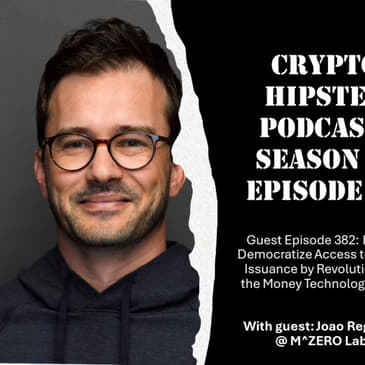

Joao Reginatto is the Chief Strategy Officer at M^ZERO Labs. Prior to this, he served as the Vice President of Product for Stablecoins at Circle, where he led the development of USDC. With 25 years of experience in tech product development, Joao has built both consumer and enterprise products, primarily in the finance sector. He possesses a strong technical background and is passionate about blockchain technology and the creation of a more open financial world.
[00:00:00] Hello everybody and welcome to the Crypto Hipster podcast. This is your host Jamil Hasan, the crypto hipster where I interview founders, entrepreneurs, executives, thought leaders, artists, you name it all over the world.
[00:00:14] So Crypto Hip Blockchene and I have an amazing guest today and I'm excited about this interview because this company seems to be doing a really well recently.
[00:00:24] And I'm excited about them and my guest today is Juao Reginatto, he is Chief Strategy Officer at MZERO Labs, Juao Welcome to the show.
[00:00:38] Thanks for having me. Very welcome and first question of the kick things off is I'm going to ask you what is your background and is it a logical background for what you doing now?
[00:00:50] I love that question that you have to guess. I think it is a very logical background actually even though looking backwards as Steve Jobs said it's always easy for your dots to connect but I have separated my career into two phases and they are kind of equally
[00:01:10] Lasting at this point now I have originally a very technical background graduated in computer science you know worked as a software engineer and led teams of software engineers for many, many years.
[00:01:21] And funny enough I tell this to people for me back in 1998, 1999 when I started working professionally my first the first technology that I had traveled with was Cryptography.
[00:01:32] It did not have to do with blockchain at all but I was doing I was doing some more on security of networks and the early internet and things like that and actually I always liked to joke that my boss at the time was writing a PhD thesis precisely on the use of cryptography to potential like digital cash applications.
[00:01:55] I remember helping him as an intern does you know besides writing a bit of code and bringing coffee to the bosses you know like I also helped him review his PhD thesis.
[00:02:07] And I remember being fascinated by that particular application of cryptography I never thought that you know that could be one of the users usually people associate cryptography more with security writing and keeping things safe and an office catered.
[00:02:20] But in any case I you know went and had my technical part of my career in financial services for many years work in regional banks I'm a region from Brazil so worked in regional banks and larger banks in Latin America.
[00:02:36] That I moved outside of Brazil worked in some financial services spaces in Europe as well and that I decided to make a shift in my career and moved over to more of a product function.
[00:02:48] And I decided to do a Masters in business in 2012 to kind of support that transition in my career and the best thing I always tell this joke is well the best thing I got from my masters was finding out about Bitcoin because that's that's when I found out about it.
[00:03:03] I had a colleague that just dragged me into that sort of rabbit hole and started explaining it to me. And as I said because I have had that exposure to the the raw technology behind something like Bitcoin no public public and private key cryptography and all that.
[00:03:18] I so I felt that I immediately grabbed that and I immediately thought that you know it was very promising and something I wanted to spend more time with. I didn't do anything immediately professionally speaking but then in 2015 I joined circle.
[00:03:32] And that was my first kind of for a professionally into the space of crypto and blockchain I worked for circle for eight years I led the build out of USC which is the second largest dollar stable coin product.
[00:03:47] You know has been between like you know for fifth, fifth, sixth, seventh like largest crypto asset in the world which is pretty amazing product that we created there in my tenure over there I led all the product teams in this stable coin space for many, many years.
[00:04:02] And then last year you know decided to that it was time for me to do something different and decided to join.
[00:04:09] And is zero and the amazing team that Luca and Oliver and Greg are forming because I think it's it's very promising but but that's all to say going back to your question that yeah I think I have a logical path now looking back to my trajectory you know always kind of connected somehow to the technical underbelly of financial services and trying to improve.
[00:04:31] I have I don't use it in a follow up after this question after my first question but I do today. So you are introduced the cryptography in 1998, 1999.
[00:04:46] Bitcoin came about in 2009 there was 10 years between when you know that time that you were learning that cryptography and Bitcoin was creation. What took them so long to create Bitcoin?
[00:05:02] That's a great point and I think Bitcoin is like one of those amazingly elegant products right or pieces of technology.
[00:05:12] And I think Bitcoin actually there wasn't there wasn't much like fundamentally innovative in and of itself in Bitcoin maybe that's a both statement but I think whoever situation I come out was.
[00:05:26] I think the great thing that he or she or they were able to do was to actually connect a lot of these technologies together because I think Bitcoin connects you know a lot of a lot of evolution on.
[00:05:41] And I think it's kind of kind of the ability to prove to prove work without the need for trust between kind of parties right that was a big.
[00:05:50] That was a big element I think missing in earlier attempts at developing like digital cash models because digital cash demands like digital scarcity right and and that's a very very hard thing to design and I think so to she was able to like.
[00:06:08] And I think it's a very hard thing to do with the things that we're doing is to get in a beautiful way but also then.
[00:06:15] You know the ability to kind of link link that with with the emerging watching research that was happening you know many years before as well and kind of adopt some.
[00:06:26] Digitalization you know the use for mercury and hashing those things instead of you know using other approaches before I think it was it was really like a co-nextor of multiple.
[00:06:36] Disprotectionologies into something that actually worked for the first time and it was scalable and to prove it is today that it is scalable and you know it has been so resilient and secure for over a decade.
[00:06:48] And those things take time I think photography in general is a body of research and technology that is decades and decades long right you know a lot of what we do.
[00:06:58] Today when we you know create an account on a theorem right to they have some some some tokens transfer you know that that creation of public and private addresses and keys it all comes from like the 60s and 70s and so.
[00:07:13] I think I think that's another that's another reason that I as a technologist have to kind of believe in in all this space is because it's really based on sound research and sound technology has been created for years and you know that it takes time.
[00:07:29] Yeah we're learning that we're learning this week of the next few weeks of the crypto market the time takes time. So. M zero like what's it all about what's your role what's your focus what do you guys do well.
[00:07:43] Yeah so I'll start with a simple one and then go to the more complex so I I lead both product and strategy for him zero you know that what that means it like both product and then obviously getting those products to market right the business development and marketing.
[00:07:59] Yeah because it's the development that is involved with a complex offering like him zero because him zero is not actually a product and zero is infrastructure so.
[00:08:07] There's a short term in a long term kind of explanation to what we do the short term is that we're building infrastructure to power.
[00:08:16] And open Federation of crypto dollar issuers we we like to term crypto dollar over the term stable coin because I think stable coins we can talk about this more in detail but stable coins are these types of crypto assets that people have created a you know as as I think somebody has defined it attempts to peg the value of a crypto asset to the value of something else.
[00:08:37] And that's just one element of what I think is necessary so in any case we prefer to term crypto dollars because I think similar to your dollars and to other forms of dollars I think it's more holistic.
[00:08:48] And to go back to the definition of what I'm just trying to do as I said so we're building this infrastructure that is both on chain but also some some of it off chain.
[00:08:57] And it powers and network of of issuers of these types of assets and why are we trying to do this because if you look into if you look into the stable coin space as it is today, you know mostly dominated by.
[00:09:11] I tab there to a large extent and all the products that they have successfully created over last number of years. And then also circle and then to a less extent you know some coins developed by by Paxos some decentralized options like dive from maker and things like that.
[00:09:29] There's there's a lot of different categories and ways of implementing those products but in general they also for from sort of the same problems which is. They are they are you know centralized around like one particular solution one particular siloed issuer.
[00:09:50] They are they are pretty common to that this point in terms of the technology that is used and yet they are completely non interoperable right so if I have.
[00:09:59] And I send it to you but you as a user to me, your preferred to use us to see good luck like they there is no you're going to have to go and essentially use like a trading or as I prefer to say a price discovery mechanism to go from one to the other then you're going to leave some.
[00:10:15] behind you're going to leave some fees behind because the price discovery can go one way or the other depending on the day and there will be fees because it's a trading operation etc etc.
[00:10:24] When you look at how we love to bolster and talk about decentralization and crypto right. But actually those products are extremely centralized and extremely non interoperable today and then if we look at the equivalent in the traditional world which is really banking.
[00:10:39] Banking has been decentralized and federated for many decades right and so we have to be we have to put our money where our mouth is.
[00:10:49] Because there's no reason it's just due to poor technology honestly there's no reason why these products should not be more interoperable and should not be issued by a lot much larger number of counter parties as opposed to you know,
[00:11:02] this is all mine and I'm the only issue of this thing it's all down to the complexity that can be addressed by technology in the longer term if you want to then think about how this impacts and why this matters in the longer term I think.
[00:11:15] We're all as with many others in the space where all of this journey where we want to bring money to the digital era we want to bring money to the internet era right I think. I think just as you know the internet has disrupted so many areas.
[00:11:31] You know from the early days and continues to do so today there's there's always I think the immediate version of how digitalization and the internet more broadly impacts a particular type of category or product.
[00:11:45] And then people over time realize oh hold on a second this can be entirely reinvented and then you actually disrupt these models so for example I'm sure you remember you know the the first version of the digital.
[00:11:58] You know version of the new year of times was like a scan of the print version right like people would create those PDFs and they would put them online and oh not there is in New York Times is not on the internet right obviously that was very naive.
[00:12:11] But it was what people could immediately you know grasp and think about when they when they come across a new technology like that and then eventually they realize oh hold on a second like the internet completely changes the way newspaper is distributed.
[00:12:24] And now my version of the New York Times can be different to your version of the New York Times because now there's personalization on the spot right on the man.
[00:12:33] And so when it's important then the business model changed and the ads model changed and now we have like a completely different newspaper industry than we used to have back in the 90s right.
[00:12:43] I think the same thing will happen to money today were very used to you know how we interact with money but the reality is that stable coins are kind of the first you know.
[00:12:53] That digitalization attempt at at dollars but it's it's also a very naive one right is just as I said it's just as can of the physical copy and putting that copy somewhere else.
[00:13:04] But there's a there's a huge opportunity for you to go down this tech technology stack of money and and allow the blockchain to kind of disrupt and make it significantly more efficient which which is the goal that we have.
[00:13:21] And me, I think stable coins get it you know there are there are there are some bad connotations with stable ones because when I appear stable ones I think terrible and I think other things that lost their pay across.
[00:13:33] Right crypto dollar sounds more reasonable and logical so let me ask you this how do you democratize access to money issuance right infrastructure and then revolutionize the technology money stack.
[00:13:52] Yeah, I think I think we or I have and I have actually written about this a number of weeks ago but.
[00:14:00] I think when you you have to be a nerd about about money and really try to go and understand a bit deeper how money actually works to figure out what layers of money have already been disrupted and what layers of money can be further disrupted right and I think we have grown accustomed to this idea that.
[00:14:21] You know a thin tech right and fin tech is the thing for the last two decades at least and you know we have all it to different extents in different parts of the world but we have grown to.
[00:14:31] Become accustomed to a lot of innovation in what I would call the the facade of money right so all of a sudden we started having things like Venmo and it was super easy to pay you know friends and family perhaps more more of a cash experience but in electronic forums.
[00:14:46] Of course, what a payments has improved somewhat around around the edges you know opening accounts with banks became significantly easier and people can do that over the internet when it used to be a pain and had to go to a branch and things like that.
[00:15:00] A lot of the the way that people experience and then you know not to mention like credit cards, debit cards like Apple pay like you know that the ton of like payment payment methods and instruments that we have seen innovation on in the last number decades.
[00:15:13] But that is all that is your really in this kind of facade of money right it's like you already have money how how do you use it more easily how do you transact more easily particularly for commerce and other types of use cases.
[00:15:25] But money has actually order fundamental layers that are super important.
[00:15:29] First of all, at the base layer is this is this kind of agreement that we have as a society on what what actually is money what what part of what we call money has actual value right and this this.
[00:15:42] But changes over time like societies have evolved over time since we have known as humans to use money you know over 5000 years ago, you know sometimes people value things that are more backed by.
[00:15:54] Or, or, or, or, or, or, or pressure's metal is right and sometimes like he goes the other way and we are happy as societies to just.
[00:16:03] A scribe value to to something that is really more of a of social construct right so trust for example trust has value I trust the government of the United States. or I trust the army power of the government of the United States, you know, things like that.
[00:16:19] Those are kind of social constructs. And if you say, you know, we're going to build money on top of that, then a lot of people are going to say, yeah, sounds good. That's that's some money.
[00:16:26] That's on the base layer. That's not for me. I think to attempt to innovate, you know, that's a lot more kind of fundamental in nature and how it evolves. So, though it does evolve
[00:16:37] it tends to take hundreds of years and centuries for people to move between one option and now between these two things that I mentioned, so how money is used on a day-to-day basis in this
[00:16:46] foundation layer. There's a whole body of like technology that people usually don't care about, right? So, these are like where the banks are like centrally like position, right? So, who actually creates
[00:16:58] and destroys money and money supply, right? How is it done? Like how is it governed? Who is authorized to do that? You know, what are the central mechanisms that happen there? If it is a federated system
[00:17:14] as it is today, how do you ensure interoperability? How do I know that I can move my changed dollars to my bank of America dollars and they are interoperable? And, you know, there's no
[00:17:23] trading or price is going over there. So, this is what we call by the middleware of money. You know, it's the whole technology stack that exists primarily in central banking and commercial banking
[00:17:34] systems around the world that we think that we think, you know, we have grown over the last number of decades to make it or centuries even as you say to make it too centralized and to
[00:17:45] cumbersome, right? Because I think you would also agree with me that regulation is something that also evolves in ways, right? You have more, maybe more conservative, you know, like seasons or
[00:17:59] decades and then you go back to more relaxed decades and we keep going and balancing back and forth. We are in a very, very kind of stringent phase of our existence, right? And I think the global
[00:18:11] financial crisis and a lot of things have contributed to that. But, but if again, if you zoom out and you think now that we have blockchain and we have crypto technology, if we wanted to reinvent
[00:18:21] this middleware from money, what kind of entities should banks be, right? And what kind of operations they should be allowed to undertake when it comes to the issuance and destruction of money? And
[00:18:33] and what technology should they build on top of? And should it be more siloed and nation-state based or should it be based on more of a global technology stack as the blockchain is? That's
[00:18:45] what we mean by that. We think we have the ability and we have come up with a design for reconstructing this middleware of money, where essentially instead of, you know, a couple of thousand banks
[00:18:55] in the United States, you could open this infrastructure up to hundreds of thousands of entities, you know, in a way that is governed on chain in a scalable way, in a transparent way, potentially to create like a new way of innovation for this sector.
[00:19:14] I was going to ask this a little later but you brought it up. Money has federated middleware. I've been in crypto for a while, a few, 20th or so. And there's people out there who argue that
[00:19:28] you know, middleware of kind of like chain link and others are just a price feed. And nothing else, right? And you said that banking is a robust sophisticated, really, or crypto money is a robust sophisticated middleware. So what's the fallacy
[00:19:44] and thinking that middleware is just a price feed? How should people think of it differently? Yeah, I think there is a bit of that, you know, that a lot of that middleware that is constructed
[00:20:00] in the space of money that we're talking about. It is still a lot about connecting I don't like the term real world with crypto world because it makes it sound like crypto
[00:20:13] is not real and it's very real. It's so real that you know, we can manage our keys on pieces of paper if we don't want to use software and it just works just the same. But I think you still have
[00:20:26] to connect and using my prior way of explaining money, it's not about connecting the real world with crypto world. It's actually about connecting the foundation, the base layer of money with the infrastructure that can be built on chain. And a lot of that has to
[00:20:45] demands technology that needs to be built off-chain with technology that needs to be built on chain. Building things on chain gives us like a tremendous improvement in terms of transparency, you know, speed of decision making, scalability of allowing that decision to be made
[00:21:05] by multiple, multiple kind of parties in a very secure and transparent way. In ways that, the current technology stack for central banking and commercial banking is far from that. It's far from being scalable, far from being transparent and executed on a global stage.
[00:21:23] But you still need to connect all these benefits to the foundation layer of money which is in the case of the dollar and the way that we, you know, that it matters at least for us at
[00:21:35] M0 US Treasuries. Right? Short-term US Treasuries, which are for now the best, the best base layer of representation for what the dollar is. It changes from currency to currency from nation to nation, but for the dollar zooming in on the dollar, you know, if you have the ability
[00:21:52] to hold on yourself as an entity to US Treasuries, that's the closest thing to being connected to the foundation layer of the dollar. You need to connect that with all the stack that lives on chain.
[00:22:08] So it is more complicated than just price fees, as you said. But at the same time from a design point of view, it's not too different either. You are essentially trying to connect those two things and intermediate those two different types of systems and architectures. I think it
[00:22:24] is a complex type of capability that in our industry we need to continue to flex. Like, you need to have very robust entities, you know, governing a very robust way that are able
[00:22:38] to have a step on each of those sides. And I think that's where the evolution still resides, like compared to things like price fees and oracles, because I think a lot of that is still
[00:22:49] very incipient and, you know, pretty much not really, not really as transparent as it can be or not regulated, regulators not that we're not governed as it could be. Right? So there's a lot of
[00:22:59] trust me, bro, still on those things. But we think, for example, for the design of M0, what that means in particular is that we have entities that can connect to the protocol and have
[00:23:13] collateral that they bring to these off-chain structures, right? We tend to be like very robust and very routinely utilized in environments like securityization and things like that for years, which are special purpose vehicles, where you can lock up collateral and issue notes on the back
[00:23:31] of that and only say that those notes are going to be utilized in a particular way. All of that clearly regulated, you know, with sound oversight and especially in particular jurisdictions. But then, but then you need to connect that through through the on-chain to the on-chain world.
[00:23:49] And so we have, we have an entity, a type of entity in our protocol called a validator, which is essentially an entity that can look through on those off-chain boxes if you will and and look and have a read-only access and see yet there is collateral there, there's
[00:24:03] an particular amount of collateral. So I'm going to publish this information and to sign with my reputation, you know, a claim that the thing is exists on-chain. And if you multiply like those number of actors and especially bring actors that are reputable, you know, people like
[00:24:20] auditors and accounting firms and et cetera and get them to be used to this new business model, where they're basically attesting to these facts on-chain just as they attacks a test to it in
[00:24:32] other forums. We think we can build a sound connectivity between the foundation layer of money and in the blockchain. Interesting. So I got to tell you, back in 2004, I was in Nepal
[00:24:50] and I traded some of my dollars for Nepalese currency. And then I'm away home, I left the country of Nepal, went to Thailand with my Nepalese currency and I tried to trade it for bot and they said
[00:25:03] you can't trade that here, you were not going to take that. So that was pretty bad currency in Nepal work but it didn't work anywhere else. So you make an association between good and bad
[00:25:16] currency, right? You know what makes a good or bad besides, you know, the ability or inability to spend it somewhere. Yeah, that's a big topic. I think when you asked that question,
[00:25:31] I think about it in two ways. I think there's form and substance, right? I think I think there's good money and bad money in two dimensions in the form of it and in the substance of it. I think
[00:25:44] I think in the form of it, you know, in particularly we were talking about the topic of stablecoins, there's a lot of different form factors of money that, you know, that are essentially
[00:25:59] pretty much the same construct under the hood. I know I know most users of money, they don't do one thing but I have a particular guilty pleasure that again it's something that I think
[00:26:10] nerd people, people who nerd around money they do it often which is every time you go and you use a financial product right? Oh, I'm going to sign up for this new account because I think it sounds
[00:26:19] interesting. You could be a payment account or some new bank account or whatever. But really go and spend your your your afternoon sitting in the sun in the weekend reading their terms and conditions.
[00:26:33] I know I'm joking nobody does that right? Why would you suffer from doing that? But if you're actually going to read the terms and conditions, that's how you usually find out about how these
[00:26:41] things are constructed and you're going to find especially a lot of different names of entities there, right? You're going to find out that you're not dealing with, you know, next backs best money.
[00:26:52] LTD only but you're actually dealing with a lot of other legal entities. There are actually behind the scenes operating this financial instrument or construct. And I think, I think, you know, there's a lot of regulation to make sure that consumers are not harmed by that. But the
[00:27:10] form factor of money usually has this idea of what is good and what is bad because I think sometimes people are using some form factor of money without really understanding the embedded risks
[00:27:21] that they have in there, right? Money and particularly on the front end has a lot of intermediation. So as I as I joked about like you can be thinking you're using an instrument from company A,
[00:27:31] but actually there's company B, C, D all the way to Zets, like also touching that thing in the back and any one of those could fail for different reasons, right? Or could have an issue for different
[00:27:41] reasons and all of a sudden the instrument that you're holding might expose you to a risk. You never contemplated to be the case, right? In crypto we saw to your point, in crypto that's why we don't
[00:27:50] like the term stable corn right? In crypto we saw that with Taron Luna, right? From a stable coin pure concept point of view, Taron Luna was great. It kept its bag all the way to the last two days,
[00:28:01] right? Until it didn't and then it was completely like burned to the ground. So like people don't have easy ways to measure the embedded risk, the level of intermediation that they have on money instruments on the form factor because there's no transparency around it, right? So transparency are
[00:28:20] these terms and conditions which are impossible for people to read and comprehend. So I think I think that's why you know part of part of what we're trying to do at M0 is really reconstruct the
[00:28:31] stack in this middle to kind of remove a lot of intermediation and provide more, more C through transparency, right? From the form factor that people are holding which is a token on chain,
[00:28:42] but if they want to go like somewhere on chain as well, super transparent updated on a daily basis to find out where's the collateral for the thing that backs the instrument that they're using,
[00:28:53] that they can do so without like a significant level of of of of of of a fuscation. But that's on the form factor. Then I think on the on the on the on the substance of money,
[00:29:05] that that that that is closer to what I what I described as this foundation layer that really underpins what money is. I think I think it's very interesting. I would recommend for people who
[00:29:15] want to become like more nerds on money. There's a book called Death the first 5,000 years. It's a really good book and it talks about this idea that I mentioned that the foundation layer of money, it really it really only kind of you know, by-fricated between two greater options
[00:29:34] like over the course of humanity so far. One is a foundation layer of money that is backed by by Boolean. So precious metals, gold, silver, you know, all the all the the piles of like
[00:29:47] something shiny and valuable that used to underpin forms of money, depending on the place in history that you land on. And the other the other option or the other approach that tends to be
[00:30:01] a credit-based approach to to the value of money. This is like I'll use this is the trust construct that I mentioned before. Like I trust the government of the United States so that
[00:30:12] that's a credit approach. They owe something to me because I'm placing that trust with them right so there's a social construct in there and any of these two fundamentally different approaches to how we value money, society wise, they have different qualities. Some of them are good
[00:30:34] for something, some of them are good for something else. For example money that is backed by Boolean can be stolen. You can claim that trust cannot be stolen but you can also forge
[00:30:44] trust more easily that you can forge like hard, hard, hard metals right. Hard metals are very hard to like move around so they you know they tend to they tend to they they play the role in
[00:30:58] history with more centralized societies. Trust is something that you know it's it's more based on who you know so it's more decentralized by nature. So the way that societies have centralized and decentralized over time have also been more prone to using one form of
[00:31:13] foundation layer of money or the other. I think there are people who say you know and it's an opinion I don't know if I even have an opinion in this case but what I do like Bitcoin and Bitcoin sounds a lot
[00:31:23] more gold sounds a lot more like hard money than it is like a credit-based approach. But there are people who say that you know a Boolean based foundation for money is just better it's more
[00:31:35] it's more resilient over time and it's interesting that now that we are seen you know in the last 15 years or so the emergence of things like Bitcoin that is really kind of an electronic
[00:31:46] gold or precious metal kind of acid that we could see in conjunction with all this reinventation money that we are seeing perhaps a near-eera where there will be societies that will
[00:31:59] we are going to give value to Bitcoin just the same way that we're going to give value to our government army or our village to pay our bills or something like that and I think that's that's
[00:32:08] really interesting to to imagine how the world could be and how you could be different but I won't I won't like risk an opinion there because I think it's it's too to hurt it to tell but that's how
[00:32:20] I think you can look at you know what good and money and good and bad money is it's both on the form factor you know how to what the level of transparency you have to understand like
[00:32:29] who's intermediating who's behind what you're using but also you know fundamentally and this is more of a political or philosophical discussion like do you prefer trusting in government or do you prefer trusting in things that are more factual and I think it's a question that everybody has to
[00:32:45] answer individually for them so interesting I think you answered my I was going to ask you about how playman platforms could partner with crypto providers but you explained to me pretty well there's two different paths one is the debt path the one is the equity path
[00:33:04] I want to find out from you though you know what your take is on the future of funcible crypto dollars and you know the real out of that and the robustness of creating that infrastructure for paper providers to provide more options for their customers
[00:33:21] yeah that's I have I have a lot of a lot of opinions in a lot a lot to say on that thanks for thanks for bringing it up I think I think definitely as I said I think the the the model that we
[00:33:33] or the situation that we are in right now is not the the end state I think it's just a step a good step there was a lot of great products and great companies being built in this space
[00:33:44] during this phase but it's just a stepping stone into where we need to get to because again if we were to just use the analogy of the the current context of stable coins as they are
[00:33:56] today and if you were to transport that to just to use a rough analog but to the banking system right with people with people accept that dollars from one bank would not be intrawable with dollars
[00:34:09] from another bank and you would need to go through like a like a next change step in between with people accept that you know the vast vast majority of dollars issued in a particular
[00:34:23] sector to be owned by like a single player like all of those things are clearly the answer would clearly be no people will not accept that people would demand change and and the fact that our
[00:34:36] banking system at least in the US again if you want to stick to the US the fact that our banking system in the US is already much more has much better quality properties when it comes
[00:34:46] to to our stable coin sector I think it's a testament that you know something's got to change it's about time for us to see change so what we are building at M0 is again is this infrastructure where
[00:34:57] any entity can come in be approved by by governance to become a crypto dollar issuer but all of these entities around the protocol they all issue the same asset right so again similarly to how
[00:35:10] today in the banking system bank of America chase all banks are issuing the dollar like there's no you know like fragmentation there yes if I am holding dollars with chase I am holding a
[00:35:25] particular liability with that bank and if that bank goes under I might lose all of my dollars with that bank if you ignore all the protections that are in the system but there is seamless
[00:35:37] interoperability right I can move my funds around and I'm not locked up to any particular provider usually it's free for me to leave one one banking provider and go to the other one the other thing
[00:35:47] that's very different as well is that banks have many business models right and they are not in the business of just issuing dollars like they are in the business of giving people credit giving people
[00:35:58] insurance you know selling people autonomous sophisticated products and today if I if I am centralized crypto exchange for example or if I am building an application that is just attracting a lot of customers right attracting a lot of customer dollar deposits why is it that
[00:36:17] there's somebody else right monetizing those those deposits for me why is it that I allow as a business to have these stable coin issuers monetize all of those deposits for me because essentially that's
[00:36:29] what's happening right like I am holding as a crypto exchange in this example hundreds of millions of dollars of stable coin deposits and all of the money that's occurring on those reserves
[00:36:40] are going to the issuers and not to the to the players that actually create the utility for customers create the use case for customers so I I think I think this model that at M 0 we propose which is you know
[00:36:52] upside down multiple issuers but all issuing a funder bull a single crypto dollar it's kind of inevitable I think we will invariably go in debt direction I think finance in general has a lot of
[00:37:06] gravity and it tends to attract centralization by by definition just because you know that's that's how things tend to get efficient you know I'm going to create my own ledger and write all these
[00:37:16] transactions on my ledger that's going to be better than trying to reconcile with everybody else but but I think I think now we have gone through enough of these cycles to to understand that
[00:37:26] you know the model has to change and I think we are just living through you know a transition phase but I think in the next 10 years we'll see a lot more share of digital dollar issuants coming from
[00:37:40] these networks that have multiple entities right that actually have a federation of issuers all issuing funder bull a I'm definitely interested in intrigued to see how you guys everything plays out yeah lots of think about here so I want to thank you very much for your time today
[00:38:04] I enjoyed learning about money and George speaking with you thank you I have one last question it's how can people find that more information about you about M 0 how can they get involved or
[00:38:18] to some more researcher how really you know how to do that yeah they can go to m0.org which is the website of the project and there's a lot of pointers there but you know there's there's documentation portal there's a research secondary website that people can read about
[00:38:38] the stuff that our team likes to write about and you can find M 0 in Twitter as well on the the handle of the M 0 foundation which is M 0 foundation and you can find me on Twitter as well
[00:38:52] under the handle regionato which is my last name so M 0 found that M 0 dot foundation for Twitter M 0 foundation altogether thank you very much for your time today thank you thanks for having me Jero