
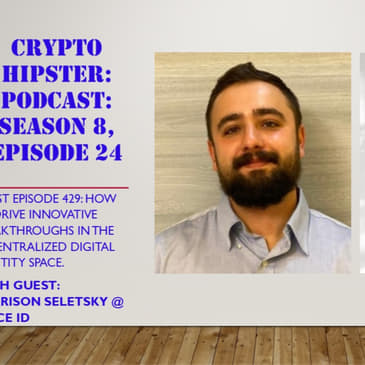

Building in the blockchain space since 2017, Harrison Seletsky is the Director of Business Development at SPACE ID, a universal identity and domain name platform, and the largest multi-chain web3 domain name service by users and registrations. Harrison leads the ecosystem growth, partner expansion, and partnership success at SPACE ID, and is charged with many of the forward-facing and strategic aspects of the SPACE ID identity platform, driving its innovation in the decentralized identity space. Prior to SPACE ID, Harrison worked at NFTrade as the Head of Growth and Strategy, at a blockchain-focused hedge fund, as a contributor to various crypto news outlets, and has worked privately with blockchain networks and applications collectively worth billions on their business development, strategy, and user-facing interactions.
[00:00:00] Hello, everybody, and welcome to the Crypto Hipster Podcast. This is your host, Jamil Hasan, the Crypto Hipster, where I interview founders, entrepreneurs, executives, thought leaders, amazing guests all around the world of crypto and blockchain. And today I have another amazing guest. I have the Director of Business Development at SPACE ID, Harrison Seletsky. Harrison, welcome to the show.
[00:00:28] Hi, Jamil. Thanks so much for having me today.
[00:00:30] You're very welcome. I'm excited and looking forward to this.
[00:00:35] So let me kick things off, and I ask the same question to everybody, and again, all amazing answers.
[00:00:42] What is your background, and is it a logical background for what you're doing now?
[00:00:49] Yeah, so I guess just to start my background in the crypto space generally, I was first introduced to crypto in late 2016 by some friends, specifically Ethereum.
[00:00:59] So trying to understand what smart contracts were, decentralized applications, and that opened like a whole world of questions.
[00:01:06] You know, what is money? What is value?
[00:01:09] You know, even before I was introduced to Bitcoin, I was introduced more on the decentralized application side.
[00:01:16] So how can users benefit from the applications they're participating in, and how can that drive value back to the ecosystem?
[00:01:23] This was when I was in university.
[00:01:24] So I have a background in accounting and finance.
[00:01:28] So I started working initially at a small capital firm called Emerging Star Capital, where we were a research and analysis firm focused in the crypto space.
[00:01:45] I enjoyed that very much. I do enjoy the analytical side, but I also really enjoy the strategy and the creative side.
[00:01:52] So that led me more down the marketing and the business development route.
[00:01:56] I've written for quite a few different crypto-based publications.
[00:02:00] Before my role at Space ID, I was working at an NFT marketplace, a multi-chain NFT marketplace called NFTrade, on the growth and strategy front.
[00:02:10] And yeah, I joined Space ID almost two years ago on the BD team, and now running the BD team, running the strategy, working on partnerships, integrations, bringing utility to our domain name services and users,
[00:02:21] and just trying to make it as easy as possible for users to interact on chain.
[00:02:27] I did interview with somebody, NFTrade, a couple years ago. I don't remember who.
[00:02:33] But you guys are up to some pretty cool things.
[00:02:37] And I'm going to add that to our conversation because NFTs have changed.
[00:02:43] So I was wondering, what made you switch from NFTs to what you're doing now?
[00:02:49] You know, what was the catalyst?
[00:02:53] Yeah, so actually, Space ID, we still utilize NFTs.
[00:02:59] More on the infrastructure side.
[00:03:01] So all of our domain names are represented as ERC-721 tokens or their equivalents.
[00:03:06] Essentially, they're all unique NFTs or unique tokens that point to the domain name of the actual address owner.
[00:03:14] So if you own jameel.bnb or I own harrison.bnb, these are all cryptocurrency tokens,
[00:03:19] but they're not necessarily interchangeable one-to-one like Ethereum or Bitcoin.
[00:03:23] I think NFTs provide a really interesting underlying tech structure.
[00:03:28] Personally, I was never really super into the art side.
[00:03:32] I did own, you know, one NFT that pretty much was just a chicken in a pirate hat.
[00:03:37] I thought it was pretty funny.
[00:03:38] It was pretty cheap.
[00:03:40] And yeah, besides that, like, I think the value proposition of NFTs, especially in gaming and other places, like now Identity 2, is very interesting.
[00:03:50] But I wanted to focus more on the utility side.
[00:03:52] And, you know, building something that is more, you know, value producing versus a marketplace where it's more kind of just making it easy for these users to swap and interact.
[00:04:05] Where this, it's more strategic.
[00:04:07] It's more about building an actual product with end utility versus building out a marketplace and just attracting the user bases to build on your trading volume.
[00:04:16] That makes sense to me.
[00:04:20] So, I want to find out in depth what Space ID is all about and how you are transforming the way we look at digital identity.
[00:04:29] Yeah, sure.
[00:04:30] So, from the high level, Space ID is a universal domain name platform and aggregator.
[00:04:36] We work with L1s, L2s, and top ecosystems to launch and aggregate top-level domains.
[00:04:41] We've created domain name services like .bnb, .arb.
[00:04:45] We work with ecosystems like Say, Injective, Zeta, Manta, and others at the ecosystem level to build out their identity infrastructure on their chain.
[00:04:55] So, essentially, what we try and do is just simplify that user process, you know, try and erase the random 42 letters and numbers that make up an L1s wallet address and provide something that's more human-readable that they can choose to either connect to their Web2 interface, you know, their usernames, their Twitter profiles,
[00:05:12] or if they want something pseudonymous, you know, that they can just use to make it easy to understand who's on that other side of the transaction.
[00:05:19] There's lots of really great ways to utilize them.
[00:05:21] Some of the most introductory are just within wallets, making it easier and safer to send and receive funds.
[00:05:26] It makes it a lot harder for users to have a mistake or put the wrong wallet address or get phished.
[00:05:32] You know, there's a lot of phishing scams where a scammer will change a few of the numbers or letters in the middle of the wallet address and you're copying and pasting something you don't realize.
[00:05:43] And by the time you press send, it's too late.
[00:05:45] So, if you're not meticulously checking, and even someone, you know, like me in the identity space and many other of these crypto users,
[00:05:52] you make sure you're looking at every single letter and number before you hit send.
[00:05:55] You don't want to make that mistake.
[00:05:57] So, this makes it a much more easier operation when you're using something more like sending an email or a text message.
[00:06:04] And then we also aggregate the established domain name ecosystems on the space, like Ethereum name service, ENS, Solana name service, Lens protocol.
[00:06:12] So, users can register, manage, and trade all of their domains in a single place.
[00:06:17] And Dapt can integrate all of these necessary domain name services for the chains they support through a single interface.
[00:06:23] So, we really just try and make it all-encompassing and as easy as possible for users and developers to introduce these identities into their journey.
[00:06:34] Very cool.
[00:06:34] Cool.
[00:06:35] So, recently, I know you had an announcement about, I think it was called MetaMask Snaps.
[00:06:45] What was the basis of the announcement?
[00:06:47] What's going on?
[00:06:48] What are you looking forward to with that?
[00:06:51] Yeah, sure.
[00:06:52] Yeah.
[00:06:52] So, we just announced our MetaMask Snap about a week and a half ago.
[00:06:55] So, the Snaps program is essentially MetaMask Dapp store or application storefront where third-party developers can submit applications that users can then choose to integrate or choose to add to their MetaMask experience.
[00:07:09] So, we launched our identity Snap for about 20 different domain name services, some that we created.
[00:07:16] And then we also added a feature that resolved these ENS domains on every single chain that's EVM compatible.
[00:07:22] So, currently, before our Snap, you could use your ENS domain name to send and receive funds on Ethereum.
[00:07:28] But when you use our Snap, you can send and receive funds using your ENS domain name on any EVM compatible chain.
[00:07:34] So, essentially, it's a way for users to use their decentralized identities directly within MetaMask.
[00:07:39] We work with a lot of top wallets in the space, Finance Rep3 Wallet, Trust Wallet, OKEx Wallet, Token Pocket, many others as well to make it easy for users to send and receive funds using their domain names.
[00:07:52] And now that's also available within MetaMask.
[00:07:55] So, we've been working with their team for a while as they've been developing their Snap.
[00:07:59] We were essentially waiting for them to onboard their decentralized identity, you know, pool of applications.
[00:08:06] And we were one of the first identity protocols to launch with them as well.
[00:08:09] So, now, besides PNS, you can use pretty much any EVM compatible domain name service directly within MetaMask to make it safer and easier to send and receive funds.
[00:08:22] In theory, it sounds great.
[00:08:24] So, I guess I'm one of the more MetaMask challenged people where every time I've used it, I've made an error or there's been some kind of something that has happened where I've lost funds, you know.
[00:08:37] So, and you mentioned the word before, you mentioned phishing.
[00:08:40] You know, my concern is what do you see as the drawbacks of moving from this seed phrase approach to a more, you know, Google Mail or X account?
[00:08:55] Do you see that improving security?
[00:08:59] Or how do you see, you know, there might be a lapse in security?
[00:09:03] What are the benefits and what are the drawbacks?
[00:09:07] Yeah, so I think the main benefit is it just abstracts away a lot of these technical complexities.
[00:09:13] The actual underlying technology of sending, receiving the funds doesn't change.
[00:09:18] It just essentially allows you to point to this human readable wallet address versus the randomized wallet address.
[00:09:24] So, the process is exactly the same.
[00:09:26] Let's say, you know, you own Jamil.bnb or you have your standard Rx wallet address.
[00:09:31] Both of those experiences to sending would be the same.
[00:09:35] The transaction is the same.
[00:09:36] Just through this integration, I can now send directly to Jamil.bnb.
[00:09:40] So, I don't have to worry about, you know, messing up when I'm typing in the address or copying and pasting.
[00:09:46] So, that's kind of where the security aspect comes in.
[00:09:49] You're really just abstracting away that the alphanumerical randomness of the wallet addresses
[00:09:54] and making something that's much more akin to a Web3 username.
[00:10:01] Okay.
[00:10:02] That makes sense.
[00:10:03] Yeah.
[00:10:03] Okay.
[00:10:04] I can see me not – I can see messing up a 25 random digit address.
[00:10:10] But if I'm going to send it to you, Harrison.bnb, then I think it'll be easier for me for the user.
[00:10:19] Sure.
[00:10:20] Yeah.
[00:10:20] And it's also on the exchange side.
[00:10:22] Right now, mostly on the withdrawal side, we work with exchanges like HTX, like Quobey.
[00:10:27] So, you can withdraw directly to your domain name.
[00:10:29] We're also working with some exchanges on the deposit side.
[00:10:33] This is a little more complex because, you know, there's so many different unique deposit addresses for each individual user.
[00:10:41] But just really trying to make it easy and less technical to do this, especially for newcomers,
[00:10:47] where their first point of contact are these wallets or these exchanges.
[00:10:50] You're kind of already hit with something that you don't want to make a mistake on, these randomized wallet addresses.
[00:10:56] And this just provides a much more traditional Internet experience with how users interact with one another.
[00:11:02] Cool.
[00:11:04] Okay.
[00:11:05] So, those are a couple things additional in your pipeline, right?
[00:11:09] What other things do you have that you're working on that you're excited about?
[00:11:13] Yeah.
[00:11:13] So, there's a lot that we have coming up.
[00:11:15] We do have some new domain name services coming out with L1s and L2s, bringing identity infrastructure to their protocols.
[00:11:23] The MetaMask integration was a pretty big one for us.
[00:11:25] We're still working with other wallets and exchanges as well as dApps, you know, just to make it easier for them to interact.
[00:11:32] Pretty much anywhere you're connecting a wallet or tracking the wallet address, there's a way to integrate domain names to make that easier for the end user.
[00:11:39] We were talking about NFT marketplaces a little bit before.
[00:11:42] You know, when you're tracking the provenance of an NFT using a domain name, a Web3 domain name, you can see exactly the artist.
[00:11:49] You know, that instead of having to see the artist's wallet address, you could see it came from Beeple.e or, you know, any other artist has that actual on-chain identity.
[00:11:59] So, yeah, what we're trying to do is really just make this technology more pervasive, you know, work with social FI applications, GameFi applications, applications where there's more of these social on-chain interactions to make the actual transaction process easier and smoother between users.
[00:12:18] Something we're also working towards that won't come to fruition until probably the end of 2025 or 2026 is working with ICANN, the domain name provider for the web2space.com.gov, to kind of be able to tie in your Web3 domain name with your Web2 experience so that you can actually manage a website directly within any browser, Google Chrome, Brave, Safari.
[00:12:46] And it will be owned and managed by your domain name.
[00:12:50] And then you'll be able to access it directly on through your web browser as well.
[00:12:56] So, yeah, these are some things we're working on.
[00:12:58] Also working to make it easier to buy these domain names on traditional Web2 interfaces.
[00:13:03] We're working with a company or they're building out a product with our technology that will allow users to buy and refer domain names directly through Twitter.
[00:13:13] So you'll be able to connect your wallet, but you won't have to go through, you know, many different pages or websites.
[00:13:19] You'll be able to buy it pretty much anywhere you're connected to and then use that across your entire blockchain journey.
[00:13:26] Beyond that, our future goal is, you know, making these domain name services more cross-chain and interoperable.
[00:13:32] Right now they're more siloed.
[00:13:34] You know, there's the ETH, the ENS Ethereum name service for Ethereum.
[00:13:37] There's the Solana name service for Solana, .BNB, .ARB, etc.
[00:13:41] And at some point when the market deems it necessary and these more cross-chain applications become bigger and more usable,
[00:13:49] there will probably be some sort of unified domain name service where you can kind of point to all of your different wallet addresses through a single domain name.
[00:13:58] So if I wanted to send to jameel.BNB, that would also be connected to your address on Solana.
[00:14:05] It would also be connected to other profiles, on-chain data, off-chain data.
[00:14:11] So, yeah, there's a lot of interesting aspects, especially with ZK technology as well.
[00:14:16] Being able to tie in some of this off-chain data onto your on-chain identity.
[00:14:21] You know, something like KYC information where if you verify your ID or your passport, you verify that your KYC is usable and acceptable.
[00:14:33] You can now use that identity that's tied to your KYC to access these different exchanges without having to relay all of that data back to them.
[00:14:43] So, essentially just using your identity as almost like a passport that has a lot of other information tied to it that you don't need to necessarily divulge to the end party.
[00:14:53] They can just know through zero-knowledge proofs that it's been verified in the past and that you can now utilize these services.
[00:15:03] I'm trying to think about that.
[00:15:05] So it would be similar to like a link tree, but for what three?
[00:15:09] Almost, yeah.
[00:15:10] So you can tie in even medical data as an example.
[00:15:13] You know, let's say you go to the doctor's office and they want to know your health records and you want to divulge some information, but not everything.
[00:15:20] You can tie that in all to your Web3 domain name and then you can choose which data you want to make available.
[00:15:26] And they can verify it as you as the domain name owner.
[00:15:30] So, essentially, if you own jameel.bnb, you sign from the jameel.bnb wallet address to prove that you're the owner of this information.
[00:15:37] And then you can show them the information that you want to make public, at least to them.
[00:15:41] And then you can also choose to keep information private.
[00:15:44] So it's going to go much more encompassing, more from like a decentralized domain name to like a full identity protocol where you can really have so much more information at your fingertips that you don't have to verify continuously every time you sign up to a new exchange or do a new application.
[00:16:04] It'll all be kind of there for you to pick and choose as you want.
[00:16:09] Then you can truly be a sovereign individual.
[00:16:13] Yeah.
[00:16:14] And you have full control over the data.
[00:16:16] It would be fully stored in a decentralized way.
[00:16:18] There's also fully homomorphic encryption, HFE, which we're looking into.
[00:16:23] Some of these protocols have raised, you know, I think the main ones, Zama, they raised like $70 million to build out this infrastructure.
[00:16:31] So these are other like privacy preserving infrastructure protocols that make it easy for end users to decide what information they want to make available to who without revealing everything.
[00:16:44] So this is going to take some time to come to market.
[00:16:48] But this is already, you know, what a lot of these identity protocols are looking into.
[00:16:52] You know, how does this evolve to the next steps?
[00:16:55] How do we make it easy for users to kind of encompass all of their identity and all of their data points in one place, but also keep it secure and also keep it decentralized?
[00:17:04] Because you don't want data leaks, you know, which is a very common problem in the Web2 space, password leaks, information leaks.
[00:17:11] So decentralized tech and, you know, ZK and FHE provide really interesting and novel ways to approach this.
[00:17:19] Yeah.
[00:17:20] So it seems to me like identity is becoming a bigger deal, you know.
[00:17:28] And, you know, there are there's arguments out there, at least on X that I see all the time that people are making between privacy and security in the realms of identity.
[00:17:38] There seems to be a lot of friction, right?
[00:17:41] How can we, you know, resolve like how can we resolve that friction?
[00:17:45] How can we come to a better understanding or common ground resolution on on some of these pain points?
[00:17:53] Yeah.
[00:17:54] Yeah.
[00:17:54] Yeah.
[00:17:54] So this is almost like what I was saying a little bit, you know, on the blockchain, everything is public and open in a lot of ways.
[00:18:00] So it is anonymous in some ways.
[00:18:04] But if you are able to connect the user to their wallet address, you now know the entire history and who it's connected to.
[00:18:11] So some of these privacy preserving features, you know, like zero knowledge proofs, like fully homomorphic encryption,
[00:18:16] they do offer ways to keep this data secure and leave a lot of the privacy up to the end user.
[00:18:24] So you're still able to make these on chain interactions without revealing everything to all parties.
[00:18:31] It is a little technical, even, you know, for me, for anyone that's outside of like a development, like that's not a developer.
[00:18:38] However, the actual underlying infrastructure is pretty technical, you know, in terms of how the cryptography works on a fundamental level.
[00:18:46] But it does present ways to offer data and data distribution in a secure way where you as the end user can have a lot of your data or information available on chain without making it publicly available to parties that you don't want to have that information.
[00:19:06] Got it.
[00:19:10] So I'm here in the U.S. and we have an election coming up next week.
[00:19:17] And we had a little bit of this four years ago, but there's a lot now is there's no way for some of the states here in the U.S.
[00:19:27] to really identify people's identity because there's so many migrants and who can vote, who can't vote.
[00:19:34] So it's and there's every size different as far as the narrative.
[00:19:38] It's almost impossible to validate anymore, you know.
[00:19:43] So in a realm of like identity and like my and I look at I'm only using politics.
[00:19:50] I don't talk about politics on the show much.
[00:19:53] I want to find out, like, what's some of the challenges and dangers are of not being able to verify people's identity on a mass scale and how we can, you know, use a blockchain or what plan we can put forward to mitigate those dangers going forward.
[00:20:07] So we don't have a constant state of confusion all the time.
[00:20:12] Yeah.
[00:20:13] Yeah.
[00:20:14] I mean, that's a super complex question.
[00:20:16] You know, of course, when you're voting, when you're doing these important civic duties, you want to make sure first that people are telling the truth, that people are who they say they are.
[00:20:27] I know in the U.S. there's some aspects where you don't even have to show voter ID in order to vote and that like you don't have to show any ID.
[00:20:36] And that can open up a lot of negative consequences if, you know, you don't know who's actually getting involved in your system.
[00:20:43] So blockchain does potentially present a way to mitigate this, although it will take a lot of testing.
[00:20:53] It will, especially governments there, you know, they move very slow.
[00:20:56] So it will probably take some time before they're comfortable with something like this.
[00:21:00] But there is a way, you know, whether it's through an application layer to kind of verify each user on an individual level.
[00:21:09] There are these tokens called soulbound tokens, which are tokens that are minted to a wallet address.
[00:21:15] And then it's never allowed to leave or transfer that wallet address.
[00:21:19] So, for example, let's say you go get your driver's license or you go get your passport and then you're issued, you know, your government wallet address.
[00:21:27] And then that government wallet address issues you a soulbound identity token that says you actually are Jamil Hassan.
[00:21:33] No one else is Jamil Hassan, it's you.
[00:21:35] So every time you go to vote or you go to do anything where you need to prove your identity,
[00:21:42] you would then have to essentially sign or verify from this Jamil Hassan wallet address that you are who you say you are.
[00:21:50] And again, this is kind of where the ZK proofs or the fully homomorphic encryption can come into play,
[00:21:55] where you can verify who you are without giving away all of your information.
[00:22:00] So let's say you have other information, you have private information, you have trading information.
[00:22:05] Maybe you wouldn't want that connected to your, you know, government issued wallet address anyway.
[00:22:09] But it would provide a way for the government to say, OK, this is the address we gave him.
[00:22:14] This proves that he is who he says he is. And this is our record of him.
[00:22:18] And anytime you want to vote or you want to get involved, you can now not only do this online.
[00:22:25] So like it can create a lot less friction and, you know, compared to doing in-person voting.
[00:22:29] But it's very easy to prove that you are the one doing it because you must have access to the wallet address
[00:22:36] that says you are who you are in order to actually cast that vote or move forward with whatever procedure you're doing.
[00:22:44] So there are some areas where this is starting to take place.
[00:22:49] In Argentina, they are starting a flagship program, which is digitizing some aspects of identity on the blockchain.
[00:22:58] Same in California in the DMV.
[00:23:01] They're putting some of the car data for specific cars onto the blockchain so that, you know, if I go to sell a car,
[00:23:09] I can't say, oh, yeah, it's a great car, blah, blah, blah, when you can just look and see that it was actually a junker
[00:23:16] and it broke down and I had to take it to the mechanic 10 different times.
[00:23:20] So it does provide you a way to be much more transparent with that data.
[00:23:24] And it's also very, very easily verifiable.
[00:23:28] So there is options.
[00:23:29] I think something like that is still very, very far away just because it's hard to get people comfortable with stuff that does seem to have these technical walls still around them.
[00:23:44] But it's not out of the question.
[00:23:46] I mean, people and governments are already starting to look into this, to dive into this, to create MVPs, to see how they can utilize it.
[00:23:55] But so, yeah, I think it will play a role in the future.
[00:23:59] It could take a decade.
[00:24:01] It could take less.
[00:24:02] Kind of depends on how much people want to prioritize this.
[00:24:06] But especially as we move more online as a society, we're going to need ways to verify our online interactions.
[00:24:14] And blockchain presents a really interesting and safe way to do that where it's much harder to hack and it's much harder to lie.
[00:24:21] Because each person essentially needs control over the private keys of their wallet in order to move forward with any of these transactions.
[00:24:30] Then there is that security question again.
[00:24:32] What if you lose your private keys?
[00:24:33] What if you lose access to your wallet?
[00:24:35] How would that actually work?
[00:24:37] But these are questions that will need to, you know, come into play as something like this continues to evolve.
[00:24:45] Yeah.
[00:24:46] Ten years in the developed economy.
[00:24:50] You know, I'm thinking about them.
[00:24:53] I'm thinking about the emerging economies don't have access to electricity.
[00:24:56] It's only going to take them, you know?
[00:24:59] Yeah.
[00:24:59] Yeah.
[00:25:00] Well, there's even, I mean, a lot of countries in Africa, for example, it's really interesting.
[00:25:05] You're seeing a massive adoption in crypto because they kind of skipped over the PC era, you know, that we had maybe in the early 2000s.
[00:25:14] Because they lacked either the money or the wealth or the capabilities to buy a computer for, you know, hundreds of thousands of dollars.
[00:25:22] But now you can buy an internet-enabled smartphone for 20 bucks.
[00:25:25] And you have the power of that internet right at your fingertips in a cheap and accessible way.
[00:25:30] So a lot of these emerging economies kind of, like, jump-stepped a generation past or, like, skipped a generation of technology.
[00:25:39] And they now have access to a lot of these same tools just in different formats.
[00:25:42] So you don't need an iPhone or a MacBook in order to access these features.
[00:25:47] You just need any generic smartphone.
[00:25:49] And as technology gets cheaper and more accessible, a lot of these people that were previously excluded from these types of features or applications, it's now much, much easier for them to access.
[00:26:00] So you're seeing a lot of these emerging economies, like Nigeria, as a massive crypto community and has a massive percentage of their population involved in crypto because it presents a way for them to kind of get safer and stable currencies through stable coins, even through Bitcoin, compared to their own native currency.
[00:26:19] So they may not have had that personal home computer growing up.
[00:26:23] But now with the smartphone, they're able to access this technology in a really accessible way.
[00:26:29] It's interesting because I went to the World Bank's forum last week and I went to one talk where it was, like, electrification of sub-Sahara Africa.
[00:26:42] And they had foreign ministers there on stage.
[00:26:44] And I'm in the crowd.
[00:26:45] I'm like, OK, I got it.
[00:26:46] It was packed.
[00:26:47] It's six foreign ministers from Africa.
[00:26:51] And I didn't have a hearing.
[00:26:53] The dialogue changed.
[00:26:55] So they all spoke French.
[00:26:58] So I sat there for two years and I couldn't understand a thing.
[00:27:00] I don't speak French.
[00:27:01] And I'm like, I wish I knew what they said.
[00:27:04] You know, so you're saying that they can bypass the infrastructure with the smartphone and be able to access blockchain and crypto and identity platforms.
[00:27:13] Yeah, for sure.
[00:27:14] Yeah.
[00:27:15] Even if you're in some remote village or remote area, you know, previously, how would you get internet out there?
[00:27:20] But now you have things like Starlink.
[00:27:21] And these technologies will continue to get cheaper and cheaper over time as they grow.
[00:27:26] So it's going to be a lot easier for these people that were previously kind of excluded from these ecosystems to get that access.
[00:27:34] And even from the translation side, you know, now you have Google Translate apps where you speak into the app in any language and it translated in real time to English.
[00:27:44] You know, we're going to it's crazy.
[00:27:46] Like you see in the movies, the people that had the earphones that are, you know, translating all these different languages in real time.
[00:27:51] That's already available technology.
[00:27:54] And like it's going to be continuing to get cheaper and easier and more accessible.
[00:27:59] And it's going to continue to globalize.
[00:28:01] So all of these issues are going to be available and be resolvable, which was previously kind of just available into Western countries that had like the wealth to support it.
[00:28:13] Now it's going to be available and like approached by a lot more of the worlds that wasn't able to access it in the past.
[00:28:22] I like that.
[00:28:23] That sounds good to me, especially the part where I can put an earphone in my ear again.
[00:28:29] It's an automatic translation and I can sit there and understand what's going on.
[00:28:34] You said a word earlier that I want to find out the role of it.
[00:28:38] You said interoperability.
[00:28:40] So why is there a growing need for blockchain interoperability, especially not just and not just, you know, with identity technology, but overall?
[00:28:54] Yeah, I think interoperability is going to play a huge role in all crypto applications because it's just so complicated to navigate right now between all these different L1s, these L2s, different marketplaces.
[00:29:06] You know, the journey to get from like, let's say you're on Solana and you want to go to Arbitrum.
[00:29:12] You know, you have to first probably bridge to Ethereum or maybe you can bridge directly to Arbitrum now.
[00:29:19] But it's expensive.
[00:29:21] You know, it can be costly.
[00:29:22] You have to trust the application layer that you're doing the bridge on that they don't take advantage of you or that it's actually safe.
[00:29:29] And that just makes the user journey very, very complicated.
[00:29:33] You know, if you want to use a decentralized exchange on one blockchain and it's not available on the other blockchain, if you want to use it, get a token, you know, that's not available on a single blockchain.
[00:29:45] It's a long user journey and you have to make sure you have to have the right gas token.
[00:29:51] You have to make sure you have, you know, the right wallet because if it's an EVM chain interacting with a non-EVM chain, you know, the Ethereum virtual machine, then it may not be able to interact with each other.
[00:30:02] So I think right now we see a lot of these L1s and L2s that are popping up.
[00:30:07] I think most of them will probably die out over time.
[00:30:11] I mean, even the ones that have a lot of funding, they'll be able to keep their lifecycle going, but there's not going to be a lot of building on them eventually.
[00:30:19] It's going to kind of go to where the value of the end user is going.
[00:30:24] But this interoperability play essentially will just make it much more seamless for users to interact where they don't necessarily need to even know which blockchain a specific application is on.
[00:30:34] They just want to be able to use the application and do what it's supposed to do.
[00:30:39] Even something like Polymarket, which has started to see a lot of product market fit right now, that's mainly on Polygon or Ethereum.
[00:30:46] So if I have money on Solana that I want to gamble on Polymarket or a place to bet on Polymarket, it's a complicated journey, especially for a non-technical user to be able to do that.
[00:30:57] And if they want to on-ramp with their credit card or their debit card, they're going to have to pay 5% or 10% in order to get those fees.
[00:31:03] So interoperability is just going to make these applications much more acceptable.
[00:31:09] Right now, honestly, I still think we're a little far from that.
[00:31:13] I think, I mean, bridges are presenting a really kind of first-generation way to make applications more interoperable.
[00:31:22] But as we see more like broad-stream consumer applications, like decentralized applications hit the market, we see a lot more users getting more involved.
[00:31:32] Interoperability is going to become much, much more important.
[00:31:35] So I think the infrastructure is still kind of being built out now.
[00:31:38] But once we do have those applications on all these different chains that people want to interact with, interoperability is really the only way to kind of get rid of that headache of migrating all of your tokens and all of your data from one chain to another.
[00:31:56] Somebody said to me, said once, the key to onboarding the next billion people into blockchain is have them come in without even knowing they're using blockchain.
[00:32:07] Yeah, I 100% agree.
[00:32:10] I mean, I think it's not fair to compare blockchain to AI like ChatGBT because they're such different applications.
[00:32:17] But one of the reasons ChatGBT took off so easily is because people have a very easy and good understanding of what a search engine is, what it's like to just type and ask a question.
[00:32:27] They don't really care about the large language model that's powering the brain behind ChatGBT.
[00:32:33] They just want to know that the problem they're looking for will be solved.
[00:32:38] And I think that's what people in crypto want, too.
[00:32:41] I mean, now you're starting to see with Off the Grid, a new blockchain game, kind of the first mainstream game to hit the market.
[00:32:48] You know, you have Twitch streamers, you have people playing on Xbox, on PlayStation 5.
[00:32:53] And no one really cares that it's a blockchain game, but they do care that they can buy and sell their assets easily and instantly.
[00:33:02] And that's really where the value proposition is.
[00:33:04] It's not like the underlying technology that powers it is important, but making the user journey as seamless as possible, where people don't even know that it's a blockchain game to start.
[00:33:14] And then like, oh, wow, this is just an interesting infrastructure that's different than a centralized database.
[00:33:19] I mean, most people don't even care about that.
[00:33:21] They just want to know that the action that they are partaking in will be successful.
[00:33:26] So I totally agree with you.
[00:33:28] I think onboarding, the technical barrier needs to be lowered as much as possible.
[00:33:33] If people don't know they're using blockchain, that's great for me.
[00:33:37] It doesn't change anything.
[00:33:39] And yeah, I think it will make it a lot easier for people to just understand when they don't have to care about the technology.
[00:33:45] They just have to care about the value proposition of the product and what it's trying to do for the audience.
[00:33:51] And with the name service and using your Google account or your X account and not knowing you have to have the seed phrase, I think that probably goes a long, long way.
[00:34:00] Yeah.
[00:34:00] I mean, if you don't have to memorize your wallet address, let's say we're playing a game and I want to add you as a friend and we're just brand new to blockchain.
[00:34:09] It's much easier to just add jameel.bnb or even just jameel or whatever the end name is instead of just this random set of letters and numbers.
[00:34:20] I mean, even when you take it to the internet, each website has a corresponding IP address.
[00:34:26] It can be like 1.1.19.17.18 and that goes to Facebook.
[00:34:32] You can put either one in to get to Facebook, but it's much easier to type in facebook.com and to memorize each individual IP address of each individual website.
[00:34:41] So that's kind of what these domain names are doing too.
[00:34:45] It's just creating a human readable version that's much more easier for people to understand.
[00:34:52] Yeah, I like it.
[00:34:53] I like it a lot.
[00:34:56] So I want to thank you very much for speaking with me today.
[00:35:00] I have one further question.
[00:35:04] It's easy.
[00:35:05] How can people find out more information about you?
[00:35:09] How can they find out more information about Space ID?
[00:35:11] How can they become users or clients, customers?
[00:35:14] How can they do that?
[00:35:15] Yeah, how can they do that?
[00:35:17] Yeah, sure.
[00:35:18] For Space ID, you can visit us on our site, space.id.
[00:35:21] Domain names start at $5 per year.
[00:35:24] You can also buy them on secondary marketplaces for cheaper if users are listing them there.
[00:35:29] Breaks down all the different types of domain name services, how they're used, how to register.
[00:35:33] We also have a Twitter profile, a pretty big one with about 800,000 users following us.
[00:35:39] That's Space ID Protocol.
[00:35:40] If you want to find me, I'm available on Twitter and LinkedIn as well.
[00:35:44] Space ID Harrison on Twitter.
[00:35:46] Harrison Sleksky on LinkedIn.
[00:35:48] I'm always happy to discuss or answer questions or help with the user journey or with the developer journey if you're a developer out there.
[00:35:56] And we walk you through the entire registration process.
[00:35:58] It's pretty easy as long as you know how to use your wallet.
[00:36:01] Registering the domain name just takes a couple clicks and a few dollars.
[00:36:05] And then you can set it and start using it as your on-chain identity.
[00:36:08] We've integrated into hundreds of different dApps, wallets, exchanges, et cetera.
[00:36:12] So once you have your identity, you'll start seeing it in all of the most common applications you're using.
[00:36:17] And just start to see how it really improves that user experience.
[00:36:20] So feel free to check us out.
[00:36:22] Dive more into these centralized identities.
[00:36:24] And yeah, hopefully it was helpful.
[00:36:27] Awesome.
[00:36:28] Thank you very much for your time today.
[00:36:31] Yeah, thanks a lot, Jamil.
[00:36:33] Appreciate it.