
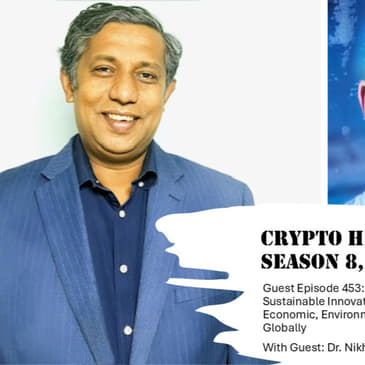

Dr. Nikhil Varma is an Associate Professor of Management at the Anisfield School of Business, Ramapo College of New Jersey, and a globally recognized expert in blockchain technology, operations, and sustainability. With over 20 years of academic and professional experience, he bridges the gap between research and practice in emerging technologies and management.
Dr. Varma serves as the Senior Fellow and Chair of the Blockchain Workgroup at The Digital Economist and is the Technical Lead for the Algorand Foundation in India, where he supports blockchain diffusion and adoption across the country. His work focuses on leveraging decentralized technologies to drive innovation and sustainable growth.
Holding a Ph.D. in Business Administration and an MBA from HEC Montréal, along with advanced engineering credentials, Dr. Varma has published extensively on supply chains, sustainability, and blockchain applications in top-tier journals and global conferences. He is also a sought-after advisor, having supported ventures like Aten Ventures and Qbrics.
At Ramapo College, he designs and teaches cutting-edge courses in Business Analytics, Data Visualization, and Sustainability, equipping students with real-world skills in data-driven decision-making. A certified Scrum Master and SAP professional, Dr. Varma combines technical expertise with strategic insight to advance the adoption of blockchain and emerging technologies globally.
[00:00:00] Hello, everybody, and welcome to the Crypto Hipster Podcast. This is your host, Jamil Hasan, the Crypto Hipster, where I interview founders, entrepreneurs, executives, important people, and amazing people all around the world of crypto and blockchain. And today I have another amazing guest. I've known this man for a few months, and he and I are part of the Digital Economist. He's in charge of blockchain there.
[00:00:30] Welcome, Nikhil Varma, to the show. Nikhil, welcome. Thank you, Jamil. Thank you so much. You're very welcome. It's an honor to be a part of your show. I've heard you talk to so many people, and it feels great to be chatting with you over here. I'm excited. So let's kick things off. I'll ask you first, you know, what is your background, and is it a logical background for what you're doing now?
[00:01:00] Nikhil Varma, Well, I'm a trained computer engineer, studied computer science in the late 90s, and, you know, started my career just before the Y2K. And, in fact, started my professional career working for a company just before Y2K. And we were hoping a lot of things to happen, nothing happened, which was a bit of a letdown because we're assuming that, hey, now this is the time when computer engineers are going to save the world.
[00:01:27] So, after working in India and Australia for a bit, I came to Canada, wanted to kind of dig deeper into computer science and started studying in Concordia University in Montreal, where my research was on mission-critical software design. In fact, mission-critical protocol design. My professor used to work for Canadian Aerospace Agency. So my research kind of was indirectly related to things around the space.
[00:01:55] So suppose something goes to space and it crashes, how are we able to recover that? That essentially was my master's thesis. And I became an entrepreneur right after that, did not pursue my PhD. I started a company, fresh and new immigrant in Canada two years and, you know, dared to do that. But I was lucky enough to be able to sell my company to a public company.
[00:02:18] And that was my start of entrepreneurship journey where, you know, I did a lot of interesting things, wore different hats, as all entrepreneurs do. But the fun part was that I was also a part of a public company, which I had acquired my, where I actually sold my company and had the opportunity to go and do fundraising, presenting in front of investors all around the world.
[00:02:44] Moved on from there and then started another company with that money, a services company. Then 2007 hit, 2007-2008 market started going down. I needed to rediscover myself. The first child was coming and that's when I decided to kind of get into a different space where I started, I kind of applied for the MBA program in, I should say, Montreal.
[00:03:09] That is one of the things which I always wanted to do because as an engineer, management was something we assumed that we knew. But then when you actually start managing companies, you know that you don't know management. It was a lot of fun to do that intensive MBA program, did management consulting after that, traveled a bit, that kind of got on to me and then I decided to go back to school and do my PhD. And my PhD was again in operations management using artificial intelligence.
[00:03:40] And in 2016, I moved to the US as an associate professor. So that's when, you know, I was looking for avenues and areas where I would kind of develop some kind of an interest. Of course, artificial intelligence was my first love. But that is when a friend of mine just called me from Montreal and said, hey, you want to be a part of our startup? And I was like, what exactly is your startup all about? And he's like, it's on blockchain. And I had read a bit of blockchain.
[00:04:09] My master's thesis was on distributed systems. So I understood the construct of this distributed system and especially decentralization. And believe it or not, Jamal, it's since 2016, there's only one thing I do, and that's blockchain. And, you know, I have tried to implement blockchain in different environments, but force-fitting it, trying to understand the value of decentralization in organizations.
[00:04:37] And in fact, slowly kind of developed a keen interest and specialization in business model transformation, how businesses can transform into decentralized mode and what are the benefits, what are the key performance indicators, you know, what should be the transition strategy and why decentralization can give them that competitive edge. So that's the whole idea of sustainability coming into the mix. So this is who I am. This is what I've been doing.
[00:05:05] It's almost nine years plus since I've been just doing blockchain. And I love this. And I continue to be surprised every day with the amazing things that I get to see, amazing people like yourself that I get to meet in different walks of life, different avenues that I go to. And I learn from everyone. And that's what keeps me going. Sounds awesome to me. I didn't know that you had a company you founded and sold. That's pretty good.
[00:05:35] So, yeah, entrepreneurship from the get-go. That's really cool. So you said this. You said you wear multiple hats. And I know you're from The Digital Economist, but you also wear that hat. I want to find out more about what we do there. But you also wear the professor hat. And you wear what else? I'll go around that. I'll go around foundation. So what are your multiple hats? And what do you focus on? Yeah.
[00:06:04] So, I mean, yeah, I'm anchored. I mean, I would say anchored because that's what my identity is. That's how I see myself as a professor in Ramapo College of New Jersey. It's a small state university, but a beautiful state university, which gives you all the ability to be able to innovate. We celebrate innovation. We do a lot of interesting things, a very pragmatic school.
[00:06:32] And during my, you know, this innovation endeavors that I've been doing, I've been going around the world, going and talking about blockchain and different platforms. I came across a very amazing friend. I mean, who kind of got me into this Algorand Foundation. And what I do with the Algorand Foundation, my job is to be able to help in the diffusion of this platform,
[00:07:01] to be able to be an evangelist, kind of a person explaining why blockchain is important and helping people do the transformation. And the focus area, the geographical location that I focus on is in India. So going to India, working with all kinds of, right from enterprises, multi-billion dollar enterprises to the farmers and looking at scenarios where blockchain will be able to transform their lives. That's my other hat that I wear.
[00:07:30] So I kind of, I'm still a tenured professor in Ramapo College and I work with this foundation, Algorand Foundation. And yes, very recently, this was last year, I was, I kind of joined this think tank, the digital economist. And Navroop very kindly asked me to chair the blockchain work group. And that's how I happened to meet all these amazing people, learn and interact with people like yourself.
[00:07:58] So these are three different hats, if you may say, that I wear, but they are very much of the same color. So there's just a little bit of shade difference. That's it. That's how I see them. All focused on blockchain. So that's right. Awesome. Awesome. So we want, we had a conversation about sustainability and I, and to me, sustainability, when I talk to the founders, everybody has a different definition of sustainability.
[00:08:25] You know, I want to find out what your, your definition is. So I look at whenever I, somebody talks to me about sustainability, right? In fact, the roots and, or maybe sometimes people get confused also is that comes from a whole environmental mindset, right? People talk about environment and they kind of inter, they kind of use both the word interchangeably environment and then sustainability.
[00:08:54] And having taught sustainability, having actually designed a course in sustainability, having practiced sustainability, having to work with multiple projects in sustainability, I see it as a three-legged stool. And the stool is that each one of the legs of the stool have to be the same. So essentially I see it as, of course, environment is one of the legs. Economic is one of the legs and social is the third leg.
[00:09:21] So all these three legs have to be evenly balanced for you to be able to call yourself sustainability. If you're an organization, which is only focused on, on, on, on making money, then the other two legs might not be balanced and your stool is going to topple. And if, if you are only an activist in an environment, then you might not have economically sustainable models. Economic, without economics, being a professor in a business school,
[00:09:51] I can't talk about anything, which does not have an economic sense, but only economic sense is also a problem. So that, that, that extra piece that comes in, which is with the social and environmental, along with the economic is what, you know, we call sustainability, what I call sustainability, what I work every day to be able to make sure that organizations are able to achieve. Got it. I haven't,
[00:10:19] I haven't checked the, the, the level of, of, you know, environmental level for Algorand foundation. I know Bitcoin is environmentally positive for the, you know, for Bitcoin, for helping the environment. What is the, what is the situation status with Algorand and how do you see the, the move forward over the future for that? Yeah. Yeah. So see,
[00:10:49] you see what happens in every blockchain before we actually get into this whole sustainability discussion, we need to understand what exactly is, you know, causing that, that carbon footprint or the energy consumption. So every blockchain is decentralized, right? For this decentralized system to be able to kind of come to a decision, there has to be some kind of a mechanism and that mechanism is called consensus. Okay. And, and, and Bitcoin has something which is called a proof of work consensus
[00:11:16] mechanism and proof of work consensus mechanism requires people to be able to demonstrate that they have done some work to be able to kind of be the leader. And, and that kind of ends up getting things written in that ledger. Yeah. And that's that energy. That's just because it's very computation intensive. You need high performance computers, which consume a lot of energy, electricity, and, and hence, you know, they have a huge carbon footprint. That being said,
[00:11:46] I mean, there are alternate sources that people are looking at, like, you know, why don't we kind of make sure that, you know, consensus, all the nodes that are in the part of the consensus are using clean, sustainable energy. Yeah. So it's not that Bitcoin is dirty. It's just that the, the energy that we are kind of feeding into those, those nodes, which are a part of the consensus mechanism is not clean. Yeah. It can very much be clean. Now it's still going to be a quite an energy consumer.
[00:12:16] It's like, you know, a hammer, which is an electric hammer. Yeah. You'll still have an electric hammer there. But when it comes to the newer generation blockchain platforms, what they kind of designed and they kept this energy consumption into mind when it was looking, when they were looking at their, the consensus mechanism and, and, and platforms like Algorand have a very small energy requirement for that consensus to happen.
[00:12:45] It's called a pure proof of stake consensus mechanism, which is in the family of proof of stake, which generally takes a subset of people rather than the whole ecosystem, whole, all, all the set of nodes to be able to come into consensus, but still make sure that everything is safe. Algorand has taken one step further. So Algorand actually we, the amount of energy that we consume anyways, it's very less,
[00:13:12] but we compute that and we actually buy carbon credits slightly more than that. Hence making the platform carbon negative. So anybody building on Algorand blockchain is actually going to have an application that is going to be carbon negative. Unless, of course, there is a component of their application, which is going to be outside the chain. Suppose they are hosting in an Amazon web server or something that might have a carbon footprint,
[00:13:40] but their blockchain component would have a negative carbon footprint. So that makes it a sustainable blockchain, a clean blockchain, and blockchain committed to making sure that there is no environmental degradation when we are building applications in this platform. Got it. So your focus has been on how to secure sustainability, right? A lot of people don't talk about that. You know,
[00:14:08] how do you secure sustainability using blockchain? That's a slightly different piece. Yeah. One is basically the blockchain as such. The other thing is, how do we make sure that the sustainable initiatives that the organizations are taking are actually safe, are not green. There is no greenwashing or sustainable washing or any kind of washing misrepresentation that is taking place. Now,
[00:14:38] blockchain by nature being immutable gives you a lot of ability to be able to kind of secure the data. I often say, if you are able to secure the data before it becomes information, the chances of that data being manipulated becomes less and less. So I'll give you an example, simple example.
[00:15:06] Carbon footprint or carbon credits rather. Carbon credits in this day and age is, you know, there is a market that has been created since the time Kyoto Protocol was signed. Organizations have different mechanisms through which they are able to get carbon credits, which fund these sustainable initiatives. Sustainable because there is a social component also that you will be able to tie to those carbon credits. So essentially making sure that it's fair trade, people are getting the right share of money and so on and so forth.
[00:15:37] Now, the problem is that, you know, there is a subjectivity over here. It's basically people coming in and doing an audit. Right. Right. And people coming in and doing an audit on what is working and what is not working and doing a whole tabulation of maybe a small sample, a random sample of your whole population, and then kind of extrapolating and saying, hey, I'm going to give you 200,000 credits. Yeah. Now, that 200,000 credits is very subjective.
[00:16:07] We don't quite know whether it was actually 200,000 credits, 200,000 tons of carbon dioxide that was actually reduced because of this project, because of this endeavor. It is just a record because somebody has validated that in person. Now, what we are doing now is we are kind of presenting mechanisms through which this subjectivity is going to go away and the transparency is going to come in. Essentially,
[00:16:35] when you are generating any kind of alternate energy or consuming, suppose you're making biogas, right? We have a digital meter, which is recording the amount of biogas that's being produced. And that digital meter is sending a date, sending data to a secure system on a daily basis. And we take a hash of the data, digital signature of the data and write it onto the blockchain. Now, nobody can manipulate that data.
[00:17:04] And suppose there is any kind of a manipulation, suppose there is suddenly a spike, then there is a red flag that is, that it comes out because we have, we can, we are actually looking at mechanisms, putting in a triangulation mechanism using artificial, artificial intelligence. Yeah. Which would kind of call out, Hey, how did you produce that much of gas today? All of a sudden, all this time, your gas production was not all that high. Yeah. So, so there are some mechanisms that, you know,
[00:17:32] we are able to put into play with artificial intelligence and blockchain playing, you know, in working hand in hand. As of now, AI has not been brought in. The triangulation part is still something that we are looking to build later. But the first part, which is also called digital monitoring, recording and verification, they are called DMRV mechanisms, is something which we are doing to be able to secure the data for sustainability. Yeah. On top of that, there is another component.
[00:18:02] So this is the first part. This is the production part of blockchain. The other part that we also see is, that these carbon credits that you're buying, suppose you go and buy carbon credits, suppose you're flying an airline and you say, hey, I want to tell you to pay $14 and reduce your carbon footprint. You don't quite know where the carbon credit is coming from. Right? And if I am able to show you that information in a ledger,
[00:18:27] that this carbon credit was in this particular area with this particular project, and whatever $14 you're paying for that carbon credit, $10 is going to the person who actually worked to reduce the carbon footprint, and $4 is going to go to the network, which is facilitating all this. You will start feeling a lot more confident about carbon credits all of a sudden. Right? And as of now, it's a black box. So that's the other side where we are kind of bringing in transparency.
[00:18:55] We are making sure there is no double accounting, double counting rather. So these are some other things which blockchain helps in this whole sustainability endeavor. Got it. So that covers the environmental aspect. You know, economics though. Right. So the economics is a whole different game. I know we recently at TDE published a book about, you know,
[00:19:24] I forget the title. You know, it was centered around economics, you know, in an inclusive world. Right? Yes. Yes. Yes. How do we get, you know, ESG, or how do we get sustainability, to help us from an economic, global economic perspective? How does it tie in? Well,
[00:19:55] see, whenever we are consuming anything, any kind of energy, let's, let's, let's talk about cooking gas, for an example. Yeah. So, in, in many countries, we still have, in India, for example, we do have gas in supply lines also, but you get them in cylinders. Yeah. Gas cylinders, which are portable cylinders, and they come in from supply, there's a whole supply chain around it.
[00:20:25] The cylinders come to your house. It's about, it's, it's a decent amount of money. It's about 10 to $12. I mean, with purchasing power parity, it's about 60 to $80. Yeah. Of burning gas that you would need to be able to just cook food, my friend, nothing to do, no heating enough. It's just cooking food. Yeah. For a, for a small household, for a medium, middle class families,
[00:20:54] this can be a pretty high, and the cost is, is actually kind of hurting them. It's, it's difficult. And, and in fact, there is no, there is no chance that we see that this is ever going to go down. It's only going up from here. Okay. Now, suppose it's 1,000 rupees. Yeah. Now, if they invest 8,000 rupees, there are companies, in fact, there's companies in our ecosystem also who are trying to build,
[00:21:24] this, they, if these people pay 8,000 rupees, they will set up this whole biodigester plant for them. Yeah. Because there's somebody else who's financing the other biodigester unit. Okay. And, you see, the break-even point is like six to eight months for these households, because they put 8,000. Now they have, now they have free gas for cooking. Yeah. On top of that, after the eight months, or during the eight months,
[00:21:52] these people are also going to get a part of the carbon credit, which is being generated, because they have stopped using a dirty source. Suppose they were in firewoods or gas, they would, there are different kinds of accounting model, because you have to kind of compute based on substitution. They would get some carbon credits. And the carbon credits that they get is going to be the gravy on top. You know, forgive me, I'm Indian. I see gravy in everything. So, you know, there is,
[00:22:21] that's going to be their gravy here. And that, that, that gravy is, is, you know, the incentive, the economic incentives, essentially, we are going clean, and we are making money. That's sometimes very counterintuitive. Sometimes people think, hey, I have to pay money to be able to go clean. But over here, it's, it's the other way around. Yeah. And, besides that, the government incentives, the government,
[00:22:51] education, the, the quality of health of these individuals, because now they are using a cleaner energy source. And the byproduct of these biodigesters are used in their fields as fertilizers. So it's, it's really cool stuff when you go and see the transformation that is going, that is happening because of just one small substitution, right? Which is facilitated by government, private agencies, NGOs,
[00:23:21] whoever. Yeah. On the other hand, the people who are companies who have a carbon footprint, not that they should keep buying things, they should also reduce their carbon footprint, are, are actually investing in these farmers because they are buying the carbon credits. They are getting some social credits also because this is transformative to the life of women, men, poor people. And there is a fair trade aspect. Plus,
[00:23:48] this is so transparent that you get to see whose life you are making a change. Right. I mean, organizations in making investments every year, they say, oh, we made this much of investment for our social aspect. Yeah. But what exactly do you mean by social aspect? Right. You just went to a school and kind of gave away some gifts or you actually transformed the school. You are transformed the lives of people. Right. So that's, that's something which,
[00:24:18] you know, I envision, I see coming, I see happening. happening. And I hope that the diffusion goes faster than, you know, than, because we are in already in a, in a state of climate unrest. And so if we don't, if we don't take this situation in our hands, it's going to be a problem. And I, I mentioned government when I was talking, but I do not necessarily mean that this is always, this can always be government driven.
[00:24:48] This can be private company driven too, because there is an outside market. Government can be a facilitator. Yeah. But private companies can come in, can be the leaders, can be the beneficiaries in both ways, because the perception of their investors changes, because this company is, is not kind of throwing money out just out there. They are, they are demonstrating that they are going to be a sustainable organization. So you would like to go and buy their shares. You would invest in them. So that's,
[00:25:18] that's like a two way street here. It's, it's, it's, it's just not an act of benevolence here. This is, there is an economic component too. Okay. Yeah. That's interesting that you mentioned the government. I'm going to have to get into that. You did mention fair trade and you didn't, it mentioned sustainability, improving social opportunities. Those to me seem like benefits. There are, there's a new president.
[00:25:48] In the U S Donald Trump. And Donald Trump. Has backed out of the Paris climate accord. Now I know the block, the Paris blockchain weeks coming up, you know, sustainability is on a topic. That's a hot topic, you know, and the use of blockchain to, to reach that, you know, how do you think this move to back out of that accord, you know,
[00:26:13] would affect the approach of using blockchain for these environmental sustainability benefits that you just talked about? So, as I was mentioning, you know, before also, right. I mean, government is definitely an important catalyst in all these endeavors. Yeah. However, you know, being a part of a developed country, like, you know, not everything over here that we live on is government driven. There is, you know,
[00:26:43] we are a pure capitalist country. I mean, I mean, there is some bit of socialism and certain things like social insurance and so on and so forth, but U S is a very capitalist leaning country. And to be, you know, so the government component going away is definitely creating a bit of a, you know, problem in sustainable initiatives,
[00:27:10] but this is the time for companies to step up. In my opinion, this is an opportunity. And in fact, this is a good opportunities opportunity for all companies to be able to demonstrate, Hey, we can make the transformation in the world without, with or without the government. See, and that's where blockchain is also so beautiful, right? We keep talking about decentralization. What does that mean? We don't need one entity.
[00:27:39] We don't need a government. I mean, as much as we like governments, we want to stay within the realm of law, but we don't need one single government to drive this all. Yeah. See U S pulling out of Paris climate occurred is one aspect of it, but U S organizations are doing business all around the world. In fact, the same Donald Trump says, our president says that we should come and make things in America,
[00:28:07] buy things from American companies, right? The American companies now have an ability to be able to demonstrate to the world. Hey, we are a capitalist country. Our government is pulled out. Doesn't matter. We are the leaders. We are going to be the transformers. Right. And that's, I feel that is an opportunity. That is something I am very sure we'll be seeing more and more happen now.
[00:28:36] That makes all the sense in the world to me. So yeah, we have, we, we, we are great entrepreneurs and innovators when given the opportunity. No, exactly. Exactly. So. We touched on the environment. We touched on economic. Let's touch on social. When I think of sustainability and blockchain, I think is the industry going to remain? Is the industry going to grow? Or are we just, were we just an experiment? Right. Um,
[00:29:04] and you see things like the Trump coin get launched. You see a million, you know, uh, tokens being created on pumped up fun a day that are 99% go to zero in a matter of a couple days. Right. To me, that's not a sustainable thing. You know, um, is this mean coin craze part of that social sustainability perspective or,
[00:29:34] you know, how do we improve what's going on and make things that they can, they have a lasting effect or will it just be in a failed experiment in the end? I'll tell you what I think about, uh, blockchain first, right? Blockchain was, was created to solve real life problems. Right. Blockchain. And if you look at Satoshi Nakamoto's first message, Bitcoin, uh, was a kind of an anti establishment kind of a message. However,
[00:30:04] blockchain has moved out of that and very rightly so. Otherwise, I don't think blockchain had a future. If you were anti government, anti everything, I just, let's create a parallel economy. I don't think, I don't subscribe to that view. However, that was the history, but for blockchain to be successful, we have to solve real life problems. Right. And when you look at, uh, meme coins,
[00:30:33] getting that kind of attraction, I feel sometimes that kind of noise is, uh, is good in, in a, in a, in a very particular way, because it creates, you know, people to come in and see, Hey, what is this blockchain thing that people are talking about? Right. Uh, I mean, when Bitcoin was $80, I remember a friend of mine calling and telling me, Hey, can you help me sell Bitcoin? Uh, and $80, by the way. Yeah. Uh,
[00:31:02] so he, he had 30,000 Bitcoin that time and he sold it. Uh, and, uh, it's, it's just that now nobody's going to call you and say, Jamil, can you help me sell 30,000 Bitcoins? Of course, they would not have 30,000 Bitcoin in the first place, even three Bitcoin. Uh, you'll be like, you don't know that. You see what happened is when these things gain mainstream attention, there is a lot of good things happen, uh, that happens in that ecosystem,
[00:31:33] right? All of a sudden, people have suddenly talking about crypto again. They're talking about, Hey, crypto is so cool, but crypto can be dangerous. Why don't we regulate it? So these regulators who were just flirting with this idea of crypto is good or not. And, and, you know, it was subject to interpretation. At least now they have a task cut out on for them. I feel for crypto to be successful, we have to have clear regulations. If you don't have clear regulations, we are just contemplating that this would be adopted.
[00:32:02] This would not be adopted, right? A stable coin is a, is a great tool for, for, for you to be able to do business in blockchain. Now, the, we've seen the Congress, the previous Congress, you know, they've said we'll ban stable coin. Without understanding the underpinnings of what stable coin is all about. You get me? And, and if, if there is a US regulation that, Hey, if we have a stable coin, if you are going to be using a stable coin or anything,
[00:32:32] a stable coin has to be asset back, which is tracked, traceable. And these are the entities that this, this is the check boxes that you need to have. If it is, uh, collateralized, then you'd have to be, uh, under collateralized or overcoated, depending on what is the risk outlook for that. Right? So when we have regulations, it becomes safer. It becomes more mainstream. So I think meme coin, as long as, you know, they, they, they could hurt because, you know, people lose money. People just,
[00:33:02] you know, are gullible. They're not, there is no kind of, uh, safety net set up here. You put 1000 and you, you think next morning you'll wake up, wake up being a millionaire. Um, that 1000 turns into 10 cents. And then you, uh, start, uh, you know, calling it a scam. It's, it's essentially that, you know, even, even in lottery, you don't get, you know, that kind of a return of investment, if you see. So if you lose money in crypto, because you were greedy,
[00:33:32] that was your call, right? But crypto is not only meant for making money or getting rich overnight. Crypto is a mechanism to be able to, uh, fund or to be able to facilitate transactions in a blockchain. So first understand what this blockchain is all about. Look at this blockchain platform. Look at the ecosystem. Look at the projects there. Look at people who are leading it. If Jamil, you know, I'm a, I, I, I have a meme called flying Eagle and I start a new blockchain platform and
[00:34:02] say, Hey, this platform is going to turn, uh, all the AI bots and kind of do something with that. I mean, there is no reason why you should trust me because I, if I'm not coming out in the open who I am, then there is a problem. Yes. Bitcoin, whoever is Satoshi Nakamoto, we don't know, but not, we could not, we cannot have multiple bitcoins, right? If you look at Ethereum as a platform, yeah, you have a founder, you have a founder who's,
[00:34:31] who's kind of working day in and out, talks, goes to events, talks about all kinds of things around that ecosystem. Yeah. If you have every single platform, which is out there, which is successful, which people trust, which people should trust rather, you first need to do your due diligence. It's like investing in a company. Would you invest in a company, which is a shell company out of Delaware with no name? I mean, who would do that? Right? Right? So, I feel that, I mean, these hypes are for,
[00:35:01] there is always going to be a set of people who like gambling. You know, if you want to gamble, go gamble. Who's going to stop you from doing that? But, there is opportunity. There is a real opportunity. Real opportunity does not turn $1,000 into $1 million. That's kind of, call a spade a spade here, right? But, yeah, there could be 20% gain. There could be 30% gain. There could be 100% gain. If you are looking at it in a, in a, using your, you know, thinking hat or,
[00:35:30] or talk to people. These platforms are very transparent. These platforms are not where there is a, an executive who is selling their stock or kind of misreport, representing things. Every single thing that is happening in most of the platform, they have to actually publish it because they are, they are, they are open. Any kind of software,
[00:35:56] any kind of update has to be voted by the people in the ecosystem. It's not that the company can turn off the switches tomorrow for any platform that is running there. It's not that the company can do a software, software upgrade on their own whims and fancies. This has to be done by the people who own those tokens. So be a part of the ecosystem, understand the ecosystem. And then go and play with it. That's, that's would be my thought, you know, but yes, meme coins definitely create interest.
[00:36:26] And, and, you know, but that interest has to be grounded with some kind of knowledge and, and background, in my opinion. Yeah, I agree. I agree. I agree with you. And I think the same is, you said most people don't turn 1000 into 1 billion. You know, I don't know if you've, if you've seen some, if you follow X at all, for some reason, some ungodly reason. Recently, the past couple of days,
[00:36:54] I've been getting these notifications from anonymous traders saying they did exactly that. They turned 1000 into 1 billion using DeepSeq, you know? And I'm like, I don't think it's true. And I said, you don't have to do anything. Oh, but you have to code this. You'd have to code that. Like, what do you, what's the real ramifications of AI on blockchain and the future? see, I, I,
[00:37:24] I think, I call it the end game. Like, I feel that it's AI blockchain, IoT working together is going to give us the real smart world, the future world that we would be living in. Okay. AI by itself is very dangerous. Very fascinating also. Because, you know, you could be Jamil Hassan, who's,
[00:37:52] who's with whom I'm talking right now. It could very much be an AI one day that could just log in or take over your account and, and talk with me and kind of post and, or maybe not even talk with me, create some kind of a voice modulation of me. I mean, it's very easy by the way, to be able to just kind of train an AI engine to speak like you. And, and there is no way to validate that. It's very difficult to validate and it's only getting better and better by the day. Yeah.
[00:38:20] I feel the security aspect in AI is only going to happen when we have our own AI agents. And when we have our own AI agents, we'll have to secure it. There has to be some kind of privacy tied to it. And that's where blockchain would come into play. Blockchain is where, you know, your identity and everything would be secured under your control. And you will be able to share whatever you want to share. Now, this might sound too fancy, but as technology gets more and more diffused.
[00:38:50] And that's one of the things which I gave in my recent TED talk, TEDx talk rather, is, you know, for starters, it becomes, you know, when we had our first smartphone, everybody was like, wow, what is this? And, you know, when you must have kind of received your first email in a smartphone, you were like, wow, the world has changed. And imagine the kind of things we can do with the smartphone right now. So when technology gets more and more diffused, more mainstream,
[00:39:17] these things would be abstracted from us, but still have some kind of a model which would protect us. So AI, privacy breach, privacy violation, misrepresentation can very well be protected with the blockchain based system. Right? That's the first thing. Because if suppose you have your identity token, Jamil, yeah, I have my identity token.
[00:39:44] And if there is any kind of a video of mine that goes out, yeah, like my voice, I'm talking with you right now, I will share some kind of an identity token with this podcast. So anybody can verify that it was actually Nikhil who was talking, not an AI bot, which was trained in Nikhil's voice. You get me? And that's, that can only happen with a blockchain based system. Yeah. So now blockchain is securing AI. That's one way of looking at it. On the other side,
[00:40:12] AI is also going to help blockchain multitude of ways. Blockchain has something called a smart contract. A smart contract is, if this happens, then do that. Now, for now, that if this happens, then do that. If verification is done by something which is called an oracle. Yeah. Yeah. And those oracles are not written in a very complex model right now, because, you know, it has to be black and white. It cannot be fuzzy. So it says like,
[00:40:41] if the temperature is more than 50 degrees, pay these poor people who have bought micro insurance, the heat insurance money. Yeah. You get me? So people are getting this. These are called parametric insurance, which is coming in a big way. Yeah. Now, but we could have more complex scenarios, okay, which would be facilitated by artificial intelligence. You get me? So an AI engine can say,
[00:41:10] if the quality of work is high, pay this person. Okay. Now that quality is very difficult to measure. It probably has a longitudinal data set. Yeah. So it's like over a period of time, the AI has mechanisms to be able to look at the data set and say, Hey, you know what there's up and down, but overall it hits the threshold. Hence the quality is high. You get me? So you can, you can have an oracle, which is actually backed up with an AI system.
[00:41:38] I was just talking to you about this whole violation in data, right? So I have a solar panel, suppose on front of my house and I'm getting carbon credit. Yeah. But suppose I claimed the carbon credit. I live in New Jersey. Suppose I claimed carbon credit on a day when it was snowing here. Yeah. You, you get me right. The AI will say, I looked up the weather data. It doesn't make sense. How did you actually make electricity on that day? Yeah. So kind of,
[00:42:08] it makes us more efficient. It verifies us. It validates things. So AI, IoT, internet of things, and blockchain. These three are, are, are going to work together. These three things are going to be the future. They would help each other in multitude of ways, and they would make our lives much more better, much more efficient, much more safer. Well, that sounds wonderful to me. So, Nicole,
[00:42:37] I want to thank you very much for your time today. I enjoy speaking with you. This is a great conversation. And I have one last question. I didn't get into it too much, but this is a time to tell me and tell the others, my listeners, you know, how can people find out more information about you? And then you said your TED talk, how can they watch or listen to your TED talk as well? So, yeah, I'm, I'm very much available in all kinds of social media.
[00:43:07] I will be, you know, when you're publishing this, I will send out my Twitter handle, my LinkedIn link. I do also write in medium and I'll definitely share my TEDx talk link. My TEDx talk was titled from calculators to smart contract. So essentially talking about diffusion of, of technology and what is going to be the future of work. So I'll, I'll love to share that and would definitely love to interact with your listeners.
[00:43:37] In whichever way they would like to. And anything that is going to impact our lives, anything that is going to impact or change the quality of life of people who don't have access to things really motivates me to wake up every morning and work. Let me be very clear on that, right? I'm not a, a meme coin lover or a person who wants to turn $1,000 into $1 million. I want to change the life of $1 million.
[00:44:08] And that's what is, that's what is my objective. That's what I want to leave as a footprint behind. That's, that's what I want to do. And anyone who wants to join me in this is more than welcome to, to connect with me and I would be happy to chat with you. Awesome. Awesome. Awesome. Thank you very much for your time today. Thank you, John. Thank you. Thank you.