
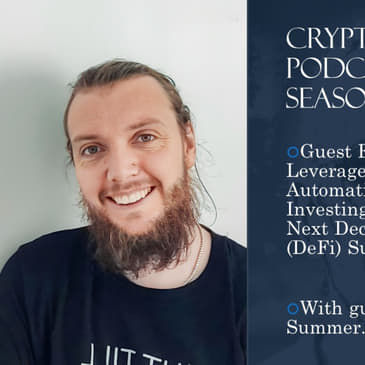

Chris Bradbury, chief executive officer of DeFi capital management protocol Summer.fi (ex Oasis.app). Chris is an experienced product lead, who is passionate about helping teams create products that users love and use everyday.
After graduating in Engineering, Chris started his career by working in various fintech companies and startups initially as a software developer and then product manager. He joined the Blockchain and DeFi space in 2018, when he took the role of product manager for Maker Foundation (MakerDAO), eventually becoming product lead for Oasis.app to create real usage for Dai and Maker Vaults. From June 2021, Chris became the CEO of Oazo Apps, the team behind Oasis.app, which is now a stand alone company aiming to become the most trusted place in DeFi to deploy and manage your capital.
Social media pages: https://www.linkedin.com/in/chris-bradbury-b7354246/?originalSubdomain=uk
https://twitter.com/chrisbducky
[00:00:00] Hello everybody and welcome to the Crypto Hipster podcast. This is your host Jamil Hasan, the Crypto Hipster, where I bring you founders, entrepreneurs, executives, thought leaders, artists, you name it all over the world in crypto and blockchain. And I have an amazing guest for you today. I always have amazing guests. I'm very fortunate that way. Today, he is the CEO of Summer Phi. His name is Chris Bradbury. Chris, welcome.
[00:00:29] Hi, yeah, thanks. Thanks for having me.
[00:00:32] Very welcome. Very welcome. So let's kick things off and ask you a first question is this is what is your background? And is it a logical background for what you're doing now?
[00:00:41] Yeah, sure. So I would like to think so. So I've been a product manager for probably eight almost eight years now before crypto. I was product manager in fintech kind of in startup and great companies. I did a little bit like software engineer for a little bit. But I like to think I'm a much better product manager from that point of view. And yeah, kind of the fintech track took me into crypto in 2018. I joined maker, maker DAO.
[00:01:11] As one of the first product managers in kind of mid 2018. And yeah, always kind of been focused on the kind of product management space for like user interfaces, the kind of consumer driven apps and so on. And yeah, kind of product manager all the way through the maker foundation until until the foundation dissolved into 21.
[00:01:30] And we took what was always this app at the time, which you know, which knew the front end front end interface of the maker DAO protocol. In June 21, we took that into a separate kind of external company that I was product lead for in the foundation. So I kind of just naturally fell into the kind of CEO role for it here. And then yeah, that rebranded into some of my last summer European summer. And yeah, takes us through today. So yeah, I think a logical background. I mean, I studied a lot of things.
[00:01:57] Yeah, I think a logical background. I mean, I studied aerospace engineering, which is a tiny bit of a tangent back in back in university. But yeah, sat behind a desk instead of stood on an aeroplane somewhere. But other than that, fairly, fairly logical, I think.
[00:02:14] Aerospace engineering is no easy field to study.
[00:02:18] So,
[00:02:20] yeah, I got a good friend who was it, who's it make it with me as well Kenton. He's kind of was doing sense until recently and so on as well. He was also a fellow aerospace engineer. So yeah, we always had, we always had to kind of like this this new aerospace connection inside make it back in the day.
[00:02:38] Got it. Yeah, so makers come under fire a little bit recently. So like with die maybe losing its peg I don't fully understand what's going on there. Maybe you could talk about that a little bit.
[00:02:52] Before we get into what summer fire is all about.
[00:02:55] Yeah, I mean, so like we do a lot more than make it just now. But I mean, I don't think that die is not not losing its peg. I think the issue is the amount of die being being pumped in against like kind of Athena collateral. So the kind of S USD and USD. I don't know what the numbers are at the moment, but I think it's scheduled to go up to about a billion dollars.
[00:03:16] Basically, kind of effectively die backing that or S USD and USD backing backing die. And there's, yeah, kind of a lot of different opinions on Twitter. Basically, whether it's a good idea, whether it's a bad idea, kind of how it actually works kind of what security die maker has in some ways against being able to like redeem the collateral for actual dollars to keep keep die back. Yeah, and then and then you've kind of got to the point where you've got to get the money back.
[00:03:46] Yeah, I think that's kind of what the kind of almost a semi in fighting in some ways between kind of like our very maker. It's kind of kind of half half existed for a little while. Really? But yeah, and obviously then that was kind of that was that that S USD and USD kind of stuff was kind of through spark and more foe as well.
[00:04:06] So I created this kind of like the three way, three way fight in some ways of maker maker spark and more from one side and I'll be or Mark on the other side saying saying it's a bad idea. I mean, personally, I think it's it's a great idea with like this kind of similar ish things done done in the past as well.
[00:04:26] I think the comparisons to the kind of lunar terror stuff are unfair on the USD side of things. And yeah, I mean, it's a great product for the users that know what they're doing. We've put on some of five the kind of one click yield loop as well. So you can kind of like between five x and 10 x in one transaction which is which has been super useful for our users in particular. And yeah, there's always a non zero chance it can blow up but in reality, I think that's I think it's closer to zero than than normal.
[00:04:56] And that's kind of what some people are making out on Twitter, at least.
[00:05:00] You said the magic word early on you said there are a lot of opinions on Twitter, a lot of opinions that are unqualified opinion so let's talk about qualifications.
[00:05:09] So what's that all about? And why should divide defy advocates trust your platform.
[00:05:19] Yeah, so so far yeah we're one of the leading kind of like kind of service layer interfaces really into into kind of what we like to think of as a trusted layer of defy.
[00:05:29] So we only curate the kind of like the best protocols.
[00:05:33] Really, so you'll see that on that maker you'll see spark you'll see Arjuna you'll see more for you'll see are they.
[00:05:39] So these are all protocols that everyone inside summer uses themselves so you won't see protocols on somebody that we wouldn't use ourselves is kind of the first layer.
[00:05:47] So if we wouldn't use it, it won't be on summer. That's the first thing we've got over $5 billion, I think, or maybe just under the current market movements and so on being managed through the summer fire interface.
[00:05:59] So yeah, there's a lot of people that trust us with a lot of dollars in there. We're one of the oldest front end interfaces into defy in reality so yeah we like the Oasis app brand launched in 2019 with the launch of MCD multi collateral die.
[00:06:16] But in reality yeah the same team was responsible for the single collateral die portal going back to like 2018.
[00:06:23] And so on. But, yeah, we've got some of the best automation tools available in defy keeping keeping a lot of people's bolts and stuff secure from that kind of trusted point of view.
[00:06:34] But most importantly, it's defy and it's entirely self custody, like custodial.
[00:06:39] Only you who own the private key can touch touch your assets and so on you're not trusting anyone else with them even the automation system is entirely self custody or you can enable automation you can turn off automation, no one else can do anything with that.
[00:06:53] If the conditions are right, it will be executed kind of simple as that really. But yeah, we've got a lot of users and a lot of money that trusts some of my end. Yeah, we only put protocols on there that we know and we trust.
[00:07:07] Sometimes, sometimes just described as an aggregator, but we kind of in my opinion stay away from that a little bit, but an aggregator is a sort like the sort of place that would bring everything available on the market in one place but yeah, we don't have that.
[00:07:20] So what we like to think is the users delegate their trust to us and we will pay them by kind of keeping keeping trusted protocols available in some of my
[00:07:30] Got it.
[00:07:31] Very cool.
[00:07:33] So, the current landscape of defy right what there's a lot of mixed opinion like earlier mixed opinions right. What do you believe the current global landscape of defy is and what's holding us back from achieving what we was possible.
[00:07:51] Yeah, so I mean, I mean if we start if we start kind of the second half really of like what's holding us back. I mean, I don't think there's a huge amount holding us back at the moment in reality, I mean we're still very very early in this, in this technology, there's a lot of value.
[00:08:04] And to be fair still a fairly high number of like kind of let's say early adopter users using using the technology, but that's kind of where we are still at the moment we're still at the early adopter stage.
[00:08:14] And we're still at the development stage as well of this early technology.
[00:08:18] And so on. I think it's been, it's been super interesting at the moment to see kind of some of the more recent developments kind of in defy as well particularly around kind of like the more focus on isolated markets.
[00:08:30] So kind of looking further away at the kind of like the maker that are the compound models where it kind of everything kind of was put into a single bucket and backs all the tokens where it was maker kind of all the varied collateral backing die, and all the die.
[00:08:44] But it was our very whether it was everything that was deposited was backing everything that was borrowed in reality and so on. So yeah, I mean going down this more like different model, trying to try to remove governance, I think that's been a pretty key focus more and more recently as well.
[00:08:59] Like, I think the Dow kind of idea like Dow governance is like it was a super interesting idea and stuff and I still think is a really good idea personally, but we can see protocols now trying to move away from that a little bit more.
[00:09:14] Uniswap is such a great example where they just deployed Uniswap v1 v2 v3 and it just runs like it's there, it runs, then there's no really nothing anyone can do about it.
[00:09:26] Obviously, the likes of maker and rv and compound have all got these big governance models behind them. They can be stopped or paused or shut down or whatever.
[00:09:36] And now you've got the kind of newer markets, the kind of argeness out there the completely permissionless markets and so on, like completely governance less.
[00:09:44] You've got the morphos now with the morpho blue protocol metamorpho volts which are like just permissionless pools effectively deployed by the volt curators and so on.
[00:09:56] But once they're deployed, they can't be changed and so on. You deploy it, you assign an oracle to it, you put your parameters in and that will live there now as kind of eternity in some ways.
[00:10:08] I think this is like, I think a really positive direction we're going in because we haven't had the tens of thousands of people governing a protocol correctly. We don't really have the experts.
[00:10:18] You see I think a lot like maker going through its endgame stuff, constantly trying to change governance in some ways there. I think Rune recently talked about how everybody shouldn't be trying to govern maker and so on.
[00:10:30] It should just be like kind of like almost selected people or select people or like a few experts in some ways.
[00:10:36] But yeah, but I don't think that's the thing that holds us back. I think in reality the thing that's holding us back or will hold us back until we really solve it is still the UX.
[00:10:46] The UX, the de-fi is heavily fragmented. Like liquidity is all over the place. Like stale collateral effectively is just all over the place. You see the amount of collateral and like old versions of compound and RV and so on.
[00:11:00] And it just isn't moving. And yeah, and that's something we're trying to solve for at Summerfy as well. It's like bring all of the top quality stuff together and make it incredibly easy eventually for users just to deposit and earn.
[00:11:13] Whether that's earning through multiply trading or anything like that, or just earning through passive LP strategies and so on.
[00:11:20] But long term adoption is not like every retail user moving their positions around every couple of days trying to get their extra one or two percent yield and so on.
[00:11:31] Or having to de-risk their position and increase it or move it from this protocol to this protocol because the borrowing rates have shot up.
[00:11:37] Like that isn't the future, but that is kind of where we're dominated today. And hopefully at Summerfy that's what we're solving for at the moment and trying every day to kind of fix that problem.
[00:11:48] And eventually yeah, I think we will want to plug de-fi into the wider kind of web2 world. I think we're already making advancements with that with the wallet, some of the wallet technology and so on.
[00:11:59] And some of the recent EIPs and stuff that are going through. But yeah, now we just kind of want to see really bigger and broader adoption I think from more and more people.
[00:12:15] Interesting. So that seems to be a theme.
[00:12:22] You said money not moving. It's not just in the DeFi space. There's money not moving most places, right?
[00:12:29] So there's some kind of hang up or some kind of something going on. What is that underlying thing going on and how do you solve it?
[00:12:42] You solve it I believe through UX and that's the thing that generally solves most industries and growth. I mean web2 is a huge UX really on top of web1.
[00:12:51] And so when you look at FinTech in the kind of 2012, 2013, 2014, you look at things like transfer wise, like adding such a clean and slick UX layer on top of FX transfers around the world and so on.
[00:13:04] Generally UX if you look back at even the social networks and so on, UX wins nine times out of ten. If you can massively improve the UX, if you can focus on UX and have a team of people focusing on the user experience regardless of what it is, whether it's money or payments or NFTs or whatever.
[00:13:23] If the UX makes it simple and easy where you don't even really have to think about what you're doing. And if in reality, if you look back and you don't even realize you were almost doing that thing, then it makes it so much easier.
[00:13:37] I mean if you just look at digital payments and stuff now even with banks, like you can go out for lunch now and just one person can pay and five people now can just send that person their share of the money instantly.
[00:13:48] Like you go back 20 years and so on. Like you've all had to go to the bank or you'd have to have the cash or you had to have change, make a bank transfer, a kiosk in a bank and so on.
[00:13:57] Like UX is so much smoother, so much simpler. And now like obviously this is the first kind of like banking digital first in a sense.
[00:14:07] We're not just putting a digital app on top of a very old 20, 30, 40 year old system. It's been designed and built digital first. And that creates a huge opportunity to create an even better and slick UX.
[00:14:21] And that's even shown from the self custody kind of side of it where you own your own money. And yeah, now we can just make that more powerful.
[00:14:33] Right now owning your own money like that, like as a drawback to the UX, like it's incredibly difficult with private keys and so on. But it gives us a huge opportunity to make it so much better than the future.
[00:14:47] I agree with that. I agree with most of what you said. There's one thing that you said in the past few minutes that I don't agree with. That should maybe I do. I don't know.
[00:14:57] We talked about Uniswap.
[00:14:59] Yeah, Uniswap is very good and no one can do anything about it. Right? However, last week the SEC sued the Uniswap, you know, calling security and trying to shut it down. So will the SEC be successful with that?
[00:15:15] I mean, I think it was just a well-smeared it's right to say they're going to take action rather than actually suing them at the moment. But that's just up, I think towards Uniswap Labs. So there is nothing the SEC can do.
[00:15:31] I mean, unless they want to take down every single ETH stake around the world and so on. They cannot shut down or stop the protocol running. They can take down the interface or force Uniswap Labs to take down the interface, for example, but they cannot take down the protocol that's running.
[00:15:48] They can't even buy all the Uniswap tokens to shut down the protocol because it doesn't have that option. So Uniswap protocol is going to run indefinitely as long as there are people staking Ethereum to verify and validate the network, the Uniswap protocol now will run indefinitely.
[00:16:05] There is no way to stop that. So, yeah, I mean, the SEC can take down the website. I mean, if they do, there's already hundreds of other ways you can access Uniswap protocol today already.
[00:16:20] And yeah, like the SEC doesn't have the power unfortunately to, well, fortunately probably to take down the Uniswap protocol. And yeah, it's not the protocol there. They served the world's notice too, right? It is the Labs team that run the user interface on top of the protocol at the moment, which today now several years after it's all been deployed, I've got two completely separate things.
[00:16:45] Sounds good to me. They can't do anything about it.
[00:16:47] They can't do anything about it. I like the sound of that. So institutions, you know, they're fighting, they're fighting like crazy to not have DeFi work. But, you know, what are the greatest benefits? So for them, what are the greatest benefits of using DeFi's Rails for institutions that are going down swinging?
[00:17:10] Yeah, so I think when we talk about institutions that don't want it, they're mainly the ones that are already controlling the kind of what's happening with the money anyway, right? So already it's the big banks and so on that are calling it out. In reality, I don't think we hear too often about institutions that are actually holding the money and trying to earn a decent yield on it.
[00:17:30] The thing that's holding back the institutions in reality, I think is just a very unclear kind of global regulation. There is not a single jurisdiction around the world that has a clear kind of policy on how to regulate access to any of this DeFi stuff really.
[00:17:48] Really? And none of these investment funds or institutions that have got tens of millions, hundreds of millions, maybe billions of dollars that may just want to put like 1% of it through DeFi for some of the solid yields that you can earn.
[00:18:00] No risk or compliance team is going to allow that for 95% of those institutions. However, we are perfectly set up to accept that capital and DeFi needs capital in order to run the other side of it.
[00:18:17] It relies on liquidity, it relies on LPs effectively to put that in and they're rewarded handsomely in kind of all cases for that. So from an institutions point of view, if it can be made safe, like if they can pass their kind of checks and some of those checks, obviously, they're going to be compliance checks and regulatory checks and so on.
[00:18:38] But also part of that is going to be knowing that they're not mixing funds with any dirty money and so on. Even though all we hear in the news is bank X has been fined for like laundering money or bank Y has been fined for helping like another government launder money and so on.
[00:18:51] Like there's this higher expectation in some ways that if they use crypto, they want to be able to do it, knowing that they're not going to mix it in with bad money.
[00:19:00] And that's also possible with the technology that we have as well and that we're building. Again, it's digital first. It's like you even look at kind of some of the privacy pool stuff that Vitalik and Ko have talked about and put out there, which is like a very high confidence that there is no bad money kind of in there.
[00:19:17] But we have the technology to be able to create like these rails to say, hey, if that's what you need, we can allow and create that access for you in reality. But the biggest blocker really for that is still the extremely unclear regulations.
[00:19:35] And that isn't going to really be solved with the likes of the kind of the bigger banks and someone constantly trying to block this innovation because they want that liquidity at the end of the day.
[00:19:47] They don't want to give up that liquidity and that money in those funds. But yeah, I think it's inevitable at some point. The question is when and not if really.
[00:20:00] But the technology is there for them to deploy it, manage it themselves, have more control over it than they do in any other probably kind of like white labeled management account that they have where they're still kind of sending huge sums over the phone and so on.
[00:20:14] The technology is there. We now just need to kind of move that little bit further forward. A little bit like companies adopting email in the early days.
[00:20:23] Like there's still a lot of faxes going around when email was 10 years old.
[00:20:29] And yeah, defy isn't yet 10 years old.
[00:20:34] I remember the I remember using the fast machine at work.
[00:20:39] Yeah, so you have what became so much easier. That's right.
[00:20:43] And then the regulation goes into what you said about fragmented markets and I can see that, you know, something that that I want to shift gears a little bit now towards defy users.
[00:20:58] Right. And that includes the regular user, which include traders or investors.
[00:21:03] Right. Something I've never used because I've been a long term holder only and I've never like been an active trader.
[00:21:11] It's not this concept of stop loss, right?
[00:21:16] I want to find out why is important to use stop loss when trading cryptocurrencies. And does that even make sense for somebody who is a long term buy and hold only investor?
[00:21:28] I mean, I think so. So we have we have stop loss on our trading strategies on summer.
[00:21:33] I'm a heavy user of stop loss.
[00:21:36] I got stop lost out, I think, Friday when the market when the market drops.
[00:21:41] And I spoke at length recently with with one of our product managers and user researchers about literally about how we both use automation strategies and so on.
[00:21:48] But yeah, I mean, I think things like stop loss is an incredibly powerful tool, like especially when combined with some of the other kind of like automation strategies that you can have as well.
[00:22:01] Like such as like automated take profit on the other end as well.
[00:22:05] But yeah, I mean, even even as a buy and hold.
[00:22:08] I mean, like when you look back to like 2021 and so on, like lots of people kind of rode that wave all the way up and then it kind of came crashing back down in 2022.
[00:22:19] The same in 2017, kind of January 2018, it then came crashing back down.
[00:22:23] And the whole hodl thing was was there.
[00:22:26] Was there. But in reality, like when you try and take the emotional, I kind of like I'm not selling sort of thing.
[00:22:32] I'm a believer in this. I'm a holder in this.
[00:22:35] But in reality, like you could have stopped lost out at like maybe 3000 or so.
[00:22:43] It fell all the way down to like say 1000 at some point, I think, in the midst of the FTX.
[00:22:48] So on and then it started raising now even if you didn't have the confidence to buy.
[00:22:52] I think it's very difficult to kind of buy at 1000, although everyone says like, oh, like I stacked my bags up further at like the all time lows or whatever.
[00:23:01] Or that kind of loads of 22.
[00:23:03] Like it's actually very difficult to do it when or to catch that bottom.
[00:23:07] At what point you catch the falling knife.
[00:23:09] I remember 2017 or 2018 in particular, like the buy the dip was like by the dip was everyone like Reddit or Twitter and so on.
[00:23:17] Everyone was still buying the dip, buying the dip and that and it just kept going down.
[00:23:21] It's so hard to catch that falling knife.
[00:23:24] But let's say it then went up to 1500 again and that it was like that kind of trending toward in 23.
[00:23:29] It was kind of it felt flat, but it was slowly trending up.
[00:23:32] If you had stopped lost out to you, say USD or USD stable coin like state like die or USDC or something at say 3K or even two and a half K.
[00:23:41] And you bought back in at one and a half K like you're winning at that point.
[00:23:46] Right. Like you stopped your losses. Let's say it went all the way down to 200 dollars.
[00:23:49] In reality, nobody really knows knew how low it was going to go or how long it was going to go low.
[00:23:55] But if you get stopped out then like particularly if at that point, let's say you bought in at 1500 and you get stopped out at 3000 because it went up to three and a half thousand.
[00:24:07] You're stopping out in profit.
[00:24:09] And that is that is that is like such the important thing there.
[00:24:13] If you want to buy it back in, you can buy in.
[00:24:15] And in fact, you can then like buying again at 1500 maybe it goes back up to where it is today at what is hovering around 3000.
[00:24:23] I think but now you've you've pretty much probably doubled your stack at that point because you kind of took the emotion.
[00:24:30] You took the emotion out of it in some ways to say I'm just a hold on just a holder.
[00:24:34] I'm not I'm never selling. I'm never selling. I'm just holding.
[00:24:39] But like emotion gets in the way of the head a lot and things like stop loss help take the emotion out of it.
[00:24:45] If you set your price, set your level like I personally probably have my stop loss set way too conservatively.
[00:24:51] It's always like I think I've been stopped off like three times this year already because like I always had the paranoia just of losing too much.
[00:25:00] So I often have to stop loss set around like between five and ten percent lower than where it currently is.
[00:25:05] If if I'm using summer and using the multiply features and so on.
[00:25:09] And that means like yeah, when there's a big dip on Friday, I get stopped out and get stopped out to die.
[00:25:15] But for example, I've already bought back in.
[00:25:17] But I've got more now from when I got stopped out on Friday because I bought back in at a lower price because the price did keep falling.
[00:25:25] It fell even further on Saturday.
[00:25:27] So I'm now in a position where I got more Ethan.
[00:25:29] I did do on Friday when I got stopped out.
[00:25:31] But had Saturday gone like worse and it would have fallen another 20 or 30 percent.
[00:25:37] I'd have still just been in dollars again at that point.
[00:25:40] And that's the power of stop loss.
[00:25:42] And the reverse of that is the power of take profit as well, which is again available.
[00:25:46] It's available on Summify where you can set the price you want to start taking profit and it will just slowly withdraw collateral from your wallet at regular set intervals that you choose.
[00:25:57] And it can take out either as collateral if you don't want the exposure to the market.
[00:26:01] Let's say you're at two and a half or three X and you don't and you want to take collateral out and kind of put it back at one X basically.
[00:26:08] Or more importantly, at least from my perspective, it can take it out in dollars.
[00:26:12] And if you're a say a two and a half X multiple exposure and say if the price only has to go up 40 percent for you to have 100 percent of your principal back in your wallet.
[00:26:23] While still having the same dollar amount exposed to the market the whole time.
[00:26:28] So like and again, we saw in 21 loads and loads of people like rode that wave up massively.
[00:26:33] Very few like took out anything in that time and actually ended up with less in 22 and starting 23 than they stopped then they bought in at 21.
[00:26:43] But if you had a stop loss or you had to take profit one you'd have taken profits out.
[00:26:48] And then once that market started to dip, you'd have closed closed for the profit as well.
[00:26:53] And then when the market started recovering again, it's super hot and really know when the markets recovering.
[00:26:58] But it gives you the opportunity to buy back in at that point.
[00:27:01] And you can still be a long term holder like in that regard.
[00:27:04] You can still be used with theory and you can still be used with DeFi and crypto.
[00:27:08] Like but like you're kind of like, OK, the market is dropping.
[00:27:12] There's no rational reason to keep holding on to this asset.
[00:27:15] Like if I don't need to and that's reality, you don't need to hold on to it.
[00:27:22] And yeah, like the smartest money is not holding it all the way down.
[00:27:26] Ultimately, right. The ones are kind of causing it to go down.
[00:27:30] And with things like automated stop loss and so on, like you can take that emotion out of it in some ways.
[00:27:36] Like, oh, I'm sure it's going to go back up.
[00:27:38] Like just set the tools where you're comfortable with even like trailing stop loss like we've got.
[00:27:43] Right. Like the market goes up, up and up and up and up.
[00:27:45] If it has a little dip, it gets you out.
[00:27:47] Maybe it carries on going up a little bit further when you lose some potential gains like that's hard and that's annoying.
[00:27:53] But actually, if it was to drop 25 or 30 percent, then you're then you're smiling at that point.
[00:28:00] And you can still have the entire intention of coming back in or you can go and deposit that that that die or USDC or USD backed like stable coin.
[00:28:09] Like you can go deposit that somewhere else into into defy and like on some of you can earn around 10 percent on on that.
[00:28:15] So you can still use defy. You can still be supported in the ecosystem.
[00:28:20] You can support the ecosystem without just holding ETH or Bitcoin or whatever.
[00:28:25] And there's other opportunities out there for when the market is going in the wrong direction.
[00:28:30] Basically.
[00:28:34] Very good.
[00:28:36] So I remember I was part of that wave in twenty twenty one that ruined everything up and then part of that wave that came crashing down.
[00:28:45] You know, yeah.
[00:28:48] And there are a couple during that time, there were a couple unnatural movements, you know, like a 60 percent drop a couple of times that really a lot of people out now.
[00:29:01] If I want to if I'm a user, I'm going to use some or five and I'm not an experienced user.
[00:29:06] Although I have defy cryptos right.
[00:29:09] And I wanted to stop loss and I want to take profit and I want to use your platform.
[00:29:15] How how can I do that?
[00:29:18] And how is the user experience set up?
[00:29:20] So it makes it simple like for somebody like me who's never done those two things before.
[00:29:25] How can they do that?
[00:29:27] Yeah, yeah. So I mean, if you just had to some of five, depending on what your use case is, you're presented with a table.
[00:29:33] The easiest case where you're asked if you want to borrow, multiply or earn, borrow and multiply are very similar products.
[00:29:41] Multiply just uses the borrowed funds to instantly buy by by more of the collateral asset and deposit into your vault so you can go from one X to three X in one transaction.
[00:29:50] For example, borrow is ultimately the way to do it manually.
[00:29:54] Or if you want to get liquidity from from somewhere else or you want to do a basis trade or something like that.
[00:29:59] So let's say you want to borrow.
[00:30:01] You've got a ton of it. You want to borrow die against that.
[00:30:03] Ethan, you want to swap that die to like USD and you want to stake that stake that for us, USD and kind of like whatever is the 15, 20, 30 percent funding rates and so on.
[00:30:14] That's on that at the moment.
[00:30:16] So you would do that to be borrow, borrow and multiply both have stop loss trailing stop losses as well available on Aave and Spark.
[00:30:24] We've got both of those going live very soon on Morpho Blue as well.
[00:30:28] We've got ordinary stop loss available on Maker.
[00:30:30] But again, if you come to Summify interface, you choose borrow or multiply and you will see the different the different automations available for the different tokens that can be supported as collateral.
[00:30:43] They're also available on Aave on L2s as well.
[00:30:47] So if you don't want to pay the gas fee, the insane gas fees at times on Ethereum layer one, you can you can optimism arbitra and base.
[00:30:54] They're all available in there as well.
[00:30:57] But yeah, once you've opened that position, you can be prompted to add a stop loss and then you can choose between a kind of regular stop loss, which is fixed.
[00:31:04] And now you choose the LTV to close that again or the trailing stop loss where you choose the kind of kind of drop amounts.
[00:31:12] If the price is going up and up and up and you set $100 at any point, if it then drops $100 to the max price, it's hit.
[00:31:19] It will then just stop you out regardless.
[00:31:22] And you can choose to collateral or to or to the debt token.
[00:31:25] So often the debt tokens are USDC or or die or USDT.
[00:31:30] But yeah, it is incredibly simple.
[00:31:32] It shows you all the numbers you need to you need to see.
[00:31:35] It shows you LTVs. It shows you kind of the dynamic price.
[00:31:38] And the reason it's a dynamic price, particularly for the ordinary stop loss is that you can go and adjust your position constantly.
[00:31:45] And if you adjust your position, that adjusts the stop loss price as well on there because the stop loss is a set like a like a loan to value because this isn't just holding assets on some of you're actually kind of getting either increased exposure or borrowing against them.
[00:31:59] But but yeah, it's incredibly easy.
[00:32:02] Our own products don't have stop loss.
[00:32:04] There's kind of no need for the stock losses on the products.
[00:32:08] But yeah, it works great on borrow and multiply.
[00:32:13] Great. Awesome. I'm going to check it out.
[00:32:16] I'm going to try it out and I'm not going to put all my money there to start off.
[00:32:20] They're going to learn. And I recommend people do that first.
[00:32:23] Right.
[00:32:25] So, so the everyday person right. How can the everyday person, you know, become a defy superhero.
[00:32:33] You know, what must they must they know how can they do that.
[00:32:37] Yeah, so, so at the moment, yeah, I mean, probably the easiest thing for an everyday person to do is just everyone likes to earn on their assets to be some of why we have a number of different options on the tab depending if you're holding ETH.
[00:32:51] If you don't want to be doing the whole trading and so on.
[00:32:53] There's a number of different options of ETH whether you just want to lend ETH in a very simple kind of liquidity pool, whether it's on Arginal or Morpho or something like that.
[00:33:01] Or we've got some slightly more advanced ones with in reality fairly low risk but there is still risk there.
[00:33:06] And that's things like the ETH yield loop.
[00:33:08] So at the moment you can earn about three and a half percent if you were to liquid stake your ETH.
[00:33:14] Do we someone like Lido or Rocketpool but actually you can earn around 12% at the moment if you want to yield loop that on something like Arve or Morpho or Spark, where you can get like maybe 10x exposure to the state to the state yield at the moment, which is kind of then
[00:33:34] get it out against the borrower rate of ETH.
[00:33:36] But at the moment I think kind of currently this week it's kind of averaging around 12%.
[00:33:40] I think the 90 day yield is around 8% or 9% I think so that so there's solid returns, but for everyday user that's just holding their assets it doesn't understand the concepts of kind of like price impact or slippage or how to calculate the kind of the borrower rates against the yield rates and so on.
[00:34:00] So earning is the simplest and easiest way to get started. And yeah, by the end of this quarter as well. We've got some big plans to make saving even simpler and even easier for the for the for the ordinary user and the users coming into DeFi for the very first time.
[00:34:17] So, yeah, stay tuned for that. Yeah, really exciting things happening on that side kind of launching on summer in the summer.
[00:34:27] I love it. I love it. And then since we're talking about summer, talking about I want to talk about DeFi summer.
[00:34:39] I love the first one, you know, and I'm like, when's the next one coming?
[00:34:46] Yeah, yeah. Well, that's yeah I mean it's the impossible question right but let's let's hope I mean, yeah, the markets, the markets have been pretty volatile this year we had a we had a nice little kind of run up at the end of end of last year.
[00:35:02] I mean it was it was summer in the southern hemisphere right when it when it started. So it's always summer somewhere, pretty much. But yeah, I mean, who knows where the markets are kind of going to go.
[00:35:14] That's the kind of impossibility. That's why we have the tools on our summer that we do, whether it's the markets going down or whether they're going up or they're going sideways.
[00:35:23] There's the tools on summer to help you like kind of make the most of your money in the safest possible way on there. But yeah, we're all hoping for another DeFi summer this year.
[00:35:37] Yeah, and yeah, northern hemisphere summertime hopefully right hopefully we don't have to wait until the end of end of the year again for any more things but I think it's going to be bumpy.
[00:35:46] There's some really cool stuff being built. There's some constantly constantly new things. Hopefully we see far fewer like kind of scams, and so on. Unfortunately, that's just part of the industry that we're in.
[00:35:57] But yeah, we'll see how it goes right.
[00:36:02] I'm hoping.
[00:36:05] I want to thank you very much for your time today. I really enjoy speaking with you and it's been a great conversation, and I do have one final question.
[00:36:14] And it's simple. It's how can people find out more information about you about summer if I happen to become customer or clients, or user platform.
[00:36:23] How can we do that.
[00:36:25] Yeah, I think just head to summer.fi.
[00:36:28] Yeah, that is the easiest way everything you need to know is on there through onboarding just like link offs to the knowledge base and so on helping you do whatever it is you're trying to do.
[00:36:38] Yeah, if you've got questions, either hit us up on Twitter or a discord or the links on the summer.fi website. And yeah, if you had discord I'm there in the public discord channels, regulate either either helping users out answering questions.
[00:36:53] Yeah, or just speculating wrongly normally on the price rising and falling. So yeah, but summer.fi is the main place you will find everything you need to get started.
[00:37:03] And yeah, we're always always always very grateful for feedback. So yeah, drop anything in the feedback channels that you have and anything that's not there that you want. Just let us know.
[00:37:13] Awesome. Thank you very much for your time today.
[00:37:16] Thank you.