
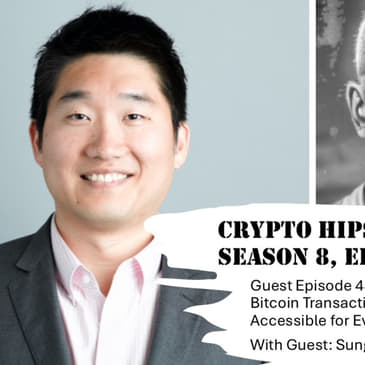

Sung Choi is the senior vice president of business development and operations at Coinme. He focuses on business development, strategy, and operations at Coinme, a leading cryptocurrency cash exchange in the U.S. with over 21,000 locations to convert cash into digital assets. At Coinme, Sung is focused on product strategy, operations and business development.
Before his work at Coinme, Sung worked in renewables, leading efforts to develop and finance wind and solar projects. Between the renewable energy industry and crypto, Sung also fulfilled a lifelong dream of owning a bar/restaurant. Sung holds a bachelor’s of science in aerospace engineering, a master’s in economics from the Georgia Institute of Technology, and a Juris Doctorate from Seattle University School of Law.
[00:00:03] Hello, everybody, and welcome to the Crypto Hipster Podcast. This is your host, Jamil Hasan, the Crypto Hipster, where I interview founders, entrepreneurs, executives, thought leaders, amazing people all over the world of blockchain and crypto.
[00:00:19] And today I have an amazing guest. He is the, let's see if I get this right, Senior Vice President of Operations and Business Development at Coinme. His name is Sung Choi. Sung, welcome to the show. Jamil, thanks for having me, and thanks for getting that right. It was so mouthful. You're very welcome. I'll make sure I get it right. So, glad to have you. Kicking off the new year. Happy New Year.
[00:00:48] And I look forward to speaking with you today. So. Me as well. Awesome. So, let's kick things off and ask you the first question I ask everybody. What is your background? And is it a logical background for what you're doing now? I think for most people in crypto, there really isn't any logical background in crypto. I have an undergraduate degree in aerospace engineering. I have a master's degree in economics. I have a law degree.
[00:01:14] I used to work in renewable energy. I've owned a restaurant slash bar for a little bit of a time. So, yeah, nothing I do probably makes sense to anyone. But especially in crypto, you're going to see all kinds of crazy backgrounds that all kind of come together and really works out for the industry. I agree. I agree. I've met a lot of really, really, really smart people. It's always a joy and a pleasure to speak to people who are a lot smarter than me.
[00:01:45] So, let's kick off first and ask you first, you know, what is Coin.me all about, including your role and your vision in that role and the vision for the company? Coin.me is a licensed and regulated provider of B2B2B exchange services. So, basically what that means is we have APIs that enable our partners to quickly build and integrate a native crypto product that they can offer from their own product or application.
[00:02:12] The experience looks native, but it leverages our backend solutions and crypto infrastructure. That includes our compliance program, our regulatory licensing, which then allows a very rapid way of standing up a very native feeling crypto solution. So, you know, a couple examples are Coinstar. You can go to a Coinstar kiosk and buy, sell and custody crypto, but that's using our infrastructure.
[00:02:41] MoneyGram is another example where you can do the same thing. We're about to launch a handful of Web3 providers as well that we're really excited about. And then at the end of the day, we also have our own B2C product that really focuses on cash services where you can buy, sell and custody crypto within the Coin.me app. That's like a partner product with what Coinstar offers. But that also allows us to experiment with some B2C services. Then we then offer those to our B2B customers.
[00:03:11] So, really the focus is a B2B solution that's really similar to banking as a service, but we call it crypto as a service. And then from there, you know, we then offer it across all the different Web3 and Web2 verticals. When I think of Coinstar, I think of taking a whole bunch of pennies and nickels from my jar and going over to the shopping shop and putting money and getting dollars and then taking those dollars and buying crypto.
[00:03:39] So, if I go to the supermarket, can I get crypto at the Coinstar machine or they specialize machines or is it all over? There's about, I want to say, like 6,000 or 8,000 machines somewhere in that range. It fluctuates based on which partners are live at any given point. And also, certain retailers haven't activated the feature yet. So, it's a lot of different machines all across the country.
[00:04:05] And you can take dollar bills and go buy crypto with it. The change part isn't active yet. Some of it's banking. Some of it's, you know, intercompany related for Coinstar. But really, you're able to do higher dollar value transactions, obviously, with dollar bills. So, that's the product that we have active today.
[00:04:31] And another product that I didn't mention is you can also turn crypto into physical cash at about 10,000 ATMs across the country. We work with a company called ReadyCode. And that's like a code-based system where you can generate a transaction within the CoinMe app.
[00:04:56] And some partners will start using this solution as well, where you can type in your code into an ATM and you get cash. And the fee is, I think, $2.50. It's $2.50. So, it's cheaper than a debit card withdrawal and just as convenient. Very good. Very good. Nice.
[00:05:16] So, I'm going to start with a basic question is, I found out the importance of crypto enabling physical and traditional financial service platforms. And how will that help with the mainstream adoption of crypto? And not just the U.S., but globally.
[00:05:37] On a high level, if you try to use – so, like on a high level, you have banks, credit unions, fintechs, traditional investment brokerage apps, things like that. Those types of applications can rapidly enable crypto. So, rather than having to go through years of licensing and putting together infrastructure, you can just go ahead and enable things very quickly.
[00:06:06] And similar to banking as a service, you'll see the chimes of the world that will never get their own banking license versus you'll – I think Aspiration was one that went and got their own banking license. Another one was SoFi. SoFi used to use a partner bank, and then, excuse me, they went ahead and got their own banking license. It just really depends on your business model. So, I think it allows you to scale quickly, similar to what fintech banks have been able to do.
[00:06:34] And then you're able to then go develop and grow into the business that you need to be or you want to be. So, that's one use case. And over on the Web3 side, even if you think about, let's say, you know, like if you're a retail company trying to sell NFTs or something, or if you want to be able to accept stablecoins as a payment, today's Web3 user experience feels to me a lot like early days of Web2,
[00:07:01] where, you know, like let's say you're using like one of the on-ramps, like you're transported from your user experience to an external on-ramp widget. And from there, you buy the crypto and it automatically gets sent back to your application and then you're kicked back. So, whether it's a DeFi app or whether it's, you know, an NFT app or whatever it might be, you have to go somewhere else to buy your crypto. So, and companies in that space have done an amazing job, right?
[00:07:29] Like PayPal did in the early 90s or late 90s, early 2000s. But it's still a bit of a jarring experience. And a lot of people might feel like, hey, like there's something wrong with this experience. I don't like the fact that you go from, you know, the Web3 app over to something different and come back. That's not ideal. So, what we're trying to enable is our partners so that they can offer a crypto native payments experience.
[00:07:54] So, whether it's a debit on-ramp or a bank transfer, you know, the similar payment methods that are popular in Web2. We want Web3 companies to have that same native experience. So, you know, you can have Apple Pay pay for your experience. You know, if you wanted to load up on your DeFi, you know, exchange of some kind, you wanted to buy an NFT, whatever it might be. We don't want you to have to be kicked over to a different application and then come back.
[00:08:21] We want you to remain in that native experience so that it feels like a Web2 transaction from start to finish. And that's really what our product can offer, you know, especially for Web3 companies that are smaller startups and don't want to go through the process of having to put together that payments infrastructure. infrastructure, which, like, I think a lot of people are surprised by how much regulation exists for crypto exchange. All the same infrastructure that was in place for all the major money transmitters like Western Union and MoneyGram.
[00:08:48] That entire regulatory regime came down over onto crypto exchange and custody and transfer. And so it's a massive amount of work, regulatory work that one has to get through to be able to offer these services. And then on top of that, to then add payment processing. And that's a major challenge all by itself, the payment processing piece. So it's like all these different layers make it super complex to be able to offer a native experience.
[00:09:13] And similar to what Stripe did, you know, in the late, like mid, like in the 2000s, kind of in general, to make payments really simple for startups. We're trying to do something similar for Web3 companies today. It's interesting because my brother-in-law is a CFA. He said he was talking to the hedge fund, a hedge fund guy last week. And he wants to know if crypto will be used for payments.
[00:09:40] And I'm like, you really have no idea, you know, do you? You know, of course it's used for payments. But the challenges that we had 10 years ago on payments are not the same challenges that we have today. But what are the challenges that we have today in payment processing? And how do you help make it easier for your partners with those payment processing capabilities?
[00:10:05] So I think an easy one is stable coins, where if you enable stable coins on your platform, then payments become instant, steep, and amazingly simple, right? And so we have anything from B2B partners that are enabling stable coin custody and payments within their solutions. So that, let's say, someone wants to send money to a friend or family member in Mexico.
[00:10:32] You know, that's a $60 billion a year mittens corridor. And it's a very expensive corridor. It just has remained that way. You know, it's anywhere between 5% and 8% of the entire amount remitted is collected as a fee, which seems crazy. But the fact that someone can now just buy stable coins and send it and incur next to no fees, you know, especially depending on what chain of USDC you might be using, might be zero fee at all, right?
[00:11:04] And really, the only fee you have to worry about is the on-ramp fee and off-ramp fee. But there's many solutions that will let you do that for very low cost as well. So I think the challenge is to put all those pieces together, and there's a lot of different Web3 apps that are doing exactly that. And we also offer the infrastructure to be able to do most of that legwork. So I think what we're going to find is challenger remittance companies in the next, you know, year or two that are really going to take over.
[00:11:31] Like, I think Bitso has taken over the vast majority of that early entry market. So I think I read that 10% of the U.S to Mexico corridor has been taken over by Bitso. But we're going to see some simpler applications, more designed towards, like, the non-tech-savvy folks. Because, you know, you think about an exchange, and generally you get younger and more tech-savvy individuals, and not like the, you know, like 60-year-old individuals who might not be as into the technology.
[00:12:01] Like, I think about, like, my parents and my father-in-law, people like that, where, like, if I tell them to go create a crypto wallet, they're not going to want to do that. But if it's just a wallet that, you know, is hidden in an application and it just works, they'll be happy to just make a payment, have it go to the right place. I agree with you. I'm 53, and I'm not wanting to learn how to use new wallets. I'm like, just use Coinbase. Yeah. Yeah. Yeah.
[00:12:30] Again, it's ease of use, right? So that's stablecoins, right? But people are using other cryptos for payments. Like, people want to use Bitcoin for payments. I don't know why you would. People use Litecoin for payments. People want to use Ethereum and others. So what's the trajectory of those cryptos in the payment network? Or is it only going to be eventually just stablecoins? What do you think?
[00:12:56] I mean, if you read the Bitcoin white paper, it is, you know, it was meant for payments. The way it's developed has changed that a bit because it's, you know, the block times are slower and it's expensive. And there's been better innovation in terms of the payments use case. But I think you're right. Like, you know, people still want to use Litecoin for payments. It's a really good use case for that asset. You know, XRP was designed for that. You know, there's a lot of different assets that are purpose-built for remittances.
[00:13:26] You know, I think it really just kind of depends on how a person looks at money, right? And the more Bitcoin becomes standardized and accepted as a stable form of, you know, storing money, then I think people will think of Bitcoin as the fixed value asset. And then everything else is inflating around it, right? So U.S. dollar, like if you look at it from a Bitcoin perspective, the U.S. dollar is inflating like crazy.
[00:13:55] It's not that Bitcoin is going up in price, right? It's that the U.S. dollar is inflating just because of how fiat money is generally designed is you build inflation into it where, you know, a lot of crypto tries to avoid that, right? And so I think that, you know, people will start switching their worldviews and you won't feel as bad about sending your asset that you expect to inflate. What you're doing is you're sending the stable asset and everything around it is inflating.
[00:14:25] Yeah. Yeah. So the Vanguard CEO came out, I think last over the weekend or last week and said Bitcoin is valueless because it has no cash flows. It's not stable and it causes havoc in our portfolios. And a lot of the Bitcoin people were like, no, that's so wrong. I'm like, she's right. He's actually right.
[00:14:52] You know, did you have an opinion on her perspective? It has no cash flows. It has no value. And it's causes havoc in the portfolio. If havoc means that it goes up hundreds of percent year over year, that's the kind of havoc that I want in my life. Yeah. So, you know, there's been that argument of, you know, Bitcoin has no inherent value and things like that. But if you think about the US dollar, there's a lot of very right.
[00:15:22] Like you, the dollar is valuable, not because it's gold back, which went away. And I think the 50s, the Bretton Woods system or whatever that was. Right. When the gold backing went away, it was just play money at that point. And it was worth about as much as people were willing to trust it. And Bitcoin is the same exact thing. Right. Except it's you don't even have to trust it. Like it's a trustless system that you can verify on your own.
[00:15:51] So, you know, I think, again, it's one of those people need to change their worldviews on what money is and actually understand what it looks like. Like gold, you could argue a similar. I mean, gold does have some inherent value in that it's used for, you know, manufacturing of things and, you know, conduction of electricity and jewelry and things like that. But ultimately, like if you think about it, like we placed value on the material because it was easy to exchange. Right.
[00:16:19] It's hard to manufacture more of. And it was easy enough to exchange, turn it into bars and be able to exchange with it. But I mean, Bitcoin at the end of the day is exactly that. It's easy to exchange. People trust it. People demand it. And that's money at the end of the day. So, you know, I think people have changed their minds at a pretty rapid rate over the last half a decade or so. And I think we'll see that accelerate even more over the next half a decade. Yeah, I see it really simple.
[00:16:50] You can either look at the world through Keynesian economics, which is fiat's great and nothing else is money. Or you can look at it from an Austrian perspective, which means the real money is Bitcoin and gold. You know, so it's just a simple choice. You know, OK, so mentioned Satoshi's vision. You know, Bitcoin has adapted to that store of value.
[00:17:15] Are we ever going to achieve Satoshi's vision as a peer-to-peer payment network? So, you know, there's some cool layer two Bitcoin technologies that have developed, you know, and like other chains, like people are working on other chains to essentially tokenize Bitcoin onto other assets as well. So I think it's possible.
[00:17:42] You know, I think it goes back to whether people are willing to change their worldview and actually transact with an asset that you expect to be inflating versus things are, sorry, you expect, you know, the cost to be going up, right? Or is it that everything else is inflating around it? You know, we'll see if that changes. You know, I personally also find it hard to sell my Bitcoin, right? Because I think it's a long-term asset.
[00:18:10] So anytime something's a long-term asset, I think people are unwilling to spend it as much. But we will, I'm sure, reach a point where it's more equilibrium, right? Where the halving comes to an end and the supply is fixed. And I think at that point, it's probably much easier to think of it that way. But the other part of this is I think Satoshi thought of Bitcoin a certain way. But I'm sure Satoshi also thought about the development of crypto assets in general, right?
[00:18:40] And that maybe he probably didn't think. Because at that time, I think there was a lot of experimentation around digital currencies. And so I'm sure there was a shared belief amongst a lot of those early founders of digital assets that, hey, you know, it might not be this one. But this is the right concept. And from here, we need to expand it and adapt to what, you know, the people want to utilize at that given moment, right? Right. And so I do think that that initial vision of digital assets serving this need, I think that's still very true.
[00:19:09] And then with some layer twos, it could still be something that happens. But sometimes it's difficult to stifle innovation, right? Where like some of these assets are purposely built for that peer-to-peer use case. Like it's cheaper, it's faster. It's, you know, and as long as those assets are trusted at that moment of transmission, I think people will likely be more willing to use that, like USDC as it is today.
[00:19:32] But I think the jury's still out whether over, you know, 20 and 50 years, whether, you know, Satoshi's vision will come to fruition. And they talked about Einstein and a lot of the stuff that he imagined and thought, like in the early 1900s, they were able to verify it as true in like the mid-1950s, right? Like I think we'll see some of that with Satoshi as well. I agree.
[00:20:00] So, you said two very interesting words there that I'm going to come back to after I ask my next question. I make sure I come back to them. But I want to find out, you know, you mentioned early on that you offer crypto as a service, right? What do you feel is the best way to monetize crypto services in Web3 platforms?
[00:20:21] So, the exchange of, you know, from fiat to crypto, that's always going to be, if you do it correctly, you know, within the confines of the regulatory, you know, all the regulations and laws that exist in the United States, that's going to be, there's always going to be a cost of doing that. And just, you know, regulatory adherence cost money. It is what it is. You know, compliance programs cost money. KYC and AML cost money. Like all those things cost money.
[00:20:49] And so, a user will have to pay money to go from one asset to another. And then if you want convenient payment processing, which most people, you know, on the web want that, that costs money as well. And none of this is Web3 based. All of this is just the regular Web2 world that's already been put in place, right? And so, for an application, I think there's two functions. One is because something costs money, like there's generally a margin.
[00:21:16] And as a startup, you can have a bit of that margin, right? Like we run our company on that margin. And obviously, it's a commodity business and we're trying to lower the cost. But, you know, and it's a race to the bottom when it comes to these things across industries like ours. But ultimately, there will always be some margin on the otherwise, you know, why is a company like us a business, right? And so, there's a bit of that margin that we're always happy to share with our partners. So, I think as a Web3 company, you know, there's a revenue opportunity.
[00:21:46] But on the other side of this is it's that native user experience that you can enable that can allow your users to have a very simple experience. A lot of Web3 products are very complex. Like I used to joke and I kind of still joke about this today. But most of the DeFi applications that I've, you know, put money into and try to invest into, you know, I don't know if I'm making money or not, right?
[00:22:12] Like I have to exit out of all of my positions, turn it back into fiat and see if, right? Like there's a lot of like calculations that are very difficult. And so, like that kind of complexity will keep a lot of everyday users from being able to take advantage of it. And I think when you can make fiat on ramps native, that's one less piece of complexity that you can abstract away. And then march towards building very native feeling experiences, like Web2 feeling experiences that are available on Web3.
[00:22:42] Because I think about, like I saw, like I've seen a lot of cool applications that are being developed for Web3, including like, you know, things that will let creators publish their art. And then allow them for derivative work to be built on top of it. And the initial creator then gets to earn, you know, royalties from all this. But for the people that are buying this art, like if you have to do it by going and buying stable coins on an exchange, coming back and paying for it, like that makes it really difficult.
[00:23:12] We have a partner that is going through a beta test where they've launched a debit card tied to a very major crypto wallet. And if you, you know, like you get an Apple Pay or Google Pay debit card, right now there's only one, like very, like not yet fully supported chain of USDC that is available for beta testing.
[00:23:38] And so just to go buy that version of USDC, I had to go through, you know, like a bridge. I had to go buy USDC on base and go through a bridge and get the right kind of USDC, send that to my correct wallet and then be able to spend it. Like all of this is really difficult. And really what we're here offering is an ability to take away that complexity so that you can now use this Web3 product in a much more native fashion.
[00:24:05] So I think that's really the huge opportunity for companies to be able to just create such a native, normal feeling experience that they might not even know that, you know, they're using a Web3 product. And I think that's, that's the dream, right? Like in the late nineties, early two thousands, like every company branded themselves as an internet company. And it was super important that you're an internet company or a.com. But today, if you tell someone you're an internet company, they'll look at you funny, right?
[00:24:31] Like if you talk to a Gen Z person and ask them like, like, what do you think about this internet company? Like, what's like, are you talking about like an ISP, right? Because you have to be an internet company. And I think in the very near future, every company is going to be a Web3 company. You'll just never know, right? You'll never, never know what that even means. You'll never know what the underlying piping looks like because it's just baked into everything.
[00:24:55] And I think to be able to get there, you have to be able to make the transfer between fiat to crypto so seamless that you'll, you never notice that's even happening. I agree. I agree. So remove the complexity and make it seem like they're not using blockchain at all. Exactly. That sounds good. So we'll go back to those two words you said. You said stifle and innovation.
[00:25:23] We've just had a regime that's ending next week in the U.S. Biden presidency with Gary Gensler as SEC chief. It did a lot of work to stifle innovation in the U.S., right? Now we seem like we're going to have a more crypto positive, crypto friendly administration with the second Trump administration. How do you see that barrier of stifling innovation being removed? Or what's the future of the innovation in the U.S.?
[00:25:52] What opportunities do you think will now exist that were being stifled the last four years? It's been really unfortunate that the regulation of an industry has become so politicized. Because, and I'm sure a lot of, like everyone in the industry will agree, like it never should have been politicized. And it never should have been a political issue. Like it just, it never should have been. But the fact that it happened that way, just really unfortunate.
[00:26:22] I think it opens up a lot of opportunities. It kind of reminds you of back more like 2017, where, you know, you remember kind of the ICO boom. And there's so much that happened around that, where we saw some interesting innovation come out and a lot of interesting use cases come out. The timing of that, you know, that market wasn't great because we had the bear market, right? Like right around late 2017, early 2018. But there were so many innovative companies coming out.
[00:26:52] But also a lot of, you know, some not so great companies that took advantage of some folks. So, you know, like regulation is important. But smart regulation is what we need. And my hope is that in the next four years, we're going to be able to find some smart regulation. But it still allows for innovation to happen. You know, as a company that's under all kinds of scrutiny by the states, we know that's not going to go away.
[00:27:17] You know, we have state regulators that, you know, want to protect the interests of their constituents. And we definitely understand that, right? You know, it costs a lot of money and a lot of effort, a lot of time to adhere to those regulations. And there's exams and there's, you know, all kinds of things that the states put on us. But ultimately, we know that like some of this is necessary to protect consumer interests.
[00:27:42] But ultimately, like you don't want a government saying you can't conduct this or you can't go forward with this innovation because we don't understand it. And basically, I think that's what it boiled down to is they didn't understand how this was going to help consumers. And maybe today it's not as helpful as you might think. But hey, in, you know, 12 months and 18 months, as there's adoption and as there's growth, like we've seen a lot of really major innovations happen in the crypto space.
[00:28:10] I mean, if you would have told me, you know, back in 2017 that stable coins was going to take stable coins were going to take over as they have today. And, you know, I think in 12 months, we're going to see stable coins becoming a very common thing amongst all Americans. You know, like most people wouldn't have believed you. Right. But it's been a very short journey to get to here. And I think it's going to be a much shorter journey to get to the next phase.
[00:28:33] And I don't I think the journey would have been much more arduous had it been still a political issue that, you know, had carried over from the previous administration. So I'm really glad about that. And I'm really looking forward to innovation allowing to be had and to occur within this industry. Got it. Yeah, that makes sense. So you did briefly mention that you still are still hurdles at the local level.
[00:29:02] Right. So these ATMs you have, you know, the risks, you know, the risk of using Bitcoin ATMs or other crypto ATMs at the local level. What do you still work on on how to on mitigating those risks? How do you how do you do it and what needs to continue to occur? So, you know, local regulations and generally there's state level. There's very, very, very little outside of the state level regulations.
[00:29:33] Regulators have, you know, a mandate from from their constituents. And depending on, you know, how businesses are being run, they might have to put on more regulations. Like in the early days of of of this industry, there are a lot of less than reputable Bitcoin ATM companies, which have largely gone away. The most of the remaining companies are larger enterprises that do a great job.
[00:29:59] But because of those some of those early players that weren't doing such a great job, there have been you know, there's been a stigma for the industry a bit. So, you know, we've worked hard to change that, especially with regulators and showing them what we do to help protect consumers. Just like any money transmission platform, especially ones that use cash. You know, you think about Western Union, MoneyGram, even gift card companies. There's always a lot of fraud that happens.
[00:30:29] There's always people that are trying to get someone else's money. And, you know, some of the common scams are romance scams and law enforcement impersonation scams and stuff like that, where, you know, someone will call you and convince you that there's some kind of law enforcement. Now you have to go deposit money into a machine and stuff like that. Yeah. And, you know, we're using all the technology available to us to implement and make sure that a person can't do that. We also give plenty of warning screens on screen.
[00:30:59] But these, you know, criminals do a very good job of impersonating and convincing, you know, more vulnerable individuals. Like, you know, there's elder-based scams and, you know, some people that might not, like, might have some emotional or mental, you know, instability. You know, those people are generally the ones that are targeted and attacked.
[00:31:23] And so, you know, the local regulatory bodies, they want to make sure that these people are protected. And that places regulatory burden on them. And that translates to regulatory burden on us. You know, similar things happen with wallets as well. So, like, it's not just even a cash crypto thing. It's just money transmission in general. Anytime money is involved, there's always scammers. There's always criminals that are trying to get someone else's money. And so we try to protect against, you know, those individuals.
[00:31:52] We work with the regulators. We work with law enforcement to, you know, understand the latest scams. We also communicate to them the latest scams that we're seeing. And then we work together to create, you know, to make sure that laws that are being implemented are the ones that should get implemented. So, like, for example, our first money transmission license was back from 2014. And that was with the state of Washington. A lot of states have their own money transmission licensing. So, you know, we go state by state, do an analysis and see which ones we need.
[00:32:22] Kind of, you know, like we think of like, you know, the United States is one country, but it's also 50 countries. Right. And each country has its own different regulatory bodies and regimes and everything else. And so we work with different states. Washington state having been the first one, we work with the regulators in Washington state to actually create virtual currency licensing, which is still in place today.
[00:32:43] And the Washington state regulators were very forward thinking about this new innovation and that, you know, there should be like this is an industry to help grow and monitor and to then help protect consumers. So it wasn't just a narrow, we're going to protect consumers. So you can't do have any innovation. It was, hey, like this innovation looks like something that could be great and like might be necessary.
[00:33:06] So we're going to help foster it and then work with the company and understand more about the industry because ultimately, you know, regulators and state legislators or even national legislators. But, you know, legislators need to understand what's happening so that they could create laws around it. Right. And, you know, Washington state has done a great job. There's many other states that have done a really great job. So some states, you know, have taken not such a great view on things.
[00:33:34] And obviously our federal government has taken not such a great view on things in the past. So it's a work in progress. But, you know, it keeps our lives interesting. Let's put it that way. Yeah, I agree. Sounds good to me. So I want to thank you very much for your time today. I enjoyed speaking with you. This has been a wonderful conversation. I have one last question and it's easy. How can people find out more information about you, about Coin.me? How can they become customers? How can they do that?
[00:34:04] So if you for the B2B2C product, the cryptos of service, if you can go to coinme.com slash enterprise, you can find out more. I'm available on LinkedIn. That's probably the easiest place to reach me. Just Sung Choi on LinkedIn. And obviously I work for Coin.me. So if you just say Sung Choi or Sung Choi Coin.me, I'm probably one of the first ones to pop up. Awesome. Thank you very much for your time today. Samil, thanks for having me. Really appreciate it.