
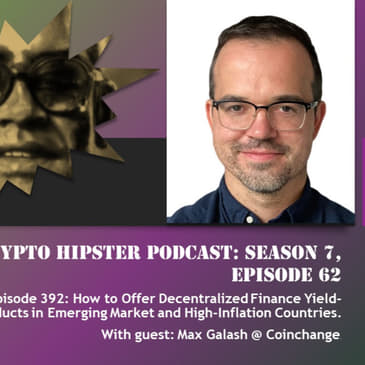

Max Galash is a serial entrepreneur, investor and advisor with over ten years of experience building technology companies in FinTech, Blockchain and IT services. Max is currently CEO of the fast-growing DeFi platform CoinChange Financials, and a Board Member at: https://wattum.io/, https://flyshot.io/, http://boxc.com/, and https://itmhouse.com/.
Prior to his current roles, Maxim was Partner at venture capital firm BGS Ventures for 4 years. He was responsible for many early stage investment success stories at BGS Ventures, including https://strateos.com.
In the early part of his career, Max worked as a business consultant, software developer and portfolio manager. His educational background includes a BAS in Electrical and Computer Engineering from University of Toronto and Master of Business from PowerMBA.
[00:00:01] Hello everybody and welcome to the Crypto Hipster podcast. This is your host, Jimi Al-Hassan, Crypto Hipster, where I interview founders on to ProNores, executives, thought leaders, amazing people, guests from all over the world in crypto and blockchain.
[00:00:15] And today I have an amazing guest coming to us from country to the north, in the US, he's a candidate. I welcome the CEO of Coinchange Max Galash, Max Walton to the show. Thanks Jamil for having me appreciated.
[00:00:32] You're very welcome. So let's kick things off and we ask you first, what's your background? And is it a logical background for what you're doing now? I think logical background is overrated. I am originally from Belarus, born there. But I've been in Canada for the last 25 years.
[00:00:56] I did my electrical and computer engineering degree here at the University of Toronto. Since then, I had a software development agency that's still around, cold ITM.
[00:01:07] It's been almost 15 years right now. The service and different type of clients is still sitting on the board and the collect my dividends to my duty on the board. But not active on the operational level. I had a venture fund called BDS Ventures.
[00:01:22] It was a pre-c timeline or fund out of Cayman. And it was we ran it for about four years into 7 and 11 to 7 and 15. After that, I transitioned towards the interpriniership myself. So came back to the service agency and we started building various types of startups and products
[00:01:44] and taken them to market. So I sold one, I had a one-exit and couple of them did fail. And as my latest venture is Coinschenge. We've been doing it for about four years right now. Started at 2020 as an idea and took it to market somewhere 2021.
[00:02:00] We've been servicing clients for the last few years. And two weeks it's going to be three years in the market. So that's pretty much my journey. I don't know how well am I set up for crypto business but I've been buying Bitcoin and ethers since 2017.
[00:02:16] I do hold some other tokens as well, not investment advice. But yeah, I've been buying for a while for probably the last seven years and I've been building crypto for the last four years. And engineering background helps. Yeah sounds good.
[00:02:35] I won't give investment advice either but all my everything on my screen is red today. So you know, find out, you know the ups and downs of crypto right? That's right. That's right. I'm still in balls to be in the industry this days. Going from 16 to 60.
[00:02:53] Everywhere in between sound. Yeah. So Coinschenge. What's it all about? Sorry, sorry, Jamil. That's it. How do you revolutionize digital currency exchanging? I know it's a little bit more than that. We're not really focused on exchange business.
[00:03:15] Coinschenge started initially as a competitor to sales use block five, Voyageor and many many other famous names that we still love or hate, you know, mostly hate, I guess. But the last few years, there was a lot of trauma to the market because a lot of those bankruptcies.
[00:03:33] But we did a competitor to sell sales use pretty much building a brokerage business license brokerage business. When you can have a custody of your assets on the platform, you can swap between different crypto assets and you can have a
[00:03:44] Fiat accounts, so move money in and out through your banking system. The purchase like an on and off ground into the crypto world. We do it. We did have an earned account, so earned account was not a lending business.
[00:03:56] We didn't participate in any of the lending activity that was very, very popular those days. We built up our own yield farm strategies. So everything on chains, smart contract driven and data driven was pretty simple at the very early days.
[00:04:10] So in 2021 we started building data was a pretty much a smart order router to find the better pull, to allocate the liquidity. Obviously in the last four years, the system has really been asked right now.
[00:04:23] It has quantitative systematic ways to find yield to use re-staking using liquid lending, using a concentrated liquidity provisioning. An old types of native blockchain mechanics to generate rewards and returns on participation on those different decentralized applications.
[00:04:44] So more than that, I mean this is the earned business that's a core of our platform. But we do have a card gift card off-rent business as well. We do have an on and off-rent business and all those three products are offered under the Co-Intention
[00:04:58] Browet directly to business customers as well as the white label to our distributors, B2B to seek customers that embed those products into their apps and allow their end clients to do those to have those features available.
[00:05:13] So more like an B2B platform as well as the infrastructure play as an extension to that. Competitor to Celsius. Yeah, but it's changed since then. I mean that was the after FTX we did a hard pivot towards the infrastructure.
[00:05:29] So if you're going to go to the Co-Intention website right now, you'll see everything about the API, you know, sandbox integration guides. So we work with FinTechs right work was wallets exchanges.
[00:05:43] Pro new banks and payment providers, so they can integrate let's say our earned account of their application, so that they have pulled any stable coins there, climb their end clients will be able to tap and earn on those deposits.
[00:05:56] So we don't really phase the client directly with face it through our wallet. That's our partner will face it through an exchange itself partner will face it through a payment platform for this out partner. Right, so we work with the businesses.
[00:06:08] They can have a direct business account with us and use their balance sheet to earn or do the not do the trades on an offer and for use the gift cards, but they can also integrate all those products into their application to offer to their end clients.
[00:06:20] And everything is revenue share driven. So we don't charge them for the products. They earn with us. So we'll call it not sale of the partnerships. Got it. So that's why you're still standing in Celsius block by and others are not because it did it directly.
[00:06:37] Yeah, we didn't really participate in the lending. I think the major problem was the shadow banking component when the lender decline assets from their balance sheet to traders, miners and whoever else.
[00:06:47] Right, and obviously not a lot of controls and very high high for high speed market and the flash crashes and everything.
[00:06:57] So we'll look at it a lot of those positions. So definitely a trickle dot effect right we've never participated in that we only used yield farming mechanics and yield farming decentralized world was stable. Even when FTX happened a lot of liquidity was upsetting the market through dexes.
[00:07:12] So and it's for one of them more to be more rigid right now with a restaking and obviously liquid state like like. Yeah, again, that's taking restaking. So I want to find out how you guys optimize defying an aggregation and make it friendly because I'm telling you.
[00:07:31] I used to go into the yield farming chat rooms and like I was like, I was looking at how it glyphics. Yeah, it's another world.
[00:07:40] I mean, it's that's kind of a big question right. How do you make defy accessible to all how do you really decentralize and make products very user friendly? And I think the combination of C5 and D5 will solve that. So like we're C, D5 player.
[00:07:55] So we do have cost a year of your assets right when you when you deposit into our system but we use defy mechanics to generate yield and for our partners let's say exchanges they see it through everything.
[00:08:07] So they have the full visibility on chain onto their assets, but they have very limited control. So it's not a protocol they cannot pull the assets out and they cannot deposit directly.
[00:08:19] It happens through an aggregated basis, pull basis with our operations team but they see it through all their assets. They can have a separately managed world specifically private, old dedicated for them where they see all the assets and all that funds flow,
[00:08:33] where the money is which pulls are used and all which tokens they hold, which stake in a restaking or lending protocols are involved. They contract through all the funds and they can have all the balances visible to them.
[00:08:44] So that makes a big difference because there is a lot of trust because they can see everything on chain. Even though they can't control this deal of a counterpart risk with us, they can control those assets but they can at least validate for themselves whatever been told.
[00:08:59] And so it's kind of a big big difference. I like that word you used. I use it all the time it's called vault. Yeah, a lot of. They are not using a vault.
[00:09:15] They're actually holding a position for a few seconds and trading them and trading them and memes and sometimes they make money and a lot of them lose. You know, I call a volatility but what are the benefits people should know about using vaults?
[00:09:34] For my perspective, vault is a combination of different strategies. So think about as a portfolio. Vault is a portfolio, right? And strategy is something that will utilize the assets to generate certain returns. Can be a lending borrow in sequence.
[00:09:53] So let's say on how it can be concentrated liquid it's a provisioning and uniswap. Can be stake and restaking can be flash loans. So there's different strategies and those strategies could be either executed manually by a trader or can be executed programmatically by a smart contract.
[00:10:12] Our is our executed programmatically by the smart contracts based on the data signals. So data signals, very much data is, A signal is a based on math, right?
[00:10:23] And data is something that you get from the notes directly and analyze where a third party vendor like Dune and analyze the data aggregated and provide a signal to the smart contract to execute. So our execution is cross chain, so chain agnostic.
[00:10:38] It's across many of any protocols and it has automated resmanagement until that. Yeah, so when you can win down the positions, you can exit the position when it's required. You can full stop the strategy. So vault is a combination of those strategies and some of them work independently.
[00:11:00] So once a strategy can depend on the other. So it's a way to have a unified access to certain rewards system through one vote. You don't really have to jump through all the hopes yourself and gives you the unified access to certain reward systems. And that's it.
[00:11:19] Very simple. That was good though. Everything sounds good and looks going on paper, right? Yeah, you should try before you know it. What doesn't look good on paper is I don't know if you will hear what did you come in the crypto to 17 17.
[00:11:39] Okay, I was trading in 2019 and during that summer, I don't know people remember this or not a lot of liquidity dried up. So you know when the could even crypto drives up it goes to zero and then it doesn't come back.
[00:11:54] Yeah, some that's driven by just by slow market and sometimes it's driven by highly volatile inflation. You know, I think you make it so that people can earn despite different, you know, despite drier liquidity or highly volatile inflation.
[00:12:13] Why is the down market not the death now that it used to be. Listen, I'll address your question from. From another angle, we work primarily solely on the image markets right now. That's where the need is for stable coin let's say stable coin yield products.
[00:12:37] People have a lot of stable coins people don't trust their government, their banks. They don't want to preserve value in their local currency so this stack up stable coins.
[00:12:47] Right off and that even have an access to USD account in the bank and most of those dirt and why do a lot of those jurisdictions.
[00:12:54] So they'll buy stutter primarily in the emerging market see what you see is not really yet that popular so and then they'll look for ways to generate some dividends and returns on on that preserved value because usually it's other is either use for international payments.
[00:13:10] But, Argentina to buy you name it or to preserve value on your balance sheet or your own your family. So we work again with wallets exchanges payment service providers to give them an ability to offer an order product of their clients and this is older merchant markets.
[00:13:29] So we are we're in Eastern Europe we are in North Africa we are in Asia we are in Latam a lot in Latam because there's a need. There's a need for earnings and dividends returns on a daily basis principle protected through other or use DC staking.
[00:13:48] Not staking but call it yield farming staking whatever the easiest terminology is based on jurisdiction again, I mean they also change it by the way how you probably call it some of them just call it earn some of them pull it yields farming volt.
[00:14:00] Some of them will name it as a daily variable interest account you know depending on the jurisdiction and the licensing but the partner has they can have different naming conventions for the same product that we offer.
[00:14:10] But at the essence of that as you know it's yield farming strategies on chain.
[00:14:15] So the emerging markets is a big play there's a clear need I think in the US first of all you cannot offer any of the yield farming products right now because the SEC there's no way to register or to get.
[00:14:29] The only option is to operate through a fund structure right so and to institutional type of investors that's what not that's not something that we do. Even though we have a.
[00:14:40] Fund management business as well out of the broader called block capital but this is a separate conversation work. We're primarily focusing at the size business where folks on the emerging markets.
[00:14:50] In fact, it's been tax and their and retail clients so in the fund you cannot service any and retail clients.
[00:14:57] In the US I don't think there is a much on Canada or in the Western world there is not much of a need to have our product because there is not. I don't think there is enough upside because we try to keep those.
[00:15:12] I don't think there is enough upside because there is enough upside because there is no market risk. So the average return on stable coins right now will be around 11 to 12 percent while you know a good dividend stock and pay you eight.
[00:15:26] Or a good real estate mortgage can give you 10, 1, 12. So there is not really a risk return profile to participate in any defy products for a retail client or institutional in client I would say in the Canada US Western world market.
[00:15:41] While in the emergent markets the retail don't have access to that top of wallfrucks in the USD denominated products and their local currency is highly inflationary and they don't have access to the banks.
[00:15:55] But the long access to the USD accounts and the banks or USD method products and the banks quite often.
[00:16:00] So that's I think decisive factor for us at least choosing SMBs so one tail clients emergent markets for the earn product and we have a gift card product as I mentioned so that will enable when wallet will integrate our gift card aggregation product they'll enable their and clients to buy gift cards for crypto globally.
[00:16:22] So if you are a ledger client, cake wallet client you will be able to all fram your salana into a Walmart gift card was no key YC.
[00:16:34] Because gift cards don't require any key YC it's a privacy first product you can buy that a guest stage without showing your ID so there is a global offram the major value proposition on that product as minimal to no key YC right very very simple.
[00:16:51] Payment mechanics so it's a paper mesh like I give credit pay out.
[00:16:55] I can send it to you as well buy it from my cake wallet I can send it to you right and jimmy will get a bling by email and put it on his apple pay and can use it anywhere the anywhere let's say Walmart Starbucks or visa visa voucher because there's also visa gift cards are accepted.
[00:17:11] So that product will also offer to wallets exchanges and payment providers but there is a different angle to that it's not generating returns on your ID alas.
[00:17:20] It's like stablecoins on Ethereum but it is for payouts and all fram your crypto in a privacy first environment to yourself or to a third party by an emailing the link.
[00:17:33] And all mechanics is integrated against running PI and very simple fast integration without them built necessary to build up all those connectivity to the issue in banks for visa but they aggregateers to the wallmark and Starbucks over the world there's 3,000 brands.
[00:17:50] So that's another product that would take to the emergent markets as well and to the same I see piece that we have. And I know I've interviewed hundreds of people and most people have focused on the on ramps. And you just created a way for massive off ramp.
[00:18:13] Yeah. Yeah. What's that? I'm just starting to think of the potentials as dynamical right what what are the opportunities that are going to derive from that and how is that going to help make rewards. Points with supposed to be in the one which hasn't been so far.
[00:18:35] A viable of. Turing extra in our business in crypto. I'll touch upon again from another angle a little bit we do have an on ramp business as well because we have some.
[00:18:52] Authorizations into U.S. we're able to get the direct bank and relationships and we can facilitate on a null fram through direct bank and rails that we have.
[00:19:02] That's offered directly to business clients through our launching application so they can have a U.S. the account on that by Bitcoin transfer it. On USD through a Swift or ACH into a coin exchange account by Tether or U.S. DC and transfer it.
[00:19:17] And there is also all ramps the same matter we have set by Europe we have Swift globally and we have ACH in US.
[00:19:25] Those features are as well right now than available through an API so for an event act like a wallet exchange or a payment provider to integrate into their ecosystem.
[00:19:36] As well, so it's not only gift cards is not only earned product it's also on a null fram business product that we have.
[00:19:43] How does the I think the theorem is a great ecosystem there's a lot of innovation I bad long term and ether it's like a new A to will use for the world you know a lot of people.
[00:19:53] And a lot of people have built on top of that and using the stack and as the case there's a lot of cool L2s that are coming up and definitely EVM is kind of the major holder of the value of the other. Of their ecosystem.
[00:20:10] I think Bitcoin is trying to catch up there's a lot of innovation happening right now all of money been put in as well in the L2s they're building like Bitcoin we're taking Bitcoin payments Bitcoin money obviously we're spending those light name.
[00:20:22] Bitcoin is trying to reinvete itself from the store of the value to more of the as well server infrastructure and the ecosystem of the development developed for first environment.
[00:20:33] So I think it's great for both you know I don't really not do I'm not the one that has a hard line I hold both and like both but we again we at the the de-fice side of our earned business we only built on the EVM compatible.
[00:20:47] And I think it's a lot of things right now so if you we don't touch let's say Bitcoin block Bitcoin blockchain or even. Torn blockchain that's also pretty popular right now telegram blockchain.
[00:21:00] It is it's like in the top somewhere around the world time this like in the top five of uses so yeah. I don't use it I used telegram but not a lot.
[00:21:11] But you said a few interesting things there you said that some things are being built on Bitcoin like the like you know the. Staking restaking on Bitcoin. I want to find out what's been the effect on on big of you know on the miners of Bitcoin's latest having.
[00:21:31] And what do you think this impact will cause downstream to aggregation of various. Defi layers and protocols that are not built on Bitcoin. Yeah I think I think Bitcoin holding has two major effects of first of all it's.
[00:21:50] Miners are starting to look for cheaper energy source and for more efficient equipment. So that's number one number two I think they're starting to look for secondary ways to generate yield and returns on the Bitcoin that they have on their balance sheet so this is the Bitcoin.
[00:22:07] Ealts farming and Bitcoin Larry tools that have been right now coming up to market. So I think they're going to have an influx of those what it's you because the miners are forced to look for an extra income to keep their PNL intact you know.
[00:22:21] So bigger than the helping. I think that's it that's that's the major to so cheaper source of energy more efficient equipment and extra income on their balance sheet.
[00:22:32] To replify the Bitcoin and find the native native way to generate more returns to to keep the same margins of the business. Got it. So. Let's talk about investing in D5 then so.
[00:22:47] I think that's really terms recently have been restaking liquid-staking pulled staking what are those and how are they risk reducers when investing in D5.
[00:22:59] So I'll keep it short I think you know pulling the assets is like it acts like an insurance right for the losses socializes the losses for all the depositors.
[00:23:11] That's what pulling does and this is pretty much the model that LRT and re-staking platform like I can layer going for. I think capital efficiency of the big one as well. Because it benefit and all the depositors regardless of the capital they have.
[00:23:27] So the capital efficiency in place I mean you have a small deposit or super large deposit you guys are benefiting the same matter in the same way. Cost efficiency so cost efficiency when there's rebalancing operations right so.
[00:23:40] You will not going to pay more than the other stake or that has way more assets on the platform so again it's insurance social island the losses for all the depositors capital efficiency and cost efficiency in my opinion. Interesting there's been there's been.
[00:24:00] You know that socializing the losses has come under fire recently. I think a lot of the ways I've seen a lot of the ways that projects do it. Others claim that is because the issue more they issue more tokens and dilute their.
[00:24:18] You know platforms and hence have more people in the ecosystem but you know that's a down that's a down I think. Negative part of some of these projects that are you know built on Ethereum. You see as the you know what when you're.
[00:24:38] The name importance of a cap on these cryptos and the important and what are the benefits of these projects you know issuing more tokens to delight their dilute their. Holders and socialize those losses because it seems like a lot of these projects are dumping on their holders.
[00:24:56] Yeah listen I think it's a well known phenomenon right the pump and dump and have the access to put it in place and. And it's late in the token price and the inflation effects of burning. I mean I think it's all kind of a known.
[00:25:12] And I think also what's important to consider is the risks that are associated with that right so loss of capital D to poor operational management would say. Of the GFI.
[00:25:22] Investments or defact protocols right some they still have an operation procedure is like let's it's so fine as got hacked because they didn't see their polls.
[00:25:29] That was probably three months ago and there's many many other examples one there is they just immediately operational procedure that's well known as well and well documented then just operational management doesn't take.
[00:25:39] And so I think that's what the team is doing is just about to understand the second one is the team you know the good the team is known or you don't want to have a rock poem and there are less and less kind of.
[00:25:49] If phenomena because there's more transparency to the deep by right now whether still quite a lot of a. An indemitic right on the founder side right but different for different protocols.
[00:26:02] So I think little portfolio like small small protocols they will run into capital you should not capital efficiency right protocols that is molding and a day out and the big ones are going to consolidate more of the market liquidity.
[00:26:17] And yeah protocols that have a higher risk you know higher level of leverage. We'll probably have a higher risk and volatility right so it will impact the. You know.
[00:26:28] Stratages that are definitely manually managed so I don't know if Anna it's kind of a hedge fund on chain for me there's there's. There's risk and there definitely takes a lot of boxes so.
[00:26:44] I think I think risks are very important to consider when you participate in the view. I think I said not only the tokenomics and inflation and inflation impacts of that but also the risks behind the protocol itself. I want to thank you very much for your time today.
[00:27:00] I enjoyed speaking with you and I have one last question. Yeah, how can people find that more from. About you how can they find a more information about you about coin change how can they do that.
[00:27:11] Yeah, I think it's easier to find them in that you can go on acts. Access X Twitter. Find me there it's max gxg.
[00:27:21] My name is there max callash so just my handle max callash you can find me there you can go and coin change and just email or you can just text them until it grants max g86. Feel free to reach out at any point of time.
[00:27:36] Follow me on Twitter and yeah would be will be a pleasure coming to your part again. Thanks a lot. Awesome, thank you very much for your time today. We're here at another one. Cheers.