
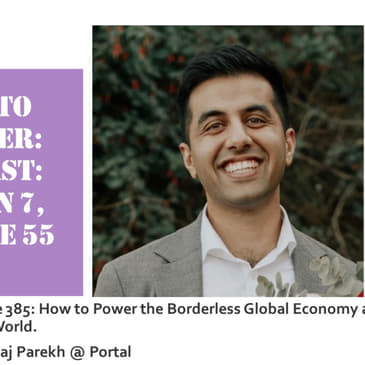

[00:00:00] Hello everybody and welcome to the Crypto Hipster podcast this is your host, Jamil Hasan, the Crypto Hipster, where I interview founders, entrepreneurs, executives, leaders.
[00:00:11] You name it, look at the world of Crypto unboxing and I have an amazing guest for you today. He is the founder and CEO of Portal. His name is Raj Parekh, Raj welcome. Thank you. Please show you having me here. Thank you very much for joining me.
[00:00:33] And my first question to kick things off is, what is your background and is it a logical background? What are you doing now? Yeah. I think it's a starting point in one, I'm sorry to my career at Visa, work really hard, just payment network in the world.
[00:00:51] The early part of my career at Visa was focused on building out a security platform to help banks think about breaches, exploits fraud. There's up the intersection of security and payments that I start to go down the Crypto Rabblehole.
[00:01:03] Bob my first Bitcoin in 2015 and basically just like ask myself, like wait, there is like this open source permissionless network that's moving a ton of value. And then other hand, I'm working at this company called Visa that's also moving just as much value as well.
[00:01:20] Like at some point open source has to win. And so ever since I first, you know Bitcoin purchased and discovering blockchains, they almost felt like imperative for me to build a career in this direction.
[00:01:33] That led me to starting and being part of the early Visa Crypto team where the newly created team focused on, you know, how do we explore, how do we go into the front here, Crypto and blockchain and how that intersects with Visa's business today.
[00:01:47] And that led me to like lead Crypto products globally at Visa for about three years where we launched products and did a bunch of fun things also. But when we launched products like USTC settlement where we could settle transactions at Visa directly with stablecoins over multiple networks.
[00:02:04] So did fun things like, uh, bi be like one of the first public-intradient companies to buy and then it's you like a crypto fund which was like a really fun, which is a really fun adventure too.
[00:02:14] But yeah that's that's my career really started up security, nerding out in the intersection of payments and security and then ultimately going down the crypto rabbit hole. And now you know fast forward to 2024 still building in the crypto space too. Awesome.
[00:02:30] And I want to find out what portal was all about and then you also had a successful capital race, you know during a very challenging market environment so we want to find out how that went to.
[00:02:40] Yeah, I mean at first off, if portal I think, you know, telling them I create Visa it was pretty evident that there was defy summer there was, you know,
[00:02:48] and of the NFT boom there was stablecoins like the number of use cases that are popping up in crypto which is exploding. But it felt like the infrastructure to date was always focused on trading.
[00:02:59] And so we ultimately, I ultimately left the build portal to build a modular developer platform where customers can also pick their own pick and choose their own adventure.
[00:03:08] They want to go build a stablecoin payments product that they can do so fairly quickly with high high security, high UX. But if they wanted to build like a full done web, free wallet interacting with smart contracts and protocols, they should be able to do that as well.
[00:03:22] So that's what we ended up building at portal and I think partly to answer your second question about raising capital successfully.
[00:03:32] I didn't get it goes down to that being a couple key elements is like one there was obviously a very large accidentally increase in, you know, what what's happening in crypto so from a market standpoint it's growing.
[00:03:44] Second is carving out the right team that gives you a competitive advantage unlike when you're building in the ecosystem because, you know, there you need, you need like touch points network expertise and the product side understanding of the premise when it comes to crypto itself.
[00:04:00] And I think the last thing is, you know, having a really clear like articulated narrative and pitch about, you know, what what area if you're really focused on in your wedge.
[00:04:11] And so I think those are some of the key elements that leaf I found, but obviously like the market's been the market's tricky for for most folks as well. We've been obviously fortunate to have greater investors that believe in us as well. It is a little tricky.
[00:04:27] I want to get into that a little bit thanks for bringing it up. The first thing I want to do is I want to ask you about, you know, what's your what actually, you know, what's your what is your pitch. Your, your, your, your.
[00:04:40] Yeah, I mean it comes down to I mean, I mean even today like it comes down to you know, there was no set of building blocks that if I go if you go to any company today and you're like, hey, I want to go build in crypto it's like where do you start?
[00:04:52] Like how do you even go about doing it? And so that was like the starting point of there isn't really much that anyone can really build when it comes to the space unless you're like super deep and like the open source ecosystem and your crypto native.
[00:05:06] And so we wanted to make crypto really approachable. We wanted to say, hey, you're a developer at an enterprise or a fintech or a bank.
[00:05:13] Anyone you guys can go and get up and running with SDKs API is like simple to use with great UX we're building it through your grandma not for the crypto native user also. And then from there start to make crypto fuel approachable.
[00:05:27] And I think I always joke that you know, today we spent a lot of time with the nuts and bolts of crypto but when you look at companies like these that. That you spend your visa card every single day, but do you know how that works?
[00:05:39] And if you ask most people like they actually don't know how how these are works today all they know is that I'll do to make that transaction the merchant got their money and that's basically it.
[00:05:49] And I think we haven't come to the aha moment with crypto quiet where it just works underneath the hood if I want to send money to my friends and family overseas. He has stable coins that should just work.
[00:05:59] If I want to make a trade or sometimes a transaction, it should just be working behind the scenes. And so that's that's like the level abstraction that we're trying to get to portal and that's what we ultimately build.
[00:06:08] It's interesting you bring that up about the dad's you know over the course of past three and a half years have been doing podcasts right. At different times I've tried to get a job right in crypto and then every time comes back you're not crypto natives.
[00:06:25] You know, and I'm like I'm crypto friendly. So how do we how do we break down that. Hostility you know and be friendly for everybody.
[00:06:36] I think it's happening already and I think a lot of is you see really interesting projects that are actually doing this today and like. Now you look at their website and there's no crypto mentions at all it's just value proposition.
[00:06:48] It's just use case it's like here's what a you know here's what value means to the user. I'll give you a couple examples like if you look at companies like Felix Pago.
[00:06:56] A stable coin remains that everything's built through what's out and so I go to a what's out, but I say I'm going to send. You know, an X dollars to my friends and family over to Mexico.
[00:07:07] It's all happening underneath the head with stable coins, but the user doesn't feel like they're touching crypto and at all. And so I think that's what type of experiences that we're seeing over and over again or even you know whenever a portal customers added Brazil that's building below.
[00:07:22] It's the easiest way to access dollars in emerging markets like Brazil. There you go from Brazilian AI to the dollars super fast and then from there the users just you know feels like they're holding like a USP bank account.
[00:07:36] In a different market and so I think that's the type of stuff that we're seeing where there's no mentions of crypto it's just using the powers of the technology. And then from there making it really approachable and I'll be another example is that the company talking those.
[00:07:51] Not an Argentina they're building a freelancer platform if you're a freelancer that's working for a USP company you want to receive payments quickly. You use talking those in underneath the hood by the way everything's all derived with stable coins and blockcains and crypto.
[00:08:05] And so I think we're getting to a point now where there's a lot of really impressive teams that are starting to move away from you know the maxi the crypto native world is starting to build use cases that derive real value from users.
[00:08:18] And it's exciting to see them like continue to grow as well and like those types of products ever excited to support to. Awesome.
[00:08:26] So you you mentioned Brazilian mentioned Argentina you mentioned different places around the world you know I want to find out what your definition is of a borderless economy. A borderless global society and what challenges we must still face to get there now you help.
[00:08:45] Yeah, I mean you know I think one of the things that just you know having a front row see that these are like these are you can argue is a global payment network.
[00:08:54] And so like I was fortunate to be able to you know work with companies and teams across many different jurisdictions and markets. But building a company with traditional fintech in the existing financial infrastructure is really hard it's hyper regional.
[00:09:08] Usually you only build a US based in tech or in Mexico based in tech or European based in tech.
[00:09:14] You can't you can never build like a multinational company with the traditional financial infrastructure unless you raise you know a lot of money and you got license of the cross all these different markets.
[00:09:23] With crypto the beauty of it is you can have a self custody wallet and now you're on day one your global you can be in the most remote part of the world.
[00:09:33] But as long as you have that self custody wallet you could actually still receive payments from anyone at the world at any time you want and that's what I think is the beauty of crypto that it is borderless by definition.
[00:09:48] There's no boundaries in terms of countries or states. You can you can cast data around the entire world and still carry your wealth with you.
[00:09:56] And I think that's the next generation of what fintech looks like is a true borderless economy where I can move money from you know from India to Africa to the US with no restrictions with high speeds with high guarantees for security also.
[00:10:11] And that's kind of what we're getting into that thing that and that's where people started realize the real value of crypto and blockchains that.
[00:10:18] We actually do have these capabilities now and it transcends like payments and it transcends spent tech and it's becoming its own category of what borderless finance could actually look like to. There's still obviously a lot of things that we usually figure out.
[00:10:32] The developer infrastructure needs to get better user experience continues needs to get better. We obviously need to get regulatory clarity from more markets also on what is you know what is crypto and what is blockchains actually mean and get proper definitions right now because.
[00:10:46] We all know there's companies that are ready to engage with regulators but we're also waiting for clarity in order to get that to.
[00:10:53] There's still obviously a lot of you know, paths for us to work through but yeah it's hard not to be optimistic about the journey we've had to date and also to some of the progress is being built with some of the teams that are out there as well.
[00:11:07] I'm going to ask what I want to talk about today with you as the regulatory clarity. I'm going to do that a little bit later. I want to. That you talked about just you know a little bit earlier you said you were a visa during defy summer.
[00:11:22] I was on the beach during defy summer. I'm a misdemeanor summer you know that was all about the price discovery you know and so. Schools of argument will say that we have not yet had an institutional bull market we've only had retail bull markets.
[00:11:44] But the institution on bull market is close. What do you think what do you see what you know what what when we get the institutional summer.
[00:11:55] Yeah I mean it's I think it's already happening and you know I think institutions are a little different where they're not going to. They're not going to stream from the you know top of the mountain and say hey we're here guys we're going to.
[00:12:06] You know we're going to go invest in the space you know but you know every you talk to any major like institution like Goldman Sachs, Bernstein they all have a digital asset department they have teams that are actually working on it.
[00:12:19] They're doing real research behind the scenes unlike the true value proposition and how it can actually like return you know returns for their for their investors and their LPs also.
[00:12:30] And so it's already happening I think the ETF is really one of the a middle as a major milestone because you know a lot of these a lot of these institutions are are regulated there's a lot of constraints that they have they can't you know all get a met a mass.
[00:12:43] And they're going to be a big corner you know e-pon it or specifically e-pher met a mass they can't they can't do that today they have to be you know have you know they have to have proper control and processes.
[00:12:54] And and honestly like the market cap has to make sense for them usually some of these institutions are investing in you know multi trillion dollar asset classes.
[00:13:03] And you know crypto we're still like you know we're still you know over the trillion dollar mark but that's just been a recent endeavor as well.
[00:13:09] And so there's a lot of things that have to go right between market cap having the right products now also which we have with the point ETF you know EETF app you know coming up pre you know fairly quickly here.
[00:13:20] And likely see some version of the salana ETF also where as an institution I can now invest in Bitcoin. I don't have to change any of my infrastructure I can say cool there's a new ticker now that I can invest in and from there I'm ready to go.
[00:13:34] And so I think we're starting to see just like more and more like optimism from that perspective.
[00:13:40] And and from there you know I think the setup is better now than it was before where we both have we have the regulated products and we also have some of the increase momentum from this space generally speaking also. Now we'll talk about the regulatory.
[00:13:56] So it's like institutions are beholden to regulations whereas retail is not right. You know so. I think we have people say we have going on in this election that's coming up really soon we have the first bipartisan issue where both sides.
[00:14:17] You'll want to be on the wrong side of innovation and technology right how do you think the election upcoming election is going to play a role. You know with the institutional adoption.
[00:14:30] I think it's going to be huge I think you know anytime you get you know regulators giving the thumbs up on you know certain type of innovation whether it's crypto or you know it could be AI could be anything.
[00:14:40] And obviously it makes makes folks feel comfortable you know if you're a large institution or a larger enterprise. The last thing you want is have a large you know legal team and legal bills having to go figure out.
[00:14:52] And get clarity and you know there's a few companies that we've been fortunate to have and are you because it's like a consensus or a coin base.
[00:14:58] You know they're going up to that for us as a community already but not everyone has the you know the you know the luxury to do that. And so I think anytime you're able to have an election where you know the output is hopefully some type of clarity.
[00:15:12] I'm a big believer in having you know regulation I think it's fine. I think at the same time like we have to be able to meaningfully engage and have substantial discussions with our politicians and our policy makers.
[00:15:24] And so I think once we have that it should you know hopefully start to beat more innovation and honestly unlock budgets. You know across some of these major banks that when I was a visa but I'd used to talk to banks all the time.
[00:15:36] And always if there was always a crypto team there and people don't they don't they don't get a lot of attention because you know they're like considered like the dark or sometimes but.
[00:15:44] As soon as the regulatory like clarity comes that you can rest you know you can be assured that. Don't have a budget and there'll be some interesting outlets that come from those teams as well.
[00:15:55] Interesting thing I think was that when Jamie Diamond back into 2017 was calling Bitcoin abroad. He had a he had a Bitcoin he had a crypto team in JP Morgan. You know it's often the case.
[00:16:08] You know it's it's yeah I mean for my time of visa I can tell you there's many many crypto teams are crying. I just actually just talked to a bank passionate is there's many many crypto teams it still exists across many banks that they do.
[00:16:20] Yeah I thought so. So we're going to have to improve some things in order to get you know adoption and payments and everything all around the world and create this borderless economy.
[00:16:33] One of those things is user experience right it's still not optimal right how do you what's the future of crypto user experience how do you improve it how you make it optimal.
[00:16:45] Yeah I mean it's it starts with the basics and then we all know the basics are like we have to get rid of seed phases like there's no way that you know we're going to have you know my grandma or like you know.
[00:16:56] Even just like you know parents or anyone say hey you know go memorize the seed phase and from there we will you know if you forget it by the way all your money is gone like that's just that's just not realistic.
[00:17:07] You know everyone's used to having the forgot your password option for any account because you know we're human we ultimately forget.
[00:17:14] And so having the forgot your password option in crypto I think is table stakes and you know we've done some of that in person we've built on that infrastructure portal where you can use your face ID you could use.
[00:17:25] You know you can use g drive I cloud you can even use WhatsApp OTP or telegram OTP.
[00:17:30] You can use different methods to then recover your wallet which is you know warfum millier to an end user and I think from there you ultimately need to think about what what is the value proposition of.
[00:17:42] You know the the underlying technology for your user base and you can argue right now and last time is ground zero for your stable coin adoption right now it's there is you know every and you know you see this over and over across other markets also but.
[00:17:56] You know you know you see use cases like reminces or you know marketplace payouts for freelancers those are some of the use cases that you're seeing and having a freelancer receive a payment from like a.
[00:18:08] Marketplace and say oh by the way you need to see trees like that's just not going to work and so I think that's that's table stakes is getting the UX ray and that's something that we know we've even building.
[00:18:18] You know and thinking deeply about it for all which we're really excited to showcase I think the other thing is that we need to start thinking about mobile first infrastructure I mean.
[00:18:26] You know mobile mobile adoption starting a hit about 90% like smartphone adoption specifically across the globe and a lot of crypto is typically web first we've you know have a website we go to and from near be interact with some type of application and the Chrome extension.
[00:18:42] With the whole scheme of things like we have to meet the users where they are today and that comes to actually having a really simple mobile experience of the users can actually lean on.
[00:18:51] And you know we're excited to support companies like like floor that are building you know mobile like first web three experiences where you just use your IOS or android device and from there you can interact with NFTs with defy applications with games.
[00:19:05] And from there I have a really fun experience around it but I think that's the two things is thinking about mobile first thinking about.
[00:19:12] Removing seed phrases as a table state requirement and then from there continue to iterate on use cases that drive adoption because you know for one user it may be payments for another user it might be playing a game and we need to get that right for you know whether users are today as well.
[00:19:28] I struggle with this. You know you mentioned eyeballs. I'm not in the camp where many governments are against you know eyeballs about metric but. What I struggle with is that everybody's a lot of people are terrified of eyeballs but no one's terrified of using their figure.
[00:19:49] You know print and I'm like isn't it the same thing you know so how do you know what the user wants to use it as not the user wants.
[00:19:59] No and this is where you get the options and I think this goes down to you know providing like a set of different options for you know for your user base and learning about your user base as well.
[00:20:08] You know if you are catering to a certain camp the users that are like you know pretty. You know they feel pretty threatened and we're about you know given their bio metric information away that's it could really help learning and inside where you started and introduce.
[00:20:20] You know other methods whether it's like you know using cloud storage or you know using like your login information right something along those lines.
[00:20:27] Like I know for example like I'm not you know I'm not personally a clear customer because I don't feel comfortable giving my bio metric information away just to get.
[00:20:36] Early access through TSA at the airport like that's not my not my M.O. but you know maybe for another user you know they they don't feel like they don't feel as friendly by it.
[00:20:46] It is okay principally for them to then opt in that way as well. So I think it really just comes down to learning more about your user because.
[00:20:53] Our goals is builders is for solving pain points and a lot of it comes from like deep empathy and like what the user is looking for and really catering to that as well. That makes sense to me.
[00:21:06] So you know I don't know if you had a chance to go to consensus. It's best year. I didn't go this year but my team was okay. Very cool. A couple things couple narratives that came out of that besides the regulation besides the SAP 111 stuff and you know.
[00:21:24] Where the future of zero knowledge and account abstraction people today they have both have huge potential to grow the industry.
[00:21:34] Yeah right you know right now the only thing I see on Twitter X that's hot or meme coins you know dog with other stuff right how do you cut through fads hype and paranoid and bring real technological change in adoption that.
[00:21:46] Can really move the industry and humanity forward.
[00:21:50] Yeah, you know it's funny that I've probably iterated my thinking on you know meme coins and you know and some of these fads you know over the years but I think now I take like a less serious view on them and I think of it as more like fun and culture like you know you would when you're like browsing TikTok or like Instagram.
[00:22:08] You know you see fads all the time across many platforms is not specific to crypto anymore as well.
[00:22:15] And I think what I think the cool output that's come from you know meme coins and some of these other trends that we see in crypto that are just more fun.
[00:22:23] Is that actually stress tests is the infrastructure but right now like there's the outside of the tokens being created on salana every single day. And it's stress testing the upper limits of like what throughput and performance could look like for them.
[00:22:36] And you know as you think about a world where everything is tokenized and like this whole narrative like RWA the real world assets and tokenization as well.
[00:22:44] Can we have like every single asset being tokenized there are going to be many tokens that are created every single day and a blockchain is probably going to have to support that also.
[00:22:53] And so I think of a lot of the trends that we're seeing with like meme points and some of the fun that we're generally having in a crypto space as way so we can you know stress tests are user onboarding look good.
[00:23:05] And so we're looking at our you know can the performance of the actual underlying blockchain actually support the needs of you know many of these users also.
[00:23:13] And so I kind of started to see it in that light and you know it's it's generally fun to interact with and you know we all as humans like love playing games and love speculating also.
[00:23:23] And so it's never going to change and the fact it's not specific to crypto also like we see it in every other vertical or industry as well. So I just thought as a bunch of junk being created on Solana but you said stress testing.
[00:23:42] Is that do you think the meme points are going to be the catalyst and drive the Solana ETF.
[00:23:50] They may not be correlated because like you know still Solana is still like the underlying asset and you know up for the native chain itself, but you know Solana's been used for for many purposes I mean.
[00:24:00] By my old team of these are they actually believe that Solana is actually purpose built for payments when it comes to payments you can't you know wait for you know a bunch of confirmation to take place where it can't be.
[00:24:13] You know it's got to move really fast the cast to be has to happen like sub seconds so I think we're actually starting to see the utility with Solana transcend just meme coins and you know right now mean coin obviously has a lot of attention but.
[00:24:26] You look at the visa report on Solana they actually did a really thorough thesis and deep dive into why it's actually really strong for payment purposes.
[00:24:35] And you start to see like new projects pop up on Solana for tokenization where you know what are friends at the team at MetaWelth. They're building a real estate tokenization platform on Solana where you can now buy real estate assets directly on Solana.
[00:24:49] And it's all through like a really nice user experience and they're out buying properties and then making that really you know seamlessly available on Solana.
[00:24:57] And so you start to see more happen with Solana and you know the meme coin and the ETF is just a cherry on top where you know as like a commodity underneath the hood. It's starting to like showcase its value proposition across many many different use cases also.
[00:25:12] So let's look under the hood then I don't mean the bad I don't mean the bash on Solana at all you know. Looking at the types of blockchains that are similar to you know there's three elements of blockchains right one is security one the speed and scale.
[00:25:30] Right there's three security speed and scale why is it crucial to be uncompromising on security as opposed to the other two.
[00:25:39] Yeah I mean you know for us is a team I come from a security background like our entire fighting team come from a security background also like we actually we believe that's our super power.
[00:25:49] We don't take shortcuts when it comes to security because I think and we think about this and I know like other you know major projects also think about this it's a personal responsibility.
[00:25:57] You know we're you're seeing hacks happen every single day you know for different projects and you know they're its like experience or like you know whoever you know whatever it is that's happening out there.
[00:26:08] Ultimately it comes down to like someone missed the ball with many came to security and that didn't just affect them and affect it all their users afterwards.
[00:26:16] And so I think security is paramount and I don't think any real team can build real reputation and track record without actually hanging their hat on the security side.
[00:26:26] And I think you know you it all takes just one hack to really fill that away and so we stay really hyper paranoid and vigilant at all times. And I think that's actually a personal responsibility to crypto ecosystem where we can showcase that at scale.
[00:26:41] It's going to be really really hard for us to get users to really trust what we're building also. I just got a paper in the mail. So that my mom had been. Had a life insurance policy permit but she does she created it like 40 some years ago.
[00:26:58] And credential was the company and then they got hacked you know I see more track fire hacks now than I see crypto hacks. You know what can track five do that you know that they're not doing well that crypto is doing well to help move them into F3.
[00:27:17] You know it's like it's one of those things where we can all learn from each other there is a lot of things that you know track fires done really well and like as.
[00:27:24] Security as you know excuse in crypto like maybe we shouldn't push code into production too fast you know maybe we should run our checks or quality checks and not just deploy smart contract to quickly right.
[00:27:35] And on the other side you know maybe you know maybe all the audits and you know all the level audits that we do on the crypto side maybe.
[00:27:41] The track by companies could do that as well security is one of those things where we can all like collectively learn from each other and I think of it as like. You know police departments across different cities like they're not competing against each other.
[00:27:52] They're actually friends with each other and so I think I think of it that way where you know we there's so much to learn from you know the web to space.
[00:28:00] And there's obviously things that we're doing well on the crypto side but there's obviously a number of things that we're not doing well also. With there's still like folks that are you know getting their happy they're wallets hack or drained or something along those lines too.
[00:28:11] So I think security is just like a collective effort and it's important to stay really humble while thinking about security also. And none of those hacks are the blockchain themselves and they're at the the the on and off ramps.
[00:28:25] Right or the protocol itself right or you you know you see smart contracts and you know protocols that may have some type of you know weird multi-six set up where.
[00:28:34] You know it gets compromised by some type of group and so you know you're seeing this over and over again and where it comes down to really having a nice polished and you know polish process around how you think about security.
[00:28:45] And as that portal we we actually started the company being talked to type to you compliant we didn't think it was like a nice to have future we thought it was a must have because.
[00:28:54] We need to have the right certification and processes internally where we're thinking about security every single day and that's the standard that we've at least set for ourselves to.
[00:29:05] That's I like that that's good idea. That's a good that's a good mentality to have I like it. Thank you. Um, so I want to thank you very much for your time today. Enjoy speaking with you and I have one last question. And just easy.
[00:29:21] Pack the people find a more information about you about portal. I can become clients. I can start you guys. Yeah, I mean I think the simplest way is you can go on a portal HQ.io and you know learn more about portal.
[00:29:33] Um, you can find me on Twitter also and I'll just have to look up for my Twitter handle is it's a it's Raj Park underscore. My first name last name underscore afterwards.
[00:29:44] So you can come find me you can you can send me a DM as well and I'm happy to chat with the other than anyone as well. And also thank you again for having me this was fun. Awesome. Thank you very much for your time today.
[00:29:56] Of course have a good one.