
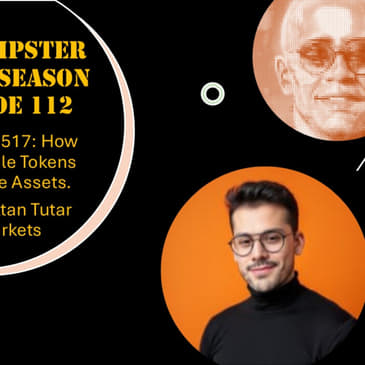

Altan Tutar is the Co-Founder and CEO of MoreMarkets, a global liquidity marketplace that transforms idle tokens into productive assets. He has previously worked at NEAR Foundation both as a Core Contributor and a member of the Senior Technical Business Development team.
[00:00:03] Hello, everybody, and welcome to the Crypto Hipster Podcast. This is your host, Jamil Hasan, the Crypto Hipster, where I interview founders, entrepreneurs, executives, thought leaders, amazing people all around the world of crypto and blockchain. And today I have another amazing guest. He is the co-founder and CEO of MoreMarkets. His name is Altan Tutar. Altan, welcome to the show. Thanks for having me.
[00:00:28] You're very welcome. Thanks for being here today. So, first question I ask everybody, I get amazing answers, is this. What is your background and is it a logical background for what you're doing now? That's a good question, especially the latter one. Yeah, I can introduce myself, Altan, one of the founders of MoreMarkets. Before MoreMarkets, I'll speak about myself. I grew up in Turkey. That was back in 1997.
[00:00:57] I spent almost 18 years in Turkey. And Jamil, we've been talking about it after that I lived in the United States. One of the important things about this is, you know, crypto is usually a place where people come in as a sort of a, almost like an alternative to financial system. Turkey had a pretty bad lira, almost erosion. So, lira to Turkish lira, lira to dollars was one to one in 2009.
[00:01:27] And within like almost 14, 15 years, it dropped from one to one to one to 36. So, that's like a crazy amount of inflation. And the lira just lost its value. So, we saw a lot of people that flocked to Bitcoin. And even you can see if you go to Turkey, if you're lucky enough in the summer, it's amazing. You can actually go to these stores where they can actually sell you Bitcoin in the street.
[00:01:56] Like, you don't have to go to an decentralized exchange. You can literally buy it in the store. It's just as a hedge that like people see it after gold. And I think it's coming up. But going back to my story, studied computer science at Davidson College in Georgia Tech in the US. And arrived in London in 2020. That was around COVID. COVID was interesting in a sense that I really got into computers.
[00:02:23] I was like trying to get into every area. I was AI back then. It was pretty interesting to me. I studied AI at the Beale College London. But also, crypto was a very big interest alongside with virtual reality. So, all of these things. And when I look at my path, which is sort of AI, virtual reality, I have a paper in virtual reality. And crypto, they're all, in some cases, it's like a simulation, right?
[00:02:51] So, virtual reality, control and environment. In AI, I worked in robotics in simulation. So, I actually taught robots to how to do things in the virtual world and transfer them into the real world. And crypto, to me, for that reason, was like so interesting because now you can add something like money to it and have introduced money to the internet.
[00:03:13] So, that's how I started in crypto. Started hacking, hacking in a sense of like building projects or hackathons. And won the Nier hackathon in 2022. Really loved what Nier was building back in the day. Nier, the founder, was one of the authors of Attention is All You Need, which is a transformer paper. That's the T in GPT. And just found myself working there. So, I started working there in 2022. Was a partner engineer.
[00:03:44] And I really loved it. And I've been in a bunch of different projects, which one of them became a very infrastructure heavy. So, looking at cross-strain space. And after that, decided to become an entrepreneur. So, that was almost a year ago. And we raised our seed round. That was $13 million by electric capital. And started looking into, just like every different entrepreneur, started looking into different areas and pivoted a little bit in different sub-niches of crypto.
[00:04:14] And really landed this one as now more markets looking into idle assets and liquidity. And how we can use of all these, you know, if you look at top 10 crypto assets. How do we make them productive in DeFi?
[00:04:32] And really start nailing down into the infrastructure, but also on the product level as well as to how to make it easy for, let's say, XRP holders and Bitcoin holders to come into the product and earn from tokens that they have. And you asked the important question. I'll answer that too. What was different about my background? So, a lot of crypto guys are very technical. So, that's not different about me.
[00:04:56] But I think when I talk about with other entrepreneurs as well, as I talked before, coming from Turkey, understanding the sort of emerging market side is quite different. A lot of people that I talk with, they grew up in the United States or in the UK. But I really saw that when I was growing in Turkey with the impact of inflation. So, that's probably different about my background compared to some other entrepreneurs out there.
[00:05:25] Got it. You know, it's interesting because when I look at the top, people listen to my podcast in 123 countries. Number one is the US. Number two is Turkey. Wow, that's crazy. A lot of tech savvy people in Turkey. So, you know, it's pretty good. And then I just have hosted a podcast recently and published it where I talked to one of the near developers. So, yeah.
[00:05:55] So, it was great. I recommend people read that, watch that as well as watch this one. So, let's talk about more markets, right? What's your mission and your vision? And then how do you distinguish between, you know, idle tokens and dead coins? You know, how do you bring, you know, market to both of those? And what's the difference? Yeah. So, the vision is a platform where liquidity flows freely.
[00:06:23] And a platform where these idle assets become productive. So, it's an important question. How do we look at what's idle and what's actually active? So, if you look at top 10, what I would say active ecosystems are, and assets, I would say assets is more important, are ETH and Solana. So, ETH is almost, the TVL of Ethereum is 16% of its market cap, which is pretty high.
[00:06:51] Like, it's almost 2 out of 10 ETH is locked somewhere doing something productive work for the ecosystem. And the other one is Solana. I think that's around 8-9%. But, you know, POS systems are usually not very idle. Like, they're actually active because, you know, there's always 40%, 50% of the tokens being contributed to the network.
[00:07:16] When I say proof of stake, right, the stake is actually me locking the value of the token and validating the chain. But when you look at Bitcoin and XRP and Doge, right, Bitcoin is around getting close to 1% now with some projects, but it's still not there. XRP is around 0.05%, which is very low. And Doge is in similar, you know, similar numbers as well.
[00:07:43] And those two are, you know, if you, those three, if you sum them up, it is like crazy amount of value. It's more than $2 trillion of value that's just sitting, doing nothing. So that's the vision. The vision is that, you know, we built the cross-chain infrastructure to be able to do this. We have pretty complicated tech. I can get into that. But in the front end, you know, it's very hard for people to come in.
[00:08:06] And even RappBTC was around, which is RappBitcoin, that you can take Bitcoin from the Bitcoin chain to Ethereum and other markets. I say markets. And that didn't even take off because you have to go to Bridge. You have to, like, Rapp, UnRapp, and then go to another DeFi, you know, front end. So it's very complicated for the user. Like, I certainly, if I'm jumping around even the Ethereum ecosystem itself, it sometimes takes me like an hour coming, you know,
[00:08:36] taking from Ethereum to go to Unichain, which is a new chain. How to go there. So our vision is that, you know, you stay on your chain. Don't worry about all that stuff. We decentralize and make it self-custodial in the background. And you just, you know, deposit your assets with us. And, you know, you can just keep earning. And at the end of the day, you have, you can see where you're earning. So there's transparency. And you can also, you hold the asset because we have an MPC network plus a token that we give.
[00:09:05] So without the token that lives in your wallet, nobody can withdraw your funds. So that's the difference here is that I say it almost in a, it is a centralized exchange-like looking product. But the back end is fully DeFi. So it's decentralized. That makes sense to me. So the benefit of the centralization looking is that people can understand it. So. Yeah. Awesome.
[00:09:33] But you're not taking ownership or, you know, or control over anybody's assets. No, it's fully self-custodial. We have, yeah, the MPC network is decentralized. So we use NIR's, yeah, MPC network. So MPC networks are just, you can think about them as there's like 10 parties that come in. And then they all have their own share, right? So then they basically come up and then they combine those shares to be able to sign a transaction.
[00:10:03] Plus a token that we give on the network, on NIR that with these two, you can now sign it as transaction on any different chain. So without you providing that token, we can't sign on behalf of you or we can't withdraw the fund. So, and that is in the user's wallet that stays with you. Got it. Makes sense.
[00:10:28] So I want to talk about then, I want to talk about, you mentioned or alluded to it briefly, I think, but ecosystem fragmentation, right? What is ecosystem fragmentation and how do you solve this problem? Yeah, so ecosystem fragmentation is, it's happened, it's been happening since, I would assume, since the start of crypto, right?
[00:10:54] So it was, there was a divide between Bitcoin and Ethereum and XRP at the time. They all went their own ways and people rave about them and blah, blah, blah. But when you come in now, this is even a bigger problem. So, you know, you look at Solana that has a different ecosystem. You have Ethereum that has a big ecosystem. You have Bitcoin, Bitcoin L2s. Like, you know, if you're not in the trenches like myself or a founder, like you wouldn't be able to understand what's going on here.
[00:11:21] So for us, it's like, forget about all this stuff. Like if you're a very power user, sure, maybe that's interesting to you. But for us, it's how do we increase the sort of the number of users on crypto and its debate to kind of almost entangling everything that was fragmented and bring everything into one front end that you can come in and interact with. Right. So that's the solution to that. I think we also have the technology right now.
[00:11:50] Like in 2002, we didn't have any really good message passing networks back then. Like Layer Zero and Wormhole was just being getting started. And right now we have amazing MPC networks. It's not only Nier, but also Suya has one. We have message passing that's almost becoming, you know, even Pether is using them now, like USDT Zero. So I think that is passed, right? Like the technology is there.
[00:12:17] The bridge risks are reducing, obviously. Like the latest hacks have not been bridges, but more of social manipulation, right? Like we've seen in Bybit. So I think we're in a place where you can use the technology to be able to, you know, stay in one front end, but interact with, I don't know, four or five different chains at the same time. For example, in our case is if you're putting your XRP in, you're actually interacting in the background with three different chains, like XRP, Nier, and let's say it goes to Ethereum and then we run something there.
[00:12:49] So it's getting solved, right? Like we're basically solving that with just the one front end. Got it. So I want to come back to the coins you mentioned that they're not fully utilized, right? So, you know, make sense. Like I know XRP does. I know Ethereum does and Bitcoin. You mentioned Doge, right? What I know about Doge is it helps Litecoin mining. Okay.
[00:13:18] Helps merge mining for Litecoin. Other than that, what is the use for it? Yeah, there's almost nothing at this point, right? So that's the, like even XRP is in that, like Bitcoin and XRP. I mean, you use Bitcoin network for, you know, transacting, but like what else is there for the use of Bitcoin, right? I mean, it's the, and Doge is like crazy market. I think it's like 30 billion, 40 billion, just sits in wallets, like does nothing.
[00:13:43] And there's some miners, you write people mine and then they just hold it, you know, and then they don't do anything with it. But, so that's the problem. Also, the other thing is like Bitcoin, Ripple, like XRP ledger is not improving. They're now getting smart contracts in there. But traditionally there was no smart contracts. And Doge does not have smart contracts either. For those chains, especially, what we have is pretty, very convincing, right?
[00:14:12] Because now you can just add smart contract capability on top of it without even people seeing that, right? You just take a synthetic asset, mint it on another chain, and then you can use it as a collateral. You can use it in any DeFi. And this is already happening with Bitcoin, right? That's trend is already there. Lombard and Babylon is taking probably five, six billion dollars of BTC. Doge, maybe like that's not the primary strategy we have.
[00:14:37] More markets is to start with XRP because retail has it and some institutions have it. And go down and, you know, take some Bitcoin to make sure that people can earn, you know, four or 5% on those assets with stable coins in the background. And after that, maybe, maybe, you know, there's still big Doge holders that are not earning anything. So maybe target those and go down the list, right? So that's the kind of division. Great.
[00:15:03] I bring that up because there's still pockets of populations called Maxis. So there's Bitcoin Maxis. I like Ethereum Max. Like I can't, I'm not going to make, say any derogatory comments about any Maxis, right? I just don't agree with their philosophy. But, you know, there are still these silos. There are these, you know, emotional, mental, financial silos of people. There's also liquidity silos. And we talked about fragmentation.
[00:15:33] So to me, I would say liquidity silos are suppressing yields, right? So why is it necessary to dissolve those silos and everybody collaborate and get along? So on the, on the technical, I guess, the silos are pretty much killing crypto, right? They're killing the potential of crypto in a sense. Like the, we really like silos.
[00:16:01] Then we could have just stayed in the banking system where there's everything is siloed, right? Like you're sitting in the United States. Me interacting with your bank from Turkey is very, very hard. Like I can't, it takes a lot of time. It takes, you know, sometimes when I send money from Turkey to the United States, it takes 24 hours to get there. And I get charged a bunch of times, you know, like I get charged in my Turkish bank. I change, charged by the Swift network and I get charged by the U.S. bank. I'm like, I've lost loads of money.
[00:16:28] And that money that I brought you there, it's probably not going to do anything that much. So I need to swap that to U.S. dollars to do something. Crypto doesn't have this by nature, right? Crypto is just computers and like machines that are running a bunch of stuff. There is fees, obviously, right? There is fees that you can, that Bitcoin network is charging, that let's say Turkey is like a near network. A near network is charging. But it is composable in a sense, right? You can compose Bitcoin with something else on the other network. And you can even use it as a collateral on the other network.
[00:16:58] And you can design these. You don't have to be a bank to be able to design these things. Like you can just be a random person that comes in and, you know, wants to design it and runs a marketing campaign and being able to do that. So that's exciting. And I think just by the nature of crypto, like it is surprising that this has not happened. But there has been attempts that people wanted to do it with Rapp BTC, you know, Babylon and Lombard coming after with Bitcoin as well.
[00:17:24] I think it's a time that you can try with other assets like XRP where you can just deposit, you know, the maxis maybe they don't see where it's going. It doesn't really matter. They don't have to change. But we can still create markets for those assets and get them used, pay the yield back to the maxi. It doesn't matter. It makes money. Everybody wants to earn more from their assets. So that's all I see it. I think like fundamentally crypto as a technology is better than banks. Therefore, these silos shouldn't exist.
[00:17:54] I agree with you. I agree with you. We're better than banks and silos shouldn't exist. So you believe that DeFi needs to double down on simplicity, right? Why is that? And then if you do double down on simplicity, what new opportunities would that unlock that are different than banks? Yeah. So Ethereum is great in the sense that Ethereum created DeFi. You know, it was a DeFi summer.
[00:18:24] Everybody wanted to hop into that train in 2020, 2021. But one thing that is still, obviously the products have improved. But if you look at a lot of DeFi apps, they're so confusing. Like there's like five, six different tabs. You come in. Sometimes you don't know what this tab is for. And that is like losing people in a sense. If you come into the front end, you have to just, you know, if you don't have a wallet, for example, you need to connect the wallet.
[00:18:54] Then you have to go get a MetaMask and all that sort of stuff. So that's killing the potential of DeFi and limiting that to almost 10,000 people, right? So which is like people that are on Ethereum, you know, doing the same thing all over and over again. But I think if we want to be better than banks per se, which banks are not transparent, you know, banks don't have the over collateralization that we do have in crypto, right?
[00:19:21] They're usually on the collateralized with 10% of the deposits usually guaranteed. So crypto should be, in a sense, how we think about in more markets, for example, the front end is just going to be simple, right? Like there's an app called Revolut in Europe that is just super simple. Like you can come in, you do a bit of KYC, obviously, because it's a financial institution. But then you get in. After that, it's so easy to use. It's so easy to change different tabs.
[00:19:48] It's so easy to buy crypto there too, for example, if you hold dollars and you can buy. If you hold dollars, you can switch to Europe immediately. So front end is like that. But, you know, Revolut is still not transparent. You don't know the deposit that they, you know, you've given them. But in crypto, there's a way to prove to you that I hold those deposits, right? Because there's on-chain. Everybody interacts with them. So I think, in a sense, crypto is a better version of or earning, right?
[00:20:15] Because let's assume that something happens to the banks tomorrow. You know, we've seen it in Silicon Valley Bank, right? Like it was almost two years ago. It was a huge bank run. That, by nature, happens in crypto too. Like people want to take their deposits. But everything's on-chain. You know that you have the funds, right? So it's not something that if you can unwind the positions, you can just get out. So that's the version of crypto that I like.
[00:20:41] Like it's fully transparent and self-custodial that also improves on the UX, which I think with the improved UX, like you can get better than the banks. Got it. You know, every year since 2017, I mean, not every year, but all the time, if I ever got money in my checking account and my bank, I immediately bought crypto. Immediately. This time, I got some money and I'm trying something new.
[00:21:09] I'm holding it in my bank until like July, August, because liquidity tends to dry up in the summer in crypto. That's correct. I might be wrong. It might be the opposite this year, but I'm like, you know what? I'm willing to like give that a try, you know, and see what happens, you know? Yeah.
[00:21:27] But we, you know, we are creating or you're creating a vertically integrated system that helps to build resilient ecosystems. So I want to understand what the vertical integrated system is, how it works. And then I want to have a follow-up. Yeah. Yeah. So if you look at, this is a trend I'm seeing in crypto. And I had to talk about this in South Korea.
[00:21:57] There was a conference there. And like Google and Amazon, when they started, you know, they, they had one part of, they were just building one product, right? It was Google was just only search. Amazon was only just like bookstore. And eventually to deliver almost a better experience, they started to own the stack, right? So they, if you look at Apple, for example, they, they started with the Intel chips for their laptops.
[00:22:24] And then they now doing their own chips, which is M1s, M2s that they produce. And I've started to see this with crypto too, in a sense, like, for example, Hyperliquid. And that's very, it's, it's one of the most successful applications of this, of the cycle, which is, it's a PerpDex on chain and they own their L1, right? So they have their own L1. They designed L1 just specifically for PerpDex.
[00:22:49] Now, if we go to obviously more markets case, like we're designing everything starting from the front end and eventually the backend to make sure that, you know, for all this for dormant assets to be active. So what do we do, right? We have a front end that's simple. That's like a Revolut experience. We go down the stack, we built our own smart contracts that are, you know, it's not ours, but we, we, we took inspiration from OpenTorce projects.
[00:23:16] We use something called Boring, Boring Vault from Veta. They're one of the biggest sort of money managers in Ethereum. They hold like $3 billion of assets. So we took that and basically made it a bit more multi-chain. So you can now deploy those vaults in, in Suya and Aptos if you really want to, you know, near and, near and Solana where, you know, where we think the best yields are.
[00:23:41] And then we have our own sort of, we don't have our own MPC yet just because we believe near as MPC is pretty good. And, and, and, you know, we, we trust the near team that they built a really good L1. And I think they, they've done a really good job with the MPC too. And eventually, you know, owning the lending market, right? So there's a lending markets. We provide the collateral as let's say XRP and then pull out the stable coin against it.
[00:24:06] And eventually we think there's like a better way to do, you know, next generation lending just for these assets that I mentioned, right? Bitcoin, you know, maybe it's Litecoin, for example, that I did not mention that as a big, it's a big asset too. So that's what I talk about in VerticLite systems is to, as you start, you know, owning the user, you can just go down the stack and make sure that the user gets the best experience with the products that you offer. So we're seeing this more in crypto.
[00:24:33] And I think, I think it's going to get more and more as crypto becomes more like a, more like traditional venture really, right? I think it starts to be, people start to pay more attention to revenue now, which is great. Right. And then they, you know, and then you basically have, you'll see more of these companies building multiple things in the stack and making sure that the users are happy.
[00:24:55] Great. So your definition of resilient, my definition of resilient ecosystem is something that doesn't, doesn't, doesn't like, you know, just go away. Right. I mean, yeah, but your definition of resilient ecosystems is what, what do you envision as resilient ecosystem? So for, for us or for anybody? Well, for anybody, your, your, your, your view of what that means. Yeah. So resilient ecosystem. Well, depends.
[00:25:23] If you talk about that once it is like going through these back and forth of, of these cycles and making sure that, you know, builders don't leave. But for us, resilient is obviously something decentralized, right? Like if you make it decentralized with smart contracts, with, you know, the decentralized NPC, that's resilient, right? Like for that system to fail, there needs to be so many things in the system that needs to, that needs to be canceled.
[00:25:52] And, you know, that needs to be, that needs to be failing at the same time. Um, so that's my thing of resilience. For example, if you want to, you know, if somebody attacks our, you know, any, any, any protocol they need to find, you need to think about it very, very hard to be able to, you know, corrupt the network, which crypto is very good at, right? Like resiliency in terms of like, good luck finding all these validators and making sure that they, they disagree all the time. That's just not going to happen.
[00:26:20] Um, and for MPC, for example, like it's finding those AYB institutions and, you know, going against them is pretty hard, but for me, resilient ecosystem means, you know, um, if something happens, we have enough decentralization and enough, um, other operations that can save the system. Um, that's, that's for us obviously, but for Alwans, for example, if you're covering Solana or something, I think ecosystem might mean something else. Like builders are motivated, even though something happens in the ecosystem, right?
[00:26:49] They can still keep building. I think Solana did that really well last cycle. Um, so I think that that's definitely, there's a, there's a nuanced difference between like human resilience versus like, I guess, system and technical resilience. Got it. Got it. So, okay. So you're making, you're, you're making these dormant assets active. Okay. Now they're active. Now they're resilient. What's possible for the next cycle? Yeah.
[00:27:17] So as these, and I, I, I define these sort of demand centers, which is, I think Solana and Ethereum are there. Um, you know, they, they became pretty large demand centers as they are like, there's a lot of liquidity in these, in these systems. So if the, if these assets are resilient, um, they become what I call, they have some monetary premium.
[00:27:40] So monetary premium means like that you use this asset, not only on the, in the network, but also elsewhere as collateral, as stake, as, you know, anything that people want to take in the other network. Right. So, um, an example of this, if for example, XRP becomes very resilient to me, that would be, we have loads of XRP that was deposited from the XRP ledger. That goes to the Ethereum network as more XRP.
[00:28:07] And then we have access to a lot of stable coins that people have put already that you can basically, anybody can borrow with some LTV issues. LTV is basically, if you put more, one more BTC, I can take, um, let's say with 50% LTV, I can only take 0.5, uh, worth of USD, like dollar worth of stable. And then I can run strategies on that. Right. So in that case, XRP becomes resilient because like for you to, that becomes useful, right?
[00:28:34] Because you can actually, it becomes a collateral that people can use it, um, as collateral to run strategies. So that's what I'm excited about. I think lending is good. Staking is good, all that stuff. But if, if any of these financial activity that happens on Ethereum also has these assets and we're seeing examples of it. Right. Uh, that is, that is very good for the dormant assets and you know, they, they become very. And plus, right.
[00:29:02] Because, because these assets are being used elsewhere. There's other builders from their own ecosystem that will get excited and try to build on that, uh, on their assets in that chain. Right. That becomes, makes it very competitive, which resilient markets are competitive. Right. If there's, if it's a monopoly, it's, it's not really great. Um, so. That's what I'm excited about. I think we're seeing that more too. And with all these chains that's, uh, have their own kind of markets too. And you get true innovation.
[00:29:32] You get creative strategies and you get, and you get, yeah. That sounds great to me. So awesome. So. Yeah. And then one, one more point as well. Like if somebody else does, for example, another synthetic version of XRP on Ethereum, that's also very good because then there's competition. There's also the file is composable, right? Because now then you have, let's say more XRP, let's say general creators on XRP, let's say general XRP. There's a pair for that right now. Right. So then people can come and trade that.
[00:30:02] And you know, there's network effects around that. So, um, I've been seeing more, one or two coming in as well, like the, to mint the synthetic XRP. So it's going to be great because then you can create landing markets around it, you know, um, any market really. And that's, that's great for the, for the asset itself. I like to see that. I like to see the pair has become, you know, instead of like pairing up, you know, Solana and a meme coin, you can pair up, you know, XRP and Ethereum and create financial products. Yeah, exactly.
[00:30:31] So yeah, that's going to be great. So thank you very much. Uh, or thank you very much for your time today. This is awesome. Um, I have one last question. Um, how can people find out more information about you, about more markets? How can they start to use your platform? How can they do that? Yeah. So we are currently, um, we're taking people to join the wait lists. So if you go to more markets.xyz, uh, you can join the wet list, wait list and try to be one of the first users. Cause we're going to open it up, um, in, in batches almost.
[00:31:02] Um, and, uh, if they want, if yeah, you can also follow me on, um, X I'm Mr. Altantotar with my mister and my first name and last name. Uh, you can also follow us in, in X as well. We have more markets, X, Y, Z just like the website, but just drop the dot then that you can be able to find us. Um, yeah, we're pushing, we'll be sort of having our own YouTube channel soon and, uh, been
[00:31:28] doing more, we'll do more, um, quote unquote retail marketing just to get more, uh, get out of the crypto, um, crowd and get more people that, you know, uh, interested in the product. Uh, but that's, yeah, that's it. That's it about us. Awesome. Thank you very much for your time today. Thanks, Jamil.