
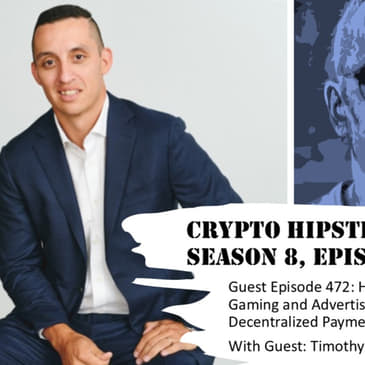

Timothy Tello is the CEO and Founder of 3thix, a passionate blockchain evangelist credited as the first person to receive an SEC no-action letter for an ERC-20 token. He also authored the patent for the use of custodial wallets on blockchain in games. With over a decade of experience, Tim is dedicated to transforming the gaming ecosystem through secure, decentralized payment solutions.
[00:00:03] Hello everybody and welcome to the Crypto Hipster Podcast. This is your host, Jamil Hasan, the Crypto Hipster, where I interview founders, entrepreneurs, executives, thought leaders, amazing people all over the world of crypto and blockchain. And today, I think everybody's in for a treat. I have an amazing founder, CEO of Ethics. His name is Tim Tello. Tim, welcome to the show. Hey, thank you for having me. Glad to be here.
[00:00:33] You're very welcome. I'm going to enjoy this and hopefully my audience will and I'm looking forward to speaking with you. So let's kick things off and I'll ask you first. I ask everybody the same question, but I get amazing answers. What is your background and is it a logical background for what you're doing now? Yeah, so I've been in the video game space for well over a decade. So I built three studios. Some of the coolest games that I've been a part of with games companies like, you know, we built Narcos.
[00:01:02] And I've built two studios, a guy named Chris Cross who created Medal of Honor and Call of Duty. So him and I, you know, built a bunch of stuff. We built the first influencer gaming company. We built one of the first games on Game Pass for Xbox. Built one of the first language learning games ever. You know, and so, you know, my whole career in gaming has led to this moment.
[00:01:25] So, you know, watching the European Union consolidate into the Euro, watching Chris go from working with me to working with Nexon and JJ to building the first version of MapleStory, which was really, truly one of the first Web3 games ever, right? They wanted Nexon token to go into all their games, but they couldn't figure it out. He called me with that problem. And then, you know, talking to guys like Clippy B, the creator of Unreal, about Fortnite before it was the first free-to-play game on console,
[00:01:55] led me to creating the first Web3 gaming company, writing the patent for the use of blockchain in a video game, getting the first SEC approval ever given, and helping get the first games on Apple, Google, Steam, Epic, and the first credit card deal in all of Web3. Awesome. So the SEC gave, I want to talk about that. SEC gave you approval for crypto on gaming? What was the approval?
[00:02:19] Yeah, so it's a, if you go look up on the SEC's website, they write about one mil action letter every seven years. So before Gary Gensler was the chairman, I worked with the SEC and DLX law firm with Lewis Cohen, and we built out the first ever model that was completely compliant by all U.S. regulatory laws for any token. So it's a, it's for any ERC-20 token. So any simple Ethereum-based token, EVM-compatible token to use.
[00:02:47] So not only has it been monumental for gaming, but it's been monumental for a lot of things. So most stable tokens fall under the line of this no action letter. So Paxos, when the SEC started to come after them a couple of years back for Binance USD, pointed at my no action letter and said, hey, we're 100% compliant. You cannot come after us. And they dropped the lawsuit. So a lot of the stable tokens like Circle and those exist because of that no action letter.
[00:03:13] So really it was groundbreaking, you know, DLX and Lewis. I honestly, I thought Lewis was going to be, I predicted it a couple of years back that the SEC would create a chair for crypto. And I said Lewis Cohen would be tapped for that chair. And of course it went to Hester, who was also fantastic. But, you know, I think, you know, he really set the stage for crypto compliance in the United States. Interesting. Wow. Very cool. I did not know that.
[00:03:43] So, yeah. Awesome. So I want to talk about your company, you know, Ethics. What is it all about? What differentiates you at the crossroads of AI and blockchain? What's it all about? Yeah. So Ethics is redefining the ad tech layer of the Internet. Most people don't realize, but ads are the monetization source of the Internet. You know, Apple, Google, all these people make most of their money from ads.
[00:04:06] So there was a product called IDFA, which is identifier for advertisement, which is about 60 percent of Apple's revenue. And what it was is that basically it would take all your private information that you would type into your phone, iPad or MacBook, and it would then turn around and sell that to advertisers to be able to target market to you. That became illegal under the U.S. Privacy Act in 2023. And then also in Europe, we have GDPR, which is their Privacy Act.
[00:04:36] So what we do, what we talk about is like, you know, we like to say the cookie is crumbled. Essentially, you can't use a cookie to target people anymore. That's why every website you go to ask you for approval or to decline to be able to be tracked. You know, websites like Shopify, Shopify, all the direct-to-consumer models are dying a painful death because user acquisition is so expensive. But gaming, what people don't realize, you know, most gaming is mobile.
[00:05:02] 200 billion of the 360 billion dollar industry is mobile and 72 percent of that is ads. So companies like Unity, who is the largest video game engine in the world, you know, as soon as this law went into effect in 2023, you know, they went from a 59 billion dollar market cap on the stock market to 8 billion within 90 days because all their monetization was gone. Companies like Voodoo and Tapplay, who have billions of users, have no money
[00:05:29] because the average cost or average value of an ad went from 8 cents to a dollar, depending on what kind of ad it was, to like 1 cent. So what we're doing is we're taking your data from payment processing on-chain or in-game. So like every item, imagine the receipt from every item that you have, moving it into a custodial wallet, something you don't have to control. And then we advertise directly to that wallet and then we give you tokens.
[00:05:57] So, you know, I think also a big part of it and why we call ourselves ethics is we take no money. It's your time. It's your data. You should be funded for that. And so we provide the payment processing solution that then licenses that data to run the network, but it's fully decentralized. It's your data. It should be out there for you to get capitalization on, not for Mark Zuckerberg or Jeff Bezos or any of those guys. You should be making the money from it.
[00:06:28] I wholeheartedly agree with that. That's what ethics is all about. Changing the ad tech layer, changing a cookie into a custodial wallet where it's decentralized. I don't need to see you as Jamil. I see you as an ID, as a user ID, as a wallet address, nothing more. And I airdrop directly to that address. And you can do whatever you like with it. And you can, you know, you can change it into ETX. You can use it to buy Robux. You can use it to do whatever you want.
[00:06:55] And it's 100% yours because the only thing in this world that has any value is time. And it's your time and it's your data. Let's see. The ad tech model then has changed over time. So I understand this correctly. Websites are not allowed to ask me about cookies anymore. I don't understand. No, no, they can.
[00:07:18] They have to give express permission for a company to target you and to take your personal information and use that to advertise to you. So like every time you go onto a website now, at the very bottom, it says accept or deny, right? Almost every website. That's because of those laws. And they're about to change it because what's really what's happening is like you go on that website and you assume accept or deny.
[00:07:45] If you said deny, they're going to kick you off the website and you want to be there. So it doesn't really work in the favor of the consumer. And so they're actually changing that law that they have to be complicit and they have to be attentive on what they're telling you. You can still stay on this website, but you do not have to share your data with them. And that's the whole point of the Internet is this is ours. It's not supposed to be owned by three or four guys. And at this point, it is, right?
[00:08:13] You know, the reason Mark Zuckerberg is so wealthy, it's not because Facebook is so valuable. It's the rule of multiplicity, right? He is basically taking every single person on on Facebook and they're just a can of soup or a bag of chips on the shelf to him. You're all a product. People assume like Facebook is a product. No, no, you're the problem. Facebook is just designed as a loop or attention loop to keep you there as long as it can keep you there.
[00:08:41] So that way it can keep selling you over and over and over again. So he gets wealthy. It's not for you at all. It's a psychological prison that you're stuck in. So then how can the user get wealthy using their data? Well, I wouldn't say wealthy is the right way, because, again, the rule of multiplicity applies. So he has billions of people using Facebook and Instagram. You know, there's just you and your family. But it reduces the cost of inflation.
[00:09:11] It reduces the cost of product. So let's let's look at an example. Target right now spends about 20 million dollars a month to advertise mostly to women. Women are the biggest shoppers at Target. And if you know, if you're like my wife, your wife's like my wife, she cannot go to Target to buy a toothbrush without spending four hundred dollars. If I go buy my own toothbrush, I'll spend three dollars. But she goes to Target to buy a toothbrush. Four hundred dollars coming out of the pocket. Target knows that. And, you know, they exploit it.
[00:09:41] And so they focus mostly on Instagram where all the women reside. And so now let's talk about like an average ad. So that 20 million dollars to spend, let's say you have they base everything on percentage. So the average of a really good click through rate is five percent on an ad. But every view of an ad costs nine to ten cents for a view. So if you scroll past an ad, it costs that brand nine to ten cents. If you click on that ad, it costs three dollars.
[00:10:09] OK, so out of 100 people, a good click through rate is five percent. Right. So five people out of 100 click, that's fifteen dollars. But the ninety five who didn't click, that's nine dollars and fifty cents. So so far to send five people to Target's website, Target has spent about twenty five bucks. Right. The average conversion on a website is two percent. And that's really high. Like that's a solid conversion. If you own a Shopify channel and you're doing two percent conversions, you're killing it.
[00:10:38] That is really, really good. But I've only sent five people to Target's website for twenty five bucks. It is not enough to convert at a two percent conversion. I need to go back, multiply it by 10 to get to 50 people. So one person converts. Right. So now I've spent two hundred and fifty dollars before one person buys anything. What does that mean? That means the cost of goods go up to cover the cost of advertising because user acquisition is about
[00:11:08] thirty dollars per paying person now. That means you as a consumer are covering the basis for everybody else. And not only that, but where they're gotten to the point where geo and demographics have higher CPAs and higher costs. Like if you go and look, if you use a VPN and you look at Target. In like a rural area and you look at a price of a good on their website. Now, then go to the store and look at that same price of good.
[00:11:38] It'll be like two or three dollars higher. They use location based pricing for affluent areas for, you know, on the website based on your geos. Like they're they understand that some people can afford to pay the cost of their advertisement. But this is all starting to have a major effect on inflation, on cost of goods sold. You know, they people talk about all the time over the last two terms of different presidents,
[00:12:08] the cost of groceries have gone up for X. It's not really a political problem. It's an advertising problem. Because if you also look back, the same time is when all the privacy acts went into effect. When those privacy acts went into effect, it caused a major issue. So used to be Facebook got chart would charge, you know, $10 to paint this wall. Right now they they they promise you the same thing. But instead of.
[00:12:36] Pain the whole wall, they just throw a bucket of paint at the wall, but it still costs $10 because they have no idea who they're advertising to. It makes you think, you know, you had a couple of things there. One was. Let's talk about this first. My wife is kind of like your wife. I went to Ethan Allen with her on Saturday and I thought it was going to be 20 minutes. Yeah, it was four hours. So my son calls me.
[00:13:06] He's like, where are you? I've been going all day. So I bought him an Xbox X as a present. You're a nice dad. Been on for four hours and you get an Xbox. I'll tell you to leave all the time. The groceries, though, the price is going to go up. Right. And I don't see that as an advertising problem. Right. I saw as a as an inflation, you know, or as a tariff problem. Right. They said the price is going to go up. Right.
[00:13:35] So are they tied in any way, tariffs and advertising or it's just, you know. I mean, that that that's where the political inflation comes in the line. Right. Because with a tariff. We we as the United States import, I think, like 70 percent of our domestic products, like the things that we use almost 70 percent. That means if we're charging 25 percent, someone has to cover that.
[00:14:01] Now, I can also tell you, you know, my wife owns one of the fastest growing direct to consumer brands in the country. And we we do a lot of our sourcing from China, Italy and France. So we're going to get hit with either. Well, and what people don't realize is China already had 25 percent tariff. He added 10 percent. So now it's 35 percent tariff. And then you have, you know, 25 percent Canada, Mexico. If any of those sources, I think what's going to actually happen.
[00:14:28] And we've already I've already seen it from, you know, directly is I turned around immediately to my suppliers and I said, you're going to have to eat that cost or you're going to lose me. I mean, they did. They ate it. So I don't know, because like I'm not going to charge more my wife's product to U.S. consumers. That's not fair to U.S. consumers. But someone has to cover that cost. And it's either I cover it or they cover it. But again, go back to ads.
[00:14:58] Most people and luckily my wife is an influencer and does not buy ads. And so all of our traffic is organic. But that is not the case for 99 percent of products in the world. 99 percent of products rely on ads. So if I'm already spending thirty two dollars to acquire a purchaser on average, that's a big deal. If I'm now paying another three fifty and cost of goods sold per unit when my profit was
[00:15:27] already at like eight to twelve percent. So I don't have room to move. So we're going to have to see we're going to see companies fail because they're not going to negotiate well. We're going to also see, you know, a lot of companies turn around to their suppliers and have to negotiate very hard to get them to cover those costs. Got it. So I want to talk about I want to talk about supplier relationship. You are not only revolutionizing the ad tech space, you're revolutionizing the way payments are done.
[00:15:55] And one of the big problems in payments. I'm a Litecoin holder. I've been a Litecoin holder for many years. I know the importance of chargebacks and I know that the risks and all that with chargebacks. Right. How are you revolutionizing, you know, the payment space? And then how do we, you know, using crypto eliminate the chargeback risks that our suppliers and vendors face when, you know, when dealing with business with us? I think that's the beauty of crypto. Right.
[00:16:26] Confirmations showcase you have the funds. So unlike debit and credit card and processing rails, which we do provide. Um, most of those rails are alone. I'm sending money or I'm telling you, I owe you my MasterCard. Right. There's a reason MasterCard charges at 2.3% plus interchange. Right. That, that fee is to cover chargebacks. It's to cover the cost of, of their product.
[00:16:54] So what they're saying is like, you know, you go to the grocery store, you write, you swipe your card. The grocery store does not get that money right there. A grocery store might get it, you know, ACH to them because the ACH costs like seven cents, four cents. They don't want to run that transaction. They're going to ACH to them two to three days down the line. But if you go turn around and you tell your bank, I didn't do that. Or, you know, later on, 30 days later, you tell the bank, I didn't do that. No, that's why they charge that 2.3%.
[00:17:21] And then they charge the, you know, the, the merchant $25 fee. Now, when we talk, talk about cryptocurrencies, if I wanted to send you Bitcoin, right? The whole process of sending you a Bitcoin, you have to have validation of the network, right? You need 21 people to say, yes, he has this much Bitcoin. And yes, this is a real wallet that it is going to. And so as soon as that block is served, you can't take it back.
[00:17:49] So all those, but it's a slow process. So then you get validators to speed that up with, you know, proof of stake. And so a validator can say, okay, look, we can look at all 21 of these transactions really fast and like tell you, I guess, yes, yes, yes, yes, yes. Way faster than, you know, they can do the math. Now, the only way crypto works and why they, you know, it's kind of funny because like people talk about like, oh, you know, we can reduce the cost of, you know, international transactions.
[00:18:17] And this is like the big thing, like XRPers always talk about like, right? It's like, oh, you know, cross-border payments. It's going to be so cheap. Everyone can do cross-border payments. You know, actually, if you think about it, base is probably the cheapest out of everybody to do cross-border payments, but all crypto works the same. You have to validate that I have this and you have an active valid wallet and then I'm sending it to you. And then it validates that you received it. It confirms that transaction every single time.
[00:18:46] So when we do a transaction on chain, it's very hard to back it up. Now, it's kind of like, think about like this. If I sent you money, there's a qualm to this. If I send you money and you scammed me, getting it back is almost impossible. So that's another issue that we deal with. And so on our end, you know, we work with AI. We work with companies like Insure. We work with, you know, early fraud detection.
[00:19:15] We look at lookalikes through our AI models and machine learning to really break this down. So gaming, you know, has 20 to 30% chargebacks industry-wide. It's probably one of the highest high-risk markets in the world. And so there's really, really good AI and machine learning tools that have been around for the last decade that really help prevent this. There's also, you know, very complex. So like the chargeback rate on someone that swipes their card is very low.
[00:19:45] You can, most people just assume they have a camera. But when you're there in person swiping your card, it's almost like a digital signature. You were there. It happened. It's very hard to say you didn't do it. But they're starting to build these very complex, and Micah is a good one to look at, these very complex algorithmic expressions that essentially provide a digital signature
[00:20:08] that you are you, that you really did it, that eliminates like 99% of all chargeback and fraud. So we're, the whole industry is moving on online and on chain, and it's all being done because we can validate transactions at the moment of creation to the moment of securement. And that'll reduce the chargebacks? By at least 99%. Got it. That sounds good.
[00:20:36] So I'm thinking the use of AI is important here. And what you'll be able to do then, especially like from remote parts of the world, is you'll be able to assign an identity to people who you're dealing business with, right? What breakthroughs are going to be possible now using AI that were not, you know, present just only blockchain, but now the combination of two enables? What does it enable? And how do you, you know, what's your role making that improvement?
[00:21:06] And happen. So I think that this is a, another one of those things that people assume is new, right? When we talk about AI, it's kind of funny to me that so many people like are scared of AI, like it's a new thing. AI and machine learning have been around for a very long time, extremely long time. And I think it's also important to understand what AI is. It's essentially it's assumption models, right?
[00:21:32] If a plus B equals C, then you tell that to the machine and it reminds everybody that the answer is C. So think of it like this. A hundred people took a test and 90% of those people said the answer to question one was A, right? And then 10, 7% said B. And then the last few percent said C and D. When you ask that question to you, say, Chad GPT, it would tell you the answer is A. But it gives you the option at the bottom saying, well, this answer's not good enough.
[00:22:02] Oh, it might be B. So AI isn't really AI. What's happening is it's using assumption models based on the most approved selection. And so, you know, we're not taking AI and we're creating something new with blockchain. We're taking blockchain and adding AI. And so for us, like we're taking all the receipts from what you buy on in a video game
[00:22:30] or what you buy through our payment processing to on ramp and off ramp crypto, what you're buying through our partners. We're looking at all that information and we're applying it to AI models and machine learning models to create lookalikes, to create data lakes, to create, you know, assumption models. So, you know, they've proven that they could take your last five credit card transactions on Visa's network.
[00:22:56] And with a deviation of about three, they can figure out what your credit score is. Just look at your last five transactions because they can compare it to everybody else in the Visa network who's had similar five transactions. What were their credit scores? What do we know about them? So without with a blind blindfolded, they can look at it and say, oh, his credit score is a 720 just off of these five transactions. That's how good AI and machine learning is.
[00:23:24] So when you get down to the consumption level and not your personal information, not your age, sex or location, but what do you buy? Right. If I bought a flight to Miami, you probably need some swim shorts. You probably need flip flops. You probably need these things because that's what everyone else who went to Miami, that's what they did next. And so when you understand those things, you understand how to advertise better. So then the advertising goes up. Now you go to, you know, your favorite flip flop store or you go to your, you go to Billy
[00:23:53] Bong to get a pair of swim trunks and you pop on their website because you saw their ad and they say, hey, you've got $12 in billabong rewards for seeing our ad. And you can use that. The chances of you buying something increases from 2%, like 80%. And then I charge them a referral fee. Interesting. So I'll tell you my last five transactions. I'm not an AI, but.
[00:24:24] It was, it was gas salad cookies from the crumble. My son's spa. Cause he had a physical therapy and WWE tickets. Yeah. Well, I could just, I'm not, again, I'm not an AI, but I can tell you a lot from that. And I can learn a lot from you. One, you know, I get WWE tickets. You probably have kids, right? You, you, you know, you can learn that pretty quickly. You bought a salad. So you choose to eat healthy.
[00:24:53] So you're probably, you know, a healthier person. You went to a spa. So I'd immediately assume you're between the ages of 35 and 55. And then you said gas. That one kind of is a, is a, an anomaly because everyone buys gas. But you start to break these things down based on what you do and you compare them to other people. You know, I would also assume that you're affluent because you can buy WWE tickets. Now, if I look at the price of the WWE tickets, I can know how close you are to the stage.
[00:25:21] If I know you're closer to the stage, you're probably a wealthier human being. Then I can start to say, okay, his credit score is probably in this range. And not only does it matter about what you bought, the price that you bought it at. Right. And then, so we can start to figure out different things just by taking assumptions and taking the most probable next answer. Yeah. Wow. I didn't think like you do, you do a lot of. I'm just telling.
[00:25:51] That's how my mind works. My mind works different. Yeah. Yeah. No, it's great. It's great. So I guess we're going to be able to. Yeah. I'm going to. I want to, I want to touch on this. I want to shift gears, but you made me think. So thank you. Of course. Yeah. I want to talk about your title, your company, the name of your company. Ethics. Yeah. Ethics. It's something that's missing right now in crypto and blockchain, right? Isn't it?
[00:26:19] What, how do you think we improve the ethics in the industry? You know, I think, you know, like I said, I basically invented Web3 Gaming, right? And I helped create Polygon. Janty Kunani used to work for me. He was my lead engineer. I built the first ZK based on Mario Brothers. I built the first Layer 2s. I worked with the SEC. I set the pathway for people to come down.
[00:26:43] And the only reason I am not as famous as like Joe Lubin or Vitalik or, you know, all those guys, men, is because for the last seven years, I have not agreed with anything gaming related in Web3. I don't believe in speculation is always needed. I don't believe, you know, your NFT art is really worth hundreds of thousands of dollars. I don't really believe, like these things really matter.
[00:27:12] And I really don't believe in rubbles. I don't enjoy VCs writing checks to people to then turn around when they get their cliff on their equity or their token and immediately selling it all. And so like these projects that are trying to build lose all their validity, all their credibility. Everything just goes to the wayside. I don't agree. And so for us, ethics is all about doing what's right.
[00:27:39] You know, we wholeheartedly believe your data and your time is valuable and that you should be rewarded for those things. We don't take any money out of it. Our ad network, you get 100% of every dollar earned. So we partner like Procter & Gamble, Pepsi Foods, Burger King. When they run an ad to you and you see that ad, I immediately airdrop the exact amount that that ad was worth. And I give it all to you. I only make money if you were to buy something.
[00:28:06] Like if you were to go to Burger King and use that token that they gave you to buy Burger King, fantastic. And I'll make 10% or whatever it is that I've agreed to at Burger King. But I don't believe that I should be the kind of person that gets value from other people's time and hard work or their consumption. That doesn't make any sense to me. So, you know, when we look at things, we look at them a little bit different.
[00:28:32] Like, you know, we look at things as how do we remove bad actors from the space while setting the precedence and the tone for the rest of the space? And I think decentralization is how you do that. I think, you know, greed is an inherent quality of all people. You can't take it out of you. So you have to understand it and accept it. And you have to move further down the line. And an example of that would be like, you know, it's so hard.
[00:28:59] People don't realize how hard it is not for these people not to rug pull, right? Think about it, right? You're sitting on these tokens and it's one click, one time, you click a button saying do it. Your heart's racing. It's moving fast. You're just like, I don't, you know, there's hundreds of millions of dollars just sitting there that you could just have it. Take it. It's yours. Imagine it's like the Aladdin, right? You walk into the cave of wonders and there's jewels everywhere.
[00:29:29] Don't touch them. If you touch them, it's over. You have to get to the genie's land. If you touch anything else, it's done. But you're sitting there every day at your computer, one click away from rug pulling at all times. So what I did on my tokens is that one, I set a besting schedule out for, you know, longer than everybody else's. And I put what I call nuclear launch codes in.
[00:29:54] I have to have a validation network agree to let me sell any of my tokens over 1% of my entire supply. If I decide I want to sell 1% of the whole supply of my tokens, not 1% of the whole token supply of just my tokens, my allocation. I have to have five people say yes to let me do that. And I think I'm going to insert a randomization.
[00:30:21] So, you know, where it just goes to people on the network and say, you know, it'll send them a thing and say, hey, you know, this person wants to sell this many tokens. This is what it is. Yes or no. And you click yes, boom, I can do it. But I really think that if more people understood that it's so hard, that temptation to click, if you just remove that temptation, I don't have that ability. No matter what I do, I'll never have to deal with that ability because I've written it into our smart contract.
[00:30:49] Like I don't, it's something that we all have. Greed is a part of who we are. We wouldn't work, right? We wouldn't want the biggest house. We wouldn't want the nicest car. We wouldn't want the coolest clothes. It's who we are as a human population. And so we have to accept that and we have to move forward in understanding how to prevent it. But most people don't think like me. And that's been the problem with the industry. And like, you know, I'm a big golf fan. Tiger Woods had millions and millions of women throw themselves at him. He messed up one time.
[00:31:19] And that one time, this cat dropped him, right? It's so hard to deal with that temptation every day, a million times a day, without this one time giving in. Yeah, I can see that. Interesting. So I want to have a follow-up there. I can do a lot of follow-ups on what you just said. But I want to do one because you are from the gaming industry, right?
[00:31:50] A lot of projects in this space in Crypto Web 3 gaming projects have done this model play to earn. Terrible model. Yeah. What do you think would be a better model? Roblox is the best Web 3 model on the planet. You don't need a token that has speculation. Here's the problem with play to earn. Play to earn, you got to understand, you need buyers and you need sellers. But you also need in the middle, grinders. And people forget the grinders part.
[00:32:20] So you like salad? You went and bought a salad? I bet you didn't pick those tomatoes, right? You need someone to go pick those tomatoes. So that way they can then sell them to the market. The grinder picked them. The seller sold them. You bought them. Play to earn is missing the middle. You have people that are going in Southeast Asia who can be the grinders, but they're not selling into the open market.
[00:32:45] What they're doing is they're turning around and just selling to the liquidity pool, to the exchanges, where no one is buying. Because there's no product market in there. So instead, if you were to give them items or NFT or digital things that they could then sell on a secondary market to the game players themselves, think of it like World of Warcraft. World of Warcraft is one of the first World of Three games ever.
[00:33:10] And the reason is people would grind gold and sell it on eBay. People would buy that gold if they didn't want to do it. And then they would turn around and play the game. Someone like me, I played Pokemon Go when it first came out. I walked 10 miles the first day. Probably the most I've walked in 10 years. And, you know, I played it. And the problem is and why it fell off is I had to catch 400 Magikarp to get one Garados. I had to grind that out.
[00:33:37] But if you told me I could pay 10 cents for a Garados and, you know, they would have got a 3% rake and someone could have gone out and grinded those Magikarp for me and sold them like eBay secondary market, I'd have bought all of them. I'd have bought them all day. I would have spent 40 bucks to get a Garados. So now I have a grinder. I have a seller at the secondary market and I have a buyer. But the tokens, what did you do with the token? You just sold it. You didn't. You didn't. There were no buyers. Everyone was selling. They were earning them. They were selling. They were earning them. They were selling.
[00:34:07] There was no value add to the economy of scale. Now look at Roblox. You got to understand in a game. There's everyone has their own value proposition, right? Users. What is the value to the user? Well, it's content. TikTok has proven it. Roblox has proven it. The more content you have available at any time when I get bored, that is what I want. That is the value to a user. To a developer. A developer is essentially an artist, right? What is the value to any artist?
[00:34:37] If you're an author, if you're a painter, you just want someone to take what you did and enjoy it. Read it. Write. Look at it. Enjoy it. Right? So their content value is users, right? So now I'm a platform. How do I marry these two things together? I create an economy. I need a grinder. I need a buyer. And I need to sell it. And so Roblox figured that out. Roblox switched to a single currency model in 2015.
[00:35:03] And for seven years in a row, their revenue doubled every single year. Now, they are worth more than the entire AAA gaming industry by themselves. I like it. I like it. I think it's a good model. I like that. So I could use that to apply it to the NFTs as well or anything else. Anything. Anything. You have to have to create a flywheel. You need an economy of scale. Create an economy of scale.
[00:35:33] You need grinders. You need buyers. And you need sellers. That's how that works. And if you leave one out, the wheels don't turn. Right? If you think of it like a gear, right? You have two big gears here. But you have that little gear right at the bottom. Balancing the other two gears. Right? You have to have all three. If one of them stops, it just doesn't work. It'll roll for a little while. But then you're going to start chipping teeth. You're going to start breaking stuff. It's not going to work. Yeah. I agree.
[00:36:04] Well, this has been very insightful. And I enjoyed and enjoyable. I enjoyed talking to you today. Thank you very much for speaking with me. Thank you, Ralph. Yeah, you're welcome. I have one last question. It's easy. Shoot. How can people find out more information about you and about ethics? Yeah, you can Google me. That's I'm easy to find. Ethics. We have a website, ethics.com. Three T-H-I-X dot com. We have socials. We have discords. We have telegrams. You know, I jump in there from time to time.
[00:36:34] You can always find me speaking on some stage around the world at some crypto or gaming conference. You know, reach out. You know, I'm a normal person. I like to talk to everybody. And, you know, I'm happy to talk to anybody. So, you know, I'm on LinkedIn. I'm on Facebook. I'm on Instagram. Just reach out. Awesome. Awesome. Thank you very much for your time today. Of course. Thank you for having me. Thank you.