
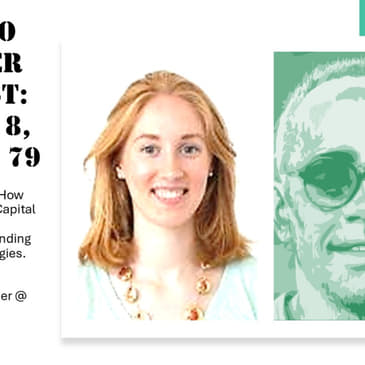

Meg Lister is a leading voice in Web3 funding, transforming capital allocation as a Managing Director at Gitcoin Labs to drive financial returns for ecosystems and builders while ensuring long-term, sustainable growth. She specializes in designing multi-layered funding strategies that support every stage of a project’s lifecycle—quadratic funding for onboarding, retroactive funding for retention, and direct grants for scaling—empowering Ethereum ecosystem participants to achieve more.
Gitcoin (May 2023 – Present): Leads Grants Lab, the core business unit powering Gitcoin’s multi-mechanism funding infrastructure. She initially joined to oversee Grants Stack, one of Gitcoin’s flagship products, and was quickly promoted to lead its consolidation and strategy.
Flipside Crypto: As VP of Product & Ops, she launched a flagship analytics product that secured a $50M Series A, making on-chain data more accessible and actionable for ecosystem builders.
WordStream: Scaled the company post-Series A, earning five promotions, launching a $1M ARR business unit, and contributing to its acquisition by Gannett.
Meg is reshaping Web3 funding models by creating efficient capital distribution mechanisms that support ecosystem-wide goals, ensuring Ethereum builders and enterprises have the resources needed to innovate, scale, and succeed.
Why VC Funding Model Fails Web3 Projects
Experience driving Web3 capital efficiency: Media mentions:
[00:00:02] Hello, everybody, and welcome to the Crypto Hipster Podcast. This is your host, Jamil Hasan, the Crypto Hipster, where I interview founders, entrepreneurs, executives, thought leaders, amazing people all around the world of crypto and blockchain. And today I have an amazing guest. She is the general manager of labs at Gitcoin. Her name is Meg Lister. Meg, welcome to the show. Oh, thank you so much for having me. I'm excited to be here.
[00:00:31] Awesome. I'm happy you're here and I'm looking forward to our conversation. So let's get to it. My first question is the same for everybody, you know, and it's a great question because people give me all kinds of amazing answers. It's what is your background and is it a logical background for what you're doing now? You know what? I feel like in any interesting career and particularly in crypto, 90% of the time the answer to that question is no.
[00:01:00] And I am in that 90% bucket. You know, I, in college, majored in philosophy. I really wanted to go into academia. But in the U.S., a lot of people graduate with this little thing called student loans. And so I woke up one day and realized, holy shit, I got to get a job.
[00:01:20] I managed to fall into tech from that background and spent the first couple of years of my career in marketing organizations at tech companies. And while I no longer work in marketing, the skills that I've learned there have been so foundational to everything else that I've done.
[00:01:43] And the idea of listening to the market, to the way that marketers kind of communicate to their audience and test and learn is so foundational to so many skills. That I always recommend somebody spends a student marketing. But from there, I have a background in web to product management and in traditional SaaS companies.
[00:02:10] I spent five years at an advertising technology company and got to the point where I had achieved a lot that I was proud of and spent a long time kind of building this company from a Series B organization through to acquisition by a Fortune 500 company.
[00:02:32] But it felt like everything that we were doing was kind of in service of Google and Facebook profit in the ad tech world. And it gets to a point, particularly when you're passionate about entrepreneurship and innovation, where that's just not fun anymore. And so a friend of a friend said, hey, if you're looking for something really different, you should try this thing called crypto. Yeah. And that was five years ago.
[00:03:00] I was really fortunate to land at a fantastic crypto company called Flipside Crypto, which provides data analytics for on-chain organizations. I led the product organization there from their seed through Series A scale and launched their flagship product. And then about two years ago, had the opportunity to join Gitcoin, again, leading their product organization and now leading our business unit, Grants Labs.
[00:03:28] Awesome. I interviewed Flipside, I think last year. Oh, no way. Yeah. I don't remember the person's name. I talked to so many people, but I definitely did. Fantastic. Lots of great people over there. Yeah. Yeah. So Gitcoin has some great people too. And I want to find out your role there and including what your vision is, what your mission is for what you do.
[00:03:56] Yeah. So my role there is brought on to lead the product organization, fairly similar to other points in my career. Someone said, hey, we've got this product idea. We're trying to launch it. Can you kind of get it over the line and see if there's something there? And so I joined Gitcoin. We had just launched this product that was designed to help other grant programs grow and scale. And Gitcoin itself is most known for the grants program that we run. We've done that for years and years.
[00:04:26] And it got to the point where other people started coming to us. Maybe they were grantees that we had funded before or other ecosystems that were growing up saying, hey, you guys have been running grants programs forever. What kind of tools or expertise do you have that I can use to grow my grants program? And so we realized we were sitting on something much bigger and decided to launch a product that first could help other organizations run quadratic funding.
[00:04:51] And so we launched that in 2023 when I first started and scaled that across our internal use and our first couple partners. We saw a lot of traction with that in alignment with our core vision. And so early last year, we structured the organization to continue to support the grants program that we've been running forever,
[00:05:15] as well as spin up kind of a separate business unit that we call Grants Labs that is focused on helping our customers at L2s or large protocols that operate on the EVM to grow and scale their grants programs. And so that is what myself and our L2s team are super focused on these days.
[00:05:35] And we're particularly excited about it because we feel like grants programs are really one of the keys to a sustainable and thriving Ethereum ecosystem. The grants programs are the way that small and early stage builders get funded and encouraged and sustained. And we're really excited about the part we play in that. Awesome. I was at an event last night and I have a follow up. I was at an event last night. We're talking about Ethereum and we're talking about, you know,
[00:06:05] it seems to be that people are spinning their wheels a little bit or not acting with maybe a sense of urgency that people in other ecosystems, like maybe Solana are, you know, what's the state of, you know, the growing and building projects that use your grants program. What's the underlying, you know, state there in the, in the, in the space. Yeah. You know,
[00:06:33] I would say one of the major trends that we notice is not necessarily across ecosystems from, from Ethereum to Solana, but it is, it has been tricky over the past few years to comply with regulatory guidance appropriately. And so we're, every time we achieve some more clarity from various administrations, things speed up a lot there. I, I do think that over the last couple of months,
[00:07:02] we have seen negative sentiment across crypto and across Ethereum, Ethereum, especially. And that is, I, I don't think isolated to Ethereum, but certainly having an impact on builders. And so our, our challenge and the momentum that we're trying to build with all of our partners is actually now is the perfect time for grants programs to step in.
[00:07:27] And one of the things that makes me so enthusiastic about grants programs is the way that we saw so many of our partner ecosystems double down on grants in the last bear market. And you can see the ones that doubled down, particularly optimism as a shining example of this are the ones that have flourished in the years since. And you see that investment from grants really coming back to benefit the ecosystem on this like one to two year cycle. Awesome.
[00:07:56] So I think in any case, I have one of what I hear about crypto grants programs and especially get coin is it's a lot better than traditional grant funding. Right. So how is, why is traditional grant funding inefficient? How can we improve it? And why should people embrace coming to the web three grants program space? Yeah. You know, I think there are all kinds of problems with both web two and web three grant funding.
[00:08:24] And one of the things that I want to be transparent about too, is I think that web three grant programs also have a ton of room to improve, but that they're coming into the situation with so many more advantages and opportunities to, to do so, to embrace new ways of working in a new design space because of the tools that we have available.
[00:08:48] And so this idea that crypto is programmable money and that we're using crypto as a funding source just gives us so much opportunity in the design space. And so it's so much easier to unlock things like locked grants or revenue sharing grants or token and equity sharing grants.
[00:09:14] We can really like program and design around all of these, as well as get so much quicker and more efficient in tracking impact when we're funding on-chain builders and on-chain organizations, because it's so transparent and that data is so transparent and available to us as grants managers and builders. Awesome. So you said some different, some different types. You said equity, what are the, what are the different types of grants people could try to get?
[00:09:44] Yeah. So at Gitcoin, we primarily see three types of grants. One of them is direct grants where I, as a grants manager say, Hey Jamil, here's 10 K to go build your program or sponsor your podcast. Um, the other one we see is quadratic funding. Um, so that's a situation where I, as a grants manager might say, Hey, I've got some hunches about what I want to fund, but I don't have all the information.
[00:10:11] I'm going to crowdsource information from my community to help make that decision. Um, the third one is retroactive funding. So this is where, again, I, as a grants manager say, Hey, I don't have all of the information or maybe all of the time to sort through the data and making a decision about what to fund, but I'm going to compile a list of what's gone on in my organization over the last year and let a few qualified individuals decide how to fund those results. Um,
[00:10:41] which I think is already a huge step forward over a lot of traditional web two grants programs, particularly those retroactive and quadratic funding examples. Some of the things that we're starting to get excited about experimenting with are, grants that, uh, could be given in any of those contexts, but also, um, unlike some part of either equity or revenue sharing back to the grant funder.
[00:11:10] Um, and just position both the, the builder and to the funder, um, towards long-term alignment and success. So providing the funder with an ROI for the, that's, that's smart. That's a good idea, you know? Um, so let's talk, let's dive a little bit into each of these. So direct, right. Um, I know what that is. Actually, I tried to get one once. I think I felt, I think I rescinded it. Um,
[00:11:40] it was when I was first struck out on my own new podcasting and I wasn't, I didn't know what the landland was. Right. But there is a traditional, like there is a traditional VC model, right. Of direct investments, but that fails, right. That fails most web three projects. So, so why is it, why is it that, why do they fail? Yeah. You know, VC funding is kind of like web two funding in the same way that we talk about it. Um,
[00:12:07] it's good at some things and not good at some other things. And I, um, saw it with the thread on Twitter the other day about how, um, VC funding in crypto has declined dramatically over the last few years, which is not a surprise to any of us. Um, and the commentary there was, Hey, there's, there's still a lot of opportunities to be funded in crypto and a ton of economic potential.
[00:12:35] All of us here and probably listening to the podcast are really bullish on the long-term outlook in crypto. Um, but this disconnect between things that are getting VC funded and the overall excitement in crypto, um, has something to do with VC investing in crypto not being very profitable lately. Um, VC funding looks for a very particular type of opportunity. Um, they've got a very particular, you know, time window for that return too. Um,
[00:13:04] and so using something like a revenue sharing investment vehicle or an equity sharing investment vehicle, just really opens up, um, both kind of like the risk profile for the investor, um, the opportunities to get involved. And I think could really broaden the pool of who is funding, um, and investing in web three outside of BC. Got it. That makes sense because somebody gave me a statistic the other day. I didn't believe it at first,
[00:13:34] but like, it was the most well-known crypto outside of the crypto sphere. If you're not from the crypto sphere, if you're from, if you're in a normal world, um, the most well-known one is XRP. And I'm like, that doesn't make sense to me in crypto, you know, but the VC, I guess they look at things a lot differently. So it's a VC funding is such a huge signal to, especially outside of crypto. Um, and so,
[00:14:04] you know, that's just another example of this disconnect between what gets VC funded and all of the, like, exciting opportunities that are getting built that you and I and your listeners are more familiar with. Yeah. Yeah. So let's stay in that lane and talk about retroactive, you know, or quite no quadratic. Let's talk about quadratic first. I don't, I don't know what that is, you know? So what is quadratic funding? You know, um, how's it work? Why is it a great model? Yeah.
[00:14:32] So quadratic funding came about probably six or seven years ago, which we'll call it, you know, in a year and in crypto time. Um, and it came from a, uh, actually an, a research paper that was authored by Vitalik Glenn Weil, um, and a few other individuals exploring this problem of, uh, the same topic we've just been talking about. What are other models besides VC funding to encourage investment in the crypto space? Um,
[00:15:01] and the idea behind it is that, you know, VCs take a limited number of, uh, shots on goal, if you will, they invest in a limited number of projects, um, and VCs and any, you know, individual can only have so much knowledge about the set of organizations that they're looking at. Um, and that information is biased by, you know,
[00:15:29] that individual's particular perspective, which is all to say, Hey, what if there was another model? And what if we could, um, really enable funding through collective intelligence from a community and for people who actually also really benefit or really invested in seeing particular projects succeed? Um, um, other than the intelligence or even the bias of a single or small group of investors.
[00:15:58] And the way that it works is, um, um, say that the Ethereum foundation wants to fund startup developer tools on Ethereum, which they've done many times. Um, and they're saying, Hey, who better to make these decisions than the developers themselves? And so they say, Hey, we're going to put a million dollars behind this. Um, but in order to make those decisions, we want the, you know,
[00:16:28] community to tell us what's most important. And the community is actually going to vote with their dollars. Um, and so you and I were both Ethereum developers and we put, you know, a dollar, two dollars in donations towards each of the projects we support, um, which count as basically votes towards those projects. So we've got skin in the game and, you know, we're invested in our small dollar way. And how does investments should be bundled? Does that make sense? It, it does.
[00:16:58] And I have a couple follow-ups, um, you know, he used to talk about, you know, back in five years ago, or even seven years, eight years ago, when I came in the, the strength of the crypto community, right? Because it was a smaller community, but it was very strong, right? You don't really hear about the crypto community anymore. You know, you hear, I guess, you know, do we still have strength in that, in that community? Is it, it seems to be going by the wayside.
[00:17:28] Um, why is the community still important? Yeah, I think community is still incredibly important. Um, and in my read, there's two things at play. Um, one of them is that the tightest knit and most active communities also tend to be some of the smallest. Um, um, and so naturally, um, as an industry expands, those original communities, they get bigger,
[00:17:57] and they have more of those looser ties versus a small group of people with tighter ties. Um, and there's an opportunity there for us to empower kind of, um, it's like decentralized or smaller, more focused communities within crypto, um, to replace the, uh, kind of monolithic crypto community that we've thought of in the past. Um, the other thing is,
[00:18:21] I think that this is a perception that is really skewed by social media and the way that we communicate today. Um, and every time I bring this up, I sound like my mother, but, um, this is one of those times where I have to admit that she's onto something. Um, and the, uh, discourse on social media has an obvious bias towards, uh, kind of rabble rousing and negativity.
[00:18:48] And so the folks that you see on there are not the folks or the statements that you see gaining traction. They're not the unifying and uplifting ones that you might've seen in the past, or that are truly indicative of overall sentiment. You're just seeing what the algorithm's rewarding. And so I do think that there's still a lot going on outside of social media behind the scenes, um, with crypto communities that just isn't reflected quite as widely. So then how do you,
[00:19:18] how do you discern between the collective intelligence of that real true community for certain coins and the, um, um, the biasness that is embedded in the algorithms? Yeah. And I really think this comes down to finding other, um, ways, both platforms and like activities or mechanisms for communities to engage. And quadratic funding is a perfect example of that. Um, I, again, not to sound like my mother,
[00:19:47] but nothing productive ever gets done on Twitter. Um, and, you know, I deleted it from my phone a couple of weeks ago and I've never been happier, more productive. Um, what is actually, um, you know, motivating and rewarding both for communities and the ecosystems they support is to give them a job to do. Um, and that could be something like running a quadratic funding program, um, and really harnessing again, that intelligence that the community has.
[00:20:18] Interesting. I like the, I like, I like quadratic funding, but I hear, so I want to, now I want to ask you about the retroactive, right? retroactive public good funding, you know, why is that also better for web three? Yeah. So retroactive funding is a really simple idea, um, which is the idea that it is, you are better able to reward impact after you can measure the impact that's already happened. Um,
[00:20:45] and so it's a little bit of a carrot in a stick approach. Um, I say, Hey, um, if you want to build in my ecosystem, amazing. I am going to give $10 million at this time next year to the, um, products that have succeeded in attracting the most users to my L2. Um, which is actually very close to optimism's playbook. Um, they're really the champions of retroactive funding right now.
[00:21:16] Um, and what that does is that sets the, all of the builders. Oh my God, there's a huge opportunity to build and get rewarded on this L2. Um, I want to start right now. I know the parameters of how I'm going to get rewarded and the rewards are there. Um, and then on the, on behalf of the people who are managing the grants and putting those $10 million up, you know, that you're only rewarding for actual impact once it's already happened. Um, you know, you don't hear,
[00:21:45] you hear, you hear a lot about meme coins. You hear a lot about different kinds of investing and they're making, making a quick buck. I think cryptos, as far as impact investing, as far as social good, as far as the areas that, you know, could be impacted positively, you don't really hear about the promises of blockchain too much anymore. We're currently, you know, um, why is, why is investing for social goods still, you know, important? Yeah. You know,
[00:22:15] I think that, uh, we see this in web three and elsewhere too. There's a lot of fluctuations in social good narratives. Um, and sometimes those are tied to like, Hey, social good, uh, or environmental causes are good for us to invest in when we have the money or when the economy is doing great. Um, we see that in regular old politics. We see that in web three. Um, and our philosophy on,
[00:22:45] at Gitcoin is to abstract away from that for two reasons. Um, one, because regardless of the economic climate, you want to be investing in, the things that are good for your community and ecosystem overall. Um, you know, it's not about funding special interests or pet projects. Um, we're all early stage builders who are trying to fund things that are going to grow our ecosystem. Um, and that's really what we focus on is what are the levers that are going to
[00:23:14] help you grow your ecosystem, whether or not those are social impact, public goods, or for-profit goods. Um, that's, you know, that's not really the categorization that you should be using for funding. Um, and the second one is just because it's become such a murky definition, um, particularly in such a new space that draws so many diverse voices. Um, settling on those definitions is almost a full-time job in itself and not one that feels very high ROI.
[00:23:47] So what you're saying is there's, there's a need to like, a lot of Ethereum developers I talked to talk about account abstraction, right? So what you're saying is really narrative abstraction is equally, like, it should be equally important. Why should people say, okay, you know, take on the role of engaging in narrative abstraction? Um, narrative abstraction is such an interesting way to put it. Um,
[00:24:17] I might, uh, say that that narrative abstraction is a way to reorient on the higher level strategy. Um, and that strategy is the why behind what we're funding. And so it's not the what it's not, Hey, we're public, we're funding public goods or Hey, we're funding developer tools. Hey, we're funding growth in our ecosystem. Um, and these are the three ways that we'll measure that, or these are the three,
[00:24:46] you know, growth verticals that we see. Awesome. So under and two, if, if the dissipation in this narrative and, and, and, it was, it was caused by, I'm thinking about it. I think it's caused by COVID the decline in, in the, in the importance of focus on community narrative is, has, has been impacted by the after effects of COVID. Yeah. You know, I saw a study, um,
[00:25:14] we just hit in the U S at least like our five year anniversary of when COVID really hit and lockdown started rolling out. Um, and I just saw a study of the percentage of Americans who are reporting higher rates of loneliness. Um, and lack of regular social communication. Um, and so those definitely seem correlated. Yeah. Interesting. Just, I understand to do further studies on that. So, um, um, um,
[00:25:44] what other new categories of funding that you think offer a substantial improvement over traditional funding? Yeah. So one thing that we're interested in is just continuing to push the boundaries of some of these, um, popular mechanisms like quadratic funding and retro funding. Um, um, we have just rolled out a version of retro funding, um, that operates on, uh, like metrics based funding. And so instead of analyzing individual projects, we say, Hey,
[00:26:13] I want to most reward the, um, monthly active users in this ecosystem versus the new TVL brought into this ecosystem. Um, and so you're voting on metrics rather than, uh, specific projects. Um, and I think that one's pretty interesting. Um, we're also working on, um, more metrics driven funding, um,
[00:26:39] and creating like leaderboards or metrics based milestones that unlock new funding for projects, um, and experimenting with different, um, payment methodologies too. So to go back to the, um, um, Hey, it's programmable money. We can do so much with it. Um, what if we experimented with different ways of locking grants, um, or of streaming grants,
[00:27:04] or even of creating like preferential lending pools for the recipients of grants. Awesome. So there's a lot, there's a lot to look forward to, you know, um, and there's a lot of good way. Yeah. I remember, um, eight years ago, I was, I helped a startup put together, a VC presentation and they started for, I think it was for heart monitors and he didn't get the funding because they didn't like the, the, the color blue on the graph on page 32.
[00:27:33] And I'm like, that doesn't work. You know? Yeah. So lots of good options. This seems like you're, you're, you've, you've come up with. So. Great. Awesome. So I want to thank you very much, uh, for your time today. I enjoyed speaking with you. And, uh, one last question is how can people find out more information about you, about get coin, about get coin grants program. How can they do that? Oh, Oh, wonderful. Um, we actually have a new launch of the get coin grants program, um,
[00:28:03] applications open at the end of the month. And you can find, um, more information about that at get coin.co or on any of our socials, as much as I just disparaged them, we're on Twitter at, at get coin, um, and on, uh, Barcaster at the same handle. Um, for me, you can find me at, uh, make lister.com or any of my socials, um, at make lister. Awesome. Thank you very much for your time today.
[00:28:33] Thank you. It was such a pleasure to talk to you.