
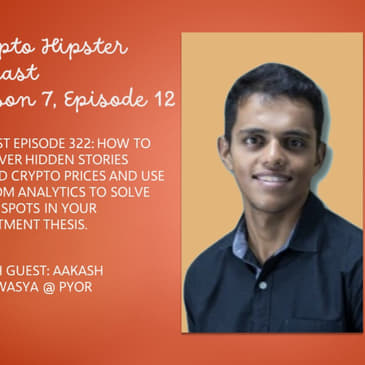

Aakash Athawasya is the head of research at PYOR, a crypto data analytics company for institutional investors and crypto protocols. He looks at ongoing crypto narratives, from alt-L1s, staking and restaking, and DePin, among others. Before PYOR, he was the founder of Doodhwala, India's most-read crypto newsletter that covered crypto research and news daily.
Check out PYOR: https://www.pyor.xyz/Reach out to Aakash here: https://www.linkedin.com/in/aakash-pyor/
[00:00:00] Hello everybody and welcome to the Crypto Hipster podcast. This is your host Jamil Hasan, the Crypto Hipster where I bring you founders, entrepreneurs, executives, thought leaders, artists, you name it across the world of crypto blockchain all around the world.
[00:00:19] Today I have an amazing guest, pretty much all my guests are amazing but this man is really amazing too. He is, I didn't ask him to put a hard across his name before I started so I'm going to give him my best shot and he'll let me know.
[00:00:32] Akash Athawassia, he's the research lead at PYOR.
[00:00:42] Akash welcome.
[00:00:44] Thank you. Thank you Jamil for having me excited to be on the podcast.
[00:00:48] You're very welcome. So yeah, so let's pick things off and ask you first. What is your background and is it a logical background for what you're doing now?
[00:00:58] I don't think anyone crypto has a logical background. They just land up because they like the space or they do something adjacent to it. My adjacent role was I was a journalist in a crypto company luckily enough but before that a financial company.
[00:01:14] Crypto happened to be the most interesting thing to write about according to the crypto space and the evolution of a writer or a journalist in crypto is you either go into the investigative pieces that would be something covering like the likes of SPF in Israel, or you go into the analytical side.
[00:01:29] I went to the latter. I went into the analytical product side, worked with a bunch of analytical companies including a company called Wald which unfortunately went bankrupt during the FTX Luna crisis of 22.
[00:01:44] I had my own media company in crypto, had a newsletter with over 15k readers and most recently I'm working in a company called PR or PYOR as you rightly mentioned.
[00:01:55] The full form is Power Your Own Research. It is a data analytics company that provides fundamental data, fundamental being protocols, revenue, protocols, expenses, if they take home any profit, how many users there are, what is the market data, etc.
[00:02:13] And I lead research there. We make data dashboards on the B2C side for anyone like you and me to go and use. And also we do custom work with protocols if they want certain specific metrics to look at and also research reports, both long form and short form for institutions as well as protocols.
[00:02:36] Sounds good. So my next question was going to be what PYOR is all about? You just answered that. What makes it great?
[00:02:48] So in the data space within crypto, we try to segment it or rather we'll try to unbundle it. Crypto doesn't have one data company that does everything like a Bloomberg.
[00:03:01] They have several data companies that do smaller subsets of information. For example, if someone wants wallet level data they go to Nansan.
[00:03:09] If they want entity level data, which is wallet collated at an entity, they go to maybe Aakam. If they want research and reports specifically quantifiable English material that you can actually read rather than looking at numbers, they go to Misari or Delphi, both at an institutional level and at a retail level.
[00:03:28] If you want shitcoin level information, these smaller meme coins, you want to see what people are trading. You go to something like a bird's eye. You go to Gekko terminal, you go to Dex screener.
[00:03:39] So there are various data companies. What we do is we look at crypto companies as a fundamental business. Now how do you look at a business?
[00:03:47] A business that is public will have a financial statement. It'll have a balance sheet, a profit and loss statement, a cash flow statement.
[00:03:54] Crypto companies have the same thing and these are open source. These are public. You can look at companies or protocols, revenue that they generate, the amount of fees that they give to the L1s, the amount of fees that they keep as L2s, the amount of fees that they give to an L2 if there are protocol on top of it.
[00:04:13] Beyond this, we look at when you look at a startup, when you look at a startup like Uber or Amazon, etc. You look at it in terms of how many people are using it? How many orders do you have per day?
[00:04:24] Those are metrics that an investor looks at to evaluate startup A versus startup B. We can look at the same thing for a protocol. We can look at the same thing for a layer 1, layer 2 blockchain.
[00:04:34] How many transactions are happening on a blockchain at a particular point of time? Is it increasing or decreasing? Why is it increasing or decreasing?
[00:04:44] What is the average transaction? Does one blockchain have a high value user, someone who comes and make a 20,000 rupees deposit or a transaction versus a blockchain that has a low user?
[00:04:55] We can use that to understand the customer base of an asset. For example, BNB or Binance Smart Chain, Pancake Swap is the premier dex there.
[00:05:05] The transaction fees are so low that the average transaction value, the amount that some random person is coming and swapping is fairly low, significantly low.
[00:05:16] The average transaction value is $200 to $300, which is very low compared to something like a Uniswap where people are transacting on an average ticket size about $2,000-$2,500.
[00:05:26] In Curve, which is extremely high because it's a stable coin dex, it's about $10,000. We can look at that from a fundamental metric and that helps a lot of protocols as well as institutions make better decisions as well as retail customers making better decisions.
[00:05:43] If you look at things as a way that an institution would, and I'm trying to think of how an institution looks at things, there's a CFA framework.
[00:05:53] The CFA framework is pretty standard but they look at margins, they look at working capital liquidity, they look at debt capitalization and they look at return on investment.
[00:06:08] So if you were to do an equivalent of a crypto versus traditional finance comparison using those four categories, what data would you capture and how would you go ahead and put the crypto analytics into that framework?
[00:06:25] Great. I'm really glad you asked that question because if you go to our platform right now, this is a plug-in unfortunately.
[00:06:31] The one protocol that we looked at first is the protocol that people are the type of the category of protocol that a lot of users first time use and those are decentralized exchanges.
[00:06:43] You connect your wallet, you go and swap stuff.
[00:06:46] So you mentioned a few metrics there and I can sort of walk you through how we look at them.
[00:06:50] For example, a fundamental business metric when valuing a public company with a stock or a share that is publicly traded on an honest national stock exchange is something like a price to earnings ratio.
[00:07:05] That's a fundamental metric. CFA handbook, everybody uses that.
[00:07:08] What they look at there is the price of the share, the trading price of the share divided by the revenue or the earnings per share, which is either the revenue or the profit per share.
[00:07:18] Which is you want to see how much value the company is generating or how much profit the company is generating, which is then divided by or the price is divided by that.
[00:07:28] To see how overvalued or undervalued the company is compared to its peers, compared to a benchmark, compared to international competitors, etc.
[00:07:35] People do this for Tesla all the time, Amazon, Google, etc.
[00:07:38] We do the same thing for decentralized exchanges.
[00:07:41] Now the metrics we look at, for price, we look at price again because a uni and a cake and a sushi and a curve, they all have tokens that they trade for.
[00:07:50] That they trade for US dollars for. So we look at that.
[00:07:52] The underlying sort of denominator there, of course, we don't, there's no static revenue, but we look at fees.
[00:07:58] What is the fee generated by a decentralized exchange?
[00:08:01] We look at price to fees as a metric, which is a simple valuation metric.
[00:08:04] Another thing that we look at is, say the working capital turnover, which is how much the company generating on an ongoing basis in terms of actual operational capital.
[00:08:12] Now what does a dex use to sort of operate?
[00:08:15] It's the LP pools, the liquidity pools that is used as the supply side.
[00:08:20] So we look at working capital turnover ratio.
[00:08:22] What is the working capital to the actual turnover, which is the sales that it actually creates?
[00:08:27] We look at return on capital employed.
[00:08:29] What is the return on the capital that they employed?
[00:08:31] And we benchmark that against our own index.
[00:08:34] We have a pure tax benchmark index, which consists of the top 10 dexes on Ethereum and EVM chains.
[00:08:42] Do this for other alternative ones like Solana, et cetera.
[00:08:46] Fundamental level.
[00:08:47] We evaluate that for the protocol itself on an absolute basis.
[00:08:51] Also on a relative basis comparing to peers.
[00:08:53] So you can go to our platform and see working capital turnover offer uni versus a sushi versus a curve versus a dodo versus a level finance bunch of others.
[00:09:08] I like it.
[00:09:09] I didn't know you I didn't know that existed.
[00:09:12] But I'm glad.
[00:09:14] And so I'm confused a little bit then because a lot of you see a lot of CFA's, you see a lot of traditional finance guys saying that you can't evaluate and measure crypto.
[00:09:28] But usually that main work was very comparable to what they do for the stock market.
[00:09:33] So why are they not getting it?
[00:09:36] I think it's a matter of frenzy, right?
[00:09:41] Crypto's are looked at mainly at a token level and they're not looking at looked at a protocol level.
[00:09:46] So that is the opposite of a company.
[00:09:48] A company first has company performance metrics.
[00:09:52] And if they tend to do well, the investors stakeholders and management decide, okay, let's IPO, right?
[00:09:59] Let's have a price per share of the company that people can use as a benchmark.
[00:10:04] So today, Tesla's trading at whatever $800, $900, right?
[00:10:08] And people use that as a benchmark to see that if the price of the share has improved, then the company's performance has improved.
[00:10:14] That is usually a lagging indicator, right?
[00:10:17] But in the traditional finance world, these metrics, these financial metrics, these fundamental metrics, these user metrics are A unknown.
[00:10:26] B, if they're known, they're known on a three month quarterly basis.
[00:10:29] You don't look at it on an ongoing basis.
[00:10:31] You don't know whether a particular event has triggered a particular reaction on the financial side or the operational KPI side.
[00:10:39] That is untrue in the crypto industry where you can see everything and everything is open source, everything is public and everything is updated on a minute to minute second to second basis on the blockchain itself.
[00:10:53] And there are various block explorers where you can go see this data.
[00:10:56] There are various data platforms as being one of them, which you can go and see this data on a minute by minute, week by week basis, etc.
[00:11:03] The problem that you mentioned is that most people look at crypto as at a token level, right?
[00:11:09] And they only employ one kind of analysis to it, which is your traditional technical analysis.
[00:11:14] Your traditional technical analysis only looks at two metrics, your price, what is the actual price and how does it move on an ongoing basis and the volume.
[00:11:22] How many coins in terms of the number of coins into the value per coin is actually being traded.
[00:11:27] And is that velocity increasing or decreasing on an exchange?
[00:11:31] And most people make their trades on an exchange by most people, I mean most retail investors like you and I, we make those trades on an exchange, a centralized exchange, something like a coin base or a crack and or a Binance, etc.
[00:11:45] Which does not cover because they don't need to these fundamental metrics.
[00:11:49] But once you click, I think one or two levels deeper, you look at for a token, right?
[00:11:55] If you uncover it on a step by step basis, you look at ETH, ETH is the native token of the Ethereum blockchain.
[00:12:01] What does the blockchain do? What is the main metric that it looks at?
[00:12:04] Transaction counts. How many transactions are going in on a second hour daily basis?
[00:12:10] Then you look at the speed per transaction, the cost per transaction.
[00:12:14] Who does that expense go to? Does it go to the supplying entity? Does it go to the validating entity, etc.
[00:12:20] Then you can break it down further on a protocol level. Which protocol Ghana is the most amount of fees.
[00:12:25] So these are step by step analysis that people do not do because they limit their analysis unfortunately to the price and the volume.
[00:12:34] That is why I think most traditional people don't look into it.
[00:12:37] But if they do, they realize that there's a large swath of data that is immediate, that is verifiable, that is also understandable at a traditional financial level.
[00:12:48] Like how you read a balance sheet or a profit and loss statement of a company.
[00:12:56] This is insane for me because I looked at balance sheets for a year. I built balance sheets for years.
[00:13:02] It would be nice to be able to do that. It sounds like I can.
[00:13:07] Your institutional clients, when you look at balance sheets and profit and loss in the annual reports, you see more than just the three statements.
[00:13:18] You see additional data that's in the notes.
[00:13:22] I'm sure that your institutional clients are asking for additional info.
[00:13:27] How do you provide them with their key insights they're asking for? Are you meeting their needs and how as an industry can we build these analytics even further?
[00:13:39] So our institutional clients, they want to know from a blockchain level, both at an absolute level and appear to be at level.
[00:13:48] What is happening at probably three to four metrics?
[00:13:52] So they want to know the operational KPIs. What is the main metric that drives performance?
[00:13:59] For example, if you look at an Uber, the main metric that drives performance is number of rights.
[00:14:06] For example, number of rights for customers, number of rights overall, number of rights per square kilometer area, etc.
[00:14:13] That is the main metric that they look at. If they increase the number of rights, that means the company are doing well.
[00:14:18] If the rights for some reason go down, then probably it's a problem somewhere.
[00:14:22] So that's the main metric we look at for every protocol.
[00:14:25] For example, for your layer one blockchain, the main metric to ideally look at is the transaction count.
[00:14:30] Are people using it? How often are they using it? That's the main metric you look at.
[00:14:34] For a DEX, it's the swap count. How many people are actually swapping? How many people are actually trading a crypto?
[00:14:39] For a lending protocol, it's the borrowing volume. Are people actually borrowing lent crypto on it?
[00:14:45] And what is the rate at which they're lending it? The percentage rate of interest?
[00:14:50] Or is the percentage rate of interest that they're borrowing at, lending at?
[00:14:53] And do the lending platform keep a fee? For an NFT marketplace, it's trading volume.
[00:14:58] How many NFTs are being minted, bought and sold?
[00:15:01] So an institution looks at this operational KPI, then they try to understand what kind of users are on the platform.
[00:15:08] What is the daily active use account? What is the monthly active use account?
[00:15:12] Are people more sticky? Are they less sticky? How many new addresses are generated on a 30-day basis on a one-year basis?
[00:15:17] Is that more or less than their peers? What is the fee that an address pays when they are first acquired versus what they pay ongoing?
[00:15:24] What is the retention rate at an M1, M2, M4, which is at the end of month 1, at the end of month 2, at the end of month 12, etc.
[00:15:33] Beyond this, they look at financial metrics which is where the financialization of the balance sheet comes in, which is what is the protocol revenue?
[00:15:42] Do they pay any fee? What is the amount that they take home in the form of profit or they keep in their treasury?
[00:15:48] Then at the end, they look at market metrics, which is what is the price of the token?
[00:15:54] What is the circulating supply? Do they have any token unlocks coming that might impact liquidity and that might create some selling pressure?
[00:16:00] So that is looked at on a very protocol level. Then within it, our institutional clients look at say bellwethers in the space.
[00:16:09] So for example, for Ethereum they look at sort of categories, right? Dex is how are Dex's performing, how are lending protocols performing?
[00:16:17] For Bitcoin, they mainly look at the chain itself but now they're looking at ordinances, right? How is the NFT inscriptions increasing? Is it decreasing?
[00:16:26] For Solana, I think there's a huge rush in Dex volumes, right? So a lot of attention is going on looking at how do Dex and Dex aggregators work, right?
[00:16:35] So these are what an ongoing institution looks at but they also try to go one level deeper where they have all the metrics in front of them on like a sheet of paper for example, right?
[00:16:45] They want to know sort of second level insights, third level insight which is mainly in the form of say evaluation ratio.
[00:16:52] So where they look at what is the Dex velocity of an Ethereum versus Solana which basically means that what is the volume, Dex volume on a Solana versus the total value locked on the chain itself, right?
[00:17:05] That shows how often the chain is being used in terms of trading activity versus the amount that is already there.
[00:17:11] That's a useful metric and we recently saw that the Dex velocity on Solana significantly outpaced the Dex velocity on Ethereum.
[00:17:19] So those are things that people look at on a deeper level and that's what we provided them.
[00:17:25] Yeah, the velocity for Solana is outperforming Ethereum and as people are complaining that Solana has a 75% downtime but or production fail but it's because of that velocity that you know as protocols grow in the capacity grows to supposedly
[00:17:49] you know it's interesting because in the traditional financial world there's lots of different sectors and you have analysts who look at only one specific sector, right?
[00:18:00] They're usually the price to catch up has nothing to do with the price of I don't know as I say fertilizer but toys or whatever you know in crypto everything's interwoven and interrelated
[00:18:13] So let's look at some of those outliers emerging trends that might affect you know different chains. One of them first of all is the Ethereum Dencun upgrade, right?
[00:18:24] I'm asking what's that all about and how's it going and how has it impacted the EVM and layer 2 in Ethereum?
[00:18:34] Got it. The Dencun upgrade was mainly meant is mainly meant to reduce transaction fees by increasing scalability through something called Blobs which is quite funny, right?
[00:18:46] The name itself it's think of a layer 2 which is like a super highway on the main road, right?
[00:18:54] The layer 2s process transactions they use Ethereum for storage. They use Ethereum for finality or security rather but most of the transaction happened on a layer 2 which is like an arbitrage and optimism base etc.
[00:19:11] These layer 2s were also getting filled up with people using them as a highway to sort of commute or in this case transact.
[00:19:20] The problem is it couldn't hold that many. So the Dencun upgrade allowed them to sort of increase data storage albeit temporarily I think it's for a period of 15 to 20 days where they can temporarily store some more transactions like an extra space.
[00:19:35] It's not something that was improved upon but it's like an extra space that they're getting so that they can store more transactions for a temporary period so that the speed and the cost, speed increases and cost decreases
[00:19:48] and that immediately happened. I think the Dencun upgrade sort of went through 3 to 4 weeks ago and the gas fees on Ethereum L2s significantly dropped to a point where they were almost comparable to Solana
[00:20:03] and this was when sort of the meme coin frenzy got hold of Solana so people were trading for very low amounts in terms of gas fees and now they could do that or they can do that on an arbitrage or an optimism etc.
[00:20:15] It didn't happen altogether. I think some chains had the Dencun upgrade slightly later, arbitrage being an example. Base had it quite quickly but I think those fees were fluctuating because when I checked those fees a week after the upgrade
[00:20:31] they were almost at the level of before the Dencun upgrade so that was a slight sort of it was it was a dissatisfaction point but it happened and now I can see I think before this call I checked the gas fees on I'm looking at it right now.
[00:20:46] Now base is about 0.005 for a Uniswap swap or an overall fee with Blobs is about a couple of cents right 0.001 cent and Ethereum on for example it's still at $10 for a Uniswap swap.
[00:21:07] I think before this the last I swapped it was about $25 to $30 and it's also because the rising price of ETH as an asset right.
[00:21:16] So the price was significantly high on dollar terms but it's good to see that the price has fallen down although it's fluctuates right so again I'm looking at it right now the lowest L2 fees is 0.005 dollars.
[00:21:29] The highest is almost 10-20 times that which is at a scroll scroll is about 0.75 which is almost a dollar which is quite high so it did reduce the fees to a certain extent although that has come back but I think as time goes on they'll have more space to work with and fees will go down.
[00:21:51] You and I for making trades we like lower fees of course.
[00:21:55] You know I want to jump in I want to jump into the Salana meme season right.
[00:22:05] You know every season every speculative season has been met with a heavy crash and a winter right we had that with the ICOs we had that with the NFTs.
[00:22:18] You see this meme coin being just a fad and if it's just fad you know is it going to break and yeah and if does you know how is crypto shifted away from the utility and only toward gambling.
[00:22:36] Leme coins are generally like the ends of the ends of a sort of bell curve right.
[00:22:46] They start with the rise that the most volatile they go up the most but they also go down the most that has been the case in most most seasons and meme coin seasons right.
[00:22:58] But they're never the main theme in the past couple of years.
[00:23:01] They're usually a secondary theme to an FT secondary team to ICO secondary team to whatever is going on this time they are the primary thing although it happened after the Bitcoin ETF approval in January and I think in late Jan Feb March
[00:23:19] and now in April we've seen a lot of meme coins being created and bought but interestingly it's not on the main chains so that the two main chains were where meme coins sort of kicked off specifically meme coins not any other sort of outlier asset class is Ethereum
[00:23:37] and on native chains right.
[00:23:38] Ethereum had of course ship and Pepe and others as well but on native chains being something like a doge which is on its own chain but that didn't happen because the fees were significantly high to trade and that happened on Solanas for a number of reasons.
[00:23:57] One is people had a lot of soul to trade because some of them accumulated during 2023 and the prices risen so much that they're like I don't mind spending a couple of cents on gas fees for this for this token.
[00:24:09] So they were willing to give it up and they were willing to mint and trade a lot of assets and the other is there was just a lot of attention on Solana because it started with Jupiter Jupiter had an airdrop Jupiter is the tax aggregated on Solana.
[00:24:23] They had an airdrop towards the end of January.
[00:24:29] So leading up to January a lot of people started trading on Jupiter in order to qualify for the Jupiter airdrop and some of them began trading meme coins right and a lot of these meme coins were made in December.
[00:24:44] Prior to anything that's happened.
[00:24:47] In December and January they started being created and being promoted but more than that I think that meme coins aren't sort of a growing fad.
[00:24:57] They are in a certain sense gambling and entertainment free entertainment is on Twitter but there are more than that they're like a there are social aspect their social fires people call them where you can garner attention on a particular social topic create a coin out of it.
[00:25:14] Brand it really well market it really well create good content in a probably a community as well and the price of that coin goes up provided the social interest is strong enough.
[00:25:25] We've seen that with dog with hat and the other with hat coins.
[00:25:29] We've seen that with political fire which is the class of coins that were made out of political characters like Trump on Donald Trump and board in on Joe Biden and a bunch of other American politicians.
[00:25:42] Now they're creating smaller versions of that none of which have the sort of social weight to hold the volume but that's another interesting team that has come about.
[00:25:52] But given all of this the fact that people had sold the fact that social interest came out the fact that Jupiter had this airdrop season the fact that people were trading on Solana the fact that Ethereum fees were so high.
[00:26:05] And the fact that Bitcoin also was also approved Bitcoin ETF was approved and price action went up this all of this sort of resulted in a meme coin season.
[00:26:15] I don't think it's going to go away soon I think there's a lot of volume that is within it but it needs to translate into actual either social capital that is built up or utility utilities very unlikely.
[00:26:29] But what's interesting is like all of these older meme coins have not seen the same amount of attention as the newer ones like a bank on Solana or a Pepe or a doge or a ship.
[00:26:41] Comparatively they haven't which is very interesting to see I think we're seeing a new wave of meme coins.
[00:26:46] I my thoughts and I could be wrong is that once the year or two years or whatever how long me if it doesn't build up social capital all the that value will flow back into the Solana main chain.
[00:27:06] Great.
[00:27:08] Great.
[00:27:09] Okay, great.
[00:27:10] I'm thinking correctly though.
[00:27:12] Thank you.
[00:27:14] So another thing that has affected the market and they're not as popular I guess but they are kind of like entities that are Bitcoin ordinals right and that has affected the main Bitcoin chain.
[00:27:31] And with the having coming up in what is it the 15 days you know how do you what do you see as far as the Bitcoin you know ecosystem as far as the price of Bitcoin happening and the value of the ordinals.
[00:27:48] So historically whenever the having happens I think a year to a year and a half before there is historically price action.
[00:27:58] So if the having is scheduled for somewhere at the end of this month.
[00:28:02] The price action started early last year, which is true and that's exactly when ordinals were announced ordinals I think sort of came up in December 22 January 23.
[00:28:12] And then inscriptions are of took off and they got a new token standard and FD marketplaces started supporting them wallet started supporting them etc.
[00:28:22] So as far as the having and the ordinals go I think that the timing was very right regardless of the ETF based on historical price actions of the having.
[00:28:34] Once the having takes place.
[00:28:36] Bitcoin supplies usually crunched because miners get a smaller share they hold they might hold on more or they might sell more etc.
[00:28:45] Last time I think in 2020 when the having happened in May 2020.
[00:28:51] I remember the price of Bitcoin following the COVID crash was three to $5000 and as the year progressed it inched up to 15 to $20,000 and then a year later in 21 it was close to $70,000 from which it started descending.
[00:29:11] So there was a lot of fervor after the after the having because people had less Bitcoin that they received and there was generally a supply crunch for the miners which could be the case this year.
[00:29:24] But this year the difference is that for the first time Bitcoin has monetary utility beyond just monetary security.
[00:29:34] People can actually use the Bitcoin to pay for fees for getting a piece of media inscripted on the Bitcoin blockchain which is kind of the same thing as an NFT.
[00:29:45] And given that we've seen support for it we could see a lot of lot more ordinals sort of kickoff provided the fees are tempered.
[00:29:55] I think the fees rose significantly last year during the ordinal type and since then has descended as price action fell and right now it's coming back up again.
[00:30:04] Few interesting things that I'm seeing one is from Magic Eden.
[00:30:09] I think there's something called Bitcoin runes that the developer who started the ordinal's inscription is sort of launching which is similar to ordinal's itself.
[00:30:19] But it has easier minting and transacting which is going to sort of increase the velocity at which people trade ordinals.
[00:30:29] If the attention still comes we don't know but the way I see it is that attention for monetary utility on Bitcoin is lower than on most other chains simply because applications are lower on Bitcoin compared to Ethereum and Solana.
[00:30:45] And people don't see it as such they see it more as a buy and hold buy and transact buy and move capital around in diastrates as opposed to use it.
[00:30:56] But ordinals proved it otherwise where there was billion dollars or more of trading volume on ordinals marketplaces combined and maybe even individually I'm not sure I think Magic Eden leads that race.
[00:31:10] So there is a lot going on but yeah it's interesting to see Bitcoin moving from utility, sorry security to utility.
[00:31:22] So it is I agree.
[00:31:25] So I'm thinking you know we talked about blobs we talked about means talked about ordinals are any of these things on the radar of your institutional clients are these extra things you know or they are.
[00:31:39] Are they only are they sticking with you know their look is at the institutional metrics. What is their consideration in this market.
[00:31:51] In terms of what their views are it's of course very diverse but ordinals is something that people are looking at for Bitcoin specifically because the value eventually boils down to Bitcoins not specifically projects on it.
[00:32:07] Although there are certain some interesting projects on it from an from mean coin from a mean coin perspective it's usually the base layer that is seeing a lot of interest, whether that base layer is the chain itself which is Solana or the protocol that is garnering the most amount of volume like Jupiter or or
[00:32:27] or radium etc.
[00:32:31] But an interesting use case that a lot of people are seeing is the development of alternate layer ones.
[00:32:38] That are both EVM and non EVM one example could be on that that's an alt EVM sorry all player one but even compatible blockchain that is coming up I think they've launched their dev net recently and they will launch their main net in Q2 of this year.
[00:32:55] People are looking at non EVM alternative layer ones like Sui like say like aptos there are a lot of projects building on top of them.
[00:33:06] Those are interesting that's not something else institutional clients are looking at clients are not are not specifically looking at not talking about our clients but institutions in general.
[00:33:18] I'm not specifically looking at NFTs.
[00:33:22] Either because they're still suffering a down cycle especially on the ethereum side, but later on will come back up probably I again I'm not too sure about that.
[00:33:33] All tell once what am I missing here base layers for trading mean coins is going up significantly.
[00:33:40] We did a couple of napkin back of the napkin analytics on radium versus uniswap right.
[00:33:46] Radium is sort of the premier marketplace for Solana trading volume or either through aggregator or not but they're executed on radium and it's trading at a very small or multiple to uniswap which is the premier trading venue for ethereum or all EVM chains.
[00:34:04] That's another interesting use case to look at so I think to sum up my answer application layers that facilitate a frenzy like meme coins works really well.
[00:34:15] All tell once EVM or non EVM that is also an interesting use case.
[00:34:21] Awesome.
[00:34:23] So, I have one last couple of last questions.
[00:34:27] You know, I want to think about I want to talk about derivatives.
[00:34:32] Right.
[00:34:34] So I want to find out what the state of the funding rates across derivative exchanges are both C phi and D phi and like what your thoughts are on when we're going to be triggered for the next defi rally which we had like 2021 I think.
[00:34:54] So, start off by saying that most derivatives volume happens on centralized exchanges I think close to 90% of trading volume happens on centralized exchanges now that's spread between finance by bids.
[00:35:14] Bitmax etc.
[00:35:16] But it happens on centralized exchanges, all of which have a positive funding rate right now, which means that are more long than shots and longs are paying the shots so you would make money if you open a short position but if the market goes up you are liquidated.
[00:35:31] And that is true on decentralized exchanges as well.
[00:35:34] I looked at the funding rates for Bitcoin on dy dx and Ethereum on dy dx significantly in the green which means it is positive.
[00:35:43] So there is an overwhelming sentiment of going long in the market.
[00:35:47] Therefore, if you go short you will sort of benefit again but again if the prices go up your screw.
[00:35:53] That's a general theme and I think this theme has been true since October 23 October 2023 and that's I'm not sure where the price was but it's somewhere around 30 Bitcoin was somewhere between 30 to $40,000.
[00:36:07] One interesting thing that I was looking at before this call again is the leverage rates, the open interest leverage which looks at an exchange's leveraged position of Bitcoin Ethereum etc.
[00:36:20] To the coins that it holds which means how many people are trading on leverage.
[00:36:25] On centralized exchanges there's not a lot which is very surprising in fact the leverage for Bitcoin is dropping has been dropping since early 2024.
[00:36:36] Ethereum is going up marginally so but it is going up more so compared to Bitcoin which either means that people were trading on leverage longs later in 2023 which is probably second or the third or the fourth quarter of 2023 somewhere around September onwards.
[00:36:54] And they either made money and they moved out and they don't want to leverage longs again or people think that the market is too in the green to leverage upwards.
[00:37:05] So just a couple of combinations there. Funding rates are positive, important Ethereum and Bitcoin but for Bitcoin the leverage ratio is dropping which means people aren't taking leverage long bets.
[00:37:17] They might be taking, they're still taking long bets but they're not taking leverage long bets which means they expect the price to go up but not at a high degree or not like a 10%, 20% in a week kind of.
[00:37:28] In Ethereum longs are still dominant, funding rates are still positive but the leverage ratio is increasing which means that they think that the price of Ethereum if it goes up can go up substantially.
[00:37:42] Which is true if you just look at like the all time high difference Bitcoin is well past its 2021 highs of $69,000.
[00:37:51] Ethereum is still hovering below I think it was 4800 and now it's being closed up at 41 maybe 40 but it didn't come close to the 4800 mark.
[00:38:02] Given sort of maybe increase in fees most value accruing to L2s, L1s doing really well etc.
[00:38:10] So that is just an interesting thing that I'm seeing right now with perpetuals and their funding rates for Bitcoin and Ethereum.
[00:38:21] Really interesting, really interesting.
[00:38:25] Cool.
[00:38:27] And so that you know when do you see the next DeFi summer?
[00:38:32] I think it's happening if we look at the DeFi summer of 21 was when a lot of Dexes started coming up.
[00:38:41] They started creating a lot of pools and people started farming for yields by depositing ratios of tokens that other people could then trade.
[00:38:48] So because a lot of new traders came in, a lot of those pools became or were utilized and the rates sort of increased.
[00:38:58] And that is happening to some extent on the trading side where if you go to a lending marketplace on Solana,
[00:39:07] people are depositing a lot of stable blue chips by stable blue chips.
[00:39:14] I mean something like a wrapped Bitcoin, a wrapped ETH or on Ethereum marketplace that or a wrap soul or soul itself on Solana
[00:39:22] or on the Ethereum marketplace that depositing wrapped staked ETH.
[00:39:26] That is in fact the highest.
[00:39:29] This is very interesting.
[00:39:30] I was looking at the Aave collateralized amount, the collateralized assets on Aave and the most increase in a collateralized asset class was on wrapped staked ETH
[00:39:41] which grew by about 10X in the past year, which means more people deposited a wrapped staked ETH than any other asset to borrow stable coins,
[00:39:51] presumably to trade it can be for anything but presumably to trade.
[00:39:54] And they were paying a high interest there.
[00:39:57] And people who deposited sort of smaller coins also earned a lot of interest and that's happening on Solana as well.
[00:40:03] So I think DeFi summer is happening currently simply on the trading side because people need USD equivalent, USDC, USDT, USDE to trade.
[00:40:14] Some of the rates are bonkers even for stable coins is going up to 100% plus but those are on sketchy stable coins that
[00:40:21] the peg is questionable.
[00:40:24] So that's still happening but to answer your question when and where, when probably it's already started,
[00:40:30] where it's on any marketplace that allows you to lend an asset that can be used or given asset,
[00:40:40] it can be lend, it can be deposited in a pool anything that can be used to trade.
[00:40:46] It also restaking and staking marketplaces have seen a significant amount of interest on all TEL ones.
[00:40:51] I was looking at CELO stake, the staking and restaking platform at Fosse, the new L1 blockchain, not new but fairly recent.
[00:41:00] That's also seen a significant increase in people staking their say and that and the rates are very low.
[00:41:07] The rates are comparatively low comparatively to say Solana which is 7.45%.
[00:41:12] It's about 3 to 4%.
[00:41:15] So that's still happening maybe at a different level and again to trade right now but of course the use of it can change over time.
[00:41:26] Oh, this is very fascinating.
[00:41:28] I want to thank you very much for your time today.
[00:41:31] This has been great and I learned a lot so definitely appreciate it.
[00:41:36] Thank you very much.
[00:41:37] I have one last question.
[00:41:39] Really, how can people find out more information about you, about PYOR?
[00:41:47] How can use your protocol platform?
[00:41:51] How can they do that?
[00:41:53] How can they learn more information and become institutional clients as well?
[00:41:57] Sure. Thank you for asking that.
[00:41:59] You can head over to our website pyor.xyz.
[00:42:03] If you are an institutional client, you can sort of register your interest and we'll get back to you on any data needs that you need.
[00:42:11] If you want to use our platform, there's of course a tab right there.
[00:42:14] You can use that platform right from the app.
[00:42:16] I would encourage you to look at any protocol that you like but the metrics that we track quite deeply are for DEXs and lending platforms also for L1s and we have over like 20 plus L1s there.
[00:42:26] We also built our own benchmark for DEXs.
[00:42:29] So if you want to compare an EVM DEX to either a benchmark or two peers, that's a good way to check it out.
[00:42:35] We publish a lot of content in the form of research as well as interviews on our Twitter pyor.xyz at pyor.xyz on LinkedIn as well, Focaster as well and YouTube and the rest.
[00:42:49] So please check it out.
[00:42:51] And if you have any feedback on the data, if you want to get your own custom dashboards built, happy to do that.
[00:42:56] You can reach out to me directly or reach out to pyor and I can get back to you.
[00:43:01] Awesome. Thank you very much for your time today.
[00:43:05] Thanks. Thanks, Lajumet.
[00:43:07] Thanks to God for hosting the podcast. Really interesting questions and I hope your viewers, listeners had learned something.