
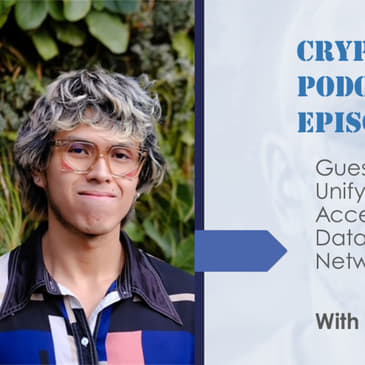

“Bunny is the Co-Founder and CEO of DORA, a multichain search engine designed to unify and enhance the accessibility of blockchain data across various networks. Known as the "Infinite Discovery Engine," Dora aims to simplify the user experience by integrating search and action functionalities across multiple blockchains and virtual machine ecosystems. Bunny possesses considerable knowledge and deep insights on the evolution of Multichain and MultiVM block explorers, enhancing blockchain accessibility and user experience, the future of blockchain interoperability, and building and leading a blockchain startup”.
[00:00:00] [SPEAKER_01]: Hello everybody and welcome to the Crypto Hipster podcast. This is your host, to me on Hasan, the Crypto Hipster, where I interview founders, entrepreneurs, executives, thought leaders, amazing people all around the world of crypto and blockchain.
[00:00:14] [SPEAKER_01]: And today I have one of those amazing people coming to meet from Berlin. I'm looking forward to this conversation. He is the CEO of DORA. He goes by the name of Bunny.
[00:00:26] [SPEAKER_01]: Bunny, welcome to the show. Hey, how's it going? Great to be here. Happy to have you happy to have you join me. I'm looking forward to it.
[00:00:36] [SPEAKER_01]: So yeah, so let's kick things off. And now what is your background and is a logical background for what you're doing now?
[00:00:46] [SPEAKER_00]: I'd say there's clearly some signs that it was eventually going to get into a little bit of a non-traditional pad, but yeah.
[00:00:56] [SPEAKER_00]: So I've been around myself when I'm in Mauricio also known as Bunny. In university, I a lot of my focus. A lot of my career actually started more so in social experiments as ecology.
[00:01:06] [SPEAKER_00]: I switch around careers a lot in university, M.T.V.C. during the meantime at guidance of one of my professors.
[00:01:14] [SPEAKER_00]: I started focusing more into playing looking into different datasets. It's a special item more on the statistical posture of things which eventually on wanting to just look a little bit more on markets.
[00:01:27] [SPEAKER_00]: Maybe start playing helping my parents to pay for university and whatnot. I started looking at markets.
[00:01:33] [SPEAKER_00]: Other open, decentralized, I guess, constantly generating datasets. One of the most successful markets. So came up with a few models for starting trading on my own.
[00:01:43] [SPEAKER_00]: Chatting with some markets right up a little bit more about quantitative finance.
[00:01:47] [SPEAKER_00]: Chatting with a few other as managers and eventually went through the process of actually raising for a fun based on what is your market.
[00:01:54] [SPEAKER_00]: Data for a number of years and then in parallel I got to also meet a lot of other researchers, both in traditional finance as well as crypto.
[00:02:05] [SPEAKER_00]: For a fun structure was primarily focused on markets. So a lot of fun strategy was primarily based on market structure which eventually led me down the rabbit hole of oh how that's fine as working on essentially minor.
[00:02:19] [SPEAKER_00]: And yeah I guess a few years afterwards I got to had a good log of meeting a few people that worked very early on our role of infrastructure technology and gave me visibility that hey, role of certain have become the default way for people to start interacting with our training systems.
[00:02:36] [SPEAKER_00]: And in the class of whether we had this goal in HLP online adoption that came handy can with the golden nature of third-changes.
[00:02:43] [SPEAKER_00]: I realized that we need a new search engine, new discovery and engine that it has people to just forget about what crypto is, how crypto works and just start engaging with different goods and services that just will happen to be offered on chain pass forward to a half years we have to work.
[00:03:01] [SPEAKER_01]: Very cool so Dora you know it's known as the infinite discovery engine right so not all about and how do you you kind of have success ability of blockchain data across various networks.
[00:03:16] [SPEAKER_00]: So Dora let's say a lot of block explorers traditionally focus a little more on just developer use cases, Dora on the other hand focus a lot more on user on more than into different chains.
[00:03:28] [SPEAKER_00]: Every single roll up is now known as their own service provider for different goods and services you can go to a roll up just to perform financial activity should go to another roll up to a sorry maintain FT is you can go to another roll up to buy new sick another roll up to a movies and whatnot.
[00:03:45] [SPEAKER_00]: From this standpoint we realized that it's really truly cumbersome even for very experienced career users to switch context to start learning new tools for a new environment and new ecosystem so we tried to unify them all and we.
[00:04:01] [SPEAKER_00]: We created two main tools which are door ID which unifies all your different tokens and FTs and your transactions back to the single EVM address that is composable across a single chain and then we created door actions which enables you to start bridging and stopping and crossing stopping directly into a token that you want across a single roll up that we've integrated.
[00:04:31] [SPEAKER_01]: Great so.
[00:04:32] [SPEAKER_01]: The vision of this so every every you say every blockchain would have its own roll up the roll into door.
[00:04:41] [SPEAKER_00]: So every single chain.
[00:04:43] [SPEAKER_00]: I guess the easiest way to put it is that you can think of every single chain as an application everything one application this application is both information by the theorem.
[00:04:52] [SPEAKER_00]: That is able to how that is how they're able to work on a security and whatnot but in the end you've ended up with this hyper fragmented world that does not really speak to each other very easily.
[00:05:03] [SPEAKER_00]: A way of going about unifying or abstracting a way a lot of the complexity is the blockchain is to start putting all the information back together in a single interface that is something that we worked to want to have your son is very hard work and now we also have there's like many subset companies that were built specifically for certain parts of our products.
[00:05:26] [SPEAKER_00]: So that is how we're able to if you want if there's a new let's say NFT that is only mintable on a certain chain you no longer have to grab your tokens bridge them over bridge to a new chain or and then you can finally mint.
[00:05:41] [SPEAKER_00]: You can just comment or search of the NFT we tell you all you go right here to mint and you're able to cross chain mint this NFT if there's a token that only exist on chain A and you're on chain C and you need to go to chain B and then finally to chain A you don't have to that on the or you can just go for change to chain A.
[00:06:04] [SPEAKER_00]: We have tried that a lot of the in between steps.
[00:06:06] [SPEAKER_01]: Yeah, sounds like it.
[00:06:09] [SPEAKER_01]: So when I think of the word infinite right or infinite free I think of you're going to be able to you're going to be able to bring in all new chains come on forward and you're going to last forever so that's what I think.
[00:06:20] [SPEAKER_01]: When I hear infinite discovery but what do you what is what do you see it.
[00:06:24] [SPEAKER_00]: So I actually do very much like the idea that there's a.
[00:06:30] [SPEAKER_00]: The block chains are just happened to write the right direction towards information living forever right like a smart contract quintessentially don't need people to maintain them.
[00:06:39] [SPEAKER_00]: We call it an infinite discovery and change instead of a search engine that we use to because people still don't really know what to search on chain.
[00:06:46] [SPEAKER_00]: And it's not it's not to anyone's fault.
[00:06:50] [SPEAKER_00]: It's not really necessary that someone learns how smart contract words or works or the specific word in use to deploy something on chain that is something useful for developers yes.
[00:07:03] [SPEAKER_00]: Doesn't necessarily you don't have to know how Amazon works in order to get something from Amazon that is where a lot of the aspect of this infinite discovery comes from in which we truly don't know what are the different industries that will start coming into crypto.
[00:07:17] [SPEAKER_00]: That are going to start deploying their own chains with almost recently Sony deployed their own chain and that change can be very heavily used for a lot of new state and also video.
[00:07:29] [SPEAKER_00]: The services you will be able to access them through door you won't have to go to Sony changed specifically and learn all the Sony tools you can just learn one single two one single.
[00:07:41] [SPEAKER_00]: One single engine that you they're able to use to access every single one of these services.
[00:07:50] [SPEAKER_01]: So you're going to be there you're going to be like the Amazon of crypto.
[00:07:55] [SPEAKER_00]: That is our ultimate aim the Amazon of crypto or more so.
[00:08:00] [SPEAKER_00]: The Google of crypto because Google very much as something like Google doesn't exist in crypto just yet right but we all know that there's a lot of websites there's a lot of platforms or so lot of chains.
[00:08:11] [SPEAKER_00]: The major discovery the Google made or the major focus wasn't being able to rank all these goods and services and let people be able to procure all these in one single interface that is exactly where the experience they were trying to replicate on on door.
[00:08:26] [SPEAKER_00]: I think it's needed.
[00:08:29] [SPEAKER_01]: Yeah that one is needed too.
[00:08:32] [SPEAKER_01]: Very cool so.
[00:08:35] [SPEAKER_01]: I want to talk about the evolution of multi chain right and you know multi VM black explorers to date you know where have we come where do you start where have we come and what's where we headed.
[00:08:49] [SPEAKER_00]: So a lot of block explorers in the early days there they were developer focus they were single chain focus and they primarily provided visibility to transactions.
[00:09:02] [SPEAKER_00]: As this community.
[00:09:04] [SPEAKER_00]: Sorry, sorry growing we realized something that actually were even lessons for ourselves.
[00:09:11] [SPEAKER_00]: We started to realize okay there's going to be a lot of change when you place to modify them all that is where we decided to create this unified block explorer.
[00:09:18] [SPEAKER_00]: Then a multi chain block explorers then we realized okay people still care about their identities.
[00:09:24] [SPEAKER_00]: So we stopped focusing so much on the aspect of transactions no one really likes looking at the receipts of the transactions no one goes on badmones says yes I paid you just send them their money and the person sees on their account change if any balance is a change.
[00:09:39] [SPEAKER_00]: So we started focusing on accounts then beyond that now that.
[00:09:44] [SPEAKER_00]: EVM chains or chains that borrowed the theorem virtual machine.
[00:09:49] [SPEAKER_00]: Have you come somewhat stand right now there's this entire new paradigm of multi virtual machine environments in which there you can leverage anything programming language and deploy.
[00:10:01] [SPEAKER_00]: I've changed that just focuses on executing that one language so now we're starting to create new custom infrastructure for a lot of these chains.
[00:10:10] [SPEAKER_00]: We don't know which languages will end up having a lot of adoption the most recent one that we've seen a lot of spike interest on these moves which.
[00:10:23] [SPEAKER_00]: That was developed that Facebook a few years back so that is the new hottest language in town and we're building a custom infrastructure to unify this entirely new the different way of producing data.
[00:10:37] [SPEAKER_00]: To again a single interface that just makes every single good service accessible through one single.
[00:10:46] [SPEAKER_01]: What's the language that Facebook created and what is it like what has a different other languages.
[00:10:51] [SPEAKER_00]: Is move is a lot more type types say you have a lot of more type safety in and it allows you to have a much higher throughput chain bottom line issues a language that allows blockcions to be way faster and way more secure at the moment of deploying that's mark contract if you deploy it's mark contract and it has a bug that then.
[00:11:11] [SPEAKER_00]: Someone who used to hack this mark contract this language makes it a lot easier to identify these bugs at the moment of deployment such that then you know if you deploy a contract and it says so there's this major bug here you shouldn't use this application.
[00:11:27] [SPEAKER_00]: This is apparently possible on the VVM it doesn't necessarily mean that the VM is worth it just means that.
[00:11:33] [SPEAKER_00]: It's a different way of approaching blockchain technology and there's a lot of move developers in the world actually you can say very growing community.
[00:11:43] [SPEAKER_00]: So it also enables us to onboard all of these new developer co-force into.
[00:11:48] [SPEAKER_00]: Into our industry.
[00:11:51] [SPEAKER_01]: bug fixes that's a problem still I don't talk about it much but the bug fix bugs are problem in I guess in every coding right what are the dangers of you know not addressing the bug issue and you know how do we get it done and why is necessary.
[00:12:10] [SPEAKER_00]: It's necessary because in web to if your application has a bug maybe.
[00:12:19] [SPEAKER_00]: Or you were unable to post an image at the right time you were able to tweet something out you were able to post something on LinkedIn and you have to retry.
[00:12:28] [SPEAKER_00]: When crypto has a bug you then something major hacks people lose their lives savings people lose a lot of money people lose access to historical data that is really valuable to them.
[00:12:40] [SPEAKER_00]: I personally have actually haven't been in this industry now for a few years have a lot of very emotionally valuable stuff I guess associated to me wallet like.
[00:13:20] [SPEAKER_00]: I have.
[00:14:04] [SPEAKER_01]: I look at different explorers that exist today okay there's a few of them that I can read you know.
[00:14:21] [SPEAKER_00]: I'm not sure if you can read the books and now it's focusing on this technology called intense intense can get very complicated there incredibly complex piece of technology.
[00:14:30] [SPEAKER_00]: However, the one key thing that we can borrow from that submission is that people don't really care about how a process is executed people care that that process is fulfilled that the intention that you have.
[00:14:44] [SPEAKER_00]: I could insert this with fulfill or if it wasn't why it wasn't can I retry to get access to this again right so from the standpoint.
[00:14:54] [SPEAKER_00]: I thought we created a few things like our cemented label or which welcome in film tagging the intent of a user at the moment of that they interact with an application use someone in trust with a soft in application they're most likely looking to buy a token right so we call it just.
[00:15:10] [SPEAKER_00]: And someone transfers a tokens or interactions with a contract that eventually transfers to token.
[00:15:16] [SPEAKER_00]: We call that whole process a transfer something that is very easy for people to be able to understand, if someone interacts with a contract, that then that's a bunch of things on the back end and then gives you back an NFT the people, that an NFTwind or an NFT buy that is it there's no need to get a new one sense of how.
[00:15:40] [SPEAKER_00]: your service, which is one to tell people, let people help people understand exactly what
[00:15:46] [SPEAKER_00]: they wanted to do and what they're going to do. In that light actually I think that in the end
[00:15:52] [SPEAKER_00]: adore we did such a good job, but being able to contextualize some of the high-level actions
[00:15:57] [SPEAKER_00]: that people were focusing on, then now people don't even look at actions. People just look at
[00:16:02] [SPEAKER_00]: all of it. What's my actions successful? That's great. People don't often tend to check or if
[00:16:07] [SPEAKER_00]: they're actually on an application, but to application what's successful. You'll see that it was
[00:16:11] [SPEAKER_00]: executed and they move on, they see the change of this action on their balances. So that is
[00:16:18] [SPEAKER_00]: more so where we start focusing on. We were like, okay people are going to look at their accounts
[00:16:23] [SPEAKER_00]: to verify if actually something occurred. That is where we are putting a lot of focus now.
[00:16:30] [SPEAKER_01]: Got it. So is that difficult to make sure that you assure people that their intent is fulfilled
[00:16:37] [SPEAKER_01]: what are some of the risks involved with that? I only heard of the tens of last month.
[00:16:43] [SPEAKER_01]: Two or two months ago, for the first time. What are some of the risks involved in that?
[00:16:50] [SPEAKER_01]: Especially if you're a platform like yours where the user does achieve the intent they
[00:16:58] [SPEAKER_01]: were looking to do, how do you mitigate that or how do you help them?
[00:17:03] [SPEAKER_00]: I think that, so this is where it actually becomes a much more collaborative problem.
[00:17:08] [SPEAKER_00]: Right now at Dora we focus on contextualizing our chain data and then creating a very
[00:17:15] [SPEAKER_00]: accessible user profile for people to see that every single action that they engage on was fulfilled.
[00:17:23] [SPEAKER_00]: So then from the standpoint that is one subset of the problem, the other subset of the problem is
[00:17:27] [SPEAKER_00]: how can order we call them interoperability providers. People that are able to enable you
[00:17:34] [SPEAKER_00]: enable one chain to speak to another chain. These providers started with the focus a lot on
[00:17:41] [SPEAKER_00]: how to provide good interfaces of all this is the action that you want to engage on.
[00:17:48] [SPEAKER_00]: This is the little label that we give you to say that it was fulfilled. So the way that we collaborate
[00:17:54] [SPEAKER_00]: with them is that whenever we integrate a new chain and we want to let people not only look at
[00:17:59] [SPEAKER_00]: this chain state but also start accessing these chain security services, we tell them hey can
[00:18:06] [SPEAKER_00]: you help us integrate this chain integrated from the end and that's what it. The major risks
[00:18:12] [SPEAKER_00]: at say from our side is that we do the more complex the action gets, the more
[00:18:18] [SPEAKER_00]: are these two things where what was supposed to happen? So do lose a little bit of visibility
[00:18:26] [SPEAKER_00]: on the transaction, if you want to dissect the transactions? However, a very easy way to know
[00:18:35] [SPEAKER_00]: okay what was supposed to happen is to actually see the balance change on your account.
[00:18:40] [SPEAKER_00]: If you want to buy a bottle of water and then this purchase gets routed through
[00:18:48] [SPEAKER_00]: five different sub providers that all gave a confirmation and all executed different transactions
[00:18:54] [SPEAKER_00]: so that you were able to give such that Avenger was able to give you back that bottle
[00:19:00] [SPEAKER_00]: that gets in my succumb to get it. We focus on at least having really good pressure in
[00:19:05] [SPEAKER_00]: that hey now you have a bottle of water on your account. That is the easiest way to compare
[00:19:10] [SPEAKER_01]: what actually happened. God, I want to get in a upper ability at a moment.
[00:19:18] [SPEAKER_01]: I do. I do have a concern and everybody right now is working on the user experience. They
[00:19:28] [SPEAKER_01]: want the way to bring the masses back into the crypto, but retailer money is with it. You said
[00:19:33] [SPEAKER_01]: earlier they don't have the no salinity, right? They don't have to know no coding at all.
[00:19:38] [SPEAKER_01]: Say they don't and you guys achieve your mission is and that's good. There are the block
[00:19:46] [SPEAKER_01]: chains that come out with increasing complexity. Here a user and you don't understand
[00:19:54] [SPEAKER_01]: what's going on. There is increasing complexity. What's the risk there of people not
[00:20:03] [SPEAKER_01]: understanding but put in their money up and then not with the intention or whatever
[00:20:11] [SPEAKER_01]: you know not having their money in their hands anymore and losing it all because of the
[00:20:17] [SPEAKER_00]: growing complexities in the backend. I was actually having this discussion with a few people earlier
[00:20:25] [SPEAKER_00]: today. I think that there is a really good compromising which blockchain that more indeed
[00:20:32] [SPEAKER_00]: infrastructure focus block. Developers can make sure that there's safety around everything
[00:20:39] [SPEAKER_00]: one of these chains that kept deployed. How safety focus makes the external course and the easiest
[00:20:45] [SPEAKER_00]: way to assure safety is that you're able to guarantee it to a user that even is a new chain
[00:20:51] [SPEAKER_00]: process up and you put money in your money won't go away. That we have a proof that you had
[00:20:56] [SPEAKER_00]: money on that chain and were able to somehow recover the funds even if the chain dies, right?
[00:21:04] [SPEAKER_00]: So we need to work on these security assurances, provide greater increase speed of being able
[00:21:11] [SPEAKER_00]: to go between different chains and also to it in a manner that feels into it for the user.
[00:21:18] [SPEAKER_00]: I think that is where a lot of our industry is also focusing on. We all are all trying to improve
[00:21:24] [SPEAKER_00]: the user experience to very little security that's remain of them all. Interesting.
[00:21:36] [SPEAKER_01]: I want to onboard the next billion people, right? So one of the ways to do that is through
[00:21:45] [SPEAKER_01]: blockchain interoperability. So what's the future of interoperability and then what are the roles
[00:21:52] [SPEAKER_01]: of zero knowledge and deep in in accomplishing this interoperability?
[00:22:00] [SPEAKER_00]: So I think the interoperability when it comes to zero knowledge is specifically, you can get
[00:22:04] [SPEAKER_00]: very interesting because you're able to let's say right now we have companies that are starting
[00:22:11] [SPEAKER_00]: to launch their own chains. You can envision a world in which, let's say Sony is not only a music
[00:22:19] [SPEAKER_00]: or movie producing company, right? They also, they are effectively a conglomerate. You can imagine
[00:22:24] [SPEAKER_00]: a world in which Sony doesn't put all of their conglomerate to one single chain but it produces
[00:22:31] [SPEAKER_00]: creates a chain for every single one of their goods and services. You're able to create
[00:22:35] [SPEAKER_00]: something to a probability solution thing which you can leverage, let's say CK to reduce cost
[00:22:39] [SPEAKER_00]: or to a laugh or cross chain communication and you can have this, I guess, base chains that then
[00:22:46] [SPEAKER_00]: are able to compress information and also provide information back to every single chain for
[00:22:52] [SPEAKER_00]: these chains to be able to communicate a little bit more. You can have, let's say, base Sony chain
[00:22:58] [SPEAKER_00]: and then within it you have a subset of music focused chains, regional focus chains or movie focus
[00:23:04] [SPEAKER_00]: chains, right? So do you have all the teams or these regional, regional, localization or whatnot?
[00:23:10] [SPEAKER_00]: I think CK can enable us to reduce the cost of being able to launch every single chain
[00:23:14] [SPEAKER_00]: and then post back a proof that every single transaction in a very economic efficient manner.
[00:23:24] [SPEAKER_00]: In regards to the opinion, I think that there is a world-ing which
[00:23:29] [SPEAKER_00]: decentralized physical infrastructure is able to provide greater guarantees of hey your data is
[00:23:35] [SPEAKER_00]: retrievable. It doesn't only live in AWS service but also lives across the distributed servers
[00:23:42] [SPEAKER_00]: worldwide such that then people are able to ensure that no matter what happens, no matter what
[00:23:49] [SPEAKER_00]: company fails or company goes down, a proof of your data is stored somewhere and you're able to
[00:23:57] [SPEAKER_00]: ensure that your assets are always going to be safe. Right? As soon as you have this proof, you're able
[00:24:02] [SPEAKER_00]: to be able to then guarantee that okay, you can access your assets back at least on this base chain
[00:24:10] [SPEAKER_01]: that can be able to change such as Ethereum. I like your concept of Sony. I know, it's a good one.
[00:24:24] [SPEAKER_01]: I'm trying to think of different organizations and different major corporations around the world
[00:24:30] [SPEAKER_01]: like who have like an arm like Sony with different divisions, right? Using blockchains,
[00:24:37] [SPEAKER_01]: this world in that where all these companies are used on all the blockchain,
[00:24:41] [SPEAKER_01]: you know, how much do you think is going to be a public ledger blockchain versus their own private
[00:24:47] [SPEAKER_01]: sale? And then if it is their own private sale, how do you break down the sales? I think that
[00:24:54] [SPEAKER_00]: it is definitely going to be blended. We all another one of our clients adore this
[00:25:00] [SPEAKER_00]: chain that was effectively funded by Warner Brothers and a lot of these information needs.
[00:25:06] [SPEAKER_00]: You can only interact with this chain in a permission manner, it's not permission less,
[00:25:10] [SPEAKER_00]: you need to create an account through their own interfaces and whatnot. And they do this to
[00:25:14] [SPEAKER_00]: protect the IP that is created or is blended towards this chain, right? If you want to mint a
[00:25:21] [SPEAKER_00]: major league baseball NFT trading curve, if you want to mint a Netflix shows NFT,
[00:25:28] [SPEAKER_00]: you can only do it through this chain called Paul Network. They do this because different
[00:25:33] [SPEAKER_00]: corporations want to have different privacy use cases privacy needs, such as the most simple one.
[00:25:42] [SPEAKER_00]: You don't naturally want to allow and that an artist's work ends up anywhere without their own
[00:25:49] [SPEAKER_00]: consent or that someone else steals their IP. There's this whole discussion around how can we protect
[00:25:56] [SPEAKER_00]: IP now? And you can do it by preserving the privacy or the access to some of these chains, right?
[00:26:03] [SPEAKER_00]: In the similar manner, if let's say you have a chain that focuses on just
[00:26:08] [SPEAKER_00]: supply to blockchain tracking. You don't necessarily want someone to come in and say,
[00:26:13] [SPEAKER_00]: oh I created this new thing here now you can track it somewhere else. It could be nice, yes,
[00:26:19] [SPEAKER_00]: to have a more global distributed supply chain focus nurture, but maybe you don't want
[00:26:25] [SPEAKER_00]: something that is illegal to get distributed so easily, right? And to enter the supply chain
[00:26:32] [SPEAKER_00]: and unsupervised manner. So I think that there's definitely a mix of clothes that we're already
[00:26:37] [SPEAKER_00]: starting to see emerge. I'm very curious to see where these things are.
[00:26:45] [SPEAKER_01]: I'm intrigued because the other day here in the US, the SEC,
[00:26:52] [SPEAKER_01]: sued OpenC, saying that all the artwork on their securities. Well, all the artwork on their
[00:26:58] [SPEAKER_01]: securities isn't everything provided by Amazon, Google and anybody else Disney, you know,
[00:27:05] [SPEAKER_01]: what they have on their platform are they securities too? Where do you draw the line and how
[00:27:10] [SPEAKER_01]: do you bring in the technology to create such fine lines of distinctions?
[00:27:16] [SPEAKER_00]: Yeah, I like the deal at C, Dean, as security exchange. I think that if you turn it,
[00:27:26] [SPEAKER_00]: if you follow these exact same line of reasoning then you effectively made it such that every single
[00:27:31] [SPEAKER_00]: even a small local artist just trying to put their work out there on Etsy now is in violations
[00:27:36] [SPEAKER_00]: of them. According to the SEC, I think that we get people nationwide, wild up very quickly.
[00:27:44] [SPEAKER_00]: Synthy would have Amazon's same thing with, you know, it's all of Disney land as security
[00:27:52] [SPEAKER_00]: is violation. Right? So this is what is every time you buy a little Mickey Mouse,
[00:27:57] [SPEAKER_00]: close-curse security violation, maybe not hopefully not, hopefully it isn't.
[00:28:03] [SPEAKER_00]: But I think that hopefully our regulators are starting to realize that hey,
[00:28:07] [SPEAKER_00]: this technology is in the bad. It's actually pretty good. We can actually optimize a lot of our
[00:28:12] [SPEAKER_00]: needed real life infrastructure just by leveraging it in a privacy preserving manner as well.
[00:28:19] [SPEAKER_00]: I think hopefully things will start headed on the right direction soon.
[00:28:25] [SPEAKER_01]: I certainly hope so. Some things are not so mystical. So, you know, I want to, yeah,
[00:28:35] [SPEAKER_01]: awesome. So I really enjoy speaking with you today, I enjoy this conversation.
[00:28:39] [SPEAKER_01]: I think what you're doing is needed, you know, and I'm glad to see you getting success
[00:28:44] [SPEAKER_01]: interaction on it. So it's great. I have one last question. And so how can people find it
[00:28:51] [SPEAKER_01]: more information about you? About Dora? How could they become users clients? How can they,
[00:28:58] [SPEAKER_00]: you know, do any of that? Sure. So would you confine us on Twitter if you search
[00:29:04] [SPEAKER_00]: search on Dora? You can find me on Twitter as well. I'm also active there. It is
[00:29:09] [SPEAKER_00]: search connect whole capital that's CO and E, J.O. Capital. And then only 10 as well. I'm
[00:29:20] [SPEAKER_00]: Mauricio Trujillo. And yeah, I think you can find you can find us there. The links
[00:29:27] [SPEAKER_00]: all the links to Dora are also on our website. You can go on Google, Google search on Dora.
[00:29:34] [SPEAKER_00]: Dora also on Twitter. They're on LinkedIn. You are very easy to find. I'm actually very
[00:29:38] [SPEAKER_00]: happy to think that we're the top Google search whenever you search search on Dora.
[00:29:44] [SPEAKER_00]: Yeah, and how you can become users. Dora is actually interesting. There's a few search
[00:29:51] [SPEAKER_00]: engines that put to search engines that you have to pay for. We're completely free. We don't
[00:29:55] [SPEAKER_00]: believe anyone would use Google if you had to pay every time you search. That would be insane.
[00:30:02] [SPEAKER_00]: Yeah, as soon as you enter Dora, you don't have to create a wallet. You don't have to do anything.
[00:30:06] [SPEAKER_00]: You can just start searching for the sense of services and procure them. That's the next
[00:30:10] [SPEAKER_00]: you want them. Awesome. Thank you very much for your time today. Thanks to you,
[00:30:17] [SPEAKER_00]: I appreciate it coming here, Jamil.