
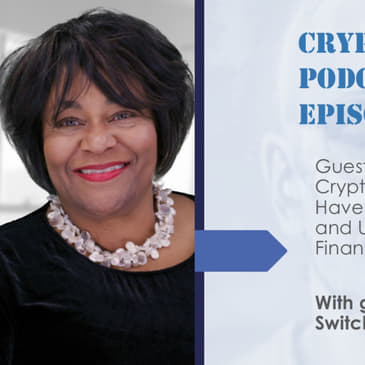

KATHY ROBERTS is CEO of Switch Reward Card - a blockchain finance ecosystem. Kathy started her career with Sears and then transferred over as an early executive (or Dawner as they called them) when Sears started Discover Card. Kathy went on to become the President of Discover Bank and served as the first female Chair of the Delaware Bankers Association. Current member of Salt Lake Chamber’s Board of Governors.
Kathy Roberts’ charitable endeavors include but in no way are limited to the following organizations:
Delaware Junior Achievement (Board of Directors), New Mexico Museum Foundation, WHOlives (Board of Directors), https://wholives.org/ - Providing clean water in the developing world using the innovative Village Drill. The History Makers, https://www.thehistorymakers.org/ - Documenting video oral histories of influential and sometimes unsung African Americans heroes. Kathy currently splits her time between Santa Fe, NM and Salt Lake City with her son Malachi, who is a musician.
Website: www.SwitchRewardCard.com
LinkedIn: https://www.linkedin.com/in/kathyrobertsswitch/
[00:00:01] [SPEAKER_01]: Hello everybody and welcome to the Crypto Hipster podcast. This is your host, Jamil Hasan, the crypto hipster, where interview founders on the bernores, executives, thought leaders, you name it all over the world, Crypto and blockchain and today I have an amazing guest.
[00:00:16] [SPEAKER_01]: Her name is probably one of the easiest things I've had to say on this show and it was a true delight to have the CEO of Switch Reward Card, Kathy Roberts, Kathy welcome to the show.
[00:00:31] [SPEAKER_00]: Thank you very much for having me. I'm delighted to be here.
[00:00:34] [SPEAKER_01]: You're very welcome. So let's kick things off and I'll ask you first. What is your background and is a logical background for what you're doing now?
[00:00:42] [SPEAKER_00]: You know, my background goes back a ways. It's not a logical background for what I'm doing now because I started working in 1971 and you know most people weren't born but all of our time, my background ended in traditional banking which I would say is not a logical place for a traditional banker to be in the crypto space or the blockchain space.
[00:01:10] [SPEAKER_00]: So I think that is a nontraditional route. However, it has led us to operate in the most compliant ways that you can operate in a blockchain and in a card product.
[00:01:29] [SPEAKER_01]: And so I'll ask you about the card product, you know, especially a word card. What is it all about? You know and how did you get from Sears to crypto?
[00:01:39] [SPEAKER_00]: Okay, Switch Reward Card and we're you can read all about us at switchrewardcard.com and that is a product that we started with originally a debit card and it's a traditional mastercard or visa.
[00:01:55] [SPEAKER_00]: Our next project will be in a mastercard or visa in a prepaid card. Prepades a little different from a debit card and in that space you can go on our site and right now we're running a special where you can pick up that in Ft for the card.
[00:02:14] [SPEAKER_00]: It will be ready at about 45 to 60 days about with our new vendor, which is a global vendor and allow you to wallets when you come onto your switch site one for non custodial and one for custodial.
[00:02:31] [SPEAKER_00]: When I say non custodial, whatever you put into that wallet whether it be Bitcoin or your switch token or other tokens. I don't know about it and I can't ever see it. I can't get to it. I can't move it when you look in your custodial wallet moving things from your non custodial wallet or from your bank to your prepaid card will come from your custodial wallet. And that's where we have other partners that help you spin on that mastercard or visa.
[00:03:01] [SPEAKER_00]: And it's a prepaid kind of vehicle. How did I get from Sears to what I do today? Again, it's a long story but after school when I was a teenager I went down and applied for a Christmas job and I was in high school and after Christmas I kept getting a schedule so I kept showing up.
[00:03:24] [SPEAKER_00]: But at some point about a year later they asked me to work in the HR department. So I was the girl that would interview you and determine whether you got a second interview to get a job at my local store and to come wash you tin.
[00:03:39] [SPEAKER_00]: From there I entered college like everybody else and then a couple of years in to college somebody asked me to go to another store and Seattle and run the HR office there and I did HR for a good amount of my career.
[00:03:53] [SPEAKER_00]: But when I saw the payroll of the guys who ran the place the store managers etc. I want to be one of those guys and I went into customer service and then to credit and in 1983 I want to say the store managers went to a meeting every year and I said how are we doing?
[00:04:11] [SPEAKER_00]: They said we're doing great. They already owned all state they had created that to ensure their products but at that point Sears had purchased Colourl banker they purchased Dean Witter.
[00:04:22] [SPEAKER_00]: They had a mortgage company they had serious savings bank they were a large Colourl. They were also unknown to most people to be probably the third largest lender in the nation and they did that state by state and nobody really knew after the car manufacturers and dealers.
[00:04:40] [SPEAKER_00]: Sears was one of the largest lenders. So a project was started that said what do we already do well today?
[00:04:49] [SPEAKER_00]: That we can do again and that's how the Discover Card came on the marketplace because Sears was looking at things they already knew how to do which was credit.
[00:04:59] [SPEAKER_00]: They said well why don't we have a visa or a master cart and they did go to visa and master cart and there were bylaws against American Express and bylaws against Sears because of the serious locations.
[00:05:11] [SPEAKER_00]: They just thought Sears would become a bank and would be too much competition for other people and be too convenient for people to go in and bank there.
[00:05:20] [SPEAKER_00]: So they went to Delaware they purchased a bank and Discover Card was born in 1985 and in 1986 they company asked me to move to Chicago and I went to Chicago and helped with the start up of Discover and we were all called Donners the Don of Discover that commercial from the Super Bowl that year.
[00:05:45] [SPEAKER_01]: Great. Wow, I didn't know I did not know that Sears was the was that's something in I've learned new today just now.
[00:05:53] [SPEAKER_00]: Yeah, it's people it was a large conglomerate at its time now it's a sense gone by the way outside and I do remember the days when it was split up and it was the investors to California teachers union suggested that splitting the company up which at that point was I think Morgan Stanley had they discarded the Dean Witter.
[00:06:15] [SPEAKER_00]: And they did not have a lot of money in the world because Dean Witter purchased Morgan Stanley a lot of people think that Morgan Stanley purchased Dean Witter and got we're going to that name well it's Dean Witter purchased Morgan Stanley and they discarded the Dean Witter name so at that point Sears owned Morgan Stanley and we as a financial institution rolled up to Morgan Stanley and that's that's my visits to New York and Connecticut at that time from Delaware.
[00:06:41] [SPEAKER_00]: I was wondering what happened to Dean Witter. Yeah, yeah it was it was it was a grand name but when they made the deal to purchase Morgan Stanley that's what went away.
[00:06:54] [SPEAKER_01]: Got it okay good to know I also wonder what happened to you.
[00:07:00] [SPEAKER_00]: I don't know about that one.
[00:07:02] [SPEAKER_00]: Okay, I don't remember at a blunt point there were so much consolidation in the markets I thought gee there's only going to be one bank one airline and you know one bus company if we keep going but it the cycles go and it's coming gone.
[00:07:16] [SPEAKER_01]: Okay, I have a question about zero so you're in the payment space and I have a question a lot of people you know a crypto and want to get into I want to get into the future of crypto but I want to transition and buy this question.
[00:07:29] [SPEAKER_01]: A lot of people who do payments and crypto want to remove the middle man what are we with the master card in the visa and they don't want to have that 3% they want to have it instead of the melody without doing that percentage you know payment to those companies.
[00:07:44] [SPEAKER_01]: How do you see that working how does it work within you know, what's your work card and then we'll go into what you see as a future of crypto.
[00:07:53] [SPEAKER_00]: Yes, and when you look at crypto I think a lot of people are purest and they do want to see a peer to peer kind of scenario which is how Bitcoin will start it and the anticipation that you can just use the instrument in a boardless manner and
[00:08:12] [SPEAKER_00]: you can compare to peer and that type of thing without the restrictions of the time of day etc.
[00:08:18] [SPEAKER_00]: And in a lot of regards which can do the boardless we can do the but out the time of day it is faster than your local banking dormily can produce things if you had to go into the bank or something of that sort.
[00:08:32] [SPEAKER_00]: However, right now we are a traditional.
[00:08:38] [SPEAKER_00]: At the end of the stream when I say the custodial wallet that is traditional that's when we move into using.
[00:08:47] [SPEAKER_00]: Processors and vendors and banks if when we want to lay down the in product so you've moved from crypto through an exchange if you move your your crypto to.
[00:08:59] [SPEAKER_00]: The, and it could be a various fiat's and then the spin.
[00:09:05] [SPEAKER_00]: I'm not saying that someday it won't be more automated or more peer to peer but today that's how most of this is done and that's how we do it at switch.
[00:09:17] [SPEAKER_00]: What we do though in a very careful manner of having those two wallets and not having access to your non custodial wallet is it prevents any opportunity even for me.
[00:09:29] [SPEAKER_00]: To know what's in your wallet or to move that money that's in your or are the crypto that's in that non traditional wallet and we always suggest you only place what you need in your custodial wallet.
[00:09:43] [SPEAKER_00]: And of course there is a big difference in the security rules things that you put into that those wallets you do have your seed phrases and those kinds of things to keep it.
[00:09:55] [SPEAKER_00]: Secure and it is up to you on the security more than if you were using a traditional vehicle like a credit card or something of that sort.
[00:10:05] [SPEAKER_00]: So there are responsibilities in the crypto space that are a little different than in the traditional space but.
[00:10:13] [SPEAKER_00]: We see the value of people moving from one to the traditional use because utility utility utility utility you got to be able to use whatever it is.
[00:10:23] [SPEAKER_00]: And the next form of the switch token which is not under by control that is something when it launched that separate.
[00:10:31] [SPEAKER_00]: Of making more opportunity for you to use that switch token to us is the key for switch.
[00:10:40] [SPEAKER_01]: That makes all the sense of the world to me.
[00:10:43] [SPEAKER_01]: The other day someone has said, you know, you've been in crypto for seven years how are you got a million area and I said I've hit every landmine.
[00:10:52] [SPEAKER_01]: You know, there are still landmines right so there are challenges you know how do you see the challenges.
[00:11:01] [SPEAKER_01]: How do you see them being solved and what's in store for the future of this industry.
[00:11:05] [SPEAKER_00]: You know that's an interesting comment you made about how are you not a millionaire yet.
[00:11:10] [SPEAKER_00]: I think the major challenge is that initially I think some people saw this as a get rich quick opportunity and that's not always the case.
[00:11:21] [SPEAKER_00]: And there are various types of instruments for vehicles that you can be involved in.
[00:11:27] [SPEAKER_00]: Some of it is purely hype and if you do your own research we say that a lot at switch is before you make a decision to purchase anything.
[00:11:39] [SPEAKER_00]: You know whether I have a hard time even buying clothing or shoes online because I need to try them on.
[00:11:45] [SPEAKER_00]: So I need to run down to my favorite department store which is Nordstrom's for my hometown and I need to try on the shoes or I need to know that I can return them or whatever is the case.
[00:11:57] [SPEAKER_00]: So I don't have a Nordstrom's here in Santa Fe so I might have to go to Phoenix I might have to go to Seattle but I can't buy that pair of shoes without doing that.
[00:12:06] [SPEAKER_00]: And people have made decisions on instruments in the crypto markets without doing any research just looking at a picture of something just saying oh that looks like fun and that's fine.
[00:12:19] [SPEAKER_00]: If the money that you're putting into that is non consequential to you.
[00:12:25] [SPEAKER_00]: You don't want to do that with your grocery money you don't want to do that with your car note money you don't want to do that with your house note money.
[00:12:32] [SPEAKER_00]: So doing your own research about whatever you're participating in on the blockchain and in crypto is absolutely tantamont to what you're putting into it.
[00:12:45] [SPEAKER_00]: That's one of the things that I expressed to people so making a decision without doing your own research I think that's caused some of the challenges.
[00:12:55] [SPEAKER_00]: I think the other thing is here in the United States we are behind the rest of the globe.
[00:13:02] [SPEAKER_00]: The rest of the globe is quickly adopting blockchain and quickly adopting crypto.
[00:13:09] [SPEAKER_00]: In fact, if you look at blockchain it's probably the fastest adopted technology ever maybe the will was more but you know the way we're now connected versus how we used to be disconnected people are adopting this.
[00:13:25] [SPEAKER_00]: Quickly and I believe that in the United States we're so concerned about the consumer piece of it that we haven't bridge all of the educational pieces and all of the protection pieces together to make sure people understand it.
[00:13:42] [SPEAKER_00]: But if you'll look at the rest of the globe, it is going quite rapidly I hate for us to be behind.
[00:13:47] [SPEAKER_00]: And so every opportunity I get with switch to educate people about things I'm happy to do that because I think this is one of those areas where it used to be say go west and go west now it's go east and man go east with the way we're treating this.
[00:14:04] [SPEAKER_00]: And I don't believe it's going to stop around the globe. I hate to be last but right now we're behind the the eight.
[00:14:13] [SPEAKER_01]: Yeah, and I don't want to make this a political conversation at all.
[00:14:18] [SPEAKER_01]: But it looks like politics or you know different groups are part of the challenges right.
[00:14:24] [SPEAKER_00]: Yeah, yeah.
[00:14:25] [SPEAKER_01]: How do you see us all come in together despite the various backgrounds?
[00:14:29] [SPEAKER_00]: Well, I hope that we could see that we might be missing the boat that we might be driving business outside of the United States that we want to have here.
[00:14:39] [SPEAKER_00]: We've always been innovators here in the United States and that was part of you know necessity, you know you had to be an innovator to come here to some degree.
[00:14:50] [SPEAKER_00]: And to survive here. And so I hope our spearhead of wanting to be innovators will help us.
[00:14:58] [SPEAKER_00]: I hope the lawmakers and the regulators will see the point of that, and I think they're coming around.
[00:15:04] [SPEAKER_00]: And then I also think everyone who's involved in all these different agencies.
[00:15:09] [SPEAKER_00]: It seems like there might be a little bit of a fight over who should regulate it.
[00:15:15] [SPEAKER_00]: I think it should not be any of the current regulations or regulators involved because a lot of those laws and things are you know, 100 years old.
[00:15:27] [SPEAKER_00]: I had retired early and when I came back for this project, I thought, I don't know maybe I should not do this because I've been out of the game for a long time.
[00:15:37] [SPEAKER_00]: And what I found out was that banking had not changed substantially.
[00:15:41] [SPEAKER_00]: A lot of the things were still there.
[00:15:43] [SPEAKER_00]: This is something different.
[00:15:44] [SPEAKER_00]: And I would encourage any regulator or lawmaker looking at this to not try to shove it into a current agency.
[00:15:52] [SPEAKER_00]: We need to look at this differently.
[00:15:54] [SPEAKER_00]: It is new technology, it is different technology.
[00:15:58] [SPEAKER_00]: It is forward thinking and it is not just in the market of currencies.
[00:16:04] [SPEAKER_00]: It could be that when you're looking at the blockchain, there are people who need help at least in third world countries and defining even their property lines that they don't have ways to do that.
[00:16:15] [SPEAKER_00]: There are governments, adopting these things for this type of thing.
[00:16:19] [SPEAKER_00]: So I would encourage everyone to look at this in a little different regard than just shoving into one of the current agencies.
[00:16:29] [SPEAKER_01]: I agree with you.
[00:16:30] [SPEAKER_01]: I think that is a right point.
[00:16:35] [SPEAKER_01]: So I want to get the lay the land on the crypto payment sector.
[00:16:39] [SPEAKER_01]: You know, crypto has a lot of different sectors, one's mean coins.
[00:16:43] [SPEAKER_01]: You know, that is for gambling or people who want to do that not me.
[00:16:46] [SPEAKER_01]: There are different and there are depend and there are all kinds of stuff.
[00:16:49] [SPEAKER_01]: But as far as payments, it seems to be the last to catch on for some reason.
[00:16:54] [SPEAKER_01]: But I don't know if it's overcrowded now or not crowded enough.
[00:16:58] [SPEAKER_01]: You know, what do you see the land land as and then I can get that off so it's clear after that.
[00:17:02] [SPEAKER_00]: Great. There are a lot of people jumping into the payment sector.
[00:17:07] [SPEAKER_00]: And again, it's a little bit more difficult inside the United States.
[00:17:13] [SPEAKER_00]: And every government has a different opinion about how payments should be run.
[00:17:18] [SPEAKER_00]: Who would have ever thought that today we would be talking about India having the largest population.
[00:17:24] [SPEAKER_00]: And on in the world versus China.
[00:17:27] [SPEAKER_00]: And so if you look at India, you'll find some very forward payment vehicles in India that we don't have here in the United States.
[00:17:38] [SPEAKER_00]: And there are emerging populations all over the world that are looking at ways to make sure payments are secure and moving through.
[00:17:49] [SPEAKER_00]: So I think it is very well populated.
[00:17:52] [SPEAKER_00]: I don't think that everyone will survive, but it doesn't it doesn't work that in any business.
[00:17:59] [SPEAKER_00]: But when you look at things like the fact that Nigeria will move from number 55 and the world economy up to 35 and the next 10 years payments.
[00:18:10] [SPEAKER_00]: And ways to get payments across is extremely important.
[00:18:14] [SPEAKER_00]: It is extremely diverse. I think something like what we're doing at Switch is going to be one of those bellweathers or hallmarks of how people do things.
[00:18:26] [SPEAKER_00]: And I do think that cryptocurrencies will also play a huge piece of that around the globe.
[00:18:36] [SPEAKER_00]: Now we're positioning ourselves with our next vendor to be able to ensure that that prepaid card,
[00:18:42] [SPEAKER_00]: the way you set that down, whether it's on your phone or with a card that it is a global product.
[00:18:49] [SPEAKER_00]: And the way the partner vault that we're doing that with does it by having three vendors in the geographic area where you're at.
[00:19:00] [SPEAKER_00]: So let's say, you know, you know, a few years ago you would have looked at the UK and said,
[00:19:06] [SPEAKER_00]: hmm, they don't believe in this and now they're coming forward with London rise and all these other things and being more forward thinking.
[00:19:15] [SPEAKER_00]: So there'd be three providers, a international international and a local in each one of these areas that we're going to be serving in.
[00:19:24] [SPEAKER_00]: And that's part of the reason I think this will be a huge success because we've done the work and the background to get to the vendor that can do that in a global positioning.
[00:19:36] [SPEAKER_01]: Awesome.
[00:19:38] [SPEAKER_01]: I'm, it's interesting to mention Nigeria because I think I looked on on X this morning or yesterday and I saw the,
[00:19:47] [SPEAKER_01]: the rates of like children out for household in the Western countries like the US and Europe and then versus Africa and ours is like a part of a child in a half and there's like four and a half.
[00:20:00] [SPEAKER_01]: We're, they're really booming economically with that with that boom you know I want to find out you know there's there's been opportunities for women encoding.
[00:20:12] [SPEAKER_01]: I want to find out what you think about you know, if it's more, if a more ship can be done how things have played out the date and how you see women encoding improving going forward and then that goes down to the family to and and you know,
[00:20:28] [SPEAKER_00]: what are you, what are you, what's the, women encoding is fascinating to me and I'm so far away from being a coder or even sometimes understanding all the technology.
[00:20:38] [SPEAKER_00]: I work at that quite hard to ensure that I understand what's going on.
[00:20:43] [SPEAKER_00]: And when you talk about women encoding or women in any emerging economy or emerging kind of ventures, you often talk about very, very small numbers.
[00:20:56] [SPEAKER_00]: But there are programs and especially in the education categories where they're encouraging girls to be into this space and into programming and into blockchain.
[00:21:09] [SPEAKER_00]: In Utah where we have our offices there's a statewide program that encourages young women and I always suggest to young women and young people in general to look at these evolving opportunities.
[00:21:25] [SPEAKER_00]: It does seem to be something that you might think might be difficult, however.
[00:21:32] [SPEAKER_00]: I grew up in a household where my father would, I would say if you said something like I don't know how we quit saying that because as soon as you say I don't know how to do that he would say you can't learn any younger.
[00:21:45] [SPEAKER_00]: And so I think there's some perceived bias against women in these new technology and there's perceived I can't do it and there's no you can't do it.
[00:21:56] [SPEAKER_00]: You need to jump into the river or jump into the lake and figure it out now I'm not saying that's not going to be hard.
[00:22:03] [SPEAKER_00]: And if there's an educational opportunity or a mentoring available to you you need to take advantage of everything to succeed in these categories.
[00:22:14] [SPEAKER_00]: Even when I first started learning about the blockchain, start at learning about cryptocurrency sometimes I'd ask four or five times can you go over that with me one more time because I'll get it after the fifth or six times.
[00:22:27] [SPEAKER_00]: And I say you ought to take on a no fear kind of policy if that's what you want to do.
[00:22:35] [SPEAKER_00]: You know when you look at my career and what I was in high school, I thought I'm going to be an airline pilot I might as well be an airline pilot there's no women doing that.
[00:22:44] [SPEAKER_00]: And I think when I was in geometry I'm like oh gee, I don't know. I were talking about maybe I'd have changed my career goals but I'm an advocate for not letting there be any glass ceilings and if there is a glass ceiling I had at Pirro High Hills shoes you just knock it open.
[00:23:01] [SPEAKER_01]: I like it. I like knocking that ceiling open that sounds good to me. You know, I was born in 1971.
[00:23:12] [SPEAKER_01]: You know, my earliest memory with my dad was being in the car and for like two hours while I was waiting to get gasoline.
[00:23:21] [SPEAKER_00]: You know, it was a lineup that's right.
[00:23:23] [SPEAKER_01]: Yeah, yeah there was a lineup so that has changed you know I can go to the gas station instantly now.
[00:23:30] [SPEAKER_01]: But you've seen the role of women change, you know dramatically right throughout your career and the women in the workforce. How have the roles changed throughout the career from what it was, you know, 53 years ago.
[00:23:47] [SPEAKER_00]: Yeah, it's been a real dramatic change and I can remember being you know promoted through the ranks at Sears and I was helping somebody.
[00:23:59] [SPEAKER_00]: I can't remember what the assignment was at a different store from where I worked.
[00:24:03] [SPEAKER_00]: And the guy from the loading dock. I was a serious executive and the other woman I was working with is a serious executive and he came around and said, hey girls, you know, the XYZ I can't remember what he said and the older woman turned around to say to me when will we not be girls.
[00:24:19] [SPEAKER_00]: However, you know, I've been fortunate to work for companies that were really forward looking.
[00:24:28] [SPEAKER_00]: Whether it was about women, whether it was about minorities, etc.
[00:24:33] [SPEAKER_00]: And look at the ability that you had to put something at the bottom of their profit level.
[00:24:40] [SPEAKER_00]: You know, it was all about how can we help everybody succeed. And over time that has changed dramatically where you see a lot more women CEOs used to never see a woman CEO.
[00:24:55] [SPEAKER_00]: I remember the earliest meetings that I would go to at Sears as an executive.
[00:25:00] [SPEAKER_00]: We're in rooms that were smoke filled and there might have been 50 men and one or two or three women.
[00:25:09] [SPEAKER_00]: Now, there are not you know a laborer of female CEOs out there but the opportunity is there and over time I think the way to get there has also changed when I was coming up.
[00:25:23] [SPEAKER_00]: They very clearly said, okay, if you want to do this, you might want to make a decision between your family and having a family or having children or getting married.
[00:25:34] [SPEAKER_00]: And if you really want to shoot for the top, you won't have time for that.
[00:25:38] [SPEAKER_00]: Well, number of CEOs that I'd work for that were women sometimes in man's state home, sometimes he took care of the children.
[00:25:45] [SPEAKER_00]: So things have changed over time quite dramatically.
[00:25:51] [SPEAKER_00]: And I do believe that there is open space, it's still very hard.
[00:25:57] [SPEAKER_00]: It's still the top job as always takes up a lot of your day, a lot of your time, but people have learned how to work smarter than just working harder.
[00:26:10] [SPEAKER_01]: Yeah, the roles are definitely reversed in my household on the stay homes.
[00:26:15] [SPEAKER_01]: So once my kids get home at 230 I'm on duty for the next eight hours.
[00:26:19] [SPEAKER_01]: There you go.
[00:26:22] [SPEAKER_01]: So, so what advice would you give a young woman in 2024 who aspires to be CEO somebody who's just coming out of grad school or college who wants to aspire to be at that top job?
[00:26:34] [SPEAKER_00]: I think when you aspire to be at the top job many times you have an idea of, I only want to look at this particular arena or I only wanted to aspire to this particular job.
[00:26:49] [SPEAKER_00]: And it could change over time so I would say be open to the opportunities.
[00:26:53] [SPEAKER_00]: I would say having those wonderful educations is a great big advantage for you.
[00:27:01] [SPEAKER_00]: I didn't finish up college.
[00:27:03] [SPEAKER_00]: I went to a few years of college and Sears said go over there and do that and I went over there and did that over time I've taken additional courses and that kind of thing.
[00:27:12] [SPEAKER_00]: But remember, a lot of it is jumping into it and being the most prepared person in the room no matter what.
[00:27:20] [SPEAKER_00]: I would never ever ever ever.
[00:27:23] [SPEAKER_00]: I would talk about going to the my first board meeting, discover bank.
[00:27:26] [SPEAKER_00]: I stayed up all night.
[00:27:28] [SPEAKER_00]: I didn't get the board book in time and when I did get it I stayed up all night.
[00:27:33] [SPEAKER_00]: I read every jot and tell all of that board book and they didn't of course go over everything in the in the board meeting.
[00:27:40] [SPEAKER_00]: But my policy was not to walk in a room with those guys and not know everything they knew so at 430 or 5 in the morning.
[00:27:47] [SPEAKER_00]: Every newspaper where there was a pink sheet so Wall Street Journal whatever was going on.
[00:27:52] [SPEAKER_00]: I would know that before I got to work or got to the office.
[00:27:56] [SPEAKER_00]: I think it's important to be the most prepared person in the room no matter what your gender is.
[00:28:02] [SPEAKER_00]: I think that's really part of the game because at the top job, even though you don't do every process you are a responsible party.
[00:28:14] [SPEAKER_00]: And I think you're got to keep that in mind that you're integrity.
[00:28:19] [SPEAKER_00]: Your ability to help others succeed is tantamont because you can't do the job all of it by yourself.
[00:28:26] [SPEAKER_00]: But jumping into the water, remember, I don't think Oprah had her degree neither did Bill Gates.
[00:28:34] [SPEAKER_00]: Warren Buffett started his business.
[00:28:36] [SPEAKER_00]: What 20 or something on that sort.
[00:28:40] [SPEAKER_00]: Sometimes you don't have to know every single thing but do not let that fear factor in pj project.
[00:28:51] [SPEAKER_01]: So be the most knowledgeable person in the room, who's in the room?
[00:28:55] [SPEAKER_00]: No matter who's in the room.
[00:28:57] [SPEAKER_01]: I like it. It's rated guys.
[00:28:58] [SPEAKER_01]: The push I had taken that one I was a corporate America.
[00:29:01] [SPEAKER_00]: So it's tough.
[00:29:03] [SPEAKER_01]: It's tough.
[00:29:04] [SPEAKER_01]: But the height of awesome.
[00:29:05] [SPEAKER_01]: So, very cool.
[00:29:08] [SPEAKER_01]: So I want to thank you very much for speaking with me today.
[00:29:12] [SPEAKER_01]: I'd love to talk to you.
[00:29:13] [SPEAKER_01]: I do have one last question.
[00:29:16] [SPEAKER_01]: I want to find out how can people find out more information about you, about swishry award card, about what you have come up shortly.
[00:29:26] [SPEAKER_01]: Have become clients of yours, customers, how can they do that?
[00:29:30] [SPEAKER_00]: I'd love to see any of you watch my LinkedIn, Kathleen Roberts on LinkedIn.
[00:29:37] [SPEAKER_00]: I'd love to see any of you go to swishry award card and there's it's switch reward.
[00:29:44] [SPEAKER_00]: There's no S and then card.
[00:29:46] [SPEAKER_00]: There's no S.
[00:29:49] [SPEAKER_00]: On our website dot com, switchrewardcard.com.
[00:29:53] [SPEAKER_00]: On there, you can sign up for the free wallets.
[00:29:56] [SPEAKER_00]: We give away the wallets.
[00:29:57] [SPEAKER_00]: There's no charge.
[00:29:58] [SPEAKER_00]: Sometimes companies do charge for the wallets.
[00:30:01] [SPEAKER_00]: And then also on there, you will find information about our software notes that produce the switch token.
[00:30:10] [SPEAKER_00]: And you will find a way to look at the products like the pre-paid card or purchase of the node.
[00:30:17] [SPEAKER_00]: You also can look at it just type in switchrewardcard on YouTube.
[00:30:22] [SPEAKER_00]: And you'll see a lot of our educational or informational videos that we've made.
[00:30:28] [SPEAKER_00]: There's the plethora of information about all the processes, all the products out there for switchreward card.
[00:30:35] [SPEAKER_00]: So I hope that you'll go on and take a look there.
[00:30:40] [SPEAKER_01]: Awesome.
[00:30:41] [SPEAKER_01]: Thank you very much for your time today.
[00:30:43] [SPEAKER_00]: All right.
[00:30:43] [SPEAKER_00]: Thank you.
[00:30:44] [SPEAKER_00]: Have a great rest of your day.