
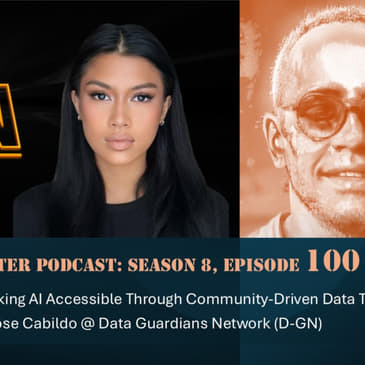

Johanna Rose Cabildo is the founder and CEO of Data Guardians Network (D-GN), a decentralized platform making AI accessible through community-driven data training. Previously, she led enterprise AI projects at droppGroup for the Saudi Government, Saudi Aramco, and Cisco, delivering cutting-edge innovation. With a background in technology, design, and crypto trading, Johanna is a continuous self-taught builder focused on turning curiosity into impact. Her mission is to create real on-ramps into tech, so anyone, anywhere, can contribute and own a piece of the future.
Link to D-GN website – https://dataguardians.xyz/
Johanna's LinkedIn – https://www.linkedin.com/in/johanna-cabildo-1217b4113/
[00:00:03] Hello, everybody, and welcome to the Crypto Hipster Podcast. This is your host, Jamil Hasan, the Crypto Hipster, where I interview founders, entrepreneurs, executives, thought leaders, amazing people all around the world of crypto and blockchain. And today, I have another amazing guest. She is the CEO and co-founder of the Data Guardians Network. Her name is Johanna Cabildo. Johanna, welcome to the show.
[00:00:28] Jamil, it's a pleasure being here. Thank you so much for having me on the podcast. I'm tuning in from Dubai, but as we spoke, you're here in spirit. So really appreciate you having me on here. Awesome. Awesome. I'm glad you're here. It's a pleasure to have you here. And maybe one day I'll go to Dubai. I always wanted to go to Atlantis there. So, you know, we'll see.
[00:00:51] Yeah, so let's kick things off and ask you first, what is your background and is it a logical background for what you're doing now? Yeah, for sure. So I previously led enterprise projects for Drop Group, which essentially focuses on operating systems for Web3. Clients include Saudi government, Saudi Arabia, Saudi Aramco, Qatari government and many, many more.
[00:01:15] In terms of the blockchain side, I have a funny story, but, you know, I originally got introduced to the industry more so on the trading side of digital assets. I managed to get in and take advantage of the fun ICO era, ended up collecting a few NFTs, you know, the whole CryptoKitties as well. That was one of my favorites. And then on the nights
[00:01:44] I couldn't sleep, of course, dabbled as a D-gen and, you know, had a lot of fun trading because who doesn't love a good meme coin? But to be perfectly honest, I got to a point where I was so obsessed with the tech and I saw so many use cases and I truly got interested and started reading a ton of books, watching a bunch of videos, doing a lot of research on my own.
[00:02:12] And I just found blockchain specifically so exciting. And so I sat back one day and I thought to myself, like, I did all this work to find out about the industry and I want to start putting what I've learned into practice. So I found a way to actually reverse engineer my way into the industry, funny enough, ended up leveraging these conferences. And so I remember around 2017,
[00:02:42] I started finding certain companies that needed help with conferences and events. Again, so grateful for these incredible companies that put me on and opened doors for me. And essentially, when it comes to these conferences, as you know, with Token or ConsenSys or any of these big conferences, it costs money to be there. And so I thought about it and I'm like, I want to get involved in the
[00:03:10] industry. So how do I find a way to get paid to be there? So again, I piggybacked off of these incredible companies. And instead of me having to chase these key leaders, these book authors, these incredible people in the community, they were actually coming to me. So for me, that was really fun, really exciting. And I feel like a lot of people are just genuinely so curious about
[00:03:37] these sectors, like both AI and blockchain. And so I find that nowadays, they don't necessarily have the right vehicle that allows them to, again, do the same thing as I did, where you get paid to be there after you're learning and actually providing impact within the industry and you're contributing. And so obviously, every time I worked with one of these companies, I took the time to learn about
[00:04:06] the company, learn about their products, etc. And, you know, you have all these incredible courses that are out here. But if you're in the middle of a job transition, it might be a little challenging to take a pay cut, to be out of a job for a little bit just to pivot. And so I think that was a huge gap
[00:04:30] that I wanted to try and solve. One of many things that inspired me to start DGen. And yeah, it's super exciting. Awesome. Yeah, actually, I didn't fully get that like the data guardians network, the acronym is DGen. Yeah, right? Yeah, what's it? You know, that's pretty cool. So what's
[00:04:55] it all about? And how do you convert AI data, I guess, into decentralized and secure user data for people to use it? Yeah, so as I mentioned, just out of my own personal journey, right now, I'm on a continuous journey to kind of find solutions for future generations. Right now with
[00:05:17] data guardians network, we are essentially redefining the relationship between data, AI and people who power it. So essentially, right now we're building a decentralized annotation network that focuses on ethical AI. So anyone with a smartphone and Wi Fi connection will then be able to become a paid
[00:05:41] annotator. And there's so many aspects to the platform, because again, this is such an exciting vehicle for someone like me, who's seen different gaps in different areas. We decided to primarily pay out our users in USCT. A lot of people are keen to stable coin, especially as I said, if you're pivoting from one sector or even trying to dabble in a new industry, you want to make sure that you're not just
[00:06:10] going to get rug pulled by a very volatile coin. Obviously, at this point, too, there are so many people this is such an incredible method to kind of incorporate those people who don't necessarily have a bank account, but obviously can create a wallet. Another thing too, is the fact that, you know, we're building ownership into the foundation of AI. So every contribution is tracked,
[00:06:39] rewarded and owned by the contributor. And as I mentioned, you know, we pay out in USCT. So imagine you swipe, tag, speak, earn and get paid out. Simple. On the flip side, I know a ton of people really love different projects where they were able to take advantage of volatility. So this is still in the
[00:07:02] works. But we do plan on launching our own utility coin token. And if you are keen to learn more about that, definitely follow us on social media. We want to frame it as more of a utility token, because at the end of the day, community is so important to us. Our overall goal is to make sure
[00:07:26] that everyone has a seat at the table. And obviously, if we can build out a sort of DAO infrastructure, I think that would definitely be an ideal goal for us. And at the end of the day, our biggest goal is to become the largest community-owned data engine in the world. So yeah.
[00:07:54] Very cool. Very cool. Now, there might be a little bit of a... I mean, you said you're focusing on ethical AI. Correct. But you're also claiming... You also have the name Degen. When you take those two... When you take those two terms and you compare it and you see the activity going on in social media, they don't necessarily align, right? How do you get people to see Degen as being ethical?
[00:08:25] So again, I think that was just a fun branding place, to be perfectly honest. You know, when it comes down to Slack, for instance, the virality of the fact that it was the exact opposite of what the company does, it was just pure genius, which I truly admire. And, you know, at the end of the day, big tech, they're trying to keep up with the demand from the community. So many people are starting to
[00:08:55] get excited about all of these implications, what they can... How they can use AI in their companies, how they can, you know, use AI for personal use. And right now, we're at a huge turning point where web content, art, and even charts are starting to get used without consent. So Degen is flipping the
[00:09:23] model to consensual tokenized data contribution. Like, we want to make sure that the value chain actually rewards the real contributors. Got it. So I'm going to talk about big tech. That's all I do. But there's also been an AI data boom recently. Okay. Of course. Not all the data is correct. You know, I can go on chat GBT and say, how many books has author Jamil Hassan
[00:09:51] written? And it'll say 30. The correct answer is 337. There's only 310 off, right? Oh, that's crazy. How do you rely... How do you begin to write on this data when the data, like, the data might not be right? And then how do you... How do you... And you say unauthorized data. So you have wrong data, big techs using it. You know, it seems like we've got a big problem there. How do you break the... How do you break the monopoly?
[00:10:20] So, again, this is the whole idea of centralized data being a huge danger for the future. Why do we decentralize anything? Concentrated power in very few hands leads to a ton of bias, lack of oversight and opacity. So it's very tricky when centralized AI, obviously,
[00:10:46] is just relied on this very small data pool. As I said, it can be such an issue because down the road, the bar is going to get higher. Right now, people are starting to use chat GBT, for instance, on a daily basis. And, you know, if you look at companies who are providing next day delivery, for instance,
[00:11:12] people are so accustomed to it. And yes, right now, big companies can rely on, you know, even synthetic data. But I don't see that as being sustainable down the road. At the end of the day, I want DGEN to be the go-to platform for trusted ethical AI data and actually include human-in-the-loop processes.
[00:11:35] Because when more companies realize that they need clean, secure data, we'll be the foundation to build on. And as we grow, the rewards for people contributing to it will also grow. Got it. I don't want you to give away the farm here, but I want to know how you get there. You know, you can't just scrub all the chat GBT's data. What kind of model should we use?
[00:12:00] What's the best model? What's the best approach? So in terms of just in general, like people need to start using transparency and consent, fair payment ownership. They need to have a decision-making input and really make ethics and incentives align. So especially with us, we've managed to
[00:12:25] gamify our systems. We've created different modules that invite people from, again, different nationalities, different backgrounds. And we're doing it in a method where you don't necessarily need to be an industry, someone who is actually experienced yet. So we're actually finding a moat
[00:12:50] where we can give people experience without having experience. And if you take the first step now and decide to grow and contribute to an industry that's going to shape future generations, you're going to learn more skills. You're going to be able to identify what's a good annotation versus a bad one. With our company, we're actually developing a QAS system, which is essentially like a credit score.
[00:13:17] It keeps track of all of the annotations and contributions that you make on our platform. So down the road, we're going to be able to see how you develop your skills, how you progress within the different work that you're contributing to. And yeah, it's really exciting in the sense that now we know where the data is coming from. It's not just, oh, we're finding these new photos online,
[00:13:46] we're taking ownership of someone else's work. People are now able to see and track and trace exactly where those contributions are coming from. And yeah, that's very exciting for me. I like the whole entire concept of you gain experience without having experience. That'll solve the job issue for many people if they embrace what you're doing, right?
[00:14:13] How can you get people? People have been scared off by data ownership. We've seen it because they traded all convenience to Facebook, stuff like that, right? So how do you get people who want to take ownership of their data, to want to gain those skills? How do you bring them in? Again, you know, you have to focus on the fact that data creators are like the builders of tomorrow.
[00:14:38] So my advice, my best advice for people now is don't just watch AI evolve, be a part of it. This is your window to get involved, stack skills, get exposed to what's really going to shape the next few years. If you look at the rapid rate of how much AI's evolved, blockchains evolved over even the past few months, it's so interesting, but also scary because even the data experts of yesterday,
[00:15:08] you know, they still have to constantly keep up. They still have to constantly learn and grow and adapt with the industry because they are now experiencing so much progress in such a short amount of time. Every single day, we're seeing new AI tools, new AI agents, advancements. And I think this is where blockchain plays a huge role in being a core foundation to just a more transparent, ethical,
[00:15:38] and fair future. Because if you look at the volume of transactions and digital footprints and all of these services that are being made and created by AI today, the blockchain's the only real ledger that can keep up with that kind of volume. So I think, again, these two sectors and industries just focus hand in hand
[00:16:03] on, and they really complement each other in a way that if we're going to grow the AI industry ethically down the line, we need to be able to be accountable to every contribution. But yeah. So I want to explore that word ethics. Yeah.
[00:16:24] You know, who's ethics? Is it Elon Musk's ethics? Like, what's the standard for people to determine what ethics are? How do you like, is there a roadmap for implementation of a certain kind of ethics? How do you determine what's ethical?
[00:16:44] To be perfectly honest, it is a very complex idea. And as you mentioned, you know, there are so many ways that we can tackle it. To be perfectly honest, just in terms of what's going on today with artists, with current contributors on Web2 platforms, you know, we can focus on the fact that
[00:17:14] we are able to start with giving credit. We're giving credit to its rightful owners. Right now, there's so much going on. And again, it's really tricky to just tackle and say this is ethical versus non-ethical. To train certain data sets, like again, I was having a conversation with someone at
[00:17:40] Token, and they brought up synthetic data. I get it. And I respect it in the sense that, you know, people do want to keep up with the demand. But at the end of the day, you know, according to McKinsey research, there's over 500 million jobs that are allegedly going to be displaced by AI in 2030.
[00:18:04] If we can find a way to use AI, to use blockchain, to empower these people to create opportunities rather than take it away. I think that definitely aligns more with the ethical messaging and mission. Yeah, I think so too. Now, you said, you know, data creator. I think there's one area that AI can't displace.
[00:18:30] And that's the content creator, because you could be a data creator. You can create efficiencies in data, but you can't create the uses for it. Like you can't, like, I think innovation is up to the person, it's up to a person that's up to the right side of the brain, right? Up to creation, right? So how do you, how do you build a world where, where creators are working together with data creators
[00:18:59] to implement that ethical AI or the future of AI and the culmination of blockchain working with AI? Yeah. So when I look back at things I've collected over the years, certain missions I've been on, I've always boiled it down to three points where I personally want to focus on innovation, automation,
[00:19:21] and collaboration. Innovation is phenomenal in the sense that, you know, this world has just rapidly evolved and we have so many technological advancements that we need to start processing certain things via automation. There are so many talented people in this world who, again, could be doing bigger, better things if they had the opportunity to do it. The tricky thing with AI
[00:19:51] right now is it's so exciting, but frightening at the same time. When you look at AI, it opens the door for opportunities. Someone who doesn't necessarily have a Harvard degree now has the tools to be able to learn at their own pace. They're able to break down big ideas in a way that they can personally understand.
[00:20:18] They're able to have access to more information than presidents of the United States 10 years ago. And that's really exciting. But at the same time, we look at the flip side. Unfortunately, as much as we want to paint this pretty picture where AI is always ethical, always used correctly, there are other things
[00:20:44] that people need to be aware of. The fact that scammers now have the right infrastructure to essentially create clone accounts for social media, for instance, people are able to clone voices. And I again think that if we focus on more solutions and keep trying to use AI in the right way,
[00:21:09] I think that more people will hopefully see that it's not necessarily all bad. Again, I am a huge advocate for all of the implement, for many AI implementations. I think it's wonderful for someone like me. I feel like it's advanced my workflow. Being someone who just even learns in a
[00:21:35] certain way, I managed to find my own way to teach myself subjects. And to me, that's so exciting. Down the road, collaborators who didn't necessarily have the platform or thought they didn't have the platform to project, let's say their music. Artists can now leverage the fact that they have access to
[00:21:59] so much information. They can read up on case studies, they can learn about what are the best ways to create campaigns and what are the best ways that they can monetize their reach. And I, again, was having an incredible conversation with an artist this past Token conference. And he brought up the fact that
[00:22:24] you know, he spent years learning how to even perfect a brushstroke when it comes down to his art. And now people are able to, again, take tools and visualize anything that they want to. For instance, my son and I, I'll be perfectly honest, I introduced him to ChatGPT. Because if I had that when I was
[00:22:49] younger, and I can paint a picture of all of the things I ever imagined in a dream, for instance, then I think I would have definitely felt more confident a lot sooner. You know, this is a cool way to conceptualize anything and everything. But again, when it comes down to using artists work and
[00:23:14] or even any sort of contributors work, I think it's really important to just trace it back to the original contributor and make sure they actually get compensated. And yeah. That's where the combination of blockchain and AI come into focus, right? Right. Being able to trace back who actually is the authentic owner and creator. Sure. For sure. And that way, artists can make money again, like they were in the NFT days.
[00:23:44] Absolutely. Did you ever buy an NFT? I have lots of them. Actually, my image behind me is an NFT. Wonderful. So it was Jamie Goldblatt, MindChill360 was the creator I just interviewed in this past week. So again, the third time. Full circle moment. I love that. I interviewed somebody a few years ago where they remember their skill was to remember their dreams and to paint their dreams. Wow.
[00:24:15] And I'm trying to think, you know, question for you is, you know, the AI has enabled you and agents have enabled you to do what you'd like to do. How can, how can this intersection of blockchain, AI and, you know, creativity help us move forward as far as overcoming, you know, personal and social issues? Well, saying this firsthand, just because I know so many people, everyone experienced the pandemic.
[00:24:44] For the first time in my life, I actually experienced social anxiety. It was a very isolating period. I ended up not seeing anyone, to be honest. And if it weren't for AI, and I know this might sound a little controversial and corny, but AI truly helped me come out of that shell.
[00:25:08] Because when I was experiencing this moment of not feeling confident in a room and not knowing what to say, I was able to fall back on AI and really lean into the fact that I could find a way to regain that confidence confidence without having to recruit another third party, which was biased.
[00:25:33] You know, at the time, Chad GPT, all of these fun companies, they were growing at such a rapid rate. And when I found it, I just found it to be so interesting, so exciting, because then I realized that you now have so much access to all this information.
[00:25:52] And when it came down to certain moments where I felt truly isolated, I was able to, again, systematically break down thoughts and then go into a meeting afterwards and just tackle it as if, you know, I wasn't experiencing this social anxiety. So for me personally, I feel like it was truly impactful. I feel like it was really helpful.
[00:26:17] Down the road, people can use it in so many different ways. I know there's certain people who are just using LLMs, for instance, on a very basic scale. But realistically, you have to remember the fact that this is something that can really accelerate your future.
[00:26:39] If there's a topic that you want to learn about, you can now compress these huge ideas into smaller concepts that you can understand, that you can actually engage with, and it aligns with your interest. At the end of the day, I know even when it comes down to my son, with my son, I've realized that, for instance, he loves cars.
[00:27:06] He loves, you know, a very typical boy. But I've realized that the best way to gamify any sort of learning when it comes down to him is through ChatGPT. I will go into any sort of AI agent and basically break down the fact that, okay, I need to communicate and use these words, and I need to break it down in a way that he'll actually understand.
[00:27:35] There's a brilliant author called Ruth Spiro. She actually takes this and uses this in her publications. So she has these incredible children's books. And let's say you wanted to learn about quantum physics. She takes down Schrodinger's theory, and she breaks it into very, very simple terms where, you know, even a four-year-old can understand it without knowing they're understanding it.
[00:28:03] And I truly think that's so incredible and so fascinating. When it comes down to it today, I think people should not be afraid to use these resources. This is your best friend. And when it comes down to wanting a mentor, when it comes down to wanting another voice, just to even collect your thoughts, this could be such a powerful tool, an accelerator.
[00:28:33] I love it. People should start thinking about it this way, too. I agree. So I want to thank you very much for your time today. This has been a wonderful conversation. I have one last question. I have one last question. It's easy. It's how can people find out more information about you, about Data Guardian Network? How can they start using data to create? How can they do that?
[00:28:57] So if you can, I invite everyone to definitely sign up to our wait list. Follow us on our socials. We are pumping out some exciting news in the next few weeks. And as I mentioned, we plan on launching our own token. Again, thank you so much for having me on here and giving me the opportunity to share Data Guardian Network. Awesome. Thank you very much for your time today. Thank you so much. I appreciate you.