
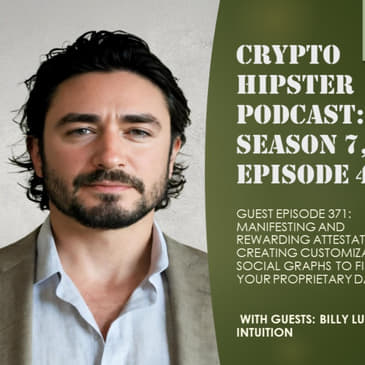

Billy Luedtke is the CEO and Founder of Intuition, an Ethereum-based authentication protocol. Billy previously served as Senior Technology Advisor at EY, a leading global professional services organization providing assurance, tax, audit, strategy and transactions. At EY, Billy created the company’s blockchain consulting practice, leading the technical development of blockchain-enabled distributed systems. Billy later became a Senior Token Engineer at ConsenSys, a leading Ethereum developer (MetaMask, Infura, Linea). Billy continues to serve as an advisor at ConsenSys and MetaMask.
[00:00:00] Hello everybody and welcome to the Crypto Hipster Podcast. This is your host, Jamil Hasan, the Crypto Hipster, where I bring you founders on to Pernor's executives, thought leaders, artists, you name it across the world of Crypto and blockchain globally and I have...
[00:00:16] You guessed it, another amazing guest, oh my guests are amazing and this is going to be an interview I'm really looking forward to. I have the founder and CEO of Intuition with me today, his name is Billy Luedtke. Billy, welcome to the show.
[00:00:32] Thank you so much for having me on, really excited for this. You're very welcome. Thank you for joining me. So, the first thing I ask everybody is, you know, what should background and is it a logical background for what you're doing now?
[00:00:46] Yeah, I think it is. So I did my undergrad in systems engineering which is a relatively broad topic and it deals with just systems generally which I think is really cool because everything is a system like the way that people move through society as a system like a warehouse or a supply chain as a system.
[00:01:06] It's not necessarily just technological systems, it's just systems generally and I thought that that was kind of generally applicable to anything.
[00:01:14] And so that's why I did that and then coming out of college my first real job was working on this distributed seismic network at Caltech with the United States Geological Survey Office just randomly stumbled into that and that ended up being extremely relevant.
[00:01:32] So I got really exposed to distributed systems and got involved in crypter on the same time. So I've been in cryptos since 2012, I've been involved with Ethereum since early 2014. Help start the blockchain consulting practice at Ernst and young back in, I guess 2015 or so.
[00:01:49] And then moved over to consensus where I've actually been for seven years. I'm still a special advisor to consensus. So I've been there probably longer than almost anyone. And along that journey, I did a bunch of decentralized identity stuff.
[00:02:05] So starting when I was at UI I was building these KYC POCs which led me to randomly stumbled into the early formations of the decentralized identity foundation, which led me to meet the U-port team and so when I ended up joining consensus I ended up working with the U-port team, which is one of the first self-suffering identity projects built on Ethereum.
[00:02:26] So I think because of that, it all kind of culminated in this and even what intuition is largely dictated by where it came from. So I guess the background is even more applicable. So I'll just quickly frame that because it also helps frame what intuition is.
[00:02:44] So where intuition came from was last cycle, I had taken a leave of absence from consensus to focus on my own portfolio and I was doing a ton of annual investing in advisory work and my unique value property people was, hey let me connect the dots for you.
[00:02:59] Let me tell you who's come before who exists now best practices, tooling things like that and that were great.
[00:03:05] But I found myself on all of these calls and meetings all the time and I didn't really like the meetings and so I thought to myself how can I disintermediate myself here.
[00:03:13] And so when I did was I took my mind map of web 3 and I put it into this kind of visual knowledge graph that you could navigate for yourself.
[00:03:21] So instead of needing to come to me to ask me questions like hey what are the layer two teams that you like and who are the people on them that you like and that I should talk to or whatever you can just go to the knowledge graph and find that information for yourself.
[00:03:34] And that were great and I just started using this to keep track of my own stuff because I had a million browser tabs.
[00:03:40] I still have a million browser tabs open, like a thousand bookmarks that I really I've never gone back to them a single time I've never used the bookmark in my entire life.
[00:03:51] I don't think I use room research and I take notes and I tag things with things properly sometimes, but it's not like really good for organizing lists of things.
[00:04:01] So I just started using this like nice visual tool to keep track of my own stuff and in keeping track of it for me, it kept track of it for everyone else with no additional friction.
[00:04:09] So all of my friends and my pork goes my clients they can just like see the information that I was aggregating as I never gave the crypto ecosystem. And so then I thought to myself okay, that's pretty cool but it's just my knowledge in the knowledge graph.
[00:04:22] But what if that wasn't the case? What if it was everyone's knowledge in the knowledge graph? And what if people were incentivized to add good data to the knowledge graph? That'd be pretty interesting.
[00:04:31] And the more I thought about it, the more obsessed I got with it because at first I was just thinking about it in the context of crypto.
[00:04:38] But then I thought wow, this like actually can kind of change the world I think and then I went to kind of architect it and started writing the white paper what it started to look like was the way that you achieve this as you leverage a lot of the decentralized identity and data and finance primitives that have been kind of emerging over the past couple years.
[00:04:58] So it's really this like composition of all of this amazing work done by a lot of different people with like a bunch of interesting innovations on top to help you build this kind of crowdsource decentralized permissionless semantic knowledge graph composed of verifiable data about things.
[00:05:15] And that's the background. I have two follow ups. I never have two follow ups after the first response, but the first one is part of your story includes Denver hackathon story. Yes, what was that about?
[00:05:33] Yeah, so I had written this white paper and at the time I was I was jamming on this stuff with this guy Odysseus shadow Odysseus, love Odysseus.
[00:05:48] And we were like, hey, let's let's go to Denver and build a POC for this thing. So I kind of like shopped the white paper out and started asking on Twitter and stuff who might be interested in building a POC.
[00:06:01] We assembled a team of like 12 people to fly out to Denver to work on this hackathon project. And we the maximum team size was four, so we kind of segregated people out into a couple different teams, but a lot of people worked on kind of general intuition stuff.
[00:06:18] And so we built kind of the first POC to kind of prove whether or not the concept was actually capable of being achieved and made it to the finals got to present to the talent didn't ended up like winning.
[00:06:31] I think we won like, we won some of the tracks. We weren't like the main winners or anything but we did really good. And then afterwards everyone was like, hey.
[00:06:41] We should probably keep building this right and I was like, I guess so. And so for about a year we had team of about eight that worked unpaid on the first iterations of intuition before he raised any money because everyone was so excited about it. So that was pretty cool.
[00:07:00] I entered my first hackathon in May. So we submitted a link one so we'll see what happens, you know, I'm not the developer or the lead I just helped out so we'll see you know that's amazing.
[00:07:15] So the other fall I had, you said you worked at geological survey right so what's your background in geology zero. It was like, yeah, I thought it was interesting I thought it was awesome what I just thought it was cool what they were doing.
[00:07:35] So basically the concept was and I won't go too deep down this rabbit hole but I'll just talk about it a little bit because it's interesting.
[00:07:43] So before this thing called the Quake Catcher Network and I don't know what the status of all this is now I don't pay attention to this world at all, but they would they had these really big expensive size mommeters that they would place in various strategic locations to try to track seismic activity.
[00:08:00] So the goal of the Quake Catcher Network which is the thing that I was working on was what if we had really small really inexpensive seismometers they could put anywhere like you can put them in your house you could put them in a college a university museum so I was working with these like higher learning institutions like universities, libraries things like that and installing these sensors and all of these just everywhere everywhere we could get coverage.
[00:08:25] So instead of you just having like one really big one in one spot you the thought was you have this distributed network of seismometers that is way more effective at tracking seismic activity.
[00:08:35] And we used something called blank which is the Berkeley Open infrastructure for network computing and what they use for like setting it home and things like that. So that was yeah, don't know I don't know anything about geology or that's stuff but I thought it was cool.
[00:08:51] Yeah, I undergrad my degree was in liberal arts but I had three concentrations business communications and geology and you know you're doing these do you talk about the graph that you built and that network and I'm thinking I'm thinking contour maps I'm thinking you know the design geological survey map is similar to what you're doing so I just wanted to get that you know perspective.
[00:09:18] So my first question regarding your graph regarding you know what you're doing now is add the stations what are they and how do you incentivize them. That's a great question so the way that I think about.
[00:09:32] And so it's really simple I just think of them as signed data about things and to kind of a library on that concept so. In the early days of Ethereum. And you you you were signing transactions with yourself sovereign private keys which is great.
[00:09:55] But then the thought was like okay what if there was like one additional step where you know you signed a transaction about a thing like that's an attestation so like the thing like the transaction has some sort of message and then the message is about a subject so it could be like.
[00:10:15] Bob is trustworthy that that's that's really all an attestation is and what the the current state of. And so the first thing that I think about the actual actions is that they are mainly being used in specific context for purely deterministic stuff.
[00:10:34] So I think we're seeing the most traction is kind of in the quest world and the anti civil world where you know you go to. And you see your layer three and you do the quest and the issue and attestation that just saying hey like we.
[00:10:47] Verified some set of criteria and because we were able to verify this criteria here's. An attestation that says you completed the quest so it's just a sign message that says.
[00:10:58] And you complete your good we have verifiable evidence that you did it so now you can go claim your air drop. So mainly only businesses are doing it and it's for like deterministic things it's not like.
[00:11:10] Persujective stuff so it's not pay this smart contract I like it and it's kind of cool or like this guy is cool like working with them that that stuff really there's not any of that yet it's really this purely one to one deterministic flow and so.
[00:11:27] I guess the our approach is very different in the sense that we're. I think that the deterministic one to one stuff is really just the tip of the iceberg because if you think about like the the important data about things oftentimes it's the subjective stuff so.
[00:11:44] It's you know whether or not a person is good at their job or trust for the or things like that or and you can get that through credentials but you can also get it through kind of the wisdom of the crowds or it's the sentiment around a publication or it's the reviews on a product or business all of these things.
[00:12:03] You don't really want just one trusted entity telling you yes verified by this thing you you want a bunch of different data points from a bunch of different people to make a decision.
[00:12:13] People to make a decision or arrive at a conclusion so yes we can accommodate the more objective stuff but we're really focused on these. So I'm solving the problem of these more subjective claims about things and I use the word claims about things interchangeably with.
[00:12:30] Act of stations because that's that's really all this. I'll pause there before moving into the into the second piece of your question if you want to comment or ask questions.
[00:12:41] No, no thank you for telling what they are yeah how do you it's like if there are only term initiative how do you incentivize them and would be more opportunity to incentivize them if they were subjective. Yeah exactly so what we do is.
[00:12:58] Basically there's there's two ways to incentivize these types of things actually there's two ways and then there's four different kind of levers that you can pull so. To create a parallel for how to think about this.
[00:13:15] Let's think about the web to world and quote unquote act of stations in the web to world so.
[00:13:21] And Amazon review is kind of like an act of station it's not an act of station because it's not signed by a product like a self-sauven private key but you're you're making a claim about a thing and if you look at the data.
[00:13:31] No one is like 97% of people aren't actively leaving reviews like I've never written in Amazon review I've never written a yelper view I've never done a LinkedIn endorse me I do five stars and over every time because I don't care.
[00:13:44] And everyone I talk to also is not an active contributor to these platforms so looking at that you think okay in web to the UX is really easy sometimes all you have to do is click five stars and even then people don't do it so.
[00:13:58] Just having the infrastructure to claim things about things is obviously not enough and I think that's the assumption that people are operating in an active station land is.
[00:14:08] If you build it they'll come and the answer is no they won't come they would be what why would people go out of their way to spend their time and energy to.
[00:14:18] Make claims about things like if they have no reason to do it and so then you have that that it becomes kind of a relatively philosophical question and so.
[00:14:28] Our answer is that there's four there's four kind of categories of incentives that you can tap into to get people to want to claim things about things.
[00:14:38] One of them is economic I'll start with that it's it's the most complex and it's our biggest innovation so I can go into this one in way more detail but basically when you when you contribute data to intuition.
[00:14:51] You get ownership of that data like fractional ownership and then anytime anyone in the future interacts with that data you get paid.
[00:14:59] And so basically you can think of it like when you go to create the data you got to pay some small fee because there's a cost of storage there's a cost of all this computation that needs to happen so just like a gas cost you got an entirely permissionless system there has to be a feed of doing things or else you get civil and also tacked so small fee gets paid.
[00:15:18] Think of it like a gas cost where that gas cost goes is not to like miners or validators or whatever it goes to purchasing ownership or equity in the.
[00:15:28] And then the where the rest of that fee goes is to all the other owners of that data like that's adjacent to the thing that you're trying to say.
[00:15:38] So basically on the on purely the right with with the W like the right side of the data you can build these incentive models that kind of create these interesting games that.
[00:15:51] And I'll remain on the economic piece for one more second and frame it with the parallel and web to so think about you watch a YouTube video and.
[00:16:04] My I'm like well if your responses that piece of content was totally worth consuming my response right now is okay I don't hit the like button maybe I'm a bad person but I don't I don't hit the like button.
[00:16:16] I don't subscribe maybe I'll share it with a couple friends via text. But what if you were economically rewarded for liking a thing early so you watch the video it only has a hundred likes and you say to yourself wow this piece of content is really worth consuming.
[00:16:33] I'm going to take an economic bet on the fact that this is going to get a lot of likes because every subsequent like I'm going to get some money from it so then the thing you like it as a hundred person and then 10 million people like it.
[00:16:44] You're getting you're getting fees from all those subsequent 10 million people.
[00:16:48] So that's kind of the the economic model on the right side of the equation and then on the read side of the equation now that you have a verifiable attribution of who created the data in the first place you can flow.
[00:17:01] Revenue back to the people who created the data when the data is used for anything so let's say it's some arbitrary cost per query model and a person's paying a penny to query the data or hit the API I don't know whatever you can you can flow a fraction of that penny to the people who created the data that gets returned as a result from their query or something like that.
[00:17:22] It's way more complex and it's way more gameifiable than the other piece so we're focused on kind of the right with a W side of things first but that's kind of the economic level and I'll pause there before moving into the other ones.
[00:17:37] I like it you know I think right now might if we did it that way my my sons who follow people on TikTok and YouTube they would be millionaires.
[00:17:50] Yeah, probably yeah that's the thing it's I come across things all the time where I'm like oh that's I'm early to this one I want to signal that I believe in this thing I want verifiable attribution of me claiming a thing at a certain point in time and I also want to make money from it.
[00:18:06] That's what I want. Yeah, sounds good okay yellow three yeah so we have economic and then we have function maybe these are bad categories and if anyone has any recommendations for how to change them let me know but we've got functional educational and.
[00:18:25] So on the functional piece maybe you want to make out to stations about things if it's really easy and it provides you some value not like not economic value but like sell some pain point in your daily life so.
[00:18:41] Going back to my angel investing advisory knowledge graph thing that was functionally useful to me like this this tool I was basically creating claims about things by categorizing them tagging them adding data about them because I was organizing my own life it was it like I was just doing it purely selfishly for me.
[00:19:03] I was just doing it but to you know lump all my the wallets that I had discovered together and all the AMM's and it's oh you're bridging over to this chain here's the bridge that I like to take so.
[00:19:12] I think data about things because it was useful to me but then it was also by proxy useful to everyone else so maybe you want to make out to stations because it's easy and it's useful. Cool and then the reputation of peace is.
[00:19:32] Let's say we're on Amazon again so.
[00:19:35] One reason I don't really review is about anything is because my reputation doesn't get me anything like I can still buy any product that I want without reviewing a single thing and not only does my reputation not get me anything in the context of Amazon it doesn't get me anything in the context outside of Amazon because my reputation is not portable but what if you know.
[00:19:56] I could take my reputation as a good Amazon reviewer and get an under collateralized loan and defy or open a big account or something there's there's some tangible value to building reputation like it has.
[00:20:10] Even though it's maybe hard to quantify there is some value in having a strong reputation so what if you could do interesting stuff with this now portable reputation so maybe now within this world of.
[00:20:21] Portal for reputation you care about making claims about things because making good claims about things increases your reputation in those contexts and now you can take that reputation across context and use them for whatever arbitrary thing that you want to do.
[00:20:40] I guess like the reputation of peace starts to tie over into the educational piece.
[00:20:46] Where when you also think about Amazon so one reason another reason I don't leave reviews on things like Amazon and I don't want to box this whole thing into being a review thing but it's just a nice act of station parallel so I'll just keep using it but.
[00:21:02] Basically I don't have an Amazon friend list which seems wild so like I don't have an Amazon social graph so I see when I go to a product I see 10,000 reviews from anonymous people that I don't know.
[00:21:15] And there's there's some value in that I still go and I still say all five stars 10,000 reviews like yeah I'm going to buy this one even though I know the data's flawed but.
[00:21:23] One trusted opinion from a person that I trust is worth more to me typically than 10,000 anonymous reviews so. Once you can kind of have these portable social graphs you could overlay something like Amazon with.
[00:21:37] Contextual trust graphs so you can say hey you know I trust Dr. Huberman in the context of supplements and now I'm shopping for supplements so overlay the act of stational data with. You know my trust graph and oh look Dr. Huberman.
[00:21:51] I'm saying I don't care about what everyone else is saying I just care what the people I trust are saying about these things and the reason you might want to make claims about things in that scenario is.
[00:22:02] Because then the people you care about our seeing your reviews like if I leave a review right now it's just going to get lost probably and so I'm I wasted you know five 10 minutes of my time to create something that no one that I care about's ever going to see.
[00:22:16] Which I'm just shouting into the ether but what if that wasn't the case like I recommend things and group chats all the time I text people I have conversations with people so I'm doing it I'm a testing to things I'm claiming things about things in real life but.
[00:22:29] I'm not capturing that data online at the point of interaction with the thing so the the data's fragmented it's not discoverable it's kind of.
[00:22:37] In the social fabric of society floating around not in the platforms where you're actually doing the interaction so that was really long winded but I hope that that kind of frame things relatively well.
[00:22:50] It makes perfect sense to me so pretty much everything I do is in the social fabric of earth exactly yeah and well.
[00:22:58] That's why it's all intuition because we're trying to build the intuition module of the collective conscious so it's like it's the data's out there it's it's in the social fabric of the earth.
[00:23:08] But that's not really readily accessible like I don't know how we tap into the ether so what we have to do is we have to get people to express the same things but in the digital realm.
[00:23:20] In a structured format that's semantic so that we can actually use the data to make better decisions in our everyday lives because we now have a lot more data about things.
[00:23:31] We have a lot more data we have a lot more decisions we don't have our data in one customizable place but if we did. What will be possible. Everything. I think. I think it changes everything and yeah I can I can not chunk in T. Galap.
[00:23:56] I think what's possible is. The way that I view what we're building is we're trying to build this this trustful interaction layer. So. I'll break that down a little bit so trustful just means you have trust and interaction layers like. The layer of.
[00:24:21] Society where you interact with things so think about like most things are interaction so we're talking this is an interaction I buy a thing it's an interaction I click approve on my metamask them improving tokens is send us some contract interaction lot the interactions everywhere.
[00:24:39] Now all of web three is really focused on. Trustless code trying to try to migrate society from the subjective trust systems to these objective trust systems where trust is actually just removed from the equation and you can verify not trust but that is.
[00:24:59] Actually oftentimes a bug and not a feature when you don't have trustful interaction because. I think that's a very interesting thing.
[00:25:09] So, you know, person interacts with the wrong smart contract code is trustless but it's the wrong code it's a scammer and then you lose all your money or lose your identity so not great.
[00:25:19] So like we have to I'm going to start talking about this a lot more and I'm going to release the updated intuition web paper soon that kind of elaborates on all these concepts but. So, I think that's a very interesting interaction layer and if you think about crypto.
[00:25:33] We almost have even stronger of a reliance on the subjective trust mechanisms because of what I just described because it's just extremely high risk environment where if you interact with the wrong things it's not like I'm buying a product on Amazon and I can return it or it's a 10 dollar thing.
[00:25:50] And all of the money in my wallet and people don't really have great. They don't buy by best practices and they pull all their money in their hot wallet and then they lose it all by it just happens all of the time and so I think that.
[00:26:02] What is possible with what we're doing is.
[00:26:08] Giving people a little bit more certainty whenever they go to interact with stuff and the stuff can be anything it can be a smart contract on Ethereum it could be a person they're trying to hire it can be a product they're trying to buy.
[00:26:19] Product they're trying to buy it could be a they're browsing for podcast and they want to know which podcast to interact with just just trying to. Take this data of society that presently is either it either remains unexpressed or.
[00:26:36] Is expressed into the social fabric of society and is not captured in the digital realm in any structured way take all of that stuff and then take all the stuff we already have.
[00:26:46] And then we're going to be a little bit harder because there's like centralized gatekeepers protecting the data but you know there is good data in platforms like Twitter Amazon, y'all Wikipedia whatever so take all that stuff.
[00:26:59] Take all this other stuff that either remains unexpressed or expressed in fragmented ways and combine it together into this open permission list decentralized knowledge graph. And I think that you know an example of what the world can look like is.
[00:27:16] Let's say you're going to interact with a smart contract or just a general eth address using met a mask like instead of just seeing a bunch of non human readable jargon you know at the point of interaction you can see.
[00:27:28] Oh, you know here's the smart the 10 smart contract auditors I trust three out of ten of them have said that this thing is audited amazing i'm going to i'm going to click control for you know.
[00:27:40] This army of defy regions that i really trust have all claimed that this is a scam so.
[00:27:46] I'm going to reject the transaction and not have it go through like these things are already happening like but what you have to do to find the information is you have to scroll through Twitter you have to scroll through the group chats.
[00:27:58] If you're technical you can actually read the smart contract code it's just not very efficient so what I want is at the point of interaction.
[00:28:05] You just have more data about the thing that you're about to interact with so it's like okay people claiming things about things and then serving that data at the point of interaction.
[00:28:19] It's interesting that you said you could lose all your money or you could lose your identity right. You know the three promises to blockchain right. What are the three promises? Banking for the unbanked or if you're a Celsius unbanking your bank.
[00:28:36] You know we won't get that you know identity for the unidentified and something else that no one focuses on but you do it's a voice for the voiceless. You give them people a voice. Yeah.
[00:28:54] I think that's a huge one and I think it's becoming ever more prevalent in the society that we live in and it's a it's a difficult balance like.
[00:29:08] When you start dealing with the identities of people and if you let basically we let anyone claim anything about anything and our primitive is allow you to do that.
[00:29:17] Where it gets tricky is when you start dealing with claims about people and you enter kind of data privacy laws but.
[00:29:25] I don't know I think that the the the protocol has to remain unapininated we can't if we start preventing people from saying certain things we enter this slippery slope of censorship and. I think that's a very important thing. And who who knows where we end up so.
[00:29:42] Hopefully people don't abuse the system they will because it's crypto and like some someone somewhere out there will do it but. For things that aren't people. I think the answer is real obvious and I think people don't focus on this enough where.
[00:29:56] Giving people a voice about things that are it you know human entities. It's really important because I want to be able to claim so the whole decentralized identity world is based on this concept of kind of.
[00:30:11] Private data by the fall and then selective disclosure so you selectively disclose the data that you want to disclose about yourself now. And as entities that don't have agency over themselves so let's let's say like I want to claim something about the concept of the theorem.
[00:30:26] How is a theory I'm going to select the will be disclosed data and it's not it's not a thing that can do that.
[00:30:33] So like and then then you'd have to give someone agency over the concept of the theorem who's who's going to be that person is it going to be metallic then we start enter this world of centralization so.
[00:30:43] You kind of have to have data as a public good in these scenarios you have to let people claim anything they want about anything and display that data so.
[00:30:53] When you do with things that aren't people I think the answer is obvious when you deal with people it gets more sensitive but.
[00:30:59] I don't know my argument is I want to be able to claim some bad things about people I want to claim the SVF's the scammer I want to claim that the three hours capital guys or scammers and if you can't do that.
[00:31:08] And you're only basing all of your judgments on positive attestations about things which is the only thing that you can do in this world of this selective disclosure because their argument is the lack of positive attribute or positive attestations is.
[00:31:24] Signal that there's negative sentiment but if you look at the theorem as capital guys or SVF or whatever they had a lot of really positive claims made about them and so they could selectively disclose. Just the positive front ones from before they were caught.
[00:31:41] And so then it would look like they were highly reputation like they had really high reputations so I think. It's weird and it's new us and it's hard and people like to dance around it and the easy answer is.
[00:31:54] Privacy by default selective disclosure but that I don't think that's the right answer it's way more nuanced and so we have to think about these things because to your point.
[00:32:03] I think I also agree freedom of expression is it is so important and it is a superpower that crypto unlocks that people don't often talk about so I'm really excited to try to bring into reality.
[00:32:17] I think that's awesome I think that's awesome and I this is my show and I could say SVF is a scammer and I could say it's three hours guys or scammers and I could see the carry cancer scammers.
[00:32:29] And shut down since yet so you know I do you know. I want to say I feel honored episode to go I like a three years ago I interviewed some people and we talked about trust. We still talking about trust.
[00:32:46] It doesn't it's been a no improvement you know. We're still running at a trust deficit I think more now than ever. What would the world look like if we had a trustless truly genuinely trustless mobile society.
[00:33:02] Oh man I think I think that's the ultimate M state and that's that's what we need to strive for I think removing trust from the equation just.
[00:33:12] It trust is a requirement of coordination and coordination is humanity superpower and so like if you're if you are able to remove trust from all of our interactions make everything trustless you enter this world where we are able to.
[00:33:30] Collaborate and coordinate at a scale that is orders of magnitudes better than what we're capable of doing right now. But I think enabled to in order to get to full trustlessness.
[00:33:43] That requires a lot of invasiveness which I think the only place to get to real trustlessness people people in blockchain world I think they're like oh yeah we got trustless systems now but it's like no it's built on the back of social consensus everything social consensus all the way down.
[00:33:58] So but to get like real trustlessness we need to like all have the narrow links we need all need to be able to read each other's minds and then have nothing be private and we're all just this board so I don't know if it's I don't know if it's really achievable or good.
[00:34:13] Gen I don't know that's that's I'll I'm happy to rent philosophically about that for hours but that's kind of the only way that we get true trustlessness so in the meantime my hypothesis and like this thing that I'm trying to put out into the world is.
[00:34:28] We can't make everything trustless it's we don't even want to so let's make them more trustful or trusted I'm if you prefer one of those words let me know because like trying to AB test the two. But like yeah. Well we'll figure it out. But yeah so.
[00:34:54] I think it's a move point to think about full trustlessness and and I think the what we have to do is we have to think about.
[00:35:04] And we have to think about it holistically and then we have to carve out the pieces of the trust that that we can make trustless and we've done a really good job at that so you know we've got trustless consensus and we've got trustless execution and we got trustless storage and we now have self-sauver and private keys so we kind of have like trustless identity in a way.
[00:35:27] The full system so go back to me being like assistant and you're like you view the whole thing is like one system. You're still operating you will have to keep operating for probably thousands of years on some trust assumptions.
[00:35:45] Even even if the code is trustless unless you're reading every single line of code that has been written you're trusting somebody somewhere maybe you're trusting an audit it from.
[00:35:56] Maybe you're trusting a really technical friend of yours but you have you have to trust people still so I don't know even how we get really to full trustlessness anytime soon. Or ever without extremely invasive technologies.
[00:36:17] Yeah we're human so by fall you know that's that's the who you know. Yeah I agree that's danger may I will get into that two different topics.
[00:36:27] I do I enjoy speaking with you today I want to thank you very much for your time at the price talk to you for a few more hours my podcast don't go that long so it come back again. I have one last question for you.
[00:36:42] How can people find out more information about you about intuition about we start using your platform how can they do that. Yeah so our website is intuition dot systems you can find everything from the website on Twitter where OX intuition on Twitter I'm zero ex Billy.
[00:37:04] If you want to stay up to date on things we are we're about to launch to production in about a month so follow us turn notifications on pay attention I'll be dropping the updated white paper soon please give that agreed let me know your thoughts.
[00:37:19] Most of the conversation happens on on Twitter and in discord so make sure to follow us there and join our discord and feel free to always reach out if you ever want to chat for having questions I'm always available.
[00:37:31] Twitter is the best way to reach me again just zero ex Billy but yeah that's us. Thank you very much for your time today. Thank you this is awesome.