
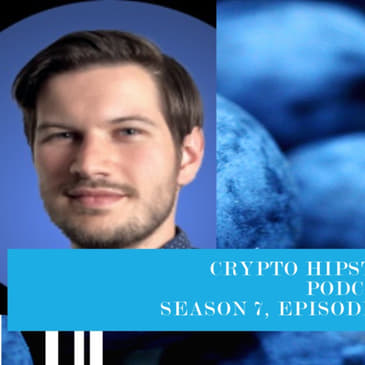

Jonathan Thomas is CEO and co-founder of Blueberry Protocol, a DeFi protocol that aims to provide a non-custodial prime brokerage experience. His background includes the development of over ten projects in the blockchain space, where he has been actively engaged in the Bitcoin and crypto community since 2011. Prior to founding Blueberry, Jonathan was the CEO and co-founder Synced Labs, which helped accelerate companies transition from web2 to web3.
[00:00:01] Hello everybody and welcome to the Crypto Hipster podcast. This is your host, Jamil Hasan, the Crypto Hipster, where I interview founders, entrepreneurs, executives, co-founders, wonderful, amazing people all around the world, artists, you name it.
[00:00:17] And today I have an amazing guest. His name is Jonathan Thomas. He's the founder and the CEO of Blueberry Protocol. Jonathan, welcome to the show today.
[00:00:28] Yeah, thanks for having me. It's great to be on here.
[00:00:32] You're very welcome. You're very welcome. So let's kick things off and ask you first, what is your background? And is it a logical background for what you're doing now?
[00:00:41] Yeah, so I would say like my background is a little bit spread out all over the place. But then as far as like being crypto for building on Blueberry joined crypto back in 2011 2012. So about 12 years ago at this point.
[00:00:55] First started off by trading in game currency for video games with random people around the world and the currency of choice for them was Bitcoin at the time. So pretty much like had the first foray into it back then without really understanding anything that was going on in the space or like what was the importance of it, but just that it was commodity that you're able to exchange one for one or, you know, different value.
[00:01:22] And then took a couple years break and back into crypto whenever the whole ICO scene really started taking off in 2017. Like that, you know, got burned a couple times and had fun with that. And then didn't really take this space too seriously until about 2018 2019.
[00:01:40] And then started getting into high frequency trading, and then just going more into the actual building space and figuring out like more about the technology itself instead of it just being strictly from like a trading perspective. So that kind of led down the rabbit hole to what Blueberry is, where being able to build that out now.
[00:02:00] You only got burned a couple times.
[00:02:05] Yeah, just a handful with a couple of sketchy exchanges that are currently trying to figure out if they're going to refund or not by court case. That's always fun too.
[00:02:14] Yeah, I agree.
[00:02:18] So Blueberry protocol when it get into that you know what is it all about and how do you provide a top tier non custodial prime brokerage experience for your clients.
[00:02:29] Yeah, so Blueberry is a default protocol that aims to provide a non custodial prime brokerage experience for all users, and being able to really challenge the status quo of you having to go on to a centralized exchange and be able to have access to leverage that way.
[00:02:47] Instead, now we're able to offer this fully on chain, and then just have a lot easier of a user interface than the alternatives of say looping a position to be able to get leverage. So looping is just being able to borrow, and then borrow on top of your borrow repeatedly.
[00:03:04] So being able to bring down the amount of steps that a user is going to be taking.
[00:03:09] And you know this and I know this but some people might not know.
[00:03:16] What are the disadvantages of looping.
[00:03:19] Yeah, so the disadvantage of looping is that there's just a whole bunch of transactions that you're having to do repeatedly. So you have the first part just additional spend to be able to perform all those transactions, as well as then whenever you want to close that position,
[00:03:34] then you're going to have to repeat the exact opposite and repeat all those actions again, over and over again to try and close that position.
[00:03:43] And it's just not a very nice user experience. And you have to spend a lot of time working through that. They don't really know truly what your position is, and what is the risk associated with that.
[00:03:59] And in the case with the centralized exchanges that you mentioned briefly before you get marching calls.
[00:04:07] Yeah, right. And so for the centralized exchanges, you're not really going to know what's going on behind the scenes instead of say if it's on chain. Now everything is transparent, you're able to see and know exactly what is your position, how close are you to liquidation or what are those risks involved, and then being able to keep an eye on those key important figures.
[00:04:29] So say that like your collateral that you posted is now starting to decrease in value. Now you know that you either A, can increase the amount of collateral that you've posted, or you can close down your position and it just gives you a little bit more safety since you have more knowledge.
[00:04:43] That makes good sense because in the last full cycle with these exchanges people didn't know they were going to liquidate until it was too late.
[00:04:53] Yeah, pretty much like the only time they would have any contact with you is when your position was already liquidated instead of giving you a heads up to say you might want to take a look at your position and maintain it a little bit more.
[00:05:06] Sounds good.
[00:05:08] So, you're working on deleveraging the risks associated with leveraged DeFi investing and lending.
[00:05:18] You know, how are you deleveraging and what are the risks of going 100x?
[00:05:24] Yeah, so for right now being able to deleverage the amount of risk. So for us at Blueberry we take a look at what is the specific position that you're creating, just so that we're able to really break it down into a full risk matrix, and then take a look at that and say what is the collateral that you're posting, what type of activity are you going into, then being able to provide you with the correct amount of leverage that we feel comfortable that you should be able to take on chain.
[00:05:53] So really taking in a whole wide variety of different informational components that is fully available on chain, and then being able to figure out what is the actual limits that you should be able to take instead of it being, you know, saying that you can take 100x leverage where 100x leverage might have a lot of risk associated with it where if the price of the asset moves less than 1%, you're probably already liquidated.
[00:06:17] So just being able to make it a little bit more intuitive as well as be able to offer leverage in a more informed manner, like where it's very intent driven.
[00:06:30] So there is still this concept in the crypto called, I mean, I love DeFi. I think it's for me it's conservative, coming from an insurance background, it's conservative. You know, some of the best protocols are DeFi. But then you have this concept of meme coins with people chasing that 100 or 1000 or million X.
[00:06:56] Right. So what do you see as the real, you know, the downside of chasing? And then what's the benefit of DeFi as opposed to chasing?
[00:07:13] Yeah, so to start off with like the downside of chasing is you'll have every cycle you always see a couple of meme points that just take off like an insane amount where they have that 100 million X associated with it. And, you know, then whenever you see that starting to continue rising in price for three days straight or something like that, then you want to, you know, follow the trend. But majority of the time if you're going to hop in, you're probably already too late.
[00:07:40] And it's one of those battles that either you try and find it super early or you try and, you know, remove emotion and not try and follow that trend. So it's a little bit challenging, I would say, because I know probably everybody's first cycle, they see something that's going up price constantly, they just want to hop in. But then they're more likely than not, they're probably gonna get burned on it.
[00:08:11] I'm under the I use the Warren Buffett mindset. You know, there's like you could have a million opportunities, but they're like in the batter's box, but you want to wait for the ball that's perfect for you. That you know you
[00:08:23] know, you know, and with that, you know, I want to go into your your view on some of the best crypto trading tips as we head into. I want to say, uncharted territory, but we've we've had Bitcoin habits before this was a little different because there's more institutions here. And there's a new political climate, too. So I want to get your constant your idea on some of the best trading tips.
[00:08:50] Yeah, I definitely do agree that since we have witnessed these having previously, the biggest trading tips really come down to just looking at what happened in the previous cycles. So it's almost to the point where we are following that four year pattern to like almost a perfect T, where you know, you can't really exactly know what the price is going to be day to day. But just general sentiment, you're able to know like is this month or this week, historically been an up or down week and then just be able to see what's going on.
[00:09:20] I think we're able to pick direction that way and make a more informed decision. But this is probably the first cycle where we don't actually have like free capital. So historically, interest rates have been super low, where the cost of money has been almost non existent.
[00:09:36] But at the same time, now we're actually having the adoption of institutions. So I think the institution adoption is kind of outweighing that pressure that we would be feeling from the interest rate hikes as far as pricing goes. So like for four new people that are just joining, I would say the bigger thing to look out for is just seeing taking in how much knowledge can you find from previous cycles and be able to use that to make an informed decision.
[00:10:06] Going forward. So the having just happened and usually in past cycles, it's been about six months, six months for the price of Bitcoin to go up after the having. Right? Yeah, like the six months to retrace all the way back to new all time highs or back to previous all time highs.
[00:10:25] The issue this year is that we're going to have not only the US election, but there's 30 countries having major elections right now.
[00:10:33] What do you think that's going to do? The Bitcoin and we're going to see a huge I mean, it's you know, had a crystal ball course, I would be like Biff Tenen from the Back of the Future movie. But like, how's that going to play a role?
[00:10:50] Yeah, I think that's going to play a pretty large role. Just because it's like here in the US alone, you see like a whole bunch of new legislation coming out and then people getting really charged up about different political parties since they're voting their way for crypto.
[00:11:05] And only imagine that's going to be the similar case in the other countries that are also having elections this year. So I think it's going to really come down to what are the results? Like I think a lot of people are actually being sidelined right now and just waiting for the next election.
[00:11:20] For that political part are the results from the election to come out before they start moving their chips one way or another.
[00:11:28] I agree. I agree. So when I switch gears a little bit, I want to talk about things that I don't understand. And that's I understand Ethereum.
[00:11:40] I don't understand all these new EIPs, right? I think there's four of them. Right. And there's a recent one proposed by Vitalik. You know, what is the current way to land with Ethereum?
[00:11:55] Yeah, so I would say the way of the land is like we're getting to that point in the cycle again where people are getting charged up about improving Ethereum and the blockchain.
[00:12:06] So that's the whole point of the EIPs is just to drive positive changes that improve either user experience or the developer experience.
[00:12:15] So one of the more recent ones from Vitalik was having a more dynamic gas pricing, just because like if you're a regular user of Ethereum, it's going to be pretty expensive right now.
[00:12:27] So that's why a whole bunch of people have been moving over to layer twos or other side chains.
[00:12:32] So the whole attempt with that most recent proposal is to bring down gas costs or make it a little bit more dynamic and cheaper for users, and then hopefully trying to increase more adoption long term.
[00:12:47] Gas fees. I noticed they haven't been as high as they were back in 2021, 2022 when you had the NFTs, right? But they're still very sporadic.
[00:13:07] So what would be the benefit of lowering those gas fees? And then also, if you lower the gas fees, would you need these side chains and layer twos?
[00:13:20] Yeah. So I think overall all these proposals have really attempted to normalize gas fees just so it's a little bit more constant and instead of it being very sporadic.
[00:13:31] So like about two months ago, there was one that came out that was quote unquote the blob EIP.
[00:13:40] So then pretty much just making it cheaper for layer twos to be able to relay information back to Ethereum mainnet.
[00:13:47] And the net effect of that wasn't really that gas prices went down too much.
[00:13:53] It just made it so that there was not any crazy volatile spikes and then just being able to normalize it on a steady state.
[00:13:59] So with like these different changes, I still think a lot of people will be attracted to the L2s just because it is a lot faster experience.
[00:14:09] So a transaction can confirm and be able to process fully in about a one second depending on what chain it is.
[00:14:17] While then on ETH mainnet you're looking at 12 second block times.
[00:14:21] So say that you have multiple transactions queued up and they have to go one by one.
[00:14:27] Now you're going to be waiting a lot longer on Ethereum mainnet versus if you're using an L2, which is able to process a lot faster.
[00:14:35] I heard talk of blobs and I asked people about it. No one can explain it the way you just explained it in one sentence.
[00:14:44] You know, how has the blobs gone so far?
[00:14:48] Yeah, so far they've been good.
[00:14:51] So like the first day that they came out some of the L2s like there were maybe three or five transactions and then they got subpenny.
[00:15:00] But that was just because of a non competitive market yet.
[00:15:04] So I think now everybody's starting to realize that they're having a better experience on L2s after the implementation.
[00:15:13] Got it. I like the word better experience.
[00:15:20] All right. And then the other thing about Ethereum is there's plenty of back and forth over whether there will be an ETF.
[00:15:30] You know, it's May.
[00:15:33] The SEC was supposed to is supposed to rule on Ethereum this month.
[00:15:39] What's the sentiment? What do you think is going to happen?
[00:15:41] Yeah, I think the first final decision date is May 23rd.
[00:15:45] And to be honest, I think they're still going to come up with a reason to delay it further.
[00:15:51] I just don't think that it's going to get approved in May.
[00:15:54] It'll probably get approved later this year though.
[00:15:57] So I have a super positive outlook on it getting approved.
[00:16:01] It's more so the question of when but I don't think it's going to be May.
[00:16:07] Yeah, I've heard rumors that companies are switching to Litecoin.
[00:16:11] Solana, Chainlink, Avalanche, maybe other things other than Ethereum ETF.
[00:16:17] I think that's that's denying the fact that there's still issues we need to work out with the SEC.
[00:16:22] Yeah, I think a lot of the other firms have been eyeing those other points for ETFs.
[00:16:28] But at the same time, the first one that probably will get approved out of that list is the Ethereum ETF.
[00:16:33] Pretty much the way I see it is that it's been around the longest and it's also the most decentralized.
[00:16:39] Therefore, it should be able to have the best chance of getting approved compared to the other ones.
[00:16:45] Say it is.
[00:16:47] Say it gets approved.
[00:16:48] Say ETH is a security, right?
[00:16:53] You do a lot of work with, you know, or you focus on institutional DeFi, right?
[00:16:59] How does that how would that work?
[00:17:01] Yeah, so with Ethereum got considered as a security, I would say either a lot of protocols would take one or two stances, either A, KYC and know your customer and go through the whole traditional financial system.
[00:17:14] And then you would have to have a lot of other protocols that would be considered as a security.
[00:17:19] So I think that's a good point.
[00:17:21] I would say either a lot of protocols would take one or two stances, either A, KYC and know your customer and go through the whole traditional financial route that pretty much mirrors what we have today.
[00:17:35] Or the second option would be that they would be blocking all US users and just not look at that US market as a client anymore.
[00:17:46] Don't think you thought already.
[00:17:47] Yeah, so they do that already.
[00:17:51] But then I would say like there then you wouldn't have any founders left in the States because I think there is like a handful of founders that want to stay inside the States and develop here, but then are just getting pushed and creating products that are used everywhere else except for where they live.
[00:18:10] Yeah, I've seen that.
[00:18:12] I've seen it happen.
[00:18:13] I think it's going to happen.
[00:18:15] So the other area that we want to work on, I think, in addition to the ETFs is the government's talking about CBDCs.
[00:18:25] The different regimes are talking or I call them regimes or parties, right?
[00:18:29] But they still like regimes.
[00:18:31] So, CBDCs, like what do you see happening here versus everywhere else in the world and what lessons can we take from the rest of the world to bring them here to US?
[00:18:46] Yeah.
[00:18:48] With like CBDCs, I feel like it's a very interesting aspect because we're probably going to get to the point where maybe not every bank is creating their own dollar or their own stable coin.
[00:19:00] But it will be to that point where every institution themselves is creating it.
[00:19:05] So I don't think that's going to be like taking the shape and form of CBDC that we know of.
[00:19:09] But instead just saying a financial institution, they want to be able to lower the amount of friction that users of their products that they have.
[00:19:18] So say that you're at one of these large institutions and you want to be able to use their different applications that they have internally and then just being able to make their whole accounting process easier instead of using a fiat dollar, then you're going to be using their dollar that they created.
[00:19:34] So if they want to do it internally, why wouldn't they just use Hyperledger?
[00:19:39] Yeah, well because when you're doing it internally, then you're the ones that are going to be able to maintain that interest or the yield that you have on that underlying dollar that got deposited.
[00:19:50] But then if you use like a third party, then you're either having a fee share with them or you're foregoing that interest or that yield that be associated with it.
[00:20:01] Okay.
[00:20:03] All right.
[00:20:05] All right.
[00:20:07] So they're going to create their own coins.
[00:20:11] So you have a paradox there. You have RWA, right?
[00:20:16] Stocks being tokenized.
[00:20:19] And then you also have this institutional led DeFi possibilities on things like Aave or Maker or whatever.
[00:20:27] Where do you see both of those different, I guess the two different roads, you know, either diverging or converging? What's the benefit of each?
[00:20:37] Yeah, I think there truly is going to be a lot more convergence going on just because in blockchain you're like, you're able to just have that increase in our liquidity.
[00:20:47] So the real driver is the composability, just being able to use those as money legos, if you will, and be able to plug and play them into different ecosystems.
[00:20:57] So I would say that's going to be that huge unlock.
[00:21:00] And why there is such that large of a push bringing everything on chain is it just makes everything a lot more liquid.
[00:21:08] So right now on the traditional markets, you know, they're only open Monday through Friday and then some limited use of before and after hours.
[00:21:18] So just being able to convert all the markets being 24 seven.
[00:21:22] How would you see that?
[00:21:27] I would personally, I would love that for crypto is not 24 seven.
[00:21:33] You know, you would love to see like some kind of structure, right?
[00:21:37] I remember back in the ICO days, I like got two hours of sleep based on region.
[00:21:43] Yeah, pretty much like you had that one sweet spot where there was no opening bell for a couple hours.
[00:21:49] Yeah.
[00:21:51] The biggest thing I see is probably just the shifting of having all the different markets, how they're still rotating between Asia, Europe and North America.
[00:22:02] And then just being able to say each one of them is going to come form to the actual agreement on how the financial market should work overall.
[00:22:11] Because I guess that's probably the bigger area that hasn't been too clear lately is just what are the actual rules and regulations that we all want to abide by and figure out what is.
[00:22:24] The ground, the guidelines that we can all work with and be able to create an innovate on top of.
[00:22:31] I wonder what those guidelines should be, you know?
[00:22:38] What do you think?
[00:22:39] Yeah, I mean, there's quite a lot.
[00:22:42] I would say where there is still being able to maintain privacy is a huge one for me.
[00:22:49] And then just being able to know that you are still interacting with legitimate entities is also a large one too.
[00:22:58] So I think we're going to get into this interesting place where individuals are going to KYC or know your customer and provide identity to a few parties.
[00:23:06] And then just be able to have a representation of that on chain where they're able to still interact with counterparties, but knowing that they're not interacting with anybody that should be sanctioned or on a restricted list.
[00:23:19] Interesting. I too am in favor of privacy.
[00:23:25] But if you have a world of RWF real world assets on chain, don't you lose that privacy? And how do you get it back?
[00:23:35] I think it really just comes down to how are you structuring products.
[00:23:40] So the biggest part is depending on how a product is structured will directly translate into how it's classified and regulated overall.
[00:23:53] So then it's just being creative with what the blockchain is able to allow you to do in your structuring of your products.
[00:24:01] Got it.
[00:24:02] So one particular product that hasn't had its finest days recently, but did have a boom, which you were around for, were the NFTs.
[00:24:15] They lost a lot of value, but they still exist and they're being advanced. Their business cases are being built on top of the NFTs.
[00:24:27] So how do you see the future marketplace of the NFTs being structured and bring have that asset class be, you know, go to the next level as far as product cycle?
[00:24:40] Yeah. So I think the biggest probably advancement that we're going to see in NFTs is going to be the divergence of it.
[00:24:47] So where it's either going to be the combination of real products or the combination of more boring documentation that's being brought on chain.
[00:24:56] So like your mortgage license or like the actual commercial papers behind it, that's probably going to get turned into an NFT and be able to be stored on chain instead of it being the traditional JPEGs that we all know and love of like animal pictures.
[00:25:10] Right. So I think it's going to be more so centered around like the actual true business use case for it and just saying that the NFT has importance because you're able to prove like have that proof of receipt on chain.
[00:25:27] How about the community?
[00:25:29] There's one area I'm not really great at as far as investment.
[00:25:33] And it's community driven stuff. It's, you know, it's the social network stuff.
[00:25:38] It's like the NFTs had the social network behind it. Now the meme coins have the social behind it.
[00:25:44] You know, how do you like it's easy to like, you know, assess and evaluate DeFi tokens and their value.
[00:25:53] It's really hard, at least for me, to assess community driven tokens.
[00:25:58] How do we and there's still going to be a place for that.
[00:26:00] So how do we, how do we begin to do that? And what are, what are some of the insights you could think people can look at as far as evaluation of that, of that community driven purpose tokens?
[00:26:13] Yeah. So I think probably the starting point would be the NFTs.
[00:26:17] So NFTs back when they had the huge craze where they truly were like the drivers of being able to create large communities.
[00:26:25] But for a lot of the very popular entities, the prices went up and then became too high of an entrance fee for people to join those communities.
[00:26:34] So that's why right now that you just started seeing a whole bunch of meme coins or cultural coins, if you will, starting to take off because it really lowered the barrier for people to join these communities and be able to have like that attachment to it.
[00:26:47] And then you just start to see that the value of the community is really high.
[00:26:51] And then you just start to see that the value of the community is really high.
[00:26:55] And then you just start to see that the value of the community is really high.
[00:26:59] So I would say like now people, it's more so about finding the group of people or the community that you see yourself aligned with and being able to get comfortable with.
[00:27:09] So what kind of money do you want to invest in that community that you enjoy being part of?
[00:27:16] I see that too.
[00:27:19] You know, a lot of people think crypto has no value because you know that I say the cultural experience is valuable.
[00:27:31] What do you say to the naysayers as far as their evaluation of the beams and different tokens?
[00:27:38] Yeah, I think that's probably the biggest unlock that we've had over the past couple of years is now that you're actually able to price community and culture.
[00:27:46] So previously in the Web2Days where it was like on Facebook, MySpace or any of these other platforms, it truly was you were able to create memes, create culture, but you just weren't ever awarded for it or being able to have a price associated with it since you were just pushing it out there.
[00:28:04] And then now you're able to actually have this new marketplace, if you will, that you're able to set a price associated with that culture that's getting created.
[00:28:14] People should take a note.
[00:28:19] And then I want to get into one last question. Is something I've been waiting for since 2021 hasn't happened again?
[00:28:28] I don't know when it will. DeFi Summer 2. When is it going to happen? Is it going to happen at all? What do you think?
[00:28:37] Yeah, I mean, hopefully optimistic about it happening this summer because I know like for me, a lot of my friends, they've been building just cool applications that are all about to get announced and launched this summer.
[00:28:48] So I think we're probably going to actually have like that new expansion again where there is new ideas getting tested and then being able to have like that whole flywheel of new products getting released, better infrastructure overall, and just be able to create a better experience for users.
[00:29:04] And then just create that new wave of DeFi Summer. So pretty optimistic for hopefully it being this summer.
[00:29:12] I hope so.
[00:29:13] I want to thank you very much for your time today for coming on the show. I do have one last question that's probably the easiest one. It's how can people find out more information about you, about Blueberry Protocol? How can they become a user to your platform protocol? How can they do that?
[00:29:33] Yeah, so Blueberry, we just launched our full product on Saturday last weekend. And so now just being able to have the protocol fully open for everybody to use going forward. And right now we've been doing a couple like early adopter campaigns as well just like early users.
[00:29:52] So the best way to probably follow us and figure out more information about us is following us on Twitter. So the Twitter handle is Blueberry FDN. And that's pretty much the Blueberry Foundation. And that's probably the best way to follow us. And then we also have a Discord where a lot of us are hanging out and communicating with the community.
[00:30:14] Awesome. Congratulations on this past Saturday. Yeah, sounds really good. So thank you very much for your time today.
[00:30:24] Yep, I appreciate it. Thank you.