
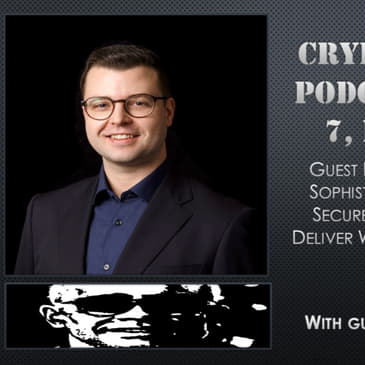

Myles Harrison has over 10 years of experience of creating award winning products across financial services. A visionary product leader he has a proven track record for delivering commercial success in scaling companies as well as a large global bank. He is passionate about harnessing the opportunities from emerging technologies to drive innovation and generate value for consumers. Having graduated from Lancaster University he went on to hold several product roles at Santander UK and prior to AMINA worked as the Chief Product Officer for London based Fintech Globacap.
[00:00:00] Hello everybody and welcome to the Crypto Hipster podcast. This is your host Jamil Hasan the Crypto Hipster where I bring you founders entrepreneurs executives thought leaders artists Amazing people all around the world of crypto on blockchain globally and today I have another amazing guest
[00:00:20] He is the chief product officer at Amina Bank out of Switzerland His name is Myles Myles, welcome to the show today Thank you Jamil, great to be here What is your background and is it a logical background for what you're doing now?
[00:00:40] Yeah, so I started my career in traditional finance So I spent many many years working for Santander in various product roles across retail corporate and commercial banking
[00:00:57] I started actually there to develop a passion for blockchain as a bank at the time we were starting to play around with the concept of utilizing blockchain as a technology within financial services From there I moved to a startup in the London fintech scene
[00:01:19] That was focused really on utilizing blockchain as a core part of its business for private registered securities They actually created the first private registered security using blockchain that was compliant with FCA regulation
[00:01:35] And it made it easier to acquire, to transfer, reduce some of the barriers to entry for the general public who wanted to access private registered securities which obviously is a growing industry From there I moved and joined Amina about 18 months ago
[00:01:57] So it used to be called Sebabank and now called Amina And that was really driven by the growing adoption of crypto in the industry When I first got a call to say hey do you want to join this bank based in Switzerland?
[00:02:12] They're a crypto bank, I thought to myself what is a crypto bank? I didn't really even know that they existed at the time But the more I researched, the more I realized that being a product guy I love to solve problems
[00:02:24] And I realized that in today's world and as crypto and traditional finance continue to grow closer That there are many problems that exist when I was researching but also even still today That me and my team seek to solve
[00:02:40] So that's really what drove my journey from pure traditional finance To now this emergence of digital assets and crypto And the fusion that is happening with the traditional financial ecosystem So Amina Bank is a crypto native bank? What is a crypto bank anyway?
[00:03:05] Good question. So we offer a full range of products and services across traditional products Right from bank accounts through to lending, securities, investments But we also do everything on the crypto side So crypto spot trading, custody, we do options derivatives, we do staking
[00:03:28] And we also have as a service offering so banks, fintechs, other financial institutions Looking to make crypto available to their users to continue to drive adoption And as they see more client demand, particularly after approval of the ETFs that we saw at the beginning of the year
[00:03:46] They can provide those products using our infrastructure and using our knowledge and know-how that we've built up over the last five years Got it. So you mentioned these ETPs right? So we have exchange traded products, exchange traded funds recently in Ethereum and earlier this year in Bitcoin
[00:04:08] What new products can asset managers deliver based on these new ETPs and ETFs? Yes. So we have the original products which are mostly single coin backed ETPs or ETFs So we offer a range of those ETPs. What we also have is an index basket
[00:04:34] That contains a number of different coins and we really curated that because as we see further innovation in this space And people and users get more comfortable, they want to continue to see the benefit of the wider crypto ecosystem
[00:04:53] So not just the top coins, but for those also that are still maybe on their journey a little bit They don't want to have direct exposure still. They can benefit from the sort of safety
[00:05:05] From the volatility directly of the underlying asset by benefiting from this index type product So that's where we're seeing more and more demand. The first wave was kind of for the single coin trackers And now we're starting to see this branch out into more index based products
[00:05:26] Got it. So what are you indexing? Like different ecosystems? Indexing crypto versus trade? Yes, so we actually have AvanitX which is an index of a number of coins We manage that ourselves so that can change the coins that are in that
[00:05:50] Obviously based on their performance can change over time And obviously we're trying to generate the best returns for investors in that product That is also available to retail investors not just professional investors And that's listed on a number of exchanges as well
[00:06:07] We also have a metaverse index as well which contains a number of metaverse projects within that index As metaverse continues to grow and to continue to expand as a section of the industry You said an interesting word. You said fusion
[00:06:33] Some people want to fuse the Web3 world with traditional finance And some people want to replace the Web2 finance altogether, right? So what's your view and why you see it as a necessary as a fusion instead of a replacement?
[00:06:56] Well, you know if we think about banking, just to sort of not get too technical for a second But if we think about banking itself, it's been built up over several decades The infrastructure that's there, how we go about our daily lives
[00:07:14] Whether it's we're paying for the tube or whether we're paying at a grocery store Everything behind scenes is linked and has been built up within the infrastructure As I mentioned over decades And there are several different components to that
[00:07:32] And if we track even just for example the flow of funds We can go through acquirers, go through banks, go through payment processes And so that infrastructure has matured And if we think about Web3 coming into financial services It's not going to replace that overnight
[00:07:56] And that behavior that consumers have built up over years is not going to change We know that in any industry, right? And we know that if we look at the sort of technology adoption curve
[00:08:06] We know many people consider that crypto itself is kind of in the chasm at the moment Trying to cross into mainstream We kind of see that as well, crypto and sort of we'd put Web3 in that bracket as well
[00:08:19] So the tech enthusiasts, the early adopters are already there But we're really trying to cross that chasm And if we want people to start using our mission Certainly as a product team as well is to be in a world where crypto is a part of everyday life
[00:08:38] For the majority of the world's population And if we want to achieve that And, you know, okay, we can talk about the sort of traditional crypto coins But if we look at stable coins, for example
[00:08:48] Which we know are growing, the use case is there to use stables as a means of payment method We're starting to see interest bearing accounts in stable coins Which mimic kind of traditional cash deposit accounts So, you know, Web3 coming into financial services
[00:09:09] Which of course is also heavily regulated It's not going to kind of just replace that infrastructure overnight There has to be an embedding to a certain degree And I think, you know, we see it as let's take the best bits of what exists today
[00:09:23] And merge it and improve it where we can with the developments that Web3 And the opportunities that Web3 brings with it So, let's embed Web3 into traditional finance I see five areas, you know, that it's important to do so Asset management, insurance, pensions, retirement
[00:09:52] And what was the last one? Like life insurance, you know And banking, I'll call it and banking How do you see a smooth transition for Web3 into these Web2 areas That have been really been, you know, like hard to crack the code
[00:10:11] What do you think how we can get products into each of those areas? Yeah, I think it's, you know, for me it comes down to making sure that we have Use cases that I mentioned earlier about solving problems
[00:10:31] And, you know, what tends to happen with new technology is that Yes, it can often be exciting and there's lots of potential But we need to make sure that we're not kind of driving it forward Just because it's sitting there as a new technology, right?
[00:10:51] It has to solve problems and that's problems for companies, you know And that exists within all of those areas that you mentioned And that's also everyday users and consumers And so whether it's using blockchain itself as a technology to create efficiency
[00:11:08] To create transparency, to, you know, build trust Or whether it's, you know, crypto as an asset class Or an investment vehicle or, you know, a payment method We really need to continue to identify, discover and build on those moving forward
[00:11:28] I think it's also important to work on education You know, there is still a long way to go on education And, you know, people that, again, maybe, you know, tech enthusiasts, early adopters You know, we have an essential role to play in that
[00:11:45] And that means that breaking down barriers so that blockchain itself is not so difficult to understand Because a lot of people do struggle And, you know, it's no different, right? It's the same that we saw with the dot com era and the evolution of the internet, right?
[00:12:00] It's the same that we saw during that period And we have different, you know, sections of society and different generations That, you know, kind of are on a different curve as well
[00:12:11] And so we have a responsibility, you know, if we really want to drive towards that mass adoption To support on that education journey And I think finally what I would say, particularly within the financial services space
[00:12:25] You know, we think that it's really important to work, to drive forward with regulators So to work actively with regulators, you know, and to also work with industry bodies To start to set standards, you know
[00:12:42] It's very difficult to mature an industry and to drive again towards that wider adoption without standards And we see that as well on a daily basis We look to integrate partners within our ecosystem We look to build new products
[00:12:58] And it's very important for us that there are standards there You know, we see one example which has come in recently Which is the travel rule, you know, for the transfer of crypto And we see that as a great advancement And actually it's also opened up new innovation
[00:13:17] Because we now have companies operating similar to what we see in Web 2 With things like open banking and that's kind of all now evolving for Web 3 The transferability between different wallets, between exchanges, between banks is growing It's becoming easier
[00:13:35] And that's reducing the barriers to entry again, you know, again for as we drive up that adoption curve What products in particular are you seeing as a result of the travel rule? So one that we see not necessarily a product per se
[00:13:54] But we are working with a provider who connects various wallets and does it in a compliant way Makes it easy to see your holdings across all of those wallets Makes it easy to transfer between those wallets easier than it ever has been before
[00:14:13] And that kind of has come about because of the consistency and the standards that are being set by things like the travel rule coming in Because it makes it easier to connect, right? You don't have endless parameters that you're trying to connect between different providers
[00:14:28] We need to share the same information in the same format And that actually itself, you know, it can sound quite boring on the surface But actually there is a lot of innovation that can spark out of that Okay. So I want to talk about products in particular
[00:14:46] I want to talk about asset managers, right? Asset managers are exciting No, they're excited I wouldn't say they're exciting You know, we have these ETFs, these opportunities for products in a way that didn't exist in the past decade With just Bitcoin and Ethereum And Nexus is pretty cool
[00:15:10] What are you seeing as areas that they're most excited about? And what products do you think will come out of it? Yeah, so like I mentioned earlier, what we're seeing is already the evolution They started typically with just the single coin trackers
[00:15:35] That's what we saw in the beginning That was based on their risk appetite Now we're seeing them start to diversify with index type products We also white label products So we have clients who utilize that service as well So they can curate their own product for their clients
[00:15:58] And they can base it on their own risk appetite, risk parameters and the portfolio that they're managing What we are seeing is that this is continuing to drive more interest And we are seeing more and more queries and contacts from this space
[00:16:22] We ourselves are also launching another new product next week So keep your eyes peeled We're launching that in conjunction with a big provider And that provides another strategy using a momentum index That looks at crypto underlying but also then manages that against the cash position
[00:16:45] So these are the types of products that we're now seeing to come into the market As it continues to evolve and gain traction One of the areas that I'm really concerned about, I'll be honest with you, is I used to work at AIG
[00:17:01] Before I came into crypto, I worked at AIG And we made some products The one particular product was called Credit Default Swaps And Credit Default Swaps was what caused the whole entire financial implosion and the creation of Bitcoin
[00:17:15] My concern is that we end up with some kind of crypto credit default swaps Or some kind of crazy product like that that wipes everybody out You mentioned regulators What do you see as, how do you see this playing out with the potential of crazy products
[00:17:40] And in conjunction with working with regulators Do you think we'll end up with another financial crisis? So we work extremely closely with the regulators in the geographies that we operate in And we have strict governance processes that our products, any new products go through
[00:18:05] That's the same that we would run for crypto and non-crypto products, so traditional products as well We do a lot of true diligence And we speak to a number of experts in different fields as we take those products through that process
[00:18:24] And for crypto, that's across both crypto natives that input into that As well as people from traditional backgrounds and traditional finance So we make sure that there are measures in place for any product that we're launching into the market
[00:18:40] To ensure we have a duty to make sure that consumers and the industry are protected And so we make sure that we have very prudent risk management on that front And we work not just with, as I mentioned, the regulators but also across the industry
[00:18:58] With our peers and also with traditional players to continue to monitor the products that are out there in the market The impact that they may have on the wider financial ecosystem as well Great. So I want to shift gears a little bit
[00:19:16] Because you said something really early on that I'm really interested in And I want to hear about it The metaverse index A lot of people think metaverse is just a hype word And there hasn't been as much hype recently
[00:19:33] But there's an index, so how does that work? What's in it? What's your mandate on that? I'm interested to do a dive there Yeah, sure. What I would say is that the investment solutions team here are absolutely the experts on that
[00:19:51] And like you said, we did see a dip in demand in line with the metaverse itself But we are seeing that start to pick up again, particularly with the wider adoption
[00:20:08] Within the basket, the format is a basket of tokens and blockchain products that have been selected based on market capitalization and liquidity It's listed in Switzerland on the 6th exchange And customers can buy either directly through ourselves as a bank or through a broker
[00:20:39] The custody of the underlying assets as well are fully protected and managed by us as a regulated bank here in Switzerland You can find out the historical performance via our website Great. I think it's interesting because JP Morgan set up a lounge in central land
[00:21:14] And Morgan Stanley has invested a lot of money in the metaverse And you're the third bank I've heard of that has set up a product for the metaverse So I'm wondering what you're seeing, like what the banks are seeing in the metaverse potential
[00:21:30] And why is that a key strategy overall? Not a lot of people talk about that So what I would say is that we continue to innovate in a number of areas
[00:21:42] And we also have a gold token that we have launched as well as part of our wider range of investment solutions So it's not that we necessarily are focused or have a strategic focus on the metaverse
[00:22:02] But we curate our products based on customer demand, based on market dynamics Based on where we see potential for the market to grow in the future as well So this was a concept that we came up with where those individuals that are passionate about the metaverse
[00:22:25] Could access a more traditional investment vehicle to support the ecosystem And as a crypto bank there are many areas of Web3 that we like, that we are looking to support And the metaverse is one of those Awesome. How about mint coins?
[00:22:51] So I mentioned that we have a strict due diligence process And that also goes for the coins that we select and we work with We are a regulated bank and therefore we do, we are I would say quite selective versus a lot of providers
[00:23:14] We don't work at the moment with mint coins But let's see what the future holds I like your answer It's consistent with a bank So you're not speculating and running after every single thing that you see which is great
[00:23:38] I want to go to this area that you talked about earlier a little bit too Called education And I want to tie that with what I talked about, insurance A lot of people, in the US a lot of people, I'm not going to give you a percentage
[00:23:56] Because my idea of percentage is a lot higher than what people are But I say a lot of people are financially illiterate That holds especially true when you're talking to a life insurance agent or some kind of pension agent
[00:24:10] Or anybody else that the amount of people don't know comes shining through It's very difficult stuff to comprehend So as far as helping people become financially illiterate Or more functionally illiterate as we move from Web 2 into Web 3
[00:24:28] What do you think should be done that's not being done so far? And how do you help? I think companies for me, companies and large corporations Should be doing more in this space And I think also from an education system perspective, so in schools
[00:24:51] I think it's essential to make sure that these skills are being taught And the knowledge is being taught To make sure that by the time that children who are at school now enter the workforce
[00:25:07] Be very common, I expect it to be very common that many corporations are using blockchain technology in some form And that there's a deep understanding there We know that many foundations for example have programs and grants for
[00:25:27] Engineering or coding courses to continue to support the Web 3 ecosystem and the growth of their particular protocol So these are really important as well So I think corporations, companies need to do more And I think education in schools and throughout the education system is really important Got it
[00:25:59] So I know you guys work hand in hand with Breggenlander to talk about that I think where you are now, Switzerland is a little more crypto friendly than most places in the rest of the world, right?
[00:26:12] What lessons do you think that banks here or anywhere can learn from what you guys are doing and doing well That they can implement and they can help go to the future along with you guys?
[00:26:26] Yeah, I would say like you mentioned, yes, Switzerland is very progressive on that front We've had distributed ledger technology written into law for many years now Which is fantastic and it's seen a thriving ecosystem here in Switzerland
[00:26:51] In terms of lessons, like I said, we have a very good relationship with the regulatory bodies that we work with We have an open relationship We on both sides seek to understand what we're trying to achieve
[00:27:12] And to make sure that we do that within the guidelines and within the legislation that exists Our first and foremost priority is to make sure that our clients' assets are secure and safe And that we really provide the role in protecting and keeping our consumers safe as well
[00:27:40] So I'd say openness, willingness to work together to drive the industry forward and to drive product innovation And you spoke earlier about, you picked up on this point that I said around fusion
[00:28:00] And it comes back to finding a way to ensure that the Web2 world in financial services and banking can work with Web3 And one thing that we see, for example, and it impacts the approach when we're looking at new products
[00:28:17] Is this concept or the principle that crypto is 24-7 Which Web2 and traditional banking was not, right? Based on business hours, Monday to Friday, come 5pm on a Friday, everything would close down And we know that crypto doesn't work like that
[00:28:43] That completely changes how we think about products when we're building them What our clients need, what they demand from us And one kind of link on that is we've just launched the Amino Payments Network
[00:29:00] Which is a 24-7, 365 days a year instant settlement in fiat currencies, particularly for crypto corporates That never sleep, right? That are constantly trading, constantly monitoring the crypto market Which as we know is always running Now you gave me an additional question to ask
[00:29:26] So, you know, 24-7, it used to be, you know, it's changed a lot, right? 24-7 back in 2017 meant that prices could fluctuate dramatically anytime in a day Now there seems to be a lot more stability even though markets are open
[00:29:47] You don't have that wild up and down swings, right? So why is now the right time for people to be comfortable with 24-7 more than it was ever before? Yeah, so I think what we're actually also seeing is that
[00:30:04] And what I think for me a real benefit of Web3 as the next sort of technological evolution Is that it's also bringing the world closer together And so one thing that we see is not just on the crypto market side
[00:30:21] But also that there is a growing need for entities, for individuals to settle with each other To push payments in different jurisdictions, you know, most times across today And therefore again, you know, cross-border restrictions or limitations historically can impact
[00:30:48] Or maybe it's waiting for a settlement over a weekend So we are also using, you know, the next evolution of our payments network will focus on stablecoins and crypto How can we start to settle on chain as well? So not just using traditional fiat routes
[00:31:07] So I think that it's not just the sort of like volatility piece on the 24-7 with the markets It's also kind of the downstream repercussions of Web3 and Web3 growing within the banking environment
[00:31:21] And what it's doing to customer behavior and the fact that we are seeing the world get closer together Closer than it kind of ever has been before Very cool. Yeah, I can see that too. That's awesome. Thank you
[00:31:37] So I want to thank you very much for your time today for speaking with me I really enjoyed speaking with you and learning what you guys are up to I have one last question and it's a simple one
[00:31:47] How can people find out more information about you, about admin at bank Become I guess if they're in Switzerland or outside become clients, how can they actually do that? Yeah, so we actually serve clients in over 33 countries now and growing
[00:32:02] So our bank is headquartered and licensed in Switzerland But we can serve clients who come to us outside So you can find out more information about us at AminaGroup.com That's our main website Awesome. Thank you very much for your time today
[00:32:25] Thanks Jamil. Great to speak to you