
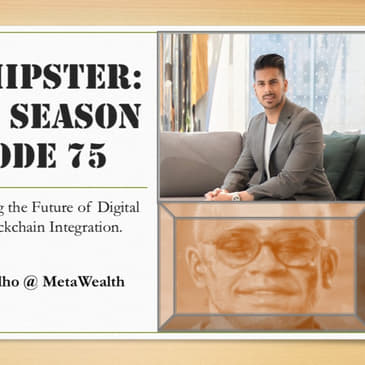

Darren Carvalho is a distinguished graduate of the University of Toronto's Computer Science program and the Ivey Business School. His professional journey began at Toronto Dominion Bank, where he spearheaded AI and Machine Learning initiatives, demonstrating a keen aptitude for innovative technology solutions. Darren's expertise and leadership quickly propelled him to the role of Vice President at Goldman Sachs, where he played a pivotal role in strategic investments and projects in the DSML space. Darren is now the Co-founder and Co-CEO of MetaWealth, a pioneering company in Real World Asset (RWA) Tokenization. His vision and leadership are shaping the future of digital asset management and blockchain integration.
[00:00:00] [SPEAKER_00]: Hello everybody and welcome to the Crypto Hipster podcast. This is your host, Jamil Hasan, the Crypto Hipster, where I interview founders, entrepreneurs, executives, thought leaders, amazing people all around the world of crypto and blockchain.
[00:00:14] [SPEAKER_00]: And today I have another amazing guest he is the co-founder of MetaWealth.
[00:00:21] [SPEAKER_01]: This is Darren Carvalho, Darren welcome to the show. Thank you. Thank you very appreciate it for having me and excited to have this conversation.
[00:00:32] [SPEAKER_00]: I'm looking forward to it too. So yeah, let's kick things off and ask you first about your background.
[00:00:38] [SPEAKER_00]: What is your background and is a logical background for what you're doing now?
[00:00:44] [SPEAKER_01]: Yeah, I think I definitely beyond quite a ride. Decorated career I'd say up until now.
[00:00:51] [SPEAKER_01]: But I guess to start off from my roots, I was really more of a technologist to start off with.
[00:00:56] [SPEAKER_01]: So I started at University of Toronto Computer Science doing a lot of different, you know, more technical matters pertaining to web apps and
[00:01:07] [SPEAKER_01]: systems engineering systems architecture, that kind of thing.
[00:01:11] [SPEAKER_01]: Then I went on to do actually an MBA as well from a Toronto Business School.
[00:01:17] [SPEAKER_01]: And then after that I joined Toronto Dominion Bank. So basically we were at the time we acquired a startup.
[00:01:24] [SPEAKER_01]: So we had about six AINML PhDs joined us and I was basically the platform architect developing the AI platform that they were developing their use cases on.
[00:01:34] [SPEAKER_01]: So we grew that program to about 40 AINML PhDs.
[00:01:39] [SPEAKER_01]: We deployed about 60 use cases across the bank, anything you can think come from credit education, auto education, trading,
[00:01:46] [SPEAKER_01]: you know, basically, you know, multiple different business lines were working with us.
[00:01:51] [SPEAKER_01]: And this was before AI was cool, right? So this is like 2015 something like that.
[00:01:56] [SPEAKER_01]: And we had a lot of fun there. We did a lot of cool projects.
[00:01:58] [SPEAKER_01]: My time I left the firm it was probably delivered around a billion dollars worth of value.
[00:02:04] [SPEAKER_01]: And then I joined Goldman Sachs where we were really focusing on investing in that AI ecosystem that I basically built before, right?
[00:02:12] [SPEAKER_01]: So we were deploying 50 to 250 million dollar checks into series B plus companies.
[00:02:18] [SPEAKER_01]: And that's kind of how I got more on like getting more and greater, I guess, into like, you know, that startup side and that kind of experience.
[00:02:27] [SPEAKER_01]: And then from there I started in MetaWals, this is my two co-founders and I guess that's kind of on the journey around today.
[00:02:35] [SPEAKER_01]: But I really came from like a correlation of the three co-founders, right? So myself obviously I had that technical and finance background.
[00:02:45] [SPEAKER_01]: My other co-founder, Amr, is more of like, you know, we met at university of trying to computer science, but he took it totally different route, right?
[00:02:51] [SPEAKER_01]: So he went straight to startups, his first startup was acquired. First start that he joined was acquired by Mark Zuckerberg. He went on then to build well simple as like one of the founding engineers there.
[00:03:04] [SPEAKER_01]: We did them all the way up to series B, well simple today is Canada's largest utacore and then he came to join MetaWals' us.
[00:03:11] [SPEAKER_01]: And then the third co-founder Michael is a 25 year real estate private equity guy, right?
[00:03:14] [SPEAKER_01]: So like we always say, you know, if we're a venn diagram that really middle piece of what we're doing is better well. And yeah, so we're happy to talk about that here today.
[00:03:25] [SPEAKER_00]: Pretty exciting. Yeah, so back up first, you, not a lot of people have come from banking and are now building in web three right?
[00:03:39] [SPEAKER_00]: So there had to be some kind of transformational shift in the way you view things. What was that?
[00:03:44] [SPEAKER_01]: Yeah, I mean that's a really good question, right? So I think there is a lot of bankers. Let's say in the space or on definitely on the fence of the space, right?
[00:03:52] [SPEAKER_01]: Because obviously what we're building here is new financial rails. A lot of the products are synonymous to some of the traditional products that are out there, specifically in, you know, my space, which is the RWA tokenization.
[00:04:04] [SPEAKER_01]: It's all about real world assets, which are basically, you know, have deep deep integration points with the traditional banking system, right?
[00:04:13] [SPEAKER_01]: So if we're looking at like, you know, bonds or T-bills or funds or real estate or private equity, these are traditional banking products that we're trying to bring on chain.
[00:04:21] [SPEAKER_01]: So, you know, if you consider myself, I really, I guess understand that web two banking landscape very well.
[00:04:27] [SPEAKER_01]: And then I started getting super interested in web three. Well actually, my first touch point was web three was in 2012 2013. So it's not like I just found the space like a four or five years ago, right?
[00:04:40] [SPEAKER_01]: Basically at university, it's trying to computer science. We actually had a Bitcoin miner come in and 2013 and trying to pitch us what this technology is and how do we get involved from a technical point of view, right?
[00:05:01] [SPEAKER_01]: So I was always really interested in the space, but it was more off the side of my desk, something I did personally. It wasn't like, okay, how am I going to apply this to try to buy a big way?
[00:05:11] [SPEAKER_01]: That sparked really came when I saw that, or WAs and not RWA's, but I just saw the pain points in my own personal life of how things were going with the traditional banking sector.
[00:05:23] [SPEAKER_01]: And also just real estate in general, you know, it's a thousand year old industry that's rarely been disrupted by technology.
[00:05:29] [SPEAKER_01]: And we really saw the opportunity to be able to get involved there. So that's kind of, I guess, where there's several shifts that took place to really get me to take that job, right?
[00:05:39] [SPEAKER_00]: Awesome. So let's talk about the job.
[00:05:42] [SPEAKER_00]: Meta wealth. You know, what about what opportunities are you best prepared to tackle in WAs 3?
[00:05:49] [SPEAKER_01]: Yeah definitely, I mean that's a really big question. So for us what meta wealth is, basically we take institutional grade real estate assets.
[00:05:56] [SPEAKER_01]: So we don't do like, you know, one apartment at a time, one house at a time, one villa at a time. We take large asset packages. So think of like an apartment block, a hotel.
[00:06:07] [SPEAKER_01]: You know, more commercial real estate grade kind of projects. We tokenize them and then we sell them on our mobile and web apps, right? And we sell them to a bunch of different market market audiences.
[00:06:16] [SPEAKER_01]: We sell them to family offices and sell them to funds. We're trying to get involved with institutions.
[00:06:23] [SPEAKER_01]: The mass market can get involved because our tickets are super low $100. And then a part of that mass market is also the retail and crypto crowd, right?
[00:06:33] [SPEAKER_01]: So with that we're basically tackling a bunch of different target markets for different reasons.
[00:06:39] [SPEAKER_00]: Yeah, that's basically meta wealth and a nutshell. Awesome. So real estate, you know, you're tackling a bunch of challenges. So what are some of the premier challenges that you face in real estate to achieve, you know, mass blockchain adoption and how are you best position to solve them.
[00:07:00] [SPEAKER_01]: Yeah, so we kind of look at it as like two sites to the coin, right? So on one side you have the developers, the real estate developers.
[00:07:08] [SPEAKER_01]: And on the other side you have the actual real estate investors, right? So meta wealth sits in the middle of those two things and we try their best. We try his best as we can to balance it.
[00:07:18] [SPEAKER_01]: In terms of like, you know, the real problem statements for investors let's start with is different depending on the target market, right?
[00:07:25] [SPEAKER_01]: So if we have someone that's an experience investor, if we have someone that's a maybe a family officer, a fund or we have, you know, a real estate investor or normal guy, right? You just want to get involved with real estate. There's different kind of pain points that we're solving.
[00:07:39] [SPEAKER_01]: But what are those pain points that's usually that someone doesn't have the time to be able to go out due to diligence, understand the market, what makes it good, real estate investment.
[00:07:48] [SPEAKER_01]: Then they have to do the money movement, how are they like depending on what geography they're investing in and what geography they're actually living in? They might have to move money across borders.
[00:07:59] [SPEAKER_01]: The next thing is that they actually have to do legal, illegal paperwork which is a huge process, it's an expensive process.
[00:08:05] [SPEAKER_01]: They'll have to maybe sign with the notary, depending on the country and the jurisdiction.
[00:08:11] [SPEAKER_01]: And then also like they got to make sure that they have the money, right? So they got to make sure that at the end of the day, we'll be able to afford these big down payments and only third party costs I just talked about, right?
[00:08:21] [SPEAKER_01]: So ultimately, like these are kind of the, you know, anchor pain points that we have across the board for our real estate investors for our real estate developers. It's it's a little bit different, right?
[00:08:32] [SPEAKER_01]: So real estate developers are usually selling to a localized crowd. So for example, if I'm in New York, I'm probably selling to New Yorkers, like it's pretty common.
[00:08:42] [SPEAKER_01]: Maybe New York is not the greatest example because there is a lot of foreign money coming in there.
[00:08:46] [SPEAKER_01]: But as you can imagine, you look, you know, generally across major cities, it's usually the localized crowd that's participating, right?
[00:08:53] [SPEAKER_01]: And localized crowd is what's easier to market to.
[00:08:58] [SPEAKER_01]: The second thing is that there only have access to the crowd of people that can afford it. So, you know, the moment pop shop or whatever that don't have the funds to be able to purchase a house, they're priced out of the market and the developers can no longer access that pool of capital, right?
[00:09:15] [SPEAKER_01]: And then the third things that we really see with our real estate developers operational efficiency.
[00:09:19] [SPEAKER_01]: So with us, if you're selling a block of 100 apartments and MetaWalts comes and says, you know, we can do, we can buy 30 all at once one contract, they love that.
[00:09:28] [SPEAKER_01]: That's 30% of their basically mistock that they're able to sell right away.
[00:09:33] [SPEAKER_01]: And they're able to interact with just one entity, right? Instead of finding 30 buyers, 30 contracts, 30 notaries, 30 money movesments, 30 whatever, right?
[00:09:42] [SPEAKER_01]: So that's kind of the three biggest pain points that MetaWalts saw on their side.
[00:09:51] [SPEAKER_00]: So along there's there's there's you know that what do you call it supply chain effect of all the transaction from the start to finish, incredibly brave right?
[00:10:04] [SPEAKER_00]: So you your expertise really is in the facilitation between developer and investor right?
[00:10:13] [SPEAKER_00]: Okay, great. So in addition you also helped democratize traditional assets right real estate and other traditional assets without being burdened by the traditional financial rails and obstacles.
[00:10:31] [SPEAKER_00]: How how can we best do that? How can we best democratize traditional assets in addition to real estate, you know, because there are a lot of there are a lot of obstacles by the right by
[00:10:43] [SPEAKER_01]: Yeah, 100%. So I think like you know just look at general tokenization and RWA space today right obviously it's a super hot space.
[00:10:51] [SPEAKER_01]: Everybody's talking about it and if we look at it from an institutional level they're going at it a different way.
[00:10:57] [SPEAKER_01]: The retail players are going in a different way, you know, in MetaWalts we really see all these worlds coming together because that's the beauty of the technology.
[00:11:03] [SPEAKER_01]: We want to decentralize it, we want to level the playing field. We want everybody to be on the same page. We're not discriminatory towards institutions or family offices or whatever we just really want you know the vision of the company is that like, you know,
[00:11:17] [SPEAKER_01]: The mechanic is able to participate in the same real estate deals that's a blackstone would want right?
[00:11:23] [SPEAKER_01]: Like if we could get blackstone and the mechanic on the same top table, I think like you know from an impact point of view we would have done our job like for sure.
[00:11:33] [SPEAKER_01]: And in the tri-fi world why we you know, so like why do these big institutions have so much power?
[00:11:40] [SPEAKER_01]: One is because they have so much experience, they have so much track record, they have so much capital behind them. They're able to go in and bully offers like right out of the gate.
[00:11:48] [SPEAKER_01]: Obviously you can see through like you know the big players maybe I won't name names but we can definitely and then use we can see like you know what big players are going into the south of the US for example, and just gobbling up all of the rental property right.
[00:12:03] [SPEAKER_01]: So it's basically yeah it's power track record it's capital it's experience it's access to resources like like finance and accounting and money movement and all of that that really makes it very difficult for
[00:12:17] [SPEAKER_01]: even a medium sized player to compete. So with metal walls with our technology we really get to break down those barriers right so metal walls is you know almost like a weight night for some of these
[00:12:30] [SPEAKER_01]: You know there's retail guys we're bringing all of this experience that a big player might have like you know the finance the legal money movements the power and we're really you know
[00:12:44] [SPEAKER_01]: Browding all these people together to basically build up our own backing and you know playing on the same plane feel that these guys are playing on just because we have the mass right and that's how we're doing it I'm not a wolf.
[00:12:58] [SPEAKER_00]: You've been before.
[00:13:00] [SPEAKER_00]: Party background was building up the AI capabilities of Goldman and then Toronto bank right.
[00:13:08] [SPEAKER_00]: Some people think that AI is going to be it's going to further help the mechanic like a mechanic versus the corporate investor right is going to mechanic and other people who've been thrusted on to the sidelines level the playing field.
[00:13:25] [SPEAKER_00]: Yeah, no. How do you see how do you see that playing field being level how do you see opportunities people who've been marginalized.
[00:13:37] [SPEAKER_00]: For there are a few to be able to to be in the RW of a game perhaps exceed or surpass the traditional comments.
[00:13:50] [SPEAKER_01]: Specifically with AI.
[00:13:55] [SPEAKER_00]: Well, AI and then and then with RWA and real estate as a result of the AI.
[00:14:00] [SPEAKER_01]: Yeah, yeah okay so I think like if you're talking about AI in general.
[00:14:05] [SPEAKER_01]: Some products were thinking of a metal obviously through my background even on my background is pretty deep at AI as well.
[00:14:12] [SPEAKER_01]: It's a lot about automation and making smart decisions and being able to make smart decisions faster but also autonomously right.
[00:14:19] [SPEAKER_01]: So we're thinking of different products right now like you know our expertise and the AI that's within the platform right now is really hidden.
[00:14:26] [SPEAKER_01]: We believe that it shouldn't be like you know it's a we're not building an AI research product at least right now.
[00:14:32] [SPEAKER_01]: What we're building is like you know an automated way to do things so in the future we do think that like Robo advisors and Robo asset allocation and auto investing are ways that we can make this happen.
[00:14:44] [SPEAKER_01]: And if you think about it, if we're trying to you know go up against company XYZ corporate company XYZ that's deploying let's say 50 million a month into great real estate deals.
[00:14:57] [SPEAKER_01]: Metal should have the ability or needs to have the ability to do the same thing right that's how we'll compete it's basically a head on head basis.
[00:15:07] [SPEAKER_01]: And to make that happen something like an AI or Robo advisor can help us with that right is someone or the mechanic if 100,000 mechanics pledge 100 dollars a month towards real estate.
[00:15:18] [SPEAKER_01]: Then all of a sudden we have even more buying power than the blackstone does right or that company XYZ.
[00:15:25] [SPEAKER_01]: And that's where you know will have even more power than than a company like that.
[00:15:32] [SPEAKER_01]: But that's one example right there's several examples out there and I think within D5 you can get even more specific and even more granular with some of the products that are you know kind of off to the sidelines right now.
[00:15:43] [SPEAKER_01]: But bringing them in house such as like collateralization or asset back loans or really waste a money and smarter smarter methods would help the retail users like structure dollar a little bit more in terms of you know generated wealth for themselves.
[00:16:01] [SPEAKER_00]: I'm glad you said that.
[00:16:03] [SPEAKER_00]: I thought it was just me thinking things were on the sidelines right but they actually are right.
[00:16:10] [SPEAKER_00]: What is on the sidelines right now that you think that if was brought into the current RWA you know ecosystem would be a game changer.
[00:16:22] [SPEAKER_01]: So you mean like in terms of traditional assets coming on chain like what would be the game changer.
[00:16:26] [SPEAKER_00]: Yeah.
[00:16:28] [SPEAKER_01]: Yeah, I mean I do see it as a roadmap right I think it's like and it's almost like an industrial revolution right so you start up with the things that are really easy and the big players are I think are doing that best right so they're bringing things that are ready kind of electronic on the ballad sheet such as like you know money market fund is super not I'm not going to diminish how hard it is.
[00:16:48] [SPEAKER_01]: But it's in terms of like the product it is in terms of liquidity it has in terms of you know the amount of firms that are already leveraging it's in terms of how it.
[00:16:57] [SPEAKER_01]: Makes sense and integrates into a normal business and normal institutions balance sheet and makes a lot of sense right like that's why I think like you know the black rock fiddle fund is being very successful.
[00:17:07] [SPEAKER_01]: And it's a really good example of like you know how we can you know just set the lowest thing in fruit kind of point of view take this technology right.
[00:17:15] [SPEAKER_01]: And with this proof of concept that's like I truly believe has been like a game changer in terms of why tokenization is taking off so much.
[00:17:24] [SPEAKER_01]: You can start moving into asset classes that are less disruptive let's say right so.
[00:17:30] [SPEAKER_01]: I think private equity is going to be a big one right so private equity is a very traditional business but I think.
[00:17:37] [SPEAKER_01]: I read a report somewhere that it's probably one of the most profitable businesses period right in terms of like what you can do private equity is pretty much the holy grail of profit.
[00:17:50] [SPEAKER_01]: So bringing access to deals like this on chain would would be a game changer for retail specifically because the big guys are already doing this on stop that's why they're so big it's why they're so successful is because they could maybe doing this for maybe 100 years now.
[00:18:03] [SPEAKER_01]: But if you look at defy 100 years into the future if 100 years worth of people had access to private equity well maybe maybe like the world will be different right.
[00:18:13] [SPEAKER_01]: And that's where we kind of see it right and and you know to tie it back to metal wealth and to tie it back to real estate I think real estate isn't in that same realm right so real estate over the past 100 years has been or even maybe the past 1000 years has been one of one of or if not the most performant asset class period.
[00:18:33] [SPEAKER_01]: And that's just because of you know how inflation works, how the economy works, how the population's growing there's a 100 reasons why real estate is very valuable right and if you look at like something to peg that to the US dollar has depreciated from you know I think in 1913 let's say a dollar was worth a dollar today that same dollars worth about 15 cents so it's inversely related to real estate.
[00:18:57] [SPEAKER_01]: But like I said when we tie that back to the paint points that metal wealth is trying to solve.
[00:19:03] [SPEAKER_01]: It's super hard to get access to it's hard to understand it's very bureaucratic there's a lot of big players that are kind of controlling the market and that's why you know we see such an opportunity with real estate on change.
[00:19:16] [SPEAKER_01]: But it is a little bit more difficult right because let's say the land book right now is not digitized it's a lot of pen and paper.
[00:19:24] [SPEAKER_01]: So that's kind of a bigger challenge that real estate has versus the money market fund which is already digitized on the balance sheet right got it.
[00:19:35] [SPEAKER_00]: So you said something interesting there you said you know.
[00:19:39] [SPEAKER_00]: I look at the current market sentiment.
[00:19:42] [SPEAKER_00]: In crypto blockchain and it's not too great at the moment you said a lot of big players are controlling the market it seems like the market is depressed.
[00:19:52] [SPEAKER_00]: And there's more things that are going on than the price is currently reflect right.
[00:19:59] [SPEAKER_00]: How do we get past that you know that control factor and move into the next realm of this revolution that we talk about.
[00:20:08] [SPEAKER_01]: Yeah, there's like I think a couple of answers to this question right one is that you know let's just like continue under the example with real estate so the real estate like total global value of real estate is about 500 trillion dollars.
[00:20:23] [SPEAKER_01]: That's the total number if you ended up like you know every country is real estate value that's what you're getting.
[00:20:29] [SPEAKER_01]: Now let's add up the total market cap of crypto it's like maybe two trillion right.
[00:20:36] [SPEAKER_01]: So if you look at the magnitude there it's you know 50 x or whatever 25 x.
[00:20:44] [SPEAKER_01]: Or 250 x actually so.
[00:20:48] [SPEAKER_01]: The difference is massive right and when you know you have these players that let's say have a balance sheet of x amount of real estate and then they're looking at this crypto games they're just.
[00:20:59] [SPEAKER_01]: And then you know you're not able to blow these markets out of the water right now that the institution was like getting involved and then secondly just to check the pose.
[00:21:10] [SPEAKER_01]: The RWA tokenization market is actually very different than the crypto market I see because.
[00:21:18] [SPEAKER_01]: tokenization maybe it's too far of a stretch but it's a little bit like web 2.5 right the underlying assets are very web 2 they're very like you know tangible.
[00:21:28] [SPEAKER_01]: They we live in them all the rest whereas web 3 products are sometimes.
[00:21:34] [SPEAKER_01]: Intangibles right like you can't really understand fully what's going under the hood behind the liquidity pool for example.
[00:21:43] [SPEAKER_01]: And then this just kind of opens up the door to manipulations to scams to you know what I'm going to code FDX it.
[00:21:51] [SPEAKER_01]: But that's kind of like why I think that you know crypto market and RWA market are very different things but they offer different they offer different benefits and they also come with different risk profiles.
[00:22:07] [SPEAKER_00]: Right so so which ones gonna stay or are they both gonna stay why.
[00:22:13] [SPEAKER_01]: I think that the they're both gonna stay 100% obviously I think with you know the Bitcoin ETF coming out.
[00:22:22] [SPEAKER_01]: ETS coming out and then there's a lot more in the talks I think you know more institutions are getting involved especially as.
[00:22:30] [SPEAKER_01]: Cryptocurrency becomes more you know transactable it becomes more integrated into real world life like I know Solana had a really big partnership with PayPal and strike and.
[00:22:41] [SPEAKER_01]: You know obviously there's a ton of different Ethereum apps that are coming into the real world they're both gonna stay right so I think that's when you know the the inflection points up crypto and real world really makes sense is when a lot of transactions everyday payments are made on Jay.
[00:22:59] [SPEAKER_01]: And then separately you know the backing of any art of the way platform is obviously that tokenized aspect right the blockchain aspect so when I'm using the same the same currency to buy my coffee that I'm using to buy my house.
[00:23:14] [SPEAKER_01]: Then it's it's you know we're back to one world.
[00:23:18] [SPEAKER_01]: So I don't think that there's like you know one's gonna out-sur-fast the other I think they're both growing at a kind of a pace crypto has obviously had maybe you know.
[00:23:27] [SPEAKER_01]: Probably ten years on top on like ten years lead time on top of tokenization.
[00:23:32] [SPEAKER_01]: But we're both on that same journey and that same growth.
[00:23:38] [SPEAKER_00]: Got it.
[00:23:40] [SPEAKER_00]: So you mentioned Ethereum that's just Solana I want to change gears a little bit.
[00:23:46] [SPEAKER_00]: I solve this on X I want to make sure I'm right you switch which from Ethereum to Slon earlier in the year.
[00:23:54] [SPEAKER_00]: That's right.
[00:23:58] [SPEAKER_01]: Yeah so I mean there's a lot of different reasons right so I mean we can talk about different aspects of it.
[00:24:04] [SPEAKER_01]: We initially started on Ethereum just because it was the most well known blockchain we did a lot of we had especially with our product.
[00:24:11] [SPEAKER_01]: The users were onboarding our very web two we have to make sure that like you know security is paramounts we can't have any like you know issues in terms of that.
[00:24:21] [SPEAKER_01]: So it was kind of like and especially in terms of the protocols that were available in terms of like the ERC 20 tokenization protocol or token protocol.
[00:24:28] [SPEAKER_01]: We were able to pretty quickly spin up the kind of technical platform that we needed to build.
[00:24:35] [SPEAKER_01]: So that's kind of why we were running on Ethereum for about a year and now we're basically migrating all of that ecosystem to Solana primarily because of three reasons one is the community the community on Solana is something that we really have integrated well we've been welcomed we've been you know kind of given a.
[00:24:54] [SPEAKER_01]: gamut and a gamut of tools that we can use to really you know explode our growth in terms of the mass market.
[00:25:01] [SPEAKER_01]: Two is that there's a lot more retail play that we we want to take with what we're doing and a lot of these retail players are on Solana already so that really helps us out.
[00:25:11] [SPEAKER_01]: And three is basically that technical aspect right so the cost efficiencies the speed transaction times are significantly reduced right so on Ethereum we saw where sometimes because we we pay for the cost the gas on our sides when we're doing transactions.
[00:25:25] [SPEAKER_01]: There's sometimes in some scenarios where we were actually losing money on a user coming on board which doesn't make sense obviously.
[00:25:34] [SPEAKER_01]: Where's with Solana like you know it's a fraction of a penny to get this huge round for it right so those are just some you know top level items of why we made this switch but we know we're super excited with our migration.
[00:25:46] [SPEAKER_00]: You're early you're one of the first ones to do that right.
[00:25:52] [SPEAKER_00]: But you're I believe we said miss a lot of sense you know Solana's known for you know people call the trading currency but it's known for the retail aspect lot of retail.
[00:26:04] [SPEAKER_00]: The main coins now what happens if the investment in mean coins become the investment in real estate and RWA instead of mean coins then what's what's possible.
[00:26:17] [SPEAKER_01]: We actually want to we want to see both so we do want to see that like you know people are making all their great amount of money so like if we just look at this one go to market that we have this one customer segment.
[00:26:28] [SPEAKER_01]: The crypto crowd we actually already have a lot of investors that have made a ton of money on me kid me coins they made a ton of money even outside of the Solana ecosystem this investing in Bitcoin and our theory of or whatever over time even so lot over time.
[00:26:42] [SPEAKER_01]: And you know at the end of the day when you know someone who's my background comes to look comes to the floor and says you know it never makes sense to put 100% of your networks into one asset class it always makes sense to have healthy asset allocation.
[00:26:54] [SPEAKER_01]: Real estate should always be about 30 to 40% of someone's portfolio right so do you want to take your money off change figure out a place to put it how do you do that offer and how do you do the exchanges how do you move your money how do you do your finance accounting.
[00:27:09] [SPEAKER_01]: Legal for real estate or do you just want to go straight from mean coin max like you've ready to real estate that's your mental of kind of gets involved right so it's not one of the other for us it's actually do both.
[00:27:20] [SPEAKER_01]: Do multiple things really well and that'll make you a really healthy and successfully investor right.
[00:27:28] [SPEAKER_00]: God and make what you say to me makes a lot of sense.
[00:27:33] [SPEAKER_00]: Yeah, you know I look at the real estate Google market and I'm like okay land there's always going to have value right.
[00:27:40] [SPEAKER_00]: But the demographics within the the what you put on that land and property property types the property, you know.
[00:27:48] [SPEAKER_00]: You used to be massive old houses are now you know different style house how do you see.
[00:27:54] [SPEAKER_00]: The blocking helping with it with the shift within the types of property and investments that people can have going forward as far as a word of live or a bit of business or you know what do you see that dynamic shift.
[00:28:08] [SPEAKER_01]: Yeah, I think that like.
[00:28:12] [SPEAKER_01]: The web three industry has already brought that shift before us right so aside from tokenization.
[00:28:18] [SPEAKER_01]: The ability to be a digital nomad like the amount of people when I go to like for example like token 2049 Dubai or Singapore.
[00:28:24] [SPEAKER_01]: The people there that I'm eating are never from like the the places you think right like of course like there's obviously going to be some people from New York and London and like the major hubs but it's always like you know yeah like I just work from home from Bali or I work from home from shell anchor or something like that.
[00:28:40] [SPEAKER_01]: And they're like you know they're not normally from those places right so the digital nomad life the decentralized life is definitely already a thing in the industry.
[00:28:51] [SPEAKER_01]: And then on our side with metal walls right now we definitely listen to our customers right so the target markets that were in for our real estate right now are cost of also Spain.
[00:29:01] [SPEAKER_01]: Rome Italy.
[00:29:03] [SPEAKER_01]: Germany France Romania and Greece and the reason that we do that is because we bring that decentralized approach to our real estate right if you're like a you know someone from the UK or someone from New York or someone from Switzerland or something like that.
[00:29:20] [SPEAKER_01]: And you know you can just go ahead and do it.
[00:29:25] [SPEAKER_01]: But with metal walls now you can be able to say okay I have maybe 20,000 dollars I'll put you know 5,000 dollars into four different cities pretty easily and that's the one of the biggest benefits we have right is that geographical dispersion that you can do with your capital.
[00:29:42] [SPEAKER_00]: I like it most of the countries you you named around my bucket list of places to go.
[00:29:47] [SPEAKER_00]: Well if you're in Bachelorette you'll just be going home. That's the best time to out it. Yeah sounds good awesome so.
[00:29:56] [SPEAKER_00]: I want to thank you very much for speaking with me today.
[00:30:00] [SPEAKER_00]: I enjoy speaking with you. I think you guys are doing some really cool things and excited about we to see how things work out and then play out and it's exciting times.
[00:30:09] [SPEAKER_00]: I have one last question for you. How can people find it more information about you about metal wealth that can become customers how can they how can they do any of that.
[00:30:22] [SPEAKER_01]: Yeah so we have a lot of different channels that we're working with we're also throwing several events in for Singapore talking to twenty forty nine and break points are definitely come even see the team there in person.
[00:30:33] [SPEAKER_01]: In terms of getting a hold on myself I'm pretty big on LinkedIn so LinkedIn is one of them and then the other one is Twitter. Darren Carvalo is my name my Twitter is Darren I'm Carvalo.
[00:30:45] [SPEAKER_01]: And then in terms of the team obviously meadowl stuff co and then we're also listed on the Google Play Store Apple Play Store just meadowl and then meadowl.app for our above us.
[00:30:59] [SPEAKER_01]: Thank you very much for your time. Perfect thank you very much.