
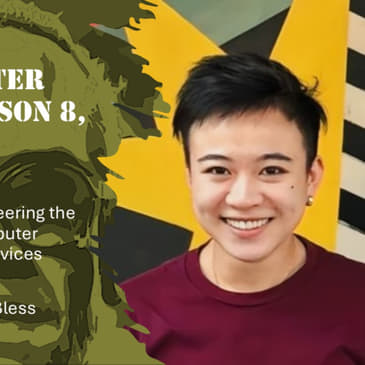

Butian Li is CEO of Bless, pioneering the world’s first shared computer—a decentralized network where everyday consumer devices power the internet. Under his leadership, Bless is reshaping internet infrastructure by enabling laptops, smartphones, and tablets to contribute their compute power collectively.
Bless' first-generation product, Tap Compute, allows users to seamlessly share their device’s computing resources through a web browser, supporting AI inference, data processing, and web hosting. By decentralizing these essential services, Bless is shifting control away from large corporations with massive data centers and back into the hands of everyday people.
A seasoned entrepreneur and investor, Butian’s expertise spans technology, finance, and strategic growth. He was previously COO of Wabi (Binance ‘17), an Investor at Lightspeed Venture Partners and NGC Ventures, and Founding Partner of Access Crypto hedge fund. His early career includes management consulting at Deloitte Consulting, where he advised Fortune 500 companies on IPOs and M&A transactions.
Butian holds an undergraduate degree in Engineering from UC Berkeley and an MBA in Quantitative Finance from Wharton.
Previous media features:
Universal Basic Compute can Combat the Future AI Divide
[00:00:03] Hello everybody and welcome to the Crypto Hipster Podcast. This is your host, Jamil Hasan, the Crypto Hipster, where I interview founders, entrepreneurs, executives, thought leaders, amazing people all around the world of crypto and blockchain. And today I have an amazing guest coming to me from California. I'm on the East Coast. And Butian Li is the co-founder and CEO of Bless Network. Butian, welcome to the show.
[00:00:33] Thank you so much, Jamil. Great to be here. You're very welcome. Very welcome. Thank you for joining me. I kick things off with the same question to everybody. And again, wonderful answers. And the first question is, you know, what is your background and is it a logical background for what you're doing now? So after I graduated from college, I studied engineering, went straight to consulting.
[00:00:59] After two years, I was just looking for something, you know, that truly excites me career-wise. Back then, it was 2017, like the ICO kind of craze. And that's what really got me into crypto. The first project that I was involved is IoT. Or these days, they're called D-Ping, actually.
[00:01:25] It has a lot to do with supply chain data and data analytics. And then afterwards, I also spent some time on the investment side working with VCs, which is Lightspeed and GC Ventures, looking at crypto projects or decentralization from the other side of the table.
[00:01:49] And later in 2021, that's when I first met my now co-founder, Michael, who has this initial white paper about BLESS.
[00:02:04] And that was something that I felt was the most exciting thing after Ethereum, which attempted to be this world computer, but sort of is incapable for delivering that vision on a lot of aspects. Technical-wise, there are a lot of boundaries that's drawn with the blockchain architecture, innate problems with that.
[00:02:30] And BLESS, basically, what we call the world's first shared computer, is tackling all those problems to truly deliver the vision of being this world computer. All right. That sounds good. So let me ask you first what – I'll ask you about the BLESS Network first. And then I'll ask you what those differences are next.
[00:02:57] But I'll ask you what's the BLESS Network all about, and what's your vision for its future? Yeah. So BLESS is the world's first shared computer powered by everyday devices, like, for example, your laptop, my Mac or PC. Those are the consumer-grade devices.
[00:03:19] Each one of them make up a compute node that delivers super-fast, real-time computing running applications on this largest global edge compute network. Awesome. So you said – I think you said Ethereum has some major shortcomings that you're trying to solve, right? What are those shortcomings, and how do you solve them? Yeah. Yeah.
[00:03:47] So I'd say not just Ethereum, mainly blockchain. They're designed to be this global ledger, right? It has a lot of, like, innovations in terms of being trustless, permissionless. And when it comes to actually running, you know, internet-scale applications, it run into throughput issue.
[00:04:13] It's, like, you have to wait for the settlement, for the block time, et cetera, right? So that's why you can't just put any kind of, like, internet-scale application on a blockchain.
[00:04:28] And that is exactly what Bless is trying to do without changing the trustless, permissionless transparency security of a decentralized stack. We make it possible to run any kind of performance application.
[00:04:50] These days, we run agents or, like, Ash inferencing, those kind of advanced modern applications on the Ash compute network. Okay. So how do you differ from a blockchain? So, yeah, the major difference, I'd say, is the, like, we talked about those, like, shortcomings that Bless solve for still remaining decentralized, right?
[00:05:18] While we can run, you know, real-time processing. Like, say, for example, these days, we have some of those DeFi agents running on the Bless network. And that is, you know, like, running, like, models on a blockchain. I'd say that's going to hit a lot of technical challenges.
[00:05:42] So, in a nutshell, Bless is just designed for much bigger-scale decentralization for any kind of general-purpose compute needs without hitting any kind of ledger or blockchain constraint. Got it. So you're focused mainly on shared computing resources, right, and apps and the use of devices of caching data, right?
[00:06:10] Like, how does that sharing, that shared resources, define or redefine the internet infrastructure? Yeah. So I think sharing economy isn't something that is new, right? In the past decade, a lot of those, you know, companies, their, like, business model innovate in, like, leveraging, like, distributed resources.
[00:06:38] Like, we've seen with, you know, Uber, Airbnb, all those good stuff, right? Well, Bless is essentially utilizing the idle compute resources from, like, personal computer, like Mac, and in the future, even, like, mobile phones, right?
[00:06:59] So we collect those compute resources, and the network itself, it automatically orchestrates the compute resources to match it with the suitable workload to run based on, you know, a couple factors, like functional requirements, like compute hardware requirements, and, like, geolocation, which one is closer to the end user and hence faster, right?
[00:07:28] So those are all automatically taken care of by the network. So for the consumer, they don't have to worry about, like, where am I contributing my compute resources for? Like, it's basically kind of like a managed service for consumers. They just need to download the application and then approve those permissions to utilize the computer, and then it's done.
[00:07:58] It's easy as that. So it's a lot easier for an average, like, user, for example, my mom and my dad to be part of this shared economy. So that's a good question, you know, or good point.
[00:08:16] So I want to find out, like, how would your mom or dad or my mom, who doesn't use computer at all, be able to join in, you know, and be part of the plus network? Yeah, I mean, to simplify it, we have the supply side of the computer resources. Like, I'd say a minimum requirement is that you need to have some sort of consumer compute devices.
[00:08:42] So, yeah, like, these days, you know, even myself, I have, like, two more computers lying at home somewhere that is just, you know, wasted resources if they're just lying there. So we kind of utilize that on a network-based level. So as an average user, all you need is just, like, say, a computer and internet.
[00:09:10] So on the, like, demand side, basically, you know, developers, enterprise companies that utilize this edge compute network, they, there is, in the technical requirements, basically, similar to how, like, you know, developers or enterprise, they use a cloud service, for example. You need to set things up.
[00:09:35] These days, we have a developer platform for those builders and also businesses to one-click deploy their application and configure, and then it's automatically deployed to this global compute network. And it automatically scales when the user base grows.
[00:10:04] And I'd say it's a very smooth process as well for the users that are in need of this kind of low-latency compute. Got it. So say I'm, I don't know anything about crypto, about blockchain. I hear about, I hear about the Blush Network, right? Why should I be part of it? Mm-hmm.
[00:10:34] I break it down to several kind of aspects. First is that we feel that innovation shouldn't exclude any parties just because, you know, there are certain technical barriers. Or, like, it isn't, like, a fair access for everyone.
[00:10:58] So the, about the accessibility, I'd say what we are trying to do is simply providing equal access for everyday users to be part of this, you know, innovation. And the other more important aspect, I'd say, is that we see these days, like, big companies like Google, AWS, for example,
[00:11:26] they are controlling the most critical resource for the age of AI. So, like, if you look across the kind of time horizon, the, like, first industrial revolution, it's about, you know, having the factory. That's the kind of requirement for participating in this, you know, industrial kind of advancement of, like, providing steam power, right?
[00:11:56] And then the second, like, industrial revolution is about electric power, controlling that resource to produce electricity. And the third is information. And now we're sort of at the age of intelligence, right?
[00:12:12] So the resource for producing intelligence is basically compute, like CPU, GPU, whoever controlled those critical production resources, you know, they are at a more advantage, they have more advantage over everyday users.
[00:12:32] So we see this kind of network effect is creating more issue with, you know, disparity and accessing the, like, the new technical innovations.
[00:12:48] And we are simply empowering everyday people, the fair access, not just as a user of, for example, AI or Gen AI applications, but they are also not reliant upon big companies or, like, those cloud providers to, like, which could ultimately have a say and, like, owns.
[00:13:18] Owns the large chunk of the economy. So I'd say, in a nutshell, it's about empowering users and providing this fair access for the community, for people that previously were excluded from this revolution.
[00:13:43] What I hear you say is that over time, there's been four major revolutions. And each one decreasing, substantially decreasingly, is a decreasing capital outlay. So right now, the capital outlay is really none. And they can join in using unlimited, really, resources, right?
[00:14:11] Before you couldn't join in with, you had to have the factory and only the factory. But now you can use your iPhone, your laptop, everyday devices, right? So that you can be part of this new revolution, right? Yeah. So how do you – what are the benefits to them of being part of this revolution?
[00:14:36] And, you know, and how can those barriers that they face today, how can they navigate through them so that they can be part of this? Yeah. I think it goes back to the ethos of decentralization. And it should extend beyond just the ideology, right?
[00:15:00] And I think the most direct answer to the question is that for everyday users, they now can earn passive income from their idle compute devices, right? And apart from that, is they're also really enabling this edge compute network that wouldn't exist without their participation.
[00:15:30] Centralized providers, they could not possibly have this kind of large network coverage. We now have over 4 million nodes running across the globe. And most of the concentration actually are with those developing countries and regions where the edge compute is needed the most because of, you know, the kind of coverage.
[00:15:59] They are, like, nowhere near where I am, right? Like, in California, they – like, we probably have, like, the most data center around the world, right?
[00:16:09] And especially for those parts of the world where the centralized infrastructure are, like, overlooking their needs, that's where the decentralized edge compute network actually fulfill most of those everyday usage of advanced applications.
[00:16:32] So, like, like, being able to really enable, you know, like, your local people, for example, your neighbor, like, if you're running a node that is providing them the access to the network, to the applications that they use on a daily basis, it's something in itself very rewarding as well. Okay.
[00:16:59] So, maybe, you know, I had an error in my questioning. You are in San Francisco. Yeah. Your network is where – it's emerging economies. So, where – what are those emerging economies that you're prevalent in? Mm-hmm. Mm-hmm. We see a lot of our users coming from, say, Nigeria, for example, like, Southeast Asia.
[00:17:29] And to them, you know, $1 is definitely more meaningful than what it is to someone who lives in California, where, like, the price is ridiculous, right? And I'd say that BLESS is – like, we are mainly an enabler for people to participate in this, like, decentralized economy. Yeah.
[00:17:57] So, I think what – like, I think what's most important is to provide this, again, fair access, right? And then what we do is simply lower the barrier for people to be part of it. Like, running an Ethereum node, for example, it's – like, it requires a lot of setup. And then, like, it won't be possible for someone, even like me, right?
[00:18:26] I have to constantly keep an eye on it. And with our – the design of the network, make sure that it's really low maintenance on the user's end. Okay. So, I thought you were – I thought you were going to say – I thought you were going to say Africa and Southeast Asia, and you did.
[00:18:47] But so, in the beginning, you said that – I mean, it's easy for me, sitting in Connecticut, to have a laptop computer and to have an iPhone and to have all these devices, right? But if you're in an area of the world where there's not even electricity, you know, and you said early on, you said supply chain issue.
[00:19:08] Then how do you get these, you know, these underprivileged areas of the world to join in if there's a supply chain problem? How do you get beyond that? I mean, very good question, right? You're talking about the underlying infrastructure to the network infrastructure, right? Electricity.
[00:19:32] I'd say that, yeah, you – like, basically, there's a pyramid of, like, the needs from people, right? And then we're, like, fulfilling each layer of infrastructure before you can think about how we can do better on the next level, right?
[00:19:52] Okay. I'd say that, like, we, as a protocol or as a project, we won't be able to solve a lot of the problems that are, like, one layer below having the electricity or, like, the internet infrastructure to make it happen.
[00:20:11] But I believe as we are, as an industry, trying to advance and bring the technology and user with this advantage in, like, being able to access the, like, the kind of, like, technical resources. I'd say that, like, we're only making it better as time goes on.
[00:20:42] God, so it's incremental improvement. Yeah, very incremental. But we got to start somewhere, right? Yeah, I agree. So I want to find out how shared computing – I mean, it goes down to natural resources and stuff like that.
[00:20:59] How can shared computing reduce carbon emissions, especially on – especially, like, from those emissions caused by energy-intensive data centers like Amazon Web Services and others? Mm-hmm. Yeah. Yeah. So, you know, it costs, like, $300,000 to just deploy one single Ash node at one single location.
[00:21:30] There's the kind of, you know, construction, building the data center and having the cooling system. A lot of things that go into being able to have a data center somewhere, right? And with less, we're essentially eliminating a lot of those costs that has nothing to do with the compute hardware, the compute resource.
[00:21:59] So that is a key – I'd say a key, like, differentiation between those people-powered compute network versus, like, having a data center that's constructed and owned by some of those centralized cloud providers.
[00:22:24] And talking about carbon emission, I'd say this is, like, something that is becoming more of an issue than, like, kind of, like, a real issue other than something that people just talk about, right?
[00:22:42] I think there's, like, I think there's, like, I've read somewhere that, you know, like, big companies like Google, AWS, for example, they actually underreport the carbon or energy consumption, whereas the actual usage is, like, six times more than what's been officially reported, right?
[00:23:03] And I think the, like, like, acceleration of, like, like, artificial intelligence, like, autonomous vehicle, all those are really becoming a huge burden to the environment.
[00:23:21] And, like, like, from the ESG angle, right, the decentralized community-based network, what BLAST is doing, it gives back a lot of those resources, the energy that otherwise would be wasted. Let's talk about the ESG angle for a second, then.
[00:23:50] A lot of these, you're saying a lot of these companies engage in greenwashing. Yeah, I mean, something, something like that. Okay, so with your reduction of the overhead, right, and the use of, and combined with the use of AI, right, how can AI be used to eliminate or minimize the greenwashing? So, you know, so that your platform can really thrive.
[00:24:20] I'd say that AI is actually making it worse as it consumes more compute and energy resources, right? But it is a trend, like, we're only going to consume more energy.
[00:24:41] And that's why being able to, like, control and own those critical resources is very important. Essentially, anyone that owns rules the world, right? And just for some very practical reasons, like, I think there's this balance where centralized versus decentralized ownership, it has to coexist.
[00:25:11] And, like, last, we were kind of on the decentralized part of the industry. And, yeah, I think, like, the energy, the environmental impact is something that decentralized infrastructure provides a lot of benefit over those centralized ways of approaching this, you know, this problem.
[00:25:40] I have a follow-up there. So what specific inefficiencies in traditional cloud? Do you make better? Do you improve? And why is Bless a better option? I think when it comes to, like, efficiency of decentralized network, it wins centralized ones for a couple reasons. One is being, you know, we are really utilizing just everyday compute resources and devices.
[00:26:08] We don't have to set up data center, right? That in itself is a more efficient use of the hardware resources. And the other thing being, you know, we set up the network. We launched it just, you know, three months ago. And we already have over 4 million nodes globally.
[00:26:33] That isn't something that any centralized provider is capable of doing, right? I mean, it's crazy if you think about what is more efficient, like leveraging people's power or, like, setting things one by one just by just one single party, right?
[00:26:54] I think that says a lot about how effective and powerful a community could be. Yeah. A lot of people don't talk about the community anymore. So, yeah.
[00:27:11] And I think another thing that, and I hope this doesn't sound very complicated from, like, a technical perspective to look at how an Ash compute network is essentially the last mile of, like, cloud service, right? You cannot, for some areas in the world, like, you don't have access to, like, a very close data center.
[00:27:41] So, plus from a technical, you know, architectural design perspective, what we do is to bring the application closer to its end user. So, it's a lot faster.
[00:28:25] Yeah. So, the ad network, yeah. It basically is, like, a lot closer to the end user, and that's why it runs faster. I never thought of it that way, but yes, it's true. Interesting. Okay. Now you gave me a takeaway to think about all week. So, thank you very much for that, you know? So, you're three months old, right? You're going to grow.
[00:28:53] You're going to be growing rapidly. You're headed. You're going to grow even more rapidly. What's in the pipe for everybody to see? What should we expect coming soon or coming the rest of this year? Yeah. So, just, like, one footnote is that although the network, it only went live three months ago, but the technology that makes it happen, we've been building for over three years now.
[00:29:21] And I'd say it's an exciting time for BLESS as well. Now that we are on TaskNet, on Solana, the next biggest milestone for us is to go mainnet live.
[00:29:34] And in the short term, what we try to do is to fulfill those developer enterprise needs with a network that is delivering the kind of service level agreement that applications are in need.
[00:29:54] And in the long run, you know, we see that with the kind of investment in artificial intelligence, you know, there are going to be more and more agents that are coexisting with humans to make our life a lot easier. And I like how my co-founder, Michael, put it as the agents.
[00:30:21] If you wanted to really act as the second brain of human, you know, you needed to make, like, real-time decisions and act upon it. Like, you can't be, you know, waiting at a dialogue window with the chat GPT when it spent, you know, like, even 10 seconds thinking about a problem. You wanted to be, like, acting really, like, spontaneously, right?
[00:30:47] And I think that is the kind of vision that BLESS as the world's shared computer is trying to fulfill. It's that really enable the agents or, like, artificial intelligence to be actually useful in our day-to-day life, study, work.
[00:31:08] So that's the whole vision we're enabling to have those really, like, superpower with the ad compute network to make AI truly useful to everyday lives. I love it. I think it's ingenious. I want to thank you very much for bringing this to my show today. And thank you very much for your time. And I enjoyed speaking with you.
[00:31:37] And I have one last question. How can people find out more information about you, about BLESS Network? Yeah. So for those that are interested, you can go to Chrome Store, Google Chrome Store, to download our extension. It's called BLESS or search BLESS Network. You can also follow us on X. Our handle is theBLESS Network, spelled all together.
[00:32:06] Or if you are interested in, you know, kind of keeping up with the latest updates, feel free to go subscribe to our Discord. And, yeah, all those information can be found on BLESS.network. That's our homepage. Awesome. Thank you very much for your time today.
[00:32:34] Yeah, thank you so much, Emile, for all those great questions.