
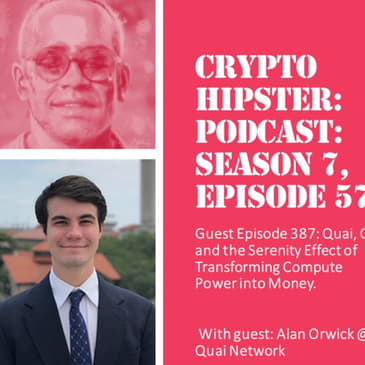

Alan Orwick is the Co-Founder of Quai Network, the only fully scalable and programmable Proof-of-Work Layer 1 designed for global commerce. He also serves as the CEO of Dominant Strategies, the development behind Quai Network devoted to building blockchain tooling and infrastructure. Previously an Apple software engineer, Alan is committed to continue innovating the Quai Network with his engineering skills. His passion for blockchain technology began while he was a student at the University of Texas at Austin, where he founded Texas Blockchain, a student-led blockchain club.
[00:00:00] Hello everybody and welcome to the Crypto Hipster podcast. This is your host, Jamil Hasan, the Crypto Hipster where I interview founders, entrepreneurs, executives, thought leaders, amazing people all around the world of Crypto and blockchain. And today I have a really
[00:00:17] amazing person and an interesting interesting company project. My guest name is Alan Orwick. He is the co-founder of Quai. Alan, welcome. Yeah, thank you Jamil. excited to be here and tell
[00:00:31] a little bit more about my story. I love to hear it. First of all, let's kick off with your story. What is your background? And is it a logical background in story for what you're doing now?
[00:00:42] For the most part, I think so. So actually got started in Crypto about 2015 was in Bitcoin and Ethereum and was really drawn to it because I was getting into programming. I was getting into computer science
[00:00:53] and trying to understand how the technology worked and that led me into the University of Texas where I was a student studying computer science. I founded Texas blockchain, which is the undergrad
[00:01:03] I do at blockchain organization. So was the president of that for a couple years to grew that to several hundred students and then that really led me down the research rabbit hole. So as
[00:01:13] I able to get connected with call colleagues, professors and others that were like-minded in the Austin area and really thought what we want Crypto to be and how we want to create these systems.
[00:01:24] So following graduation in 2020 went and worked at Apple for a couple years of software engineer. That was actually the Austin area as well as on supply chains side. But got the Crypto Mitch, decided to get back to the startup space and was able to leave Apple
[00:01:38] and get started with Quai Network and really grow the team and grow what we're doing here. And yeah, I think there's been a lot of different paths in my career that have allowed me to
[00:01:48] really work with amazing people in the space and very bright people that really want to push the industry forward for Crypto. Very cool. I was an Austin for the first time in my life in May. Oh nice. For a consensus probably right? For a consensus.
[00:02:03] Yeah, it was- I love the town. It was great. Good. You get some barbecue and hang out, go down to the go down to Lake. Yep, I had- I'd go to the lake but I had barbecue because probably
[00:02:14] some of the better barbecue ahead of my life. Nice. Oh, I'm glad you're that. Hopefully we can have you back soon. Next year, so thank you. So let's talk about Quai Network. You know, what's
[00:02:25] it all about? And why do you guys call it endometrific all yourselves this? But I think I saw it somewhere. The only fully scalable and programmable proof of the work layer one not named Bitcoin.
[00:02:39] Yeah, so you know when you think about Crypto, you have to think about the core primitives of the use cases. And with Quai, our goal is to create something that is fully scalable and
[00:02:48] programmable. So those two terms kind of on their own have to be defined, right? This scalable can be a little ambiguous. So scalable to us means something that can achieve extremely high throughput anywhere north of 10,000 transactions per second, 50,000 transactions per second, and so on.
[00:03:05] So something that can compete with the likes of a visa master card or the credit networks or the banking infrastructure that we already used today. So scalable has to be defined in a way that actually means real tangible throughput, something that Quai can accomplish and something
[00:03:21] that other newer blockchains are beginning to accomplish as well. Second to that when we say programmable, it has to have a nature of interacting with the blockchain or interacting with other parties in a decentralized way. So things like smart contracts, the EM or other forms of virtual
[00:03:39] machines that allow for trust minimized ways of facilitating interactions with third parties. So having that settle on a network doing sort of third party asset issuance or doing things like settling trader D5. So having that on Quai network on a scalable network so we can keep
[00:04:01] fees consistently low. Got it. So you guys have created two coins, right? One of them is essentially a to energy. The other one I want to find out about both and how they work.
[00:04:19] Yeah, definitely. So I touched on those two kind of first points on scalability and program ability and the way that Quai is unique that actually didn't elude to yet is we're doing this
[00:04:31] on a proof of work network. And so a lot of people have different assumptions and beliefs about what proof of work means or does or what kind of accomplish Bitcoin as you mentioned earlier
[00:04:42] is notoriously proof of work. And in many cases we see the industry has really shy away from proof of work lately and they've moved towards proof of stake, they've moved towards the layer twos
[00:04:53] and there's a lot of excitement around that rightfully so but for us we see there has to be ways to innovate within proof of work. And so when we say where the only scalable and programmable
[00:05:04] proof of work network that is the case, a lot of proof of work networks do lack those features. In fact all of them lack those to combine but now when we say well what does it mean to have
[00:05:14] this new form of stable plan alternative and all you've alternative specifically because it's not directly pegged it's more of a manifestation or a mechanistic design around the use of energy. And that's because we found a way to orcalyse the properties of proof work and use that
[00:05:33] for bringing that real expenditure so that cost, that minor input cost that for many minors is denominated primarily in energy and manifesting that on-chain. And so a two token design
[00:05:46] is utilized in which one of those tokens is like the store value or more of the sort of volatility and the second one that we call Qi almost like Tai Chi or the energy inside of you is
[00:05:59] supposed to be that decentralized energy dollar or dollar alternative, stable plan alternatives given it's not directly pegged to a dollar. It's not one to one backed. It's admitted proportionally to hash rate. It's actually how we do that so every time you give the network one hash
[00:06:15] it will give you the same amount of Qi that that differs from something like Bitcoin that sort arbitrarily has Satoshi created this schedule and said, every four years you get half the amount
[00:06:26] of Bitcoin and that creates a lot of the metacism and a lot of excitement whenever it can happen. I think looking back this year in April people thought it was going to happen on 420 so those random disturbances and the Bitcoin issuance can cause some turbulence in the market.
[00:06:45] But for us we sort of thought about it differently from an economic standpoint and that's how we create that two token design within Quynetwork. I'm thinking here you said something really interesting
[00:07:00] that prior might go over a lot of people's heads but I wanted to have into it before I moved you said you Oracleized the proof of network. When I think of Oracle I think of Chenle,
[00:07:12] I think of other RLC, other proof of stake oracles. How do you actually Oracleize a proof of work as far as the data feeds how do you add the Azure? Yeah so when we talk about Qi as an asset and we say it is tied to energy
[00:07:35] but what we mean is actually the global average energy cost because there are many different miners across the globe and so if you look at miners as we talked about with Texas there's a lot
[00:07:46] of Bitcoin miners in Texas and they're tied into Erka and they run and then whenever it gets really hot in Texas they might have to shut off their Bitcoin miners or whenever we have flash
[00:07:55] freezes they have to shut off their Bitcoin miners and put that energy back into the grid. So fundamentally those miners may run up say six is a kilowatt hour compared to someone in Germany
[00:08:04] that is running on hydroelectric or running on a wind farm that might be getting 14 cents a kilowatt so all of these miners have different costs and so they're going to have different levels of
[00:08:16] profitability based off of the energy that they need to contribute hash rate so they have a certain amount of GPUs and a certain amount of computers that are mining this network and when they do that there's a game theory or incentive design for them to mine
[00:08:31] either one of the tokens based off of their profitability and that ties into that process of Oracleization because they have that real energy denomination that goes into the creation of the token itself so when you think about Bitcoin miners they get that sort of constant rate
[00:08:48] of Bitcoin whenever they mine so that's consistent block reward but it with G specifically as it's tied to hash rate that a mission would vary based off of the participation in the network. God it's you're able to create variable rates based on the activity and minor preference as
[00:09:14] well so activity and minor preference based off of this game design and so everything in crypto boils down to game design and incentives right the network and the infrastructure is meant to facilitate these value transfers then the tokens on these protocols are meant to make people act
[00:09:30] in different ways at the benefit of the network and at the benefit of adoption so when we look at how we want this token to be utilized we want it to be utilized as a way of stability in a way
[00:09:41] and what a stability mean to us we see energy as a better denominating source for that if you look at purchasing power over time or inflation some of the key drivers there are energy
[00:09:51] oil not gas the name it many of the other ones that are emerging such as solar so we're confident in a very energy abundant future but we see a money tied to energies the most
[00:10:02] useful form of money it's ingenuous I like it thank you I appreciate it a lot of research to give this point I would think so yeah so we are we are headed toward an increasingly compute
[00:10:25] ventric economy so it's now it's more important than ever before to build scalable and for a structure go back to the water scalability how do you scale your infrastructure and why is it important to do that now yeah so I'll talk about infrastructure at a few different points
[00:10:45] so great question by the way when we look at a proof of work network there are many sort of tiers and we were just talking about the miners and miners to us are a very critical aspect given
[00:10:56] that they have the incentive to mine the token and the larger you get the more global and incentive there is to find these pockets of energy so cheap electricity that can be utilized
[00:11:08] to turn into cryptocurrency and that also appears nicely with data centers and AI so we look at infrastructure and how that's utilized we have people that are going to say al Salvador and mining
[00:11:20] on top of volcanoes because they can get free electricity there that's not being utilized for extremely the same for Texas that are putting Bitcoin miners on flaired natural gas or flaired oil wells in which they are capturing that methane that's being emitted and converting that into a
[00:11:38] consumable fuel for their Bitcoin miners and then on top of that as well when we look at the existing data warehouses that are doing large AI processing or large compute for say AWS GCP there's an incentive for these people and they're not running those intensive systems to be
[00:11:54] using it for cryptocurrency so I think we're going to see an emergence of infrastructure that is more crypto ingrained and also more AI ingrained when we think about how these jobs are pairing
[00:12:05] I won't say you know the AI x crypto category super thought out yet but it's getting there and the infrastructure play first I think is most useful because you're seeing Bitcoin miners also dabbling in running GPU or running other AI sourcing and AI jobs because they have that
[00:12:24] connection to the energy if you look at the main bottleneck of AI right now we'll talk about infrastructure it actually is access to energy because so intensive to run this processing and then
[00:12:35] as we scale all other infrastructure now that we have data centers and this ever growing need to run this type of software and access it across the globe we have to look at how this software
[00:12:46] actually runs and so the code itself as an infrastructure and with a quiet we've uniquely designed it so that we can shard and subnet the network those are two very important properties that also
[00:12:59] are tied to a lot of the research we did in which sharding allows us to break the blockchain into many different pieces that is not a new idea it's actually the bitter-aligned since 2016 and other protocols have implemented sharding before and so there's different types data sharding
[00:13:15] execution sharding where more on the data sharding side and which they're made different block shards are running in parallel and then the subnet idea in which these shards actually co-locate or correlated to a specific network topology so you can imagine a shard running in North America
[00:13:34] a shard running in South America or shard running in Europe shard running in Asia and the benefit of that from an infrastructure standpoint is if you look at how these nodes are connected they actually
[00:13:45] can reduce their latencies and increase their bandwidth and so you can imagine now instead of taking a second to talk with somebody across the globe you're taking a quarter of a second because
[00:13:56] they're just a couple states away or you know a couple countries away and that makes it more efficient in terms of network propagation and that infrastructure allows us to scale and reach that throughput that I talked about earlier that makes it usable for global commerce and
[00:14:12] people to actually tie it into payments and real world use cases for accepting and using crypto that we've been limited by interesting you know I'm so trying to picture you know the
[00:14:26] myth like the methane at a sexist like I didn't even think that like about that yeah you know and it's interesting so you tell you hear all this about you know about ESG investing
[00:14:40] but you don't hear people combining Bitcoin or other proof of work networks with ESG investing to keep an narrative is a separate because Bitcoin takes too much energy right how do you like to say what continue that was about how do you deal with how do you do
[00:14:57] others false narratives yeah proof of work it's a bad rap right and I think that's one of the many reasons why as I talked about the industry has gone so heavy into proof of stake is because
[00:15:06] we have this big ESG narrative and we're starting to see some of the ramifications on that and how it might have put us into different areas of researcher thought that be might be more of a sort of local minima as opposed to you know what is fully achievable
[00:15:21] and looking at asset like Bitcoin one of the things I'm very passionate about whenever assessing these types of protocols is actually saying well Bitcoin is actually sort of net negative for emissions because a lot of people are running their miners on not only the flared net gas
[00:15:37] or oil wells but they're also running it on landfills and I've talked about this in other talks but if you look at landfill methane emissions there anywhere from 30 to 50 times more potent
[00:15:47] to the atmosphere than CO2 and so for that Bitcoin miner to tarpa landfill and get a consistent three to seven megawatts on the 3300 landfills that exist in the United States that's a pretty lucrative opportunity for them to say hey no these landfills aren't going anywhere this trash isn't
[00:16:06] being moved and I know this landfill will admit a certain amount of methane for 15 to 50 years and so people can take those opportunities and set up there and create that infrastructure so kind of going back into you know what other ways or people creating and building out this
[00:16:23] infrastructure I think one of those is the landfill methane mitigation that would be explored and then also thinking if you look at how to frame this in a better light from a green or
[00:16:33] a environmental perspective is the sort of cop out answer is like well how much waste does our traditional banking infrastructure use right like the people driving to the banks to work in a box all day or the people having their you know ATM's a tactical swipe and people
[00:16:51] have to refill the ATM's and transport that so that's a pretty intensive process so I think to some degree people are okay with the energy expenditure that goes into these networks and you have to find a level that is reasonable in thought process but then also counter with
[00:17:05] the narratives that there are ways to make this green and there are ways to benefit the environment and to create that incentive to go and source that energy because once you source that energy
[00:17:18] is well it may be more profitable to sell back into the grid so if you imagine you're looking at a landfill that's miles away from a city and it takes a million dollars every mile to connect
[00:17:27] it and may not be profitable now to reconnect that landfill but maybe in 10 years it might whenever that city grows and it's a little closer to the landfill and there's more demand in
[00:17:36] that city for energy so I think those are some of the business impacts of crypto that people can see and then also tie that with sort of carbon credits that the government issues or other sort of
[00:17:47] e-ring processes that you can go and get as a business but you know we're not particularly in that industry we want our miners to explore that and we want to offer quiet as a way to have
[00:18:00] sort of different types of mining for these people that have GPU capacity and so you know for us those are the many things that we just try to tell people it's like find the cheapest energy
[00:18:10] and participate in these ways to do it in a renewable way. Sounds really intriguing to me something else I'm intrigued by is your co-founder I saw a video your co-founder speaking about
[00:18:25] you know about Bitcoin failing as money you know where in that lifespan do you feel that Bitcoin failed as money and what lessons has the world learned from that failure and how are you fixed in
[00:18:37] that mess yeah so when you look at Bitcoin you know Bitcoin is still emerging and I think taking a step back and we look at the life cycle of currencies I think the US dollar is still sort of coming off
[00:18:52] of its prominence and we're living in a world in which the US is losing a lot of its dominance you know I'm an American I love America but I think we have to look at the facts and we have to say
[00:19:01] how do we ensure that we can create this sort of empire this American empire and sustain it and it's hard given you know we're so spread out and the debt is growing and fiat currencies
[00:19:15] are more recently new as well you know we went off gold and you know 1930s and then more recently you know 1970s transitioned other countries off of that and for us Bitcoin I still think
[00:19:32] is rising in terms of adoption as a currency so we can't really say Bitcoin has failed yet but I think we're seeing some of the warning signals that Bitcoin is also find to the point that will
[00:19:45] open up potential avenues for failure and I think some of those as they talked about in the video are security budget so when we look at these arbitrary havings what happens to the block
[00:19:55] chain in terms of security whenever the fees continually go down and the transaction fees are not keeping up for that if we look at hash price in terms of the revenue that miners are getting
[00:20:06] today I believe it's roughly 5% away from all time low so the 5% away from the lowest amount of Bitcoin in US dollar terms being paid out to miners and the history of Bitcoin that's not a good
[00:20:18] thing because then we can't actually support the network in terms of the economic activity that is occurring on it because if you're sending a certain amount of Bitcoin you want that to have a certain amount of economic security so that it's a transaction that can get settled
[00:20:33] in an appropriate manner when we did a lot of analysis and we actually took out energy prices and inflation we actually saw Bitcoin hash rate in terms of net energy peaked roughly around 2017-2018 in terms of like peak Bitcoin and we've been actually on a decline
[00:20:52] since if you think about the energy expenditure going into it and so for us we have to think about you know what is actually the driving forces of what a monetary system should be
[00:21:02] if we think about it as money we'll how much or if we think about it as energy not money for how the system should be designed how do we get the most amount of energy going into these to
[00:21:11] secure them and then how do we create monetary systems based off of energy so that we can transact more freely of control and of this sort of censorship-resistant ways that are
[00:21:22] impued into fiat and these other currencies so for us you know I think Bitcoin still has a bright future and I think you know we don't want to put down any other systems and we want to learn from them
[00:21:33] and acknowledge how we can improve them and we're attempting to do that with quiet. Makes sense. I don't realize we're in a downward spiral when I see other proof of work chains you know with improving hash rates it's a little bit more competitive of the environment now.
[00:21:53] So I think the cash rate you know hash rate is a bit of a a can be a bit of a conflating term right because if you look at just pure hash rate well
[00:22:02] all out of the machines have improved by you know two to three x so now instead of getting you know 15 terror has your getting 105 air hash for the same amount of energy so I can still have
[00:22:14] a 3500 watt machine but that 3500 watt machines no longer you know it's 10x the hash rate for the same amount of energy so looking just at a hash rate number you know the bit of an argument
[00:22:27] there like it's just the amount of hash rate fine or is the actual manifestation of the energy preferred and for us you know we want the most amount of energy going in because that's the economic
[00:22:37] influence of the chain. God it so I believe in a decentralized future right I believe in a multi-generational decentralized future but you know what is what does that look like to you from three dimensional areas social financial and political.
[00:23:00] Yeah I mean for us and my thoughts on decentralizing this and creating a better future I think moving away from centralized forms of control in which people are able to influence your life on a day-to-day basis and monitor what you do and have overarching reach into your day-to-day
[00:23:25] life is like the reason why we have to build these systems and if you say in the future where you ate too much steak or you you drove your gas car too much or you you did things that can be
[00:23:36] tracked and recorded and then limited in terms of your freedom to move around as an individual I think is it's not the future we want to live in and definitely not the future that I want my
[00:23:46] future kids to live in and it's up to us to build these systems that allow for sovereignty and we've gone through this process in which we sort of saw the separation of of church and state
[00:23:59] and the idea of religion being on its own and how individuals are able to practice their religion in the United States and how that's a free society for people and I think America
[00:24:10] because I talked about is one of the places that people actually have a lot of freedoms there and so we're getting to the point now where people are seeing what if I want freedom to choose
[00:24:19] what money I use and how I hold and store value and how I represent my choice of the finances and so crypt those this great fight in which we have to really take it on ourselves to create
[00:24:32] the separation of the state and the money and of course that's a very hard fight because it is a very entrenched piece of the state to own the money and have control of the people through
[00:24:44] the money and the only way we can fight that is not to you know go into these systems and try to make them better from the inside out but create separate systems and create new enterprises that
[00:24:57] allow people the mobility to take on a different kind of asset ownership and take on a different form of money and if you look at these centralization then it's say how do I create these long-lasting
[00:25:08] systems that are robust for people to participate in for long enough time and so they coin may accomplish that and the short term as we already talked about but what does that look like
[00:25:18] for 100 to 200 years 500 years and so on and what systems are going to be around and how do we create those incentive schemes to keep people interested and keep people on the same network and
[00:25:30] participate together and I don't know if we really figured that out yet and I hope with why we can take the next step and experimenting and having a way of designing a system that might
[00:25:41] encourage different kinds of behavior again using that token to align incentives and to create intended or discourage unintended types of behavior and pair that with some of the other systems that are out today so some of the larger blockchains that are also experimenting with how to
[00:25:57] create these multi-generational decentralized systems. I like that answer. I'm going to ask you about this because I don't bring it up to anybody, because you know what you're talking about as far as money
[00:26:16] we have something in the run the world called COVID. When COVID happened the U.S. money printer and it was not a whole thing. Everybody knows that it was those we went in the debt but what
[00:26:28] did it do? It enriched the people who were sitting at the top of corporate America. They got more money than everybody else even though they were failing to lead their companies, their companies were failing and they weren't able to to be leaders and they were just giving a
[00:26:46] whole bunch of money so masked and entire generation of non-performance. So okay the non-formers got money everybody else got screwed you know the money supplied needs to change in order for us to come
[00:27:01] out of debt in America how can people who rely on why to help equalize or bringing that money stock back in the equilibrium so people can see where they're headed in the future. Yeah I think for why particularly in this use case you know thoughts on everything else
[00:27:20] you said before aside and if I were to answer that question directly it is how do we create crypto that can be perceived in a light of actual experimentation and use case away from traditional
[00:27:32] forms of money and so I think to get to why we have to kind of go down an existing Bitcoin rabbit hole right if the kind of like start in Bitcoin or theory and then like work your way and find
[00:27:43] and discover why but we prefer that to not be the case in the future and we'd prefer it in which quies actually a lot of people's many first time using crypto and we want that to be
[00:27:52] open and accessible so what that means is low fees and ease of use and access so can you do it in the places that are already frequented in your day-to-day life so can I go into a convenient
[00:28:02] school store and pay with quiet am I booking something on Shopify can I pay with quiet that way can I mask that experience such that you're not even really sure you're using a blockchain
[00:28:13] or you have a crypto currency as part of this transaction and that's I think limited in many ways not only by technology but of like thought and mind of the people that are in blockchain and and how
[00:28:25] they're developing these things and how they perceive the world in the future for it because a lot of people I think do got caught up in sort of the nuance of use cases in research so creating
[00:28:35] something very practical in which you can say here is a real product ship this and get it out to as many people as possible get people using crypto that's one of our goals and
[00:28:45] allowing that to be something that is sort of unconstrained and able to spread like wildfire is the hope and so getting people's first time in the crypto in a way that is a good experience
[00:28:56] because ultimately that's what I want for people and I know for me I think in many ways is you know product driven and trying to refine this product and something with light crypto is very hard to understand in many different ways that's something that people have very
[00:29:10] visceral and gut reactions to if you talk about crypto kind of across the board and so I think for us it's a matter of making that experience more pleasant and thinking about it from first principles in which if you think about how money system should be thought of,
[00:29:24] you know I want to take part in that money system because money ultimately this is just kind of value transfer between the people and almost stored time or stored experience and
[00:29:35] manifesting that and putting that in a way that is able to be digested and able to be used day-to-day as a meaningful thing. Yeah I agree we still need to have that fungible
[00:29:49] coconut everybody can use like the scent that you know that you can just use you know not and and last as a as a store as a investment but actually actually like transactions. So yeah
[00:30:03] and you know we didn't go down the rabbit hole like stablecoins and like how those are being adopted and what that looks like for us to the world but there is a very bright future for stable
[00:30:12] coins as well you know there's over $150 billion of stablecoin market cap we're seeing 350 billion plus in terms of volume over seven days so you know people are actually using these things
[00:30:25] and there is demand for the dollar across the globe so if anything the the U.S. needs to wake up and see that people want demand for U.S. treasuries and by proxy stablecoins or vice versa on that in
[00:30:37] that regard so for for us it's like well how do we actually use blockchain technology for the for the benefit of getting dollar adoption and then what other kind of currencies can also take part process so you know stablecoin problems aside I think that's an interesting area
[00:30:53] I don't I don't I tend to like from my investment had on I tend usually not to ask about stablecoins because they bore me you know they're not they're not fun and exciting they're not you know they don't
[00:31:09] have speculative access and of course right but they are the our beneficial and there are a lot of governments are in favor of them and a lot of governments who are against them you know what's
[00:31:23] what's the you know what's the pros and the cons there and how do you how do you reconcile that yeah I mean if you think about the people that actually need crypto most they don't want volatility
[00:31:35] right they're their local dollars in Argentina has been as well a Turkey are inflating 100% you're over year and so they don't want that negative volatility they want stability and so they seek stablecoins and actually those are some of the first and foremost crypto users those are
[00:31:54] the people that are paying with this stuff and so we say actually in the United States we're very blessed to have a you know running financial system in which we're good with with the dollar
[00:32:05] and we can go pay a fee semester card but there are people that are in these countries that are actually using crypto to to pay a day and day out and they they are some of the the main people
[00:32:14] that are using these systems so you know I'd see that kind of like as a merging market trend in which that's an area of crypto that's going to continue to grow. That makes it heck of a lot of
[00:32:25] sense. Thank you. Yeah. Thank you off my one side had learned to know something new every single day was so appreciate it thank you. I do want to know I do have one last question because you know I am
[00:32:40] and this is not promotional content I am going to be a speaker at the Litecoin summing hosting a panel there you know asking about you know Litecoin mining and how do you how do you compare
[00:32:56] Kui to other proof of network networks like Litecoin likes like some others how do you stack up. Yeah. So as I said in kind of led with we are the only scalable proof work network with smart contracts.
[00:33:10] So we are the only system that can run this high throughput have this adaptive network with EVM programmability we saw so much demand for the EVM we still do pitfalls of the EVM aside it's
[00:33:24] the most widely adopted and most robust form of smart contract programming on the blockchain today and then pairing that with insanely low fees on what we see as the most secure and objective
[00:33:35] form of consensus being performed. Too many that's a no brainer and so we're excited about that future we're excited to introduce that into the market and for other things like Litecoin and other
[00:33:46] proof work coins a lot of them have classified and so it's hard for them to get a lot of upgrades to start with them to stay on top of an adaptive changing market and for us we can really utilize
[00:33:59] the last move of the last move of advantage in the space to capitalize on other research and advancements. Sounds good to me that sounds really good so I want to thank you very much for
[00:34:13] tweaking through with me today um I have one last question hit me I could people find a more information about you yeah you're network about you know anything you're up to about
[00:34:25] why how can they do that? Sure so you can visit qu.ai to visit our website on twitterxwareatqine network and then we have our docs available at qu.ai slash docs youtube with large presence as well as you said
[00:34:41] you've seen doctor k speaking about Bitcoin and other things on youtube there's a ton of great content there so check that out and then join our discord if you want to hang out in the community
[00:34:51] run a node run a minor and participate in test and that more than glad to do that so ramping up from main that launched this year and excited to keep everyone involved as we do so.
[00:35:01] Awesome thank you very much for your time today. Yeah thank you Jimmel, appreciate having me.