
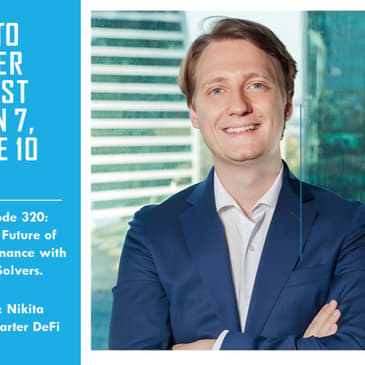

Nikita Ovchinnik has been involved in the DeFi space for over 5 years, holding various Executive positions at previous companies. His experience and expertise have positioned him as a reliable authority figure in the industry, and he has efficient cooperative relationships with organizations in the market in order to move the industry forward.
Nikita is a co-founder of Barter, a solver system on Ethereum and L2s. Barter has processed over 4B of volume through platforms like CowSwap, UniswapX and Bebop. He frequently speaks at conferences around the world (Avalanche Summit, Austin DeFi, Permissionless, The Capital etc.), sharing his insights and knowledge with other industry professionals.
Publications:
Conferences:
The Capital 2022: https://conference.coinmarketcap.com/
Austin DeFi 2022: https://youtu.be/IHsN9TnGgl8
Permissionless 2022: https://youtu.be/t_5Q0P3nNl4
Barter's Twitter: https://twitter.com/BarterDeFi
[00:00:00] Hello everybody and welcome to the Crypto Hipster podcast. This is your host, Jamil Hasan, the Crypto Hipster where I bring you founders, entrepreneurs, executives, leaders, amazing people all around the world of crypto and blockchain.
[00:00:14] And today I have my very first guest from Chile. I'm looking forward to this. His name is Nikita Avchenok. I hope I didn't butcher that too badly.
[00:00:27] Nikita Avchenok is the founder of Barter DeFi. Nikita, welcome.
[00:00:33] Welcome. Thank you, Jamil. Thanks for having me. It's a pleasure to be here. Yes.
[00:00:39] You're very welcome. So let's get things off. I look forward to this. And first question is what is your background and is it a logical background for what you're doing right now?
[00:00:52] Absolutely. So, yeah, I've been in crypto since 2017, worked at various different projects and I was fascinated by DeFi in 2019.
[00:01:01] I felt like DeFi is a great use case for crypto and that it's just natural that we should all evolve, focus and contribute to this particular market niche.
[00:01:14] And in February 2020, I've joined Oneinch as the first employee who helped co-founders Anton and Sergey with business development, investor relations, integrations.
[00:01:27] Anton and Sergey are both technical and they've been whitehead hackers and Oneinch is a great product.
[00:01:33] I was very lucky to be there early and experience DeFi summer from the first hand.
[00:01:39] And yeah, I was a chip business development officer at Oneinch for two and a half years and left when we were moving to Chile to focus a little bit more on family.
[00:01:51] I have three daughters. So it takes a lot of time and I felt like I didn't spend enough during the latest bull run.
[00:01:58] Yeah, I've been also angel investing in different projects. I'm an angel investor in cash flow, clipper, chain patrol, but most of my focus is dedicated towards DeFi.
[00:02:10] And originally, you know, I did not see much potential in the solar landscape.
[00:02:16] It felt like very niche when Cowswap launched, you know, it's Cowswap in 2022 and there were just three solvers built by Gnosis team.
[00:02:26] However, with more and more time in the ecosystem now it feels like intense is a very big and hot topic.
[00:02:34] And moreover, it feels like it abstracts a big layer of difficulties that users initially faced and create this new unique dimension.
[00:02:43] And we, you know, wanted to capture it. We feel like there is a big room for improvement and we launched a solar. Yeah.
[00:02:53] Awesome. So what's the main focus of of Barter DeFi is what?
[00:03:00] So we are, you know, facilitating transactions of on-chain. We are trying to find the best possible routes and make sure that the users always receive maximum amount of tokens based on during the swap process.
[00:03:16] And we are live on Cowswap, Uniswap X, Bebop and we've recently expanded from Ethereum into Arbitrum.
[00:03:24] So we are primarily routing through on-chain liquidity sources. We barely have our own inventory and then we don't want to become a trade firm.
[00:03:33] For example, if you look at the metrics roughly, actually over 50% of other flow from Uniswap X goes through market makers.
[00:03:43] And we don't think it should be that way. We feel like the users should rely on publicly available on-chain liquidity sources with that running on smart contracts and that liquidity originates on chain and should be settled on chain.
[00:03:56] And we are trying to find ways how to, you know, expand DeFi liquidity competitiveness. And yeah, just compete with market makers actually.
[00:04:12] My first reaction, mental reaction when you said that was what market makers? Like where are the market makers? There are certain chains where it seems like there are no market makers anymore.
[00:04:25] You know, so let me ask you for what is the status of the market making in this industry?
[00:04:32] Excellent question. I think we have a majority of market makers they are present on Ethereum mainnet because this is, you know, the richest ecosystem and just generally has majority of traction and assets issued there.
[00:04:47] And inefficiencies as well. Inefficiencies that lead to arbitrage and, you know, market makers have been historically very good at it.
[00:04:56] But, you know, from the big names that are currently present in the industry, of course, Wintermute. You know, Wintermute is settling a lot of trades on centralized exchanges and DeXS as well.
[00:05:08] And they have their own solvers running. And also they have their own system similar to Kaoswap called Bebop. And it's actually like, like, had a very good design. We like it a lot.
[00:05:22] But despite that, you know, we don't want allow like market makers. So either like many of them or one of them to settle majority of trades.
[00:05:34] There is a Tokalaps from Asia and SEP also, like some of the big names that are market making in DeFi.
[00:05:45] Interesting. You know, I see that. I was kind of, I saw some metrics yesterday. I was kind of trying to piece it together.
[00:05:57] It makes sense that the market maker, we said market makers are mostly Ethereum because I saw some of their other competitive chains that are really being shorted like beyond a norm that they should be shorted, right?
[00:06:10] What do you see going on as far as, you know, putting these shortness at bay? You know, what's the risk and how can we overcome that?
[00:06:24] Well, you know, it's a tough one really. Lime in without your own inventory and like, it's very hard to compete with market makers and with, you know, big firms in general.
[00:06:40] That's why, for example, algorithmic solvers like ours, they are present only on more sustainable chain with deep liquidity and enough protocols.
[00:06:50] For example, we've recently expanded into arbitrum, which is showing like tremendous fraction. We are also analyzing other L2s like base and maybe BLAST, you know, BSC.
[00:07:03] But generally we, you know, follow the order flow. Order flow from regular users or protocols and we want to be where they are and we want to provide them better rate that they currently get.
[00:07:20] Got it. What are the benefits of being on arbitrum?
[00:07:24] Oh, well, arbitrum was one of the first, you know, L2s that's just integrated blocks and with the latest, you know, Ethereum update.
[00:07:34] And for example, why market makers are so competitive on Ethereum mainnet is because every block is 15 seconds.
[00:07:41] And for market maker 15 seconds is, you know, light years when they can change their quote and pricing and strategy multiple times.
[00:07:50] But on arbitrum, there are like the blocks are much faster. If I recall correctly, it's like three blocks a second or close to that.
[00:07:58] At the same time with fees that are now close to zero, arbitrage opportunities are far less and we as a solver can, you know, touch more pools across different assets.
[00:08:12] For example, yeah, yeah, like like interact with more dex's and reduce slippage dramatically.
[00:08:19] And I think arbitrum is one of the interesting chains for intents.
[00:08:23] I don't know, maybe we should cover like intent topic for the users who might not be familiar with the term, but you know, transactions have this definitive, you know, definitive status where like user wants something or something has happened on chain.
[00:08:42] But with intents user does not restrict, you know, parties that is going to execute this transaction on any like like on the flow.
[00:08:54] For example, user doesn't care in general where liquidity comes from was it's like Uniswap or a market maker and within 10 or it might be actually originating on other L2.
[00:09:05] So intents allow flexibility for solvers to facilitate user desires in a more efficient manner in the manner that solver with its technical capabilities and you know infrastructure and precise accounting for like reducing MEV exposure, reducing slippage, optimizing gas can help take care of.
[00:09:29] And yeah, arbitrum has a number of new projects emerging with this intent focus and since all intent platforms run on solvers like we want to power them.
[00:09:44] All intent works on so how do you empower them?
[00:09:50] So sorry, how do we what?
[00:09:52] How do you empower them? You want to empower them? How do you do that?
[00:09:55] Right. So on Cowswap is an auction process. So the user comes to Cowswap UI, for example, this is on Ethereum and says that he wants to trade like one is for let's say $3,000.
[00:10:07] And for example, the price is now either above it or below it and the solvers are waiting for all the auctions. So it's like a batch auctions. We are waiting for all the orders that can happen in this on Cowswap.
[00:10:25] And we try to combine them in order to provide the best rate. And yeah, so Cowswap doesn't have its own routing system, but it has a solver competition and guys like us trying using our own inventory or using on-chain inventory like
[00:10:41] through algorithm, provide a quote and if the quote is profitable for user, if his intent can be aligned under the constraints that he provided, we will facilitate it.
[00:10:53] But intense can be like go deeper and beyond just in our sport trading and they can be more complex. For example, imagine if I as a user want to route through clean liquidity.
[00:11:06] And I think that is the liquidity that is good according to chain analysis or TRM. And if a solver has this capability that it can analyze pools or market makers and take out the ones that liquidity should not go through, user can receive a clean transaction.
[00:11:26] It might not be as efficient. It would not maximize like potential exchange rate, but different users has different needs and some parties with a legal presence and who needs this for legal purposes, they can have those more complex features added.
[00:11:47] It sounds like these solvers have a benefit of cheaper transactions, which is something Ethereum hasn't been able to do and cleaner and faster. I guess at least it is more efficient but flexibility in so far as I'm not going to be necessarily have to be relegated to trading spot.
[00:12:10] I can now trade derivatives to ordinary user, right?
[00:12:14] Yes, this is how the market evolves and one of the biggest ideas that we have for example for intense. So if we simplify intense, intense are limit orders, but if we simplify them even more intense are liquidity.
[00:12:30] Liquidity is that can be used in some kind of fashion, the ways that solver see fit as long as you know the user conditions are met. And what we find out and that was like really revealing to us that almost 100% of order flow on Ethereum mainnet goes through automated market makers or PMMs private market makers, like Dexus and market makers.
[00:12:58] And there is no peer to peer component. So for example, if I want to sell tennis and you want to buy tennis, our orders will not match. And also, you know, existing systems like for example, zero X, they have no network effect.
[00:13:12] So meaning doesn't matter how many wallets or dApps or platforms integrate their API, the product the user receives is the same. And what we are trying to build with intense is that we are trying to, you know,
[00:13:26] the way we see it is we call it an off chain, we call it a decentralized clearing house vision or a decentralized peer to peer matching order book. So we try to find intense originating across all those different venues, all those different dApps and you know aggregators like one inch where I've worked.
[00:13:51] They did a phenomenal job by spotting that liquidity is fragmented between Dexus and different liquidity sources, but intense are also fragmented and people keep on using different UIs that they've originally met or like.
[00:14:07] And the UIs are very sticky. So in order to like truly unlock intense and have a big price improvement, we need to be present on many different venues, whereas those intense originate, like for example, Uniswap X, you know, again one inch, Paraswap recently announced that they are moving towards, you know, Solver system and that way, like, like for example, if an order originates on Paraswap,
[00:14:37] they cannot be connected on a protocol level, but they can be connected on a solver level. So we can see those two traits unite them and save on fees and save on gas. And this is what we are trying to do.
[00:14:52] He said the magic words for me, which is save on fees and save on gas.
[00:14:57] You know, so Solvers can also, I'm looking forward to that.
[00:15:07] Going back to something you said earlier that you were involved with genosis, right? In some way, right? Back in 2018, 2019 when I started trading these little alts, you know, I call it little alts.
[00:15:21] Back in the day where the price wasn't high. One of them was genosis and the other one was auger and I grabbed, I saw on my BRD app that there was an arbitrage opportunity between the two because they had people from the same team who were working on it.
[00:15:35] The one goes up. I was able to catch that just by luck, right? But we don't want people to capture things by luck. We wanted to be designed, right?
[00:15:47] Well, let's just have you brought over to the solver process that can help people design their ways of capturing arbitrage.
[00:15:55] Right. So arbitrage. Excellent question.
[00:16:01] Do we want arbitrage? I mean as a user probably we do because you know we financially benefit out of it.
[00:16:12] However, in general like arbitrage, MEV and all those other sorts of inefficiencies, they harm you know the ecosystem and if we want to scale crypto to billion users, if we want crypto to be sustainable and you know have financial and economic rails
[00:16:32] built on top of blockchain, we need to get rid of them one way or another. And with what we are building as a solver, we are trying to you know make swaps and this like trading more efficient so the user would not even face those kind of like arbitrage issues that sometimes might be favorable but honestly most of the time are not.
[00:17:01] And ensure you know ensures that the users in the same given block on Ethereum blockchain receive the same rate. So it would be fundamentally wrong imagine if in one block you know someone would buy ease for $3,500 and another user would pay like more or less.
[00:17:20] So we want to like even out this process and provide just fair transparent and efficient conditions for everyone.
[00:17:32] I like that. I like that so people who have intentional design can be able to do that.
[00:17:38] Great. So you just had a magic word though and I first is the first time I paid attention probably not the first time I heard it.
[00:17:47] First time I paid attention to it this week.
[00:17:51] Me V right.
[00:17:53] I'm going to ask you what your views are on me V and if it is a problem and how does it get solved.
[00:18:00] Right.
[00:18:02] So me V is probably the biggest problem that Ethereum community is facing and and not just Ethereum actually you know we see that now and maybe enters other chains that generate reasonable traction and trading activity like Salana and even Bitcoin but me V is you know well well the
[00:18:27] me V is minor acceptable value and it was coined by a flashbots co founder back in the early days of Ethereum and you know they unveiled a huge beast that is
[00:18:39] that is yeah attacking the ecosystem.
[00:18:42] So me V you know me V.
[00:18:47] Let's explain it on a concept of front running.
[00:18:51] So front running is when user wants to perform a swap and the swap is navigated to some kind of decks for example curve yeah and the exchange rate by curve is algorithmic and if and sophisticated player a searcher or me V bot might input a transaction before you that would change the
[00:19:12] exchange rate and then you would perform a swap under like bad conditions and then right after you they will put another swap that would rebalance the system back to the state that it was a few seconds before you perform the swap.
[00:19:28] They can extract this easy profit of like a few hundred dollars on every single swap and this is this is really bad for the ecosystem, you know because people might not be aware of it they might not know if they are protected and when they
[00:19:46] perform a swap they have a slippage tolerance and if the slippage is not you know is not correctly transmitted on chain in a publicly available mean pool then the user gets gets hurt and then he's not coming back to defy ever again or at least not
[00:20:05] not anytime soon and we want to avoid it so we want to make sure that no one is kind of abusing the system in their own fashion and there are a lot of like like teams are working on it, however, solving like me V is incredibly tough.
[00:20:22] We have like some of the smartest people working from, for example, flashbots team and many many others and there are more and more you know projects in merch that are trying to combat it.
[00:20:34] The way we are approaching that is that any V is kind of exists is going to exist by design on on the very minute in a foreseeable future. However, if we offset it by at least moving some volumes, especially during volatile periods from, you know, MMS and having this peer to
[00:21:01] peer component that we've just discussed between different UIs and matching users transactions directly. So if I want to sell 10 E's and maybe you want to buy 10 E's and how others meet each other, there is no MED because we've just be the, you know, like like this direct ideal swap.
[00:21:19] And this is, you know, like like fights it in a way and reduces it dramatically. And from our perspective, it also like attacks market makers a little bit because if there is a direct swap like this exists, there is no room for market makers to improve pricing or competing pricing because this is like equilibrium.
[00:21:41] And yeah, yeah.
[00:21:46] Thank you. Thank you. It is a big problem. So I have to investigate that more as my season seven goes along here. Appreciate it.
[00:21:54] So, I want to go back to something you said earlier on you said you entered it on the DeFi realm in 2019. Right?
[00:22:02] That was fun back then. You know, I had, I had chain link, I had Aave and I was like, I'm on the beach and my price, my value goes up by $20,000 and I did nothing.
[00:22:11] You know, I'm like, you know, I kind of, I kind of missed those days. You know, we haven't had a DeFi summer, you know, in a few years, right?
[00:22:21] What's going to kick off the next DeFi summer? How do you, what is that going to happen? What do you see? What are the catalysts to be able to get us to that next evolution of DeFi 2.0?
[00:22:33] Let me let me say a controversial opinion that I think DeFi never really took off. So DeFi, you know, emerged it was, you know, the blessed child of crypto in 2020.
[00:22:46] But like, like it didn't achieve majority of its promises. And we still have a major room for improvement and innovation in the sector in particular, you know, from stable coins to AMM designs to order flow auction systems, and much more than that,
[00:23:05] even like lending protocols and some, some things that's been around for a long time, like real world assets. It's of course in my opinion it's part of a larger DeFi landscape.
[00:23:16] And I remember talks about real world assets since, you know, 2017. And yeah, so in like, like for DeFi, in order for it to become big, it would probably take a few years.
[00:23:32] And it would, like we need to get rid of those complexities that, you know, distract user and, you know, may have this better design for community.
[00:23:47] So this is one point of the equation. Another one is we just need to have more liquidity and more meaningful interactions with, you know, real world and build those financial rails on chain. Yeah.
[00:24:08] So when you say real world, you're talking about banks?
[00:24:14] Yeah, we need to have systems that would mimic or would do, you know, the features that banks facilitate on a day-to-day basis but in a DeFi environment, that would be accessible from every wallet and would have like transparent conditions for everyone. Yeah.
[00:24:36] That makes a lot of sense.
[00:24:38] It does. Now, we talked about, see, you talk about anything you talked about, centralized clearing method we talked about arbitrage, we talked about, we did not talk about account abstraction, right? What is your view on the role of account abstraction and all this as a help or hurt?
[00:25:00] Well, account abstraction definitely helps. You know, it's one of those systems that was incredibly important in order to, you know, allow user, better user experience and perform like certain actions in a smoother and swifter way.
[00:25:19] So yeah, definitely a big step forward for DeFi landscape in general and it allows more unique use cases that were not previously possible. Yeah.
[00:25:36] Interesting. So you said a word a little bit ago. You said front running.
[00:25:42] Right.
[00:25:43] And there's two ways I look at front running. I don't want to get your opinions on both. One is meme coins and getting your buy in there before anybody else does and who's in the know to be able to do that?
[00:25:58] That's the first one. The other part, I think I think of when I hear front running is let's buy all the big one we can before the banks do.
[00:26:08] So, you know, how are those two front running one of them is negative. One of them is positive. You know, depending who you are both of you positive.
[00:26:19] How do we solve front running and how we make a more fairer landscape for everybody?
[00:26:25] Yeah, good one. Good one. So solving front running should probably happen not on an application layer rather than on a blockchain or like network and chain layer.
[00:26:43] So whenever we're like, like, okay, let's take a look at the example of a bed front running when a project that has like a reputation and users issues a new coin.
[00:26:55] And for example, it makes a Uniswap pool with this new coin. And some users might think that hey, like people are going to come people will keep on buying this token and I want to be the first one to grab it.
[00:27:08] And they, you know, pay builders absurd amount of fees for in order for that transaction to be number one in the block.
[00:27:17] And they, you know, just, you know, sweep all the coins available in the pool and potentially benefit highly from if the bet they made was correct and the price is going up and users actually want to buy it.
[00:27:32] So this kind of like interactions are very tough to solve on a protocol level, but you know applications and I think we'll definitely be already seen it but we will see more of it to kind of prevent and also
[00:27:49] this encourage behavior like that.
[00:27:53] Yeah, so there might be some kind of like slashing there might be some kind of penalties builders might not, for example, accept the wall wall accept those transactions.
[00:28:05] There is no ideal way how to fight it right now, but we will prevail.
[00:28:16] Got it. I've been saying earlier for the mean coin frenzy because you know, I guess I'm afraid but you know, I have when I was in my 20s a gamble a little bit too much.
[00:28:31] So, you know, so I don't I don't now but um but yeah, so and I wanted to get your I wanted to get your perspective because you do angel investing.
[00:28:41] So how do you see angel investing is different than then early gambling.
[00:28:48] So angel investing always have a big amount of risk related to it.
[00:28:54] However, like majority of angel investors including myself. Oh well I'm a very risk averse guy. You know, I want to make sure that you know the idea makes sense that the founders have good biography that there are reputable VCs present in the round and they've done a
[00:29:13] lot of good diligence and they've checked you know that this project might be amazing. And at the same time I'm always checking a source code and I do not invest unless there is a product that can be touched and filled and interacted with and luckily because
[00:29:32] I have this you know like like one inch background and I've been attending different conferences and hackathons. I know a lot of good engineers so I can always ask the opinion on the you know repository of the code and how good it is, and provide you
[00:29:49] have this you know, such party feedback. And I also only invest in projects where I can contribute as a community member or as a DAO participant and where I can bring meaningful value with my experience, whether it's you know business development and
[00:30:07] interacting and the fast connecting faster to certain like important protocols, or you know from a marketing perspective from talking economics design.
[00:30:19] Yeah, so those are my spheres of expertise and I try to contribute to the projects. How it's different with like meme coins and gambling. So with meme coins, you never truly know how long it's going to last.
[00:30:34] This is like the game is dancing chairs when the music stops someone's you know going to be upset. And I mean, I don't mind meme coins. I think it's a necessary part of our ecosystem and it actually can generate value.
[00:30:53] And more or less for some users who are new into crypto and who want to, you know, not get rich fast but I don't know build a meaningful
[00:31:04] you know, earn some money in order to buy more stable reputable assets. The stable coins can be a good way to go. And yeah, so you know they should exist.
[00:31:17] It's it's like I don't mind them. They're very healthy and good part of the ecosystem, but it's very different game with with Angel in lesson.
[00:31:27] Yeah, you reminded me coming back to my 2017 2018 days when I was an SEO advisor and I did all that due diligence it was tough. Now it's like okay this is a deal be done you just throw it dark, you know, you did say, I have one last question.
[00:31:44] I wasn't going to say but you said the magic word again. You said stable coins and you are building a defy protocol and you said stable coins and we all know the last and last implosion happened because of Terra Luna and the cascade effect from that.
[00:31:59] I see there's something going on with die.
[00:32:02] What to make it out.
[00:32:04] I don't know exactly all the details but how are you looking at that and are you are you concerned and what should we look out for.
[00:32:11] Right, so. Okay, I think the current issue and hype is a little bit over exaggerated, but the problem is not as specifically with dies a problem with Athena.
[00:32:26] So the reason you project called Athena that was launched six months ago or so maybe like like less than less than a year ago, and they have a very strong team, you know, I take a look at their round and they they have a very strong team.
[00:32:41] They have amazing investors like dragonfly capital for example, you know they are very solid have a lot of network and good expertise on the market. And Athena is a bit risky, you know, they have those design mechanism with a very high API.
[00:32:57] And we know it cannot be sustainable when you see like 30% yield on a stable coin that screams like risk is higher than it might be presented.
[00:33:09] And just to be clear, Athena does not present risk in they're not trying to hide anything they're very transparent in jumps how they operate and they openly show that there might be like like negative weeks and negative yield and they explain how it can be generated.
[00:33:25] But people in January don't care. People you know see 30% it's a stable coin or it's called like use the e I believe and they want to APM and they like those returns.
[00:33:38] However, you know, since everything on blockchain is public and those issues or like vulnerabilities are public. They might be abused. They might be abused unintentionally just because the market will shift against you know what they bet, but they it can also be abused by sophisticated parties who might see it as a honeypot and like take take advantage of it.
[00:34:05] And the maker now recently proposed to invest I think $600 million into Athena and you know generate yield for their users. And a lot of people, especially from our ecosystem, they published a lot of negative like reviews and risks and they want to be evaluating
[00:34:25] the maker token and die issuance. And this all creates this, you know, risky dynamic. We'll see how it unveils I am not like like, I don't think we will have another terror Luna in any time soon and yeah I think it should all even out.
[00:34:47] But but this is a story.
[00:34:50] I'm glad you feel this is not that we're not going to have another terror Luna. That's good.
[00:34:55] Thank you.
[00:34:59] I want to thank you very much for your time today and this has been a very fun and enjoyable and educational conversation for me.
[00:35:06] And I have one last question, and it's how can people find out more information about you about barter defy. How can they do that.
[00:35:14] Right so you know we've just launched less than a year ago and we already processed the 4 billion volumes on the terrain mainnet.
[00:35:22] And yeah I guess Twitter is the only like because we are back end you know we are unseen right we call ourselves an invisible hand of the market because people don't know that barter facilitates transactions on their behalf on like uniswap acts or cow swap.
[00:35:37] And we are doing like all those calculations and striving to give users the best rate. But I mean in the future we will definitely have at least a landing page which describes all the information should be done pretty soon.
[00:35:52] And we have a Twitter account where we publish our research and all the key ideas. Please take a look barter defy and subscribe we would really appreciate it.
[00:36:02] Awesome. Thank you very much for your time today.
[00:36:04] Thank you very much Jimmy it was a pleasure. Take care. Bye bye.