
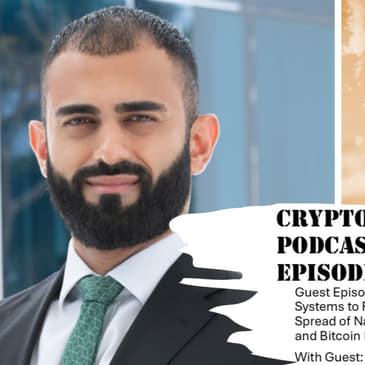

Mohamed El-Masri is a corporate finance expert with a focus on alternative investments and blockchain innovation, aims to reform socio-economic systems to facilitate the generation and spread of natural wealth via energy, finance, and technology.
With a varied educational background encompassing sociology, political science, and economics, he possesses multiple securities qualifications and certifications in corporate finance regulations. Driven by a passion for establishing a fairer future, Mohamed showcases how finance can be a catalyst for societal progress. Mr. El-Masri serves as the Founder of PermianChain Technologies, Director, Brox Equity Ltd., and is the Author of “Natural Gas and Blockchain” published by Canada’s Blockchain Research Institute (BRI) and included in Alex Tapscott’s recent book “Digital Asset Revolution.”
He is the Managing Partner of Hodler Investments, which is launching the first digital asset energy fund in DIFC UAE.
https://www.linkedin.com/in/mohamedelmasri/
[00:00:03] Hello, everybody, and welcome to the Crypto Hipster Podcast. This is your host, Jamil Hasan, the Crypto Hipster, where I interview founders, entrepreneurs, executives, thought leaders, amazing people all around the world of crypto and blockchain. And today I have another amazing guest. I'm looking forward to this interview. We have a lot of content to cover. So my guest today is Mohamed El-Masri. He is the managing director at Hodler and the founder of the Crypto Hipster Podcast.
[00:00:33] and CEO at Permian Chain. Mohamed, welcome to the show today.
[00:00:39] Yeah, thanks, Jamil. My pleasure.
[00:00:41] You're very welcome. So let's kick things off, and I'll ask you first. I ask everybody this, but I'm really intrigued. What is your background, and is it a logical background for what you're doing now?
[00:00:55] Maybe so. So my background, my academic background stems from like a political science and economics.
[00:01:05] So I minored in economics and majored in political science. So I did that for three years before kind of finding a new path into investment banking and finance.
[00:01:20] And so post getting all those prerequisites to get into the industry, I was more on the corporate finance, sell side advisory type of work.
[00:01:34] So, you know, eight or nine years later, I ventured into tokenization and real world assets tokenization because it just made perfect sense in corporate finance when you run private placements or when you structure investment products.
[00:01:52] You're pretty much securitizing assets. And it just it was the same concept, just running on more advanced technology.
[00:02:01] So digitizing the entire corporate finance practice resonated with me.
[00:02:07] So, yeah, to answer your question, it did make sense as I ventured into blockchain and then landed on Bitcoin mining as I was working more on the energy side.
[00:02:17] So I looked at the energy market from a corporate finance perspective.
[00:02:21] I used to get deals on my desk for, you know, private oil and gas plays, whether it may be in the Permian Basin or in Alberta, more in deregulated and private markets.
[00:02:33] So as I was working on these energy projects and learned more about challenges that oil and gas companies, upstream oil and gas companies face with their gas associated gas as they drill further oil or whatnot, I was able.
[00:02:50] It just resonated with me that there's so much wasted energy in this world.
[00:02:54] There's so much wasted resources that are not monetized for various reasons, maybe whether it's commercial or geopolitical or whatnot.
[00:03:04] And it just resonated because I was already entrenched in Bitcoin mining.
[00:03:08] It was just a perfect marriage for me.
[00:03:12] I've been working on that since 2018 and I've turned really passionate about the intersection between the digital economy and the energy sector.
[00:03:23] Interesting. Interesting.
[00:03:24] Interesting. So I want to find out both, you know, what Hodler and Permian Chain are all about, including your vision and your mission.
[00:03:33] Yeah. So, you know, I set up Hodler back in maybe 21 to really structure a vehicle or an entity that allows me to consolidate my thoughts.
[00:03:49] Right. And my efforts because I was all over the place working on energy, working on Bitcoin mining, working on natural resource tokenization projects.
[00:03:58] And I realized that there has to be a way to structure all that we're working on with the various partners and people that are involved in the ecosystem that I was a part of or that I was fortunate enough to organically build to consolidate all these efforts and have us all work as one force.
[00:04:21] So set up Hodler investments in Dubai in order to consolidate the efforts across the various ventures from energy to decentralized technology to tokenization to Bitcoin mining.
[00:04:36] So all these projects are now consolidated under Hodler investments.
[00:04:40] So Hodler investments is really a investment corporation that invests in these various sectors that we're right now active in.
[00:04:50] And really, our slogan is diamond hands for a brighter future.
[00:04:54] So, you know, we want to hold on to the assets or the projects that we're venturing into in order to make real impact.
[00:05:04] So ultimately, it's really all about impact investing and making a difference within the communities that we end up building projects in.
[00:05:15] Because a lot of these natural resources or a lot of these energy projects or the energy infrastructure projects that we seek to invest in that ultimately are built for the purpose of compute, whether it may be Bitcoin mining, edge AI applications or whatnot, end up to be in communities, right?
[00:05:33] Or marginal communities where there's a lot of idle or underutilized energy resources for various reasons.
[00:05:43] And mainly because there isn't any advanced infrastructure in those areas to bring this resource to market.
[00:05:50] And there won't be advanced resource, advanced infrastructure in those areas to bring this resource to market because the international community is not necessarily looking at these areas as core areas when it comes for business, right?
[00:06:05] So Hodler investments really has the essence in its word.
[00:06:10] Hodler comes, you know, from the Bitcoin community where it's good for hold on for dear life, right?
[00:06:16] So we are pro believers of, you know, not, we're not probably not max maximalists or maxis in the Bitcoin space, but we're pro Bitcoin.
[00:06:27] We believe in the fact that this is a digital asset that can revolutionize finance in the world of finance.
[00:06:36] But yeah, that's Hodler's mission is really to spearhead the investment within the energy infrastructure, Bitcoin mining, edge AI applications in order to ultimately serve the communities where these remote compute clusters are located.
[00:06:54] Got it. Interesting.
[00:06:55] So I want to get in, I want to get into some of these projects.
[00:07:01] You had a couple major news announcements though recently, right?
[00:07:05] So you recently announced plans for a digital energy infrastructure fund, right?
[00:07:14] So I'm interested to know how that will work and what your, what will be in your investment mandate and where, where's that going to serve?
[00:07:23] The digital energy infrastructure fund has been years in the making.
[00:07:27] It's been something that we had to really hone in on as we got closer to turning this into a serious application.
[00:07:38] So we are now in stages, in final stages of finalizing the establishment of that fund.
[00:07:44] And, you know, we're looking to establish this fund in Dubai and we will have parallel funds in different jurisdictions where we have sizable projects.
[00:07:56] And, you know, this fund is really focused on what it, what it is called digital energy infrastructure.
[00:08:04] So we invest in energy infrastructure that ultimately is going to be built to serve compute, compute clusters or compute requirements around the world.
[00:08:16] We're initially focused on Bitcoin mining as an immediate monetization solution for this energy, for these energy assets that the fund ultimately invests in.
[00:08:25] But also alongside Bitcoin mining applications, we will have AI or edge AI applications or remote AI applications that will be enabled on that infrastructure in order to serve the communities or the town or the local market where these projects are located on the AI as a service type of thing, right?
[00:08:49] And we're working with a company out of the US called Armada.
[00:08:54] And, you know, they're a very well backed company that manufactures these edge AI applications, these remote data center applications that are state of the art, really, and they're being applied in the US.
[00:09:10] But we're not working with them to, you know, implement this application within the projects that the fund will ultimately invest in or that Permian chain that will ultimately be participating.
[00:09:24] So the investment strategy is really focused on the entire energy to compute value chain and all of its verticals, whether and those verticals can fall into software, could fall into, you know, platforms, other digital solutions.
[00:09:40] So the fund will allocate some of its resources or capital commitments towards investing in startups that are seed or series A companies that are basically value add to the infrastructure and the data center part of the portfolio.
[00:10:05] Got it. There's a lot of opportunities in the verticals.
[00:10:08] It's massive.
[00:10:09] It's incredible what's happening today within the market.
[00:10:12] We're seeing the narrative from the, mainly from the energy sector has completely evolved and matured from where it was five years ago to understand that there could be a direct relationship and a direct marriage between the digital economy and the energy producers around the world.
[00:10:34] Right now, the power grids around the world cannot sustain the incredible amount of demand from the data center sector or even from the entire digital economy as it is.
[00:10:51] It is not going to slow down.
[00:10:53] It is not going to slow down.
[00:10:53] We will continue to accelerate technology development.
[00:10:56] We will continue to accelerate the development of AI, of blockchain, of quantum computing, of all these other types of solutions that would require more and more compute, which ultimately will require more and more energy.
[00:11:09] And the application of going, taking these new compute deployments on grid is no longer feasible, not from an economic, commercial, social, or even environmental perspective.
[00:11:26] So the only solution is, in my perspective, is to go off grid.
[00:11:31] And to go off grid means you have to go to the source, maybe hydro, solar, gas, whatever the source is, you have to go to the source and build your own infrastructure.
[00:11:41] And some of the publicly listed companies today that were predominantly Bitcoin mining publicly listed companies, whether they're on the NASDAQ or the Toronto Stock Exchange or whatnot, some of these companies, and I would say a handful of these companies, have already gotten the idea that they need to own their infrastructure in order to be able to scale and have reliable source of power to maintain their business moving forward.
[00:12:08] And some of them have done that.
[00:12:09] They've acquired their own power plants.
[00:12:19] Awesome.
[00:12:19] Awesome.
[00:12:21] Interesting.
[00:12:22] Off grid versus grid.
[00:12:24] Right?
[00:12:26] Yeah.
[00:12:26] There's challenges of both, right?
[00:12:29] Of course.
[00:12:29] There are challenges of both.
[00:12:31] And the thing is, natural gas is a reliable source of energy.
[00:12:36] So it is the go-to source for power, for electricity, right?
[00:12:40] Regardless of how much we hear about the energy transition from fossil fuels to greener or renewable sources of energy, that transition is, in my opinion, not practical enough today.
[00:12:58] It's the correct, it's the proper route.
[00:13:01] It's the appropriate way forward.
[00:13:03] But if we want to be realistic, it's not today's solution.
[00:13:07] It's a long-term, it's a gradual solution.
[00:13:10] It's a solution that we'll achieve gradually.
[00:13:12] So renewable energy is a gradual solution.
[00:13:16] An immediate solution is natural gas.
[00:13:18] There's an abundance of natural gas around the world that's flared in the atmosphere that could be captured.
[00:13:25] And theoretically or hypothetically speaking, the flare gas, we have like around 147 billion cubic meters of gas that's being flared annually.
[00:13:36] And converting that into a monetary sense is like $16 billion a year in annual revenue that's just being burnt into the atmosphere.
[00:13:46] And that's a hypothetical statement because probably you won't be able to capture all of this flare gas and actually make its composition compatible with power generation everywhere, right?
[00:14:00] So let's just say maybe 30, 40% of this gas could be captured and used for power.
[00:14:05] But ultimately, there's a lot of gas being flared.
[00:14:07] But in addition to that, think around 30%, 40% of the world's proven gas reserves are stranded, right?
[00:14:17] So which means there is no economic viability to produce it.
[00:14:21] So it stays in the ground and they shut in these gas wells, which end up become a liability for the producers that own them.
[00:14:29] So this is a liability that could be monetized to generate cash flow and ultimately increase net asset value, right?
[00:14:40] Not in addition to shareholder value, in addition to adding value to the community where these gas wells are located because then you have also royalties and taxes and government revenues.
[00:14:50] So it's a circular economy that you can create with energy resources that are stranded, wasted, or idle, or underutilized, and the digital economy that needs all of this power.
[00:15:03] And some components and some parts of the digital economy, you don't need 100% electricity 24-7, 365.
[00:15:11] So going off grid is not a major challenge as long as you can maintain 90-95% runtime on your Bitcoin mining operation, you're feasible, right?
[00:15:20] So, you know, all of this is, there's a lot more I can say about that, but there's a lot of energy in the world, especially on the natural gas side that could be used to better communities in those areas, especially with modern technology that exists today on the infrastructure side.
[00:15:40] It's fascinating.
[00:15:41] It's absolutely fascinating.
[00:15:42] Very cool.
[00:15:43] I'm sure we could talk about this for hours.
[00:15:46] Yeah.
[00:15:48] Yeah.
[00:15:49] Awesome.
[00:15:49] So I do want to get into another project that you guys are doing, though.
[00:15:56] You recently announced a strategic partnership with GCL Group.
[00:16:01] And how does that partnership accelerate your mission to build the decentralized distributed energy infrastructure in, I think it's Ethiopia, right?
[00:16:11] So we entered into a memorandum of understanding with GCL to build energy infrastructure, distributed energy infrastructure for compute.
[00:16:23] And that is something that, you know, is in motion and that we're working on with the team at GCL.
[00:16:32] So, but I'm not at liberty to disclose anything more than what was in the press release.
[00:16:38] However, it is a very strong partnership that would eventually, after going through the proper channels, have great impact for the country.
[00:16:51] I believe, sincerely.
[00:16:54] But, you know, we need to go through those channels and then be able to start executing on our project.
[00:17:03] Got it.
[00:17:04] Got it.
[00:17:04] And then you met.
[00:17:05] Every country right now, when it comes to this application, especially, you know, energy to power.
[00:17:11] Every country has its own regulatory frameworks, legislative frameworks, and, you know, certain ministries regulate certain sectors.
[00:17:23] So whether you're in Canada and Alberta, whether you're in Texas, whether you're in the GCC or any parts of the Middle East and Africa,
[00:17:31] every country has its own approach to how it regulates energy, how it regulates utilities, how it regulates data centers with the flow of data,
[00:17:42] which is very sensitive and could be an issue of national security.
[00:17:47] But now when you say about Bitcoin mining, you know, there are many different departments within every government that want to look at Bitcoin mining as this is our jurisdiction.
[00:18:00] Right.
[00:18:00] Right.
[00:18:01] Because if you look at it, Bitcoin mining, the central bank wants to say, the Ministry of Energy wants to say, the Ministry of Communication and Transportation wants to say,
[00:18:10] because within Bitcoin mining, all those sectors are relevant.
[00:18:15] Right.
[00:18:15] You cannot do Bitcoin mining without energy.
[00:18:17] You cannot do Bitcoin mining without telecom and communications.
[00:18:21] And Bitcoin itself as a decentralized currency has eyes on it from central banks all around the world.
[00:18:29] So you have to go through proper channels in every country where this framework doesn't exist yet.
[00:18:35] Not talking about Ethiopia specifically, but in countries where frameworks for Bitcoin mining is not yet implemented.
[00:18:41] There are these challenges.
[00:18:44] There are these challenges.
[00:18:44] And through HODLer, this is something that we pursue in every country, even though we don't have projects.
[00:18:51] Every country we have access to, we go and work with the relevant authorities and departments and channels to secure those licenses.
[00:19:03] How's your French speaking abilities?
[00:19:07] I speak French very well.
[00:19:10] Okay.
[00:19:11] Yeah.
[00:19:11] I ask you that because I, about a month ago, I went to the, I went to the UN, uh, to the, to the, the world, the, no, the world, the world bank summit in Washington, DC.
[00:19:21] And there was one event.
[00:19:24] Um, it was Africa energy 2030.
[00:19:27] Okay.
[00:19:29] The room is packed.
[00:19:30] I mean, absolutely packed.
[00:19:32] And you have bar ministers from six African nations in the front of the room.
[00:19:36] And they say, does anybody, and I'm in the middle of the room, I'm sandwiched in.
[00:19:40] Does anybody need a, um, uh, hearing like a translation, you know, headphones?
[00:19:45] And I'm like, I don't need that.
[00:19:47] Then they started speaking and they spoke in French.
[00:19:50] And I'm like, I don't understand a word of French.
[00:19:53] So, you know, I'm like your solution.
[00:19:56] And I'm looking at sub-Saharan Africa.
[00:19:59] How would your solution apply to the countries of sub-Saharan Africa?
[00:20:03] And how would they be able to get and head and be helped, you know, in this 2030 Africa energy initiative?
[00:20:12] Yeah.
[00:20:13] See, our, I won't say this is our solution because, um, I wouldn't be doing justice to many of our peers in the industry.
[00:20:22] Right.
[00:20:23] Uh, this is a, this is a solution that was developed over time by the industry.
[00:20:29] And we were just fortunate enough to be part of that growth and apply this early on and pioneer it, uh, in our own way.
[00:20:39] And I see this, the, uh, however, we adopted on top of this whole thing, the infrastructure side, the platform, Permian Chain, where we created a distributed energy market, right?
[00:20:51] Global distributed energy market for compute, right?
[00:20:55] And compute means Bitcoin mining, AI, whatever the case may be that compute that can be remote compute that can be on the edge compute.
[00:21:03] That doesn't require a hundred percent 24, seven, three 65 for runtime.
[00:21:07] So we made a market for this energy that is idle, that is underutilized, that is wasted, that is stranded in a sector that is looking for it in a sector that needs it.
[00:21:20] Currently, even though we're not a very large company or platform yet, we have no shortage of demand for power.
[00:21:27] We work with some of the largest Bitcoin mining companies in the world.
[00:21:32] We're working with sizable AI, um, end users, uh, whether it's research and development labs, whether it's universities, et cetera, that have a need for this energy source.
[00:21:41] So imagine that today, if you're, uh, a hydro dam that's shut in, in Tanzania, or whether you're a natural gas, um, uh, site, that's a non-core area for some of the large producers.
[00:21:57] So you've been, you're, that site is abandoned and somewhere in Africa or anywhere else in the world, you can't make a market for this gas unless you built the infrastructure.
[00:22:08] Well, we bring the market to you right on site where you can sell gas, you can sell power, you can sell energy on site, and it'll be consumed where it is being produced.
[00:22:20] You no longer have to transport this energy through, uh, expensive transportation lines that may or may not even be built due to geopolitical reasons.
[00:22:32] And you'll never be able to monetize this resource and that community in that area is forever energy poor.
[00:22:41] So our solution, I strongly believe over time, as it grows, as it accelerates, as it attracts more volume and, and more resources will reduce the spread of energy poverty.
[00:22:55] And we will be able to build energy infrastructure all over the world to service cloud-based solutions.
[00:23:01] Cause my data center could be in the middle of the Amazon and I can still be running my website.
[00:23:06] Right. So that, you know, hosting is, is a cloud thing, right?
[00:23:10] My Bitcoin mining container or setup could be anywhere in that is remote.
[00:23:16] And I'll still receive my Bitcoin to my wallet on my dashboard and track the performance of my computing.
[00:23:22] So I personally don't need to be there, but I can take the infrastructure there, consume the energy, monetize it and pay the bill.
[00:23:29] Right. So all of this, to answer your question, we were able to completely,
[00:23:36] revolutionize the way energy infrastructure is built and actually build equitable energy systems for those communities in those areas.
[00:23:49] Equitable energy systems. I'm, I'm pro that I like that.
[00:23:53] Um, a lot.
[00:23:55] So, um, great.
[00:23:57] Yeah. So you have another strategic alliance, right?
[00:24:00] It was with EHC investment, right?
[00:24:02] And you're looking to integrate data mining systems and support the creation of sovereign digital economies.
[00:24:09] There are, there are a lot of countries around the world that have sovereign digital economies and people don't realize it.
[00:24:14] Right.
[00:24:15] Um, so how do you, how, how do you help create those sovereign economies?
[00:24:20] And how do you see that happening at, at, at scale and around the world and giving people those equitable opportunities?
[00:24:28] The digital economy itself, uh, basically, um, I gotta say, uh, spearheaded or accelerated or even, you know, made it even more and more possible to be at liberty.
[00:24:40] Right. I mean, without, without the digital economy today, there's not much liberty in this world.
[00:24:45] Right.
[00:24:45] We're able to create our own companies in seconds.
[00:24:48] We're able to, you know, generate wealth from, you know, in ways never before possible.
[00:24:54] Right.
[00:24:55] Uh, so the digital economy provides liberty.
[00:24:58] Um, so, you know, yes, having a digital economy basically, um, uh, strengthens the potential and the possibility of a sovereign economy.
[00:25:12] Right.
[00:25:12] Of a sovereign, um, uh, sovereign country and, or maintaining that sovereignty.
[00:25:19] Right.
[00:25:19] A lot of these countries don't have the military might to maintain their sovereignty.
[00:25:25] Right.
[00:25:26] And the only way you're able to maintain your sovereignty in the digital economy is if you have the infrastructure to run it.
[00:25:33] And a lot of these countries that without even naming those countries, natural energy resources are in abundance and they're untapped.
[00:25:43] And this is right now we're living in a time where literally if you build it, they will come.
[00:25:51] This is the type of market we are in right now, especially in the data center industry, where as a whole, I would say, not just for the subsets of Bitcoin mining and AI.
[00:26:03] If you have the infrastructure, they will come.
[00:26:06] Now, the problem with data centers is traditional data centers.
[00:26:11] They cannot be just anywhere in the world because that there, there, there, there are global and international, uh, implications with data.
[00:26:22] Right.
[00:26:22] What kind of data you're processing, who you're processing from, how are you storing it, you know, cybersecurity, all data is, is, is, is, is a question of national security all the time.
[00:26:33] Right.
[00:26:33] So not anyone can build data centers depending in, in, in, in, uh, anywhere in the world and depending where they're from.
[00:26:43] Right.
[00:26:44] There's always issues between, you know, East and West or whatever the case may be.
[00:26:48] So you have to be careful how you build your data centers and who you serve.
[00:26:54] Um, but ultimately countries that have their own data centers for their own purpose to serve their local economies will be able to have data sovereignty because then their data is not stored somewhere in Ohio on Amazon server, which is not a bad thing, but it is not, it is not something that you control.
[00:27:18] Right.
[00:27:19] It is not under your jurisdiction.
[00:27:22] It is in a data center somewhere very far away.
[00:27:25] And the latency issue could be something that would not be, uh, uh, efficient for most of these economies or these countries that might need data with low latency requirements.
[00:27:36] So, and that's the thing with edge AI, for example.
[00:27:39] So you get data center at the edge, you know, where the data is needed and where the data is being produced or generated.
[00:27:46] And that just makes it faster and quicker to build AI applications.
[00:27:51] For example, if you have robots and humanoids and arms and robot dogs, they need access to that server, that GPU or that card to process every movement they make constantly.
[00:28:08] Right.
[00:28:09] So you, you're better off having that data closer to where this R and D program or this R and D lab is, is, is, is implemented versus having that data inferencing somewhere else in the world.
[00:28:21] Uh, so it all, for me, it all plays a role.
[00:28:24] Like I've, I've limited understanding with the way data is processed.
[00:28:28] I have limited understanding with the way traditional data centers work.
[00:28:32] Most of our work has been on the Bitcoin mining and energy side, but ultimately I see that there are limitations just by being in discussions with these countries.
[00:28:43] There are limitations in certain countries for them to build their own data center infrastructures because of, you know, global politics.
[00:28:53] And these countries will be able to build their own infrastructure.
[00:28:58] If they had, it'll be feasible if they had the offtake for it.
[00:29:02] Right.
[00:29:03] So now you get into a question where, you know, you're tapping into a market and you need to select your offtakers, uh, uh, wisely.
[00:29:12] Uh, so there are a lot of things that are better, better left on set, I guess.
[00:29:19] Yeah.
[00:29:20] Well, I'm looking at it from a retail person perspective and the question during the Christmas time, how, um, I order from Amazon and it shows up the next day, you know, their, their data centers to me are pretty efficient, but they're also the, they're also far more, you know, environmentally harmful than any Bitcoin miner.
[00:29:41] I mean, you know, the efficiency question is based on, you know, what, what are you using it for?
[00:29:46] Right.
[00:29:46] I mean, you e-commerce and, and, and, uh, uh, uh, you know, uh, uh, what's called, uh, you know, shipping and, and, and, uh, logistics, you know, I guess that's a standard, uh, e-commerce, uh, part of the standard process of an e-commerce value chain or supply chain.
[00:30:07] Uh, and, and that won't be a major issue in terms of efficiency of, of, of processing data.
[00:30:13] It's, it's all fairly instant on the internet, but I'm talking as, as, as, as the digital economy becomes more advanced and modern and AI continues to accelerate and nothing that we consume in terms of technology is going to be run without AI.
[00:30:30] As we proceed, even our phones today, they have some AI functionality on them as they make recommendations, suggestions, and et cetera, and notifications come.
[00:30:40] But, you know, as this happens, these countries that don't have the infrastructure will not be able to advance their economies and they will continue to fall back decades or years compared to more, uh, developed economies where AI infrastructure or data center infrastructure exists because the energy was built to service it.
[00:31:09] Got it.
[00:31:10] Got it.
[00:31:11] So those countries are going to have to end up, those countries are going to have to end up being a little more innovative, right?
[00:31:18] So what are some.
[00:31:19] We're going to have to end up accelerating energy infrastructure development and doing so in a way, because a lot of those countries are set back by their own regulatory frameworks or the lack thereof.
[00:31:34] Right.
[00:31:35] Right.
[00:31:35] And a lot of those countries need to be proactive in how they allow foreign investors to come in and build energy infrastructure to service local compute requirements.
[00:31:51] So we're building not only the energy economy, we're also building the creativity economy.
[00:31:56] Definitely.
[00:31:58] You're going to have to, you know, more of the innovation side of things cannot be executed upon if there is no compute to support building.
[00:32:09] Yeah, I agree.
[00:32:11] I'm just wondering, we're going to have Bitcoin data centers and Web3 data centers that are better than the Web2 data centers, whether that's ever going to happen.
[00:32:20] Yeah, that's the thing with Web3.
[00:32:24] Web3 is a whole, I mean, it's energy consumption is negligible compared to Bitcoin mining specifically.
[00:32:34] And Bitcoin mining for me is really the infrastructure you're building to serve the future of money, right?
[00:32:42] Or the future of money that is going to be a bridge between fiat government-backed currency and the digital economy that will, as we progress, I see users of the digital economy, which is ultimately a large percentage of the world, will continue to prefer instantaneous digital currency that is decentralized.
[00:33:10] And as Bitcoin becomes less of a store of value and more of what it was built for, a P2P transaction system, this software called Bitcoin, which is actually a payment system software, will end up requiring all of this infrastructure to maintain its integrity, legitimacy, and security.
[00:33:37] And that's, I think, what the Bitcoin mining companies are building all over the world is to support the network, to support the infrastructure, so that in the future we have the infrastructure there to maintain the integrity and the security of the network.
[00:33:54] That's really all over the world.
[00:34:05] That's really all over the world.
[00:34:31] That's easy.
[00:34:33] How can people find out more information about you, about your companies, about what you do, what you're up to? How can they do that?
[00:34:39] Yeah, I mean, look, the best way to find out about what we're up to is to visit our website, hoddlerinvest.com.
[00:34:47] And I'm fairly active on LinkedIn, or passively active, but everything is fairly updated, so.
[00:34:55] Awesome. Awesome. Thank you very much for your time today.
[00:34:58] Thanks, Jermit. My pleasure.