
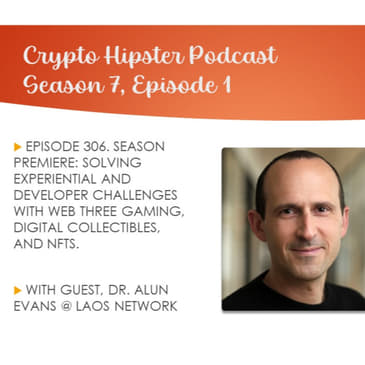

Dr Alun Evans, Co-Founder of LAOS Network
With over 20 years of experience leading and designing games and tech companies, Alun is well-versed in creating innovative products that tackle experiential and developer challenges. In addition to his stewardship of LAOS Network, he is CEO and Co-Founder of the company building LAOS, Freeverse, which focuses on building scalable blockchain infrastructure. His history as the co-founder of ‘Barcelona World Race - THE GAME’, a cutting-edge video game enabling virtual participation in real-world events, and his wider passion for gaming, have fed into his vision for LAOS Network as a solution for Web3 game developers. Alun also led Shar3d.io, a pioneering company enabling collaborative 3D web applications, and served as CTO of Bodypal.com, a virtual garment services company. He holds a Ph.D. in Medical Physics from University College London.
[00:00:00] Hello everybody and welcome to the Crypto Hipster podcast. This is your host Jamil Hasan,
[00:00:06] the Crypto Hipster where I bring you founders entrepreneurs executives thought leaders,
[00:00:12] you name it across the world of crypto and blockchain and today I have another amazing
[00:00:17] guest. I always have amazing guests and I always learn new things. My guest today is
[00:00:22] the CEO and co-founder of Lao Network. His name is Alun Evans. Alun, welcome. Hi thank you.
[00:00:29] Thank you very much for having me yeah. Very welcome. Pleasure to have you here. So let's
[00:00:35] kick things off and the first question is I always ask everybody is you know what is your background
[00:00:40] and is it a logical background for what you're doing now? It's a good first question. Yeah a nice
[00:00:46] one to lead with. So yeah my name is Alun I'm from the UK originally many many years ago I
[00:00:54] did my PhD in physics in medical physics and what interested me of that work was actually 3D stuff
[00:01:01] so 3D graphics. I was doing a lot of work with 3D graphics and the physics of that and that led me
[00:01:07] to sort of turn my attention to the video game industry and things like that and maybe about 15
[00:01:12] years ago I moved from my home country of the UK to to Barcelona and Spain and there I met a
[00:01:22] gentleman called Tony Mateos who's one of the co-founders of the Lao Network and we became friends
[00:01:29] and we were colleagues working his specialties is audio in particular originally and the physics
[00:01:34] of audio and we started working together and you know we worked together for a few years and then
[00:01:39] we went to separate ways we found some companies I made a video game or two Tony actually went
[00:01:45] away and founded a company called ImSound which is data required by Dolby and that technology
[00:01:51] that he created then became what's known as Dolby Atmos right which is the 3D audio for cinemas
[00:01:57] and beyond now which he's just actually won an Oscar for just last week so he's quite excited about
[00:02:02] that and then in about 2018 Tony sent me a ping and said I had this great idea and when somebody
[00:02:13] with 30 patents to his name comes at you with the good idea you tend to accept the coffee
[00:02:18] so I sat down and Tony told me that he fell in love with the blockchain and I had to hold my hands up
[00:02:23] and said that at that time I of course had heard of the blockchain but I wasn't really you know
[00:02:27] I knew more or less how it worked but I wasn't super engaged with it at the time
[00:02:35] but the more Tony explained the possibilities behind what you could do with blockchain technology
[00:02:39] the more I realized that this really is like felt like the internet was before it became big
[00:02:47] you know in the mid to late 90s and I thought wow this is going to be this is something that could
[00:02:52] actually really change how society deals with the concept of what we own digitally and so at that
[00:03:01] time I was just coming out of another startup that I founded again in the 3D world, 3D graphics
[00:03:07] worlds and so I turned my attention to to blockchain and fell in love with this concept of
[00:03:13] of digital ownership in particular what it means to own something digital so in 2019 we founded a
[00:03:19] company called Freeverse and Freeverse was initially a games company that was my initial sort of
[00:03:28] road into it, it was a gaming company and we thought wouldn't it be cool if you could have a game
[00:03:33] where you could trade the assets of your game so you know it might be a free-to-play game
[00:03:39] where you buy things with micro transactions but instead of just buying these things and holding
[00:03:43] them and maybe trading them for soft currency or in-game currency wouldn't it be cool if you could
[00:03:47] actually buy and sell those things with real money and we actually went away and built that game
[00:03:52] and it was a moderate success it did quite well but again in the technology we developed to make
[00:03:57] that possible we realized that actually it would be more interesting if we could open that up to
[00:04:01] other game developers and other brands who were interested in engaging with digital ownership generally
[00:04:07] so Freeverse is a company we pivoted from being a games company to being more of a
[00:04:13] I guess a platform we created our own layer where we created a specialized layer 2 that was very
[00:04:19] focused on digital ownership and we created a whole platform and API for that to work
[00:04:24] and about a year ago we realized that there would be perhaps we'd fit better in with what the
[00:04:30] market wants if we drop down a layer and focused solely on becoming infrastructure
[00:04:35] and so over a year ago now we started working on what's now become Laos Network
[00:04:40] and yeah the Laos Network is again it's an infrastructure blockchain focused on very much
[00:04:46] with digital ownership and more importantly connectivity with other blockchains
[00:04:50] and that's where we are right now that's the story so far as it were
[00:04:55] sounds good so you know I travel a little bit in Southeast Asia everybody called the country
[00:05:03] Laos they call it Laos right so I'm for now we're gonna be coming around Laos it doesn't
[00:05:10] it's not the country but it's a company you know or network so what is it all about
[00:05:17] how do you help game developers create dynamic assets across any EVM chain
[00:05:25] yes so just on the on the name to start off with there is no affiliation between Laos Network
[00:05:31] and the Laos Foundation in Switzerland with the country it's a purely coincidental name
[00:05:38] funnily enough Laos came about the original name Laos came about because
[00:05:45] what free versus previous layer two so the company that's building Laos is free
[00:05:49] thus right even though Laos is an independent foundation
[00:05:52] free versus previous product was a layer two and it very much focused on dynamic NFTs right
[00:05:56] so NFTs that could evolve and change based on how they are used which makes a lot of sense
[00:06:01] particularly in the gaming field but also in other fields and we at the time called dynamic
[00:06:07] NFTs living assets because they had a life and they could evolve and change and so the original
[00:06:13] plan for Laos when we were the working title for Laos is the layer one that we're launching
[00:06:18] in the next few weeks was the living assets open system right but however
[00:06:27] Laos now does a lot more than just dynamic NFTs we've kind of ditched that it's not an acronym
[00:06:33] it's a abbreviation we kind of ditched that now but when we were thinking of a new name for the chain
[00:06:39] we couldn't really come up with a better one than Laos it sounds like a venture and interesting
[00:06:44] stuff right so there is you know the link with the country is purely incidental
[00:06:48] and yeah so Laos the vision of Laos is to have is to really drive interoperability between chains
[00:06:55] yeah so one thing we noticed was that even during the bear market in the last couple of years
[00:07:02] around about 20% of transactions on Ethereum and Polygon were minting transactions people
[00:07:08] that were minting assets like mostly ERC 71s but also ERC 11505s and things like that
[00:07:15] and they are paying a lot of gas you know if you're creating many many tokens in Ethereum
[00:07:20] you're paying tens of thousands of equivalent of dollars equivalent in gas and even in Polygon
[00:07:26] which obviously scales Ethereum you're still you know if you want to mint many tokens then the
[00:07:31] the gas fees are very high and we thought wouldn't it be cool if you could create a system that would
[00:07:36] essentially enable offloading that minting cost away from those mature chains while still
[00:07:45] maintaining the ownership and the trading and the staking and the lending and the sending of all
[00:07:51] those assets in the existing chains what we don't want to do is is in inverted commas
[00:07:58] steel transactions away from those mature chains we just want to help them offload their minting costs
[00:08:05] and then maintain the ownership so the trading still happens so the gas fees are still being
[00:08:10] paid in ETH for example of trading but the actual minting of the assets happens on Laos so
[00:08:18] the technology we developed essentially a way of connecting multiple chains stably focused on
[00:08:25] the concepts of minting assets and offloading those minting costs onto Laos which because it's
[00:08:31] focused on one thing and one thing only does it much much faster and much cheaper and therefore if
[00:08:36] you're a builder who wants to create many assets whether it's in a video game or whether real
[00:08:42] world assets or whether you want to create an NFT collection for example and you don't want to
[00:08:46] pay those high gas costs but you want to stay in that mature ecosystem you want to have your assets
[00:08:50] in open sea or rarerable whatever other marketplace you use you can do that and you can essentially
[00:08:57] offload those minting costs onto Laos and that was kind of a vision we have with Laos and as an
[00:09:02] addition we have the dynamic NFT still in there as well so you know the living assets component
[00:09:06] to still let us have certain extent I keep seeing Ethereum people on Twitter X say the blobs are coming
[00:09:18] which means there's some kind of upgrade called dencune or delcune or something this week
[00:09:24] is that going to impact you at all sure I mean the thank you much it's great and I think
[00:09:31] it is going to have some impact on gas costs on Ethereum and that's wonderful because they're
[00:09:36] ridiculous right now they're frankly ridiculous the gas costs and don't forget we are still
[00:09:41] technically coming out of a bear market we're not even entering the bull market again I really worry
[00:09:45] to think what the gas cost will be on Ethereum when we go into a full bear market we've seen now Bitcoin
[00:09:52] hitting a new record just today right many many other token prices are going up very quickly
[00:09:59] and so that's only going to make things more expensive so I absolutely think it's a great
[00:10:04] thing that we're going to have the Dencune upgrade and Ethereum is going to get cheaper I think
[00:10:10] it's great that we have all these layer twos that are accelerating Ethereum in general with whatever
[00:10:16] technology we're using whether it's Rolex whether it's zero knowledge whatever it is I think they're
[00:10:21] all great and I want them all to succeed and I want Laos to be helping them you know further reduce
[00:10:28] the costs for builders and for users and because ultimately it comes down to that because even if
[00:10:32] Ethereum harves in price or a quarter is in price if you want to mint 10,000 assets on Ethereum
[00:10:38] you're going to pay a lot of money to do so right and I think that's where Laos comes in
[00:10:43] awesome so I want to find out so your focus may well you know one of your focuses is with
[00:10:51] three gaming right I want to find out you know the the current lay in the land and then the future
[00:10:58] role of real world as a tokenization in the web three gaming world so let's let's separate
[00:11:08] gaming and real asset tokenization so I think that's two really super interesting use cases
[00:11:13] in the gaming world you know our vision when we founded three years ago was this vision of
[00:11:22] allowing gamers to buy and sell assets for real money amongst themselves and we now let's
[00:11:28] say we now have a technology for that to happen what's happened is a lot of the initial many
[00:11:36] of the initial use cases for that technology have been essentially speculative in nature so we had
[00:11:43] the NFT boom over a couple of years ago the NFE boom was mostly driven by speculation people buying
[00:11:51] in but it comes rare items with the intention of selling them on later on and that spilled over into
[00:11:58] the gaming world and a lot of people were planning on building that speculation into the gaming
[00:12:05] world but it turns out the gamers don't want to speculate they don't want to manage their portfolio
[00:12:09] they want to have fun and play a game right and as a result the gaming world has as terms you know in
[00:12:16] general very strongly against blockchain NFTs for very understandable reasons what I would say though
[00:12:24] is that there are many advantages to using that technology if you separate speculation away from
[00:12:31] it if you for example tell a gamer who has invested many many hours and many dollars in a particular
[00:12:38] game that they could sell certain assets and somehow recuperate some of those dollars
[00:12:43] and in fact reward the time and investment they put into that game rather than just because
[00:12:49] they've collected something rare then I think most would be interested likewise if you
[00:12:55] um
[00:12:57] told us the gamer if they could take one asset from one game and use it a different one a completely
[00:13:02] different one that's imagine you have a um a football player and a football game and you could
[00:13:06] suddenly import that football player into a basketball game um then they probably
[00:13:11] interested in doing that as well right and uh so those kind of use cases are enabled by a web
[00:13:17] three technology and I think those are the use cases that the web three gaming community needs to
[00:13:23] really turn towards in order to drive the adoption you present the positive use cases to the gaming
[00:13:30] community in a way that makes sense to them for what they want to do so I think in terms of gaming
[00:13:36] that's probably where where we need to move to we need to move away from speculation and more towards
[00:13:41] real world utility or let me say the real worlds are wrong words more towards utility and then to
[00:13:47] the second part of your question about real world asset tokenization uh I think there's a huge
[00:13:52] potential market here I think during the if we are at the beginning of a of a bull market um there
[00:13:58] there is the potential that many many things will be tokenized and if you think about it a lot of
[00:14:05] there are many categories of real world things that make sense to appear on the blockchain right
[00:14:12] just taking an example at random you have invoices right when I issue you an invoice or you
[00:14:18] issue me an invoice for work done doesn't have to be on the blockchain it's just a bit of paper that's
[00:14:22] or a PDF that sent by email but does it make sense to have a permanent record so that you can prove
[00:14:28] that that invoice has been sent well yes it does right because then no one can argue the fact
[00:14:33] that invoice has been sent if I pay that invoice does it make sense that uh there is a permanent
[00:14:39] record of the fact that I have paid the invoice and you have accepted it yes it does because in
[00:14:42] a court of law if anyone has any doubt about it they can go and look at the blockchains transactions
[00:14:47] and it's and it's the proof right and so whether it's invoices whether it's certificates whether
[00:14:52] it's um bills of lady in the shipping industry uh whether it's music rights um all of these things I
[00:14:58] think they don't have to be on the blockchain but there are many benefits from them being being
[00:15:02] tokenized on the blockchain and so I think one of the the the blocks to that use case those use
[00:15:09] cases being developed is the fact that you're not going to min an invoice on the theorem because
[00:15:13] you're holding a hundred dollars to do so right if it's more than the value of the invoice
[00:15:17] but if it costs you a few cents to do so then it may be it makes sense that you do you do do that
[00:15:22] right so I think in the real world asset space so far we've just seen very high value assets being
[00:15:30] tokenized such as real estate there's quite a lot of movement in real estate recently and we haven't
[00:15:36] yet seen so much um movements into tokenization of less high value items such as for example
[00:15:43] invoices um but the reason we haven't seen that is because it's been too expensive and that's
[00:15:49] those two years in separate separately you know gaming and minting at scale and games
[00:15:53] and also real world assets and minting at scale for for assets that need to have many many
[00:16:00] or need to be very numerous in their in their scale those are the two use cases that allow us
[00:16:04] focusing on. To the magic word there that want to dive into a little bit further you said speculation
[00:16:13] the also gamers are against blockchain or like knowing that they're you know it's interesting because
[00:16:19] in order to advance and to move forward we have to add new functionality right to existing NFTs
[00:16:25] in game collectible assets for both the content perspective and from a technology perspective right
[00:16:33] so how do you how do you do that? How do you add um that you know evolution of technology to both
[00:16:40] NFTs and in game collectibles? I think what you have to do is remove the word collectibles right
[00:16:48] collectibles inherently suggest rarity and scarcity and those two words lead almost inevitably
[00:17:00] to speculation and market speculation and those are the things that the traditional gamer
[00:17:06] is not particularly so interested in and I'm not that's not just my opinion that's just a truth
[00:17:10] that we've seen with the general backlash that the gaming community has had towards the NFT
[00:17:16] market so far. And as I said that I do understand that backlash in the sense that gamers don't
[00:17:22] want to be worried about how valuable their collectibles are they want to be playing the game.
[00:17:27] So an alternative use case there is to remove the word collectibles and just call them
[00:17:34] trade of assets right so let's have a concrete use case. In the game that we actually
[00:17:41] developed five years ago in 2019 it was a sports management game um it was a football game
[00:17:48] football in the European sense of the word run the American sense of the word right so soccer for
[00:17:53] our for our American friends and when you started the game you were given a team of 18 players
[00:18:00] and those are the players you used and you managed them and you you you played in matches against
[00:18:06] other users as a multiplayer game and what you didn't realize when you logged into the game is that
[00:18:12] those 18 players on your team were actually NFTs they were all NFTs and you never realized until
[00:18:19] the opportunity presented itself that you could actually trade them to other people right
[00:18:24] and you could trade them for real money not for in-game currency but for something that had a value
[00:18:28] and so that to me makes that example is an example of the use case that's beyond collectibles
[00:18:36] and scarcity because what you could do with your players is train them and make them fitter
[00:18:41] and faster and score more goals and make more tackles and run further and so on and it get injured
[00:18:46] less often so by training them you are improving them and therefore the value that they were they
[00:18:51] had on the marketplace was not based on how rare they were or how collectible they were it was
[00:18:58] based on how well you had played the game and so that's you're inverting completely the motivation
[00:19:05] for trading those assets and wanting to buy those assets you're turning it from being a reward
[00:19:10] for NFTs as opposed to a simple rush to grab a collectible when it comes out
[00:19:16] I like it I like the concept you know I wish I could do that for some of the baseball and football
[00:19:25] game like you know we have we have my kids play that play sometimes that would be pretty cool
[00:19:32] the other the other thing you know I want to I want to stay on that speculation
[00:19:38] before I want to get into inscriptions but before I do that I want to talk about speculation
[00:19:43] further you said we're headed into a bull market right now right and
[00:19:47] essentially I said maybe we might be at the beginning simple when I said yeah we might be I think so too
[00:19:54] but what I see is I see a lot of speculation I see a lot of so many meme coins they have no utility
[00:20:00] right but do they have utility like are you are you securing the underlying network by buying that
[00:20:07] and then so you know what's where's the value at and what's the potential to be able to turn these
[00:20:12] meme coins that have no utility utility and the something that could have utility
[00:20:20] so in any market you're you're going to have speculation in one way or another probably
[00:20:28] maybe not 100% certain but it probably and even in the example I mentioned earlier on
[00:20:34] where the value of the token is based on how it's being used even then there is going to be an
[00:20:40] element of speculation whether it's a small element but it still might be an element of speculation
[00:20:45] and the crypto market of course is traditionally has been full of speculation in fact you could
[00:20:51] argue that the majority of the crypto markets not there's not the blockchain market but the crypto
[00:20:56] market in particular is based on speculation and why do people start a meme coin where it's to make
[00:21:02] money through speculation ultimately right is there a potential for a meme coin to become useful
[00:21:08] in the future well if you can use that meme coin as a currency somewhere else then perhaps
[00:21:13] there is but I think we'd all agree that people aren't starting meme coins for them to become
[00:21:19] general currencies you can buy your groceries with they're starting meme coins because they want
[00:21:24] the value to go up and and to make money out of it which is fine which is fine speculation is going
[00:21:29] to happen especially it's going to exist and also I think collectibility will happen right you
[00:21:34] know we talk about digital collectibles when and you're frequently we forget about the fact that
[00:21:41] people collect things in the real world as well right people collect stamps and trading cards
[00:21:48] and guitars and cars and all that stuff in the real world and there is speculation on the price
[00:21:53] of those two right so it's just that in the crypto or in the digital world it's perhaps slightly
[00:21:57] easier to to create a rare collection of things than it is in the real world but that the people
[00:22:05] do like to speculate and trade and collect things so I don't think even though we've seen
[00:22:10] and we're perhaps at the start of bull run as you said and even though there is going more speculation
[00:22:17] I don't think it's it's going to go away but neither do I think it's the end goal for blockchain
[00:22:22] technology as a whole and that's something that I very firmly believe in the blockchain
[00:22:28] is and should be much more than just speculation
[00:22:34] I agree with you we're in the same boat here it's great yeah so let's let me ask you let's move
[00:22:40] to inscriptions then the good the bad and the ugly you know what are the good and the bad
[00:22:45] of the ugly of inscriptions and why is it bridging less minting a better alternative
[00:22:49] so let's talk about what inscriptions really are first to make sure that we all understand
[00:22:56] so an inscription is a way of putting adding some data in the call data of a transaction
[00:23:03] so any transaction can had to optionally have some some text if you like added to it
[00:23:08] and that text community you want and an inscription is essentially a way of you writing some text
[00:23:15] that has some meaning and you create a sender transaction to yourself or it could be
[00:23:19] to anybody else but you need to use it to yourself and then that's transaction the text of that
[00:23:24] transaction appears on the blockchain great wonderful the good thing about that is that you are not
[00:23:31] actually minting a new assets on the blockchain you're creating a transaction kind of a null transaction
[00:23:38] but the the data that you want appears in that transaction therefore appears on chain
[00:23:44] and so people can see it and doing that is much much cheaper than minting an asset right so if
[00:23:51] you want to mint a traditional traditional entity as I said on Ethereum it's going to cost you
[00:23:54] $100 right to interact with the ERC 71 smart contracts whereas with an inscription it's much
[00:23:59] much cheaper because you're just writing a simple transaction and you're storing that data
[00:24:05] so that's great so inscriptions are good in that sense what's bad about inscriptions is that
[00:24:12] the ownership of the thing that you have minted is not verified on chain and in fact the the chain
[00:24:18] doesn't know really anything about what you've minted in fact to actually understand
[00:24:26] that the inscription itself you have to rely on what are called indexes so completely off chain
[00:24:33] servers or entities if you like who are reading the transactions that are being created
[00:24:40] and are indexing them and making them available on some third-party websites right so I mean
[00:24:46] technically anyone who goes and reads all the transactions can recreate the state of whatever
[00:24:51] token is being minted but you know 99% of people have not more rely on these off chain indexes
[00:24:57] right and and you know and it relies on those indexes following the rules that have been set out
[00:25:02] in terms of the structure or whatever text you put there and so I feel that as much as you know
[00:25:07] in inscriptions have been great at reducing costs for minting assets and inverted commas to me
[00:25:16] they also feel like a bit of a step backwards because the whole purpose of Ethereum and the Ethereum
[00:25:21] virtual machine it was designed to have smart contract logic and inscriptions move all that
[00:25:27] computation off the chain right so a smart contract cannot interact with that inscription
[00:25:33] and so it feels to me like a bit of a step backwards and so that's the bad side of it right
[00:25:38] and the ugly side of it is that because people have been spamming inscriptions
[00:25:41] it's almost highlighted the need for better scalable solutions because if you spam inscriptions
[00:25:48] you're actually you're congesting the network I think I'm right in saying that Arbitram was taken
[00:25:56] down because of inscriptions avalanche wasn't taken down but went very very slow for a while
[00:26:03] zks sink went very slow for a while even polygon was quite heavily affected by as well and so
[00:26:07] by all these people trying to mint inscriptions very quickly you're almost highlighting one of the
[00:26:13] problems which is what's led to them being created which is that these chains can't actually handle
[00:26:18] the volume of traffic that's required so what we're going to do with from Laos is to say well okay
[00:26:26] when it be called instead of having inscriptions you could actually mince an asset on the chain
[00:26:29] that can interact with smart contract logic and is can be validated the ownership can be validated
[00:26:36] you're not relying on some third party some third party website that you've never heard of perhaps
[00:26:40] or you don't know you can't be sure that it's following the protocol correctly you can't be
[00:26:44] sure that's really the inscription data curriculum you know just kind of trusting and the whole
[00:26:48] point about blockchain is that it's trust less so with Laos network what we're doing is
[00:26:54] we come up with this solution called bridalist minting and so what bridalist minting means is that
[00:26:59] you you essentially mint an NFT or an asset on Ethereum or another EVM chain and it's actually
[00:27:06] potentially any other chain you like and that asset point to an equivalent asset in Laos right
[00:27:14] so essentially what you've done is you've not spent any gas on Ethereum to mint that asset you
[00:27:20] only spent gas in Laos tokens which as I've said because Laos is very focused on one thing it's not
[00:27:26] trying to be ever all things to everybody it's focused on minting of assets it means it's very
[00:27:31] fast at doing that and it means it's very cheap at doing that and so you've paid you know
[00:27:35] cents in less than cents the fractions of cents to mint your token and yet that asset appears
[00:27:42] on Ethereum because the smart contract that it's linked to is on Ethereum deployed on Ethereum
[00:27:47] anyone can read that smart contract the asset appears on OpenC natively it can appear on any
[00:27:52] marketplace you want the trading happens in ETH or if it's on Polygon it happens in MATIC
[00:27:57] or if it's on whatever other chain it is it happens on the native token of that chain and so
[00:28:02] everything regarding the ownership of that token happens in the existing the maturity system
[00:28:09] the only thing happens away from that is the minting of that asset and we've done that in a very clever
[00:28:13] pattern we call it a bridalist pattern and if you want to find out how to see it then I do
[00:28:18] urge them to go to our YouTube channel get the YouTube and search Laos network you'll find a
[00:28:22] couple of very easy to understand videos of the technological way that we've managed to link these two
[00:28:29] things see I completely understand that because I used to I was an I was an efficiency guy
[00:28:38] developer at you know in SQL shop so I would take out of the code and put it into mapping tables
[00:28:45] and have things read really quickly and so I get that as I think it's a great idea I love to see it
[00:28:51] you know um let's see people thinking officially. Funnily enough we're in TestNet right now and you
[00:28:56] can actually go and try it out so if you go to our webpage laosnetwork.io and you follow the link
[00:29:03] to try bridalist minting you can actually go right now and you can mint an asset on Ethereum
[00:29:08] in the public collection we have on Ethereum because we're in TestNet we'll we'll sling some
[00:29:12] test tokens to you from the four sets and you can mint thousands of assets on Ethereum
[00:29:17] and they'll appear in OpenSea and you can trade them and you can do whatever you want so
[00:29:21] you know obviously we're in TestNet so these assets have no value right now they'll probably be
[00:29:25] deleted right but when we go live that exact same functionality will transfer as a main net that
[00:29:31] will happen probably in in May this year we're going to main net I would imagine and so
[00:29:39] but exactly the same technology exactly the same flow will happen there and in fact many members
[00:29:44] of our community have been minting some really beautiful assets that have been put for sale
[00:29:49] or not put for sale sorry they've been they've been minted they appear on OpenSea and you can see
[00:29:53] them and yeah it's great to see that people are beginning to engage with that technology already
[00:29:59] I think I want to have to take you up on that so thank you so we talked about
[00:30:07] talked about gamers we talked about speculators right let's talk about developers right so
[00:30:15] what remains some of the developer challenges in the collectible slash gaming slash NFC web
[00:30:21] 3 space you know how what what challenges remain how can they be solved
[00:30:29] that's a good question and it's a very wide question because as a developer
[00:30:36] there are many challenges depend most because there are people who develop blockchain applications
[00:30:42] right decentralized applications but all of those applications need to have some sort of purpose
[00:30:47] right and it's true that many daps so far have been finance based apps whether to do with
[00:30:51] exchanging of tokens or staking or things like that right which is great and I think now we're
[00:30:57] beginning to see a lot more daps that are targeting other areas we're seeing we're seeing games
[00:31:04] right we're seeing apps that are coming into ownership whether it's in the metaverse or digital
[00:31:10] ownership things like that but I think one thing we're going to see a lot more of is rather than
[00:31:16] developers creating a decentralized application I think we're going to see more and more
[00:31:23] developers from other fields looking to integrate some form of decentralized practice and some
[00:31:29] decentralized integration within their existing applications where there are games or
[00:31:35] whether their social media networks or whether there whatever software is a service or which
[00:31:41] there are millions of different services in the world whether they're actual
[00:31:47] applications you burn your phone or your computer for whatever purpose I think we're going to see
[00:31:52] many many more of those dipping their toe into the water to try and get the benefits of
[00:31:58] blockchain immutability you know verified a digital ownership of real goods digital identity
[00:32:04] I think that's quite a big one of the future as well decentralized identity and the challenges for them
[00:32:09] is that they know nothing about blockchain development right it's you know and blockchain
[00:32:13] development is its own worlds right it's a completely separate thing so I think we're going to see
[00:32:17] a lot a big rise of we are already seeing a big rise of companies that are offering you know APIs
[00:32:23] and SDKs that offer a sort of smoother way in for those developers in fact of the last network
[00:32:29] we were already partnering with a few of those few such APIs and SDKs which will announce on launch
[00:32:36] which help game developers and other developers make it easier to integrate with
[00:32:39] Laos and blockchain technology in general and then the final thing that I think it's worth mentioning
[00:32:44] from a developer point of view is the user experience of of engaging with blockchain those of us who
[00:32:51] are familiar with the blockchain and the crypto space think nothing of opening up Metamask or talisman
[00:32:58] or whatever or you know or our ledger plugging our ledger and doing whatever we want it's it's
[00:33:02] it comes a second nature to us and signing transactions but the majority of the people who have no
[00:33:10] experience of blockchain and digital verified ownership let's say don't know what a wallet is
[00:33:15] right and so how would you make that soft intro to people and I think as less of a developer
[00:33:22] problem it's more of a user experience problem but I do think it's a it's a major issue
[00:33:27] how we get over that and how we as a community we managed to convey the importance of
[00:33:33] not your keys and not your wallet and all that kind of going on your keys and they're going
[00:33:35] sorry and things like this so I think that's one of the major challenges that we've been facing
[00:33:39] in the next few years but I think a lot of people are working on it a lot of kind of people
[00:33:43] are working on it and so I think we'll I think we'll get that sounds good I hope so
[00:33:50] so you said I don't know back a little bit something said said we shouldn't call them
[00:33:56] digital collectibles anymore we should try to call them tradable assets right but you you also
[00:34:03] you created I think it was a blogger or or wrote something regarding important rules
[00:34:11] for for those tradable assets going forward what are some of those important rules that we
[00:34:16] should follow well I think we should separate between you know the distinguish between
[00:34:23] tradable assets and digital collectibles collectibles so collectibles are tradable that's true
[00:34:29] but not necessarily every tradable assets should be necessarily collectible yeah um think for
[00:34:35] example going back to my example of the football player right uh just because that football player
[00:34:39] is tradable they might not be collectible in fact uh give them that in that particular example we
[00:34:45] were gifting 18 new players tradable assets to every new new user of the game um inherently they
[00:34:53] weren't collectible because to start off with because there were just so many of them right so you're
[00:34:57] separating from that the ability to trade an asset separates it from um the fact that it's
[00:35:03] a collectible or not uh I think in when it comes to sort of setting out ground rules you need to be
[00:35:10] very careful you know you need to make sure you're avoiding um falling into traps that have
[00:35:19] lagged other games and other applications in the past that have enabled real world trading
[00:35:26] and so a very good use case here is to go back a decade or so how long ago it was uh to when
[00:35:34] Blizzard launched um real world trading in Diablo 3 and they they did so without thinking through
[00:35:42] the ramifications initially um and they and what happened was is that uh basically the game got
[00:35:49] taken over by farmers right so people would come in they would try and farm as many assets as
[00:35:53] possible um to try and sell those legally to uh players of the game in real players of the game
[00:36:01] and what that meant is that you essentially the game was taken over by by people farming
[00:36:06] and not enough by people playing having fun right and so you know these things like avoiding um uh farming
[00:36:13] you need to avoid an outflow of your economy as well you want to make sure that there is enough
[00:36:18] influx of money into the economy so that it doesn't um that is not dwarfed by the outflow of money
[00:36:24] in your economy otherwise the value of economy is going to disappear very quickly as well and so
[00:36:29] you know there are a couple of rules actually at free vs a couple years ago we published a white
[00:36:33] paper that um that sort of explained a few of those rules about how the game developer in particular
[00:36:38] you could make sure that you are um you are avoiding those traps that have that we we we know
[00:36:46] exist if you don't go in the right direction and that's all to do with basically trying to um you
[00:36:52] want to avoid again going back to what we talked earlier on you want to avoid speculation right
[00:36:56] you want to avoid people speculating you want people to be buying and selling and the value of the
[00:37:01] assets to be based on the effort that the person has made with that assets rather than just the how rare it is.
[00:37:11] Thanks sounds to me um sounds good so um i want to thank you very much for your time today this
[00:37:19] I really enjoyed speaking with you and time flew by so appreciate it um I have one last question
[00:37:25] for you it's probably easy the easiest one how can um how can people find out more information about
[00:37:31] the last network about you how can they get involved um how can they participate in joining a community
[00:37:38] how can they use your technology any that. So thank you yes so please go and to Twitter and
[00:37:45] follow us on loud at loud network or on words our community is growing crazy at the moment
[00:37:52] you know just a few weeks ago we had 200 followers on Twitter now we have you know tens of thousands
[00:37:57] which is great our discord is very similar it's very active you can go and uh if you and you
[00:38:02] can find all those links to do that if you go to a website loudsnetwork.io you can find all the links
[00:38:08] there and not only join our community and and participate in our in upcoming token launch which
[00:38:13] will be happening probably in May so we're very excited about that um but furthermore you can also
[00:38:18] follow the main button on that page to try out bridgeless minting and you can mint an asset on a
[00:38:24] theorem of polygon without paying any eath or magic um and that asset will appear on open sea
[00:38:30] and you can you can see it there and you can do whatever you want with it you can import it into your
[00:38:33] meta-masking stuff and um we'll have quite a lot of interesting partnerships coming up so if you
[00:38:38] do follow us there you'll be to see how loud is being used and how is generating value and uh and
[00:38:45] how the token is being used to generate utility which is the most important thing for us
[00:38:50] awesome thank you very much for your time today thank you i've really enjoyed it i appreciate it