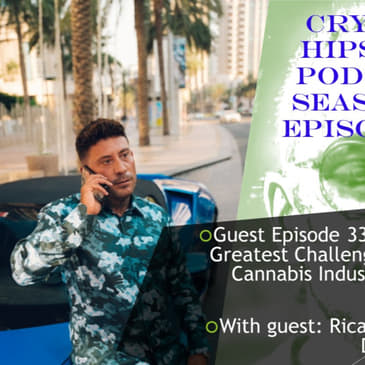

Ricardo Capone is Chief Technical Officer at Dr. Green NFT. Ricardo has a diverse and dynamic professional background and leads the company vision by implementing the technologies needed to bring Dr Green to the world. His work experience spans various industries and roles, including management positions and technical expertise in web and graphic design, VOIP technologies, networking, and infrastructure. His skills in coding, CRM development, and IT applications are particularly noteworthy. Ricardo has a passion for the cannabis industry and seeks to be a leader in the revolution for legalizing the use of cannabis on the global stage.
The Dr. Green website is: https://drgreennft.com/
[00:00:00] Hello everybody and welcome to the Crypto Hipster podcast. This is your host, Jamil Hasan, the Crypto Hipster, where I bring you founders, entrepreneurs, executives, thought leaders, artists, you name it across the world of crypto and blockchain. And today, I'm really looking forward to this interview and you should too. I have an amazing guest and a very intriguing project. My guest name is Ricardo Caponi. He is the Chief Technology Officer
[00:00:30] of Dr. Green NFT. Ricardo, welcome. Hey Jamil, thank you. Great introduction there. Appreciate it. You're very welcome. I'm looking forward to this so much. Now, sometimes I talk about sustainability and sometimes talk about NFTs and this is a mix of both. So let me ask you first, what is your background? And is it a logical background for what you are doing now?
[00:00:54] Well, I guess I started off many years ago tinkering. I think I've had an interest in technology since the Commodore 64, which was pretty much my first piece of kit. I put the old cassette tapes in there and record my programming. And I self taught myself. So I didn't go through any university or anything like that to get educated in this field. But I played around with some Python scripts and HTML over the years and built websites and even different VoIP technologies.
[00:01:24] Or as you mentioned, your database background, SQL applications. Having a lot of fun with that kind of stuff and just tinkering and enjoying. But it's turned out to be quite a fruitful career for me. And learning with something that you enjoy means that you never really have to work, right? So that was great.
[00:01:43] Got it. Yeah, I would like if you do it as if you do it as my late great uncle told me, if you do what you love, it's a vocation. And if you do what you hate, it's surgery.
[00:02:01] Yeah, that makes sense. And, you know, as much as I'm a glutton for punishment, because I'm sure you'll understand from the database background that it can be, it can have its challenges, it can have its moments. I absolutely thrive off what I do. And I've been given a great opportunity with this cannabis company to make real change in the world through some of the technology and the applications that they've allowed me to develop.
[00:02:29] They've given me a huge budget for my firm, for my department, should I say. And we have utilized some pretty interesting things that I will tell you about as we get into it. Yeah, some technology that's pretty mind blowing.
[00:02:42] Let's talk about it. Let's talk about Dr. Green NFT. What's that all about? It's your company, a trailblazer.
[00:02:48] Well, look, we're, we're coming from the medical cannabis background. So we focused heavily on biotech. And to give you an idea for a few key pieces of technology that we've been utilizing, and it will give give the answers to where we go in and what makes us a trailblazer, I guess.
[00:03:04] The technology that we focused on for the last couple of years has been human DNA analysis and genomics sequencing. So we cross information about a particular human's ailments. So if a guy's got epilepsy, for example, 120 seizures a day, he's struggling, we'll take a swab of his mouth, we'll analyze the DNA, and then we will cross reference his particular problems with our genomics library.
[00:03:23] And we'll be able to see from our digital library of strains of cannabis, what different parts of which of the plants would best suit this particular person. And you know, everybody's different Jamil, right? You might have, you might have a deficiency of 2% CBG in your brain and I might have a deficiency of 18.
[00:03:40] And you know, perhaps I will develop Parkinson's and not be able to regulate my central nervous system. And you might have, you know, not many problems at all. So everybody's different. And what this DNA analysis allows us to do is pinpoint exactly the treatment with the cannabinoids and with the different components of the body.
[00:04:00] So we focused on that unique kind of technology. And then what we do is we grow a plant specifically for the person. So if it has, if the readings from that, and the algorithm spits out that you know, I've analyzed you Jamil and you have this particular disease, you know, the problem is that we don't have any data to help us solve this person's problem.
[00:04:17] And then what we do is we grow a plant specifically for the person. So if it has, if the readings from that and the algorithm spits out that you know, I've analyzed you Jamil and you have this particular problem and we need a plant A, plant B and plant C, for example, in order to treat you.
[00:04:36] We would cross breed those strains and then end up with just one plant and provide you with that plant medicine. So it's very tailored, very bespoke cannabis treatments for the individuals and it allowed us to have great success over the last few years in our technology sector.
[00:04:52] But to kind of touch on the Dr. Green side of it and where we go in with the future tech, we wanted to break into the recreational market because medical cannabis for us is we're heading towards a ceiling.
[00:05:06] There are only so many government bodies around the world or medical industries that you can provide your plants for right? And we pretty much got all of those major contracts in the bag.
[00:05:16] So no new customers for us unless of course there's a pandemic of, you know, cancer patients rising or whatever, which is not a good way to base your business on hoping that more people get sick.
[00:05:28] You know, we're not a pharmaceutical company in that sense that we want people to be ill. So we wanted to expand our business but without kind of preying on the downfall of a population.
[00:05:39] So we looked at the recreational market because it makes up 95% of all cannabis transactions around the world. So it is a huge market for us to break into 200 billion euro market.
[00:05:51] So we didn't want to just enter the recreational field as any other cannabis company. Let's face it, there are a lot of weed companies out there who grow for recreation who have really nice cannabis.
[00:06:03] There's, you know, if you're going to enter a market like that, you have to become a leader and you have to enter with something special. So we took our technology and we asked the questions.
[00:06:12] Okay, how can we utilize our current medical tech to increase efficiency or safety in the recreational field? And more importantly, what is the biggest problem with recreational cannabis?
[00:06:25] So I think Jamil if you can solve a problem in any industry, then you can become a leader in that field. So that's the route we went and we started asking different government bodies, regulatory authorities around the world.
[00:06:39] What is, you know, what is the problem with weed in your country? And we found that the most common answer Jamil was something called spoofing. Are you familiar with spoofing? Do you know what that is when it's related to cannabis?
[00:06:51] No, I'd like to know.
[00:06:53] Okay, so simply put, it's where black market cannabis enters the legal supply chain. So for example, you have a regulated firm, they have legal packaging for their weed, and then they cook corners and they go and buy cannabis that was grown in Dave's attic or from, you know, a Mexican cartel.
[00:07:13] And they bring that weed into the States or in Europe up from Morocco, you know, it's very, very common hashish from Morocco ends up in all of the European states where cannabis is legal, but it's illegally grown weed.
[00:07:25] And the problem is with that is when you purchase legal cannabis, you expect it to be regulated. So no nasty pesticides on the plant, good chemicals that have been pumped through it, no weird, so you get kind of steroids for plants to make them grow big buds and crystals.
[00:07:43] And it's not natural. You want to make sure that that's not in it, you know, the money trail needs to be legal to so taxes being paid. It's not funding modern day slavery, you know that we know that the people who are being paid from a legal transaction that, you know, their employees of a firm that there's a big difference between illegal and legal weed.
[00:08:06] And so the problem for the regulators is there's no way for them to tell if cannabis has been spoofed or not. So the illegal weed has got fiberglass in it to make it heavier in some cases and in the United States as a huge endemic at the moment of people putting fentanyl on the cannabis to get people high.
[00:08:29] So they say it's terrible quality weed and they put a drug on it to get people high or there's something called sprinkles where it's like flavorings tiramisu or red velvet cake. And these kind of things are not good for human consumption.
[00:08:42] So from a regulator standpoint, there's no way to tackle it because well, once it's in the bag, it's just a plant in a bag. So how do you know where that plant came from? It's like basically impossible to trace.
[00:08:56] So just going back to our genomic sequencing machine for a moment, we decided to look a little bit more in depth at the individual seeds that we'd been sequencing. We noticed that every single one of them, even if they're from the same mother plant has a very slightly different genetic code, which I guess is common sense.
[00:09:16] We see it in humans all the time. A mother and a father can have two boys, even twin boys, and they might look identical, but their DNA is going to be different. We can separate them. Same thing with the seeds.
[00:09:29] You might have an amnesia haze or something and you take the seeds from the mother and the sibling seeds are different too. We can see that with our genetic sequencing.
[00:09:38] And from that, it allows us to fingerprint, create a QR code for that seed and that QR code will follow the seed throughout its life cycle in our factory. So from the nursery to mothering rooms, flowering rooms, drying, trimming, packaging areas all the way through to the end customer.
[00:09:56] They can scan the QR code on the packet and they can see, okay, where did this weed come from? What journey did it take to get to me?
[00:10:03] Not only that, all of the data stream out of our factory too. So how much water was used to grow the plant? What chemicals were pumped through it? What humidity was it grown at or lights? How long were the lights on for?
[00:10:15] How many humans have handled that weed or what percentage of nitrogen is in the packaging? Literally all of the data stream from our factory goes into this software.
[00:10:24] And from there, we're able to now provide a full traceability and accountability for the cannabis that enters into the marketplace.
[00:10:34] And if a regulator wants to check, they can now take that weed out of the bag, send it to the lab and make sure that it matches the packaging.
[00:10:42] And that way we're able to end or potentially end spoofing if we can make this a regulatory framework. So that's kind of where we go in and what we're trying to do with the trailblazer stuff.
[00:10:55] End spoofing. I like it. I like it.
[00:10:59] I want to go back to something you said.
[00:11:03] There are opportunities, I believe, for further advancement of medicine.
[00:11:10] You said that I might be healthy. Okay, I'm not.
[00:11:14] I've been doing podcasts and now for three and a quarter years the whole time I've had cancer.
[00:11:18] I do it as a way to get over the cancer. My cancer is not metastatic, but my DNA changed.
[00:11:29] And that happens. That's a random thing that happened.
[00:11:34] So with your recreational weed, when you're creating these NFTs, these doctorate NFTs, how do you do it?
[00:11:44] And do you use randomizers to create unique solutions based on people's needs?
[00:11:49] And if they're not medicinal needs, say they want to do a recreational needs, do you mix and match using your NFT technology to cater to people's specific or desirable needs?
[00:12:07] Well, no. Well, the unique selling point of tailor making the medicines was pretty much for a medical side of the company.
[00:12:17] But with the new Dr. Green stuff, the way the NFT came about was I took this software that we developed and I took it to the regulator in Portugal, Infamed, the government body who regulate all scheduled drugs in Portugal.
[00:12:31] I spoke with them about the ideas and the plans for tracing and anti spoofing. And they shot some holes in my software.
[00:12:38] So first of all, you're a software engineer, Ricardo, you can alter the data. Right.
[00:12:43] So essentially the answer to that is yes, I built it so I can change it. And that means I'm susceptible to corruption.
[00:12:50] So they can't make it a regulatory framework if it can be corrupted.
[00:12:53] Beyond that, you know, they were like, what sort of servers are you using? And, you know, just Apache servers from GoDaddy is not what they wanted to hear.
[00:13:03] They're like, you know, these servers can be hacked. You know, so there's a risk there as well of the data being altered.
[00:13:10] So they sort of sent us back to the drawing board and I sat with the CEO and we discussed on how we can bulletproof this system.
[00:13:17] And that's when we came up with blockchain technology.
[00:13:20] We looked at creating a decentralized app on the Ethereum blockchain and utilizing smart contracts to pull all of that data from the factory, directly upload that on chain with the details about the genomics as well of each plant so that the information becomes decentralized.
[00:13:38] We can't change it. It can't be hacked. And that's when we took it back to the regulator as blockchain technology and they were like, OK, great.
[00:13:45] You're onto something here. Portugal has a very close connection with Bitcoin and Ethereum.
[00:13:51] So they have regulatory frameworks for Bitcoin and Ethereum in their country.
[00:13:56] They stated that if I used an ERC 721 token or an ERC 1155 token, they would be happy for me to to proceed and pilot this project for the next three years.
[00:14:08] If I can show them a proof of concept over three years that it works, they'll look to make it a regulation in Portugal that companies have to track and trace on the blockchain in this way.
[00:14:17] So very interesting because, you know, a 721 is an NFT, right?
[00:14:22] And what that allowed us to do, Jamil, was to put our cannabis license in the background of the NFT and solve probably the second largest problem with cannabis after spoofing, which is the saleability of cannabis.
[00:14:37] It's not very accessible for an average person to sell cannabis if they have an interest in that field.
[00:14:43] It's very expensive to go and get your licensing, to be regulated, to build your facility, to then grow and get your stability right and then distribution.
[00:14:52] You know, you're looking tens of millions of dollars to get that kind of business off the ground.
[00:14:57] It's just not accessible to your small entrepreneur who's got an interest in weed.
[00:15:02] And most of the people with an interest in weed are small entrepreneurs. They're not these mega whales, right?
[00:15:09] So this allows us to then sell this NFT. The NFT essentially is a digital access token or digital certificate that allows you to trade cannabis around the world as long as you don't touch the product.
[00:15:24] It's completely above board. So that gave us the opportunity to build a drop shipping platform.
[00:15:31] So essentially the Amazon of weed. If you want to think of it like that, you can have all these different strains around the world traced on our block chain so that we're being responsible.
[00:15:41] We know where it's all coming from, where it's all going.
[00:15:44] And then all of the transactions can be handled by the small entrepreneur who's got his NFT, who logs into our decentralized platform and creates cannabis orders for his customers.
[00:15:53] And we do all of the compliance stuff. We do the regulatory stuff. We do the import, the export.
[00:15:58] We deliver the cannabis directly to the client within 24 hours in any country where cannabis is legal.
[00:16:04] And then the NFT holder receives his commission or his payout for dealing with the transaction in Ethereum.
[00:16:14] It's a smart contract that just converts the profit to Ethereum and deposits it into the wallet that's holding the NFT.
[00:16:21] So you can then build your business, build your NFT, build your client base. All the clients stay with the NFT.
[00:16:28] So if you then wanted to go and prove your track history, your sale history, it's all on the block chain.
[00:16:34] You've then got a business that you can go and sell. And that NFT comes with all the customer base that's been built up around it.
[00:16:40] So if you sell your NFT on the secondary market like OpenSea, for example, the person who buys your NFT also acquires all of your customers,
[00:16:48] which as they complete, as they keep repeat ordering, the profit gets converted to Ethereum and deposited into the wallet holding the NFT.
[00:16:56] So it has long term profitability as well.
[00:16:59] Interesting. So you your NFTs aren't just JPEGs, right? They aren't just master.
[00:17:11] It seems like you have a CRM with them.
[00:17:15] It's exactly a CRM. So you have when you upload your customer, I mean, I'm still pretty much designing it right now.
[00:17:26] But if you wanted a sneak peek, it's something that I could share my screen with you and show you in a short while where it's at.
[00:17:35] You upload your customer, your customer gets verified by our in-house compliance team, and then they fall into your sales pipeline.
[00:17:42] So you then are able to move them through your pipeline, keep all of your notes very much like a CRM system on the customer.
[00:17:49] And you see a product catalog based on their geolocation.
[00:17:54] So wherever your customer is, let's say they're in California, you will see all the strains that are available to that customer in California.
[00:18:00] If they're in the Netherlands, you'll see all the strains available in the Netherlands and so on and so forth.
[00:18:05] So when you select your customer from the CRM, it will then show you a strain library of everything that's available to be delivered within 24 hours to that customer.
[00:18:14] And you could just manually create those orders on the system or plug in with an API key and build yourself a front end flashy Shopify style store that then plugs in and allows your customers to upload their own data and their own KYC.
[00:18:28] And you basically go do the marketing for it like any drop shipping platform.
[00:18:36] I wish you could show me maybe you could show me after the podcast.
[00:18:41] Yeah, I was thinking we're audio right?
[00:18:44] One of the benefits, maybe sometime I can do a video podcast.
[00:18:50] So let me think about this.
[00:18:53] So if I'm looking at like crypto punks and I'm looking at board apes and I'm looking at the early NNTs and NNTs would benefit the owner being part of community.
[00:19:03] The difference here is that if somebody buys your NFT, they now can build a business, you know, based on the product that you have to offer.
[00:19:12] Right. And community is really important for us as well.
[00:19:16] So the way that the marketplace that we've created works is we have these characters, the NFT characters themselves are absolutely stunning.
[00:19:25] They were drawn.
[00:19:29] I don't know if I can reveal that yet.
[00:19:31] I don't know if I can reveal who drew them yet, but a very famous artist drew them.
[00:19:35] I'll reveal that later on.
[00:19:37] And instead of doing characters with traits, he put 5000 completely unique characters together.
[00:19:46] So each one is unique as a piece unique.
[00:19:50] And those 5000 characters come from 20 different planets.
[00:19:55] So they have a backstory about a planet that they come from.
[00:19:58] And we've designed these 3D graphical planets that look amazing.
[00:20:03] And that's how the marketplace works.
[00:20:05] You go into the NFT universe, as to say, and you choose your NFT by planet.
[00:20:11] And each planet has its own subset of strains that natively grow on that world.
[00:20:16] So you'll have a look and you'll go, OK, I recognize this group of strains as being popular in my location.
[00:20:22] So I'll buy my NFT from this world and then you'll be able to trade those strains.
[00:20:27] But what that allows us to do is create this sort of community sentiment where if I've got, you know,
[00:20:35] strains on planet A, Jamil, and you've got the strains on planet B,
[00:20:39] and a customer of mine is interested in planet B strains, well, there are three ways that I can make that happen.
[00:20:45] First of all, I can be a capitalist.
[00:20:47] I can just go and buy NFT from planet B also and not have to speak with anybody.
[00:20:53] I can just add those strains to my product catalogue.
[00:20:58] That's the first way. The second way, it's not so fun.
[00:21:02] The second way is diplomacy.
[00:21:04] So I can come into the community groups like the Discord or the Telegram, the sections in there for joined forces.
[00:21:11] I can be like, hey guys, Jamil, I see you have planet B.
[00:21:14] My customers really want your strains.
[00:21:17] Would you like to do a profit share? Like let's form an alliance.
[00:21:19] OK, great. We agree a split, you know, 80-20, 70-30, whatever it is.
[00:21:26] We agree. I jump on my platform.
[00:21:28] I put your wallet address in doing a profit share with Jamil.
[00:21:32] 70-30 if my customers buy strains from your world, you know, you get 30 percent.
[00:21:38] You get 70 percent of the profit. Great.
[00:21:40] And then a smart contract is created on the blockchain.
[00:21:43] So we don't need to rely on each other to honor our word.
[00:21:47] The smart contract will take a customer that's registered to my NFT.
[00:21:51] If I order cannabis that's on your planet and it's registered with your wallet,
[00:21:55] it would just do that profit share automatically for us.
[00:21:58] So we can earn money together and build that community.
[00:22:02] And then the third way, naturally we're humans, right?
[00:22:06] The third way is war. So we can go to war for it.
[00:22:09] And what I mean by that is we're developing a mobile game app that's like an RPG
[00:22:14] where you see your character in the game, you've got the planets in the game,
[00:22:17] and I can build my small army and come and attack your planet.
[00:22:21] And if I win the battle, then I get access to your strains for one month on your world.
[00:22:27] But if I lose the battle, I just can't fight you again for another week.
[00:22:30] So nobody actually loses anything in the game financially.
[00:22:34] We've only got stuff to gain. However, to win and lose wars in a game,
[00:22:39] you need stronger and weaker characters.
[00:22:41] So what we've done is we've pulled in the metadata from the blockchain,
[00:22:45] from the actual NFTs. So your character in the game,
[00:22:48] the strength is determined by three factors.
[00:22:51] One is how many customers do you have?
[00:22:54] Two is how many transactions have you made?
[00:22:57] And three is what revenue has gone through your NFT?
[00:23:00] And those three factors will determine if you're a strong character or a weak character,
[00:23:04] it will change your EXP in the game as you build your business.
[00:23:07] So if you find that you're playing this game and you're getting frustrated
[00:23:10] because you're losing all the battles, go sell some weed and come back and play again.
[00:23:15] You might win access to the other planets.
[00:23:18] So it's a way of making it fun, keeping people engaged on the platform
[00:23:22] and things like that as well.
[00:23:23] So we didn't want to just make it all serious and about money.
[00:23:27] So we wanted to keep that community spirit and also education through those communities as well.
[00:23:33] It's really important for us.
[00:23:35] I'm kind of blown away.
[00:23:39] You're taking the NFTs at an S level, you know, and I want to get into that.
[00:23:44] I want to talk about something else.
[00:23:48] So first, you said the two greatest challenges to me about, you know,
[00:23:55] in the cannabis industry are spoofing and sellability.
[00:24:00] What are the other challenges, some of the top other challenges you're focused on solving as well?
[00:24:06] Yeah, so actually those two challenges are pretty much our primary focus.
[00:24:10] And I think it's important for any business to not bite off more than they can chew.
[00:24:15] So when it comes to solving these issues,
[00:24:19] we have a long way to go to make the regulatory framework so that spoofing can be stopped around the world.
[00:24:26] And if we're able to do that,
[00:24:31] we're going to need a huge community of people trading our cannabis to pull in the data.
[00:24:36] So actually, they're quite complementary to each other for solving each other's problem because
[00:24:42] A, in order to stop spoofing, most of the cannabis in circulation needs to have been genomic sequenced.
[00:24:49] Right. So that we can prove where it came from.
[00:24:53] And two, it has to be flooding the market in every area possible.
[00:24:59] So by launching 5000 of these NFTs and giving entrepreneurs all around the world who are interested in cannabis trade a platform
[00:25:07] where they can sell weed on this blockchain, we're actually data gathering.
[00:25:14] So we're able to then utilize all of those people who are making all of those transactions around the world.
[00:25:20] And we can collect that data.
[00:25:22] And then once we've got three years of that data, we can go to the Portuguese regulator.
[00:25:26] We can show them that we've had a proof of concept and give them the figures, change the regulatory framework in Portugal,
[00:25:34] which will then, as Portugal is a leader in the European field for cannabis, right?
[00:25:38] Portugal has the most cannabis companies, 1500 in total.
[00:25:42] I mean, completely dwarfs the second in line, which I think is South Africa after, well, yes, South Africa is not Europe,
[00:25:50] but South Africa is after Portugal.
[00:25:52] I think they have somewhere like 800 cannabis companies.
[00:25:58] But with regard to the regulatory framework, if we can change that in Portugal,
[00:26:03] then we have a leeway to go and lobby the European Union to change it in Europe too.
[00:26:09] And if we are able to then take an entire continent onto this platform and be responsible in that way,
[00:26:15] well, then maybe we can enact some change on the world.
[00:26:17] But, you know, we're talking five, 10 year plans.
[00:26:20] And if we get sidetracked trying to solve all the other little problems,
[00:26:24] I mean, the other little problems are so minuscule when it comes to weed.
[00:26:28] Quantities available, strains availability of information.
[00:26:34] I guess education is probably the third biggest factor because it's kind of taboo in lots of places.
[00:26:43] There's not a lot of education for it.
[00:26:45] We teamed up with a lady called Chloe Valano.
[00:26:49] She is an American lady over there in the States, California and Colorado primarily.
[00:26:55] She owns Cloverleaf University.
[00:26:58] It's the first recognized school by the Higher Education Board of the United States.
[00:27:02] They teach a curriculum all about cannabis economics, the medicinal side of it.
[00:27:08] So I think she has somewhere like 3000 students at a time.
[00:27:13] And we have partnered with her in order to be able to bring education to the platform
[00:27:18] because we don't just want people out there selling weed.
[00:27:21] We want them to get a diploma for it, to learn about it.
[00:27:24] You know, if they're going to legalize themselves and they're going to get a certificate for their continued education,
[00:27:31] then we're really changing the game for these people and allowing the entrepreneur to be proud of his business,
[00:27:39] be proud of his education background and help squash that stigma around cannabis because there is still a lot of it in the world.
[00:27:47] There is. There is. I think we've come a long way though.
[00:27:54] I had a friend I grew up with in school.
[00:27:58] He was early into trying to sell marijuana and he's still paying for it.
[00:28:03] He's still paying for it. So many years, many years later, you know, so
[00:28:08] and you have a solution here where you told me already you have you have a CRM, you have gaming, you have NFT.
[00:28:15] And when the NFT market took a hit last few years, people thought that entities would just become digital receipts.
[00:28:23] And you have actually built something here that is unique.
[00:28:28] The combination of those three I haven't heard of before.
[00:28:32] You've also built a digital certificate, right?
[00:28:38] How like then you say, you know, we still have a problem with the with the fentanyl, right?
[00:28:47] How what's your vision to completely revolutionize the the cannabis industry so we don't have these issues like that?
[00:28:55] Yeah, I mean, what I would like to think is that if we can show enough data to to our local regulator,
[00:29:01] that this is the best way to track and trace weed around the world and hold people accountable.
[00:29:08] Whereas there's never been any accountability before, right?
[00:29:10] If if a company spoofs their weed, they get away with it because there's no way to prove it or anything like that.
[00:29:15] But I'm not interested in stopping the small time dealer who wants to sell some weed to support his family.
[00:29:22] That's not somebody who I'm interested in taking out.
[00:29:24] But these guys who report themselves to be legitimate firms, you know, if my grandma goes for her Parkinson's medication and ends up with some fentanyl laced bird or, you know,
[00:29:37] if my son traveling through the Netherlands with his pals when he's a teenager decides to smoke a joint from a shop in Amsterdam,
[00:29:44] I would like to think that they can get his hands on some clean, pure product rather than something that's been tampered with.
[00:29:50] And, you know, don't don't dress like a pastor in the day and then go hit a strip club at night.
[00:29:56] It's not there's something wrong with it.
[00:29:58] If you're pretending to be a good guy, you know, if you were purporting yourself to be a regulated firm, then you should be exactly that.
[00:30:05] And you should be held accountable if you're caught in corners that risk human health.
[00:30:10] Right. So with this product, I think that we can eventually with enough uptake and enough data,
[00:30:18] convince governments around the world to utilize blockchain technology for tracking and tracing.
[00:30:23] It would be a pleasure if it was our technology that was utilized.
[00:30:26] Obviously, I'd make some good money from licensing.
[00:30:30] So that, you know, being able to prove to a country that there is a better way and there is a responsible way to hold people accountable.
[00:30:41] That for me is is the win.
[00:30:43] And then we can we can spread that throughout every place where cannabis is leaked.
[00:30:47] Why wouldn't you want why wouldn't you want that kind of traceability?
[00:30:51] I mean, even with if I could trace water like that, I would prefer to go in a shop.
[00:30:57] You know, you see a bottle of branded water or a clear bottle with a with a QR code on it.
[00:31:04] You know, rather than trusting your evidence of the world or whatever to do a good job,
[00:31:08] I would like to be able to scan a QR code and see what spring my water came from on what date,
[00:31:12] what temperature has been stored out, what chemicals it's been treated with, you know, this kind of data stream.
[00:31:18] We live in the, you know, this century right now where data is everything.
[00:31:23] Data is so much and it's accessible.
[00:31:25] So if we can decentralize this data and make sure that it's also reliable,
[00:31:30] we could apply this technology to anything.
[00:31:33] You can apply this to olives or tomatoes.
[00:31:36] Where did your where did your tomatoes come from?
[00:31:39] Scan the QR code and see how long have they been in transit.
[00:31:42] You know, make sure they're not genetically modified in any way.
[00:31:45] What chemicals have gone into that?
[00:31:47] And I think responsible eating and consumption over the next decade is going to become it already is a pretty big thing.
[00:31:57] You go to the supermarkets, they have the healthy food section kind of makes you wonder what the rest of the food is in there.
[00:32:03] Right. But you have to have a section for the healthy foods.
[00:32:08] But if we're able to apply data to that, that we can rely on, you know,
[00:32:13] not we're not relying on the company to tell us the history of their product,
[00:32:17] but more importantly, like a block chain where it's not centralized.
[00:32:21] Then I think we can we can really start to make changes in the way that we all eat and consume medicines or food.
[00:32:29] And for me, there's a much bigger picture here than just the cannabis.
[00:32:32] It just so happens to me that we've developed this technology with weed.
[00:32:36] I like it because you said tomatoes and olives.
[00:32:42] And, you know, I remember looking in 2017 and 18, IBM was making a big push for people using hyper ledger.
[00:32:52] I don't hear so much about hyper ledger, even though it's a viable and people use it product.
[00:32:57] And they were tracking everything from cradle to grave.
[00:33:03] Right. In a life cycle.
[00:33:06] And nobody cared. Right.
[00:33:09] Because it was centralized. Right.
[00:33:11] Yeah. People care because you're you're building, you know, on decentralized rails. Right.
[00:33:18] How do you think this being sustainable for the future?
[00:33:22] And how do you how do you see it as getting that interest that they never got?
[00:33:28] That's a really good question.
[00:33:29] And I think that sustainability comes from evidence.
[00:33:33] And if you can show that this solves the world problems that we're talking about, I mean, really show it.
[00:33:41] If we can see a decline in the figures of spoofed weed, if we can see a decline in the hospital cases and these places where we launch our weed that is traced,
[00:33:55] if we can see the statistics of the user data, people who are actually utilizing it, how many times a day is you are these QR codes being scanned?
[00:34:05] Right. If we find that two or three people a day scan the QR code, well, then it shows that it doesn't work.
[00:34:12] Right. But if you if we find that there are thousands of people scanning our QR codes every day to read the information, well, then that shows interest in and care about what people are actually consuming.
[00:34:24] So for us, the sustainability is going to come from the data and the data is right now what we need to launch and start collecting, which we plan to launch on June the 15th with this product.
[00:34:35] So that was my next question about your roadmap.
[00:34:39] Yeah. Yeah. Thank you.
[00:34:42] Jumped ahead there.
[00:34:45] So 2015 so you're in launch entities as well then?
[00:34:48] Yeah. So the marketplace will launch on June the 15th, which will allow people to start purchasing the NFTs.
[00:34:56] Beyond that we'll do around six weeks of education for all those people who come on board.
[00:35:01] So everything from learning how to use the platform and having webinars and seminars with our celebrities who are all involved.
[00:35:10] And our strain developers and our geneticists and our scientists talking about the project, the products.
[00:35:18] We will do a big drive to teach people on how to use it.
[00:35:23] And then we will start dropping into different countries around the world, the actual cannabis ready to be delivered.
[00:35:30] So we'll do a phased launch throughout July, August, September, October, November.
[00:35:39] By December we'll be available in every country where cannabis is legal.
[00:35:43] But each month we will just add different countries, different regions.
[00:35:47] Depending on the uptake and where most of the NFTs get sold, we can be very on the fly with where we distribute our cannabis to.
[00:35:55] So if we find that a thousand NFTs have been sold in Europe and only 20 NFTs in America, for example,
[00:36:07] we'll distribute more cannabis into Europe than into the Americas.
[00:36:13] And so we can basically, as we move through those months, we can see where the NFTs are being taken,
[00:36:22] which groups of people have a higher interest in it and then direct the flow of cannabis to those different areas to make sure that we're not wasting products and to make sure that we're efficient.
[00:36:35] I love what you're doing. It sounds wonderful.
[00:36:41] You're welcome. I want to thank you very much for your time today talking to me and I learned a lot and this is great.
[00:36:48] And, oh, that's how can who if people want to participate, right?
[00:36:55] How can they how can they buy like where can they go? Where can they find out more information about you?
[00:37:00] How can they do that? Great question. So Dr. Green NFT dot com is our website.
[00:37:06] People can head over to there and you'll find all of our social channels there to our discord groups, telegram groups that we're just building.
[00:37:15] Community development is something I've never done before. So it's quite exciting for me to be going through that stress.
[00:37:25] And just making sure that we have all the right teams in place to answer any questions has been pretty much my side of it.
[00:37:31] The teams are in place where we're ready to begin building those communities.
[00:37:35] So head on over to the website and let's jump in our socials. Come and see us on Instagram. Talk to us.
[00:37:41] You know, we'll do some AMA's on Twitter spaces and things like that as well.
[00:37:44] So he buys out for that kind of stuff. And hopefully as we progress, Jamil will have us back on the podcast with a bit of further information as the as the project has taken off.
[00:37:55] I'm looking forward to that. That'd be great.
[00:37:58] So thank you very much for your time today.
[00:38:02] No, thank you as well. I really appreciate it.