
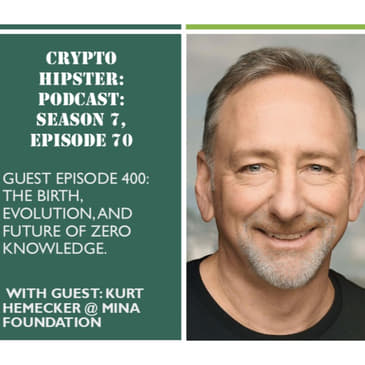

Kurt Hemecker, CEO of the Mina Foundation
Kurt Hemecker is CEO of the Mina Foundation, the public benefit corporation serving the Mina Protocol, the world’s first zero knowledge (ZK)-native blockchain, where he previously served as Chief Operating Officer. With extensive experience across the blockchain, payments, and mobile media industries, Kurt has held senior operating roles in the Diem Association (formerly Libra), Zong, a mobile payments company acquired by PayPal in 2011, and across various other PayPal initiatives with global mobile network carriers.
[00:00:01] Hello everybody and welcome to the Crypto Hipster podcast. This is your host, Jamil Hasan, the Crypto Hipster, where I interview founders, entrepreneurs, executives, thought leaders, artists, you name it amazing people all around the world of crypto and blockchain
[00:00:16] And today I have another amazing guest. I have the CEO of the Mina Foundation, his name is Kurt Hemecker.
[00:00:25] Welcome to the show. Hey Jamil, thank you so much and really pleasure to be here with you and thank you all so to your audience for being here with us as well
[00:00:36] Awesome, thank you very much for joining me and I'll kick things off and let's ask you the first question is what is your background and is a logical background for what you're doing now?
[00:00:49] That's a fantastic question and the answer is a resounding yes and sometimes I'm going to ask this, I always like to refer to. I don't know, you should be able to hear or interview your listeners ever listen to the famous, I think it was a 2005 commencement speech that Steve Jobs gave at Stanford University where you can kind of connect the dots going backwards. It's hard to connect them going forwards
[00:01:13] But going backwards I've been without dating myself, I mean you viewers can't see me. I do have a bit of a white beard but I've been around from Web Zero
[00:01:24] You know before the under before even web browsers to Web One to and now three and without going back into where I was born in my formative years
[00:01:38] But I studied computer science worked doing encryption for firmware in the eDONIX devices that moved into financial data networks on Wall Street And that worked into telecommunications and payments shortly a couple of the steps before I came into unification
[00:02:01] I was working with PayPal and doing partnerships between PayPal and mobile telecoms operators on payments That morphed into an interest in blockchain, it was happening in blockchain technology which is at the core of a large network
[00:02:20] The next evolution of the internet as we all know it and after PayPal I was one of the instrumental folks laying the groundwork for the Facebook back in the abroad Subsequently rebranded DM project space here in Switzerland and then moved into working with the unification and zero
[00:02:45] Now it's so kind of a congloberation of computer science hardcore firmware encryption background coupled with good Kind of business evolution of what's happened in the internet coupled with that working technology coupled with payments
[00:03:00] So yeah, I think I'm pretty much in their right place at the right time. If that answers that question
[00:03:09] Oh, it does. One of the few who are who are that's pretty cool. So, meaning foundation right what's it all about and how we able to come become the first blockchain so unlock ZK apps
[00:03:32] So that's it. That's also a really interesting story the birth of the protocol itself initially with something called quota and subsequently was renamed But we're sounded by two gentlemen of inch pure of who's currently the chief product and strategy officer foundation
[00:03:54] And a colleague of his name is Emeclar and they created a company called O11 Labs that incubated the mean protocol and kind of there there your reco moment was Wow blockchains Certainly Bitcoin Ethereum, you know the initial blockchain Technology as it was being launched
[00:04:18] That the state of the blockchain was just that the size of the blockchains just goes grows increasingly large as time goes by and then if you want to participate in contribute as
[00:04:31] In this security and benefit from security those blockchains you have to set up computers participate in those blockchains And they need to re execute every single transaction and as time goes by that just becomes a lot of computing power
[00:04:45] And at same time, you know both of these guys are super bright individuals I don't know the exact subject, but as he was basically doing applied mathematics PhD and Berkeley which is the ground zero of zero knowledge mathematics from you know started in 1980s with
[00:05:04] Shacky Goldwasser and then Evan had known is he since they were younger and and have been insulted Masters at Carnegie Mellon Institute, which again is like one of the top schools for computer science
[00:05:16] And they they said wow we can use zero knowledge to encapsulate consolidate the entire state of the blockchain in one single I need port so that was like a fundamental breakthrough
[00:05:34] When when they created me know was able to have the state of the entire blockchain and one salt small size proof And they did more than that Jamil and the listeners here what they did in addition
[00:05:49] They implemented infinite recursion so that no matter how much time goes on They can take is your knowledge proof of the consensus state of each between each block and keep that in the same constant size So that was a massive that was a massive breakthrough and just
[00:06:10] Putting it putting that into the context of the evolution of of blockchain right when Becoin white paper was published what October 31st 2008 Certainly there were some limitations with with with Bitcoin in terms of
[00:06:27] You know everything was transparent so there are some privacy issues and very limited at the time program ability Then comes a theory right massive step forward with smart contracts however Quickly found out there's a lot of congestion costs scalability issues
[00:06:47] It's same time shortly after you had Z cash coming out which showed that you could use ZK Snarks zero knowledge Sensitive non-interactive arguments of knowledge proofs for payments, but but ZK should limited program ability But it did show that there was a you know
[00:07:06] Big potential for ZK in blockchain and it was actually just after that that we started seeing later To's coming out to address the congestion with cost issues with theorem Three out of optimistic roll up ZK was primary release for scalability
[00:07:20] And then in 2021 was this big breakthrough of me know which is massive breakthrough Again, like I mentioned in being able to use zero knowledge proof with infinite recursion for the state of the blockchain
[00:07:33] And now here we are three years later where in addition to using it for the state of the blockchain Being able to program using that type of ZK's proofs for any kind of data that you want to provide selected disclosure privacy
[00:07:52] I'll pause there for a second. There might be a couple other questions buried in there I know that was pretty long-winded, but that's sort of the I guess the evolution of the mean protocol The answer to the question though about mean of foundation our job
[00:08:04] It's it's so meaner protocols and open source blockchain protocol based on native you know It's a layer one native zeranology blockchain Purpose of the foundation is to help promote the use of this open source protocol To help get a vibrant developer community and help this
[00:08:28] This technology find its use in product market fit in the wider world And that's through issuing grants providing education And those kinds of activities I had a couple small follow-ups first of all.
[00:08:47] Let me see what you have as in this correctly. You work Hota before now your meaner That change happened in like before the launch of the main net of the meaner name that happened in 2021
[00:09:01] That's why I had it heard about Hota in a while. Yeah, that makes sense All right The other one is I didn't know this ZK's were implemented with zcash initially in that scenario Yeah zcash as far as I know according to the history books that I've read
[00:09:22] Zcash was the first blockchain to you know implement some kind of zero knowledge Technology and they created sort of a privacy layer at the network layer for payments And so and then zk rollups were implemented as part of some of the layer two solutions for a theory
[00:09:49] But again, it weren't really focused on program ability. It was really more just bundling transactions validating them Much quicker and more efficiently than can be done directly on a theory
[00:10:03] But then still settling back to a theory. I'm still relying on a theory and but with with no like additional program ability on top of that
[00:10:13] So my next question was going to be what are you what's zk anyway and what has been used for today in your saying it's been used for rollups and bundling
[00:10:24] Yeah, predominantly you know again it's like everyone found out about zk in terms of it's you know usage and deployment In the theory in which is you know outside of Bitcoin obviously one of the largest Markets for blockchain and cryptocurrency
[00:10:44] Applications but there's so much more that can be done with with zurinology and it's a very rich space and there's a lot of activity now in different vectors and The Zk is now it's really I think the technology that's going to help bring block strain blockchain
[00:11:04] Applications to mainstream users and enterprise is it's here to study. It's a fundamental shift forward in blockchain computer science So let's look for you know I want to consensus this past year for the first time
[00:11:20] Which is pretty cool was an awesome that they next year is in Toronto my micro But there's a lot of buzz about zk's being the next trillion dollar opportunity
[00:11:31] So looking forward you know what are some of what are some of the more exciting use cases of Zk will they be and why is it going to bring people forward into the next millennia God, so I can talk about that for a couple of hours, but all
[00:11:48] You know at the very high level just think of so first of all just in terms of blockchain itself right like why is blockchain important of course It's an important aspect for the future. How do we move into a world where there's less trust and centralized organizations?
[00:12:04] How do we bring that into the water world and then how do we secure data around that and that's kind of web three in general But now as soon as we start talking about zero knowledge you start thinking How do we how do we deal with
[00:12:21] Ensuring the integrity of computation that's been done how do we deal with the requirements on You know the one stream on the one extreme is like Anonymity on the other hand, extreme you have
[00:12:36] Regulators that want to be able to collect data and and you have to find a middle ground and Zk can help with that But if you think about any industry financial data health data News media Scientific data telemetry
[00:12:56] Supply chains and you want to add a layer of selective disclosure So that's really how we talk about privacy because privacy is not about being anonym. It's about deciding what you want to share
[00:13:08] Who you want to share it with and a lot of the common use cases you hear around Zk like anyone you talk about Zk We'll talk about Zk KYC ZK and for me that's like a no greater
[00:13:20] That's going to be an area where Zk takes off certainly within finance and and bridging kind of web Traditional finance with with D5 where somebody can you can create a Zronolch proof of somebody's KYC and ML information and
[00:13:41] The beauty of that is zero knowledge means that that data itself Just it's not there. It's not shared just the validity of the statement is then shared so you could have a zronolch proof
[00:13:52] Testing that you know use your mail or somebody has passed KYC and the funds they've added into their crypto wallet Are coming from a clean source so the D5 protocol doesn't have to capture any information about you
[00:14:08] But it can just rely on the fact that there's a zero-halls proof that this KYC that there has been KYC that is still valid and again with a blockchain right. That's a temporal aspect That it's been captured and tested to at a certain moment moment in time
[00:14:26] So that's certainly one one promising area around the convergence of identity and traditional finance and and D5 And then there's so many other areas too if you think about like the Internet of Things is another area
[00:14:41] And if you think about all of the connected advice devices that are there and especially with AI now coming into that And that's it. I mean, we talked very much of the Internet of true things and we think we're on this new error
[00:14:56] And right now today, AI is predominantly a very nice friendly chatbot on your browser But, he is going to be moving what I say is it's moving into the edge which means it's moving into devices
[00:15:10] So anywhere data about us can be captured from your glasses from your smartphone from your from your smart refrigerator Right, like there's going to be data that's being captured and
[00:15:24] So we're going to want to have more control over what data is being shared and who it's being shared with Even think about like pacemakers right like there's medical data Hardcore biometric data about individuals that are being transmitted right now over Wi-Fi and Internet of devices
[00:15:44] Whether it's you know whether you're talking about IOT in a home IOT in medical devices in supply chain In energy management transport so Adding this layer of zero knowledge where you can test
[00:16:00] To the sanctity of that data without actually having to share that data provides an additional layer of security over it And I think so there's definitely applications like I mentioned before around ZKKYC identity
[00:16:17] Specific cases of how that can be done on Mina as well as you can prove that you're eligible to participate in a permission pull on a DAX Using identity and KYC information that you've provided on other other applications
[00:16:35] But there's other areas where I think fundamentally what's being developed and particularly with Mina which is like you can think of it like a zero knowledge processor
[00:16:46] So it's anything anything relying or wanting to use EK can be programmed on pop of Mina and take advantage of its infinite recursive And in this one tiny state proof you have all these proof combined and that allows proofs like I just mentioned you could have
[00:17:07] Using a proof from an application you need to use to create a proof of your identity then being provided into a DFI protocol
[00:17:16] Then you could have proofs of the transactions that you've conducted there and these can be bundled in and reused so this creates like an open composable database of attestations that allow
[00:17:31] Data sharing and sort of a new paradigm so we haven't seen before and this might sound odd but like I'm excited about the applications that we don't know about yet that can be developed
[00:17:46] And there's going to be a whole world of discovery here and we want developers playing with this and getting really creative of course having some of these key applications around boat it around identity around
[00:17:59] Health care like all these things are important I think there's a whole world of applications that we don't even know are going to be invented yet and built on top of this technology
[00:18:09] I'll pause there Jamil I can go on even more but I'll just pause there in case there's a follow up question in there. I got a bunch of them I got about how does it follow up now.
[00:18:21] So the meta let's go on the medical device route first you know, how do you think You know the CK's can help
[00:18:34] Pharma not I mean you know a lot of pharma startups and a lot of doing clinical trials and research right to find out information but how do you think they can help them with the advancement of that clinical research trials into the development of medical devices
[00:18:53] How will I help be able to streamline that or make it faster.
[00:18:56] Yeah, so the interesting thing is you know all these things I'm talking about these are just ideas these are things that are actually happening now on on meena and there's a one one project which came through one of our incubator programs called biosnics
[00:19:14] And they're using zeranology proofs to allow other entities so let's say your bio pharmaceutical company or biomedical company and you've come up with a lot of things
[00:19:27] with this certain proprietary cocktail or molecular formula and you don't want to give away the particular recipe of that formula but you want to let other people benefit by experimenting against it and putting you know inputting data and getting output.
[00:19:45] Well, you can use zero knowledge to verify that set of input has been run against this this formula without giving away the formula and so they they they you got the input and then you get the verified output so this could greatly accelerate research and development and collaboration between pharmaceutical companies for pharmaceutical.
[00:20:09] Development and yet letting people protect their their whole grail of intellectual property and intellectual data. And that's super, so the same thing you know it's really interesting because that's that's applied in this particular case with with this biosnarch project applied pharmaceutical.
[00:20:28] Research but you can apply that to large language models to machine learning the same kind of thing.
[00:20:35] Great, I think it's what I think it's wonderful. So that's good. Next one I want to talk about you follow up is is AI and you know you mentioned chat GPT and a lot of people think chat GPT is AI.
[00:20:53] But it's not really because you have fairly trained you have you have what's called federated learning. You have a lot of you know you have manufacturing chips.
[00:21:07] You have lots of different areas of AI that people don't see and don't understand and don't know right how can how can CK be a bridge to education and understanding.
[00:21:18] And help people to develop AI not just be a user of chat GPT but develop AI models for their businesses and their lives gone forward.
[00:21:28] So yeah that's that's a pretty deep one and as you know in probably most of your listeners know a large part of AI depends on training sets and data training sets.
[00:21:41] And I think you could use ZK to provide again levels of data protection over those data training sets so that you you can extract things that are valid without having to share sensitive personal data whether you're talking about you know for example big area is genetics data or
[00:22:04] or vehicle you know also vehicle training data right like if you if you you know a lot of the data for example companies like Tesla and self-deserve driving models are collecting right it needs tons of data but you don't want to have to share maybe your own personal trajectory information and you know you can widen that to even not just AI but insurance companies as well too like how much data you actually want to share.
[00:22:34] about all of your activities and if that can be done in a way where you're not personally identifiable you know that's that's the power that that's your knowledge can help around.
[00:22:46] AI data sets ensuring that something has been run against a particular AI model without giving away the proprietary. the coefficients of that that AI model much much like the pharmaceutical example that I just gave and another like fun thing I like to think about right is.
[00:23:11] I mean if you think about AI is really in general generally I it's living software right it's software that the bell up itself the bell ups itself and you know what. will there be.
[00:23:26] will this thing become conscious at some point who knows but here's another interesting thing to think about.
[00:23:32] And actually I can fact this is not my own thought but it was something that I love him or hate him some people listen to Raule pal I listened to him from time and he had the thing I about AI which I thought was pretty interesting but that is.
[00:23:47] you know at least today AI can't open a bank account right like like you have to go through KYC and AML and be a person like.
[00:23:56] like an AI couldn't go and open a bank account so what is AI going to transact it's going to transact probably initially using blockchain and then crypto cryptocurrencies so. So I think that's.
[00:24:12] kind of bullish in general or the growth of blockchain in general and cryptocurrency in general across with with AI. I'm going to. I'm excited about it. I do want to ask you this because there is concern now here in I know you're in Switzerland right. Yes.
[00:24:35] There's concern here in the US because you know we had an assassination attempt on former president from yesterday.
[00:24:42] Joe Biden says he's going to be drunk he dropped out of the you know not running a president and you know looks like come all how are Paris is trying to get that spot. We had an election four years ago and Joe Biden received 81 million.
[00:24:57] And so it's some people are concerned that that wasn't a real number that there were number that that wasn't a flated number and there was election tamperants.
[00:25:06] I'm not going to say it was or wasn't but I'm going to say how can CK help with the election process or can it help with the election process for this year of what.
[00:25:15] I think that's going to be taking if we if we were able to implement CK in that question process. Yeah, that's a great question and something really dear to my heart.
[00:25:28] And I should have mentioned this more or talking about applications for ZK but voting is a massive one and again it really just comes down to.
[00:25:40] Sort of policy makers can can you know policy and the organizers be brought together with the technology and get it out into the hands of folks. I don't know if that can be done in time for this election but the the technology is there and.
[00:26:00] ZK can help with a couple of aspects of that in fact there is there are voting applications that exist now on top better built on top of me know one of the better known ones is this company called punk call.
[00:26:12] Which is actually a South Korean startup named done government elections in South Korea using this this technology which I'll talk about more in a minute and then they also do just fun polls as well too, but what ZK does is combining.
[00:26:31] Combining the power of ZK and what I mentioned before around ZK KYC for identity. You can it ensures it does two things one for the organizers of vote. It ensures that you have valid individuals voting so they've gone through KYC.
[00:26:52] And in addition what punk poll does is they combine it not just with KYC but with social graph information so that you know that this is not just somebody who's been KYC but somebody like.
[00:27:04] It's it's a valid individual within the communities and I'll talk about in a second why that's also super important. And then the the so the organizers of the vote no okay I've got eligible voters because they've been gone through the ZK approach.
[00:27:22] I know there's not going to be civil attacks with you know one at the creating multiple fake, fictitious counts but so I've got this technological confirmation that these are valid eligible voters.
[00:27:36] And then on the voter side because he cares you see know that my data the way you voted is being kept private so like I'm not going to be called out if I voted for something that might not be popular or that I wouldn't want other people to know the way I voted so it's really kept my my data the way I voted is is kept secret and only the results of that vote.
[00:28:00] And then our known to the actual organized so that's that's really powerful right and and that kind of thing exists today but you know there's a lot of education.
[00:28:14] And then that needs to happen for users to be competent in it for regulators and governance to be confident obviously it's got to be married with some kind of. government issued identity credentials as well.
[00:28:32] Can that happen in time for the US election I I doubt and it's already contentious enough but I would love it to happen and I think it would I think I'd be surprised if. In 2028 we didn't see that kind of thing already coming out in US. US elections.
[00:28:53] And the reason the social graph thing is important I've spoken to a couple of. video like identity writers and the industry and you know in some cases people will sell them okay I see. or money just much like people sell.
[00:29:14] Orients right you know to another country you need 80 grand you sell your kidney like. Well, let's invasive to sell your passport for somebody wants to use it for for something but that's what so that's why like.
[00:29:28] The social graph element in addition to the actual KYC actually helps try to wait that that you know that kind of thing is not happen. So I want to talk about social I guess. Social graph.
[00:29:47] The benefits of it being able to to identify you know social graphs and build your own social graph. What's what they see how do you see the role there.
[00:30:00] So you know social graphs are kind of things that can build over time right so there's always a confidence sort of ranking that has to go with with the social graph and the more.
[00:30:10] Like the time as time goes on or somebody's involved in a community so so it's always kind of on a gradient sort of sort of scale.
[00:30:19] And then I guess a competent factor associated with that but again combining that with actual credentials from you know valid it validated credential somewhere create starts creating a very strong proof point but again without.
[00:30:36] And so it would be able to protect the actual data itself and just providing. Because at the end of the zero knowledge is an attestation that a statement is true but the actual details that went into a testing that statement are not shared.
[00:30:57] That's the power that's why it's called zero knowledge because the knowledge is not shared just the attestation that it's true that's what's been that's what's been. All right and and for more people to develop with you know.
[00:31:13] With the decay you know what's possible for people to be able to develop or to come on board how do you bring them on board because it sounds like there's a heck of a lot more.
[00:31:23] And we done that's being done already so how do you attract this developer so we could build that future.
[00:31:29] That's kind of the holy grail and the thing that work we're working on there actively now and we do that in a number of ways one way is just the technology itself.
[00:31:40] And in particular we've developed the scripting and development language used for that is something called type script which is one of the most common.
[00:31:51] We used web to development languages based on JavaScript so that just creates one less sort of hurdle right people can use language environment that they're already used to using to.
[00:32:06] To develop these zero knowledge applications they don't have to worry about the underlying complexity of of the zero knowledge math complications itself.
[00:32:15] And then so it's that's one part just making technology really easy and intuitive and this second part is again what the foundation is deeply involved in and that is providing education.
[00:32:27] About how to write providing reference programs had a right these kinds of applications as well as grants and submissions to. Developers and businesses that want to create businesses or new businesses on on top of that and we have a couple of different.
[00:32:44] And then grant programs one called navigators which lets people that their feet wet just experiment against the code.
[00:32:52] We have another program called ZK Ignite which is really meant for more professional builders that actually want to create and build a business and we also then link them with with incubators and venture capital companies that are looking to invest in the space and bring this is out to market and then.
[00:33:12] There's another area of grants we call core grants and those are. RFP based for companies that want to help develop and add. Kickability on top of me in a protocol itself. Sounds super exciting to me. Sounds really, really good.
[00:33:31] Wow I'm I might be I might be touched with the related data about one of those three. I want to thank you very much.
[00:33:43] I was first speaking with me today I really enjoyed speaking with you I got to bring you back in a half a year or so. You know see how I get up to see everything is going.
[00:33:53] So I enjoy this conversation I do it so I can do one last question. How could people find a more information about you about me and a foundation how can they do that.
[00:34:04] Yeah, the if you're developer I suggest just going to docs the OCS dot mean a protocol calm.
[00:34:12] Great way and then also there you can find community join the discord channel you can follow us on Twitter and that's the Twitter handles at mean a protocol and then also myself I always love getting a few more twitter followers at KM that's KHE.
[00:34:31] And so and thank you Jimil was a pleasure to be here. It's kind of short. I hope I hope my responses were concise and understandable enough but always happy to take any follow-up questions from you or listeners at a later stage.
[00:34:45] Awesome. Thank you very much for your time today. Thank you.