
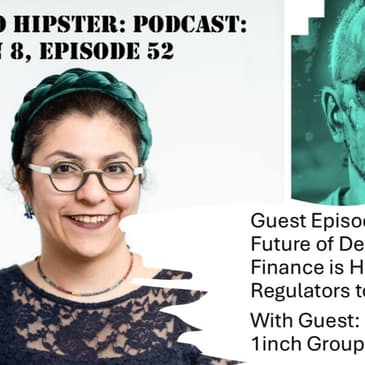

Hedi Navazan, the Chief Compliance Officer of 1inch Group, to your podcast. Hedi brings over a decade of expertise in regulatory compliance, financial crime prevention, and governance. With a distinguished career spanning both traditional finance and digital assets, Hedi is a pivotal figure in navigating the intersection of decentralized finance (DeFi) and global regulatory landscapes.
Prior to joining 1inch, Hedi managed financial crime and regulatory teams across Europe at HSBC, where she gained extensive experience in banking and compliance. Her global perspective is further enhanced by her work with prominent organizations such as Europol, Interpol, and the United Nations Office on Drugs and Crime (UNODC), where she has advised and educated policymakers on creating robust regulatory frameworks for the digital asset sector.
[00:00:03] Hello everybody and welcome to the Crypto Hipster Podcast. This is your host Jamil Hasan, the Crypto Hipster, where I interview founders, entrepreneurs, executives, thought leaders, amazing people all around the world of crypto and blockchain. And today I have another amazing guest. She is, yeah, she is the Chief Compliance Officer at 1inch Group. Her name is Hedi Navazan. Hedi, welcome to the show.
[00:00:34] Thank you very much Jamil, it's a pleasure to be here and hello to the listeners of this podcast. Thank you for joining me. I'm excited. 1inch Group is a pretty big name in crypto so this is going to be awesome. So thank you for joining me. So let me ask you first, I ask everybody the same question and I get amazing answers. What is your background and is it a logical background for what you're doing now?
[00:01:02] That's a, yeah. So I mean, my background actually in a, in one way or the other, it is logical, I have to say, but, but for me getting into crypto, I get this question sometimes. It wasn't an accident, you know, it was not an aha moment. And I was like, you know, this is for me. I knew what I was going for. And it was for me, it was all about the timing.
[00:01:30] I've, I've been, you know, monitoring the market for years and waiting for a right moment to step in. So it was just not about the hype. And let's say, if I wanted to step in, in the same, in 2012, early days, there was no need.
[00:01:50] And then we were having this wildness of crypto as the media puts it that way. And the market was premature, experimental, but I wanted to make an impact.
[00:02:01] And the real question for me was when would the industry really, the space needs a, you know, stability, a regulation or a policy around this world of digital assets and where all my experience could, could shape this space.
[00:02:22] So it was, it was purely about the timing that a couple of years back four years ago, I, I, I switched from a trade-wise space to the crypto journey. Yeah. My, my wife is a chief compliance officer for the web two space. Oh my God. I see.
[00:02:48] She understands stocks and bonds, but she doesn't get crypto at all. And, you know, so. Yeah. It reminds me of a memory, you know, because I, my background, I studied law back in the day and in London and Cambridge and, and I started my career with, with a law firm.
[00:03:09] And soon enough, I knew it's not for me. You know, I, I, life, I think it's full of challenges and surprises and law firms were, were you, it's a specific personality. If you like to create, build, bring an impact, even in your domain, I would say law firms are not for you, but it's a good learning curve.
[00:03:35] And, and because you mentioned the track, I, I have, have a love of, I think, diverse backgrounds. I joined a boutique consultancy firm, specializing, you know, rep risk and compliance, working for fintech. That time, let's say those years we did not really have regulation on fintech. Fintech actually was one of the beautiful evolution in, in, in the bridge between finance and tech.
[00:04:02] We had fintech companies rising, and then compliance with the requirements, setting up the teams. And after that, I, I, I, I wanted to join a multinational, of course, organization. I, I stepped into the track, by space, working for HSBC and other big names. And I wanted really to see what, what, what can go wrong inside and, and what can go right.
[00:04:28] And because you, you mentioned about your wife and your experience, you know, when I decided that I'm gonna move out from the track, but I never forget the day that my colleagues look at me and say, what's the next journey? And I said, crypto. And, you know, and they thought, oh my God, really? I said, yes, you didn't think about my risk appetite, you know, like, but they always knew I had a difference.
[00:04:56] I always, I was always coming with solutions and creativity, even within the banking space, which is very strict. I have to say, I do see a lot of scrutiny and record heavy requirements of financial systems. And, but I had, that was also a good reaction by the thing by the, by the, by my colleagues that time they, the CEO actually came to me and said, look at it.
[00:05:20] The next step, you're going to the crypto, you know, industry, we would love to hear back from you. We love, you know, whenever you can come back, when we do a workshop or let's have a chat. We love to hear, we wanna see how this space is evolving. And we are, you know, monitoring, right? And we wanna learn more. So it was very, I think, very positive that, that time.
[00:05:45] And I bet those times even have changed and banks and multi-financial institution, institutional players are, are ahead to some extent. Yeah. I don't think they'll ever be ahead, but, you know, cause it, cause it moves slowly and we move like at the speed of lightning. But, you know, I wanna know, you know, what OneInch is all about, including, you know, your, your vision and role there.
[00:06:14] Oh, absolutely. For those maybe not familiar, of course, with OneInch or the DeFi space, I can share a bit more background. So, OneInch is a decentralized finance aggregator. We are one of the, it's one of the biggest in the scene at the moment and basically helping users find the best prices for swapping tokens amongst multiple decentralized exchanges.
[00:06:44] Let's say, if you're a user, instead of you would manually going, checking different DEXs, the decentralized exchange platforms for the best rates, you would go to an aggregator, such as in this case, OneInch, that automatically splits and routes the trades across platforms like Unisov, Curve, or Balancer to optimize the price execution.
[00:07:12] Right. It's a bit like your personal assistance, finding the best rates automatically for you. And, and with the new technology that OneInch has implemented, it's a basically it's a cross chain swaps.
[00:07:27] So, for those more tech savvy and crypto savvy, they know like you do not need to change automatically whatever, whatever and whatever decentralized exchange you want to do your trade. It just automatically swaps for you, you do not need to change.
[00:07:47] And, and besides that, of course, we have the DeFi products like limit order protocols, liquidity farming opportunities that is addition, of course, to the core of other, you know, aggregating services.
[00:08:04] So that's in a nutshell, OneInch does and, and, and from I think from a CCO perspective, my role with OneInch is, is to make sure that we are, we are pushing the boundaries of the DeFi innovation, but we are also doing it in a, in a very responsible way that it's secure security comes first.
[00:08:30] And not only for me, for our founders, for, for everyone working at OneInch and the contributors, security matters. And, and in this space, DeFi, when we talk about risks, you know, it's a saying, it's a big thing in, in this compliance and regulatory environment. I have heard it so many times from also many experts, they say, same risks, same rules. It's the same for crypto. For me, it's not the same. I don't look at it.
[00:08:59] It's not the same risk, same rules. We are talking about a totally, a technology. We are talking about blockchain. It's not the same risk, same rules. How can we apply the same, you know, TradFi rules to this space? It won't work.
[00:09:15] And I think that's, that's also as a role, my vision as a CCO for OneInch as, as you know, at DeFi aggregator, one of the biggest in this same thing is that, is that to align, to have a very secure platform, but also aligning with expectations from authorities and regulatory bodies.
[00:09:35] I think we are, we are, the goal is for us, you know, creating a platform that is not only powerful, that it keeps its decentralized essence, and at its core, but also is trusted by the users, by institutions, also regulators. I think trust is very important. And bridging the gap between DeFi and compliance in a, in a friendly privacy manner.
[00:10:05] That is something that, at least I envision for OneInch and my team and our team at the moment. So these banks say to you, Hattie, please come back and talk to us. You help, you, you, right? Way, no way. Yeah, no TradFi for me, please. I'd be there, but you help, you help regulators and policymakers.
[00:10:34] And makers create robust frameworks, right? For the digital economy. So how do you help them? Absolutely. I think the, the reality is, I think DeFi is rewriting for me, even DeFi, I would say one step is ahead of centralized exchanges. Yeah, right. That is rewriting the rules of finance and obvious regulators.
[00:11:02] From their end, we have to understand also their frustrations, their concerns, their expectations. And, and for them is to catch up, making sure the market is stable, right? Market stability, integrity, security, and consumer protection. We have a lot of, I mean, a bunch of incidents, of course, in the market, right? We had FTX collapse.
[00:11:28] We had Luna Terra, of course, a stable coin, which many, many people, of course, lost also their assets on that. And we have a different incidents in the market, which is needed, else we are not mature. We are not getting mature. We don't learn our lesson learned. But, but I have to say, that's why the user, consumer protection and user protection is a key also for regulators.
[00:11:55] And my approach has been always bridging the gap between the innovation and regulation. When I talked to, there were times that I have been at European Parliament speaking to MEPs before MECA regulation was going to be out. And, and, you know, they were actually asking, you know, inner silker experts from technology side to provide their opinion on the bill, of course.
[00:12:22] And we had some very, very good outcomes out of those discussions and, and could make it a bit more balanced approach. Same good dialogues at senator offices in the United States, DC, at DC as well. And it's continuing. And it's, it's a global, of course, approach we are looking at it. But I think my thing is always, let's not regulate the innovation and let's innovate the regulation.
[00:12:52] And, and this is, at least the role is to bridge that gap. And I think it comes a lot with also education. And what I mean by education is that as the industry experts, we have to sit at many, many of these round tables with the regulators. But there have been even sessions, I have to tell you, Jamal, is that there have been sessions that I had to show, which I think it makes sense.
[00:13:22] It should be like that. A demo of the product. But how really, step by step, how does it work really, D5? What is D5, right? How would you, do you need even to log in? How does it, what, what does it mean you have a private wallet? What does it mean it's self-custody? That is, versus a custody and service provider. What type of risk we see? But if you do not, you do not interact yourself in the space, it's not tangible for you, right?
[00:13:50] But how can you put a regulation or draft a regulation or introduce to the, to the industry if you have not yourself testing it, you know, seeing what is it in real practice? And we had that with MEPs at European Parliament. I mean, like, I raised the question, I said, do you have yourself, any of you here, of course, having a valid address, you know, just to set it up and see how does it work?
[00:14:18] So how are we making a regulation over something that, that we are not even familiar with, right? And in this case, it can become, I have to say, it's niche, it can become complicated.
[00:14:31] A lot of education is needed, at least from, from the industry to share this knowledge, expertise and technical aspects of what we are actually working on with the regulators and policy leaders and have the same, finding the same language. That, that's, that's, that's a barrier, I have to say, yeah. So you always need to find that balance. Interesting.
[00:15:01] You said a couple of important things there. I'm going to go down the Mika path first. Mika continues to have some implementation challenges, right? You know, how does, how does that compare to the, the change and shift in the US policies toward crypto that are now more friendlier under the Trump administration?
[00:15:30] What are the challenges? How do you reconcile them with our policies and maybe what our regulators still need to do here? Sure. Sure. Yeah, that's a, that's very relevant, especially with this timeline. You know, there was deadline by December last year, actually, which we passed. It was a deadline for, for the industry to get Mika compliant. And there are a lot of challenges on the implementation level, but from two sides.
[00:16:00] One side is the industry, the private sector. The other side is the regulators themselves. So if you look, if you talk to national competent authorities within the European Union, which I have had the pleasure and honor that often, you know, in these good dialogues with different regulatory bodies, they are not ready themselves neither. So it's both sides. So there is a deadline that no one is ready.
[00:16:28] I have to say that's, that's, that's, that is the reality from both parties. But if we want to, to focus on the challenges from the private sector, I have to say, there are, there are indeed concerns over readiness.
[00:16:43] And, and there are, I can bring actually statistics talk better than, than, than, as a fact is that there have been findings that, that it shows that less than, you know, 5% of the crypto businesses are at the moment fully prepared.
[00:17:03] Like, especially in countries like, like, like, and, like, like, and I specifically give example of Poland, for example, when I was talking to the, to the, to the, uh, friendly, uh, Polish authorities for, just to give a number is that you should imagine they have more than, uh, 1,500 registered mass virtual asset service providers.
[00:17:30] Or, as we say, uh, crypto asset service providers. So more than 1,500, they were registered before Mika was enforced and going for the implementation. It means out of 1,500 registered mass, less than 5% are ready even, um, to, uh, to be fully Mika compliant. And, and there are, of course, more, I have to say, uh, concerns.
[00:17:59] One is, which is very recent. So we had, we had a statement from ESMA, the financial market authority in, um, in, uh, in the European Union. Their concern was, and I understand fully, they call for a rapid action against stable coins that they don't comply with, with, uh, new standards. Mika. And you may guess what happened.
[00:18:25] Those who are, I think might have, uh, you know, interactions with centralized exchanges registered and, uh, almost Mika compliant. Uh, everyone received the message that, uh, particularly Tether USDT will be delisted from, from, as a stable com from their platform.
[00:18:44] It has a, so no trade and, and specifically by authorities, it was mentioned, stated no trace of USDT should remain in European Union after March this year. And, uh, and even under the sell, sell, uh, mode only, you know. And these are impactful, right? Tether is, is also, it's a big player, of course.
[00:19:09] And it has an impact, relisting, uh, this stable coin from exchanges and any other stable coin that is not Mika compliant. Um, right. It has an also impact on the whole, uh, market for the stable coins as well. So it's a whole, I have to say, this is, uh, these are even the minimum of the challenges, but there are, uh, of course, hot topics at the moment.
[00:19:33] It's been discussed, but I also would like to bring another, um, you know, to your, to your attention and the listeners attention or anyone who is listening to this podcast. What I've been saying also myself personally, uh, you should imagine as a CCO, if you're dealing with centralized exchanges, their team are not competent at the moment because there is a rush to have a compliance department.
[00:19:59] There is a rush to have, uh, you know, the onboarding KYC's, KYB's, the processes in place. The team are not skilled. Even I, I'm doing, we are, you know, doing the test and trial sometimes. And I'm like, oh my God, this is, uh, you are not competent. You are like for onboarding, you guys are not competent, you know? And, and that is what we are seeing.
[00:20:25] Even sometimes centralized exchanges in crypto looks like they ask for more scrutiny than a bank. Where are we heading to? That, that is not what we are looking. There's the, like the scrutiny looks and the restriction is, is more difficult. It's getting more difficult than opening the bank account nowadays.
[00:20:48] And so I think that that's the balance approach that we are, we might be seeing that it's at least for the next couple of years, we may be facing. Yeah. Yeah.
[00:21:17] Yeah. community. President Trump signed the executive order in January, promoting U.S. leadership in digital assets. There is a working group right away established like a task force to work on the regulation for the crypto industry. I have to say, United States was never a market that we would
[00:21:41] disregard. It's a big market for a lot of players. But the unclarity regarding the regulation was very scary and scared many, many, many players. And we also saw the approach in United States in a couple of years was regulating by enforcement. A lot of enforcement actions by
[00:22:09] SEC was imposed on the founders, but also on the big projects. Good or bad, I won't comment on that. We don't have much of time for that. But we are seeing two different approaches now. So U.S. is embracing. And I think already the moment that the executive order was assigned, it immediately
[00:22:33] influenced the markets, the prices notably, you know, like increased, especially for on Bitcoin and Ethereum. And I have seen it's also over the news for anyone wants to see, but there are market moves, right? So there have been companies preparing for to establish their presence. For example, in UK,
[00:22:57] you may see a 16Z cut its UK plan preparing to enter the United States. And this is nothing I think he did. Many are at the moment are looking at their strategy and business plan that if U.S. brings clarity, of course, that is a market that you do not want to miss. Yeah.
[00:23:23] You mentioned regulation by enforcement. Don't get me started on Gary Gensler. I spent 80 episodes of The X Factor, my weekly show bashing and trashing the guy. I'm not going to do it again. He's out of it. Well, he's back to MIT. But you mentioned, he said the skill set for the bankers are not there. I'm looking at Silicon Valley Bank and Silvergate. None of their executives had any CCAR experience,
[00:23:48] you know? But our famous banker, well, one of them, and you're in Europe, Christine Lagarde. You know, I was at the World Bank Summit back in October, and she was like on stage, like two rows in front of me, telling people all about how they're creating their new banking coin, right? And then she made a public announcement recently saying Bitcoin is only used for money laundering and illegal drug
[00:24:15] financing, which is wrong. It's been proven to be otherwise, although that's her competition. That's why he says that. So I want to find out now, not only how is this comment untrue, because it is, but how do you gain traction with banking regulators when you have these sorts of comments that are still pervasive in the central banking system? It's, you know, I think, to be honest, the challenge is that these type of narratives like this, that you
[00:24:45] mentioned, from Christian Lagarde, it sticks with the media, right? It makes great headlines. And, and media loves a strong attention for a title. I have to say, actually, I lost the two weeks ago, I met, I have had some friendly and welcoming conversation with Mr. Christian Lagarde during the Davos World Economic Forum. And, and I
[00:25:09] respect her leadership in the financial space. And, and but statements like this, which media often picks it up, we will lose the bigger picture. And, and, and, and it's no secret for all of us that try to fight the traditional
[00:25:30] financial systems have long time being used as the gateway for illicit activity, right? And, and we don't see that in the media that we are going to ban cash or banking. So there is a bit of a difference. I think the reality is blockchain for the very first time in the, in the whole history, if you are looking at the finance, the financial
[00:25:56] system, this is the most transparent financial system, if it's being used, ever created. Every transaction is trans, so, and it's immutable, you can track and trace. And even law enforcement agencies, there are many cases that they could solve and resolve the criminal cases, thanks to blockchain. And I think we also, it's a fair to
[00:26:21] bring some statistics of it, such statements are picked up by media. And when we look at the fin crime statistics, and we put it into one perspective together. So the UN Office of the Drugs and Crime Statistics,
[00:26:41] they mentioned in the report in 2020, between 800 billion to 2 trillion is laundered globally each year, through traditional financial systems, and primarily involving cash and banking system, right? So if you keep in mind,
[00:27:02] the crypto crime was calculated in 2020 as 1.9 billion US dollar equivalent. So if we put it in a perspective, it just shows that the illicit activities facilitated by cryptocurrencies are a fraction of the
[00:27:32] of, from the whole picture, right? And, and what I also, I always bring this perspective to, is that criminals, even if there are illicit activities on chain, and or by the means of cryptocurrencies,
[00:27:53] the off-front services are the most higher risk. What I'm trying to say is whatever is on blockchain stays on blockchain, but criminals need to cash out.
[00:28:05] So there is a moment that they need a bank to cash out. So, because as long as you have your coins on chain, what are you going to do with that, right? And we are not yet there that you can buy a house in cryptocurrency so easily everywhere, or you can pay your coffee, or you can just cash out, right? So the ATM keys are not everywhere and accessible or for this matter.
[00:28:32] So most of the time you do need to use the off-front services in order to cash out your money. And at the end of the day, majority of the crime is related within the cash in basically manner and behaviors. So I think that that puts a better perspective to do these type of statements. But I think what when it comes to gaining the traction with regulators and
[00:29:02] and especially for example, in this case European Central Bank, the president of the European Central Bank, it's also about the thing education and engagement, right? You have to work very directly with policy makers and making sure, I mean, crypto isn't that shadowy on the world and on the ground.
[00:29:24] We are here, this is the evolution of finance and time has passed that there were doubts if crypto is going to stay with us or not. I think everyone is on the same consensus that it's not going away. One way or the other, we have to embrace it. We have to embrace it. We have to understand it.
[00:29:44] But we have to also provide an open dialogue, right? With the policy leaders and regulators, how we can all together move this forward by keeping this dialogue, but pushing also for a smart balance regulation instead of having this fear, right? From this type of narratives, which unfortunately media loves it. They just hear one sentence and they pick it up.
[00:30:12] We don't hear nearly as many statements anymore as we used to about Bitcoin's premature death and other cryptocurrencies. But you said we need to push the button forward and I agree we need to push that button forward. And one of them is through dialogue, through education. How else can we get institutions, stratified institutions on board to embrace DeFi?
[00:30:42] Oh, isn't it a trillion dollar question? I have to say, right? If you talk about, you know, to be realistic, Wall Street, right? They don't move. Wall Street doesn't move just because we have to be like serious. It doesn't move because it doesn't move because it doesn't move because just something is cool or something is hype or everyone's talking about it.
[00:31:07] They move and they move when the incentives are aligned. There is a business case. There is a use case, right? When firms realize that they can cut costs, unlock the revenue streams, and they reduce the settlement risk, especially if you look at DeFi, that's the moment that they will see it is the real momentum.
[00:31:34] And I believe, and the reason I also joined OneInch, I mean, as one of the biggest DeFi aggregators in this space, because I truly believe the potential is there and there would be a real momentum. And I think how we should look at this is that, at the end of the day, it's not about us versus them, us versus TrackFi or Wall Street.
[00:32:01] It's about the evolution of finance. So the financial system, one way or the other is shifting, right? Whether TrackFi and big institutional players are ready or not. But I think the smartest players in the TrackFi scene are already, I have to say, finding ways to integrate DeFi into their models, right?
[00:32:28] And there are sandboxes, there are pilot projects that are already working on. And the big, big players, such as JP Morgan, for example, it's already been out there for, I think, the last two years, that there have been multiple pilot projects and a lot of good work has been done.
[00:32:48] But I think the challenge is bridging the gap between DeFi's open permissionless ethos and regulatory guardrails that institutions are used to, right? So if regulators are not comfortable with players in crypto scene, how are we making sure institutional players are comfortable, right? They are under a lot of scrutiny. I have been there myself.
[00:33:18] The risk is just, I wouldn't say the entire environment is with fear. But the responsibility is high. You're accountable in front of the financial intelligence units, the authorities, the regulators. You may easily end up in a jail or a criminal, you know, if you signed up on something that happened to have not been right, right?
[00:33:43] So to wrap it up, I think the institutional players have a lot of requirements to meet, to be very honest. And the risk is high for them to get involved.
[00:33:57] But also, if regulators continuously do not feel comfortable with the crypto scene and continuously they advocate that crypto is a high risk, you know, mind you, if you want to get involved, well, you know, you may not have their blessings in one way or the other. But I think it's difficult to have institutional players get involved, right? I think we are on a right path at the moment.
[00:34:26] We really need this regulation to come even earlier. But we have Mika now or United States is very behind. We really hope they move fast. We have other jurisdictions, like, for example, Dubai, Virtual Asset Authority in Dubai, Vara. They have done a great job. They actually attracted a lot of businesses in the MENA region, same ADGM now in Abu Dhabi. And they were smart regulators.
[00:34:56] They were thinking and they want to learn from the industry. Multiple roundtables, breakfast sessions, you may name it, with experts they organize to understand the expectations. But from both ends and challenges and the frustrations, there has been some very good work that's been done by different regulators across the world. I even give an example like Liechtenstein, for example.
[00:35:23] I actually met them as well a few weeks ago. A lot of good works. They're already thinking this is impressive for now, but they're already thinking how to bring a good governance model for DAOs. Right. So there are some regulators out there that with a good, you know, thinking and innovative way that they are looking at the industry.
[00:35:48] But again, I think Wall Street and the big boys, they should feel comfortable also. In order to get involved. Sounds great to me. I'm looking forward to seeing how this everything plays out. Awesome. I want to thank you very much for speaking with me today. I very much enjoyed our conversation. I have one last question. It's simple.
[00:36:17] How can people find out more information about you and about OneInch? Sure. Yeah. Sure. Sure. I think perhaps the link can be added at the end of the podcast, but you are available. I mean, online from the OneInch.io. That's where you can find about OneInch and myself, Hedy Navas on LinkedIn. You can always look. And I'm always available or on Twitter. So responsive.
[00:36:47] We always welcome any feedbacks, initiatives, any open dialogue. That's, I think, the spirit of this space. So please, yes, reach out anytime. Thank you. Awesome. Thank you very much for your time today. Of course. Thank you very much, Jamal. And for the time, good talk and speak soon.