
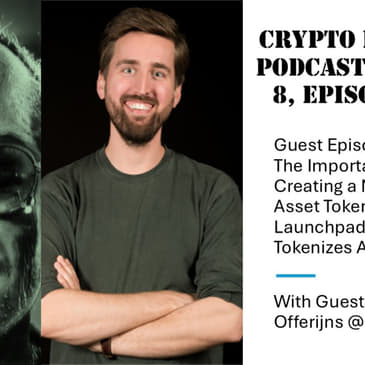

Jeroen Offerijns is the Chief Technology Officer of Centrifuge, the open standard for tokenized finance. With 10+ years of software development experience and co-founder of several startups, Jeroen brings deep expertise as an engineering & product leader. As the author of ERC-7540, the leading tokenized vault standard for RWAs, as well as ERC-7575, Jeroen has collaborated with key DeFi protocols to push the space forward.
[00:00:02] Hello, everybody, and welcome to the Crypto Hipster Podcast. This is your host, Jamil Hasan, the Crypto Hipster, where I interview founders, entrepreneurs, executives, thought leaders, amazing people all around the world of crypto and blockchain. And today I have another amazing guest. He's the Chief Technology Officer at Centrifuge. His name is Jeroen Offerijns. Jeroen, welcome to the show. Yeah, thank you so much for having me. Really excited to be here.
[00:00:30] You're very welcome. Thank you for joining me, and it's going to be great. So let's kick things off. I'll ask you first, the first question I ask everybody is, what is your background and is it a logical background for what you're doing now? Yeah, absolutely. So yeah, my background is in software engineering. I grew up as a kid, like, tinkering around with computers and learning programming, like, at a pretty young age and kind of discovering that as a pretty exciting way to build things, build products.
[00:00:59] And got really motivated by that and started doing that in late primary school, early high school, kind of all throughout my university years. And so I moved into Web2, the traditional software engineering roles, where I learned a lot about, like, technical skills, but also saw a lot of, like, how divisions, a lot of the Web2, especially financial software was.
[00:01:26] So I got quite involved in that from, like, a technical perspective, but not yet from, like, a Web3 perspective. I joined crypto a little bit later, about five or six years ago at this point, when I got involved in Sendivage, and pretty quickly realized that what I saw as, like, the technical benefits of crypto and blockchain was being utilized really well in this project. And we could talk about that much more, but I think it just all fit together really well.
[00:01:54] And so my background, my technical skills, my engineering skills were able to kind of help take this project to the next level. Awesome. Awesome. So I do want to find out the technical part of Sendivage, but I want to find out, you know, what Sendivage is all about, including your role, your mission, and focus and vision. Yeah, of course. So, yeah, we've been around for quite a long time, about seven years at this point. And what we've always focused on is looking at what do you have in crypto?
[00:02:24] What is the technology? What does it enable? But then how do you bring that to a real world and to real use cases, right? And so that's why we originally coined this term RBAs or real world assets is we're just looking at crypto in 2017, 2018, 2019, and it was all kind of a very separate world on its own. And we were thinking about how can you bring these two worlds together. And so our mission is really to reimagine finance and build it from the ground up in a way that is more efficient,
[00:02:52] more transparent, and more automated. And if you look at finance today, it's obviously a huge industry with lots of major players, lots of institutions, and a lot of innovations in the last few years already. But the core system, really the lower level, the backend, hasn't really changed. And so that means it's still limited in terms of how quickly you can innovate. And so we really think you need to rethink that entire financial system and rebuild it on crypto rails.
[00:03:21] And so that's what we're ultimately trying to do. Great. So reimagination is important. So you recently launched something that isn't really, I think it was imaginative. It's called an RWA launchpad. You know, what's that all about? And why will that be a game changer for developers who are building, you know, institutional grade products on chain? Yeah, I mean, it's something I'm really excited about, right?
[00:03:49] So I think the market of RWAs has developed a lot over the last few years. I think four years ago, we were trying to explain to people why RWAs made sense and why it was something that people should care about. Now we're in the space where BlackRock is saying everything is going to be tokenized, and we're launching funds that are hundreds of millions of dollars to get a maker. There's so much growth in the space. And what you start to see happening is, right, like, a lot of people are getting involved with RWAs, and a lot of people are getting involved with, like, tokenization.
[00:04:18] But the technology is not really, hasn't really been ready for it. What I mean by that is, right, like, if you think about, if you wanted to launch an NFT a few years ago in the whole, like, NFT boom, like, everyone wouldn't, like, most people wouldn't build their own NFT token. What they would do is they would use some other project to launch their NFT projects. And so that's very different from what you see now with RWAs. It's basically every RWAs project is building their own custom code and building everything from scratch, which just means a lot of redundant work.
[00:04:47] And a lot of, like, it's very inefficient, but it's also very risky, because it means people are doing the same thing over and over again, which, in CURF, right, like, we all know how common hacks are. And it's just not a very scalable way to, I mean, to rebuild finance ultimately. So what we're doing with RWAs launchpad is really building this toolkit that allows anyone who wants to launch an RWAs product to kind of take these different extensions, like RWAs, we call them RWAs extensions, and combine them to launch your own products, right?
[00:05:15] So you can imagine, like, maybe you want to launch, like, a tokenized treasury fund, and you would combine the KYC smart contract with tokenization of the T-bills, with an Oracle for this, and so on. Or maybe you want to launch a private credit offering, and you want to have on-chain NAV, and, like, all of these other different options. So really, we're building this toolkit, this platform that allows someone to come in and say, this is what I want to do, these are the tools that I want to use, the extensions I want to use,
[00:05:43] and then go to market a lot faster, built on the Secure Foundation that SemiFeed has already built and learned from over the last few years. Great. So the benefits, there are probably a lot of benefits, but I want to say in your words, what do you feel the benefits of the platform is? I would say, number one, it's being able to go to market faster. Like, you can launch an RWA product in days or weeks rather than months or years.
[00:06:12] Number two, it's security, which is incredibly important in this space. You don't want to launch code super quickly and then get hacked and lose users' money, right? And then three, I would say it's scalability. It's a foundation that allows you to scale an institutional-grade product to billions of dollars in TVL, while then be limited by your own custom code. Very cool. So I get confused. You know, I've been in crypto since 2017,
[00:06:40] and recently I've been confused. You mentioned earlier that you're looking to reinvent finance, right? When you're tokenizing stocks and bonds and stuff like that, from the traditional world, it's not really a reinvention, right? It's more of an extension into crypto, right? Where do you need all the strings? What still needs to be reinvented?
[00:07:08] And why are we bringing the traditional world into, you know, crypto with just the innovation of RWAs? What still needs to be reinvented? Yeah. I mean, it's a very good question, right? So I think we need to realize that, like, rebuilding finance is not going to happen in even five years. It's a very long-term project. And I think it's only a lot of people in B5 and working together already for quite a long time. And, like, I mean, we've come a long way since 2017, I would say.
[00:07:37] But there's still a long way to go as well. Like, that's, I mean, it really is a marathon, not a sprint. And so we need to figure out, like, what is the end goal? What do we want to get to? Which I think a lot of us are pretty aligned on. And then what is it that we can do today? And it's not the same thing, right? So if you think about T-bills, like, the BlackRock Fund, for example, like, it's not realistic for the US government to be tokenizing terrestries directly on Ethereum yet. They're just not going to do that. That's going to take a little bit longer. I hope it's going to happen. I think it's eventually going to happen.
[00:08:06] It's more of a question of, like, five or 15 years, I would say. But it's going to happen. But we're not there yet, right? So today, to run a fund that buys and sells T-bills, you basically need to un-and-off ramp the stablecoins and then, like, run a fund off-chain in a traditional way. You still have a lot of benefits, right? You get a token that is easily tradable in DeFi, that is much more accessible to people to buy. It's much more transparent to transparency.
[00:08:31] So I think it's still already like an incremental improvement over traditional finance. But it's maybe not the exponential step we are. It's one step in that direction. I think it's really exciting, though, as you start to look beyond T-bills. And I think that's where the market is now starting to get to, is, like, what are the next assets that we're starting to tokenize? And what can we do there to, like, go a little bit further, right? So I think if you think about, for example, private credit, what could be really interesting is, like, tokenizing individual private credit loans
[00:09:00] and then creating funds that represent, like, a portfolio of those loans. And what you get then is, like, each individual loan is actually directly on-chain and tokenized. And then the fund is the token that's basically tradable in DeFi. And so that's maybe one of the, like, next steps in, like, the evolution of this whole process. So I think there's a lot of steps like that that we need to take. And, like, we also need to realize that for this to be successful,
[00:09:25] we need to work with all of these major institutions to start entering the crypto space. And I think you see a lot of excitement, a lot of adoption from that side. Like, really, any institution we talk to, they're motivated to be part of this movement. But they're also generally risk-affers. They have a lot of backgrounds in how they do things today. And so it takes them a little while. And so you tell them, look, you need to start over from scratch. It's not going to be, it's not going to work.
[00:09:55] So we need to figure out, like, ways to work with them and help them, like, take baby steps before we take, before we get to the final North Star. What is a North Star? Again, for people who don't know or should know, what is that North Star? I think it's every person and business on this world that are actually being able to interact with the financial system on blockchain rails
[00:10:24] and have this, like, to the point that any individual person or any small business has the same access to capital and the same access to financial markets as any major corporation. I think that's a really good way to, like, captivate, to capture the end goal, which is that today we have this opaque financial system that works really well for some but not as good for others. And I think if we can get to the point where it's so accessible
[00:10:53] and so open that everybody has the same access to this market, I mean, that's really, I would say, mission accomplished. Yeah. I see that, too. I think that's a good goal. A great goal. A fantastic goal, actually. So I want to look at institutions first. You know, we want to get them on Web3, right? Why are, it might be something else,
[00:11:18] but why would RWAs be the best chance to achieve institutional Web3 adoption? I think it's a combination of a few things, right? So one, we talk about rebuilding. We talk about, like, reimagining. But the reality is there's also a lot to learn from traditional finance. There is decades or centuries, in many ways, of experience. And I think a lot of people in crypto have, like, this experience with technology
[00:11:47] and the ecosystem, but don't necessarily have, like, all of that experience with, like, financial markets and, like, all the lessons that have been learned there. So I think RWAs are kind of a great place for us to work together with institutions and really combine the best of our worlds, right? If you think about, like, funds that we are running today on Center for Which, this technology is doing a big chunk, and, like, we're able to, like, really help and make meaningful products there. But the institutions are bringing, like, the experience with how do you run a fund
[00:12:16] like this, how do you manage assets, how do you do all of these, like, things that they're very good at is really what they focus on and specialize in. And so I think RWAs are the way that institutions can leverage what they're already good at and bring that expertise to the crypto ecosystem. So I think that's really, like, number one. I think number two is institutions really see this as solving a problem for them. Right? Like, if you think about, like, Larry Fink talking about, like, every asset will be tokenized,
[00:12:45] the reason for that is because he realizes how financial markets today, although they can be quite efficient in some parts, they're really pretty inefficient in many other parts as well. And we kind of come back to, right, like, think about trading stocks, equity. It's pretty easy. Anyone can go and, like, sign up for a broker and, like, buy Google stock today. It's a pretty low fee. That's fine. But think about private credit or think about more complex fixed income products or think about commodities or other kinds of, like, parts of the financial markets.
[00:13:17] Generally, those are a lot harder to access. Generally, the fees are much higher. And so, from an institutional perspective, they see that this thing that isn't for your work and it could be a lot better. And they believe and understand that blockchain technology is ultimately the solution to that. So, it's a place that they see value and a place that they want to be able to participate and want to make progress together. Got it. Got it. So, those institutions.
[00:13:45] Let's just say my old institution before I got into crypto was AIG, right? And I'm going to dive a little bit into technical details. One of the things that people used to do, I worked in IT, you know, as a project manager, was different areas of the company would purchase platforms. They would, like, no one gave them authorization. They didn't do it. We didn't do an assessment first. Oh, we just bought this thing.
[00:14:15] Can you implement it? That still happens today in a lot of companies where they, you know, buy this thing that no one knew about or understand. Like, so that decision-making process in the technology area is really the back end. How do we get, and maybe, you know, Centricity is going to help with this. How do we get the technology to be part of the upfront decisions so that they can come in and then join Web3 more seamlessly and have solutions for the business more seamlessly?
[00:14:45] How do they do that from a technical perspective? Yeah, I mean, it's a really hard question, I would say, right? I think what really helps is that, I think, in DeFi, making the right technology choice is ultimately what unlocks all the other benefits of DeFi. And what I mean by that is, right, like, what is the ultimate, like, I think what is kind of the benefits of DeFi is about, like, being able to easily take the token and use that
[00:15:13] in these composable markets, using a Morvo, used on Uniswap, used on Alpha, used in all different protocols. But if you make the wrong technical choices, you're not going to be able to actually use that. So you can tokenize something and put it on chain, but then actually not be able to interact with the wider DeFi system. So I think it's going to be pretty clear, I think, for institutions to see that, like, choosing the right technology partner and making the right technology choices is much more important
[00:15:43] in Web3 than it is in Web2. So I think that will be a pretty strong incentive to, like, for more top-down making the right decision, basically. Beyond that, I think it's a hard problem. I think it's about how do technology players like us collaborate with institutions and make sure the right decisions are made. And it's something that we're thinking about every day, and I think it's something that we're going to, like, learn over time how to best handle that.
[00:16:14] Great. Because what I noticed when I first came into crypto was, okay, we built the solution, and then, like, companies come, like, you're going to implement it the way we build it. And I'm like, there's more collaboration. Like you said, there's more conversations that need to happen, right? So what are some of the considerations in those conversations? Yeah. And, I mean, that's where I think it's really exciting when you see institutions really partner and collaborate, right? So, for example, we work very closely with a major asset manager called James Henderson.
[00:16:43] They're a very old, like, 400 billion in AUM asset manager that has a huge amount of experience in traditional financial markets. And it's been incredibly great to see how they really adopted this perspective that they need to be ready for the move to blockchain technology, and they really need to be in that game, and they really need to be collaborating with us. And so it's really about, like, what we've learned is it's about having the right buy-in
[00:17:13] from the institution and working with the right people in those organizations. And so that's, like, for us, it's been an example where it can work really well if you're talking to those right people and if they have the right incentives. And if you do that, like, it very much is a one plus one is three situation where, like, they bring all this experience, we bring all this technology know-how, and together we can actually learn and build new products and build something better. And like you say, like, build something useful, not just build, like, a solution for a problem that maybe does not exist.
[00:17:41] But actually, like, listen to the institution and listen to their problems and understand what it is that they need and then build for that. So I think that's really the answer, right? Like, it's about finding the right partner and finding the right way to partner with that organization. Got it. Got it. So, you know, I'm trying to see a path forward here for blockchain. I mean, there's lots of paths, right? I see, like, you know, AI agents. I see, you know, meme coins.
[00:18:10] Well, that's more for retail, right? I see, you know, stable coins are supposed to be something important. But anywhere where you're competing with the banking cabal, I'll call it cabal, right? Might be using the wrong word. There's friction. I see less friction with RWAs. So how can we assure people, like, how can we assure people that other segments that there's
[00:18:37] not, that the friction that crypto blockchain is useful? And I see blue ocean for the RWAs. So let's see what you think of that and how do you see it, too? I think it all goes hand to hand, right? Like, I think we wouldn't have most of DeFi today if we didn't have all the experiments with NFTs and meme coins. Like, all of that, like, everything that happened in the last eight years has helped the technology to evolve.
[00:19:06] Very similarly today, I mean, stable coins and RWAs absolutely go hand in hand, right? Like, you can see stable coins and, like, the financial cabal as being opposite. But in many ways, like, I think they're very incentivized to work with us on RWAs and, like, become involved in that market. And the reality is, like, RWAs don't work without stable coins. Because you need a way to sell payments, you need a way to on-and-off ramp if you're going to be able to buy something in every world.
[00:19:32] So I think the growth of stable coins will ultimately help the growth of RWAs. And the growth of RWAs, for example, will help the growth of stable coins. And I think because those two are so interlinked, it also means institutions will ultimately be incentivized to help the growth of the overall market and not just, like, their own share of the pie. And I think that's where there's also a bit of a fundamental difference between Web 2 and Web 3.
[00:19:55] And what we see now is, right, I'm not saying there won't be competition, but I think the interesting point about DeFi is that there's so much more value being created for everybody if we all collaborate, right? Like, if we all use the same standard, like, if we all use it, by everybody using ERC-20 as a token standard, DeFi is much more stronger for it, right? Like, if 50% of the market had decided to use another token standard, I would have made DeFi much weaker.
[00:20:23] And I think the point I'm trying to make there is if, like, ultimately all of these institutions partnering and, like, working together and creating standards and collaborating to grow the pie with DeFi will grow each of their individual, I mean, top-line revenue ultimately. And so that's, I think, an incentive structure that helps everybody. Got it. So you said, you mentioned this twice and now I have to ask about it because you're going to have some people who disagree with you.
[00:20:53] You said Ethereum should be the standard. I guarantee you that the Solana people and the Bitcoin people are going to heavily disagree with you. So how do you gain, and maybe there's some way that all three people from all three chains could work together for a multi-chain world, right? How do you get the buy-in and collaboration from competition? Yeah. So, I mean, the main thing I was referring to is ERC-20 as a token standard being the main,
[00:21:23] like, standard that everybody uses on Ethereum. I actually, absolutely, I completely agree that clearly the future is multi-chain. And we're going to start to see, like, different markets pop up in different, like, blockchains. I don't think that's, I think that's inevitable. But despite, like, clearly Solana has many great properties that Ethereum doesn't have. And so it's going to have different users in different markets. I think what you do need is some level of standardization.
[00:21:50] So that's more about, like, if you have a token on Ethereum and you also want to have that token on Solana, how do you bring those two together? And so that's a problem that a lot of teams are working on solving. And I think it's going to be solved. Maybe it's already pretty close to being solved, to be honest. There's also next steps to that, right? So I'm actually involved with a group working on standardizing with the security tokens on Solana. And so I think there's a lot of efforts in that.
[00:22:15] And I think that is clearly going to be the way to go, like, collaborating on standards and bringing this together. I think it's not about, like, Solana versus Ethereum. It's about how do we connect these different chains. Got it. And each different chain does things well. So how to design that layout of what does well and where should it go? You know, it's going to be a thing, right? Yeah. And I think that's where you'll start to see ultimately a free market, right?
[00:22:42] You'll start to see, like, certain benefits in different places. And you'll start to see institutions also kind of deciding where they want to focus their efforts based on that. So I think that's not a – it's a game that hasn't ended, right? Like, we have to see how it evolves. And, I mean, ultimately, who's going to win because there will be winners and losers. But that's not like – there's no – I can make technical arguments for why I think one thing is better than the other. But ultimately, it's about, like, a market developing and seeing, like, how that evolves. Got it. It makes sense.
[00:23:12] So I want to return back to something you mentioned a couple times, too. You said tokenizing private credit, right? I know a little bit about the private equity markets and a little bit about the hedge funds, you know, but I'm not too familiar with private credit. How – what's the future of tokenized private credit? And how can Centervuge help build out a robust private – tokenized private credit market? Yeah.
[00:23:39] So I think private credit is really interesting because it is, in many ways, kind of the backbone of, like, the business markets in the real world. Right? Like, for any business to start up, you generally need a loan. For any person to get a house, you generally want to get a mortgage. And so all of these are ultimately loans that are either going to be funded by a bank or it's going to be funded through what you would normally call private credit.
[00:24:03] The challenge with private credit is that if you look at how it works today in traditional finance, it's a very opaque market. So if you want to try and buy private credit funds, like today, it's going to be quite hard. There is some ETFs, but they're quite limited and doesn't really give you access to everything. So it's a very opaque market. It's also a very inefficient market. And there's better people that can talk to this.
[00:24:28] But really, what it looks like is you have all those different loans that someone is giving out. They want to then kind of package those loans and, like, resell that as a single fund token. To do that, you need generally, like, 10 to 15 different, like, service providers that you work with. Generally, it's only really feasible when you do that at least above $100 million as a fund, which is quite a lot of money.
[00:24:51] And generally, you're going to be paying somewhere between 1% and 2% on, like, the money in the fund just on fees, just on service providers, just on people, lawyers, people writing spreadsheets, and all of these kind of processes that basically 95% of which could be automated. And so we see as blockchain has got a pretty good solution for this because ultimately it's about, like, taking those individual loans, tokenizing them directly on chain.
[00:25:18] So you have, like, an on chain representation, managing the entire process of those loans directly on chain as well. So managing, like, who is the end user? What should they take out? What is the interest that they need to pay? And so on. And then bundling those together and, like, creating a single token that represents, like, an investment in that portfolio of loans. And so that's, it's an example where there's a lot of inefficiencies. It clearly needs to change. Blockchain, from a technical perspective, is a really good fit.
[00:25:47] It's, the market is maybe, it wasn't ready for it yet a few years ago. I think now it's getting closer. It's getting really interesting. It's getting really, to be quite a unique opportunity. And I think it's something we're starting to see a lot more adoption in the next few years. It's definitely where Cinefridge, ultimately, like, our role is trying to build this technical layer and then find strong private credit issuers, institutions to work with that. Bring that expertise, again, of, like, how do we build a product that actually solves this problem? Like, how do we not, how do we avoid the trap of building something that no one's going to use?
[00:26:17] But how do we, like, really solve what they need? That makes sense. That makes sense because, I mean, you said it earlier that, you know, things like, you know, Beamcoins and NFTs, people, you know, not everybody launched on their own. I know people who launched on OpenSea and different platforms, but they don't, they're not going to use their own platform to launch RWAs, right? So why should they go with Cinefridge about, you know, everybody else? Why are you guys great?
[00:26:46] Yeah, so a few things. One, we have a lot of experience, especially, we were talking about multi-chain earlier. I think this is going to be an even bigger part of the story in the next few years. Clearly, if you're an institution, you're not going to want to launch just on Ethereum and my net. You're going to want to access liquidity on Solana or Base or Arbitrum or Evalanche or wherever your users might be. And so that's one thing that we're really focused on is building a product that's natively multi-chain.
[00:27:12] What that means is, like, an issuer can come to us, launch, like, a token, manage that from one blockchain, but actually get liquidity in all the software and other blockchains. And that's a pretty unique part where with basically every other solution, they need to manage the overhead of all the different chains, which, as a crypto user, I mean, I personally get confused about, like, all the different wallets and all the different gas tokens. And, like, it's complicated, right?
[00:27:36] And so abstracting that away and building a simple UX for multi-chain tokenization is something that we really hope and really focused on. Beyond that, like, coming back to the launchpad discussion, we've really focused on building this platform or this set of extensions that allow you to, like, plug and play and build your own product. But it also allows you to build on top, right? So as an institution, there are a lot of things that, like, that you can already take from what we've built. But probably you want to build, like, your own specific product as well, right? Like, for your own specific use case.
[00:28:06] And we're really focused on making that super easy. So you can take those building blocks, but you can also extend it and build your own custom use case. I think that's really where we're quite different from most of the others. And I'm really excited to kind of see what that can enable. Sounds exciting to me. Yeah, that's great. So user experience has been a problem. And I'm glad teams are working on improving that because that's always been a challenge, right? So.
[00:28:36] Yeah, and just imagine, right, like, an institution coming in, no crypto experience and telling them, like, well, you need to manage a guest on every chain. You have different RPC nodes. You have, like, different kinds of wallets. I mean, you can just imagine that your face is right. Like, it's just not, they're going to say, well, I mean, then we need a different custodian platform on every single blockchain. And it just adds up and up and up. And if we think about, like, growth of crypto, I think we're all, I think most people are agreed that institutions are a major part of that.
[00:29:04] But we're not going to get institutions to really use these products and really integrate with crypto if they have to, like, sit through that kind of UX. Like, this is a problem we need to solve. And so this is the reason we focus so much on this. Awesome. Well, it sounds great to me. So I want to thank you very much for your time today. I enjoyed speaking with you. I have one last question. It's easy. It's how can people find out more information about you, about Centrifuge? How can they become clients? How can they do that? Yeah, absolutely.
[00:29:32] So, yeah, you can follow us on Centrifuge or at Centrifuge on x-based or Centrifuge.io is our website. And, yeah, excited to speak to more people about it. Awesome. Thank you very much for your time today. Thank you so much.