
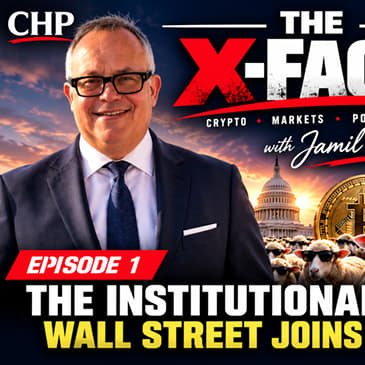

The X-Factor with Jamil Hasan returns with ten global cryptocurrency stories examined through four principles of governance: Trust, Protection, Consensus, and Stewardship.
In this revival episode, Jamil examines the digital euro, World ID's human verification technology, DeepSeek restrictions, Bitget's expansion, cryptocurrency project shutdowns, prediction-market regulation, tokenized bonds in Malaysia, and the evolving regulatory approaches to decentralized finance in Europe and the United Kingdom.
The episode concludes with a provocative examination of Bitcoin ETF flows and institutional herd behavior.
Are Wall Street investors leading the cryptocurrency market, or simply following price movements like everyone else?
Drawing on decades of institutional experience, hundreds of founder conversations, and the governance philosophy developed in The Lambs Lie Down, Jamil looks beyond the headlines to examine authority, accountability, and the human decisions shaping technological transformation.
Ten stories. Four governance principles. One X-Factor.
New episodes every Friday, with short-form commentary throughout the week.
Produced by CHP Media.
[00:00:15] [SPEAKER_00] Today is October 23rd, 2026. Welcome back to The X Factor with The Crypto Hipster. It's been a while. It's been since March of 2024 and I am now reviving this show. The Governance X-Factor is Episode 1, Episode 81, a new episode.
[00:00:45] [SPEAKER_00] The Governance X-Factor, who's really in control? You know, I have 10 stories. I have an amazing show coming to you and I am welcoming you back because it's been a while and but the cryptocurrency industry has not has not run out of things to talk about.
[00:01:09] [SPEAKER_00] If anything, the questions have become bigger. The institutions have become more involved and the consequences are more significant now than they were two years, three, four years ago when I was trashing and bashing Gary Gensler.
[00:01:32] [SPEAKER_00] I've learned a lot since then. You're not going to see me do that anymore. I've grown up and it took a little while to grow up. And now this show is coming to you with a different perspective. Every Friday. Every Friday. We're going to examine 10 stories, 10 used to be 16, used to be 18, used to be a whole bunch.
[00:02:01] [SPEAKER_00] We're going to take them from the global cryptocurrency ecosystem. And we're not going to predict the price of Bitcoin tomorrow. And I'm not going to tell you, you know, what token is going to make you rich today.
[00:02:15] [SPEAKER_00] And we're certainly not going to repeat whatever narrative becomes fashionable in the moment on social media. In fact, for irony here that I'm hosting the X Factor with the crypto hipster and I'm not on social media platform X.
[00:02:38] [SPEAKER_00] We are here to examine governance. Sounds boring. It's not. Because after years and years and years, I've been in 2017, watching this industry develop and interviewing founders and working within institutions before coming into crypto and writing 410 books plus counting about leadership, accountability, crypto, blockchain, you name it.
[00:03:10] [SPEAKER_00] I've been convinced of something. What is that? Something. The biggest challenge facing cryptocurrency isn't necessarily technology. It's people.
[00:03:24] [SPEAKER_00] It's how people exercise their perception of authority. Now, it's how institutions establish trust. It's how they protect the people who depend on them. It's how good decisions are made.
[00:03:42] [SPEAKER_00] And what happens when those decisions turn out to be wrong. In my new book, called Newer, called The Lambs Lie Down. I should see if I have a copy of The Lambs Lie Down. Right here, I do 71,000 words of it. I'm sorry, Don. You get on Amazon.
[00:04:14] [SPEAKER_00] I explore four fundamental elements, elements of governance, which are trust, protection, consensus, which we all know and love, and stewardship. Now, these four elements are going to guide our examination of the news every week as well. We're going to apply these principles, not just in the book, the historical stories and interviews I've had with founders. But we're going to examine each element of the news and the stories through that lens.
[00:04:43] [SPEAKER_00] So we're going to go from the European Central Bank to biometric identity. We're going to talk about AI and crypto exchange security. We're going to talk about failed blockchain projects and prediction markets. And then we're going to go from decentralized finance regulation to the behavior of institutional investors.
[00:05:14] [SPEAKER_00] And by the end, I think you'll see something interesting, something very unique, because a lot of people who claim to be leading the future of finance may actually be following somebody else. Let's get started. The X Factor with the crypto hipster, Friday, October 23, story one.
[00:05:44] [SPEAKER_00] The digital euro, who owns the future of money? Christian Lagarde and the European Central Bank are moving forward with plans for a digital euro. This is the same person who bashed and trashed Bitcoin for years, who saw no value whatsoever.
[00:06:09] [SPEAKER_00] The stated objectives include strengthening Europe's payment sovereignty, encouraging innovation, supporting competition, and ensuring that public money remains relevant in an increasingly digital economy. Those are legitimate objectives.
[00:06:58] [SPEAKER_00] And let me know your thoughts, which is the tagline for my first 80 X Factor books from the crypto hipster era, first era. When we digitize money, are we improving the way money works? Or are we changing the way money works? Or are we changing the relationship between the individual and the institution that issues it?
[00:07:28] [SPEAKER_00] Those are two very different things, you know. Physical cash, which I don't have any in my wallet, right, gives people certain practical freedoms. You can hand someone money without requiring a commercial payment intermediary to process any transaction. You don't need a banking application.
[00:07:51] [SPEAKER_00] And you don't need an internet connection for exchange of money, of hard cash, right? Digital payments introduce, you know, a new capability. But they also introduce dependencies. Who operates the infrastructure? Who determines access? What information is collected? Is Big Brother watching?
[00:08:19] [SPEAKER_00] What happens if the system fails? Where's your money going? And what protection exists against inappropriate surveillance or even exclusion? Bitcoin promises to be banking for the young banker on banking the bank.
[00:08:43] [SPEAKER_00] What does a European central bank digital currency that has constant surveillance by the government actually offer you? Now, to be fair, and that was not fair in my previous shows, but to be fair, the European central bank has discussed privacy protections and the possibility of offline digital euro payments for a while. The digital euro is not automatically a surveillance system.
[00:09:09] [SPEAKER_00] It would be irresponsible to characterize it that way only without evidence. Okay, so, but governance, governance requires more than assurances. It requires enforceable standards, transparent institutional responsibilities, and meaningful accountability. The ECB's responsibility is not simply to create an efficient payment infrastructure. That's one of the goals. That's not the only goal.
[00:09:39] [SPEAKER_00] It is to ensure, however, the public can trust. There's that word trust. Mechanisms without surrendering unnecessary autonomy. And that brings us to the first principle of governance. Trust is not obedience.
[00:09:59] [SPEAKER_00] Citizens should not have to accept every institutional decision simply because the institution says their decision is in their interests.
[00:10:15] [SPEAKER_00] A digital euro can be useful, public innovation, but its success should be measured not only by adoption or transaction volume, but by whether the people using it retain meaningful protection. That's the X factor.
[00:10:48] [SPEAKER_02] World ID and Zoom.
[00:10:52] [SPEAKER_00] Who decides you're human? Who decides you're human? Our second story takes us from digital money to digital identity. Our Zoom, the platform I use for this show, is introducing proof of humanity, proof of human verification capabilities associated with World ID.
[00:11:22] [SPEAKER_00] The identity technology developed by the world ecosystem. It brought you WorldCoin. The idea is straightforward as AI becomes more capable of generating convincing video and audio impersonation. Like, I'm telling you, I'm talking to you right now, but it could be my deepfake. All right? I don't have a deepfake, but it's possible there could be a deepfake of me sometime.
[00:11:51] [SPEAKER_00] Organizations need ways to establish the person appearing in the meeting is actually a human being. And let's acknowledge that problem, okay? So deepfakes are a serious security concern. An organization that conducts financial, sensitive financial transactions needs confidence that the person giving instructions is who they claim to be and not a criminal or scammer.
[00:12:20] [SPEAKER_00] And definitely not a creative and intelligent criminal or scammer. So verification has real value. But here's where governance, you know, enters the conversation. When an organization asks to prove you're human, what are you exactly being asked to surrender?
[00:12:41] [SPEAKER_00] So world identity architecture and the big problem of Gnuck and before in the past was, you know, scanning eyeballs. Right? It incorporates the biometric verification, you know, through its orbit devices, right? But it emphasizes privacy-preserving credentials as well.
[00:13:06] [SPEAKER_00] So the distinction between verifying a person and essentially storing their biometric information, I would say that's crucial. We shouldn't assume that the two are equal. Nevertheless, you know, the governance question remains. Who controls the verification infrastructure? Does the world going to it? What happens if the credentials are compromised?
[00:13:35] [SPEAKER_00] Can someone challenge an incorrect determination about somebody? If you say that my name is Joe Smith and I'm saying my name is Jamil Hasan and you're claiming I'm Joe Smith, do I need to verify that I'm Jamil Hassan and what do I show you that I am? Right? What alternatives exist for people who cannot or do not want to participate? Right? And here's the bigger issue, right?
[00:14:05] [SPEAKER_00] So today, a verification badge might be optional. Right? Tomorrow, an employer, a financial institution, a digital platform could decide that participation is mandatory. Right? Right? At that point, you know, a tool that was designed to establish trust could become a mechanism for control.
[00:14:34] [SPEAKER_00] Now, that doesn't mean that technology is bad. It means that the rules governing the technology matter as much or more than the technology itself. Protection is not control. A system designed to protect people from impersonation should not necessarily exclude people who cannot satisfy its verification requirements. Right?
[00:15:02] [SPEAKER_00] The goal should be to establish confidence while preserving dignity and individual choice. Because if you're proving you're human requires surrendering meaningful control over who you are and your identity to someone else who you don't even know, we've created an entirely new governance problem. Right? Why would we try to fix the old one?
[00:15:41] [SPEAKER_02] Story three, DeepSeq.
[00:15:43] [SPEAKER_00] When protection, which I was talking about, becomes restriction. So, this third story, it concerns the U.S. government's restrictions on DeepSeq within the federal civilian agency information systems. DeepSeq is an artificial intelligence company that is based in China.
[00:16:07] [SPEAKER_00] And American authorities have raised concerns about information security, data exposure, and the risks associated with using certain foreign developed AI systems in government environments. National security is a legitimate government responsibility. I think you'd agree.
[00:16:30] [SPEAKER_00] And nobody should expect federal agencies to place sensitive information in the systems without evaluating the risks. But the governor's question is how those decisions are made. What evidence supports a restriction? Who evaluates the evidence?
[00:16:59] [SPEAKER_00] What standards are applied? And are those standards applied consistently to people and to comparable technology? Because protecting sensitive government information is one thing. But using security as justification for arbitrary technological restriction would be something else entirely.
[00:17:28] [SPEAKER_00] We must distinguish between the two. Now, governments have authority for the government. To establish security requirements for those systems. That authority does not automatically imply that every restriction is justified. It also doesn't mean that every restriction is unjustified as well.
[00:17:52] [SPEAKER_00] The answer depends on the evidence, the scope of the policy, and the accountability mechanisms surrounding them. Now, this is particularly important in AI. Where, you know, technological capabilities are advancing faster than we can blink, right?
[00:18:16] [SPEAKER_00] And faster, much faster than any institutions possess them or can adapt to them. Institutions move slowly. AI development moves at a speed of light. Government and governance.
[00:18:34] [SPEAKER_00] Governance cannot simply become a competition between governments who can prohibit most technologies, right? Should China help at the China wall and China firewall? They can restrict.
[00:19:01] [SPEAKER_00] Governance must involve participation and proportionate responses to identifiable risks. And there's another dimension, which means that when the countries increasingly divide technological infrastructure, right? Along national boundaries, right?
[00:19:50] [SPEAKER_00] Transparency. And a willingness to reassess decisions as circumstances change. That's stewardship. Circumstances always change. And I write about stewardship in my book, Inheriting Saturn, where I've developed a stewardship framework. I could talk about this with you.
[00:20:18] [SPEAKER_00] Stewardship does not necessarily mean the exercise of authority. It's the responsible exercise of authority. Story four. Let's turn to crypto.
[00:20:47] [SPEAKER_00] Cryptocurrency exchanges. Bitget.
[00:20:52] Bitget.
[00:20:53] [SPEAKER_00] I've interviewed them a few times. Is pursuing an acquisition involving a licensed cryptocurrency exchange in Thailand. Good for them. Following the reports of a major security incident involving hundreds of millions of dollars. M&A based on security incident. Okay. They're expanding in the new markets. So, you know, it's not inherently irresponsible.
[00:21:22] [SPEAKER_00] It's something that's been done all long time. By Coinbase and Binance and others. Companies can and should pursue acquisitions. M&A. While simultaneously addressing operational challenges. Now, large organizations often manage several strategic initiatives at once. Small organizations do too. Timing matters.
[00:21:50] [SPEAKER_00] Timing is everything sometimes. More importantly, accountability matters too. When an exchange experiences a major security incident like the one in Thailand, right? The people depending on that exchange deserve answers. They demand answers. They want answers. I wanted answers when sales went bankrupt. I know the people wherever they are losing money. You demand answers right away. So, what happened?
[00:22:19] [SPEAKER_00] What system failed? Were customer assets affected? What am I going to get my money back? What corrective actions were taken here? What should have been taken? What should have been done? And what independent evidence exists that those actions had been effective? Most of the time, they're not effective. And that's why you get a hurt population of customers. Right? So, the questions that I just pose are not unreasonable questions.
[00:22:49] [SPEAKER_00] They're the questions that responsible management should expect to have to answer. So, here's why I think crypto has a particular problem. Right? The industry often treats expansion as evidence of success. In a lot of ways, it is. More countries, more customers, more trading volume, more partnerships.
[00:23:14] [SPEAKER_00] Growth doesn't necessarily establish institutional maturity. Sometimes, it establishes institutional recklessness. An exchange can become larger without becoming safer. And a company can announce an impressive acquisition. Right? Without having solved every weakness in its current operating systems.
[00:23:42] [SPEAKER_00] So, I want to be careful here because I don't know about BitCat's operating systems. And I don't know about the Thai exchanges operating systems. I will only talk to you about my experience from when I worked in corporate America. The existence of a security incident doesn't prove that a company or organization is incapable of expanding responsibly.
[00:24:13] [SPEAKER_00] You're going to have a hunch. You're going to have an idea. You're going to have an accusation. But it doesn't. And it doesn't. And the announcement itself of the acquisition is not established that management has neglected its security responsibilities either. Those conclusions both require evidence. Not hearsay. But that's the point. Right? Stewardship demonstrated through evidence.
[00:24:42] [SPEAKER_00] Not announcements. And the lamb lies down. The lambs lie down. I'll show you my book again. The lambs lie down. I don't know why it's not coming up. There we go. That's right now. I distinguish stewardship from ownership. Owning a company gives management certain legal rights.
[00:25:08] [SPEAKER_00] Stewardship creates responsibilities toward the people and interests that depend on the company. Those responsibilities don't disappear when an organization identifies an attractive growth opportunity. So the question I would ask BitCat, in particular, isn't simply why it wants to expand into Thailand.
[00:25:37] [SPEAKER_00] I would love to go to Thailand for vacation. I heard the beaches are wonderful. I should have been there. And they are. I'd ask BitCat, you know, what it has learned, you know, from the security incident. Right? What has changed operationally? How do prospective customers and regulators verify those improvements?
[00:26:03] [SPEAKER_00] Because the institution should not be judged on how rapidly it expands. It should also be judged on how responsibility and responsibly it responds when something goes wrong. And that was missing from the 2022-2023 crypto industry. So maybe we have an opportunity here.
[00:26:31] [SPEAKER_00] BitCat has an opportunity to show how to do things right. Story five. 82 cryptocurrency shutdowns. Technology is not a business. Yes. So.
[00:26:58] [SPEAKER_00] The next story is probably the most revealing story of the whole week. Right? According to research by Cointelegraph, or highlighted by Cointelegraph, 82 cryptocurrency projects and protocols have reportedly shut down during 2026. 82. That's a big number.
[00:27:27] [SPEAKER_00] Other research has identified that even a larger number of closures, depending on how projects are counted, to account a meme that is only existing for a week, that's not what's being counted in here. What's being counted are legitimate projects. The reported reasons include insufficient revenue, depleted financing,
[00:27:55] [SPEAKER_00] security breaches, and the absence of sustainable business models. To me, that doesn't sound like a blockchain. Here's my reaction, right? Why should we be surprised? Why should anyone be surprised? For years, the crypto industry has confused fundraising with success. Right? A project raises $50 million.
[00:28:26] [SPEAKER_00] Another project raises $100 million. A token launches. The community forms. A valuation appears on screen. Everybody's happy. Suddenly, everybody starts talking about the next great financial revolution. Based on that new, shiny, squirrel object.
[00:28:55] [SPEAKER_00] Speaking of squirrels. Speaking of squirrels. I talk about squirrels in this book. Animals, monsters, and unclaimed baggage. I have a question. Where's the business? Where is it? Who are the customers? You build something that you're telling people that they want, but the people aren't buying what you want. What'd you build?
[00:29:24] [SPEAKER_00] Are they your customers? Or is it just hopium? What are they paying for? And can the organization sustain itself while investors stop writing checks? Oh, we raised this money. What should we do with it? Oh, we spent it on trips. We went to conference. It says, I'm a customer. I'm not mad. I'm not pleased with you.
[00:29:53] [SPEAKER_00] A token is not revenue. A valuation is not cash flow. And a large community is not necessarily a functioning business. Right? So look at Blast. Blast is on one of the 82. It's an Ethereum layer 2 network that reportedly attracted more than $2 billion in deposits
[00:30:17] [SPEAKER_00] before it announced that it lacked a credible path to economic viability. $2 billion. $2 billion. I have an path to economic viability for crypto hipster publications. I'm not getting $2. Let alone $2 billion. That's amazing. $2 billion in deposits. And the underlying economic model still couldn't sustain the operation after $2 billion.
[00:30:53] [SPEAKER_00] So, now deposits, they're not the same thing as revenue, are they? And that's why this distinction matters the most. Because the cryptocurrency industry loves to measure how much capital enters an ecosystem. But how much value is that ecosystem producing? They're different things.
[00:31:22] [SPEAKER_00] And who is willing to pay for that value without the expectation of speculative returns? So I spent many years working inside large financial institutions. Mostly AIG, but Prudential, Excel Group, which is owned by AXA now.
[00:31:44] [SPEAKER_00] One lesson that I learned from that experience is that an organization cannot survive indefinitely on a compelling presentation and on a promise about the future. Eventually, the economics have to work. And there's another side of the story, though. You know, here's the thing.
[00:32:18] [SPEAKER_00] You know, a business shutting down isn't automatically a governance failure. Yeah. Markets change, right? They change all the time. And technology has become obsolete. Competitors that weren't there yesterday emerge.
[00:32:47] [SPEAKER_00] Some of them get handed $2 billion. Sometimes the responsible decision is, you know, is to close the operation. Rather than continue to consume resources without a credible path forward. And what matters is how leadership, in quotes, leadership, handles that decision.
[00:33:15] [SPEAKER_00] Were customers informed? Who were remaining assets protected? Were obligations honored? Did management communicate honestly about the organization's financial condition? All that is stewardship.
[00:33:42] [SPEAKER_00] And here's the uncomfortable question for the founders of these projects. Were you building something people genuinely needed? Did you know what they needed before you built? Or were you building something people wanted to speculate on?
[00:34:07] [SPEAKER_00] Or were you speculating that this is something that you think people might need because you built it? None of those are the same thing. You know, if we want cryptocurrency to mature into an enduring economic system, we must stop treating fundraising as the proof of value creation.
[00:34:38] [SPEAKER_00] Technology is not a business. A token is not revenue. And a successful launch is not a sustainable future.
[00:34:48] [SPEAKER_02] Another story. Story six.
[00:35:01] [SPEAKER_00] Calci versus Utah. Who gets to make the rules? Our sixth story concerns prediction markets. I told you we're going to talk about prediction markets. So Utah, the state of Utah, has taken legal action against Calci and related trading entities.
[00:35:23] [SPEAKER_00] They argue that certain prediction market contracts violate state gambling laws. Interesting. Prediction versus lotto, right? Calci's position centers on the federal derivatives regulation and the authority for the commodity futures trading commission.
[00:35:47] [SPEAKER_00] So we have an emerging marketplace caught between different interpretations of regulatory authority. Who regulates the lotto in Utah. This is kind of where you need the lawyers or governance gets complicated. I can't talk from the legal aspect of this.
[00:36:17] [SPEAKER_00] It requires teams of lawyers. I'm not a lawyer. But to me, the question isn't simply whether prediction markets are good or bad. I know a lot of people who bet on them do well. I know those who have gambling addiction, right? The question is who has the authority to establish and steward the rules.
[00:36:45] [SPEAKER_00] State governments have responsibilities concerning gambling and consumer protection. Some states pull together gambling opportunities, and that's why you have Powerball and Mega. Not every state is involved in Powerball and Mega. But federal regulators have responsibilities concerning the derivative markets.
[00:37:11] [SPEAKER_00] And business operating across state boundaries needs some degree, interstate versus intrastate commerce, for a regulatory predictability. And those interests, there's always a conflict. Because disagreement doesn't mean governance has failed.
[00:37:35] [SPEAKER_00] Sometimes disagreement is evidence that multiple legitimate authorities are attempting to fulfill different responsibilities. Responsibility that they are responsible for. The challenge is determining when one authority ends and another one begins and where you overstep. Or where you have shared authority.
[00:38:00] [SPEAKER_00] Prediction markets are especially interesting because they blur all the familiar categories. Some contracts can resemble financial instruments. Because they blur familiar categories.
[00:38:17] [SPEAKER_00] In the area of risk management, you can make a case where some things could be governed or should be governed by the SEC and the CFTC. Bitcoin. Right? Right? For example. You know, others can resemble traditional wagers on uncertain events. DraftKings. For example.
[00:38:47] [SPEAKER_00] You never know what's going to happen at the ballgame. And sometimes the distinction depends on the contract itself, the purpose of the transaction, and the applicable law. So here's my question. Should a financial product automatically escape state gambling restrictions because it trades on federally regulated exchanges?
[00:39:17] [SPEAKER_00] Or, conversely, should states be able to impose their own restrictions even when that creates a fragmented national market? Hmm. They're not questions for me. Those are questions for courts. For legislators. For regulators. I hate to say the word politicians.
[00:39:48] [SPEAKER_00] And they got to resolve that through lawful processes, through the legal system. It's complicated. Right? But from my perspective, there's a broader governance lesson here. Consensus does not require that everybody agrees.
[00:40:10] [SPEAKER_00] It requires a legitimate process for resolving disagreement. If businesses, consumers, regulators, and governments don't know which rules to apply, uncertainty becomes a risk itself. And that uncertainty can undermine trust.
[00:40:40] [SPEAKER_00] The ultimate objective shouldn't be to give one institution unlimited authority. You see it all over the country. No kings. I don't necessarily agree with the no kings stance. In this case, maybe it's applicable.
[00:41:02] [SPEAKER_00] The ultimate objective should be to establish a coherent framework in which authority is clearly defined. And accountability follows responsibility. That's going to require a lot. That's going to require something we haven't seen on a political scale. That's cooperation.
[00:41:31] [SPEAKER_00] A marketplace without predictable rules isn't necessarily a free marketplace. Sometimes it's simply an uncertain one. Story seven. Malaysia. We're going to go to the U.S. We're going to go to Malaysia.
[00:42:01] [SPEAKER_00] I've been in Malaysia. It's nice. Kuala Lumpur is cool. Lots of big buildings. Lots of stuff to do. Awesome place. So, Malaysia's central bank is advancing its distributed ledger infrastructure for tokenized bonds. Including Islamic financial instruments known as Sukuk.
[00:42:30] [SPEAKER_00] I pronounced that right. The initiative is designed to support issuance, ownership needs, transfers, settlements through modern financial infrastructure. I don't know if Islamic finance is modern. I'm not an expert on it. But this is a significant development nonetheless.
[00:42:55] [SPEAKER_00] Because it demonstrates how blockchain-related technology is being incorporated into conventional finance. Even historical finance. Even rabbit hole finance. Right? But here's what I find interesting. You know, we spent years. Years. I have since 2017. Hearing that blockchain would eliminate intermediaries and decentralized financial power.
[00:43:22] [SPEAKER_00] Now, central banks are adopting distributed ledger technology while retaining institutional control.
[00:43:35] [SPEAKER_01] Hmm. Hmm.
[00:43:37] [SPEAKER_00] So, my question is, what exactly has been decentralized? Record-keeping? You know? Operational processes? What's the decentralized money? And I know it's not necessarily the authority governing the system. And I don't think that's automatically a problem.
[00:44:04] [SPEAKER_00] I mean, I'm curious. Right? A central bank has a public mandate. It operates within a legal framework. Right? It has responsibilities that differ from those of a permissionless cryptocurrency network. Fine. Right? There may be a legitimate reason or reasons for maintaining a centralized control or an authority over monetary settlement.
[00:44:35] [SPEAKER_00] Depending if you are a believer in Austrian economics or Keynes. Or, you know. Let's stop confusing things. Let's stop confusing the architecture of a database with the governance of an institution. Okay? A distributed ledger itself does not automatically create distributed power.
[00:44:59] [SPEAKER_00] A blockchain doesn't automatically create democratic participation. We need to say earlier, consensus does not require everyone to agree. Right? Tokenization doesn't automatically eliminate the need for trustworthy intermediaries. What matters is who can change the rules. Right?
[00:45:28] [SPEAKER_00] Who can authorize participation? Who can reverse or correct transactions under the legal applicable framework? And who do we point the finger to when something goes wrong? Who's accountable? Who's responsible? And who can hold those people responsible and accountable? Those are governance questions.
[00:45:54] [SPEAKER_00] Now, compare this story with the first article about the digital euro. Right? In both cases, established monetary authorities. One in the euro. One in Malaysia. They're both modernizing financial infrastructure. Technology may be more efficient, accessible, resilient. Right? And that's fine.
[00:46:21] [SPEAKER_00] Provided we are clear about what the technology is actually accomplishing. We should not call something decentralized. Simply because it uses distributed ledger technology or blockchain. Decentralization is about the distribution of authority as well. Not merely the distribution of records or assets.
[00:47:03] [SPEAKER_02] Story eight, we're going to talk about Cardano.
[00:47:07] [SPEAKER_00] And Mika, can you regulate decentralization? We just asked you that. The foundation, the Cardano Foundation, is urging European policymakers to reconsider whether DeFi, decentralized finance, and staking activities require additional regulation under Mika,
[00:47:35] [SPEAKER_00] under the European Union's framework. Right? So the central argument by Cardano Foundation is that regulation should reflect the activities being performed and the risks those activities create. And not simply the technology being used. Makes sense. And I think that deserves serious attention. Okay? Because DeFi presents a challenge.
[00:48:04] [SPEAKER_00] It's a challenge to regulatory systems designed around traditional financial institutions. It's centralized. Financial institutions are not centralized. So in a conventional bank, you have this legal entity. Right? Got a management team. They might be good or bad. A board of directors. Might be even worse. And identify an organization responsible for operating the business.
[00:48:30] [SPEAKER_00] What happens when financial activities are performed through software operating across decentralized networks outside of the scope of the control of the bank? Who is that institution? Who is the intermediary? Who's the management team? Who's actually controlling the activity? Anybody? Let's consider staking. Okay?
[00:48:59] [SPEAKER_00] A company that takes custody out of customer assets and operates a staking service that has responsibilities that differ from those of an individual, of you and me, who independently delegate tokens through a non-custodial mechanism. Whether I prefer the former or the latter is up to me. The economic activity might appear similar, but the control structure is completely different.
[00:49:30] [SPEAKER_00] So governance needs to recognize that difference. Now, I don't believe that calling something decentralized should automatically exempt it from regulation. That's too convenient. That's too easy. That was kind of making everybody get rich quick, right? An organization can describe itself as decentralized while a small group of insiders would then control
[00:49:58] [SPEAKER_00] its treasury, government's votes, software upgrades, and operating decisions. You don't want that. We have seen enough examples of concentrated authority disguised as decentralization to know the terminology alone means very little.
[00:50:23] [SPEAKER_00] So the question is, you know, should not be whether a project uses the word decentralized. They all can. The question should be who exercises meaningful control? Who can change the system? Who can access customer assets? And who can make decisions that materially affect other participants?
[00:50:55] [SPEAKER_00] Who's responsible when those decisions cause harm? Those are the questions regulators should be asking. And those are the questions industry participants should be prepared to answer. Because accountability should follow authority, not marketing language.
[00:51:25] [SPEAKER_00] If the European regulators can establish the distinction clearly, they have an opportunity to. They may be able to protect participants without unnecessarily restricting legitimate decentralized activity. European regulators have an opportunity here to do the right thing from the lens of stewardship.
[00:51:54] [SPEAKER_00] But if regulation treats every technological arrangement as though it were a traditional financial institution, and it's not, it risks misunderstanding the very systems it is supposed to govern. And that is the X factor.
[00:52:26] [SPEAKER_00] We're going to stay in Europe for the story nine. The United Kingdom, who regulates a system without a boss? So crossing the English Channel, looking at Big Ben, going to London, to UK, the UK's Financial Conduct Authority, which is their regulator, has opened consultations concerning decentralized finance
[00:52:54] [SPEAKER_00] and the application of cryptocurrency regulations. Good, right? The FCA is examining how existing financial crime requirements should apply to DeFi activities. While it also is clarifying which cryptocurrency arrangements may fall outside particular regulatory requirements. I think it was five years ago. There's a crackdown on,
[00:53:24] [SPEAKER_00] at the airport in the UK, where they found gold bars, people's body being trying to be, you can't do that with crypto, right? But we have an interesting contrast. And we have an interesting contrast with the previous story. Right? The Cardano Foundation is questioning the expansion of regulatory European obligations,
[00:53:49] [SPEAKER_00] while the FCA is examining how its own regulatory framework should apply to emerging decentralized activities. They're both in different jurisdictions with different legal structures, but the same underlying governance problem. How do you assign responsibility in a system where control may be distributed
[00:54:15] [SPEAKER_00] among multiple participants? So let's say a decentralized protocol, the software is a major exploit, right? Who is responsible for that exploit? The developers who wrote the code? It's easy to play fingers at them. One, the people who approved a governance proposal, the validators who process the transactions,
[00:54:44] [SPEAKER_00] or the users who interacted with the protocol, or even the organizations who operated the interface through which people accessed it. It's a difference for the developers. Right? Where do you point the finger? The answer may depend on the facts and the legal relationships and the degree of control that each participant exercised,
[00:55:13] [SPEAKER_00] the role and acts of each participant. And that's why it's difficult to determine, because traditional regulation frequently relies on identifiable intermediaries. Decentralized systems may distribute functions among participants who have very different responsibilities. But I want to challenge something here.
[00:55:41] [SPEAKER_00] The absence of a conventional chief executive does not mean the absence of leadership. And the absence of a corporate board does not mean the absence of governance. Nor does it mean that the CEO is actually a leader, or that the board didn't get their job because of who they knew instead of what they know.
[00:56:11] [SPEAKER_00] Someone may still control the treasury. And someone may still determine which software changes are proposed. Someone else might still exercise disproportionate voting power. My vote counts for one while your vote counts for 20. That's not proportionate. And someone still may benefit financially from decisions that affect everybody else negatively.
[00:56:42] [SPEAKER_00] So we have to examine how the system actually operates in practicality and actuality and not simply how it describes itself. This is where consultation becomes important, right? A regulator that listens to developers, users, businesses, advocates, and experts has a better opportunity, you know,
[00:57:12] [SPEAKER_00] to understand the consequences of the decisions. But those consultations must be meaningful and not just lip service. It shouldn't simply be a procedural exercise in which the outcome has already been decided. and you're just going through the motions. Because consensus isn't about pretending that everybody agrees. It's about creating legitimate processes
[00:57:40] [SPEAKER_00] through which competing interests can be considered. ultimately, responsible regulation should make financial systems safer without unnecessarily eliminating the characteristics that make those systems innovative.
[00:58:16] [SPEAKER_02] story 10.
[00:58:19] [SPEAKER_00] This is our last story of the week. Weekending 10-23-2026. We go Monday to Friday here unless we've got something compelling over the weekend. I'll let you bring it next Friday. We'll see. The institutional sheep. Wall Street joins the herd. The herd.
[00:58:49] [SPEAKER_00] It's my favorite story of the week by the way. And the sheep. Not to confuse the sheep with the lambs. The lambs lie down. Is Wall Street lamb? According to research from DWF Labs, Bitcoin exchange traded fund flows appear to follow price movements far more closely than they predict future returns.
[00:59:20] [SPEAKER_00] Who's chasing price? The researchers examined 694 trading days beginning in January 2024. Which I love because that's when I was wrapping down the first iteration of my first four seasons of the X factor. They started their research. This brings me to today. I love it. They found the correlation of approximately 0.54. Just good correlation. The correlation coefficient.
[00:59:50] [SPEAKER_00] Between ETF flows and Bitcoin's returns over the preceding five trading between ETF flows and returns over the following five trading sessions was only 0.03. What does that mean? Right? ETF flows showed a meaningful relationship with what Bitcoin had already done but almost no
[01:00:19] [SPEAKER_00] relationship to what Bitcoin was about to do. somebody institution A, B, C is chasing squirrels. So the research also found that seven of eight major Bitcoin sell-offs were accompanied by ETF outflows by all nine rallies at at least 15% attracted net inflows.
[01:00:48] [SPEAKER_00] That makes sense. Right? Now, let's be precise. the study does not establish that every institutional investor is following the herd. Not every one. The researchers could not definitively separate institutional and retail activity. Okay? It means retail is joining the squirrel chasing syndrome parade as well.
[01:01:19] [SPEAKER_00] Some ETF transactions reflected hedged creating strategies which are very popular now. But the aggregate pattern, the aggregate is fascinating to me because investors appear to be buying after prices rise and selling after prices fall. Does that sound familiar
[01:01:41] [SPEAKER_02] to you?
[01:01:43] [SPEAKER_00] I've been watching this behavior on financial markets for a long time. And crypto has provided some spectacular examples. people become enthusiastic when prices are rising. And they become cautious when prices are falling. It's human nature, right? They demand exposure after an asset has already appreciated substantially. And they lose conviction when the same asset becomes cheaper.
[01:02:14] [SPEAKER_00] Now, everybody's entitled to make their own decisions. Here's what I do. I buy low. and maintain my conviction because I've been doing this for a long time. I have conviction in certain coins. It's not an easy task. It's not an easy thing to do. It goes against the grain. It's kind of like shaving against the grain every day. What interests me is the narrative surrounding institutional participation, though. That, to me, is fascinating because for years,
[01:02:44] [SPEAKER_00] the cryptocurrency industry has treated institutional adoption as a form of validation. The institutions are coming. Yay! They're going to buy my bags, and they're going to build them up, and I'm going to be rich. That's not what's happening. A major financial institution announces a cryptocurrency project or
[01:03:13] [SPEAKER_00] product, and suddenly people assume the asset has become more legitimate because JPMorgan bought Bitcoin and it becomes more legitimate? Really? No. It's always been legitimate. Litecoin's always been legitimate. Zcash has always been legitimate. Just because you say it's legitimate, it's legitimate. Nah. An investment
[01:03:43] [SPEAKER_00] fund increases exposure and commentators interpret that as evidence of sophisticated conviction. Try getting lunch money of $5 or $20 or whatever comes in the door and instead of eating, buying, Bitcoin or Litecoin or Zcash instead of eating. That's conviction.
[01:04:14] [SPEAKER_00] A well-known executive makes a bullish statement and the market pays attention. But here's my question, right? Why should the size of an institution automatically establish the quality of its judgment? It doesn't. To me, it doesn't. A large institution can make excellent decisions. It can also make poor ones.
[01:04:44] [SPEAKER_00] It can conduct independent research and it can follow the same market trends as everybody else. Institutional participation is not the same thing as institutional wisdom. You don't get institutional wisdom because somebody slaps a title on you. Get it from what you built, what you lived, what you experienced. And that brings us
[01:05:14] [SPEAKER_00] directly into governance because consensus is valuable when it emerges from informed participation, independent judgment, and a legitimate decision-making process not by being handed a title. But conformity is something different, isn't it? Conformity occurs when people follow a prevailing narrative, negative,
[01:05:44] [SPEAKER_00] because everybody else appears to believe it. And financial markets are very susceptible to that behavior. I've been watching it for a long time. Think about what happens when an investor says that institutions are buying, so I should buy. Well, those institutions are buying in much more bulk than you, and allow them over to Canada because they get a cheaper price than you.
[01:06:14] [SPEAKER_00] So what has the investor, the retail investor in that case, actually established? Has the investor evaluated the asset or just saying, oh, mark, oh, crypto good? Have you examined the underlying economics? Have you considered the risks? Or have you simply delegated your judgment to somebody who has a title?
[01:06:44] [SPEAKER_00] That's not necessarily consensus. It may be imitation. Sure. I'm doing what you did because you whatever. Here's where I think the sheep metaphor becomes useful. A herd doesn't need every participant to be irrational. It only needs enough participants to base their decisions on what others are doing.
[01:07:15] [SPEAKER_00] Resulting behavior can become self-reinforcing. Prices rise, investors become more confident, money flows in, the inflows appear to validate the price increase. Bank conditions reverse. In crypto, they reverse pretty quickly. Prices decline, confidence weakens, money flows out, and suddenly
[01:07:45] [SPEAKER_00] the same participants who are celebrating institutional adoption are worried about institutional selling. Now, none of this means that Bitcoin ETFs are bad products. They're not. They provide a regulated environment vehicle, an investment vehicle, right, through which people can obtain exposure to Bitcoin without directly holding the underlying. That can be useful.
[01:08:15] [SPEAKER_00] It can be useful, but the existence of a regulated product does not eliminate behavioral risk. It simply provides another channel through which our decisions, our human decisions, influence the market. market. The market can remain irrational longer than you and I can stay solvent. And that's the lesson. The market doesn't become
[01:08:44] [SPEAKER_00] wise merely because its participants become institutional. The human element remains. Fear, greed, social pressure, and the temptation to follow the crowd all remain. So the next time someone tells you that an investment must be attractive because a
[01:09:13] [SPEAKER_00] major institution is buying it, ask a simple question, right? did the institution lead the decision or did it follow the price? Was the institution a rock or was the institution a squirrel?
[01:09:43] [SPEAKER_00] Because sometimes the people at the front of the parade are simply following the sheep ahead of them and sometimes they're the biggest institutions in the world. And that, ladies and gentlemen, is the X factor. So let's bring those
[01:10:12] [SPEAKER_00] stories together. Let's finish it off. Bring those stories together because we started with the European Central Bank and the future of digital money. We examined the growing importance of biometric identity. We looked at governments restricting artificial intelligence in the name of security. We questioned responsibilities of cryptocurrency exchanges the following major security incidents. We examined the dozens of shutdowns of crypto
[01:10:42] [SPEAKER_00] projects that could not sustain their operations. We also explored disputes over who has the authority to regulate production markets. We looked at Malaysia and we saw the adoption of DLT technology within centralized financial infrastructures. We considered the European debates, the UK. Finally, we looked at institutional investors whose aggregate trading behavior appears to follow
[01:11:12] [SPEAKER_00] market trends as followers, as sheep, rather than anticipate them. 10 stories different countries, different technologies, different institutions, but underneath all of it are the same four questions. Can we trust the people exercising authority? Are they protecting the people who depend upon
[01:11:42] [SPEAKER_00] them? Are decisions being made through legitimate processes? And are those responsible for the decisions acting as genuine stewards, as trust, protection, consensus, stewardship? And those are not abstract philosophical concepts.
[01:12:13] [SPEAKER_00] They determine whether financial systems function responsibly, whether technology serves the people, institutions remain accountable, and whether the next generation inherit systems that are stronger than the ones we have today. And that is why I'm bringing back the X factor with the crypto hamster. Every Friday, 10 stories, the global cryptocurrency
[01:12:42] [SPEAKER_00] ecosystem, not price productions, not recycled headlines, not investment recommendations, an examination of the governance decisions shaping the future of digital finance. I'm Jamil Hassan, the crypto hipster. Thanks for joining me today on, we're going to call this revised or revamped X Factor
[01:13:11] [SPEAKER_00] episode 1, overall 81, the new season, the new show. Thanks for joining me and remember, do not confuse authority with wisdom, don't confuse protection with control, and never confuse consensus with a herd of sheep. I will see you next Friday. Thank you for joining
[01:13:41] [SPEAKER_00] me today, tuning in.