
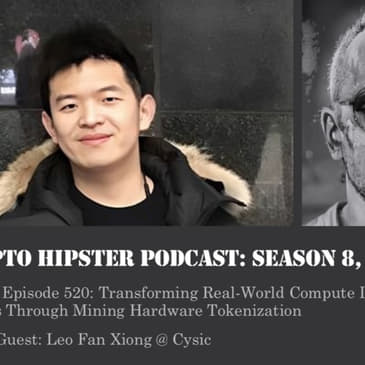

Leo Fan is Co-Founder of Cysic, Assistant Professor of Computer Science at Rutgers University, and a former core researcher at Algorand. He leads the development of ComputeFi, Cysic’s hardware tokenisation model that turns real-world compute into on-chain assets — part of Cysic’s broader mission to build low-latency, cost-efficient infrastructure for real-time Web3, AI, and decentralised applications.
[00:00:03] Hello, everybody, and welcome to the Crypto Hipster Podcast. This is your host, Jamil Hasan, the Crypto Hipster, where I interview founders, entrepreneurs, executives, thought leaders, amazing people all around the world of crypto and blockchain globally. And I have another amazing guest for you today. I have the co-founder of Cysic. His name is Leo Fan. Leo, welcome to the show. Thanks for having me here. Best to meet you, Jimmy.
[00:00:34] You're very welcome. Nice to meet you, too. So thank you for joining me. And let's kick things off, and I'll ask you first. I ask everybody the same question. I get all kinds of amazing, wonderful answers. It's this. It's what is your background, and is it a logical background for what you're doing now?
[00:00:52] Yeah, so I'll talk a little bit about my background. So I graduated. My bachelor's degree is in mathematics. I'm always intrigued by the nice logic in mathematics.
[00:01:06] And after that, like, I started doing some cryptographic research during my master's study. I was in Chinese Academy of Science. It's almost 12 or, I guess, like 14 years ago.
[00:01:22] I lost the sense of time after a pandemic. Yeah, so I did some, like, I actually, like, I encountered a very interesting paper called the Bitcoin White Paper while I was a graduate student there, like, during 2010. I guess the end of 2010. I guess the end of 2010. Yeah, I found it's, like, very fascinating in that paper to do this, like, Bitcoin, like, this decentralized cryptocurrency.
[00:01:53] So, like, at that time, like, I started doing some, like, Bitcoin mining using the, I guess, the crafts from some very big, like, GPU machines to do, to start doing some Bitcoin mining starting in 2011, probably, like, the middle of 2011. And after about, like, three years. And after, after that, I, I decided, probably, like, I, instead of just doing this, like, mining stuff, it's, it'd be boring.
[00:02:19] So, like, I found probably, like, I can, I can do, like, pursuing things, like, I'm, I have a little bit, like, educational background. So, I can pursue, like, more freedom in this, um, knowledge-based ocean. So, like, I, I did my PhD at Cornell. Like, it's in Isaka in the middle of nowhere. Absolutely, absolutely New York.
[00:02:42] Uh, yeah, I spent, like, about, like, four wonderful year, year, uh, four wonderful years there, like, probably, like, except for the, for the summer, which is the most wonderful in Isaka. Uh, yeah. And then after, after graduation, like, like, like, my, my PhD is about, like, designing, uh, this, like, post-quantum secure crypto, crypto systems, um, um, like, there.
[00:03:06] Yeah. And after, after my PhD, I spent some time as a researcher at NIST, which is, uh, I guess, like, National Institute of Standardization, uh, technology, where, like, I helped evaluate some of the, um, uh, submissions to, to NIST on the post-quantum crypto part. So, here, this crypto stands for cryptography. Uh, yeah. Then afterwards, like, I spent some time as a researcher at Argorent.
[00:03:34] So, Argorent is a blockchain company. It's a near-run blockchain funded by Silver McCartney, which, uh, who is a two-year-old and also a MIT professor. Yeah, so it was at, like, Argorent, we designed something called Argorent State Proof. So, Argorent State Proof is a ZK proof. You can use it as a ZK bridge to bridge assets from Argorent to Ethereum and Argorent to Solana.
[00:04:00] So, when I finished the POC on the design, I found it took so much time to generate just one single proof of this megastate proof, like, using a very large instance from AWS. So, like, at that time, I think, probably, like, we can design something similar to Bitcoin mining. So, before in Bitcoin mining, we started as a CPU, then GPU, then FPGA, then ASIC. So, like, we can, we can do some, we can design some specialized hardware to make the proof generation faster.
[00:04:30] So, that's the original idea to start, uh, to start CISIC. So, CISIC, uh, it's like, I borrowed, borrowed ideas from Argorent. So, Argorent, we call, is a combination of two words. So, algorithm and randomness. So, it's a combination of these two words, Argorent. So, CISIC is also a combination of two, two words, it's called. The first word is, like, cipher. The second word is, like, ASIC.
[00:04:55] So, initially, uh, essentially, we want to design some ASICs, which is a specialized hardware, to make the proof generation, to make the crypto faster. Yeah. So, that's, that's, like, how we, like, started, like, CISIC. Wow. Interesting. I, I, I, I've interviewed a number of people from Algorent, but I never knew that it was a combination of algorithm and randomness. So, I learned something new there. Thank you.
[00:05:22] Now, when I hear, when I hear cipher, I think cipherpunk, right? I think Ethereum, I don't think ASICs. You combine the two. So, what is CISIC all about, including your vision and your mission and the purpose for your company? Yeah. So, like, so, I thought, so, deep down, I'm a, like, cryptographer. So, as a cryptographer, like, I thought, like, a very wonderful, like, there are, like,
[00:05:52] so many wonderful function and so many wonderful primitives in crypto. So, which cannot be realized in the real world because it's, like, very inefficient, such as their knowledge or fuller homomorphic encryption or even, like, this IO is called indistinguishability obfuscation. So, those are, like, very wonderful, like, very powerful crypto primitives, but it's just cannot be realized in the real world. Yeah.
[00:06:21] So, it's, like, very similar to RSA. So, like, if you record, like, RSA, back in the, in the 80s, like, RSA, public key encryption is also very powerful encryption mechanism compared with a symmetric key, such as, like, AES or, like, DES. But at that time, it's, like, also, like, very, like, very efficient, inefficient, and it will require a lot of computing power for doing the RSA encryption.
[00:06:48] So, the RSA, which stands for, like, three, three very, very, like, famous and also very important cryptographers in the, here, like, Revist, Linderman, and Shamir, they, like, started a company called RSA. The RSA is, like, to develop some, like, very efficient power to instantiate this, like, RSA encryption.
[00:07:17] So, like, probably, like, in, in the, like, in the 20s, we can also, like, we can also, like, have a company which, which is, like, developing, like, some specialized hardware, like, of company with some, like, software to accelerate the nice, like, primitives in cryptography to make it real nice in the real world. Yeah. So, that's, that's the big scope. Very good. Very good.
[00:07:43] So, I want to talk about, I want to talk about chips and specialized chips, right? So, why are specialized ASIC chips necessary for verifying ZKPs, zero-knowledge proofs, in real time? And what will these chips allow? Yeah. Yeah. Yeah. So, that's a very good, good, good question here. Yeah.
[00:08:08] So, so, to be honest, like, the verifying ZKPs is, it's not a very difficult task. You can use a phone or, like, probably, like, a very night hour, such as Raspberry Pi, like, to, to verify a proof. It just takes about, like, one or two seconds. And the total computation time, probably, like, is about 50 milliseconds to verify a naked proof. And the bottleneck or the obstacle here is to generate a naked proof.
[00:08:37] The proof generation takes a lot of time. And I guess, like, also the, yeah, since, like, we, previously, like, we are tackling on this, like, very wide integers. So, it's not very tailored to this, like, CPUs or GPUs, which is, like, designed for, like, small width integers, such as probably, like, 8-bit or 16-bit.
[00:09:01] But for ZKPs, I guess, like, right now, the least wide integers is about, like, 30, 31-bit integers. So, it's a very wide integer. And if you just go with a normal design, like, you go with a normal CPU or GPU computing powerbine, it's not very efficient. You can still do the job. But if you want to scale Ethereum, saying, like, you have this, like, real-time ZK proofing for
[00:09:29] Ethereum, probably, like, you need to say, like, there is a very recent news by Succinct, which is the VKVM team. They have this, like, they use, I guess, like, 160-bit GPU to have this, like, real-time VK proofing for Ethereum. And this, like, real-time VK proofing is just to prove, to generate a VK proof, like, in about, like, 12 seconds.
[00:09:55] But that's relying on this 160-bit GPU card. It's around, like, 300k US dollars. That's enough for normal users to carry out. And, of course, it's not very beneficial for Ethereum to decentralize if Ethereum want to adopt this, like, ZK5 in their one.
[00:10:19] So, like, with ZK6 power, you can actually carry out the ZK proofing in real-time as a very cost-effective and also energy-effective way. Yeah, so that's something, like, we're working on and something we are going to realize in the upcoming months. Got it. Got it. So, there's this concern out there.
[00:10:43] I say in the market or between people I talk to, at least, you know, on X or wherever, that blockchain, and especially ZK, is critical with verifying artificial intelligence-generated results. I want to find out for you why it is important. Okay. Yeah, so I believe you are, like, you use ChargedGPD or not.
[00:11:13] But, like, they charge you, like, monthly. And probably, like, after 10 days or, like, 15 days of your monthly subscription, you will notice there is a decrease in the quality of the response by ChargedGPD. So, they are not using the most recent model to answer your question.
[00:11:34] In public, they claim they are using, like, ChargedGPD 4.0 or 4.0, but instead, probably, they are just using ChargedGPD 3.5 or, like, even ChargedGPD 3.0. And so, from, like, human perspective, we are, it's, like, very hard for us to capture the difference and also very hard for us to prove the difference.
[00:11:54] But using a ZKP here, you can say, like, whenever you use the inference, like, you use the word to, like, if you submit some, like, here is to ChargedGPD and it answers you. And in addition to the answers, it will also attach a ZKP proof showing that they are actually using the model they are claiming to reply to you.
[00:12:20] It's a responsibility for ChargedGPD for all these, like, AI models to do something like this. They're not cheating on their, like, customers. And ZKP can solve this, like, cheating issue. So, yeah. So, I noticed, I noticed that, too. I noticed, like, as a user, I'm, like, I asked ChatGPD a question. And it gives me, like, I'll ask it, how many books have I written? And it says 30. And the answer is 340.
[00:12:47] So, it's not, you know, it's not, the data, every time I look at it, your results, the data is not accurate. So. Right, yeah. So, how can we fix that? You know, how can I go and, you know, ask it a question and get the right data? Yeah, yeah. So, like, using ZKP, you can solve this issue. Like, whenever they want their inference, they can just attach a ZKP or ZK certificate along with their results.
[00:13:14] So, you can verify on that to say they are actually not cheating on you. And if they cheat, like, you have a way to tell the difference. And that's a better way to have a supervise on this, like, big AI company. Got it. Yeah. So, you started out by mining Bitcoin, right? 2011. Yeah. Yeah. So, you know, right now what I see is I see, you know, there's a new way.
[00:13:43] I guess you come up with a new way to tokenize. Like, you don't think of tokenization. You don't think of tokenizing the Bitcoin mining facilities and the Bitcoin mining hardware. Well, you can. So, how do you best tokenize the high-performance hardware? And why is tokenizing the hardware important? Yeah.
[00:14:03] So, as a, like, I guess, like, OG in the mining community, like, I know, like, a lot of, like, the mining machines and mining facilities, they are owned by, like, probably, like, around, like, 20 people. So, like, when, like, we want to get the access to the Bitcoins, like, we want to go to the exchanges we buy there.
[00:14:26] So, and as you can see, like, the exchange, their, like, cost is, you know, like, I guess at least 20% higher than the cost for the miners. So, the miners, they are, like, doing the hard work. They're doing the same thing. But they also have a very high risk. Yeah.
[00:14:47] So, like, if Bitcoin, the price of Bitcoin dropped down or not, they probably, like, they will just need to shut down their machine and then cannot get anything back. So, it's a two-sided problem. The first is, like, the normal users, we need to pay a lot of, like, premium for, to buy the Bitcoin. Like, we cannot just buy it from the miners. The miners, though, the cost will be, like, much cheaper than the exchange.
[00:15:14] And the second part is, like, the miners, they have a very high risk. They somehow want to reduce the risk. Yeah. Since, like, if the Bitcoin, there is, like, a sudden drop or, like, some OGs, like, they dump their Bitcoin or they have, they are worried about the SHA-256 or the digital signing algorithm in Bitcoin, then probably, like, the Bitcoin will, like, drop down a lot.
[00:15:38] Like, in the case of the quantum computers, which may have a very immediate, like, threat on the security of Bitcoin. So, the miners, they are worried about that. I saw only miners, like, I know that. I know that. So, the RWA in this, like, high-performance mining rigs can solve this issue.
[00:15:57] So, like, we provide a democratizing way for the normal users to access the Bitcoin or, like, some other, like, say, like, Dogecoin or Litecoin as, probably, like, similar to the price of the, similar to the cost of the miners.
[00:16:16] And, in the meantime, we also significantly reduce the risk of the miners since they are getting the stablecoin as, probably, like, some of the hedge against the risk of mining Bitcoin or this, like, other coins. So, I view it as a very balanced way to achieve a win-win for both miners and also the normal users.
[00:16:46] Got it. So, I have a couple follow-ups there. The first one, regarding Bitcoin. Regarding the Bitcoin model, the white paper was created in 2009. The Bitcoin rolled out in 2009, right? So, I don't know if Satoshi had this vision of, you know, he had this vision of every year, you know, every four years with the halving, the less Bitcoin mined, there's greater transaction fees eventually, right?
[00:17:13] But does this tokenization of the Bitcoin mining hardware and the support of the miners maybe help change that model that Satoshi already envisioned or help with the transaction, you know, income better? How does that have any effect on the Bitcoin model that was originally created or does it? Yeah, that's a very, very good question.
[00:17:41] So, like, as you can see, the Bitcoin white paper was, like, ripping up in, like, probably, like, more than one decade. Yeah, so, like, Satoshi, as the first E-wash, they didn't foresee, like, there are, like, so many significant changes in the coming ways. So, like, this, like, this, like, RAA or this, like, tokenizing the hardware.
[00:18:06] Yeah, I, to be honest, I don't see any, like, change to the fundamentals of Bitcoin. It only, like, provides a way for the miners and for the user to somehow get, like, balance points where they can, this, like, two group of users, they can get very reasonable income, very reasonable yield for their work.
[00:18:32] Yeah, yeah, so, like, as you can see, like, we are still, like, the miners are still there. The miners, they are still, like, putting a lot of, like, efforts, like, in mining Bitcoin. And due to the, I guess, as you can see, like, Bitcoin just reached all-time high during the PISA day. Yeah, so, I guess that also encouraged a lot of, like, miners to put, like, more resources, like, into mining Bitcoin,
[00:18:59] which probably, like, somehow will intrigue the interest in the normal users. Probably they also want to mine the Bitcoin, but they don't have the, they, like, if you want to maintain a machine, you need to buy a machine and then have the facility to maintain it, which is, like, the machines you are, like, very allowed. But, yeah, so, so the tokenizing or RWA in the Bitcoin mining rigs or other coin, like, mining rigs,
[00:19:27] will give the normal users a way to have access to, like, much cheaper, like, probably not much cheaper, but reasonably cheaper, like, price of these mainstream cryptos. Got it. That was my first follow-up. The second one is, last year, I moderated a panel at the Litecoin Summit in Nashville. This year, I'm not able to attend the Litecoin Summit, but last year, I interviewed three mining companies, right?
[00:19:56] And one of those mining companies was developing, was, you know, mining Litecoin, mining Dogecoin. You mentioned Litecoin and Dogecoin. And they were using chips that were AI convertible. So they could, you know, you might want to do Litecoin, you might want to dogecoin, and then later on, you're able to use those chips for AI applications, right? How does the future of AI convertible, convertible AI chips playing out?
[00:20:26] How does that help build the ecosystem forward? And what do you see the future of it as? Okay. Yeah, so, like, I'm somehow, like, to be honest, I'm somehow surprised to learn that the Dogecoin mining rigs can also be used to do AI competition. Since, as you can see, like, in the Doge or, like, coin mining, the competition carryout there is, like, called, like, the script. Script is a hash function.
[00:20:53] So, like, in my opinion, it has not much thing to do with AI computation or, like, AI influence. And, of course, you can see, like, if you come up with a general machine that can do this, like, script and also, like, AI influence and the training at the same time. But this machine must be not as efficient as a professional machine.
[00:21:16] The professional machine produced by Binman or, like, some other Dogecoin, like, mining company. Yeah, so it's, like, a compromise between this, like, general reality and efficiency you need to balance.
[00:21:34] Like, if you want to do something, like, more generalized, like, say, like, this machine can be salvaged to do some, like, recycle to do some, like, AI competition at the same time, then it must be not as efficient as the professional ones, professional mining rigs. So professional mining rigs, there is, like, only one goal they want to achieve is to get to do the mining in, like, very energy efficiency way.
[00:22:02] Yeah, so that's the only thing they want to achieve. And there's, like, no other things. So they will have this, like, script, this, like, hash function instantiated in just one chip, like, very, very efficiently. And then in just one mining machine, they will have hundreds of chips inside. So that's why they have a very high power of, like, the very high hash power, hash rates in the machine. Yeah. God, I'm glad you mentioned that, the energy efficiency.
[00:22:32] Sometimes I forget about that. Because there's still this narrative out there that Bitcoin is bad for the environment. It's awful. It takes up so much use. And I'm like, well, Amazon, you know, data centers take up, actually pollute the environment more. But why, you know, what are the, why do we continue to have a mission of, you know, energy efficiency? And why is that important? And how can, how can mining, you know, and CISIC help create that efficiency? Okay. Yeah.
[00:23:01] So there's, so, like, probably, like, something outside of the question here is, like, so, like, I, like, in the past years, I also acted as a VC, like, somehow in crypto. Like, when we want to evaluate, like, mining project is, like, not the innovative or tech side to evaluate. We do it more on the energy side. We want to make sure the mining facility, they have a very low electricity bill.
[00:23:28] Like, probably, like, their electricity bill, like, is much lower than the ones in Texas or, like, Ohio, something. Yeah. So, and, so that's the most important part. And other than that, like, we don't care too much. Yeah. So for CISIC, so the energy efficiency is, like, very important. We don't want to draw too much criticism. Yeah.
[00:23:51] Since we are, like, manufacturing, saying, like, sound, like, ZKA6, probably, like, also some miner rigs in the future. We don't want to draw a lot of criticism and to say, like, we are polluting the environments. Yeah. Yeah. We are just consuming, like, too much power to do something like cryptocurrency mining. Yeah. Yeah. There are, like, various ways to solve these issues.
[00:24:18] Like, as you know, there's, like, one way, like, it's all about the cooling of the machine. Like, the machine, like, if you just use a fan to cool the machine, then probably, like, it will be, like, very high energy consuming. But if you use some, like, liquid or, like, water to cool the machine, then it will be, like, much, probably, like, not that energy consuming on that.
[00:24:45] So that's, like, one perspective we are now exploring. And second, we are only talking about these, like, professional machines, which are, like, in the IDC or in the mining facility. It's, like, a very loud, very, very hot space. But there is, like, one possibility as well is that we can create a home-based one.
[00:25:09] And this, like, home-based one can be, like, very quiet and public or just the energy efficiency or energy requirement is, like, on a part with your coffee machine. So it's running there. It's, like, generating this revenue. And, yeah, so it's just about, like, say this, like, for instance, like, you forgot to turn off your ACs in your room, like, for one day.
[00:25:38] Probably that's the energy requirement for, like, one month of the machine. Yeah. So that's something we are going to achieve and something we have already achieved for the home-based one. Yeah. Yeah. So we have, like, two, like, for the ZK hardware product, we have, like, two hardware products. The first one we call ZK Air, which is portable. It's the size of a MacBook charger. Yeah.
[00:26:06] So you can carry it around with you and you just plug that into your computer or in your cell phone and then you can generate ZK proof on that. Yeah. So it's a very lightweight, energy-efficient machine. And, of course, we have some, like, promotions for the pros. Yeah. Yeah. So there are, like, various ways we can address the issue. I like the handheld one. Yeah. Yeah. That's good.
[00:26:36] You know? So if you have the handheld, right, and you enable, you enable, you know, ZK enabled, right, how can you enable widespread adoption of ZK inexpensively? Yeah. So that, I guess, depends on a lot of, on the, like, on the software and also on the hardware. So let's start with the software one.
[00:27:05] So previously, like, in ZK, like, when people want to run some, like, ZK program, they need to be experienced. They need to be some experts in writing the ZK circuit, which is a very particular field of programming. It's not, like, the general programming, such as, like, writing, writing code in Python or code or, like, Rust or, like, C++.
[00:27:27] It's a very, very niche field where it requires a lot of expertise in writing the ZK circuit. And in the past year, I guess, like, we saw a lot of advancement in the, you know, like, technology called ZKVM. So it's their knowledge virtual machine, which will convert the normal program written in Go, in C++, in Rust into the ZK circuit.
[00:27:56] So it lowers the barrier for the programmers to do the ZK stuff. Like, you don't need to write ZK circuits. You just need to write your normal program. And the compilers in the ZKVM will compile into the, into the, into the, into the ZK circuits. So you don't need to worry about, you don't need to have that expertise. Yeah. So that's on the software. It lowers the barrier for the programmers to use ZK. Okay. So the second one is about the hardware.
[00:28:27] On the, on the hardware. So, like, the ZKVM didn't solve the issue of, like, the snow, snow is, like, in ZK proof generation. Or the energy requirements, the resource requirement in the ZK proof generation. The online lower the barrier for the programmers to program in ZK. Yeah. So the second issue is about the hardware. So we need to design, design or, and also manufacturing some of the specialized hardware for ZK.
[00:28:56] To prove, to make the ZK proof generation faster, energy efficient, portable, and also probably, like, costly efficient. Yeah. For people to use. So in that way, the ZK can really enter the, the main streets instead of just staying in the Web3 community.
[00:29:17] So as you can see, like, in, like, in, like, in, like, in the, in the Web3 community, there is, like, no, no much mentioning in the traditional enterprise, like, using the ZK problem. Like, there are, like, several, such as Google, but I guess the majority, or 99% of them are not using ZK because of this, like, two, two barriers. And we have made, we have made enormous advancement on the software, like, by the ZKVM.
[00:29:44] But it's unaware, like, require on the hardware to, to make the ZK complete. Yeah. The hardware makes sense to me. It makes sense. Yeah. The, the, you said, you said you're lowering the barriers for programmers. Now, those barriers, you know, are there barriers in, in, in, like, I would think that if you made coding easier, then more people would be in it and then you get mass adoption. Right?
[00:30:14] You still need to make it easier, right? If we don't make it easier, then how do we get, then how do we get mass adoption of, of ZK? Because I thought it was supposed to be the next billion, you know, how do we get them there? You know, how, how can we lower barriers as far as skill level so that people can't enter? Or is it something else? Yeah. So, like, I guess, like, the real breaking point here is, like, on the hardware side.
[00:30:42] We need to develop some hardware, which allows people to generate that they can prove, like, in any way, like, any place, like, anytime they want. And it's not just taking a lot of time. We should be generating that they can prove instantly. Like, by instantly, I mean, like, from, like, with a time, like, even you cannot notice, like, less than, like, one second. And so that's, that's the thing, like, we want to achieve.
[00:31:10] And that's the thing, like, we want to achieve for the majority of the computing demand. And it's not just by proving, like, like, like, Ethereum block. So that's not something, like, we're going to achieve, like, in the coming months, probably, like, in just one or two months. So that's not a very difficult task. And the real thing is to make the case to handle the real competition in the real world, such as, like, the chat GPT one, like I just mentioned.
[00:31:39] That's, like, way much complicated than just one single Ethereum block. So the real innovation is on the hardware. Yeah. Right. Yeah. Great. Excellent. Well, I look forward to seeing what you're, what you guys achieve in the coming year. And I appreciate your time and thank you very much. I have one last question. And it's, it's how can people find out more information about you, about Sysik?
[00:32:08] How can they start to, you know, get the equipment in their hands? How can they, can they do that? Yeah. So, like, there are, like, basically two ways you can find all the information related to Sysik. There are, like, our official website is Sysik.xyz. So, saywhere.sic.xyz. So that's, like, the thing, like, you can, you can check out our website. We have a new, brand new, like, I guess, like, eye-catching new website coming next week. Yeah.
[00:32:37] So feel free to check it out. And the second name is, like, our Twitter accounts. Like, it contains all, like, we have a link training there. And, like, you can check the Discord, the Telegram, the official website, and our median, and also high-time deal things there. And our, the handle for the, for X account is CYSIC-xyz. Yeah.
[00:33:04] So that's, that's a two ways, like, you can check out for all the information about, like, Sysik. And please check our, like, X account for the most recent updates from our, from Sysik. Sounds great. Thank you very much for your time today. Thanks a lot. Thank you for having me. Thank you.