
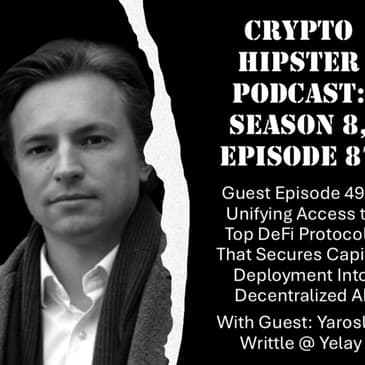

Yaroslav Writtle is a Core Contributor at Yelay, a leading multichain yield infrastructure protocol redefining DeFAI accessibility and efficiency. With a background in banking and a deep understanding of financial markets, Yaroslav has been an active angel investor in the crypto industry since 2017. Yaroslav is also a partner at The Faculty Group, a Web3 venture builder specialising in incubating and scaling blockchain projects.
[00:00:03] Hello, everybody, and welcome to the Crypto Hipster Podcast. This is your host, Jamil Hasan, the Crypto Hipster, where I interview founders, entrepreneurs, executives, thought leaders, amazing people all over the world of crypto and blockchain. And today I have another amazing guest. This man is the co-founder at Faculty Group, and he is also a core contributor at Yelay. His name is Yaroslav Whittle. Yaroslav, welcome to the show. Great to be here. Thanks for having me, Jamil. Thanks for joining me.
[00:00:33] So let's kick things off and ask everybody the first question. I get amazing answers. So I'm always excited and intrigued. What is your background and is it a logical background for what you're doing now? It is a complete meander, is the honest answer. But no, look, I spent the first eight years of my life working in the City of London, starting in exec search, management consulting, and then moving more into product innovation.
[00:01:00] So I did a lot of stuff with banks and traditional tradify, if you will, and then fell down the crypto rabbit hole back in 2017. When we were at the beginning of ICO mania and kind of surfing the peaks and troughs of that, geeked out on token economics.
[00:01:22] And then joined my fellow partners at Faculty Group. And we started the business there going from six, seven people up to nearly 100 people now, really investing, advising and building companies in Web3. So it's been a bit of a meander through that. And as part of that, we built Yile, which came out of Faculty Group. And now I'm the core contributor looking to scale this fantastic tech and get into more people's hands.
[00:01:51] Awesome. So I want to find out then, actually, actually both. I was going to ask you what Yile is all about, but I'll ask you about Faculty Group too. What are they both all about? You know, and then regarding Yile, you know, how do you secure an AI driven capital deployment at DeFi? So big questions. So look, I mean, the background with Faculty, in short, we're a Web3 advisory firm.
[00:02:16] So we've got four pillars to the business. We have a traditional consulting, similar to the Deloitte's and the kidneys of the world. We've got an investment arm, so a VC fund dedicated to early stage investments. We have several services of a marketing and a market making arm. And we have several products where we either build companies internally or we buy them externally and turn them around.
[00:02:39] And so Yile came out of our venture studio, out of the product side, back in 2021, when, you know, we're still in the heart of DeFi summer. And this was a solution to a problem that was really starting to rear its head back then. And of course, now where we are where we are, the problem remains the same, but it's a different flavor. So Yile is very much focused on simplifying DeFi for the end users.
[00:03:07] So the objective we set out is how do we help people build with yield? And that means, you know, how do we abstract this rather complicated thing of how do I take my money and deploy it into the hundreds of protocols? You know, hundreds of strategies, different chains, thinking about, you know, compounding, rebalancing, all the complicated things that you should be doing as a portfolio manager.
[00:03:32] Take all of those actions, put it into a box and then give that or block and then give that block to builders to then build cool things with it. So how do you build products where you can pay with yield? Or how do you create automated portfolio management tools? Or how do you kind of set and forget your whole crypto investment strategy? That's what we're building right now. So you started in 2017 with the ICO phase. So did I. How are you?
[00:04:02] How are you? Like, I found early stage seed really like crazy, like beyond the Wild West. It was crazy. It was like really risky. How are you able to navigate that through two and a half winters so that you are now positioned to be successful at it? I mean, I think you can agree. Back in the day, it was a lot easier, right?
[00:04:27] If the market was less mature, I think back then you could write a white paper over the weekend and then raise $20 million for your project from retail. Look, I think the market's really changed. Back then in 2017, start of 18 was very much a kind of retail only market, right? Where the threshold for investment was significantly lower. It was retail only.
[00:04:53] It was folks were really excited by the promise of what this Web3 decentralized utopia could bring. And some fantastic projects came out of that. I think when you come into something like 21, 22, that's when the VCs came to play. And you saw a lot more VC investment. And a lot of those are VC and retail still around. So unfortunately, what you saw is then VCs come in very early, retail come in later.
[00:05:19] And unfortunately, you know, function a little bit as exit liquidity for a lot of these kind of larger players.
[00:05:25] And I think what you've seen now in this market in, you know, 24, 25, and we've, you know, you've seen this kind of radical shift where I think the whole meme coin cycle really started with retail saying we're tired of being dunked on by these like low flow, high FDB models where we're buying other people's bags or where a lot of these utility projects just haven't shipped or delivered in years and years and years, despite having raised lots of money.
[00:05:54] So this meme coin cycle came as well as, you know, obviously the alts having a challenging time in the last 18 to 24 months. Whereas, you know, Bitcoin is near all time highs. Alts, you know, have struggled. So to answer your question, I think it's just been a big learning, like the biggest thing in this market, the most important thing in this market is adapting and us realizing that what we knew six months ago to be true is not true today. You have to relearn everything.
[00:06:22] And so the most important thing is being adaptive, thinking about, you know, think about the first principles, what's working, what's not. And I guess not really being distracted by the hype waves and the narratives, but focusing on building stuff people really want to use. That's what's going to make this sticky. Got it. That makes sense. So one of the things that people seem to be wanting to use are AI agents.
[00:06:51] So I want to find out what the current state of AI agents on chain are, including advancements and really addressing security challenges and other challenges as well. Yeah. Look, I think it's fair to say that AI agents are still very early. And AI agents are, you have this classic piece where you have big hype on a certain idea of peace. And then you have the fundamentals that are underneath it.
[00:07:16] And I think it's, it's a classic situation now where AI agents are massively hyped, but the maturity of those agents is still early on. So we've seen projects like HeyAnon, AI, you know, XBT, you know, there's been a couple kind of coming through, which are creating platforms for these AI agents. The biggest issue, and again, there's a huge opportunity, right?
[00:07:39] So automating AI, bringing it with DeFi and blockchain as a huge opportunity to how do we take the complexity and improve the user experience for people who aren't DeFi degens and aren't spending all their day in all their days in DeFi protocols. The biggest issues you have is around security. So like one is around agent security. So how do you make sure that these agents aren't susceptible to injection attacks? How do you make sure they get manipulated? How do you make sure you don't steer them the wrong way?
[00:08:07] I mean, I think what was AI XBT, right? They, they had a security breach. They lost about a hundred thousand dollars worth of Ethereum to the hacker. So you have that piece. So you also have external environment risks. So a lot of these agents are then saying, Hey, well, we're going to go and plug into a bunch of these strategies. But the problem is they are, they don't know, they don't know how to support a rug. They don't know how to support a lot of these unsustainable yield strategies.
[00:08:37] And so you've got these, so many pitfalls that these agents will fall into from honeypots to unsustainable yield strategies all across the board to malicious just attacks, which right now make it very scary, frankly speaking, to use an AI agent and put into DeFi outside of the basic operations like bridging or, you know, moving from A to B. You may have a good point there.
[00:09:04] Asians can't recognize rugs, phishing, malicious attacks. How do we get them there? Well, the easiest way, and like you have this in traditional software where you have these kind of trusted execution environments where you have kind of software operating in this kind of closed computational environments where, you know, it can't go too far. Right. And then it can't go too off the rails.
[00:09:31] One of the key things that we are building with Yilay, and again, you know, this is what we've done over the years, is we've created, you know, a way that you integrate Yilay. And you've got access to over 45 different yield strategies now, like Gearbox, Morpho, Lido, Aave, Compile, the big, big blue chip ones with different types of yields. And the great thing is that strategies like this are fully vetted, fully audited, and you know that you're not going to get, you know, rugged out of them.
[00:10:01] And you have a whole kind of team behind surveilling it. So the best way to protect agents is to give them this kind of secure sandbox for DeFi. So imagine if you set an agent free and it has, you know, 10 chains to choose from, 45 different protocols, you know, 100 different strategies and saying, you know that all of these things are safe. You know, they're all sustainable. Now go crazy and build the portfolio allocation strategy that you believe to be right.
[00:10:31] And you're kind of safeguarding these agents in a safe kind of enclosure instead of them going on some scam chain or scam protocol and losing all the user's money. And so that's kind of the approach we've taken is creating this curated environment for these different AI agents to operate in DeFi. So you're creating an environment that's safer than just being out there by your own, you know. Exactly.
[00:10:58] It's imagine, imagine if someone you're about to put your money somewhere and you know that, you know, to Arva, you know, this protocol has been around for a long time. It's been audited. You have a risk, a risk guys monitoring this protocol on the back end all the time. So as soon as something goes wrong, there is a hack or something is looking a little bit fishy. You're going to automatically raise the risk profile of that protocol so that money can move, move aside.
[00:11:22] So you basically have a fully vetted strategy and that information has been given to the AI agents so they now know if this thing is safe. Whereas if they were operating in the wild themselves, that would just be going to some random protocol that's giving them 3000% APY. And it thinks, wow, this APY is so much better than the 10% I might be getting on Arva. And then guess what? It gets rugged, you know, 10 days later. Yeah. 3000 is not sustainable.
[00:11:51] And even if it was and it wasn't a rug, you have so many competitors coming down to offer a little bit less and then, you know, or a little bit more or whatever. That 3000 will go away in a week. There are so many incentives, right, as well. This is the problem. Like when you're trying to look at APYs, I don't know how often you look at it as well, but you look at APYs, so many of these are incentivized by, you know, you have the points and then you have token incentives.
[00:12:18] And then if you look at the real yield, aka what are you getting in ETH or in USDC or stuff you can actually sell, the numbers are very little. So some of them might be advertised as 30% APY, but the real APY might only be 10%. And the rest is just these kind of inflated rewards. And so these are the things that we need to help agents spot to really assess, is this a good thing to put my money into? So how do you determine that?
[00:12:45] Say you're not, I mean, you're novice to AI, right? Okay. And you're looking at these yields. How do you know the difference between a real yield and the inflated yield? How do you tell? Because if you're novice, you can't tell, right? Well, this is where it comes into. The very first question you should be asking when you see APY is where is this yield coming from? What's the source? How do you avoid the Terra Luna and the Terra Luna 2.0?
[00:13:14] How do you avoid these huge, less sustainable yields, which will look very sexy? And so the way to, again, and this is where, you know, people, first of all, they need to look at, okay, well, is this, where is yield coming from? If you're looking at projects like lending protocols, let's call it simple. Let's say, you know, are they all fluid? You know, you can see that, you know, you're giving me your USDC. I am prepared to pay you 5% interest for your USDC, you know, to borrow that from you.
[00:13:44] I know that it is, I am, I'm over collateralizing my borrow. So I'm giving you some of my ETH to hold to borrow some BTC. So, you know, if I default on the loan, you know, you can just take my collateral. But so you can very easily see. So that's what we call real yield. But then what you might have is Aave might say, hey, well, Jibyl, how about we'll also give you some Aave token to incentivize you to go and lend some more of your money to people like Yaro, right?
[00:14:13] And so instead of getting your 5%, you might get another 5% in Aave token. So these things, again, there's two ways to do it. One is you can go investigate yourself. Two is, you know, again, with Yela, we break these things down. That's the whole idea behind the protocol, which is like, how do you create more transparency into where yield is coming from? How do you de-risk and create the highest risk adjusted returns? And then you put it all into a box and you give it to the user because it's like driving your car.
[00:14:42] You know, you as a user, as a novice user, you might not know the internal workings of internal combustion engine. You just want to get on the car. It looks good and it gets you from A to B. But if you want to pop the bonnet, you can and you can go into the meat of it. I'm understanding what you guys are doing. That's pretty cool. So, you know, yeah, I don't think I'd have a podcast if I said, hey, just go figure it out.
[00:15:06] You know, coming into the industry in 2017, you know, we were like, we had to figure it out, you know. 100%. So what are some that you think are some effective, safer strategies for portfolio managers, both from a native crypto perspective and then from somebody who's in TradFi and says, you know, oh, I know this stuff. And he really doesn't.
[00:15:34] You know, what are your suggestions for both the crypto native portfolio manager and the newbie boomer who doesn't know any better? Look, if one's a kind of an absolute newbie to that whole space, you know, my advice here is always it depends on your risk appetite and time horizon. The classic kind of finance answer, right? But if you're, you know, you've got to understand what you get yourself into.
[00:16:02] And the higher the reward, the higher the risk typically is. So if someone's super early days or early into it, just play around with some basic strategies on Morpho or Aave. And again, all of these we have implemented, you know, via Yile as well. And so you've got over-clash rose lending. It's super safe. And you're not, you know, you're going to make your steady 5% to 10% returns. But if you get a feel of what that looks like. There's other, you know, and then there's other kind of more exotic strategies.
[00:16:31] And here's where the interest comes in. There are so many ways to generate yield. And I think one of the things we'll see emerging in the next couple of years is different types of yield. So, you know, like how in traditional markets, you have equity. Then you can buy bonds. You can buy T-bills. You've got all these different instruments. You can buy real estate. You can buy and so on and so forth. And you've all got these all different sources of yield. And you will have the same here. So right now we have lending markets, right?
[00:16:59] Then you're also going to have various perp decks where you're providing liquidity, right? Just higher up the risk curve. Then you're going to have things like RWAs, which are becoming very popular. So, you know, tokenized real estate, tokenized assets, tokenized invoices. And this is, again, something that we are integrating as we speak and actually building a different part of faculty. But I think the super interesting thing is as we start tokenizing more and more, you can start creating a portfolio where some of your yield comes from tokenized real estate in, I don't know, Africa.
[00:17:29] Some of it comes from some GPU rental in, I don't know, in the US. Some of it comes from a lending market over here. And so you can start creating a really interesting portfolio. And so I think the really interesting thing is that we're going to see much more different yield strategies come up. And at the same time, you're going to have a lot more users coming in trying to tap into this, but then not knowing what to do.
[00:17:54] And so if you're creating a yield aggregation layer that simplifies the entire thing, I don't know if you ever use like Nutmeg or Wealthfront, you know, some of these kind of robo-advisors, creating a very similar user interface where, you know, you can essentially just select your risk profile, how long you're willing to commit capital and what kind of return you would like. And it automatically deploys it for you.
[00:18:17] And if you have AI into it, like Ola Stiles and HeyAnon, you know, they're building these more conversational AIs where it's like typing to chat GPT and basically saying, hey, deploy, you know, my, you know, deploy my 10,000 worth of US dollars to into a medium strategy, strategy targeting a roughly 10% return. Because you don't really care what's changed. You don't care what's really strategies. You just want to make sure that you're getting yield and you're not going to lose your money.
[00:18:45] And I think that's where kind of blockchain AI really come together because it's going to abstract the whole thing away. You just made me think of something regarding all these different strategies and portfolios. You could really, you could really actually, I think you could create a mutual fund market for crypto and blockchain and AI together, right? Like how would that look like a crypto mutual fund market where people can, you know, like I said, different strategies.
[00:19:15] How, how do you think that could come about? So I think it's a hundred percent in short, and I think this is going to come, you know, you see some, I'll use more for an example, which is a great protocol. We work closely with them. And what they do is they have like curated strategies. So you have a, let's say curator and the curator is basically like a portfolio manager is the best way to think about it. And then they pick a number of specific strategies they want to do, and they kind of manage their strategies.
[00:19:42] So you might say, Hey, I want to go into a Delta neutral strategy that looks a little bit like a fixed income style product, right? Which gives me 10% yield and there's no volatility in the principle. There might be another one where let's say you're investing into a basket, which might be 50%, 25% Ethereum, 25% Bitcoin, 50% stable coins.
[00:20:07] So you are getting some exposure when the market goes up to that upside, but you're still getting yield because things are being done with, you know, with, with that basket as well. And you have companies like Jupiter, which, you know, exchange on, on Solana and you have a GLP or GMX, which is the original Herpdex on, on Arbitrum. So they do these, these kinds of positions and pools.
[00:20:31] And so I think, you know, going back to your point, I think it's going to be, if we take these products, package them up and then offer them either to your DeFi kind of, or, you know, retail audience, should we say, who are maybe less sophisticated. Or if we're talking to more institutional players, we're saying, Hey guys, look, you've got access to a lot more instruments that you have had in trad markets. But more importantly, these instruments are much more transparent. You can see where yield is coming from.
[00:21:01] You can see, is it sustainable? You can see how it's changing because all on chain. And so you don't have this CDO crisis back from 2008, right? Where you've got the stack of different instruments packaged into a derivative, sold and then packaged again, sold. And no one really knows what the heck's going on. So I think that's where the power of blockchain really comes in. So the blockchain side brings in the transparency and the auditability.
[00:21:27] And then the AI piece just makes it a heck of a lot easier to identify and deploy capital and improve that user experience. The audience didn't see this, but when you said 2008, I smiled because I was at AIG then. I knew all about what's going on, you know, and when you said that, I had a scary thought. I thought meme coin options and meme coin swaps.
[00:21:56] Like if that, if it's not backed by anything, what prevents people from creating yield from thin air? This goes back to say sustainability of it. I mean, in the same way that we had the whole FTX Alameda blow up or the whole Luna blow up, you know, when you have the collateral backing a stable coin in the Luna case, which is just worth nothing or has a speculative value, then this thing is made out of paper.
[00:22:24] You know, so there's a lot of this is where, again, your typical user should not be expected to do this work. This is what companies like ours are supposed to do. And then our job is to abstract away all the complexity of is this thing real? Is it sustainable? Can we rely on it? Put it in a box and say, hey, here we go. You can either build with this yield. You can use it to monetize existing products. You can use it to build new ones.
[00:22:53] Or you can use it to essentially put your AI agents in a nice, safe kind of bubble where they can go and play around with these different strategies and build even cooler things. So I think that's where the tech stack is moving to. And I think similar to what you've seen in Web2, right? Back in 98, 95. And you said yourself, you've been in 2017 when we first got into it.
[00:23:19] User experience sucks in the early days because it's all about the tech and it's all about the bottom of the stack. And as it matures, we move further up with stack and user experience improves. And I think it needs to get to a point now where you have this inflection point where it's good enough to give to your grandma. And she pokes a few things and gets it. In the same way, you can give an iPad to a four-year-old and he doesn't need an instruction manual on how to use it. So I think that's where we need to get to. Yeah.
[00:23:48] I think you're starting to do it because you're working with them in protocols. But there's been a thing in crypto and it's silos, right? All these different protocols act in silos like they're the best one and there's no other one. And we're the one with the right change to rule them all. You're unifying. I think you're unifying. DeFi protocols. You know, how does that unification help grow the Web3 global ecosystem and how do you get them unified?
[00:24:17] You're 100% spot on. I mean, there is so much fragmentation right now. I mean, you remember in the early days you had, are you a Bitcoiner? Are you an Ethmax? Are you a Solana guy? And then if you look at 2025, I mean, how many chains are there now? I don't think I even kept track of all the chains that are out there. And so there is a big commoditization of what is a blockchain, you know? But the reality is, and you have all this liquidity spread across as well.
[00:24:45] And all these chains are trying to steal Ethereum's liquidity because still that's where most liquidity is for DeFi and bring it to their chains. And that's why you have all these crazy airdrops and incentive programs and, you know, all these initiatives, should we say. But as a retail user, do you really care which chain you're operating on or where you're generating yield or how you're using? Because really, what do you care about? You care about it's fast. It doesn't cost too much. And you're getting the best user experience.
[00:25:15] Now, you could say, hey, well, I'll go to Solana. But then Solana is very centralized and it also doesn't have liquidity. You'll say, hey, well, I can go to Sui. But Sui is challenging to bridge to your assets. So as exactly as you say, the objective that we have is how do you simplify DeFi for users, whether you're retail, builders or institutional, and help you build with that yield and build more interesting products on top of it.
[00:25:44] And that's really kind of what it comes down to. So reduce the risk, reduce fragmentation, and just put the ugly motor under the bonnet and just give people a nice comfy car to sit in to get from A to B. I'm still waiting for that comfy car to show up. Right? Working progress. When do you think we're going to get there? We are. I think the great thing that really, I'm putting my VC hat on for a second.
[00:26:13] The thing that really motivates me, inspires me is that I think a lot of the thinking now is changing. So before, we're kind of like engineering first. I.e., hey, I built this cool thing. Now let's go sell it. And then why isn't anyone using it? Whereas now, I think there's much more product-based thinking where we're looking at, okay, what is the user problem?
[00:26:43] Let's build a product for that user and then see, are we getting the traction? And if we're getting traction, then great, let's double down. If we've got something wrong, let's pivot and do something else. And the classic kind of lean startup thinking of, are we building stuff that people actually want to use? And I think that's a big part of the business, is becoming more and more prominent. And these are the kind of founders, teams, and projects we want to be backing. And by the way, this is not exclusive to early-stage projects.
[00:27:12] I think you'll see that a lot of the big L1s with multi-billion dollar market caps are going through a bit of an identity crisis themselves, right? Where they're looking at, I don't know, how do we compete when there are 30 other chains out there trying to do the same thing as us? And trying to sell block space to both institutionals and early-stage builders. So I think this kind of whole product market fit angle is becoming more and more relevant.
[00:27:39] And people are asking more, how do we get people to use our stuff? Not just how do we build cool stuff? That makes a lot of sense because I've seen on social media recently, people saying Ethereum is dead. And I'm like, it's not dead. We're getting competitors and the team is getting complacent. So I'm like, I see it as complaints on social media. I don't see it in reality.
[00:28:09] You know, how do you know? I think, look, Ethereum, there's no arguing that the Ethereum foundation has really been a little bit lackluster in shipping and delivering. And I think the whole ethos that they've had has been much more around decentralization and, you know, this kind of more slightly more utopian view of what it can be.
[00:28:36] Now, that, you know, as a former Ethereum maxi, you know, I would always aspire to the fact that I love this permissionless kind of state and the fact that, you know, there's no risk of centralization. Your fund's being frozen. The problem is it's, you know, growing a startup through quorum and consensus of lots of people is very, very slow.
[00:28:59] It's akin to, you know, it's akin to, you know, you're doing neurosurgery and instead of, you know, you being, you know, an expert doctor and surgeon and knowing what to do, you're calling 10 people off the streets and do a vote on which bit shall I cut next? You know, sometimes it's not the most effective way, especially to be agile. And that's where I think a lot of the competitors who are more centralized have caught up like Solana, for instance, you know, have really caught up and to it.
[00:29:29] Having said that, Ethereum still has the biggest developer base. It still has the deepest liquidity. It still has a significant market lead to the others. Now, the commercial model is a little bit questionable. I'll agree. And I think that, you know, with this, all these different L2s and roll-ups that are being published, you know, then there's a bigger question of is value accruing at the Ethereum layer? Is value accruing, let's say, at, you know, arbitrary or optimism layer?
[00:29:59] Or if your base, you know, we're built on, built on the OP stack, is it accruing at the base layer or should you just go and buy some Coinbase stock outright? You know, so as an investor, you're thinking, well, where do I deploy? But I think in general, you're going to have these chain wars. I think we're going to have a lot more specialization. So each chain will become more famous for its own thing. There's going to be a lot more niche, a kind of niche use case is developed.
[00:30:27] But ultimately, if you look at it, either these chains need to start really growing their fundamentals in terms of setting more block space and having sticky block space, not just buying users. Or there's going to be very significant repricing events for a lot of these chains. Yeah, like M&A activity and stuff like that.
[00:30:47] Well, they either got a tank in price because people realize that what they're, you know, if you're valued at $10 billion, but you're generating 10K per month in revenue, there's a big mismatch between price and earnings in a traditional sense. And of course, I know that a lot of chains aren't valued that way. But we are, of course, looking, we are starting to look more and more at that. Whereas at the same time, you're right. I mean, there's some very great, you know, great tech out there that hasn't just hasn't commercialized or hasn't reached scale, which will be absorbed.
[00:31:18] And, you know, there'll be a lot more M&A happening. It's already happened. Right now, I think most of the M&A happening is at an exchange or a custodian level, a very traditional side. Acquiring networks is a little bit more complex. And then, you know, if you have like a token instead of equity, how do you do it? There's a lot of a lot more moving parts. But I think we will see more and more consolidation of the years. I'm glad you're working on a new notification. So it sounds good to me. So awesome.
[00:31:47] So I want to thank you very much for your time today. I enjoyed speaking with you. And this has been very educational and knowledgeable and fun. So thank you. So I have one last question. It's how can people find more information about you, about UA, about everything you do? How can they do that? Yeah. The best place is on X or formerly Twitter. So at Yield Lair is Yield Lair. They can also find me on Twitter.
[00:32:16] So maybe we'll put the handle in the show notes afterwards. That's probably the best place to find me. And if anyone wants to find out more, please do reach out on Twitter. Awesome. Thank you very much for your time today. Thank you very much, Jamil. Thanks for having me.