
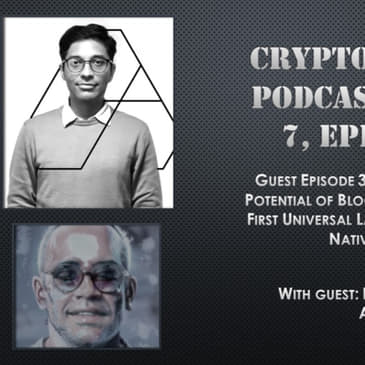

Karan Bharadwaj is the CEO of Arithmic, the world’s first universal and scalable Layer-2 with native staking. Previously, Karan served as Chief Technology Officer at multiple companies including XinFin (XDC), and later, Mool, an AI and fintech company empowering people to organize their financial life through their markets web app by providing investment analysis and research. Karan is a seasoned entrepreneur in the crypto and fintech space, leading multiple crypto projects including as the founder of Elatior where he helped build state-of-the-art distributed ledger networks and applications.
[00:00:01] Hello everybody and welcome to the Crypto Hipster Podcast, this is your host, Jamil Hasan, the Crypto Hipster, where our interview founders, entrepreneurs, executives, thought leaders, amazing people all around the world of Crypto Unblocking.
[00:00:16] And today I have another amazing guest and he is the CEO of Arithmic. His name is Karan Bharadwaj, Karan welcome to the show. I give you having me, Jimmy. It's good to be on here. You're very welcome. I almost said a arithmetic but it's a arithmetic.
[00:00:36] So, uh, make it very close. Welcome. Thank you for joining me and um, pick things off and the first question I asked everybody pretty much is, you know, what is your background? And is it a logical background for what you're doing now?
[00:00:54] I think it is, uh, I've been in the Blockchain space since 2015, 2017. When I started working in Blockchain, I happened to start working with a company that was building out of protocol as well, which is a base layer network.
[00:01:11] And I've always had my art or always have an interest in building and that layer. Since then, I've had the opportunity to build out that, uh,
[00:01:22] sadgemo centralized applications that do connect to, uh, deeper protocols. But working at the base layer at the protocol layer has always been something, uh, where the heart has been. I didn't have undergrad in physics and physically the essentially of fancy or not so fancy but essentially math.
[00:01:44] And there's a lot of supplementary math that you also need to do. And when I first came across group systems, which are sort of the sort of what decay rollups or validi rollups are built around,
[00:01:57] I suddenly could see the potential for a lot of problems that I had faced by the working at the protocol level, where the working at the application level, all working at the gap level of different kinds of bottlenecks.
[00:02:12] And when I came across this emerging technology back then, I realized that this had the potential to bring scale and a lot of economic opportunity to the blockchain space.
[00:02:24] And that's when I, you know, raised some money, started building and it's been two and a half years of existence we've been building and I think there's something very robust and exciting that coming up soon.
[00:02:37] And it's very cool. So, um, what is the rhythmic all about what you guys do well, you know, and what is your definition of a layer to native scaling network.
[00:02:57] Okay, so, but the possible way is a bunch of different, I do have a lot of the blockchain space, right? So, I think you're going to have a lot of good coin.
[00:03:10] A native scaling L2 or native from the second, taking L2 is one in which as people lock liquidity or the deposit liquidity into the layer two or all kinds of reasons. They generate, they're able to generate a native yield on whatever asset that they deposit it.
[00:03:34] And because we are a layer to both for Ethereum and Bitcoin, we implemented a fairly unique system of generating yield across multiple different asset. And that sort of something that you know, I'm looking forward to discussing more with you. Yeah, let's talk about it.
[00:03:58] Before we get into the case, I wanted to make that. I don't know, anybody else is a layer two for both Ethereum and Bitcoin, right? How do you do it? Yeah, actually, it was.
[00:04:12] So, I think that it's much harder to be a layer two for Bitcoin because Bitcoin has no EVM or VM, not even no VM, no virtual vision, no scripting on its on its side.
[00:04:25] This tripping language, but it's a little bit primitive and you can do far fewer things and the amount of data that you can store on the Bitcoin layer one or the Bitcoin network is very restricted. And so running or verifier on Bitcoin layer one is not practically possible.
[00:04:47] So which is why naturally all layer two initially targeted Ethereum. And over the past year, you're in a half there have been some paradigms around bridging mechanisms from Bitcoin to layer two's that are sort of beginning to enable. Layer two networks that can scale Bitcoin.
[00:05:14] So, the things that we implement on the Ethereum side are more in for the industry, as I say more evolved than on the Bitcoin side because of certain challenges that the Bitcoin network. You know, basically.
[00:05:33] But the brain which Bitcoin, L2s today are positioned a lot of them are built or proposed around Bitcoin,
[00:05:42] which in our opinion will take some time and there are some unresolved questions that you know at his weak answer answer to whether regards to slash infrastructure on the Bitcoin side.
[00:05:53] So we've come up with our own broad proofs mechanism or a implementation of a broad proof mechanism that works a little bit differently than between we're going to be out with our white papers to on that,
[00:06:11] which will focus purely on our BDC to Earth make you know bridging near et cetera, connection. And on the Ethereum side, we build a slight different kind of for ZKVM network as well. So I'll talk about that. I'll put me on with more questions from you.
[00:06:36] All right, so let's go down the Ethereum first.
[00:06:39] Does most people understand that side first I'm going to come back to Bitcoin side because this is some tool that I want to understand how it works and then you work on the white paper and probably you know it's not.
[00:06:50] I don't want to release any trade secrets you know but I do want to understand it so. Let's talk about the Ethereum first. We have dual innovation of ZKVMs and ZK86 right, so how do they work together to unlock new opportunities in liquidity. Sure.
[00:07:11] So I talk about the ZKVM first. So the way we talk about our ZKVM is that we call it a gen to Windows ZKVM which essentially means it's a second gen ZKVM. If the existing larger networks on the ZKVM, those be like to look at as gen 1.2 ZKVMs.
[00:07:32] Now I'll quickly differentiate between the two. When you run a validity roll up or a decay roll up what you are essentially doing is you're taking a bunch of transactions off of layer one and processing them on layer two. Normally you're processing the based transactions.
[00:07:50] You're also doing a lot of mathematical computation on top of it where you've turned it into different representations etc. All of this adds computational overhead. Sometimes the computation overhead can be add high as 20,000x on a single transaction.
[00:08:08] So essentially on layer two you're doing a lot of extra computation than you would do on layer one. Now the older way of building our ZKVM was to do a lot of this overhead actually process a lot of that overhead.
[00:08:25] But in the middle sometime in the middle of 2020, a researcher by the name of Justin Taylor came up with the last so short time on you may have heard of it. He recently gone public with an implementation also told.
[00:08:44] Now we started building some last year on this paradigm and this essentially replaces a lot of overhead computations by extensively using what I call look up tables. And so all of the computation is in a way.
[00:09:03] So it will reduce your head on layer two drastically through using these kinds of. So that's a major and I think that we are probably the only leprechaut that's close to going like on the built on this paradigm.
[00:09:19] But we believe very strongly that this is the future that validity at ZKR will take rather than the general one point apart one general one point apart that they haven't been taking or they haven't built around.
[00:09:33] So that's on the ZKVM front and the numbers that we're seeing are very actually very good. And some of the newer systems that we implemented those numbers are even better.
[00:09:48] So the older system that we had the internal test center that we were running that was seen have a scene between 50 to 100 TPS and now we're seeing even higher than that. Almost such a 200 to 100 effective TPS right so on the pure.
[00:10:05] VM just as the KVM front this is what we are doing differently and. Eventually in the ZK space as protocols essentially all of these led to protocols as they stabilize. We will require custom hardware.
[00:10:24] To essentially accelerate computation on this way as I mentioned there's a lot of overhead competition that we do to ensure that you know processing of transaction you have in the right way.
[00:10:36] And I think if we truly if Lair ZK roll up Lair do's really want to be the scaling solution for blockchain they must have much better performance than Lair one which we don't see right.
[00:10:50] And partly this is partly mitigated today by throwing a lot of firepower at these networks so you have very high compute being thrown at it.
[00:11:02] But over time I think custom hardware that sort of makes these far more efficient makes the proven process far more efficient makes the verification on not only to much more efficient. And perhaps that's the validation that will bring another level of efficient landscape to Lair ZK books.
[00:11:26] And so that's better the KFX coming. I understand all that I think it's a good point you make. I mapping tables or my thing or where am I thinking when I was a sequel builder dev in corporate America.
[00:11:42] We would take the stuff out of the code build mapping tables and that will make everything run more efficiently including bring down the costs. So that makes perfect sense to me. So I like the theory I'm side.
[00:11:57] The Bitcoin side you know other tools that come back come forth in the past few years. Lightning network tap root you know are you how are you building that you know layer two on Bitcoin are using any those tools or you don't something completely completely unique.
[00:12:18] So essentially we should understand where the challenge is like very really the challenges in building a layer to complex going. So getting Bitcoin from the Bitcoin layer to a layer two that is not so complicated right that can be done honestly and an decentralized manner.
[00:12:36] Getting assets back from layer two onto layer one or distributed from distributed to the right people on layer one that is the challenges because there's no smart country contacting on Bitcoin side. So what used to happen in the past is that people would run multi-thick bridges.
[00:12:56] And when they would run multi-sick bridges, they're not fun things would happen because they would get compromised often. So with the so whether it's whatever functionality that Bitcoin and the Bitcoin scripting language has. We obviously have to use all of it.
[00:13:16] But the bridging mechanism which is built around the fraud proof mechanism that is what has been integrated on today right so it's that direction so that when assets are being transferred from layer two to layer one. It's it's happening a decentralized manner and having safely basically.
[00:13:41] And that's really a trade secret comes in that we're not going to tell the world yeah right it's up one right let's you want to. So it's so for it's essentially the fraud proof mechanism that's going to. It's going to look similar.
[00:13:56] To how it's done currently but instead of the operators. So we're behaving in the way that they operate today on between. They have slightly differently in our partners. So with liquidity, how we sort of create economics around that liquidity.
[00:14:16] Those systems are different and the fraud proof mechanism is off. So this is. Some of the things that are going to be different from. Got it sounds good sounds good. So we have this multi chain bridges and you enable.
[00:14:34] Multi chain stacking pools so you can use multiple chains to pull right what are the advantages of multi chain stacking pools and I'm assuming that you're going to build not just opportunity for Bitcoin and theory and but for others as well.
[00:14:47] That's right so I think the layer do's and especially Nick and Vanity near do's data quiet on a lot of computation right so we require two birds with a quite a value bias. We require validators, we require operators.
[00:15:01] We require all the many different if there is some computation that needs to be done in the blockchain space. Some variety of it is being done on layer two. And the way that almost all layer two is including us guarantee security and safety is through staking.
[00:15:19] So all layer two essentially one a form of proof of stake mechanism to ensure that the participants on the network are behaving honestly. Right and this taking mechanism naturally generates yield because there's no other way to actually be sticking. Right and as we were thinking about.
[00:15:42] Because essentially yield has been a yield based economic systems are not new for blockchain but new. I mean they're like a year and a half that we've been talking about it in blockchain it seems much longer because things move quickly. But we thought that as a layer two.
[00:16:03] We want to attract a variety of liquidity on our network and users essentially hold onto liquidity with the hope that game is generated for them. And there is a very strong requirement for securing our network against malicious actors which requires liquidity. So we felt very natural.
[00:16:30] This ability for multipathes of the network to come together and facilitate operations that essentially look for everyone. We call it a lightning incentives across detailed, quite-student end users, infrastructure partners and developers and partners. So we look at it as a lightning incentives.
[00:16:51] And instead of purely focusing on our own token we allow for a basket of tokens to come in and secure our network against. Or secure our network essentially.
[00:17:08] And based on that securing we generate yield and a higher yield compared to other altruities that are also looking in this direction. That's why we decided to go to multigen pool thinking. You hire a yield because you're reducing the risk.
[00:17:32] So one of the things that because we connect to elements and multiple L-dos, we run infrastructure anyway. And when we run infrastructure on other proof of state chains, we are able to access yield from those chains as well.
[00:17:48] So not only do we pay out yield from our chain but we can pay out yield from other chains. And with the explosion of L-S-T's basically liquidity derivatives, we accept those into our pools as well.
[00:18:00] The more stable projects we are able to sort of provide a higher yield basket, including from our own. Or some examples of what we're taking to our evidence. So you have Lido which is one of the major. Equipped taking protocols that's out there.
[00:18:29] I can talk for liquid-staking for a bit if you wish. So essentially what happens is that on chains like Ethereum, the consensus process is supported by large number of validators. And to run validators, you need to deposit certain amount of heat to participate in the consensus process.
[00:18:48] You are given the bonds back. And that really is where the yield comes from on Ethereum. And because the amount you need to stake is quite large, multiple protocols have come up or multiple projects have come out that pool you pool each together.
[00:19:13] And then they partner with the infrastructure providers and they run validators. And when you stake with these, essentially pool pooling protocols etc., they issue it open back to you. That issue token is essentially called a liquid-staking derivative.
[00:19:34] And then of course you can stake that back and then you have another layer of that derivative. That makes sense. Okay, thank you. You mentioned incentives. You mentioned a different players in the ecosystem in the protocol.
[00:19:56] And often the incentives of the core participants in a blockchain network are misaligned. All the time. What can we do about it? So, plus if I'm saying bad misalignment is the misalignment is...
[00:20:12] from the retail user, from the customer, for the people who just want to trade projects to attract such people. Any kind of redend method throw tokens at them essentially and saying because they're atroms.
[00:20:26] So they say take these tokens, hold them for a while, you know, price will appreciate and then perhaps you won't dump as much. That sort of word product, fake or digital customers.
[00:20:37] And then on the interest of the site, they talk to these large companies, infrastructure providers and they say look run these machines to secure an network to sort of run our nodes.
[00:20:50] And we pay you in our token and then you can sort of figure out whether that's a collaborative for you or not. And on the other side for developers and for larger projects that will build on your network.
[00:21:04] Again, I have a similar kind of legend to where we say take this money, build your and you know, we'll attract you the, you know, trying infrastructure partners and we have like a decentralized network for you to operate on.
[00:21:15] So this pulls networks in three different directions because the incentives themselves are not aligned. Now when we talk about a retail coming in or customer, the consumer's coming in with liquidity, they come in with the expectation of earning yield.
[00:21:37] When we have infrastructure partners who we can attract to the network, they come in with the expectation of also earning money but also with the barrier liquidity barrier that they face right.
[00:21:51] So at once we get aligned incentives for customers as well as infrastructure providers where stake is provided for securing the network, really generated on that stake that security in the network.
[00:22:03] Distributed amongst the customers as well as infrastructure providers and infrastructure providers begin to then provide their computation services. And to facilitate all of this, we have a layer of application builders, developers and projects that also participate in the sea activity.
[00:22:23] And whether it is to facilitate the users getting access to this or whether it is to build on top of it to sort of enhance these capabilities of the network.
[00:22:33] And so this for us aligns the incentives of the three kinds of participants, broadly speaking that we want on our network. That's sort of what we mean by a line of incentives. And this literally generates new economic activity, new liquidity. And it allows for the creation of.
[00:23:00] Of course in the blockchain space, the appreciation of the token is a major way of of value being created. But this allows for a new level of economic decent less economic activities where we are very organically aligning various participants on the same network. I like the alignment.
[00:23:27] I'm looking at I'm looking at a hole in the alignment say you have everything aligned say every all the exams are aligned and people come on with liquidity are receiving air drops right. And you know there are bots out there who.
[00:23:41] You know, who are providing no liquidity yet they're getting multiple air drops. And then there are Robin look, Quitterty of the end user who who bracelet Quitterty in. Right. So how do you deal with the internal factors external risk that tear down the security of your environment.
[00:24:00] Good question. So the existing error models have always wrapped us the wrong way. You know they sort of we've never been comfortable with the way that adrobs have function in the past.
[00:24:11] So the way we do adrobs is that we pay out adrobs or we sort of distribute adrobs within the pools themselves. Rather than handing out tokens to random wallets based on certain conditions. We in the multi change state in pool then users are taking their various tokens.
[00:24:35] We distribute adrobs through these pools in the form of returns themselves. So in that way, the activities that they need to perform in order to get adrobs are all tied to the pool. And so bots don't really come into the story here because you know we're not.
[00:25:00] We're not sort of incentivizing actions that bots would perform and giving adrobs rather we are making it into the multi change taking pools themselves. That's a good idea.
[00:25:16] And in fact, in the future what we also want to do you want to encourage other projects to execute the adrobs on our network through this mechanism. So that you know you have users who are while still participating in the way that they do in the blockchain space.
[00:25:33] But you can give out adrobs to people who are actually performing actions on the right way. I like it. I like it. Very cool. So, you know, I'm going, I went to, I don't know if you had this opportunity to go to consensus and in May. In Texas.
[00:25:58] Not this, but we are going to be at teaching. Okay, very good. Well, I learned was that you know we still have fragmentation in the industry. Right? Yes. So have people who call every who are a bit corners to call every other corner to shake when they're not.
[00:26:13] You know, but we need to stop the entraveling. You know, we need unity. You know, how can we, how can we knock down the silos and become unified? I think that. So the current maximum of them has been around for a while and you know,
[00:26:35] personality wise are like them because they're very, very libertarian. And that's an interesting way of looking at things. And I think that as you move further towards the L2 stacks less tribal and more constrained by. You know, these fairly complicated systems that people have cobbled together. Right?
[00:27:01] Because L2 is very difficult to build out and building out decentralized L2s is even harder. And the more you go in the ZK direction, building out a decentralized ZK network where people can just connect their nodes, start generating proofs, start verifying etc.
[00:27:20] That is an incredibly hard problem. And one thing that has always stuck with me throughout my journey in the blockchains place is that no matter how dedicated to developer team is or how dedicated people are, people usually don't like to run infrastructure. They're own infrastructure.
[00:27:39] And they just, which is why it comes like, insurer do so incredibly well. Right? And so it's like this very difficult problem that you build out your network and it's difficult to decentralize it. It's so it ends up being a silo, no matter what you do.
[00:28:00] And then you know, a lot bridges etc. need to be supported. But it's a organic problem is what I would like to point out first of all.
[00:28:10] Second, I think that over time for the end user and customer, the silo nature even fits continues to exist on the tech level to become invisible. And they should it should almost be like a landscape of multiple projects, multiple actions and activities that they want to undertake without.
[00:28:39] Sort of having to manually connect to these silos, which is essentially one of the situation is today. Right?
[00:28:47] And I think a deeper interoperability between layer 2s and you know, specials with the Bitcoin ones that are coming up will be essential in sort of making sure that not liquidity flows evenly, but access to liquidity is more even.
[00:29:14] There is there's an additional problem on the validity to an upside which is economic in nature. So, the developers and validity goals of these aim to reduce the transaction fees for Ethereum and Bitcoin the future.
[00:29:32] And the problem with trying to reduce the deals to almost nothing is that you do it's not lucrative activity. And so feedback there are no free mechanisms of free markets that are lucrative on for ZK, a role of companies or validity role of companies.
[00:29:52] So that is also another reality and I think that is necessary for a scaling layer to have some kind of economic activities that is sustainable essentially. And so all of these problems sort of come together and create what you see today a very fractured blockchain landscape.
[00:30:17] But I will say it's less fractured that in the past, I will say that. It's just that there's much more money in this system. In the past, we probably didn't even think about this fracturing but the fracturing has always existed. I like that word fracturing.
[00:30:42] This is my seventh season, right? I come out of season six in March and I think I know a lot of the stuff now.
[00:30:51] And I start talking to this season about ZK's bad infrastructure about you know and I see I'm like, I don't know anything like I thought I knew. Because there's so many smart people now building really fractured complicated stuff.
[00:31:09] So it's pulling my brain every day, which is good I get to learn. But it makes it very very very confusing scaling landscape globally, right? So I want to get your thoughts on what the ultimate path forward is for scaling because it is so fractured right now.
[00:31:29] I think that for the ZK flash ability roll-up landscape, I think layers that are able to multiple or process multiple of adherence day, TPS or throughput, that is crucial for us for the ZK space to be a genuine scaling layer. That's something that would be very necessary.
[00:32:00] The optimistic roll-ups do have better numbers, but we also look at optimistic roll-ups as a sort of path in the evolution for layer to multiple different layer ones, right? And so I think it's very necessary for us to mature as protocol.
[00:32:22] So we need to have a very mature protocol around ZK VM, ZK VMs, move towards the whichever type of if VM that is like the right balance. So the protocols need to finally crystallize a bit more. That's the first net-very step, right?
[00:32:41] The next net-service step is in my opinion on the technical side, on the technological side, is in the direction of stabilization of hardware. So hardware also has many intermediate steps. It's incredibly difficult to build hardware, and it's extremely difficult to build a6 for these very complicated protocols.
[00:33:02] Right? A6 are essentially you may have minimum of the Bitcoin mining, a6K day, you know, bit main, et cetera, who will build a6 for the hashing algorithm for Bitcoin. Right? But now, when you talk about A6 for a pro-system, that becomes multifold more complicated and expensive.
[00:33:24] So there are intermediate steps. So for example, we will be building out SPGAs, what are called SPGAs, which is like an intermediate step between,
[00:33:34] You can think of it as an intermediate step between A6 and what is called general compute meaning, so normal servers, normal essentially normal CPUs and GPUs, right?
[00:33:44] And what we do is let's say the protocol has five six parts, third parts are bottlenecks, right? Even for a layer two. And so those third parts we offload onto hardware.
[00:33:57] And so the evolution of hardware to support table-ized protocols is probably going to be what is necessary on the, you know, for the key on validity roll up layer two networks to begin to stabilize more. So that I think on the technology side, that's what's necessary.
[00:34:21] Interesting. And is that something that like the video work on or micro so I thought who would work on the evolution of these GKASX?
[00:34:35] So I think something, I mean, it would be great if some of them bigger cheaper users would work on this, but I think they would face similar challenges as the company's face today, which is instability on the protocol front.
[00:34:52] So every few months there's very big changes, I'll give you one example. About a year or two years ago we all thought in the GKASX, the recursion would bring a lot of scale to layer two's recursion would do it.
[00:35:10] But what ended up happening was that there was significant overheads at every level of recursion as well. And so that ended up mitigating, of course, everyone still uses the caution in daily degrees in different ways depending on your commitment scheme.
[00:35:26] But every few months we sort of evolve a bit as a, you know, I thought, a subsystem or ecosystem in blockchain right and till we get to a mature, second one mature point where front end systems back end systems storage,
[00:35:47] how we connect to networking, how we do the sequencing, till these systems are slightly more mature and they're able to get scale. It would be much harder for these bigger players like in video or Microsoft to also definitely make these protocols. Okay, got it, got it.
[00:36:12] I think I'm going to, I think I'm going to go to the next eTH conference. I don't know when that is but I think I got to go.
[00:36:22] And then the Bitcoin mining conference next year I'll go to that. Think, you know, it'd be to be around these this conversation on the development of hardware a little more than it happened. So I want to thank you very much for your time today.
[00:36:36] I learned a lot in my look forward to seeing what you guys doing next. And your white paper and read that so and so I have one last question. How could be on that more information about you, about a rhythmic.
[00:36:52] If they have any questions or when it reaches a return to me for how can they do that? So we have website, we have Twitter, we have Discord. So people can just look for arithmetic.com and they'll be sort of they can sort of find our discord.
[00:37:07] We have, we've, it is called this live and open and we're looking forward to chatting with people which we already do. Then we ramped up our activity on tele, Twitter and telegram as well.
[00:37:18] And so those are another two mediums, which we interact with people and sort of share what we've done so far. We have some, we have a like paper that's already out. That's on our githbook which is also accessible through our website.
[00:37:32] And so we're going to be out with our beaty fee paper and a larger yellow paper that we are working on as well. Awesome. Thank you very much for your time today. Thanks so much, I mean, thanks for having me.