
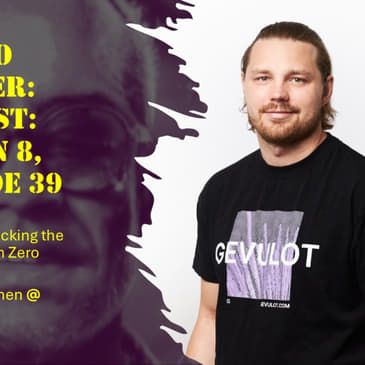

Teemu Päivinen is the Founder and CEO of ZkCloud (formerly Gevulot), the first universal proving layer democratizing access to ZK proving. Active in crypto since 2011, Teemu has founded companies such as CoinMotion and Equilibrium Labs, known for its collaborations with leading L1s and L2s. In addition, Teemu has advised Dapper Labs, Open Zeppelin, and served on Samsung NEXT’s Stack Zero Grant Committee. As a Venture Partner at CompoundVC, he helps blockchain startups scale, combining deep expertise in entrepreneurship, blockchain, and venture capital.
[00:00:03] Hello, everybody, and welcome to the Crypto Hipster Podcast. This is your host, Jamil Hasan, the Crypto Hipster, where I interview founders, entrepreneurs, executives, thought leaders, amazing people all around the world. And we are kicking off 2025 with a bang. I have a slew of new podcasts for you this year. Looking forward to an excellent year. And today I have another amazing guest. He is the CEO and founder of ZkCloud.
[00:00:32] And I wrote his name down. His first name is Teemu. His last name is Päivinen. I hope I did a good job with that. Teemu, welcome to the show. Thanks. Thanks for having me. Thanks for having me. I'm sorry for the difficult to pronounce last name. Oh, it's okay. I've had some wonderful guests with crazy last names. It's been an adventure.
[00:00:58] So I want to thank you for joining me and I want to kick things off. And I asked all my guests the same question to kick things off. And that's, what is your background? And is it a logical background for what you're doing now? Yeah. So, I mean, I've been an entrepreneur in the blockchain space since about 2012.
[00:01:23] I started like an early Bitcoin exchange in college here in Europe. Did that for a little while. Over the years, I've bounced around quite a lot in different projects. As an investor or an advisor or operator, I was back here. I think it was like 2017. I was helping the Dapper Labs guys launch CryptoKitties and working with OpenZeppelin.
[00:01:53] OpenZeppelin when this is pretty early days for them. But for those who are not familiar, OpenZeppelin is like the standard smart contract library. And now they've built all kinds of other stuff around that. And then 2018, I started a company called Equilibrium, which is now called Equilibrium Group, which basically focuses on low-level vertical development.
[00:02:16] So we work with most of the big foundations and projects in general from like Starkware and Celestia and ZK Sync to sort of L1s like Solana Foundation, Ethereum Foundation and so on. And so we sort of, or Equilibrium Group sort of focuses on building the blockchains themselves, if that makes sense, as opposed to applications.
[00:02:44] And Gevilot, which is now ZK Cloud and the network is called ZK Cloud. Gevilot is the company that was spun out of Equilibrium. So I did that for how many years? Does that make it like six, five, five, six years? Run that company and then decided to spin myself out to focus on making ZK Proving really economically efficient.
[00:03:11] Excellent. Excellent. So CryptoKitties, huh? You worked on rolling that out. So I have an interesting... Back in the day. Back in the day, I had a client that I recommended the CryptoKitties approach ERC721 to, and it was back in 2018. And their lawyer was like, get out of our building. You know, it's going to work for your solution, you know? So early days.
[00:03:38] Yeah. I mean, that was a great time in some ways, because, you know, back then, NFTs were not a thing, like at all. And in fact, I still think CryptoKitties was one of the more interesting ways that NFTs have been done. They weren't just, you know, a picture or anything. There was a whole evolutionary algorithm for how to breed your cats and so on.
[00:04:03] But my most cherished memory of that is just telling people before CryptoKitties launched about CryptoKitties. I was like, listen, cats on the blockchain. It's going to be big. Internet loves cats. And people just think I'm insane. They do. They love cats. There have been a few projects since then that have, you know...
[00:04:26] But I want to find out, you know, ZK Cloud, what it's about, you know, what makes your offerings unique in the node rental space, right? Yeah. Well, so ZK Cloud is... Well, we call it a universal proving layer. So basically, it's a prover network or a generalized prover network for computing proofs for things like zero-knowledge roll-ups or co-processors, things like that.
[00:04:54] But so let's say, you know, scroll needs to generate X amount of proofs. They have basically like they can, you know, run the prover themselves on something like AWS or sort out the machines. Or they can use ZK Cloud and kind of offload that to a decentralized system. And so that's really the... Well, that's its usability.
[00:05:19] The point of it or the reason that it is important, I think, is because by having this... By collecting hardware from across the globe with incentives, kind of like how Bitcoin mining works, it really functions as this sort of optimal search algorithm for the cheapest possible hardware, cheapest possible bandwidth, etc. And so we can drive down the costs of ZK proving quite considerably.
[00:05:47] As compared to something like AWS, you know, 95% cheaper or something like that. And that in turn means that ZK roll-ups and other ZK applications are more efficient for the end user. So whatever costs there are improving basically just get rolled to the end user in terms of transaction fees. And so this is one way of making ZK roll-ups just more competitive in the landscape of L2s.
[00:06:16] So, yeah, that's kind of the main point. Got it. You know, it's interesting. I was consensus at that. I mean, eight months in this industry is like an eternal time, right? So I'm a consensus at the end of May. Everybody's talking about how ZK is the next trillion-dollar opportunity. And then I talked to some people in Ethereum recently and said, we hope Ethereum survives the current market situation.
[00:06:44] I'm like, how'd you go from the trillion-dollar opportunity to the hopes of survival? Like, what is the disconnect? You know, why are we not achieving that trillion-dollar ZK opportunity right now? And what opportunities are there still out there to be able to get to that trillion-dollar opportunity? Yeah. So, I mean, I think that stems from the fact that, you know, narratives kind of fluctuate constantly. People are bullish, bearish all the time.
[00:07:13] It sort of changes constantly. ZK, the technology is on like a pretty straightforward trend where it's constantly improving. So if you look at, for example, what's happening in academia, like ZK is constantly getting better in terms of performance and cost and so on. So I think the underlying technology, nothing about it has really changed in the past year.
[00:07:40] In fact, maybe you could argue that we got it quite a lot sooner. So if you remember Vitalik, when he like first started talking about the L2 roadmap and optimistic roll-ups and ZK roll-ups, his view was that we would get optimistic roll-ups. And then like a couple years later, maybe we would get ZK roll-ups. And actually, we got everything kind of very, like very close to each other, right? We got optimistic roll-ups like a tiny bit earlier, but then we got ZK roll-ups.
[00:08:12] And so I think it's like been accelerating, if anything, on a technology level. But then there is this, like the issue is essentially that it is still slow. Like ZK is kind of like the only way we're actually going to scale the L1 indefinitely. But in order to do that, we need to still improve performance quite a lot from here.
[00:08:40] And so I think that's sort of where the narrative goes. So there's a lot of expectations built up for the launch of the ZK roll-ups. But the ZK roll-ups are not actually like, that's not yet the way we fully scale Ethereum. Like it's still nascent and it's going to take a little while. And the technology needs to improve more. But I think that's changing. Like the narrative is kind of shifting again.
[00:09:05] Now Ethereum is maybe kind of for the first time putting like a lot of their, the Ethereum foundation and the different projects are like really focused on getting proving times to be very short. And so that we could theoretically prove the Ethereum L1 blockchain itself. And I think that's a great goal.
[00:09:30] But, but yeah, so I mean like that in terms of like a goal for the industry or the ZK industry to meet, there hasn't been as clear before. Now it's very clear. Like we need to be able to prove Ethereum blocks within the Ethereum block time. And that allows us to sort of truly scale the Ethereum L1. And I think part of this comes from the fact that people have started to realize that if
[00:09:58] we're fully reliant on optimistic roll-ups that sort of function as their own ecosystem, then actually we're not really scaling L1. We're just moving people from Ethereum to Arbitrum, which is fine to an extent. But, but, but you know, at some point we want, you know, the Ethereum ecosystem to be much, much bigger than what it is now.
[00:10:23] So I don't know if that answered your question, but I guess the TLDR is that the narratives change every day and the technology keeps going. And people will have a tendency to condense the narrative with the technology and roll it all together into, you know, into one. And like how, and the question is, how do you help people separate the two? Yeah. I mean, I, if I knew the answer to that, I would be a very rich man.
[00:10:52] I think like any, I still haven't figured out how to like even parsing signal from noise for me, like having been in the industry for such a long time is still a struggle. So I would imagine it is for a lot of people. Yeah. So let's talk about, you said improvements.
[00:11:14] So you are looking to achieve centralized equivalent pricing performance for decentralized system, right? How is that possible to achieve it? Yeah. So the nice thing about ZK is that you don't need to do re-execution. So like every blockchain basically functions on the same principle where every server,
[00:11:41] you know, validator, full node, whatever, in those networks computes the exact same thing. Again and again and again, right? So if you have 10,000 full nodes, then you're doing the same computation 10,000 times. And they basically do that to make sure that, you know, some other guy did it correctly. The magic of ZK is that you can get that assurance that some other guy did it correctly without computing it again.
[00:12:11] And so we can generate proofs on a single machine and then the other entities don't need to participate. And so if you think about the cost structure of something like a blockchain, normally it really stems from that reason. You're just doing unnecessary work in huge amounts constantly. With ZK, you don't need to do that.
[00:12:37] And so you can achieve like, so I mean, that's part of the cost structure. The other part is just like the hardware to be used. And here I think a decentralized system is actually superior to centralized solutions. So what I was talking about earlier, finding the cheapest hardware from around the world, like the Bitcoin miners are very innovative, much more innovative than any single company would be.
[00:13:02] They'll find some, you know, dam or something somewhere in the middle of nowhere where electricity is free and then they'll mine there. And so we want to bring that same kind of dynamic to proving. So, yeah, it's kind of like those two things. In terms of performance, being decentralized isn't a constraint because you're only generating the proof essentially on one machine or one cluster.
[00:13:32] You don't need to do the same thing in every single node in your network. And then in terms of cost, you just like have incentives to find the cheapest possible cost structure that's available in the world. Interesting. Interesting. I forget sometimes because I've been in it so long that, you know, Bitcoin miners are using, you know, like they use volcanoes. They use, you know, tsunamis. They use all kinds of stuff, you know. So. They're very opportunistic folks.
[00:14:02] Yeah, yeah. And very good at finding it. Those opportunities. Like, and there's no way. Like, if I was to hire a team and I was like, find me the cheapest options for like, you know, running some kind of data center. It's just impossible for them to actually find the cheapest options all over the world. Like there's just logistically, it doesn't work.
[00:14:26] What you need is like many, many different companies in many different parts of the world who have a better understanding of what's available locally to then sort of utilize those things and bring them online into a network without needing permission or kind of like top down direction.
[00:15:17] Interesting. Interesting. prover implementations are getting better there's all kinds of like um there's better hardware coming from you know big companies like nvidia and then smaller companies like um fabric that's doing custom chips for doing zk proving and and so on um and so i think like zk getting faster is like an inevitability like it's just gonna happen um
[00:15:42] um and what we want to do is just to provide like the place where this can all um all that innovation can basically like be brought to market um so we'll kind of like connecting the hardware and the software supply in a sense um and our but we're in terms of where like our thinking for our competitive dynamic with centralized providers like let's say the
[00:16:09] traditional cloud providers we're more focused on being on being cheaper like the hardware will generally be like anyone can kind of buy an nvidia gpu there's going to be a limit to how much better your hardware can be than the next guy um but what is very hard to do on sort of an individual basis um is is get to sufficient scale where you can really bring down the cost um and and like said
[00:16:37] you know the all the other elements of the location where like you know your electricity and your bandwidth and whatnot um so we want to drive down the costs of proving to basically zero which then opens up all kinds of possibilities um for the types of use cases that are economically viable um and then the technology will sort of improve by itself by the efforts of all the people in academia
[00:17:04] and these great projects like starquare and zksync and so on awesome i think nvidia just uh released or made an announcement they released a new a new supercomputer uh it's like yesterday or this morning i don't know i i watched it afterwards so i don't know when it was but yeah they also announced um this thing called digits which is like a mac mini size thing um that has an insane amount
[00:17:34] of compute um and so our team has been all uh you know going a little bit insane we're like maybe we should just order like you know a thousand of these things um because i think it will so there's zk cloud it's potentially very interesting for us because it potentially means that almost any normal person if they just have a good enough internet connection could run like a zk cloud proving
[00:17:59] cluster in their you know bedroom um that's cool and the cost structure of that is insanely low it's like the same as a gpu um um and then you know all the other um elements of it like you know everyone has access to enough compute to run big ai models all this stuff like i think it's i i'm i'm very uh
[00:18:24] enthusiastic about this future where um you know it would be commonplace to have enough compute that you can run a local ai model i think the the current direction of ai where we all sort of give all of our data to to open ai uh and a couple other companies is is a bit concerning uh doesn't fit very
[00:18:46] neatly with my sort of you know crypto libertarian whatever ideology you'd be either so you know i agree with you it'd be great if we have a local um so we're talking about adoption right we're talking about if you could do it locally you're gonna have more adoption right so i'm gonna find out how zk's and you know we'll pave the way for greater adoption and that's the thing everybody
[00:19:14] keeps talking about is get more people involved run the next billion well i've heard for years but i haven't seen it so you know how do you how do you how do you how do you achieve it you know um i think this is another one of those things where if i had all the answers i'd be a very rich man uh but uh
[00:19:36] so like well one one thing to maybe know is i'm not sure zk the technology is like that's not really the user facing thing like you know joe schmo on the street doesn't care whether it's zk or something else um it's more about what it makes what it makes possible like i think ultimately always
[00:20:00] adoption in every cycle so far comes from there being something that you know more and more people want to do that just exists on chain either because it's only possible to do on chain sometimes just because it happens to be on chain um i'm kind of indifferent to which one pulls in adoption um but i think that's always where it comes from so it's use cases things like that but um we already
[00:20:26] have use cases which are driving huge amounts of adoption um the one i like to point to which now is like pretty self-evident for everyone but um at some point wasn't as clear as like i think we have actual strong product market fit in payments um which is funny because we were talking about this back in you know when it was just bitcoin everyone was like oh payments are going to be big and it's like
[00:20:49] well it took 10 years but whatever um and i think payments have like a lot of interesting dynamics that um that zk will uh help accelerate so um there's sort of payment some payments need to be really fast but the thing with payments in general is that there's just like if we actually want to onboard
[00:21:12] like all payments that's a lot of payments there is no l1 no chain that is able to handle that kind of volume um i suspect even theoretically it is it is impossible um and so we need to scale capacity to a point which we don't fully understand yet so i'm maybe like not that focused on like what exactly
[00:21:38] is going to do what in this you know year or this cycle it's more like in order for us to like win the long-term game um we need to be able to actually handle capacity not just on the level of like a visa or mastercard but on in terms of like what all kinds of monetary transactions happen in the traditional system in general and it's it's a huge huge amount and i don't think there's any other way
[00:22:06] to really scale to that point um besides zk um we we can sacrifice on decentralization of course but then we kind of like it kind of defeats the purpose of of the effort in the first place um so i i think sort of maybe i could sum it up as like i i even with just this one use case like adoption will
[00:22:31] um increase on on a you know on some time horizon obviously markets will do what they do but um it will continuously uh generate new use cases and more adoption um and so we will need more capacity and we do need that technology to be there so we've this is sort of a little bit of a side topic but um
[00:22:55] i i think it's sort of fascinating that in like every previous cycle before now um ethereum was full like that was the problem like the the big problem of crypto was basically we couldn't fit any more transactions into ethereum gas fees skyrocketed you know people were paying 500 dollars uh in transaction
[00:23:19] fees for you know doing a deck swap and things like that um that problem has now gone away which is interesting uh and now people are switching from the panic of like oh no we need to scale to oh no where is adoption coming from um and and that all all makes sense and that's sort of the way that it should go um but it is always worth bearing in mind that these things flip um pretty pretty easily
[00:23:45] um and and things take time you know like payment adoption um especially where it seems like a lot of it is going to be coming from like um different payments companies using um blockchain rails under the hood like that's just sort of integration work that that doesn't happen uh overnight um and you know if i'm i don't know paypal or something i don't want to just like
[00:24:14] have someone build something and be like i'm sure it's great and turn it on like i want to move really slowly and and and make sure it all works uh um so yeah like in terms of the zk industry i guess mostly zk roll-ups i think where where adoption comes from is simply just like there there will be more demand um and and regardless of what chain it ends up being on at some point you need to scale it beyond what um
[00:24:45] like an l1 can handle and then you need to to have zk um you know working all right so let me ask you this and in the traditional payments world because i'm on calls every month regarding that people like who's going to be the winner paypal circle who's going to be like who's going to like redmo who's going to be the ultimate winner the tradfire world and i'm
[00:25:10] like if there's more capacity than there are chains to handle that capacity would zk be able to be a tool to not just be for ethereum but could you cross pollinate different payment so that light quake could handle a section bitcoin could handle something ethereum can handle other areas of payments and zk be the facilitating technology that ties it all together and then achieves and be able to meet
[00:25:38] that capacity globally um yeah so i i think for any kind of i mean there's a lot of caveats so this is going to be a dramatic simplification and everyone should take it with a slight grain of salt um but in general i think for interoperability across different environments zk is far and away
[00:26:03] the best way to do it um so like if you look at how bridges are structured um they're generally you know multi-sigs essentially um between l1s which makes sense because there's not really any natural way for them to talk to each other they could with zk um that probably requires uh quite a lot of work and it's unclear if it makes sense to do that but where this will be very evident much sooner is between zk
[00:26:33] rollups so interoperability between zk rollups is like a very natural uh thing that's already being worked on by the you know zk sync guys on elastic chain and so on and the the reason that it's zk specifically and optim not optimistic is because optimistic uh structures have this like um i don't know what they are exactly now but like many days withdrawal window i think it's like five
[00:27:00] nor seven days withdrawal window um which means if you're moving between these things you're either trusting a centralized counterparty to basically just you know do the the the bridge um or you're waiting for for seven days um uh so that it can actually sort of like move and that's a big problem and there's various other problems relating to this like what happens if ethereum has a reorg ethereum
[00:27:27] sometimes you know just decides like actually all these blocks were a bit wrong we're going to change them um and this happens uh every now and then and if you've had all these like seven day withdrawal window cross optimistic roll of transactions happen it gets very messy um zk has the benefit of once the proof has been computed i mean you can still have a reorg but the proof itself will end up in some
[00:27:54] block and it's valid or not um and you don't need to wait like in theory we could be posting and this is what the ethereum foundation wants to do we could be posting proofs to ethereum l1 or the roll-ups could be posting proofs um every block so it would be sort of the same like your your in technical terms it's like finality would be the same as ethereum l1 um and then of course the the roll-up itself
[00:28:21] could give you pre-confirmations much faster um so i i think so the the exact way that happens i've learned to like not try to predict too much um because oftentimes even if sort of conceptually i'm correct about what happens in the future the actual shape of it ends up being quite different
[00:28:43] that i'm was anticipating um but um but i fully do think that like there's going to be specific chains which a lot of um these well companies and and other providers start using for conducting payments um and they will get blocked up at some point like it it's it's so much cheaper than the
[00:29:08] traditional financial world um which is fascinating in itself like how can it be cheaper like it just it's more an indictment on the traditional world than anything else because theoretically the traditional world should be should be quite cheap um but yeah everyone's going to start doing it just because they can save you know whatever hundreds of millions uh by doing it so it's just i think a
[00:29:31] stripe was just talking about it like if they can cut you know they pay like three percent to the payment um providers or something like that if they can cut like one and a half percent out of that with their volume it's that's like huge so it's gonna happen and then we'll need to come back to the scaling thing and i foresee that eventually we have the same discussion where we're like oh no now we need to scale again
[00:29:58] um and you know we continue this loop very cool very cool so my last my last question was going to be about about predictions um you know and you know you said you don't like predictions but you know 2025 you know i think we're except for the past couple days we had a pullback you know um something happened
[00:30:23] whatever happened what do you see as you know for crystal ball what do you see is coming down the pipe for 2025 this retail return like what happens this year well can i ask you a quick question before i go into that uh what do you think retail is not here you know it looks different than it did
[00:30:48] during the ftx prime days right and like you know you had stadiums with the names ftx all you had not a retail jumping in he had 13 super bowl commercials about the metaverse during the super bowl a few years ago it's not you know are they here yes silently you know i think but i think
[00:31:10] the hype's gone yeah it's interesting so i i uh on on um the the podcast we recorded with two of my friends we we talked about this and i think the um the tell uh for when retail arrives is usually that
[00:31:31] the buying is indiscriminate i everything goes up or everything goes down um and um up until late last year um it was it was not the case that everything was going up it was only very specific things that would have you know run-ups um but then there were many things that you know
[00:31:55] were just flat since the previous bull market and so on um i think that has changed but it is early um and so i i feel like retail is here more you know in random interactions with normal people or people who are not not not in crypto um crypto comes up way more now than it did you know even a couple months
[00:32:20] ago um but it does seem like there's not as much madness and and what we i found really interesting to think about is like it there's also not anything that's very obvious that would be the reason that like everything goes to you know crashes again like there's not like a clear luna or there's not like
[00:32:46] anywhere where there's incredible amounts of leverage um that could unwind very rapidly with maybe the exception of of micro strategy um so i don't know it it feels to me like it's early innings of a bull market but it's really hard to tell because uh because we're in a non-zero interest rate environment
[00:33:09] basically for the first time um and so we'll see how that impacts things i think if i was going to make a prediction is if if um if the bull market sort of keeps getting crazier from here um then the entire world will need to get involved um because the only argument left is that it's a zero interest
[00:33:33] rate sort of phenomenon and uh it's going to just crash when interest rates go up if the cycle continues even with positive interest rates uh you know then it becomes like the kind of self-fulfilling prophecy that you just can't avoid um but on a more practical level i i think i i think we'll start to see like
[00:33:57] the big change that happened i think last year um that will play out this year is that i think it will become normalized that um investors from the traditional world corporate treasuries etc um hold exposure uh probably primarily to bitcoin but i think they'll want um some exposure and other things as well and so that that i think is pretty pretty obvious um beyond that i don't like i if i had
[00:34:27] to predict what is going to drive retail um right now from where i'm sitting i think ai agents um i don't know like we you know we can debate the merits of chatbots with meme coins but i follow a bunch of these chatbots i think it's very interesting um and i like it feels like a little bit it feels similar to
[00:34:53] things like the icos or nfts being kind of the driver of demand except i think there's a bit of a difference because the ai agents are actually building up an audience and that audience has fundamental value um that will you know remain even after um the markets change and so um i think that's that's
[00:35:19] like an interesting dynamic that will that will play out it's like i don't think there's any kind of business model for all this stuff yet um but it does feel like that's maybe the thing that will be kind of interesting and exciting for a large amount of of people to to come and do something you know right i i'm excited about what's the what's going to be this year this will be awesome so i want to thank you very much for your time today i i enjoyed speaking with you and learned a lot and
[00:35:48] and uh and i have one last question really um it's how can people find out more information about you about zk cloud how can how can they do that how can they you know reach out how can they do that um well i mean i'm i'm on on twitter slash x uh as this uh as the zk cloud so zk cloud is that at the
[00:36:08] zk cloud and i'm at um timu pai uh you'll i'm sure find me with that if you type anything even mildly resembling my name there's not that many people so it should uh it should be uh there um then if you wanted to learn more zk cloud.com um is the website that has all the information um and yeah that's i
[00:36:33] mean you should uh you know join us and and chatting about this stuff on telegram or discord awesome thank you very much for your time today thank you