
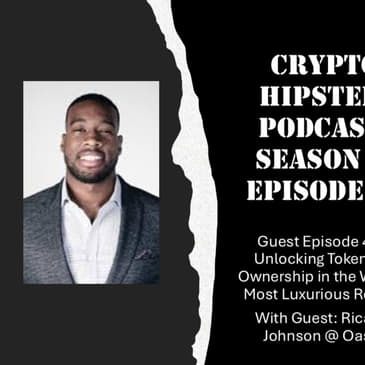

Ricardo Johnson
Ricardo Johnson is the founder of Oases, a pioneering platform revolutionizing real estate investment through blockchain technology. By leveraging tokenized co-ownership, he is unlocking access to income-generating luxury properties, allowing investors to build diversified portfolios of tangible assets with the flexibility, security, and lifestyle benefits of digital innovation.
With a strong background in finance, real estate, and emerging technologies, Ricardo specializes in:
✅ Real Estate Tokenization – Transforming traditional property ownership into accessible, fractionalized assets.
✅ Web3 & Blockchain Integration – Bridging the gap between decentralized finance and real-world real estate opportunities.
✅ Digital Asset Strategies – Creating new pathways for wealth-building in a shared economy.
Passionate about reshaping traditional ownership models, Ricardo is on a mission to make real estate investing more accessible, enabling investors to generate passive income and participate in the future of digital-first property ownership.
Linkedin: https://www.linkedin.com/in/ricardo-c-johnson/
Website: https://ownoases.io
Email: info@ricardocjohnson.com
[00:00:03] Hello, everybody, and welcome to the Crypto Hipster Podcast. This is your host, Jamil Hasan, the Crypto Hipster, where I interview founders, entrepreneurs, executives, thought leaders, and all amazing people all around the world of crypto and blockchain. And today, I have another amazing guest. I have Ricardo Johnson, who is the founder of Oases. Ricardo, welcome to the show. Thank you for having me, Jamil.
[00:00:29] You're very welcome. It's a pleasure to have you on. And let's kick things off. I ask everybody the same question. I get amazing answers. What is your background? And is it a logical background for what you're doing now? Great question. Yeah, it's a logical background for what I'm doing now. So I initially graduated with a degree in finance. And before getting into real estate, I actually ran a men's clothing brand for 10 years.
[00:00:57] I exited that company. I started what we were calling the UK deal sourcing. So essentially, what I would do is, you know, contact private investors and act on their behalf and find investment opportunities for them to invest in, in the real estate market.
[00:01:12] And I've done that for the past eight years. Around that time, I was introduced into crypto and smart contracts. This is like slightly before the NFT wave. And that's where my mind started, you know, expanding in terms of the opportunities that this technology can actually have for assets in general.
[00:01:36] So at that time, I didn't have the experience or the confidence to really, you know, tackle that problem then head on. So I've just kind of, you know, shelved it. And back in 2020, during COVID, I actually started my first tech company, which then developed into me tokenizing some investment opportunities just for a small community of investors.
[00:02:01] After that, you know, success, I then, you know, had the experience, confidence, and to start actually building out Oasis, which is more of a fully integrated marketplace for tokenized real estate. Awesome. People don't realize that some of the better projects now started in 2020, like, like Solana and Avalanche and stuff. So, you know, a lot of good things came out of COVID. I agree.
[00:02:29] So Oasis, you know, what's it all about? What's your vision and your mission? So my mission is to really democratize real estate ownership. From my experience, you know, working in property, I realized that, you know, majority of people are, you know, singled out, they're not able to actually access this asset class.
[00:02:49] And, you know, over the past hundreds of years, in fact, but, you know, it's a nice stable investment that grows, you know, over the long term, but the buyers to entry to actually get involved is so high. And, you know, as the prices are increasing every year, the buyers to entry are increasing every year, you know, so my mission was to how can I create a way to make this more accessible?
[00:03:13] You know, another issue that I found is that depending on, you know, whether you use managers or not, there's, you know, the management headaches that you have with managing your portfolio, you have to constantly, you know, be on top of what's happening with interest rates, you know, you're pretty vulnerable, you know, and highly leveraged in most cases.
[00:03:36] But I thought, you know, with this technology now, we can now democratize that ownership. So instead of having, you know, full ownership of the property, you can own a fraction of it without any debt or anything, you can earn, you know, probably better returns, in fact, without any of the management headaches. So in one sense, it's probably too good to be true. But I think at the time we're in now, we're actually able to do that.
[00:04:01] So let's get a lay of the land as far as the real estate. Your clients are focused on purchasing commercial or residential? And where? So we actually focus on luxury resorts. So what I do now is, you know, I approach developers from all over the world, who's developing these resort projects.
[00:04:25] You know, they have one issue in terms of being able to sell through their units, you know, fast enough with a global market. And I then have investors on the other side who are looking for these type of opportunities in, you know, emerging markets, for example, where they can get those, you know, comparable returns.
[00:04:45] And also, you know, have the lifestyle benefits of being able to go and visit these resorts and, you know, be able to have that tangible aspect to, you know, a commodity, essentially. So what I thought would be, you know, a great unique selling point is being able to sit in that middle, that middle ground and be in that marketplace between the two parties.
[00:05:07] Got it. I'm wondering, like, there are a lot of people who think, okay, the best resorts are the ones in the Caribbean that are established or the Maladogs or Fiji, right? But there's like a lot of good resorts in places like Cambodia, you know, and San Siadukville. Like what, how do you choose where, how do they choose, you know, where these resorts are going to be?
[00:05:31] It's a great question. I suppose how I personally look at it is depending on what's the tourist growth in that region, for example. So you have like established markets, let's like, places like Bali, for example, you know, Indonesia that over the past five years, you know, also since COVID, you know, I've seen, you know, astronomical, you know, increases in demand.
[00:05:54] And their prices have, you know, skyrocketed, same place like Dubai, Costa Rica, you know, all these regions, which, you know, are now when people are more, you know, globalized, people are way more globalized these days. These type of opportunities or these places become more attractive, you know? So what I look for is where, where, where are those opportunities now, you know?
[00:06:19] So at the moment we're looking at a resort, which is in East Africa, Tanzania, you know, Zanzibar specifically, which has seen high growth over the recent years. And there's a lot of resorts being developed there now. So where I suppose you kind of, you can follow the money essentially, you know, follow the smart money and you can see where these new resorts are being developed and getting on the action. Nice. Nice. Okay. I've never been to Africa. It's on my bucket list. So, yeah.
[00:06:48] So real estate, real estate tokenization, like has a revolution, not only the real estate industry, but also maybe the crypto industry too. Yeah. Yeah. It's an interesting, it's an interesting one. I think, you know, there's, there is an issue in the, in the crypto community in terms of how can we adopt, how can we bring more people into, into crypto? And my personal belief is that real estate and other worldwide assets is really that bridge between it, you know,
[00:07:17] where you can have the digital assets, but there's still a, you know, a tangible asset backing it. So most of the people who are not engaged in this, you know, technology, you know, who are maybe skeptical of, you know, what's behind it. I don't really understand it. It's projects like this, you know, which can create that bridge where it's something that they're already familiar with, but now have a new interface with it, you know?
[00:07:42] Yep. So, um, I'm just, I'm just like, you know, that, I mean, you're, you're in UK, right? I'm based in Spain. Spain, Spain. Okay. Very cool. You have some great food over there. So, um, Donald Trump, our new president said, we're going to create a strategic crypto reserve in the U S right. And you have a lot of people who think it's supposed to be Bitcoin only.
[00:08:07] And you have other people who are getting into the conversation like XRP. And I'm like, I'm thinking there should be an index, but why shouldn't that index include real estate? Because real estate seems like opportunities that people should have around the world. A hundred percent, a hundred percent. It should, um, not even just real estate, you should have bonds in there and you can have tokenized gold in there.
[00:08:29] They should really, if they want to be, you know, the crypto hub of the world, um, that reserve should, should reflect that also, you know, a wide variety of assets. Okay, cool. So the key opportunities now for investors then interested in tokenized real estate, um, what are they and what are the challenges? Um, I suppose to start with the challenges, the main challenges is the regulatory landscape.
[00:08:56] Um, especially when you're thinking on that on a global scale, each region will have its own jurisdiction, its own rules and regulations around it. Um, which, which are really, you know, stifling a lot of projects at the moment. Um, I think most people now, the hope is now that Donald Trump's in place and, you know, he wants to kind of spearhead, you know, the crypto movement, especially for the U S is being able to maybe relax some of the restrictions around it,
[00:09:25] around tokenization and those things to really, you know, have more innovation in that innovation in that space. Um, so that's really the main challenge of navigating those waters. Um, but the main opportunities is that think about it. If you were to buy a property today, like, you know, it's going to take you a couple months to actually, by the time you decide you're going to buy it to when you actually get the keys and go through the legal process,
[00:09:52] you know, that's a long time and it's even worse when you're trying to sell it. But imagine now that you can have, you know, a global marketplace where you can instantly buy and instantly sell these assets, you know, a bit like how you would trade stocks or crypto, but you can do that with, with real world assets. So these are the type of opportunities that, you know, are on the horizon essentially that, you know, will, will, will help a lot of people, not just access it, but access it anywhere in the world.
[00:10:19] You don't have to go through, you know, um, the same, once, I mean, once you've gone through the KYC, once you've done the AML, you know, checks and, you know, money laundering checks, you can literally build your portfolio at your own pace, you know, from the comfort of your own home and, you know, uh, build your, build your digital wealth. Yeah. So I like that idea, building digital wealth. That sounds good to me.
[00:10:49] Um, you are in Spain, you're a subject at MICA, right? So how do, how do, how do you navigate the MICA rules and regulations for, for the real estate market? Well, luckily my company's not registered here. So I, I avoid it that way. Um, but yeah, it's, it's a, it's a, it's a, it's a minefield of restrictions. If you were, if you were to build here, um, you know, with the crypto project, it's not impossible. There are, you know, tokenization platforms based here.
[00:11:18] Um, but my main market for the people who are, you know, signed up to the platform are based in the US. So that's where, you know, everything is, is, is, is regulated and secured. Okay. That sounds good. So, um, it's easier for you. Yeah, exactly. Exactly. Now you said some other, you said some things, you said, um, other assets, right?
[00:11:44] So what other sectors, what other assets do you foresee in, um, tokenization occurring? And what are the advantages with them compared to non-tokenization? Um, so I think on the more tangible, tangible level, um, people are already tokenizing like luxury watches, for example.
[00:12:07] So you can own, you know, a fraction of a Rolex, you know, um, so people who steam them as an investment vehicle, they don't necessarily have to fork out $20,000 to go and buy a particular Rolex. They can, you know, a few hundred dollars and they can still have the same ownership effectively. Um, another thing I mentioned before was, you know, gold, gold bullion and being able to, you know, own gold that way. Um, I think another one, which is more on the fringe.
[00:12:36] So I seen this a few years ago where you can essentially tokenize yourself and, uh, your earning potential. So people can invest in people this way. Um, so this was, this was, this was around like the NFT, uh, hype, you know, where there were companies who were doing these type of things. And, um, essentially I'm not sure whether, you know, that's still, still in, you know, still active.
[00:13:02] Um, but how I see things moving in the future is that these type of opportunities will be created. So think about like music rights, uh, film rights, um, really any sort of intellectual, you know, property in fact, that you can actually tokenize and have, um, own an ownership stake in these things. So, whereas to own any sort of copyright, you'd either have to know the person who owns it or be a part of a company, you know, or own a company which owns it, like you couldn't really have direct ownership.
[00:13:31] Um, where technology is going now, I feel like it's going to open a lot of doors with all different types of opportunities for tokenization. So companies can, or companies can tokenize their CEO and people can invest in their success if they, they achieve it or not. And not just paper, but like actual tangible results. So I suppose how it works, um, from the research that I've done, it's, uh, in the smart contract, you know, you would, you would set some metrics.
[00:14:00] So let's say, um, my earning, I'm going to, I'm going to pledge, you know, 10% of my earnings potential for the next 10 years, for example. And let's say you've been following me on Instagram or LinkedIn and you'd be like, you know, this person's a winner. You know, I'm sure he's going to be successful one day and I want to have a stake in that. Um, so how it's actually validated and, you know, done on the backend, I'm not sure, um, how that actually operates, but in premise, like, you know, that's what people are buying into.
[00:14:29] So providing that that person is successful and they do uphold their end and, you know, um, distribute 10% of their, their earnings, you know, essentially people are able to invest and essentially back them. You're backing that person to, to be successful, you know? I think that would go over well with a lot of people. A hundred percent. Yeah. Um, I think more so like people like music artists, for example, you know,
[00:14:57] who may want to raise money to promote an album or even to create an album instead of having to go to directly to a label, you know, they might have a small fan base, uh, on TikTok, for example, and maybe like, you know, I want to tokenize the earnings potential of this particular project, um, that people can invest in. Now, obviously they would, it would rely on them distributing those funds and being transparent with what's happening in those things, but it's definitely possible. Interesting.
[00:15:27] Interesting. So I want to talk a little bit about real, about real world assets. So actually, you know what? That gives me an idea, that gives me an idea, right? Um, you said there's, there's going to be opportunities. You said, mentioned gold. You mentioned, um, oil. So say, how do you, how do you tell if something isn't tied? Say there's like 30 gold coins with the word gold in it or 30 with the word oil in it.
[00:15:55] And some are meme coins and some are actual real. Uh, you know, how do you, how, if you're new to the industry, how do you tell what's new and what's like, how do you, how can you like tell what's what? So like a million points coming out of our day. A hundred percent. Um, the best way to tell is using the actual, uh, the contract ID. So you can use that to verify maybe with someone else who's invested in that. Say, is this, is this the right, you know, the right contract?
[00:16:25] Is this the right token? For example, um, in terms of verifying the people do create, you know, fakes of other, of other tokens all the time. Um, and that's the way you kind of get, get around that. Um, but I think another point that, that, that's came to mind, like how, how else do you know also that there's gold behind that token? You know, how do you verify that? And that's another challenge around tokenizing real world assets is that verification aspect of it.
[00:16:53] Um, so for us at Oasis, for example, um, you can set up, you can set up automated, you know, verification processes, which are third party, which ensure that this real estate still exists. You know, this real estate still doesn't have, you know, hasn't been sold. There's no debt on it, for example, et cetera, which gives the investors peace of mind that, that that's there. But so far there isn't like a foolproof solution for it.
[00:17:20] You know, um, I think that will come in time, you know, but, you know, obviously we're still early days, but, you know, once those things are in place, it's much easier to be able to verify and detect fraud and, and those things and feel more confident as an investor. But, you know, for someone new coming into Web3, those are the, those are things you can, you can do to, to kind of double check essentially. I guess it's easier with the real estate, right?
[00:17:48] You can say, okay, this thing's being built, you know, how do people assess the quality? So that's through appraisals. So when the, once the properties, you know, the development's finished, the property will be appraised and we have regular appraisals, you know, appraisals maybe every six months or even every quarter if needed. That then gives, you know, uh, it gives the investors as well. Let's say the price has gone up by 3% in that particular area.
[00:18:18] Then that's something that people can trade based off, you know, they can maybe predict what it's going to be in two years time and, you know, be able to make investment decisions based off that. But having that, you know, that back trail of real third party appraisals also gives you, you know, verification also. And you put that on the blockchain? Yeah, yeah. You can put that on the blockchain. Okay. That makes sense. So that's, that's, that's where the speculation comes into play, right?
[00:18:48] So that's cool. Um, so I know during his, uh, inauguration, President Trump said the U.S. wants to be, is going to be the U.S., the oil capital of the world, but you have all these other, you know, um, energy sources like water. You have Bitcoin tied to a volcano and, you know, in El Salvador, um, you have other opportunities.
[00:19:14] So how do you see the other opportunities playing out going down the line? And what do you think we need to do to, to bring the level of all energy sources up to par? I think the main, I think another opportunity in energy, for example, um, it's a tough question, actually. It's a tough question. But one, I think it can be used for, for good. You know, we're in a global crisis, you know, for energy at the moment.
[00:19:44] And it can be used as a way, an incentive to incentivize people to, you know, back these type of projects, which are using clean energy or, you know, nuclear energy, for example, which can really take, take us all off fossil fuels eventually. Um, and being able to have direct ownership in these type of projects, you know, could be the catalyst to, to really achieve, you know, the 2030 goals or 2050 goals, whichever, you know, that, that, that, that everyone's set.
[00:20:13] Um, I know you mentioned about like the, the volcano, um, being attached to the, to Bitcoin in, in South El Salvador. It's a very interesting, um, project or interesting use, but it's a very smart use of being able to get energy because, you know, we're using cryptos really backed by GPUs, you know, um, and it needs power. So if you can find a sustainable way to, to, to power it, you know, it's definitely needed.
[00:20:43] Yeah. I, what I like about this industry is because the innovation opportunities, a lot of people don't think of, you know, um, but so, so I want to ask you, you know, strategies, what are some important strategies for tokenizing efficiently from a developer or from a developer and investor and, and, and an operational, um, view? Good question.
[00:21:10] Um, so tokenizing for a developer, I think because the, the market's still new. So essentially there is, there's still, there is a retail market, but it's still, you know, minuscule compared to the potential for a retail market, but it would be starting to explore, uh, new platforms that have been developed like Oasis as a way to now sell through your, your units, you know, to be able to access a wider pool of investors.
[00:21:40] So instead of having to rely on the traditional methods for marketing, um, or, or for sales, for example, you know, there's more opportunities to find a global audience, you know, for, for your projects. Um, I think that's the main opportunity for developers, um, for investors.
[00:22:02] Uh, I think the main, the main thing for investors would be to really put time in educating yourself on these types of opportunities. Um, you know, I think crypto is traditionally, you know, uh, deemed as a way to not say get rich quick, but, you know, when you talk real world returns with a crypto investor, it's not as attractive, you know, if you're talking like from a real estate perspective, you know,
[00:22:31] anything over 10% is pretty, pretty good, you know, uh, for, for a return on investment, but in crypto, you know, that has to be a hundred thousand or a thousand percent, you know, it's, so it's, it's, it's, it's, it's that, um, bridging that gap, which I think is, it's really a big opportunity because imagine someone who has, you know, hundreds of thousands or millions of dollars in, you know, uh, crypto assets, uh, row on assets that are tokenized
[00:23:00] is a great way to hedge. It's a great way to diversify and to de-risk some of your portfolio, you know, without having to completely off ramp, uh, back into fiat to make these purchases. Um, and for, um, uh, operators it's, I think now is the perfect time. I think with, um, where we are in the market, you know, is various, it's a very established, you know, crypto market. Now there's trends that you can use.
[00:23:29] Um, we have a strong narrative now of, you know, bringing a billion wallets, a billion users to, to crypto. We have, um, you know, uh, a strong president in the U S which is, you know, really spearheading what's going to happen in the, in the, in the crypto market as well. And, you know, sees the opportunity there. So for developers who are thinking to, to get involved, I think now is the perfect time. Um, technology is getting cheaper to build on.
[00:23:56] Um, it's more accessible for people like myself who are non-technical. Um, and especially if you have the experience with the real estate or whichever real world asset that you have, you know, to create a solution, um, for your, for investors is, is, is, is much easier now. I think it was a couple of years ago. I saw, well, it's interesting. You say a thousand X is an expected return. I saw like the top hedge funds and like the path hedge fund was like returning 25%.
[00:24:25] And you know, the, the, if you have the 10%, that's a good thing in the track bar world, you know, um, and there's a bull market coming, you know, we're not at the peak yet, you know, uh, a little bit of pullbacks recently, but like, I went to X be an amazing return or, or three X or, you know, um, why, why should people not no longer expect a thousand X as a number?
[00:24:52] It's, um, I think it's just the mentality of, of the type of, of the type of opportunity. Um, I think overall, because anyone who's involved in crypto now is still pretty early in the grand scheme of things, right? If you think over the next 50 years, like people who got in, who invested over the last five years, last five, 10 years are very early. So, you know, this type of opportunity is expected that those type of, you know, gains
[00:25:18] are expected over the longterm, but also on the flip side is, is a lot of investors in crypto are very short term, you know, unless you're like a Bitcoin maximalist or whichever you're really investing today to be able to sell within the next, you know, three years, essentially to purchase something else, you know? So there's a way that if you get in early on, you know, particular mean coin or any other coin, you know, you can see those type of, those type of returns.
[00:25:46] Um, which means that a lot of people lose also. Um, but I think even, even in real estate now, for example, tokenized in real estate, um, studies show that, you know, it increases the value by 30%, by up to 30% just from having something that's more liquid, you know? So there's, there's huge gains there. And if you, if you own real estate, you know, today that you own for the last 10 years, you've already doubled, doubled your money there.
[00:26:14] It's just a longer horizon that you have to wait for, but those, those returns are still there, you know? Interesting. Tate, that's, I find it fascinating. I find that, I find the Bitcoin maximalist in general fascinating because you believe in this long, you believe in this single finance, new financial system, right? But I don't think we're going to see the real benefits until the, towards the end of the Bitcoin mining period, which is 2100, 2132, right? Yeah.
[00:26:43] We're not going to see it during our lifetime. You know, what do you think? I disagree with that. Um, I think we're already seeing it, you know? Um, you have to think, I mean, when I first got into crypto, Bitcoin at that stage was around like 6,000 pounds. So let's say $8,000, for example, like to compare to today where we're, you know, we're more
[00:27:08] or less a hundred thousand plus, you know, like, so there are, there have been, you know, huge gains now. And I think, and that's like, we still have, you know, a load of like over a million or even 2 million left to mine. Right. So there's, there's still a load more to mine. So yeah, to what you're saying over the next 120 years, that's when the final Bitcoin will be mined. But leading up to then, how many halving processes do we have to go through?
[00:27:37] So how many times does, you know, the, the payout for that, you know, half, you know, so it creates, um, uh, a supply squeeze for more people that want to invest in it. There's less, you know, return on being able to mine it. It's costing more to mine it. So that in itself, you know, creates more, uh, pressure on the price to go up. So I think in, in, you know, in our lifetime, um, we'll be able to see that, that, that million dollar coin.
[00:28:05] I'm, I'm, I won't go on the record, but that's what I feel like, you know, I feel like we'll get to that million dollar coin. Um, which I think at that point it's positioned to become like a, a world, you know, um, uh, uh, a world to be able to back, you know, the world's currency at that point. Say that happens, say it happens. And I hope it happens. You know, um, there will there, what do you think about like a lot of, a lot of young
[00:28:34] Gen Z's today? They can't afford a house, you know, will there be, will then they be able to afford a house, a real estate property that they're. No, they're, um, they, they, they'll probably never, I mean, you gotta think the new generation now, they'll probably never be able to own a property. You know, I think in the, so in the UK, for example, the average is 300,000 pounds, which
[00:29:04] means, well, maybe to own one personally, they would need at least 30,000, you know, uh, as deposit. So unless they have, um, parents or grandparents who are able to help them, you know, maybe they, they remortgage their property to give them the deposit to, to get on the ladder, essentially. That's really the only way, but if they're starting from scratch, it's going to be very difficult for them to work their way to do, because, you know, they say it takes them five years to save that.
[00:29:30] Then they've got, they're battling against five years of growth also, you know, um, then you have interest rates, which means your affordability criteria increases. So there's a, there's a lot of things at play, which, which makes it very difficult to really gain access to, to, to that. And that's let alone, that's just your residential. You got to think if you now have a rental property, that's a whole nother field where you need now 25%, you know, at least 25% to put down.
[00:29:58] So it kind of makes it an asset class that is, it's, it's still attractive, but there's, there's so many other opportunities now, you know, such as tokenized real estate, such as Bitcoin, such as, you know, it's these type of assets, digital assets, essentially that really democratize access to wealth. You know, um, you even got, you still have stocks, you even have stocks, but there's
[00:30:24] stocks that are, you know, a thousand dollars plus that unless they can get it fractionally, they can't actually own either. So it's, it's, it's challenging. It's definitely challenging. Yeah. Interesting time. So that's, that's, I look forward to seeing how, you know, how Oasis plays out and how people are able to use your platform to have that fractional ownership. So, yeah, thank you. Yeah. Looking forward to launching, uh, in February.
[00:30:53] And, um, we have our first, uh, tokenized resort, as I mentioned in, in, in Zanzibar, um, you know, to get involved, you can actually own real estate for less than $2,000. Um, and earn at least, you know, between 10 and 16% ROI. So it's a, it's a great overall investment opportunity. Um, let alone is backed by, you know, robot asset. Awesome. So I want to thank you very much for speaking with me today. I enjoyed this conversation. I have one last question. It's easy.
[00:31:23] How can people get involved? How can people find out more information about you, about Oasis? How can they start to invest? How can they do that? Um, so you can go to own oasis.io, um, for the website. Um, we're on Instagram, LinkedIn. You can connect with me on LinkedIn also at Ricardo C. Johnson. I'm on Instagram at Rico C. Johnson. Um, but yeah, you could just send me a DM, go onto the website. You could sign up there, join our community channels and get involved that way. Awesome.
[00:31:52] Thank you very much for your time today. Thank you, Jamil. Take care. Thank you.