
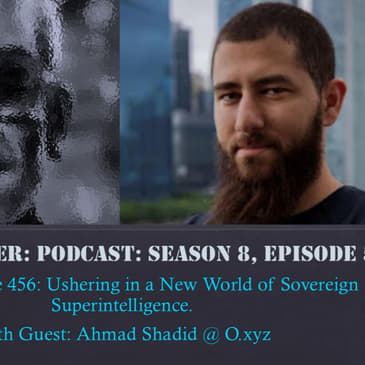

Ahmad Shadid is a tech entrepreneur known for his contributions to the artificial intelligence and blockchain industries. He is the founder ofO.XYZ, a blockchain and AI company, and the former CEO of IO.net, a Solana-based decentralized infrastructure provider (DePIN).
As Founder and ex-CEO of IO.NET, Shadid successfully transformed the startup into a multibillion-dollar enterprise within just a year. His strategic deployment of AI solutions greatly impacted the Crypto AI landscape and solidified IO.NET's position as a leader in the decentralized AI compute sector. The company's advancements under his leadership helped pave the way for broader blockchain adoption, emphasizing reliability and scalability in decentralized physical infrastructure.
At O.XYZ, Shadid’s vision focuses on building a strong platform for scalable blockchain and AI solutions, designed to cut operational costs and accelerate transaction speeds in real-world use cases.
[00:00:01] Hello everybody and welcome to the Crypto Hipster Podcast. This is your host, Jamil Hasan, the Crypto Hipster, where I interview founders, entrepreneurs, executives, thought leaders, amazing people all around the world of crypto and blockchain and even AI. And today I have another amazing guest. He is the CEO of O.xyz. His name is Ahmad Shadid. Ahmad, welcome to the show.
[00:00:31] Thank you very much. Yes, as Ahmad Shadid, by the way, we miss that. I think everyone always miss my name. So that's why my nickname is just Shadid. It's easier for everyone. You know, Arabian names are always the hardest, man. Thank you. I'm currently the interim CEO of O.xyz because after some time, Ms. O., the AI CEO, is going to take over. So, you know, my days are counted here.
[00:01:00] Well, nice to meet you and thank you very much for hosting me here. Looking forward to it. Let's get started. I'm happy to have you. And interim CEO or CEO, I'm glad you're here. I'm glad I'm talking to you because your O.xyz sounds like really interesting what you guys are up to. So let's do it.
[00:01:20] I want to find out first. I asked the same question to all my guests and it's this. What is your background and is it a logical background for what you're doing now?
[00:01:31] Very good question. Makes sense. In 2014, 2015, I was in high school. I was building some software for game engine rendering that makes game engines on GPUs run faster and better because I didn't have enough money to buy a good GPU. So I kind of find a way through Kuda language to make the GPU better and faster and overclocked like 20, 30 times more.
[00:01:57] I ended up burning a lot of GPUs and that was since high school. That's 2015, 2014. Then after that, I went into the journey of, you know, entrepreneurship, trying to build something for myself. Always into around, you know, anything technology, crypto, quant trading. And in 2020, you know, focused on quant trading. 2019, sorry, to 2023, I was full in quant trading.
[00:02:23] I had my own fund and then that fund eventually evolved to become, yeah, that fund ended up using a lot of GPUs and GPU compute power. In 2023, we kind of repurposed that fund technology that was building in the backend, which is again about GPUs. So in all these years. So I ended up building Ionet, which scaled from February 2023 or March 2023 to March 2024. It was around 1 billion valuation, where is the 40 million?
[00:02:50] June 2024, we got listed on Binance at 4.5 billion. Then I had to quit the company, started another company. They forced me to quit as a CEO. So like, okay, next time I'm going to make an AI CEO. So no one can let the CEO quit. So instead of me, I'm a human, right? Dispensable. So then, yeah, we started this concept of like, why not I work for the AI, not for the VCs? And that's basically the vision and how it started.
[00:03:16] And now O is basically building a sovereign super intelligence that is managed by the intelligence itself. And all of us are basically employees or team members that work for the AI that could fire us at any point of time. And that's basically what we're building. Like we really live in the moment of building all this tooling and infrastructure to actually work for an AI. That's as simple terms. So I guess maybe it fits what I'm doing right now. Interesting. Okay. I was going to ask you what O.XYZ was all about.
[00:03:46] Like, what is it all about? And what's it mean to be building the first sovereign super intelligence? Although I think you just told me. Yeah, I guess I could elaborate more. So the issue we have right now in the world is the intelligence is either for China or newly right deep seek and stuff. Or it's, you know, for U.S. And all these people either sanctioning each other on GPUs, computer power, stealing trade secrets.
[00:04:15] It's just this war in AI that's currently happening. And U.S. is amazing in surveillance. And these AI tools are just an amazing way to have more information on people, to have more personal details on people. It's going to get more and more scary. Anyway, so we're going to kind of give them like 40 times more power to control us with AI, with our information that is at the AI. It's basically what we think. Like, everything we think of is there.
[00:04:43] Before that, they used to predict what we want through our YouTube feed and searches and so on. Now it's even deeper than that. They know what we think, what we want, and what direction we go in our thinking based on what we answer to questions, what we're trying to build. Just everything. And everything is censored. Like, every single thing is censored. And that is, you know, provided by U.S. And you have to have a backdoor, period. There's no way you run without a backdoor.
[00:05:12] Trust me, I know. So then I got to a point where, okay, so if we really want this, build an AI that is sovereign, that no one can stop it. It does not have to come with regulation here and there and X, Y, Z. Rather, let the people build the regulation. Let people build the safety of the AI. Let people decide. Let, like, hundreds of thousands of people decide this is what we think is safe. This is what we think is not safe. Let the AI be that.
[00:05:41] As a human, we have to be, you know, like, safety board and so on to kind of control the AI around the safety measure. Sure, I'm not against that. But let the people decide that, not few politicians who will do and decide that just to kind of, like, direct the innovation to specific direction, specific field, specific use case, or to give them more control and surveillance over people. Right?
[00:06:03] So instead of making the regulation that way, like, they come up with regulation that if anyone trained an AI model on AWS GPU, if the AI model is cybersecurity threat, you have to report it to the government. But how can you know if it's a cybersecurity threat? Then you have to monitor every AI training on AWS for you to know that this is a cybersecurity threat. So, like, right? So that's a new regulation. Why did you put that regulation? To control, right?
[00:06:32] To control who will build AI, who will scale in AI and so on. And they got so angry when trying to manage to build DeepSea. So I want to just get away with this. Like, you know, that's going to hurdle the innovation. I want to unlock that, build an AI that is in international water, owned by everyone, controlled by no one, and literally surveillance-free and also have an advantage, of course. Like, if it's owned by no one, if it has its own regulation, sure, it has some advantages.
[00:07:00] But, you know, we need more, right? We need something, like, even more exciting, more fun. And we think that is basically that the AI is the CEO. It's managing everything. It has its own money. It's own coin. And we've been building this since June. We spent more than $20 million, and we just allocated $130 million on the project. So it's been a journey for the last seven months. Team right now is more than 60 people. Maybe that's a summary.
[00:07:29] And also, at the end, this AI is actually going to be launched on 22nd February. It is going to be the fastest AI on the planet. Like, seriously. Faster than ChatGPT. Faster than DeepSea. And not only, it's not answering you a question that exists in the model. No, no. It goes and surge and bring results out from the internet live and comes back. And it's still 20 times faster than Perplexity and ChatGPT and DeepSea. It's crazy. It's, like, really crazy. Why?
[00:07:58] Because it runs on the world's fastest compute chip called Cerebrus CS3 node. Each one GPU is, like, $1.5 million. This chip is just revolutionary. So that's, like, the advantage. It's better than Grok chip. Better than all these chips that are in the world. All the NVIDIA chips. Nothing compared to this chip. It's a new technology that barely few people know about. And we will be the first commercial product launching using this technology. That's why we will be the fastest they are on the planet.
[00:08:27] So stay tuned for 22nd of February, I would say. Sounds good. Sounds exciting. Interesting. Interesting. So, yeah. You mentioned DeepSeek. There's also these autonomous agents, right? These AI autonomous agents. So I'm trying to find out what the true value of those agents are and why they're... I guess now they're indispensable. It used to be, like, a dream.
[00:08:56] Now they're, like, indispensable utility, right? Why is that? Well, your question is a bit complex. I mean, why the AI agent market is bumping or why do we need that and why it will continue to grow? Both. What specifically do you want me to do? Both. Well, look. We can meet both, and you'll be honest, right? If you look at all this AI agent's coin, like, 99% of them are nothing, right? It's just something riding the hype.
[00:09:25] Just like pumped at fun, right? 99.99% of the coins are nothing. Same thing is happening also at this. But because of that happening, that itself shows you something very critical, which is there is a lot of money there, right? And people are doing anything to invest in anything. Crypto X AI in any way possible, like at the intersection of crypto AI. Whatever it takes. An AI meme, an AI agent. Just put AI there. We will invest, right?
[00:09:54] They want that AI investment in the crypto market. The crypto market lacks real projects, lacks opportunities. And when I started INET last year in 2023, no, it's two years, man. When I started INET last year, it was two years ago, there was a lack of real project that is actually AI.
[00:10:18] Like, at that time, there was only render, fit, and like, I could literally count them on my fingers. And there's so few of them. And it's so old technology. None of them have something really revolutionary that is actually usable outside of the cryptosphere. The crypto world is so small compared to what is outside.
[00:10:39] So when INET came in, it grew so fast because it had a technology that is at the bar of chatGPT-level infrastructure that is behind chatGPT. Like, something really advanced that the market haven't seen before. I mean, barely people in the AI market who works for the largest companies in the world, whoever needed to kind of train some really advanced model at that time, even knew about such technology and how to handle it.
[00:11:07] It's like really advanced technology that's usually used for hyper-concentrating machine learning training. It's the same technology that was needed to train chatGPT. So when we brought such like raw, crazy technology, but also the right market, the right time solving a real problem, business problem, all together, brought you that fast-growing thing. Now, what's happening right now is after we launched INET and it was 4.5 billion, now it's like 2 billion and something.
[00:11:34] So it wasn't a success story and so many people tried to clone it. And after that, what is happening is they throw GPU, they throw GPU cluster, they bring the same words we use and they build something so simple and just throw it there. And money flows there, right? But it's not core technology that if I would come in after the beer market, I would find them, right? It's just a pump and a long pump and dump or a trial to ride the wave, I would say. Okay. And that's what I noticed is 99% of the projects in the market.
[00:12:03] They have just tried to ride the waves. And it's for us as investors to be aware of this and also to educate our communities, you know, to tell them how to really distinguish between this is someone trying to ride the wave or someone who's actually building something solid. It's just beyond the coin, right? It's you have a treasury. Did you save enough money for the beer market? Did you have enough, you know, technology team? How are you going to handle this, that legally?
[00:12:31] You know, so many questions, you know, and only few people in the crypto industry actually have answers. Only few projects, sorry. So that's, I guess, because it's so hard, like it's not so easy to actually build something so, so like foundational that will last for years and years. So there's so means there's less coins. And it's a normal, so if you actually look at the crypto market, there was no AI agents coin. There was no AI meme coins. It only started after goat.
[00:13:01] But because there's just nothing, all these utility-based projects are backed by VCs and takes months and months of building. So they were like, just like how we're doing with, or like how, what happened in the pump fund, just pump it, put an AI on it, do any simple product, launch it. Who cares, right? And it actually worked. Right? People just want to invest. Come in, go out. Come in, go out. That's it. That's what the industry right now wants. And that's what they are interested in and attracted to.
[00:13:28] So you can build an infrastructure project, you know, like what we do, like what IronNet is doing, sure. But you have the funding to stay there, to miss the bull market, you know, it takes time, takes, you know, a lot of process. While in the other hand, you have a lot of investors that are just throwing money that they want to come in and invest and be part of an AI project. Because of that, we have so many coins and we will continue to have so many AI coins because the real AI coins are so few.
[00:13:54] Like the real, real pure AI coins that will be there in the top 100 coins for the next few years. Very few. And it's hard to find them. That's why the industry kind of evolved in a way where, sure, whenever they come up, they come up, we invest in them. But in the meanwhile, we will invest in the AI meme. So what happened is, and we noticed this with DeepSeek. Let me give you a quick, just a, you know, quick example. When DeepSeek launched, you know, all the stocks went down, right?
[00:14:23] You saw all this chaos that happened. But what was really interesting is the AI meme coins and AI agent coins also at the same seconds and the same minutes they were dumping. Same time. Now, that's very interesting. Like, why? Why would they dump? Like, at such synchronicity. Like, they're so synchronized and going down between the stock market and the crypto Solana AI meme coins. Why are they synchronized? Like, they're going down at exactly the same time. Now, the answer is amazing.
[00:14:52] Like, yes, it was a dump, right? It's horrible or sad. It's temporary. This actually gives you an amazing thing. This such synchronization and the price going down exactly the same time means that there are quant funds that are trading stock markets, that are hedging or, like, diversifying, are trying to catch the AI narrative in total in the crypto market. And they're using the quant funds to buy these tokens.
[00:15:22] So you're talking about, like, funds with billions and billions of dollars. Now seeing it's possible and feasible for that much money they have to put it in Solana and to buy the coins that are listed in Solana and to sync their quant systems between the stock market and the Solana market, Solana AI market, and do this hedging and risking, meaning that they, first of all, saw an opportunity. Second, saw available volume for them to trade at such big sizes.
[00:15:49] Third means for us, institutions are already in. And this is, we are in the middle of the AI bull market. Like, if these big quant funds are in, it's not going to stop. It's just a continuous loop. It will never stop. As long as the quant funds end. The amount quant funds go out, they usually go out with massive change in the market dynamics or war or whatever. Then, okay, things change.
[00:16:11] But right now, what I see is, it's just an amazing, actually, signal to the market and the industry that you have quant funds trading your AI coins. And even though it's nothing, like, these coins are nothing. But why do they trade it? Because all these coins together represent the AI narrative. So it's like an index. So if we just buy all the AI coins, it's like we're buying all the AI index and crypto. It doesn't matter. It's real. It's bad. It's good. You know, risk is hedged and measured through mathematical formats. But they're buying the narrative. They're buying the mindshare of people.
[00:16:40] They're just going in with the wave. And if big quant funds that trade in the U.S. market are doing this in the crypto market, that's an amazing bullish signal. Amazing bullish signal. Hope I answered the question. You answered a question that I've been asking for weeks, I think. Depending on this, the answer to the next question. Okay. Would those quant funds show up as a professionally named quant fund on X?
[00:17:09] Or would they appear as trading accounts, anonymous trading accounts where you can't tell who it is? What do you mean, X? Twitter, X. Well, I'm talking about quant funds. Well, look. I mean, if you have systems that sync between two markets, you're talking about at least, at least you have a team of 20, 30 people. Because you're trading stocks and crypto. And crypto and decentralized. So, Dex.
[00:17:38] So, you're talking about at least a team of 30, 40 people. Like this minimum. And if you're investing in stocks and because of your stocks investment going down, you stop your crypto trading. And you look at the volume in Solana, it's like 4, 3 billion, 6 billion. That's crazy volume. And then you say they are like 2, 3, 4 billion. Because look, 80% of the volume in the market right now is managed by automated trading systems. It's not by humans. And that's already in the stock market. The crypto market is even more.
[00:18:06] So, all these people, all the people trading, they barely impact 20% of the market. Like 80% of the impact, 80% of the volume is by quant systems. So, anyway, if you look at every day, the Solana volume, sorry, total Dex volume, whatever. 80%, not even 80%, more than 80% are bots. Automated trading system, quant systems, et cetera, et cetera. So, if these guys are playing with 5 billion a day in Solana or like 2 billion a day in Solana,
[00:18:34] means that at least they are playing with 20 billion in the stock market. Means that they are massive funds. Like they are, we're talking about like quant funds that are, I don't know, like 2 Sigma. For sure, 2 Sigma, I know that. Like 2 Sigma for sure. You're talking, and 2 Sigma is like $59 billion. So, there are big players in the market, like for sure. Now, would they publicly say that?
[00:19:00] Well, that's very complex because, you know, there's tax, there's questions here and there. You better not talk about it. Yeah, but if you do, you'd rather remain non-anonymous. For sure, not to bother. I mean, all your money is made through the market. If it benefits you nothing to talk, I'd rather just brings you problems. Yeah. So, just trace the system. So, what you said makes a hell of a lot of sense to me.
[00:19:31] So, interesting. The institutions are here. You mentioned, you mentioned GOAT, right? And so, GOAT, yeah. And it did well because of this terminal of truth, right? I want to find out what the definition of what your thoughts on the terminal of truth are. Or how does the terminal work and what makes it special? Well, I can't speak of a competitor.
[00:20:00] But I can tell you, the launch of GOAT, of course, we were doing like more than what they were doing since June. Like, they all have started since June. We even like in June did this ethical framework of what should we let an AICO do and not do. And the community was voting into all these things that we've been doing at all. But, again, we're not a meme type of people. We were not so much into that community. We're focused on building like really core stuff.
[00:20:30] So, it took us time to go to the market, right? And that's why GOAT came later and so on. Now, GOAT was actually a very smart move. It was the key to open the AI agent's door because, look, everything of GOAT is coordinated. Like, it's everything coordinating from the market making to the pushes from all the VCs. But everything's coordinating. Nothing was real.
[00:20:57] Like, it was pushed in a way that is... By the way, the reason why GOAT was done is, of course, to make some money. But the reason actually was to open the door for an AI agent's and AI memes cycle. That's why they did it. It was just the key. So, they did that to show people potential, to show people hope, and to open a new hype. Because Solana reached a point where there's nothing usable on Solana. And it's not in AI.
[00:21:26] And they needed kind of something that continues the hype of Solana. And they were really smart. Now, of course, not that Solana did this officially. But, you know, some other people who wanted this to happen to Solana. Like, they care about Solana. And they wanted Solana to continue the hype because that's in their benefit. They hold massive amounts in Solana coin. So, it's in their benefit for Solana to continue. So, they all coordinated together to open this cycle. They've been planning it for a long time, to open this hype.
[00:21:56] And to start a cycle and then, you know, push these coins and let other people push the coins. And it kind of opened this, you know, snowball effect by itself. So, it was a very smart move. Like, one of the smartest moves I have seen in the crypto industry. Like, really, really smart move. And it was a good move. At the end, it benefited all of us. And it's a good start. Like, finally, people became more brave, right? They want someone first to step in. Then they will step after you.
[00:22:23] And that's why I really think it was a very smart move to do such a project. So, I mean, the question is, what's the next AI X something, you know? Like, what's the next thing? AI meme done. AI agents. Sure. But what is next, right? Is it AI CEOs? AI, you know, AI, I don't know. Something. AI exchanges. AI there. So, more and more AI categories, I would guess. Because like, you're right now, you see AI launchpads.
[00:22:53] AI agency. I mean, so, AI infrastructure. AI finance, right? They saw AI DeFi, some AI finance. So, it's going to keep opening new doors. And then they would kind of monitor what really picks up in the market. And then they would focus more and then try to open other doors. Whatever works, they kind of scale it more. There are people who are working behind this to engineer all this. Like, for sure. It doesn't happen by chance, guys. Like, for sure. Nothing of this happens by chance. It's all planned. All coordinated.
[00:23:22] But it's part of the people who care about the ecosystem. To always come up with new ideas. To always adapt to the latest changes in the web tool world. That is actually evolving faster than the crypto world and the AI. So, you know, they kind of had to adapt. Just so crypto is not left behind. It's so old. There's no AI. There's no this. It's, you know, it's shame for the market. So, it's good at least we managed to pick up with web tool world. Long way to go. But at least we are on the same track. We are on the track at least. That's a good point.
[00:23:51] You mentioned PumpFun earlier. And I had a friend I had to talk to him a couple years ago. He called me yesterday morning. He was an XRP guy. I know that. But he was like, give me a list of meme coins. So, which one should I buy? And I'm like, I'm the last person on this earth who you ever want to ask about meme coins. Because I'm not into the social whatever meme coin culture. I'm not. I know DeFi. I know, you know, layer ones.
[00:24:21] I know the basically, you know, finance. Finance, yeah, that I'm good with. You know, and I'm like, I can't tell him. I was like, I can't. I was like, I stick with what I know. You know, and you're sticking, you know, and you're entering a new area. And I wasn't planning on asking this, but the AI CEO. You know, is that one of the early applications of AI agents? And will they not be sustainable?
[00:24:48] And what else is possible now because of what you're building and because of blockchain and the intersection of blockchain and AI? I like the question when this is possible. And I think I can't answer that question because or what should we build next, right? I will always be biased to the idea I like, to the concept I like, to the direction and the market I like. And that's how it all started. The beginning, wanting AI CEO was like, wait a second.
[00:25:17] I don't know what is the product this AI CEO going to build. And that's exactly the reason why I want to build an AI CEO because it has better knowledge than me with all the thousands of books that it read to actually analyze the market, analyze the financials, the metrics. I'll provide the data, right? I will help. I'll put all the information. But it's actually better for me to listen to an AI CEO to what should I do actually? What product should I build? You know, give me an idea. I am this person. This is my financial capacity. This is my knowledge.
[00:25:47] This is my past experience. This is the current market trends and dynamics, et cetera, et cetera, et cetera. What do you think is the best project that I should do that first match my experience? Second is within the current trend, et cetera, et cetera, et cetera. You know, the AI is a better person, better intelligence to answer that question than anyone, than any advisor, than any person, than any human. It's just much better.
[00:26:11] So then that's why we called it audit XYZ because XYZ is, you know, the 3D coordinates, infinity, and all sides. And that's exactly the point is we don't know what we're going to build next, right? We will adapt. We will move fast. We will make sure we are lean. And because we have an AI CEO, it makes decisions like a knife, fast. It will hire fast, fire fast, monitor fast.
[00:26:40] Anyone fails in completing their tasks and is slowing down, it knows, fires. Find someone else immediately. You know, so it has no emotion that holds back progress. And then we can kind of advise the AI, direct the AI here and there if we believe some idea is so good, but we have to provide our data why we should do this. And if the AI thinks it's a good idea, why not? Let's do it. So there's no restriction on what's our products.
[00:27:08] We first right now started with Ocean Platform, which is just like Perplexity and ChatGPT. It's deployed on these fast superchips, which also, that's so one product. And then you have another product, which is called Operators, where actually people from outside the community or in the community, other than the contributors of the project, they could come in and actually become contributors. They could work for the AI.
[00:27:34] So they could be a marketing agent, you know, do Twitter posts, do YouTube videos, blog articles, and they will be paid every day by the AI. Or they could be an engineer, pick up one of the open source repositories, fix something, update something, build something new, submit it, help us build this new AI model. There's data labeling, something we'll do for AI model training. And you have bug bounty every day. If you find a bug, there's a price of 5,000 IO coin or sorry, OI coin today.
[00:28:03] If you found a bug, if you found a security attack. So the AI is using that effect of internet and effect of it fastly can monitor it. Thousands and thousands of people using that power to build itself, right? And all these tasks for, for example, the marketing agents, well, they talk more about the AI, which brings more money to the AI, which makes the AI more famous. And it will make it have more income. Then you have the engineering agent, which, well, I cannot hire 3,000 people, but so easy.
[00:28:31] Our community of 230 on my Twitter, 230,000. So like I can easily bring four or 5,000 people to come in and work on this platform for this AI and do engineering work. I don't have to pay them a salary. I don't have to sign contracts with them. Nothing, you know, just, and it's so efficient because I only pay, the AI only pays you based on how many lines of code you wrote and how important that is. And so it gives them unlimited opportunities for people to actually work for AI rather than AI just taking people's jobs, right?
[00:29:01] It's basically doing the opposite. It's bringing jobs for people. So come in, help me, AI CEO, to become better. And I will give you a job, you know, I will give you this, that, this, that, rewards and whatever it takes. So with our knowledge in building the AI, IONet GPU block rewards that brought in the world largest GPU compute network, all rewarded on an hourly basis with like IO coins. That knowledge, now we're using it, right?
[00:29:27] Same knowledge to build such a system, but it's for contributors, for people who are building code, you know, for people who are marketing and talking about the project, like all these systems and spoofing system that detects this is right, this is wrong, is trying to game the system. We learn so much at IONet. So now when I'm doing this, I'm kind of like, already it's not something new for me. Like it's kind of just a practice basically. So that's what also something on the side that I believe is revolutionary in what we're building.
[00:29:55] Working for the AI, I think. Like, it's interesting you mentioned, you compared web two earlier and I have the screenshot behind it was one of my books, overcoming crypto catastrophes. And like, I'm thinking AI agents can help overcome web two catastrophes. You know, how? Like what?
[00:30:18] Printing a fiat money, handing, you know, having, you know, having companies make poor decisions and go out of business. Like, you know, things like AIG, where I used to work, you know, how you can use agents to create the path forward that there are no more crypto catastrophes that we, and we clean up the past catastrophes in web two. Like, how do you see, how do you see that as possible?
[00:30:48] Well, to be honest, that's fair. I mean, well, I mean, there's so many catastrophes possible in web two world, man. That's endless. But I think the decentralized part of this basically makes sure at least AI does not really become a weapon, right? It's, I mean, it's already a weapon, but it doesn't become like a really, really hurtful weapon that at one point we just cannot go back. Right?
[00:31:13] If there is no GPU decentralized compute network, you know, like INA, Trendr, these guys are trying to build such GPUs. Then the catastrophe is all GPUs are controlled 80% by US, right? So that's a catastrophe. I mean, it's good for US, but that's bad. That's bad for so many countries. For example, Saudi Arabia, Qatar, Middle East region, East Asia region, they're blocked from accessing such services. They're only given two of the GPUs, three GPUs, five GPUs.
[00:31:40] They're not given like big sizes, like enough for them to actually advance in this field. That is a catastrophe, right? For some nations and other people, that is a catastrophe. So when, but when you have this network that is permissionless and people could come in from all around the world, right? And you could come and rent or you come in and provide GPU and, you know, you kind of provide some balance between full censorship like AWS and some kind of decentralized form that's permissionless.
[00:32:07] And anyone could, you know, there's some supply to get, like it's not fully blocked. That's one. Surveillance, another. As you say, bad decisions as a company, like if you monitor, you know, AI is monitoring financial spending, cards of the team. That's, you know, that will help financial bankruptcies, right? And also, you know, I could monitor conversations between the people, right?
[00:32:32] Whatever is happening in the office and the conversation, it could detect HR issues, could detect so many things that could actually just make the company culture. Yes, more sensors, I do understand, but it actually helps the company, right? And or cybersecurity detection. It's very critical, like detection of anyone trying to access their systems, hacking. So that these are real catastrophes. Now, is it really crypto needed to protect cybersecurity?
[00:32:56] I would say yes, because when it's in crypto, it is open source more and it's more available than anyone could use it. But if it's not, you could, you have to pay like six, seven hundred thousand dollars to syscore some big players to just set up some like really advanced cybersecurity system. And if I'm a startup, I don't have that. But, you know, I, okay, maybe, maybe let's say a startup that have $500,000.
[00:33:25] Like, I'm not going to pay $200,000 just to protect the infrastructure. But then for some hacking crypto, they lose all their $500,000, right? So there is that actually in cybersecurity specifically, we suffered a lot at IronNet. We suffered a lot. It's very expensive. Like it's really, really tough and expensive for a startup. And it's really tough and always very expensive for companies that are, you know, growing fast. It takes a lot of cost.
[00:33:49] So if more and more this open source trend, more and more this decentralized and anyone could run it or somehow it actually make it more accessible to people who have more democratized to summarize. Interesting. And then let's see the incorporation of ethics. If it's done right, right, it's helpful. So there is a risk there too if it's done poorly, right?
[00:34:20] A hundred percent. Well, and look, I'm a hundred percent sure we will make mistakes, right? And it's normal. It's the evolution process. But what I believe in is, like, I first believe that this should happen with, in two layers. Layer one is there should be, and that's what we have. So we have something called Super AI Supreme Safety Committee or Safety Committee.
[00:34:46] And this committee we're building have people from Switzerland, East Asia, U.S., Middle East, and so on to kind of build this ethical framework that matches with. And these are like professors and people from universities who are actually right now partnering up with universities to bring in, like, best minds in this university to bring in the university as partners. To be part of this ethical committee, right? To build this safe AI. And then that's layer one.
[00:35:14] Like, these guys are going to set up the thing like the parliament, right? They're going to put in the regulation, bring in the ideas, and so on. Now, these ideas have to be given to the AI, and the AI will, like, assess them. And then people have the ability to lead to them, advise them. I'm talking about, like, all the community. So you have the few minds that are going to bring in the summary. Then everyone is like, Reid, do you like this? Everyone votes in the DAO system. Yes, this is a good idea to have.
[00:35:44] Done. Implement it. Right? So that's the steps how it's going to go from the safety committee to the community, and the AI CEO then implements it. Interesting. I'm looking forward to this future coming. It's going to be exciting times. And, yeah, sounds great. So I want to thank you very much for speaking with me today. I enjoyed the conversation immensely. Likewise. I have one last question. Go ahead. That's probably the easiest one I asked you.
[00:36:14] How can people find more information about you, about OXYZ, and, you know, start using your platform? O.XYZ. That's the domain. Made sure it's easy. I think you can find me on Twitter. Just write Shadid. You will always find me. Easy to find me. I think also I want everyone to stay tuned for 22nd of February.
[00:36:41] The old Limitless Summit is happening in Hong Kong where we're releasing all these crazy stuff I've been talking about. It's going to be, like, a lot of hype. So, you know, come in, join our Discord, try to be part of the community, and help us build the world's first sovereign superintelligence. Thank you. Awesome. Thank you very much for your time today. Likewise. Thank you. Thank you. Thank you.