
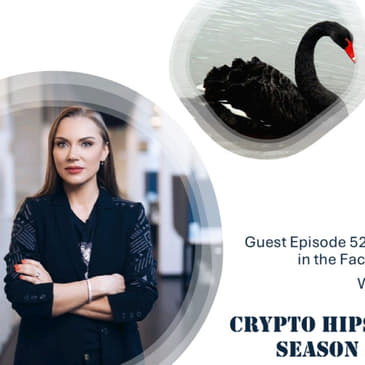

Agne Linge is the Head of Growth at WeFi, a decentralized on-chain bank. With over eight years of experience in the cryptocurrency industry, Agne has developed expertise in crypto trading and adoption and decentralized finance (DeFi), she is interested in stablecoin utilization in emerging countries and the evolving role of on-chain finance. Her professional journey includes significant roles such as Director at Binance and Head of Communications at DeGate, highlighting her influential presence in the digital finance sector.
[00:00:02] Hello everybody and welcome to the Crypto Hipster Podcast. This is your host, Jamil Hasan, the Crypto Hipster, where I interview founders, entrepreneurs, executives, thought leaders, amazing people all over the world of crypto and blockchain. And today I have an amazing guest, another amazing guest. Most of my guests are absolutely 100% amazing, so this is going to be a wonderful podcast. I have today, I have the head of growth at WeFi. Her name is Agne Linge.
[00:00:30] Okay, Lynch, thank you for joining me today, Agne. Thank you for having me. It's a pleasure and thank you for a wonderful introduction. I'm glad to join your special guests galore and look forward for our discussion. Yes. Awesome. Thanks for joining me. So I'll kick things off and I'll ask you first, you know, what is your background and is a logical background for what you're doing now?
[00:00:55] Sure. So to start answering your question, a background I can say now is in crypto since I've been in the industry for nearly 10 years. And my latest degree, which is Masters in Digital Currencies and Blockchain, which I studied in 2017 even. So that gives me even an official qualification to work in the industry, which is pretty rare.
[00:01:20] The first degree that I studied, the first background was a Bachelor's of Science that I obtained in London, in England. They gave me a background in finance as a financial analyst, understanding economics, capital markets, equity, bond markets and various financial instruments.
[00:01:39] And also had a privilege to observe the financial crisis of 2009, which was caused by many elements underpinning the incumbent financial market systems and also the risky financial instruments and the banking system.
[00:01:57] So this period at the time gave me lifelong lessons and background of how the financial markets operate and how political and other decisions are interconnected. Even at that time after the crisis, I wanted to learn more about politics rather than the numbers and pricing equities and derivatives to really understand how things work. So therefore to come back to your question.
[00:02:25] Yes, it is a very logical step to what I'm doing right now. It is building the modern financial infrastructure based on blockchain and based on cryptocurrency, based on AI. This is what Wi-Fi is doing. It is building the future of finance, building a future of banking. And it is doing this, as I mentioned, using modern tools such as blockchain and cryptocurrency concepts and AI.
[00:02:54] And having a background as I started from banking in London and observing financial markets. Now being in this industry, I think everybody should be here, whoever is working in finance. They should be having some step in crypto. So, yeah. I agree with you. I agree with you. And I wasn't planning to ask you about the financial crisis, but I'm going to come back to that a little bit later.
[00:03:26] Wi-Fi. I want to find out what Wi-Fi is all about, including your vision, your mission, your role there. Well, so first of all, Wi-Fi is a Web3 financial ecosystem. It has, you can imagine, the composable elements of financial services and products. So it's composable banking. And Wi-Fi, let's start with the mission.
[00:03:49] So Wi-Fi is committed to innovation, to channeling this innovation into financial sphere and offering banking services to everyone. You only need internet access right now. So as Elon Musk said, I think recently that you can help people, you can help the world by providing internet. Because with the internet comes the knowledge, and then you can learn, and then all kinds of opportunities come to you from business to social, etc.
[00:04:18] So Wi-Fi wants to democratize access to financial infrastructure, to those who have internet. Right now, a lot of the world, the banking services are there, but we are privileged to have had access to that. However, there are many people in the world that have never had any basic access to financial infrastructure.
[00:04:39] And as you know, that blockchain and internet and all of the new technologies right now, modern tools do give opportunity for mobile banking. And what Wi-Fi is building is to connect those worlds and even go further to connect TradeFi and give access to DeFi world, to give access to the yields, to earning opportunities in DeFi. Maybe I went a bit too deep, even if in what we're offering.
[00:05:08] And let's get back to make it short. So Wi-Fi's goal is to build a modern banking infrastructure. So the future of banking. And it's called a DeoBank, a decentralized on-chain bank. A new concept that has been founded by Wi-Fi. Previous to that, we had NIOBanks. So NIOBanks were very good at utilizing mobile applications and they use mobile services.
[00:05:35] They really introduced some new way of the way people interacting with the banking apps, right? However, they still stopped at some point. What you have is the interface that looks modern, but at the back, it's a traditional banking rails. And as you know yourself, now we have a totally different infrastructure that enables cross-border transactions to come much faster with the stable coins.
[00:06:02] And AI enables different KYC methods, such as used to be before. So everything is super exciting in the modernizing financial ecosystem. Awesome. Awesome. I saw that. I said, Wi-Fi, DeoBank. And I was like, I didn't know what that was. So I'm glad you told me. Yes.
[00:06:27] So you look at some of the important critical economic trends that are going on out there, being in the banking space. So what do you see as some of those critical trends that are going to happen in the crypto landscape over the next year or so? Mm-hmm. I think that this year is very interesting for crypto. And it started this way. It started with the inauguration of Donald Trump, of United States President Donald Trump.
[00:06:55] And it is very clear that his and his cabinets, his crew actions will have an immense impact on the crypto landscape. It already has. So everybody is awaiting clarity from the crypto working groups that they have been set up. And as much as regulation and some suggestions for stablecoin regulation. Then there are other parts that is not related to crypto.
[00:07:22] But there are Trump's tariffs, which add to economic uncertainty. And this economic uncertainty, such as even 50% tariffs in Europe that has been announced recently. Well, now delayed negotiations. But still, everything is really having an effect to the way investors are balancing their portfolio, to the way they're looking at the risk assets, to everything really. And so what are the events?
[00:07:50] Of course, we have to look at the war that is happening. The war is happening nearly in Europe, you can say. Europe has been very affected. And other countries also has been affected. So we don't know what kind of an event can cause completely unexpected consequences. And, you know, all of this is interconnected. Crypto, risky assets, economy.
[00:08:18] So you can't really isolate one thing. And also there are always such called black swan events that are happening from time to time. We think that we observe everything. And when they happen, we say, yes, it could have been predictable, but still they happen suddenly. So to get back to your question, what kind of events might shape the next year? I'm also monitoring what is happening in Japan recently.
[00:08:47] The Japan bond yields, right? And also this accumulation of Bitcoin by Japanese corporates. So it's very interesting what is going on. And where can we see this potential catalyst that might shape economy and the crypto market in an expected way? Isn't it? I knew there was a bond yield issue. And I want to ask you about that.
[00:09:17] I didn't know that these Japanese banks were accumulating BTC. I heard that some companies were trying to do the same thing that Michael Saylor and MicroStrategy were doing in creating Bitcoin reserves. But I didn't realize it might have been Japanese banks. Not the banks. It's the Japanese corporates. It's been namely Metaplanet. It's very famous Japanese corporate. I think the initial business was hotel business.
[00:09:45] But then they went to the strategy of accumulating Bitcoin. And now the shareholders, instead of being exposed to the original business, they're being exposed to Bitcoin. I think it's one of the 10th largest holders right now at Metaplanet. And correct me if I'm wrong, but I think that there was a calculation posted recently that the stockholders of Metaplanet are overpaying five times for Bitcoin.
[00:10:15] And this stock can be shorted. So imagine if they're holding so much Bitcoin, what kind of consequences can potentially be? Hopefully, everything will be fine. But yes, it's a potential risk that everybody is looking at. All right. So I'm going to ask you. That could be a black swan. I want to first talk about the Japanese bonds. Then I want to get into the possibility of a black swan.
[00:10:43] But people said there's going to be financial Armageddon because the bond yields are rising. There's going to be liquidity or whatever issue. How would that impact crypto and how can investors brace themselves for such Armageddon? It's interesting.
[00:11:03] You know, in 2009 crisis, when all of these complex financial instruments unfolded one after another, you know, this house of cards was difficult to catch. Right. Remember, first was Bear Stearns and it was Lehman. And then there was all kind of Fanny and Fanny Maya and Freddie Mac that collapsed the housing companies in the United States. So what I understand right now that the Japanese banks are the largest owners of the Japanese bonds.
[00:11:31] They said that they will stop buying the bonds. The bond yields started raising. Now they said they will reduce the supply emissions of the bonds. I'm also still following the situation. So the bond yields are raising. That means that the interest rates would be raising in Japan. And as you know, Japan is very famous for its carry trade. So the traders, they would borrow in a low interest rate Japan and would do the transactions in countries with a high interest rate.
[00:12:01] And now there is a fear that the investors would pull the capital back to Japan, etc. So how all of this will, you know, will implode and how will this affect the global financial market? Because this carry trade is a very popular trade. Right. And so then also how this will affect the investors due to the risky assets. And yes. And then again, we have the meta planet situation such as corporates accumulating Bitcoin.
[00:12:29] So we'll see how all of this is interconnected at the end. Okay. We will. I'm sure we all will, especially retail. But I want to talk about, I want to dive a little bit into that meta planet. Say I have a hypothetical situation and say people short meta planet and they also short MicroStrategy and they short any other corporates that begin to have a Bitcoin treasury, whether it be overvalued or what. Everybody shorts it.
[00:12:58] How does that impact Bitcoin, the price of Bitcoin? And does that, you know, and if Bitcoin crashes, if people flock into other cryptos and defy like, you know, or like Ethereum, for example, how does that play out? I would imagine even if the Bitcoin crashes, you know, it would recover pretty soon. There are lots of buyers these days, as you know, all the BlackRock's everybody's buying. And even me, myself and you, I'm sure we'll be happy to buy Bitcoin at a discount. So this is not a big deal.
[00:13:28] But all of this domino and house of cards will obviously have an effect on many things and also on the trust and things. So, but yeah, I don't see a situation that Bitcoin crashes and there is a complete erosion in trust in Bitcoin and people flock to Ethereum. No, it's totally different. As you know, Bitcoin now already is, I could state it's proven to be a digital gold.
[00:13:54] There is a physical gold that is also a safe haven and it has been raising in price as well as Bitcoin. But Ethereum is a different instrument. And yes. Got it. And then the third possibility for you mentioned this early on, you said the financial, you said you witnessed the financial crisis. I saw a statistic. I think, I think it's all on X. So I don't really validate it, but I saw it.
[00:14:18] Somebody showed a graph that the credit default swaps that were loading up before the financial crisis in 2008 are now on the rise again. So, you know, what should we look out for with the advent of an increase in credit default swaps? Does that make everything in the market more risky? And if the market does crash again, how does that impact crypto and deal bank? This is interesting what you mentioned. I do remember there's like a premium and this on this on this insurance.
[00:14:48] So I'll be following also this development with Japanese. Because what I read that Japan is one of the largest borrowers as well in some markets. So imagine if this industry dynamics changing, a lot of other things will be interconnected for sure. So let's stay tuned. Got it. So I want to change countries. I want to talk about China. Because you said you did tariffs, you know.
[00:15:19] How will China versus the U.S. trade and tariff war, which is an ongoing saga, bring more liquidity to Bitcoin and DeFi? Okay, the trade and tariff war. This is an interesting development this year. We are definitely experiencing whatever show has been going on. But what it's been doing, it's been fueling a lot of fresh uncertainty to the global markets.
[00:15:46] And the world was already in very much unstable situation, I would say. It's after COVID. People were completely destabilized. Everything was destabilized. Then you have Ukraine war, which is very much felt in Europe and everywhere else. Then we have Middle Eastern issues. And so Europe is also facing high energy costs, inflation, change in economic and social dynamics, all kinds of things.
[00:16:13] So Donald Trump added more fuel to the fire of this world, you know, what's been going on. And even the most sophisticated traders, I think they will not be able to guess his next move. Like now he says EU 50 percenters, then another day is delayed, then he will negotiate. So I think only his close circle probably can predict what is going to happen.
[00:16:39] So uncertainty, this is what this trade and tariff war is fueling. And uncertainty in the global markets means that investors are seeking for safe havens in assets, which traditionally has been gold and real estate. And now Bitcoin has also become a safe haven. So potentially some investors are already looking. And as you know, they are already looking at Bitcoin as a safe haven.
[00:17:06] But going back to the trade wars, OK, so what if the trade war intensifies and then some investors or some people in Asia think, OK, maybe the dollar will not be the settling currency in the trade among China and Asian countries. Let's say the dollar will lose a little bit of the relevance, which I was reading. There's some statistics that's already losing some of the trade volume.
[00:17:31] So all of this would have positive, definitely impact for Bitcoin, as we know. And yeah, that's what I think. Great, great. And then you are in Europe. I looked up, you got your master's degree at the University of Nicosia, which is in Cyprus. How do you see his tariffs affecting the European Union? I think they're affecting quite a lot. I mean, the relationship was very strong. It comes as a shock.
[00:18:00] So we'll see what will happen. I will see. I see a lot of negotiation. This is definitely business, some sort of a tactic that is going on. You know, you can also understand him. But I think a lot of dynamics will be changing. And you can see from watching the European news and from seeing European leaders that they definitely want to develop the infrastructure that will make Europe stand on its feet. It has been relying too much on the United States.
[00:18:29] So we'll see if things are changing. Got it. Sounds good. So I want to shift gears then to the U.S. You know, recently our Senate has passed a bill, a stablecoin bill called the Genius Act, right? Which is a step in the right direction toward implementing a strategic Bitcoin reserve. Now, there have been other countries, smaller nations that have created a Bitcoin reserve like Bhutan, El Salvador and some others.
[00:18:59] You know, what lessons can the U.S. and other Western nations learn from these smaller countries that had these reserves implemented? What lessons have we learned and can we take away from that? Yeah, it's a good question, actually. What lessons, you know, so always, you know, the ones who take the risk, it's always a fool, right? Nobody wants to be the first fool. And we remember quite well how El Salvador was looked at and et cetera. So they took a risk.
[00:19:29] They behaved risky. They took other maybe bold decisions, what we heard from the president. So now that the United States has taken this direction and has already recognized Bitcoin as a strategic reserve, other countries will for sure follow suit and will seek to establish the strategic reserves. And, you know, I've been in the industry for nearly 10 years and it's so interesting to observe how crypto industry,
[00:19:55] which was very much villains and scammers and valueless digital coins, as remember JP Morgan, you know, saying there was in the eyes of government. And now it has changing to become even like a playing card among politicians. So not even Trump is using this card. Now there is election in South Korea and the candidates, the three candidates, they're both, they're all playing the crypto card in order to attract the younger voters.
[00:20:24] So now crypto is becoming like a political, you know, tool even to wow the younger generation. So, yeah, it's interesting to see. So what lessons can we learn going back to the question that being brave is good, you know, those who are early birds get the first warmth, I guess. Interesting. So your company is an early bird. You're the first yield bank, right?
[00:20:54] And you're looking at issue yield, improvements in yield opportunity. So are you looking at just Bitcoin or looking at the whole spectrum of DeFi cryptos out there? What, you know, what's your, what's your vision? What are you guys looking at? How will we all benefit from that? Yeah. So we want to offer traditionally called traditional banking services. The obviously is going to be steady step by step.
[00:21:24] So we want to offer loans. Loans is very important. Backed by potentially crypto holdings. We want to also offer web to people access to yields that are offered in DeFi. This is a pretty big yield in traditional finance to earn 20% annual return is a very good investment, very good return. So this is what we want to connect the traditional world with the DeFi yields. And yes, offer other services such as cards and many other things.
[00:21:54] Got it. So, so DeFi, so DeFi in the U.S., they want to make it safe. So people, so institutions can invest in that. And there are certain cryptos that, I mean, some are DeFi, some are not like Litecoin and Solana, where companies, you know, have, have requested, you know, submitted applications for ETFs. And the SEC here, which oversees all the financial stuff, they keep delaying. They like, for the last Litecoin one, they waited until the day of.
[00:22:24] They have never done that before. But they keep pushing off and they keep delaying. So, you know, they're asking for help for public comments. So in light of that, and in light of thefts like we've seen with SWE, right? Why might the SEC be justified in their delays? Right. Good question. Interesting. You put a very important fact, the security, you know, like what happened to SWE and many other hacks in the crypto.
[00:22:53] So they really, yeah, they're really putting in a big picture what is happening, how security is important. But, you know, I don't think that crypto is an exclusive industry that is prone to security risk. I think right now with a digitalized life, everything is prone to security risk. So we have to pay attention to everything. You know, cybersecurity is super important.
[00:23:19] You know, even in your personal details, even your body stuff, you know, your face can be now replaced in AI in another image. So everything is important. So to make DeFi completely secure, it's the same as to see how can we make everything secure. There are always hackers that are ahead of you. You know, I don't know who they are, how they find out these vulnerabilities.
[00:23:46] But what's important is, I think, for DeFi protocols to do regular audits. You know, it's a standard practice that they do like two or three audits, but to regularly update and check the protocols. Maybe there are some new vulnerabilities and just to have this practice of auditing. Great. So you approve the auditing, you know, things get accepted a little faster, right? Yes.
[00:24:16] So what do you see as far as people say we're in a bull run? And I'm like, you know, I'm talking to the opposite. I'm saying we're going to have a pullback for the summer. It's going to be a liquidity shortage and everything. It's going to be a boom. So what do you see for the rest of this year, you know, and not just security, but other improvements in crypto that might make it, you know, not be a pullback in the summer that might have it become DeFi summer 2.0?
[00:24:46] Mm-hmm. I think that the market, in terms of what is called bull run, has changed a lot. You know, normally the bull run was called like Bitcoin is going up, then Ethereum, then there's altcoins and things. But the market has changed right now. You know, there are too many altcoins. The retail, the buyers are the same buyers, you know, and they're not buying into mostly, let's agree, not to the projects that are not delivering what they have promised.
[00:25:15] Sometimes they do, but they lose value, they lose traction, et cetera. So investors are much more picky, retailers are much more picky. And this game is a little bit changed in terms of what we see in bull run. But Bitcoin is at all time high. So it is sort of a bull run, as we can see. I think the macro factors are very important to watch this year. You know, what is America doing? What is Japan doing? What is happening in Europe?
[00:25:41] And, you know, to continue building, to continue believing what we believe. I think that you as well, we believe in the future of financial infrastructure. And no matter what happens now, I think is even the more positive stance towards crypto. We have been working in a very negative ecosystem. You know, everybody were looking at us as negative, negative. You know, it really could have taken one ban from the United States and all of this could have been finished somehow.
[00:26:11] So I think the people keep building. And, yeah, the bull run hopefully will be at some point. Well, we all hope that. Especially me. So we covered, you know, the tariffs. We covered Trump. We covered Japanese. Is there anything else that we might not be looking at at all that could come out of left field?
[00:26:40] You know, what do you think? I think we have a plethora of things to deal with, you know, to be honest. So the world is very busy to deal with everything that's going on. Got it. Got it. So awesome. So I look forward to seeing what's going on. So I want to thank you very much for your time today. I enjoyed speaking with you. I have one last question. It's easy. How can people find out more information about you, about WeFi DeoBank?
[00:27:10] How can they use your platform? How can they become hustler? How can they do any of that? How can they do that? Of course. So please follow us on all the socials. The normal is Instagram. We have Twitter, X. Check out our website. Join our Telegram. We have very exciting announcements. Even right now, something exciting is going on, depending on when you publish this podcast. So some people might still get an opportunity to participate in something exciting of WeFi.
[00:27:40] And with regards to me, you can find me on LinkedIn, Agne Linge, and then on Twitter and on Instagram, I'm Agne Crypto. Thank you very much for your time today. Thank you very much, Jamil. Pleasure being here. Pleasure being here.