
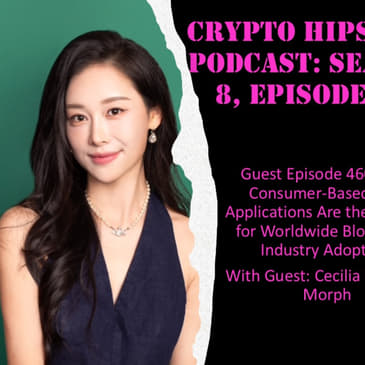

Cecilia Hsueh is the co-founder and CEO of Morph, the global consumer layer for driving blockchain adoption. A serial entrepreneur with over 12 years of experience building consumer-focused companies, she previously led crypto exchange Phemex to achieve $5B in daily trading volume. Before entering Web3, she ran a successful market research firm advising Fortune 500 companies on consumer strategy and built a direct-to-consumer sportswear brand. Cecilia is passionate about building inclusive web3 ecosystems for the mass market.
[00:00:04] Hello, everybody, and welcome to the Crypto Hipster Podcast. This is your host, Jamil Hasan, the Crypto Hipster, where I interview founders, entrepreneurs, executives, thought leaders, amazing people all around the world. And today I have an amazing guest coming to me from around the world. I have the CEO and co-founder of Morph. I have Cecilia Hsueh. Cecilia, welcome to the show.
[00:00:30] Thank you, Jamil. Hello, everyone. I'm Cecilia. I'm the co-founder and CEO of Morph. Nice to meet you, and thank you for joining me. Yeah, let's kick things off and ask you the first question. I mean, I want to get into Morph, but the first question I ask everybody is this, is what is your background and is it a logical background for what you're doing now?
[00:00:52] Yeah, sure. So my background was, it started from management consulting. So the first job after my graduation, I started from management consulting to help all these, you know, big names, big companies to do, to think about their strategy and help them to optimize their operations.
[00:01:10] And afterwards, I started my own market research firm, basically providing services like market research services to private equity, venture capitals, and also the strategy departments for big leading companies. Most of the time I was doing like due diligence for their investment to help them to support them on their investment decisions.
[00:01:35] And afterwards, I also found my own like consumer brands, which is designed for the girls like sportswear. Yeah. And then afterwards, I started the business in crypto. So my previous project in crypto was a centralized exchange called Femex. So at the peak time, we had the trading volume around four to five billion every day. And then also we have around like 5 million users.
[00:02:03] So yeah, I would say that's the first step when I entered in crypto, enter in Web3, I would say. But I think that it's a centralized exchange is actually centralized. So it's not like a fully decentralized business. So that's why I after I exited from Femex, I started to think like what kind of business I can really build on chain and make all these decentralized vision like come true.
[00:02:30] And also I was since I was helping a lot on, you know, the strategy for the big companies. And also I started my own consumer brands. I did a lot of like in-depth consumer researches and strategy in the past working experiences. So I know exactly how to talk to consumers, how to acquire users.
[00:02:54] And this is exactly what I think Web3 is missing now, especially for on-chain business, because everybody was just building the infrastructure, but no one cares about where the users are and how to bring the users to on-chain business. So this is exactly I think the opportunity was two years ago, one and a half years ago. So, yeah, that's why we started Morph.
[00:03:19] So actually Morph is to basically to bridge the real users to the on-chain business. Awesome. Awesome. So, yeah, I wanted to find out what Morph was all about, including you have some recent announcements that are pretty, pretty, sounded pretty good to me. So could you share about, you know, what those are, too? Yeah, so we recently we announced Morph Pay. Yeah, let me briefly introduce Morph a little bit.
[00:03:49] So basically Morph is a global consumer layer, provides all these resources builders need from launch to scale to the mass market. Technically, we are an EVM layer two. So we are still a scaling solution for Ethereum. But as I said that there are too many scaling solutions. There are too many layer twos. But most of the layer twos are still focusing on, you know, optimizing minor like technical features. Who's faster?
[00:04:19] Who has higher TPS? All these technical features, which I would say most of the builders and users don't really care. So what we are focusing is to help the blockchain get into the real world to get into everyday users for everyday use. So that's why we are a consumer layer, because we think that blockchain today is still built for DGEN people. It's still built for crypto native people.
[00:04:47] The product is very difficult to use. The use cases are basically not for your daily life. It's for certain speculation purpose. And Morph is different. Morph is basically building for consumer centric use cases. And that's why we launched the Morph Pay recently, which actually happened like, I think, less in one week. So Morph Pay is, I would say, a flagship product in our ecosystem.
[00:05:17] Because we think that from both sides, both like Web2 and Web3 worlds, payment is still a big pain point. For Web2 users, we are still using the Swift system, which was invented 50 years ago, which is still very slow, very expensive. And users always need to do all these KYC, all these regulation stuff. It's very, I would say it's not very easy to use.
[00:05:45] And blockchain is actually a very ideal solution for that. I mean, Bitcoin is basically, the white paper of Bitcoin is basically telling you how to solve the peer-to-peer transaction problem with Bitcoin. But no one is actually leveraging that. Everyone is still using all these crypto, these for trading, and that's it. So this is a real world problem.
[00:06:09] And for Web3 people, since all of our, most of our assets are in crypto, so how to off-frame these, your crypto assets, how to use it in your real-day life, this is another like pain point. So I guess payment for both worlds is like both worlds pain points, which we can help to solve. So MorphPay, we just announced it.
[00:06:32] We are targeting to help users, to help people to unify digital assets and their fiat assets in one account. And they can use the MorphPay, like we are going to announce our card also in the future. So basically, you can use that account or that card to pay everywhere with low fee, with any of your type of your assets, whether it's fiat or crypto.
[00:06:58] And also, meanwhile, you can, because Morph is going to integrate our DeFi ecosystem, our DeFi projects into the MorphPay platform, so that you can get high yield in your cards. So basically, it's like you pay and you get yield at the same time. And also, like you can get massive airdrops from Morph and meanwhile, all the projects from Morph ecosystem.
[00:07:24] Yeah, so this is basically, and of course, you can share a lot of like exclusive benefits from the card itself. So I think this is a kind of like one-stop solution for both Web2 and Web3 worlds. And meanwhile, it can create so much value, like beyond, you know, the traditional credit card you are using or the traditional payment solutions you are using. I have a follow-up.
[00:07:54] It's interesting. I like it. You mentioned SWIFT. I used to work at AIG. And when I think of SWIFT, and other people think of different things than SWIFT, I think, you know, low yield, fixed income, you know, conservative stuff. And you're building an ecosystem for high yield, DeFi banking, right? And I don't think of high yield as something that's available with banking, right?
[00:08:22] So how are you an improvement over the traditional? So, yeah, I mean, me, myself, I'm also, I also put my money in bank, part of my money in bank to basically take the kind of like interest from, you know, for the probably like six months or one year, just savings in my saving account.
[00:08:48] But they will only provide me something like 3%. I think last year, probably like something close to 5%, which is already a very, very good deal. But it's centralized, and you need to put your money there. So I think this is also like back to many people's problem that whether you trust a bank, you trust the centralized system or not. But in Web3, in crypto, it will be completely different.
[00:09:15] It will be, so users can still do the non-custodian. You don't need to put your money in other people's account. You can still put your money in your own wallet and then get the yield. And meanwhile, because we have like DeFi ecosystem, basically we can play it as also as legal. You can plug in your DeFi projects into the Homeoff Pay platform and help users to get high yield.
[00:09:43] But it's not like ridiculously high yield. I think for that part, you can just directly play on our like DeFi projects, which some of them can create very high yields. But for a lot of users, like you said, that some more traditional users or retail users, they want to have more stable yields or they are more conservative. So we will offer them something around, I would say like something around 10%.
[00:10:11] It's already like good enough for most of the users. And meanwhile, we will let them to choose. Like definitely we are going to screen the best ones from all the DeFi projects we will see. And we will let them to connect with the biggest ones, the most legit ones. But definitely users have this right to choose which DeFi projects they are going to be involved with. But the whole process will be very user friendly.
[00:10:39] They don't need to understand too complicated knowledge about DeFi, about all these yields. They only need to know that like they put the money in the cart. They can use it. They can spend it in all these post machine. And meanwhile, they can get yield. So sometimes if you go to a coffee shop to buy a coffee, this can be paid by your yield. If you go to book a hotel, the hotel room can be paid by your yield.
[00:11:08] It's I think this is very I never see this kind of product on the market, especially in Web3 yet. I like it. And I think it's smart to do that. This way people can take profits and not lose their base investment. It's ingenious. So you said you said DGENs earlier. You also that we need to build meaningful consumer applications in Web3. To me, those two things are opposite. Right.
[00:11:37] So let's focus on the creation of consumer applications. How do you build them? And how do you create sustainable, inclusive participation? So it's actually this is a very good question. This is also something we are thinking about. I think consumer application, consumer, beautiful consumer, beautiful everyday users is a long term vision. But it's not easy.
[00:12:04] I think most of the chains they are still choosing, for example, build, spend all of their resources and time in DeFi. There's a reason because all the money are from the DGEN people. All the money are still from the crypto native people. They are the whales. So I guess for and when we try to approach these consumer builders, we see the problems because there are not so many on the market.
[00:12:33] And also they don't. It takes time for them to educate their users because Web2 users are not used to use the on-chain application. And Web3 users are just very busy with their, you know, staking, DeFi farming, all these trading stuff. So they don't care about, you know, what kind of consumer applications you offer to them.
[00:12:56] So for us, we have, I think for us, we are figuring out a clear path, kind of like go-to-market strategy, how to enter, how to really help the builders to build up the consumer ecosystem. So the first step, I think, is due to have a very solid DeFi ecosystem as a base. Because only in this way, you will have a decent TVL. You will have decent like wallet addresses, which is your user basis.
[00:13:23] And in this way, builders, no matter builders or users, they will look into you and start to check like what you are doing, what kind of products you are offering. So this is, I think this is inevitable. You have to do that. Even though I think in the, for the long term, we are, we definitely not are only beautiful, you know, DeFi projects. But this is a base. And this is how Web3 is running. The whole industry is running.
[00:13:48] And then the next step is that once we have these users and these TVLs, we can attract these consumer builders and they will be more confident to build with us. But this vision won't be changed. MorphPay, the payment product and the payment platform won't be changed. We are still focusing to build for everyday users.
[00:14:11] I don't think too many people in this space are building that because crypto is a space which you can earn easy money, quick money. So even that you have this vision in the beginning, you will lose your vision once you have money. So yeah, I guess not every team can build that for such a long term.
[00:14:34] I saw a statistic on Reddit and I don't know the accuracy because I didn't validate the statistic, but it said 800,000 people lost a total of 2 point something billion investing in the Trump meme coin. I believe it because I was an ICO advisor in 2017 and 18, then crypto winter hit and I built my advisory business on the base of nothing. Had no base.
[00:15:03] You have an underlying base of DeFi, right? So we have the speculative phase. People are chasing memes. They're chasing things underlying. The items that it used to, that's most similar like in the past were NFTs where you had underlying utility, but they died out for now.
[00:15:21] Like how do we move it beyond the speculative phase and embrace the ability and opportunity to deliver utility and not just memes, right? How do we, how do we achieve that? Does NFTs come back in a different way? How does, how do you do it? I think exactly like what you said, like meme is very similar to NFT two, three years ago.
[00:15:49] Like it's kind of like everyone is pretty hype and everyone has form for that. Um, so, cause meme is very, um, I would say everyone is chasing it because it's very easy to understand. You don't need to understand that everyone can launch a meme and doesn't have any value behind that. I think for the past round, like the past, uh, uh, uh, cycle people, uh, were still talking about, okay, what we are building.
[00:16:17] And, uh, and then they launched their token, but for this cycle, you don't need to build anything. You just need to launch your meme coin, which doesn't have any value, um, behind, behind that. So this, uh, definitely it won't be a long-term thing. Uh, it will, the, the, the, we already see that the meme hype is going down. The altcoin, uh, the, the, the meme coin season is probably already going to the end.
[00:16:43] Um, but definitely there are still a lot of like followers, a lot of fans, um, but people will see that you lose money in the end. Uh, they make money, uh, but it's very few cases, but in the end it's like gambling. You still, only the last trade matters, right? So as long as you are still on the, on the table, uh, in the end, you will lose money. Like Trump, which we mentioned, uh, I also, in Trump, because I believe, um, you know, I, I think it's, it's, uh, it was,
[00:17:13] mostly like invest in a dream that we are in mainstream, like Trump, uh, the United States, uh, president launched, uh, a meme coin, which means that we are in the mainstream. So for me, it's mostly like invest in a dream, a crypto dream, a web three dream. Um, but that's it. Uh, but most of the people, they are just chasing for speculation.
[00:17:34] Um, so I guess eventually people will understand that, uh, if you don't have value for your token or your project, it won't, uh, the, the, the, the price won't, uh, last. So I guess the trend, uh, will switch. The narrative was switch. Um, I've already in this space for five years. I've, uh, experienced like two to three, um, cycles already.
[00:18:01] So I know exactly, uh, when people create a hype and everybody was formal, but in the end it will go, um, to a boom market and people will get more clear about it. And then when the bear market starts, people will start to build again. They will work hard and build hard again.
[00:18:21] Um, so I think for, uh, longterm, if, uh, we want to make the pie bigger, we want more people to get into web three, not to wash the same group of users, the crypto native people's money again and again, again, because eventually their money will be washed away. If you, you don't have any real use cases for them, um, their money will be washed away. Then there's no new growth. There's no new users for us, uh, to attract. Then the whole industry will be dead.
[00:18:50] Uh, our, uh, adoption rate is still less than 5%. It's still something around like 3%, which is, I think it's a pity because the, uh, the, the Bitcoin white paper was already, uh, written or launched, um, almost like 20 years ago. But our industry is due every time we say it's due at the early stage. That's because that we are not building for the, the big market.
[00:19:16] We are only built for a small group of people, but eventually people will understand that, but it takes time. And it needs advocates to speak it out and needs projects like more of to really, um, uh, talk about it. And probably not, um, not like lead the, uh, the industry, but more like to advocate people to, uh, the builders to join us together. Because more of itself, more of it's just a infrastructure, right? We are a chain.
[00:19:45] We cannot do it by ourselves. We need more builders who care about, you know, make the pie bigger, uh, push Web3 into mass adoption, um, to build together with us. Um, so that's why we have to talk about consumer layer, mass adoption all the time again and again, uh, even though it's a very, very, uh, long journey. Yeah, I, I, I mean, Bitcoin's final Bitcoin remind in 2130 something. Right.
[00:20:13] So I, I still also see that we're in very early, very early days, you know, um, I won't be around 2130 something, but, um, you know, there, there, but there are, there are, and you build it. You're an EVM layer too, which means there are complexities. Right.
[00:20:31] Um, and in order to get that 97% more people into the space, we need to weigh, we need to abstract away the complexities so that people can embrace Web3 everyday users who don't need to know anything. Right. How do we, how do we do that? Um, so I think, uh, two things that we are focusing to make user experience, uh, or make users to come to Web3.
[00:21:00] Um, so I think that's a really, uh, the first thing is that we need to simplify all these UI UX, uh, cause right now it's a huge barrier for people to enter. Uh, for example, like create your on-chain wallet and connect your wallet to different protocols and bridge your assets from layer one to layer two, or from different layers, uh, from a different layer ones or a different layer twos. Uh, it's a huge headache. It's a huge headache.
[00:21:24] No, I would say for even like crypto people, um, it's, uh, it's a headache, uh, never to mention all these like retail users, um, non-crypto users. So we need to, the first step is definitely to simplify, uh, all these UI UX, make, uh, the whole user experience much, much more user friendly. Uh, we've already seen many, many, um, use, um, like examples in Web3 already. The only, actually they didn't do much innovation on the product side.
[00:21:54] They only, uh, optimize the design, the interface, and that's it. And then it attracts so many new users to that sector, uh, in Web3. So this is definitely something we need to, um, do as a first step.
[00:22:10] And the second thing is that, as I mentioned that all these use cases in Web3 is most of the time is due for, you know, trading, uh, NFT, uh, uh, like, uh, and also like, uh, for example, uh, meme coins or, or, or, or game finds. Uh, most of the applications are still very far away from, uh, users daily life. So the frequency of the, uh, usage here is not high.
[00:22:38] Um, only if you have this, uh, purpose of trading or, you know, speculation, you use these steps. Otherwise you won't use them. So we need to bring these applications, which users are already very used to in Web2, but add more value on chain.
[00:22:56] Uh, for, for example, like incentives, for example, like security, uh, decentralization, which makes people feel like, okay, we have much more value here on chain, uh, instead of, you know, just use my regular Web2 applications. Uh, two, three years ago, there was StepIn, which actually helped us to acquire many, many Web2 users because it's simple. It's easy. The UI UX is very, uh, easy to understand.
[00:23:23] And also the whole concept is simple for users to use. And as you know, daily life, you just walk to earn. So use cases like this are something more face focus on, uh, entertainment, social loyalty, um, all these, uh, like lifestyle related applications are something easy for users to understand. And that's how we can bring them on chain. So these two, uh, things are exactly what we are focusing and try to polish all the time for users.
[00:23:54] Got it. So consumer centric, like what I think consumer centric, I used to build technology and I would go to the stakeholder and find out what they need and what their pain points are. And then build what they, you know, the solutions for them that are customized.
[00:24:12] A lot of the solutions in the crypto industry that people create are solutions, but they're based on what the developer thinks the company needs instead of what the company actually needs. So how do you bridge that gap and start building, we start building stuff based on what our stakeholders need first and find out what they need first and then build it. How do you, how do we get there? Yeah, I think this is, um, also a very good question.
[00:24:41] Uh, this is actually what I was spending my time for the past 10 years to do. I was doing market research basically. Uh, that's, uh, a business which need me to collect all these firsthand, um, data from the real users and to get back to the business, uh, owner to the shareholder and tell them, Hey, this is what exactly the users need.
[00:25:04] And we, we shouldn't, you know, close the door and think about all these product design by ourselves, but more, uh, importantly is to understand about users, um, and see what they need. And in most, uh, cases, our direct audience are the builders. So that's why we don't talk about our tech so much. Um, because as I said, at even you put your TPS as like the highest TPS in the industry, no builders really care.
[00:25:33] Uh, what they care is about, um, it's, it's actually very funny. We talked to a lot of builders. So what they really care is about, Hey, how can I set up my team? How can I recruit the best team in my starting as my starting team? How can I set up an entity? How can I find an office? Uh, how can I find my investors and how can I go? Uh, how can I do font, uh, fundraising? How can I go, uh, design my go-to market strategy?
[00:26:01] How can I go listing on centralized exchanges? So these are the real pain points they have. Um, so in this case, as a chain, your target is not to design, um, uh, like a super fast chain, which no one use, but more like most importantly is that you talk to these founders and know their, what they need and help them. Basically it's kind of like help them to, uh, help to incubate them, give them all these resources you have.
[00:26:30] So Morphe is very lucky because we are incubated by Bigget, one of the biggest, um, centralized exchange in the world, which means that we have user base. We have, uh, all these marketing, uh, support and most importantly, the listing support, uh, Bigget and Bigget wallet already have like 50 million users in total. Uh, which means that from day one, uh, we can already help our builders to funnel these, uh, these users to, to them.
[00:26:59] Uh, and also when they have this listing, um, uh, requirements, it's not like, uh, they don't know who to talk with, who are the main shareholder is, uh, it's very easy for them to access to the listing team. Uh, not only Bigget, but we are also like very long-term strategy partner with the other top exchanges, uh, including for example, like Mixi, uh, HTX, Polonex, all these big, big names. Um, so yeah, I would say more of us here.
[00:27:29] That's what I said from the beginning that we are here to offer all these resources builders need from launch to scale to the mass market instead of, you know, just providing them with a whole technical infrastructure, which we think is valuable. Got it. That makes a lot of sense to me. Uh, it sounds wonderful. So I should have one. I have, I should wanted to ask you this because you mentioned earlier bull market and bear market. Currently don't know where we're at.
[00:27:58] You know, um, it used to be cycles. Uh, it used to be like, okay, it was a very defined cycle. And, you know, now it's like, it's like, you don't know. So what do you think will be the most, like, will be some of the inclusive and sustainable trends for 2025? Like, and, and how do we embrace the new, I guess the market, the new looks of the market, uh, just powerfully, sustainable, uh, sustainably. Yeah.
[00:28:27] For me, it's, uh, I would say it's still like consumer centric, um, applications. Uh, if I don't believe in that I wouldn't, uh, build more afraid. I wouldn't put it as a long-term vision for more. So, uh, I, I think as you said that, uh, you don't know whether it's a bull market or bear market right, right now. Uh, I mean, the price is still, it's still like very close to 100,000.
[00:28:54] Uh, if we put it like any time in the history, it's a very good price already, but in this market, you don't know because you feel like as long as it's, uh, there's no volatility, there's, uh, the price is under like 100,000. It seems like it's not growing and everything is, um, I would say for that, the past one month, it's quite, it's quiet. So people don't know it's because that, uh, as I mentioned many, many times, we don't have new users coming in for this cycle.
[00:29:23] You don't know what we create. Yes, we have meme coins, but what kind of value do you have from meme coins? And can you really bring the new users into meme, uh, uh, buy meme coins into the industry? What if meme coins go to zero then they will all leave. So we haven't really built anything for this cycle yet. Um, and I think, as I said, that, uh, the whole industry, the whole space will start to realize that even it's just a small group of people start to realize that and start to
[00:29:52] build some real, um, use cases. It's a, it's a good start. So I think for after so many cycles, people will understand if we can, if we don't build something valuable, then we cannot sustain a real bull market. I always feel like for this bull market, it's always like, okay, we have, uh, uh, uh, anything related to, you know, the macro, um, uh, uh, uh, like that economy, or
[00:30:17] there's some, uh, policy, uh, uh, announced, or there's some big, uh, events happening on the market. Then the, the, the, the whole price and the market price will be influenced so much. So actually it's already very close to the traditional market, the traditional, like the stock market already. There's no core, um, uh, pillar for web three at this moment. And this is what we need to build up.
[00:30:43] Um, so yeah, to answer your question, I still think like consumer centric, um, use cases, which solve the real world problem will be the trend. Uh, probably not for this year. Uh, if it's not for this year, then it will be for next year. It will be for the next five years. Yeah. I hope next five years and beyond. So, um, awesome. So I want to thank you very much for speaking with me today. I enjoyed the conversation. I love to hear what you're building. That's it's, it's great.
[00:31:13] I've been saying somebody needs to do it for a while now. So I'm glad to see you're doing it. Um, one last question. How can people find out more information about you, about more? How can they become customers, users? How can they do that? Yeah. So, yeah, of course, uh, you can find, uh, me, uh, on Twitter with basically my name, Cecilia, a shoe, and then, uh, more is our Twitter handle and small flare.
[00:31:39] Uh, so most of the big announcement will be announced, um, on Twitter. Uh, and also we have a very active discord, uh, community group. So if you are interested to talk about consumer related, um, uh, like, uh, applications and use cases, if you are a consumer builder, uh, or if you hold the same vision as us to build for long-term or bring blockchain to everyone, uh, to the real world, then, uh, feel free to
[00:32:08] join us on discord. Awesome. Awesome. Thank you very much for your time today. Yeah. Thank you so much for having me today. Thank you.