
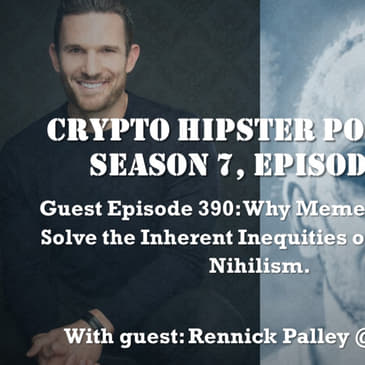

[00:00:00] Hello everybody and welcome to the Crypto Hipster podcast. This is your host, you know Hasan, Crypto Hipster, where I interview founders, entrepreneurs, executives, thought leaders, amazing people all around the world of crypto and blockchain. And today I have another amazing guest. I'm looking forward to this interview.
[00:00:18] I'm got some really cool topics. You don't want to miss it. And my guest today is Rennick Palley, who is the managing partner or co-found founder, he'll heal correctly. Of Stratos. Rennick welcome. Thanks for having me. Yeah, I'm the founding partner of Stratos.
[00:00:39] I founded it in 2016. Awesome. So I want to find out more about that. So let's first to find out about your background and is a logical background for what you're doing now.
[00:00:53] I think so, you know, I think there was a time when pretty much there wasn't any sort of typical background for crypto. It was just such a new industry that people were coming from all over the place.
[00:01:06] But, you know, my background is in educational background is in engineering, applied math and financial math and financial engineering and worked at a hedge fund before getting into crypto. Was doing research and stumbled upon Ethereum in 2015.
[00:01:29] And that's what really kind of opened my eyes to what was possible. Before that, I was familiar with Bitcoin and thought it was interesting, but I had really clicked for me that Bitcoin could also be sort of the hedge against money printing
[00:01:42] or I didn't expect the world to catch on so quickly to what Bitcoin could be.
[00:01:47] So I wasn't as interested in it as Ethereum at the time, although now, you know, I have my days where I feel like I'm a Bitcoin Maxi, but we can talk about that more later. I'm interested to talk about that.
[00:02:03] I actually want to find out first, find out, you know, what Stratos is all about including your mandate and your thesis. Yeah, so we have three funds to our early stage of enter funds. So we invest in precedence seed crypto projects.
[00:02:18] We typically will lead rounds at the earliest stages and we have a liquid hedge fund which owns everything from majors, Bitcoin, ETH, soul, to memes. So we are active across the liquid token space in the hedge fund. So your whole, you invest in ETH, U.S. and Solani.
[00:02:46] And you just said you might consider yourself a Bitcoin Maxi. None of those are related to Bitcoin. So where's the correlation? Well, when I say I'm a Bitcoin Maxi, it's more of a joke. I mean, obviously we have significant holding some things that aren't Bitcoin.
[00:03:02] But I think that there's something really appealing to the elegance of Bitcoin and that it's very simple. And it's more or less ossified into what it's going to be. And it is able to execute on its intent very precisely because of that elegance,
[00:03:21] whereas a lot of the rest of crypto, you know, people can argue that product market fit is not really there. There's 5,000 on chain users around the world. The rest of it is bots. You know, we don't actually have real product market fit and a lot of crypto.
[00:03:37] People will argue that I don't agree with it. But on days where I'm feeling like, you know, I just want something that works and it's simple. That's when I feel like I'm a Bitcoin Maxi. I might be the same as you.
[00:03:55] There's a lot of complexities now that you know keep expanding like infinitely. You know, you're just talking about your liquid token fund though. You recently did a 300x on dog with hat right? What's what's driving that velocity in the memecoin area where nothing else has velocity right now?
[00:04:21] Yeah, I mean, I think memes have kind of fallen off with the rest of also though they seem as you know in the last week to really have recovered pretty strongly and showing a lot of relative strength coming off the bottom.
[00:04:33] But I think generally speaking people are interested in memes because it's a great way to get exposure to the crypto space without necessarily having to invest in something that has significant token on mock overhangs.
[00:04:47] You know, the high FDV low flow meme that people seem to be very negative on right now. And so memes are not similar to Bitcoin, what we were just talking about. Very simple in what they report to be.
[00:05:03] They're really just intended to be a measure of a community. They're a monetary asset. They have no underlying cash flow, no underlying product. They're not intended to have those things. As a result, they have theoretically uncapped upside.
[00:05:19] And so for someone who's interested in taking as much risk as possible in crypto, you know, they're the best game in town. So it's like playing a lot of a powerball. Essentially, I mean, I think the expected return is better than gambling or the lottery.
[00:05:40] So, you know, I think there is a rational reason to be involved in memes rather than, you know, just pure gambling. Right, because I want to talk about that, you know, like some of the, some of the coins that people thought we're going to have the most adoption.
[00:05:58] Because they had the most utility. Have really no dive. And I'm not the reason for that right while the meme coins, you know, have done quite well.
[00:06:10] And you said a word there. I had twice this past week that I hadn't heard before in a while, and that's awesome vacation, right? Are we seeing awesome vacation not just in the token prices, but in the utility of some of these popular major, all right now?
[00:06:30] Well, I think if you segment the old space into different sub categories, you can start to be more precise about what you mean by that. And I think if you look at some of the, let's call them OG, blue chip, D5 protocols.
[00:06:45] There has been some ausification, but that's sort of by design. I mean, I think the idea is that a protocol, there's this philosophy around protocol governance, which is that the best governance is not having or requiring governance at all.
[00:07:03] Because the protocol is functioning as a protocol and not alive sort of changing environment. And so I think a lot of D5 protocols have taken that approach. Others are much more active in terms of changing themselves a good example is maker.
[00:07:21] But I think we have to separate the idea of utility for an application, and the utility token that's tied to it. In my view, the term utility token is a meme to sign up that was created years ago in 2020 during D5 summer when
[00:07:44] DAPs wanted to issue a governance token or utility token that was intended to not be a security. And so it had to have some reason to exist and so that name was attached to it.
[00:07:59] And so I think the market is just becoming increasingly dissatisfied with the idea that there's no value of cruel to these utility tokens. And that's why they have by and large not performed well.
[00:08:18] Could there be in the future part of it was maybe maybe the auspication utility part of was because we have had a pretty bad economic macroeconomic environment right.
[00:08:30] How can people tell the difference between if something's macro driven or if it's you know or if it's utility or equal toations driven. I can tell well, I think it's hard to disintermediate these things. So I think that if you look at the majors for example,
[00:08:55] Recently they've performed fairly well. They've had strong price floors that they've tested and bounced from multiple times whereas, all its buying large have not. They've kind of a lot of them have just been down into the right for the last few months.
[00:09:13] Now I think if you look at the broader macro environment. The macro situation in aggregate is actually not bad. We have high inflation that's come down, which is bullish. I'm expecting to see inflation come down even more over the next six months.
[00:09:34] And you have a government spending trillions of dollars in deficit while we're not in a recession. It's literally very unlikely to have a recession in the US when the government is printing spending so much extra money. They're literally adding 7% of GDP and spending.
[00:09:55] The idea that we're in a bad macro environment, I don't necessarily agree with. But in order for crypto to really do well, you have to have additional money printing and that happens in more of a lumpy way.
[00:10:09] And so I'm expecting to see more money printing this year and as a result, the majors as well as the alls, alls in particular to really benefit from that. And with that, the means should benefit as well right.
[00:10:28] Yeah, I think that memes are likely to outperform pretty much everything else in the space as a result. So if you know obviously there's subject to potentially more volatility because again there is not any cash flows for them to be anchored to.
[00:10:48] But at the same time there's no limit to the upside plus there's no additional token on locks in the future that are going to dilute the token today.
[00:10:59] That's true, that's true. There are some substantial unlock. So the interesting thing I found out about memes recently was that it doesn't just be it's not just in crypto right. It's in a stock market too and there was there was a big you know announcement and then.
[00:11:22] Surprise that roaring kitty has returned to talk about game stop and then game stop exploded again. So you know my question here is and I don't understand this term too much is regarding financial denialism. So what is financial nihilism and why was there a recent explosion in it?
[00:11:46] Yeah, so those are really two different topics. I'll talk about roaring kitty first. So I think and look GME game stop is really like the meme stock that he kind of circles around look at the end of the day every meme is just a community.
[00:12:07] There's a community around with there's a community around bog. There's a community around pepe. There's a community around game stop and so it just so happens at roaring kitty is kind of like the pie pieper of that particular community.
[00:12:21] And when he came back on to the scene, it drove people to reengage with the stock. So they're just different mediums for expressing the same sort of cultural community phenomenon that are memes whether it's a crypto meme or a stock.
[00:12:36] Me or a stock meme it's the same thing as far as I'm concerned. And then to answer the question about financial nihilism, I think it's a really unfortunate byproduct of many decades of financial and political policy in the US and that's more or less been exported to other
[00:12:58] relationships and relationships. And it's essentially the scenario where boomers have benefited disproportionately from money printing and asset price increases over the last few decades.
[00:13:13] And what that means is people of younger generations, whether it's millennials or Zoomers basically can't afford to buy those assets from the boomers because that when you think about real estate for example.
[00:13:27] When you buying a piece of real estate, you're buying it from someone else. You're not buying it a brand new piece of real estate. You know the land is there someone else owned it. You might be buying a new building on top of it.
[00:13:38] But essentially you have to buy from the guy who owned it before you and if the value it has been inflated to the point where the new guy can't afford it, the new generation of people can't afford to buy it from the old generation.
[00:13:51] And they basically lose hope and that's financial nihilism. That's basically saying look no matter what I do, I'm saving a couple hundred to a thousand dollars a month at best.
[00:14:03] There's no way I'm going to be able to afford a fifty to a hundred thousand dollar down payment on a home.
[00:14:09] I'm just never going to get there the normal way right. I can't just keep putting this money away in the S&P 500 making 7% per year hoping that I'm going to be able to you know have financial freedom at some point.
[00:14:23] The way that it worked for the older generations is not really the way it's going to work for the current generations.
[00:14:29] And so they look at that and say well what's my alternative. I can go hypergambulon memes and maybe turn that thousand dollars and do a hundred thousand dollars and actually change my life in a few months. So it's.
[00:14:46] I think you know that's probably the best way can sum it up. I have some thoughts on what the downstream ramifications of that are but hopefully that's a hopeful definition. I really want to know about this downstream ramifications because I have some ideas to.
[00:15:04] I want to see a whole line on that you know money printing did mask the money printing that happened right when pove it happened masked boomers inability to lead their companies and it gave them money.
[00:15:18] And so instead of exposing their failures it failed a map, you know just second time there got bailed out you know 2008 2020. So I'm really interested to find out what you think down the downstream effects are.
[00:15:34] Yeah and I think it's. It's on the corporate level, but it's also just every person who owns assets whether they own stocks or they own real estate benefited from the money printing because when you print dollars versus a scarce asset the scarce asset is going to increase in dollar terms even if there is no actual earnings power increased associated with it.
[00:16:01] It's the same thing same reason why we've seen Bitcoin performs so well over the last 10 years.
[00:16:07] It's all the same ideas just how do you want to express your view that money is going to keep getting printed now the problem is it's been happening for decades and so boomers got rich off of it.
[00:16:21] And so the question is well how does this play out like where does this end what what are the what is the future look like and I think the future basically looks like.
[00:16:32] Some form of universal basic income because if you think about what's happening now with inflation and money printing. There's a subset of the population who it's becoming increasingly difficult to basically afford everyday life and they're getting squeezed.
[00:16:53] And what's going to happen eventually is the price of oil and housing and car insurance and the cell phone and groceries are just going to be too much for the average person to afford. And historically what people have done to solve that problem is increase a minimum wage.
[00:17:13] But at the same time what companies are now doing is they're replacing labor with robots and AI and the like and they're only going to increasingly do that.
[00:17:23] And so you'll have a large percentage of the population that's either unemployed, under employed or not able to make ends meet even though they're fully employed. And so that subset of the population is going to need basically some form of government subsidy.
[00:17:40] So it's just a continuation of the trend line that we're on if you just roll it forward a couple of decades, that's where we wind up. And what does that mean it just means more more money printing. The dollars is going to get further debased.
[00:17:54] And in addition to the 35 trillion of debt we have the two trillion spending that were the federal government is making this year, it you know deficit spending.
[00:18:05] And then you know arguably there's another hundred trillion dollars of unfunded long-term liabilities that the government has through like Medicare Medicaid and social security. So in my mind all these things are foregone conclusion is just a matter of waiting for them to play out.
[00:18:21] All of the words subset actually I think the I think the wealth the subset is going to be minimal and everybody else is going to be in that UBI right where like how do you see the future in that case how do you see the future.
[00:18:41] It's looking pretty bleak right what do that what's our way out. Yeah, look I think one of the beautiful things about crypto is it's a non government controlled asset.
[00:18:56] That is liquid tradable 24 seven this is the first time in the history of humanity arguably that there's been an asset that is fungible and liquid. That a government doesn't control. So I think people will increasingly opt out of the traditional financial system and opt into crypto.
[00:19:24] And so hopefully that's you know a way to potentially save this. I mean I think there are the brilliance of Satoshi and launching Bitcoin in January of 2009 and directly referencing government bailouts of banks.
[00:19:43] Basically the idea that you know he was kind of tipping his hat to the idea that if you. If you give people an alternative to government money it will slowly but surely. Remove the power that the government's currently have to indirectly tax people through money printing.
[00:20:06] So I view crypto is actually a very important social construct for the future of you know the global economy. And I think we're already seeing people's willingness to shift which currencies they transact in and store value in.
[00:20:25] And a lot of that's happening today via stable coins where people in emerging markets especially countries that don't have. Strong currencies or have hyperinflation these people are using their smartphones and getting their money out of their local currency and getting it into stable coins.
[00:20:43] Which you know today are dollars and obviously everything we've just been talking about is why dollars are trash but dollars are better than pretty much every other currency in the world.
[00:20:53] But eventually those same people will catch on to Bitcoin and other crypto is in one of those instead. Yeah I've always thought that they have a coin should be even Bitcoin shouldn't be stable but it shouldn't be stable coins it should be Bitcoin.
[00:21:11] You know because you know what are the right now you know you have two types of stable coins right you have paid to the dollar and you have ag arithmetic.
[00:21:20] And you know ag arithmetic failed on the short term and the dollar is going to fail on a long term. So you know aren't the stable coins where risky then Bitcoin or even memes. Yeah I mean I think algorithmic stable coins.
[00:21:36] They come in different forms and I'm not going to argue which ones are going to fail which ones aren't because that's kind of a different rabbit hold to go down but I think if you look at.
[00:21:47] Bitcoin until today has been highly volatile and that's why people have been chosen to hold it as a store of value instead of dollars.
[00:21:57] But I think over time as Bitcoin matures and the holder based distributes it will become less volatile and it will become more appealing as an alternative to dollars.
[00:22:08] But yeah you're basically playing a game of you know whack a mole and where on the one hand you could hold dollars and they're quote unquote stable but you're losing seven to 10% per year of your purchasing power.
[00:22:22] Or you can hold Bitcoin which is appreciating in dollar terms but you know has 100% annualized volatility. But you know the reality is any form of investing is fraught with risk you're always dealing with risk even if you buy the S&P 500 or you buying the top.
[00:22:40] You know any if you buy Apple or you buying the top are they suddenly going to lose their market share and smart phones and services so everywhere you look there's going to be risk you always have to make those trade off so.
[00:22:52] I don't think trying to escape fiat as any different.
[00:22:58] That makes sense so I want to I want to have one more question on the memes and I'm kind of not understanding how this kind of works right now but there's been thousands and thousands of thousands of memes that have been printed on so on.
[00:23:14] Right and I understand it's stressed testing this a lot of network, but I would think that's some of the value accrual should go into should go into Seoul you know and not you know.
[00:23:26] And I don't see a correlation between the thriving meme market and the price of salon right now. Is there is should there be a correlation how's that work you know. Should I look at it differently. Well, I think it depends on your time horizon.
[00:23:44] Less than a year ago Seoul was under 20 bucks so from that perspective and when you look at the aggregate market cap growth of Seoul just probably 40 billion plus.
[00:23:56] That's huge value accrual you know if you if you were to sum up the value of all the memes on salon I don't think there worth 40 billion.
[00:24:03] So in that sense salon has appreciated as benefited disproportionately from the value creation of memes and if you look at where salon is trading today it's actually.
[00:24:14] As of the end of Q2 trading at the lowest price to income ratio it's ever traded at meaning that the fees relative to the market cap or higher than they've ever been.
[00:24:25] So from that perspective I'm very bullish on salon from here and look they generated almost a billion dollars annualized in fees in Q2 so people are paying.
[00:24:39] To use salon on four memes and it's just a classic platform play you want to own the platform not the individual assets on top of the. Got it got it okay thank you.
[00:24:53] So I want to have I have one couple for questions one is you know I want.
[00:24:59] To ask you about trends that you see you know from a VC perspective you know what are the trends on the horizon for this year and into next year in the crypto blockchain space especially with the upcoming election.
[00:25:16] Yeah, I mean Bitcoin infrastructure innovation has been an area of interest.
[00:25:22] I'm disappointed in most of the Bitcoin L2s because they don't actually inherit the security guarantees of Bitcoin so you know they're not actual L2s in my opinion but interesting to see people doing things in Bitcoin.
[00:25:35] I think looking at some of the you know other infrastructure advances like L2s and modular it's really interesting to see those things starting to pop up at scale.
[00:25:48] We had the view that years ago that we would eventually have thousands if not tens of thousands of execution layers and roll ups so I think we're going to get there. And so it creates a very fertile ground for new applications and user experiences.
[00:26:06] I think that crypto social has a lot of potential just because we're starting to figure out how to combine the financial incentives of crypto with a vastly improved user experience to make it actually competitive with web to.
[00:26:20] So when you combine those two things I think, you know before we know it we're going to see a pretty big use case on the social side. I think deep in is interesting.
[00:26:32] Again, same kind of story the UX gets better the infrastructure is better so that's cheaper and faster and more competitive with the existing networks. And yeah, I'm excited to see where.
[00:26:48] The infrastructure works and doesn't work because I think after this cycle or you know over the next 18 months we're going to see what else needs to be built as a response to.
[00:26:58] The infrastructure that's in place today and regarding it you know I don't know if you had the chance to go to consensus this year.
[00:27:10] I found interesting was I went to attend a couple panels on VC and AI right and no one had a uniform answer on where they see the intersection of blockchain and AI and people were working for you.
[00:27:28] How do you think that's going to work through a thing we're going to see a AI year or is this still you know still uncertainty there. I think it's going to take a while for AI crypto to play out.
[00:27:43] It's very early days today in terms of seeing AI and crypto interact. You know the idea of having a distributed GPU network seems like it makes sense but you know that's the question there always is.
[00:27:57] Can something like that compete from a latency and cost perspective was something centralized like web to eventually probably yes but it's going to take a long time.
[00:28:08] Then you have the question of what word do you train your models again same kind of questions latency and cost then the question is well then where do you do your inference once you have the models.
[00:28:19] So could that happen on chain that's a lot less data and compute intensive maybe word you actually store the models.
[00:28:28] I think storing the models on chain makes a lot of sense because it makes it open source immutable tamper proof etc so that you know exactly how the model is functioning.
[00:28:40] What the inputs are to the model so that you can ensure that it's not being censored or altered or tampered with in some way when you're using the LLM for something that's mission critical.
[00:28:54] I think another area where blockchain and AI make sense are just allowing or finding some way to identify agents so over time every human will have.
[00:29:07] Hundreds of agents working on their behalf but there'll be thousands of and millions of other agents that are kind of functioning like bots that just operate on their own behalf and maybe were released by someone nefarious.
[00:29:21] How do you prove which bots or agents are functioning and acting on behalf of a real-life human versus how do you how do you disprove that.
[00:29:33] You know one is is false or operating other false identity well being able to put that identity on chain makes sense same thing with just identifying content creators.
[00:29:47] If you want to post a photo of yourself and you're you know the rock or you know Taylor Swift or whatever how do you prove that these things are not deepfakes and how do you prove it's actually you especially if you're making money promoting a product right so all of these things I think.
[00:30:07] There's there's two choices either you put these things on chain or you trust. Facebook Amazon Google to do it for you and I think a lot of people are going to increasingly.
[00:30:19] Distrust these large centralized companies and look to put things on chain especially once it gets easier to use don't give me started on Facebook. I just recently got my my trade my trademark crypto and have stir approved by the US PTO.
[00:30:42] But for two years I was getting messages left and right from from something on Facebook saying telling me that I was violating.
[00:30:50] I've heard of the trade mark laws because I should not be using crypto history on there anymore but no one other than me has the framework now so I guess they're in trouble when they do the next time. Yeah, so. Yeah look forward to it.
[00:31:06] So I want to thank you very much for speaking with me today. I have one last question is really simple and I really is always speaking with you and yeah how could people find it more information about you about strados.
[00:31:20] Follow what you guys are up to how can do that. Yeah we have a website strados dot x y z. You can find our blog on that website where we do more in depth research pieces.
[00:31:36] So feel free to check that out. You can also see our portfolio company list and you can follow me on Twitter at Renic Payley one word. And yeah look forward to engaging with you guys in the DMs. Awesome thank you very much for your time today. Thank you.