
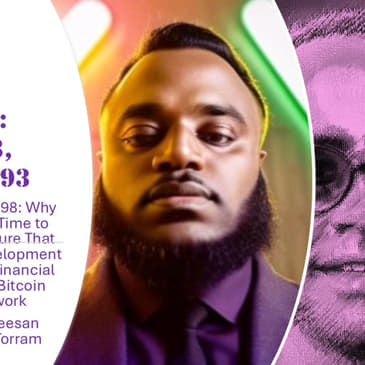

Vakeesan Mahalingam, CFA is Founder & CEO at Torram.
Ex-institutional trader turned VC turned founder, Vakeesan blends 8 years of investment industry expertise with deep experience in startups and emerging technologies. As the CEO and co-founder of Torram, he’s leading the charge in Bitcoin-native DeFi, pioneering solutions that bridge traditional finance with the decentralized economy.
More than just an innovator, Vakeesan thrives at the intersection of strategy, execution, and disruption. His expertise in business development, partnerships, and capital raising—combined with a sharp focus on crypto assets and blockchain technology—positions him as a leading voice in the future of finance. Through Torram, he’s breaking down barriers to unlock Bitcoin’s full potential, making DeFi more accessible, scalable, and ready for institutions.
https://www.linkedin.com/in/vakeesanm/
Website:https://torram.xyz/
[00:00:03] Hello everybody and welcome to the Crypto Hipster Podcast. This is your host, Jamil Hasan, the Crypto Hipster, where I interview founders, entrepreneurs, executives, thought leaders, amazing people all around the world of crypto and blockchain. And today I have another amazing guest. He is the co-founder and CEO of Torram. His name is Kisim. I'm going to pronounce this correctly. I did it once already. Mahalingam. Kisim, welcome to the show.
[00:00:33] Thank you. Thank you for having me. You're very welcome. Very welcome. So let's kick things off and ask you first, you know, what is your background and is a logical background for what you're doing now? Yeah. So, I mean, you know, we tell people that we have great founder market fit and founder product fit. And the reason for that is because so, you know, I used to spend about eight years in TradFi at the beginning of my career.
[00:00:59] You know, got a degree in economics at like one of the top schools in Canada called Waterloo. Spent the first eight years pretty much climbing the corporate ladder, you know, in the financial industry in Toronto, Canada. You know, at the height of it became a CFA charterholder in 2015. Used to run the global settlements desk at CI and then also spent some time on the rates desk as a rates trader.
[00:01:24] And then eventually was running a $2 billion fixed income portfolio at CI. Got into crypto 2016, bought my first Bitcoin and WhatsApp alpha groups on the trading desk. And pretty much never looked back, spent the next eight years in Web3 and kind of senior leadership roles. Helped build a crypto equity hybrid hedge fund in Berlin called Kentaro Capital.
[00:01:48] Then, you know, helped build the institutional DeFi strategy and VC arm of a NASDAQ listed Bitcoin mining company called Argo Blockchain. And then spent some time running head of BDM partnerships for a layer one out of Switzerland called Concordium with Lars Christensen. And then spent some time on the VC side as well before founding Torum. So definitely in my wheelhouse to kind of build a solution for institutional finance and the rails for institutional finance needed. We're going to be on Bitcoin now.
[00:02:18] You know, my co-founder has extremely complementary skill sets as well. You know, he's built Node client software before for Filecoin, was a part of first generation Oracle build outs and stuff on Ethereum. So definitely together we have some serious founder market fit here. Wow. Okay. So you have very good expertise for the topic we're going to be discussing today. So it's great.
[00:02:49] And I too was at Concordium briefly. Oh, nice. Yes. They had this TV show that the host was Claire Ross Brown. I was one of the writers for the show and, you know, I guess assistant producer or whatever it was. So I'm familiar with Concordium. Yeah. So I want to talk about Torum. You know, what's it all about? How are you building DeFi on Bitcoin? Yeah.
[00:03:19] So, I mean, the short of it is, you know, we're in the business of the picks and shovels and not necessarily applications. Right. So our infrastructure is primitive to Bitcoin DeFi actually taking off and DeFi applications actually being able to build on top of Bitcoin. So the way we position it is, you know, Torum is the first complete middleware stack natively on Bitcoin for institutional use cases.
[00:03:45] So that stack includes things like a native decentralized Oracle and indexer network, programmability via smart contracts, and then a new Bitcoin programmable token standard, which we've written the VIP for and have sent it to the Bitcoin core community to kind of unify the liquidity on Bitcoin.
[00:04:03] So our technology will actually enable things like primitives, like Bitcoin native stable coins, collateralized lending platforms natively on Bitcoin, prediction markets, and eventually, you know, tokenization of financial assets. So think about like tokenized ETFs, tokenized money market funds, pretty much everything that we know and see in traditional financial markets eventually on settling and executing on Bitcoin rails.
[00:04:35] I was going to ask you a later question. It was going to be, how are you doing this without middleware? But you are middleware. So we're going to. We felt that that was the missing piece, right? Like when we, you know, set out on this journey last year, you know, to build something, we really looked at what was possible on Bitcoin and what was missing after the top root upgrade.
[00:04:57] And we really quickly, you know, having been in this space for so long, I was looking at primitive infra and really realized really quickly that things like Chainlink or like the graph, like the decentralized Oracle network, the indexed network that really helped smart contracts become useful, were all missing in the Bitcoin eco. And so that's what we kind of set out to build. And then as we started building out the Oracle network, we realized that, okay, we also need programmability here.
[00:05:23] We also need a programmable token standard similar to like an ERC-20 because all these pieces together are what really unlocked Ethereum DeFi. And so obviously the opportunity here is, you know, a hundred times greater on Bitcoin, but it's like, we still need these primitive pieces of middleware and developer tooling and all this type of stuff to actually help get robust applications to build on top of Bitcoin. So. Okay. So let's get in.
[00:05:53] Let's get into it then because, you know, yeah, I was, I thought the same thing. I was like, how are we going to talk about DeFi without talking about Chainlink? And you're talking about, you know, being middleware. I'm like, because that was what was missing in Bitcoin. Okay. We're good. But you got a problem too. So you have, right now, it's right now Bitcoin DeFi is surging, right? And I want to find out about that, but I want to talk about three of the things that are the drawbacks of the Bitcoin technology, right?
[00:06:22] Bitcoin has issues with scalability, you know, security and governance, right? How are you addressing those three areas? Yeah. So, I mean, I mean, I wouldn't say Bitcoin has an issue with security. I think it is the most secure blockchain in the world. It's, you know, the most expensive, but most secure blockchain in the world, in the world, as far as institutional adoption goes.
[00:06:48] And the other two issues around scalability, I mean, there's multiple ways that people are looking at now to solve them. You know, Bitcoin OS proposed something called BitSnark. There's BBM. There's Citria. All these guys are working on sort of ZK solutions to scalability. But also, you know, ZK brings a certain level of programmability to Bitcoin that Bitcoin doesn't have, right?
[00:07:11] And the way that, I guess, you know, ZK technology scales Bitcoin is obviously through, like, the compression of data, you know, allowing you to kind of decouple, kind of, I would say, decouple transaction volume from block size, right? And so this way, it's heavily used, I guess, more on the L2 side of things. But it's also, it has a lot of drawbacks when it comes to L1. Obviously, it's computationally more expensive.
[00:07:40] And it's not something that actually can be done on Bitcoin L1. So we are developing a different way around scalability. And that's using a meta protocol, which is going to be torching, which can produce blocks between one minute and up to one second to help scale Bitcoin natively. So that's those two things. And then on the governance side, like, I mean, maybe you can touch on that a bit before I get into it.
[00:08:07] But I mean, I'm not really clear what you mean by issues on governance. Well, the way that I see DeFi is being fully decentralized, right? So I think of DeFi as like Aave or maybe even more or something like that, right? Bitcoin is a decentralized protocol. However, most of its holdings are held by institutions.
[00:08:32] And the holdings of it, the holding of Bitcoin is really centralized as far as, you know, the number of big whale holders, right? So I've always thought in order for DeFi to be successful, you have to have more decentralized holdings than you do Bitcoin. So how do you address the centralization issue, you know, when you're going to try and promote DeFi for regular users?
[00:09:01] I mean, I think this comes back to maybe the definition of DeFi, right? Because example, like when I left TradFi in 2016, right? Our definition of DeFi was how do we bring TradFi onto blockchain, right? How do we get traditional finance onto distributed ledger technology to solve some of the real world problems in back office, mid office functions with reconciliation,
[00:09:26] T plus zero settlement cycles, like all these sort of things that needed solutions. So when we're talking DeFi, like when bringing DeFi to Bitcoin, it is, I do believe it should be very institutional because this is kind of what Bitcoin set out to do during the 08 financial crisis when it actually, when Satoshi actually came out with this stuff, right? It was to fix a global institutional financial system, right?
[00:09:54] And so I think now we're getting back to the core of that, you know, like the narrative had changed and I don't know how or why, but, you know, over the last decade or so, it's changed into the store of value narrative. And finally, now over the last two years with Taproot Upgrade, we're finally getting that decoupling of like, you know, Bitcoin to store value and Bitcoin the network. And we're now, what we're building now is finally the middleware to enable Bitcoin the network, which we think goes beyond Bitcoin, right?
[00:10:23] It goes into like tokenization of digital assets on the Bitcoin network, which is what I think DeFi really is, right? It's more than just, you know, I'm an institution, I have a bunch of Bitcoin now because, you know, we have regulatory clarity and we're going to, you know, view this thing as an asset and put this on the balance sheet. And so, you know, a couple of months go by and these institutions get bored and they're like, okay, well, what do I do with my Bitcoin now?
[00:10:50] Right. I want to leverage it as a balance sheet asset. I want to collateralize lending against it. I want to be able to use it in DeFi in the sense of like, I want it to be a yield bearing asset or a yield generating asset. Right. And so I think that's kind of the very primitive of it, but like anybody that holds Bitcoin can participate, right? Like Bitcoin has been around forever. So I think it's, I think it's, you know, to say, you know, Bitcoin started at, you know, under a dollar, right?
[00:11:18] When it first came out. So it's like everybody had the opportunity to get involved, right? It's only now that it becomes a lot more expensive in price. Do people feel like they're priced out of the Bitcoin market or does retail feel like they're priced out of Bitcoin? But if you believe in Bitcoin and the trajectory of Bitcoin and it actually being, let's say, a store of value, then it's still early in the Bitcoin days to buy Bitcoin and participate in DeFi and earn yield, right?
[00:11:42] So I wouldn't, I wouldn't say it's an institutional only game, but I do feel like Bitcoin L1, as far as using it as a network is obviously definitely going to be just an institutional playground. Okay. So that's the distinction that I was missing that I was converging and saying, okay, it's only a store of value, but you're seeing, yeah, it has a store of value component, but it also has this network component, which is now being adopted, right?
[00:12:09] And not only being adopted, but Bitcoin DeFi is surging. So where, like what areas within DeFi have you seen Bitcoin network success surge? Yeah. So I think, you know, for all the people that kind of were around for the early days of ETH, right? It was, people remember CryptoKitties, right? People remember Bored Ape Yacht Club.
[00:12:35] You remember the NFT craze, like all this stuff that happened in the early days of Ethereum is what we pretty much experienced over the last 12 to 18 months on Bitcoin, which is the meme coin mania of like runes and ordinals. And like, you know, we've seen all these things from Ortys to Pizza Ninjas to Taproot Wizards. So like, you know, it's going through its Ethereum cycle of CryptoKitties, right?
[00:12:59] And so all the DeFi that we're seeing that's happening in these early days are all like more considered degen DeFi, which is like, you know, getting all these new Bitcoin assets and staking them and doing stuff with them and moving them around in kind of meme coin mania. Right. But that has actually resulted in like, I would say Bitcoin DeFi grew something around like 21x in about a year in 2024. And this is like according to DeFi Lama, right?
[00:13:26] So but a lot of that activity was on that side of it, right? It's only now we're seeing more adoption, especially into this year and next year and stuff like that. We're going to see a lot more on the institutional side where I think the meme coin mania stuff on Bitcoin is kind of dying out and we're seeing a lot more maturity come to the Bitcoin ecosystem. And we've seen this before. It's happened in the Ethereum ecosystem from the early days into when it kind of matured and then Compound and Aave came in and then kind of pioneered some of the DeFi primitives.
[00:13:55] And then we saw Eigenlayer, we saw all this new stuff come in into the ETH ecosystem. I think the same thing is going to happen here in the Bitcoin ecosystem where it's maturing out of that, you know, early days of figuring out what rooms and ordinals can do.
[00:14:09] And then all this type of stuff on the meme coin side into like, you know, how do we create real use cases on Bitcoin, like a Bitcoin native stable coin for net settlement or like collateralized loan products with like instant collateral verification because it's on the same chain as Bitcoin. Right. People are thinking more about different use cases like RWA tokenization platforms on Bitcoin. Right. All for digital asset tokenization and stuff like that.
[00:14:36] So we are heading in the right direction, but it obviously takes time and it takes the development of like primitive infrastructure, like what Torum is building to actually get there. Got it. Got it. Okay. So Bitcoin is going to, you believe Bitcoin is going to outpace Ethereum in three years. Right. Why do you say that? And what is, what's going to, you mentioned zero knowledge earlier, you know, and decentralized Oracle.
[00:15:04] So what's going to be the role of the set of zero knowledge and decentralized oracles in this overtaking of Ethereum by Bitcoin for DeFi? Yeah. So I think, you know, I think there's a lot of people in the camp that believe Bitcoin DeFi will one day become the largest DeFi ecosystem.
[00:15:23] Part of that being obviously institutional adoption, nation state adoption, you know, globally governments are looking at adding Bitcoin to, you know, as a nation state asset or treasury asset, balance sheet asset, whatever, whatever the case is. So the opportunity there is a lot bigger than the rest of crypto, I would say, which was mostly retail.
[00:15:43] So when we see like, you know, ETH DeFi a couple of years ago peaked at about a hundred, a hundred and five billion right now bridge TVL on ETH is around 150, 160 billion. Right. That's a drop in the bucket compared to the size of traditional financial assets. Right. If you look at the size of derivative market, that's in the trillion, size of FX markets are in the trillions, you know, size of private equity markets are in the trillions. Like everything is in the trillions. The measurement of traditional financial markets are all in the trillions.
[00:16:12] Right. So it's like it dwarfs anything that we've seen before in DeFi, as long as we can, you know, make this future possible of bringing digital assets, like the tokenization of digital assets and the tokenization of real world assets onto Bitcoin. Right. So, I mean, I don't think, I think it might happen sooner than three years.
[00:16:36] I mean, especially with everything coming with the market structure bills and stable coin bills and everything that's supposed to happen before the August recess, we're supposed to get a lot of clarity on the U.S. side of things, which will then dictate kind of global policy, global regulation.
[00:16:49] So I think going into 2026, I think we'll have a lot more clarity on that side, which will allow a lot more institutions to participate, a lot more people to participate, people to feel safer about crypto assets, you know, which kind of piles on into like a snowballing network effect. Right. And I think the entry point for a lot of people is going to be Bitcoin first.
[00:17:12] Right. Whether it's retail or whether it's institutional, the first asset that they're going to end up buying when they get their first exposures to crypto is going to be Bitcoin. Right. And then it's up to them whether they move beyond Bitcoin as like the gateway crypto they get into and start exploring altcoins. But I think a lot of people, no matter what, will still be a basket or a big nest egg of Bitcoin that's being held, whether it's on the balance sheet or in retirement accounts or, you know, whatever, whatever the case is.
[00:17:41] And that's what's eventually going to lead to this mass takeover of BTC DeFi over ETH DeFi. And then I guess to touch on your points about the ZK and the Oracle stuff. So like, obviously, we don't see any of this happening without a decentralized Oracle network natively on Bitcoin, because we believe that the data to settle any sort of smart contract or the data to reference that's going to be immutable has to live on the Bitcoin blockchain itself.
[00:18:10] So that's any sort of real world data or any sort of off chain or on chain data, depending on the use case or the application that's that's being built. Right. Whether it's decentralized ID, you know, which is essentially like if you think about it, decentralized ID is kind of like just an NFT. Right. It's a non fungible token that only applies. It's a one of one. It only applies to you. Right. But putting something like that data on chain, especially on the Bitcoin blockchain, is something that doesn't really alter over time.
[00:18:40] Right. You don't change identities day by day. Right. So it's something that stays there, you know, immutable until you die. Right. Which is a great use case for that. And then obviously, you know, the tokenization of assets we're going to see a lot of as well. So like I think Oracle's are a primitive piece that hasn't been explored properly yet, which is what we've actually built. Like our testnet alpha is live right now. We launched it on Monday.
[00:19:04] Okay. So, you know, people can go check it out. We brought 30 data feeds to Bitcoin, including, you know, the S&P 500 index, the VIX, all the kind of top crypto pricing, you know, some of the rooms ordinal pricing so that people can now get a feel for what's going to be possible on Bitcoin, depending on whatever data feed they need. Right. And so we have a B2 of that coming out or a phase two of the testnet coming out in a few weeks as well, which will have smart contract programmability in it as well.
[00:19:33] So now people can build with a native Oracle and native programmability on Bitcoin. Right. So it's all happening now because we're making it possible now. But like all this stuff that we're thinking about in the future is actually happening in weeks and not even months. Right. So that's going to be super cool. And then, yeah, the role of ZK, like obviously, like I think that's what helped the Bitcoin L2s really take off. Right. Like I think the whole Bitcoin L2 narrative, like, you know, it's confusing for a lot of people because a lot of these L2s,
[00:20:03] they're really just EVM side chains like there's nothing really Bitcoin native about these things. They're it's the same thing as just being an EVM chain and then sending one proof transaction to Bitcoin for finality. Where ZK really comes in is it actually helps like for the non kind of EVM is change that it kind of helps really scale Bitcoin by providing a programmability function.
[00:20:30] That kind of helps build native smart contracts on Bitcoin via these L2s. Right. But then you also have limitations around that, like I mentioned before, which is like this computationally expensive to use ZK. So like while it does lead to, you know, compression of data, like I mentioned earlier to kind of decoupling, like the number of transactions. So obviously for scalability versus Bitcoin block sizing, it does have its limitations.
[00:20:58] So it is things that people are exploring and you'll see it with BitSnark or BitBM and stuff like that. But like I don't know if it's something that will be heavily adopted. I think people are still exploring different solutions the way we are. Got it. So I want to I want to know I want to tell you my misconception. OK, and then I wonder what some of the others are. This is my misconception or maybe a conception.
[00:21:27] Bitcoin has seven is seven transactions per second. That's the computation on Bitcoin, seven transactions per second. If you're doing DeFi and you have a global world of DeFi on Bitcoin, you're going to need a lot more than seven transactions per second. Right. So my conception or misconception is that it can't possibly ever do that. You know, so how do you how do you debunk my conception or misconception? And what are some of the others that people that you see?
[00:21:58] Yeah. So to that misconception, I mean, that's where the scaling solutions come in. And we've developed something called, you know, in our middleware stack called the TorChain, which allows us to create like a proof of stake meta protocol on top of Bitcoin that allows for blocks to happen, let's say, between one minute and as low as one second that can store up to up to 200 transactions or more.
[00:22:51] Right. It's more about the volume and then the dollar size of what's moving between transactions. Right. So you so you don't need, you know, we don't need something like payments natively on Bitcoin or micropayments where you need like, you know, 10,000, 100,000 transactions per second, like a Visa network. Right. Right. What you need is a secure place for, let's say, banks to do interbank net settlement where like, let's say, Citi is going to send JP Morgan like 50 million on the back of the trade.
[00:23:20] And they just need a secure way to do that with T zero settlement. That's super liquid. Right. That settles within an hour or two. Right. So it's like you're getting a higher value transfer on Bitcoin network and what we call like TV or transaction value enabled versus like, you know, a number of or account for like the number of transactions that are moving on the network. Right. So that's kind of one misconception.
[00:23:49] There's a couple others, you know, there's like people think Bitcoin can't do DeFi. It needs wraps. It needs bridges. Like, you know, we're actually building a way where you don't need any wraps. You don't need L2s. You don't need bridges. And again, it is the missing middleware here. So like Bitcoin DeFi is possible beyond just Bitcoin staking. Right. It's just that it hasn't been done yet. We're pioneering a lot of it and it's coming really soon. So in the next couple of months, you guys are going to see a lot more tools to be able to actually do a lot of things natively on Bitcoin.
[00:24:19] Right. So Bitcoin DeFi is really going to be unlocked in the second half of this year, partly due to what Torum is doing. And then another piece to that is, you know, there's this outdated mindset that Bitcoin is just a store of value. Right. And people still think that Bitcoin is this digital gold asset. But again, that's that's it's not their fault. I think it's just that's just what the media has been pushing. That's what the narrative has turned into.
[00:24:44] You know, ever since the the beginnings of Bitcoin slowly, it's drifted into Bitcoin's product market fit is it's just a store of value. It's a digital gold. And people have completely forgot about Bitcoin, the network. And I think that's where that's what we're trying to revive right now and bring the attention back to say, hey, you know what? Bitcoin is the most secure financial network in the world. We should be using it as an execution and settlement layer, probably not for every single transaction between like me and you for five bucks.
[00:25:14] But like it should be for like these large, massive transactions that pretty much run the global economy. Right. So I'm thinking I'm thinking. Well, you talked about these moving the transactions, you know, in the middle of being the settlement layer. And I'm saying I'm thinking if you are successful and Bitcoin has been successful, most things it's been involved in. Right. Is there going to be a need for XRP?
[00:25:44] I mean, this is the thing. I mean, you know, a hot take on my end is like there's a lot of people that are that are they're pro or against XRP. It's very black or white. Right. As far as XRP has been in its entire history. Right. There's people that are in the XRP camp or they're super against the XRP camp. And that was from the early days. Right.
[00:26:11] Of like them trying to build for institutional use cases when everybody wanted to be super degen hoodie culture against the system type of thing. I think we're seeing a lot more people convert into that camp now, myself included. Right. Like I left the entire you know, when I left finance, I said I would never wear a suit again. I fully adopted black hoodie culture. I was like, you know, this is it. And now I'm ready to put my suits back on. But in this industry. Right.
[00:26:38] And try to actually move the needle into into real use cases. So I think, you know, I think that there's always going to be a case for multiple chains doing real world asset stuff and digital asset stuff. It's not one chain wins all. Right. XRP will be used, you know, like like a SWIFT network. And financial institutions can choose to use XRP. They can choose to use Ethereum, Solana.
[00:27:01] But what I think will happen is once this stuff is possible on Bitcoin, if I was an institution, I'd be thinking, why am I using any other chain? Why don't I just do this on Bitcoin? Because I already hold Bitcoin. So I'm already exposed to Bitcoin, the asset and the network. Right. Like I don't need to hold XRP. You know what I mean? Like I can just hold Bitcoin, which I'm doing anyway, because I believe in it as a digital gold or store of value or balance sheet asset. So I'm already exposed to the Bitcoin network.
[00:27:28] So why don't I just do this on the same network I'm already exposed to? Right. And so that's kind of where we think the thought process will go. And I say that coming from TradFi, where everything is about risk management. Everything is about security. Everything is about doing things in a way that's the most secure and introduces the least amount of risk. Right. And so that's where kind of Bitcoin plays that role. Well, you just said it makes a lot of sense to me. It makes a heck of a lot of sense to me.
[00:27:56] So, you know, one of the things we're seeing, we're seeing institutional adoption, right? We've seen institutional adoption for a while. And, you know, that store value narrative came out of a lot of effort being made for ETFs and other financial devices for Bitcoin. So why do you see, it's probably self-explanatory. Why do you see institutional adoption of Bitcoin for DeFi occurring at a rapid pace?
[00:28:24] I mean, I think, yeah, I think it's there's a lot of things that are happening at the same time. Right. We're getting a lot more regulatory clarity. Right. This is one of the things that the market was waiting for, for the SEC to be pro-crypto, for the government to be pro-crypto, for them to actually put in frameworks and policies so people know how to move within the space. Right. Right. It's unclarity is the enemy, right? It doesn't matter if the policy is pro or against.
[00:28:54] The thing is the market demands clarity. And that's true of all markets. Right. So Bitcoin and crypto is no different in that sense. But that's what institutions were waiting for. And I think as we get more clarity on that side, there's already plans from a lot of institutions that are, especially NASDAQ institutions that are like exchange listed institutions that are already looking at adopting crypto as a portion of treasury. Right. Whether it's 1% of treasury, 10% of treasury up to them. Right.
[00:29:23] And their shareholders and stuff like that. But institutional adoption is going to happen at a lot faster pace, I think, after the August recess when, you know, if the Trump administration does everything they say they're going to do, we're going to have all that clarity in place by then. And so, you know, there's trillions of Bitcoin that's just parked right now. Right.
[00:29:45] So, like, the next step for institutions is, okay, now we, you know, you sold us on this asset Bitcoin and we bought it all. Now what do we do with it? Right. And so that's really the door to the trillion dollar unlock with Bitcoin DeFi, which is like trillions of Bitcoins on the balance sheet either being used in collateralized lending or being used in staking or being used in different ways that are yield generating. Right.
[00:30:14] And so, yeah, I think most of the, you know, to go back to the question about why it's happening at a rapid pace, I think right now, you know, the biggest thing here is clarity, right? Regulatory clarity and then, you know, policy from the U.S., which is kind of what a lot of the other international global financial markets look to when it comes to devising their own plans. Right. So. Awesome.
[00:30:39] So, you know, I've been waiting since 2021, since the first DeFi summer for another one. It hasn't happened yet. And the way the things are going now, I think that DeFi, the next DeFi summer, when it comes, it's going to look entirely different. Right. It's not going to be like Avi and Chainlink going to a thousand of dollars a piece. It's going to be what you described.
[00:31:04] So I want to get your idea, you know, what you see that next era of DeFi looking like. I mean, I think this next era of DeFi is not going to be the creation of new tokens and meme coins and NFTs and all these things being like staked and restaked and DeFi platform tokens, liquid staking, like all this type of stuff.
[00:31:30] I think the next era of DeFi is going to be finally that era that I left TradFi for a decade ago, which is the tokenization of real world assets, financial assets on chain.
[00:31:41] And people are finally looking at, you know, how do we solve the problems of like the existing financial markets, whether it's, you know, illiquidity in secondary markets and private equity markets and stuff like that, or whether it's solving back office, mid office problems with corporate actions on chain and T-zero settlement cycles. So let's tokenize money market funds and all these kind of short term fixed income assets that have to have these kind of same day settlement cycles.
[00:32:10] Like these are the things that are going to run the next era of DeFi and Bitcoin is going to have a huge place in that as far as, you know, what we're building for, which is making Bitcoin useful as a network. So we think the Bitcoin native network will become a pillar backbone of institutional DeFi or institutional finance in general. I think eventually, eventually everybody will drop the word DeFi and just call it finance again.
[00:32:35] And it's just going to happen on like blockchain technology, whether it's Bitcoin or somewhere else. Right. And so, yeah, to me, the next wave of DeFi looks very, very promising, to be honest. Right. And as far as your point about DeFi summer, I really, you know, if I can give a prediction, I think Bitcoin DeFi summer will happen next summer. To be honest, 2026.
[00:32:59] I think 2026 will be the summer where we start to see all these things kind of take shape and form. And that'll definitely get us to the quarter million or half million Bitcoin, the theory that people are talking about. So interesting. And you'll be ready to put that suit back on. Right. So I think I'm ready soon, too. Yeah. I mean, you know, I'm heading to, you know, I came out of DAS a couple of weeks ago and everything was super bullish, right?
[00:33:28] Like everything was super bullish out of DAS, especially on the institutional side, as far as them all taking this very seriously, putting together bigger digital asset teams, you know, exploring it more than just some testing use case. They're all actually trying to figure out how to get involved. Right.
[00:33:47] And so, yeah, it's super exciting to finally see the big guys and the financial institutions finally taking this industry serious, even though, you know, we have this decade run of just like wizards and frogs and all these different things that we've seen. I think it's time that we kind of move beyond that and we move into actual real world applications. Awesome. Awesome. Well, I enjoyed this conversation today. I want to thank you very much for your time.
[00:34:16] I have one last question. It's how can people find more information about you, about Torum? How can you do that? Yeah. I mean, definitely follow us on Twitter at Torum underscore XYZ. Check out our White Paper 2.0. The link is there. We just launched that last week. So you can learn all about our technology, what the use cases will be, how we're going to bring institutional finance to Bitcoin Rails. Our testnet Alpha Phase 1 launched on Monday. So you can go check out the Torum Explorer.
[00:34:46] That's also on the Twitter account. So Torum underscore XYZ. We also have our seed round coming up later this month into next month. So we're doing a $2.8 million seed round. So if you're an investor or interested in kind of participating in our seed, happy to chat. Or you can connect with me on Telegram at Crypto Keysen and send me a DM. Happy to chat as well. Awesome. Thank you very much for your time today. All right.
[00:35:16] Thank you. Thanks for having me. Appreciate it. Thank you. Thank you.