
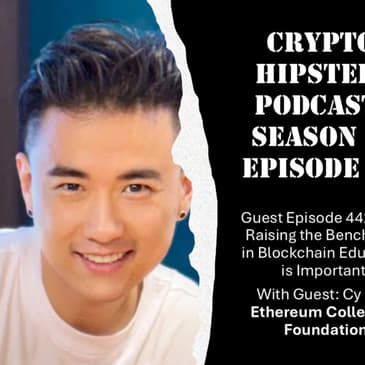

Cy Li is the director of Ethereum Collective Foundation. He is committed to elevate the global standard of digital literacy by building grass root regenerative pipelines for a healthier and more progressive Web3 industry. Equipping the leaders of tomorrow with tools and skill sets to tackle uncharted space confidently while carrying the values and ethos of open source mentality.
[00:00:01] Hello everybody and welcome to the Crypto Hipster Podcast. This is your host, Jamil Hasan, the Crypto Hipster, where I bring you entrepreneurs, founders, executives, artists, amazing people all around the world of crypto and blockchain.
[00:00:17] And today I have another amazing guest. We're kicking off the new year with 2025. This is my first podcast, 2025. I'm looking forward to another stellar year.
[00:00:28] I have an amazing guest. His name is Cy Li. He is the founder of the ETH Collective. Cy, welcome to the show.
[00:00:37] Thank you. Thank you for having me. Happy 2025.
[00:00:41] You're welcome. It's a pleasure and honor too. So let's kick things off and I'll ask you first. I ask everybody the same question. They get amazing answers.
[00:00:49] What is your background and is it a logical background for what you're doing now?
[00:00:54] I think so. I think so. I would best address myself as a solver within the greater Ethereum ecosystem, carrying the values and ethos of what Ethereum strives to become as an open source initiative.
[00:01:10] I've been in this industry for about 10 years. Started off in crypto, now in blockchain.
[00:01:17] I think I'm a pretty good example of a degenerate turning regen. In recent years, I've been helping put on EdCon, which is a traveling conference like DevCon.
[00:01:31] In 2022, we started an education initiative called the University of Ethereum, raising the benchmark of blockchain literacy.
[00:01:40] And most recently, we started a new Ethereum collective foundation.
[00:01:50] Yeah, that's a gist.
[00:01:54] Very cool. So I want to find out all about that ETH collective foundation.
[00:01:59] My question, I guess, is in two parts. The first one is, what is the ETH collective all about, including your mission and vision?
[00:02:06] The Ethereum collective is about, I think, as a benchmark of blockchain discovery and the core technology.
[00:02:21] Cross-industry players who are crypto carriers has a hard time finding a helping hand from the ecosystem.
[00:02:32] Like when they try to find, because it's decentralized nature, we want to offer ourselves as an alternative to the Ethereum foundation to help answer any questions or help provide any resource.
[00:02:52] And just be the helping hand that cross-industry players need when trying to onboard, trying to come into this industry.
[00:03:01] We want to break down the walls of intimidation and making our ecosystem as friendly and as welcoming as possible.
[00:03:09] Only then can we help propel this industry forward.
[00:03:15] Great. So I'm going to get a lot of heat right now for what I have to say about Ethereum from the people.
[00:03:22] We love Ethereum.
[00:03:24] You said, I'm at a spot right now where I hold no Ethereum.
[00:03:30] For the first time since I've been in crypto in 2017, I have no Ethereum.
[00:03:34] You said early on that you help support Ethereum's mission.
[00:03:41] And I don't really know what that is anymore.
[00:03:43] Like, you know, Vitalik said he wasn't going to, I think he said it wasn't, products aren't going to be live until 2031 or there must be some confusion there.
[00:03:55] But I'm a little lost and confused.
[00:03:57] You know, what is the current state of Ethereum's vision and vision?
[00:04:03] It seems cloudy to me.
[00:04:05] What do you think?
[00:04:08] So because of its decentralized nature, I think Ethereum white paper defaulted into the solution for blockchain when it's essentially just a solution.
[00:04:26] Because of the open source nature of the protocol, all the other protocols, it's a marginally different derivative who is able to get a bigger marketing bag to tell better stories because everyone else is more centralized.
[00:04:49] So I think the question here is, how can we further challenge Ethereum by providing alternatives to drive the future of blockchain?
[00:05:04] Where, I don't think any one person can answer that question as far as like, where is Ethereum going?
[00:05:09] Right?
[00:05:12] So you pose a question.
[00:05:14] What do you see as the answer?
[00:05:16] Like, competitive, I guess competition's healthy.
[00:05:21] You know, you have the narrative of Solana, you have SWE, you have everybody's trying to go against Ethereum, you know, head up.
[00:05:27] And where do you, how do you see the competition helping Ethereum move forward?
[00:05:34] I think like, if Ethereum was better at building communities and had a more centralized mentality, but still retaining its decentralized nature,
[00:05:47] you could argue that there shouldn't be a Solana community.
[00:05:52] Right?
[00:05:52] Props to them.
[00:05:53] They do a really good job at building out these fantastic ecosystems that has trend, that has, they have captured a large audience.
[00:06:07] But is the tech there?
[00:06:09] Yeah.
[00:06:10] That is a question.
[00:06:11] So if you're talking about fundamentals, is Solana's tech reliable?
[00:06:18] I think anyone doing some sort of due diligence will be getting to always default back to the Ethereum protocol.
[00:06:30] Yeah.
[00:06:31] I think I agree with you.
[00:06:35] So I want to talk about how does your, you have a process, you know, you're at the ETH Collective.
[00:06:44] It's called learn by doing, right?
[00:06:46] So how does learn by doing process work and what are the benefits to, you know, I guess, mentorship and expert guidance?
[00:06:55] Right.
[00:06:55] One of the initiatives under the Ethereum Collective is called the University of Ethereum.
[00:07:03] This was an education initiative we built to help raise the benchmark of blockchain literacy.
[00:07:12] So instead of asking questions like, what coin should I buy?
[00:07:17] Or why Ethereum has an all-time high?
[00:07:21] Or who is the next Vitalik?
[00:07:23] It's really just a couple hours of sitting your ass down, just learning the fundamentals.
[00:07:30] And you'll be able to understand these questions yourself.
[00:07:33] But at the same time, we do understand, you know, talking about open source, talking about blockchain, talking about decentralization is not very attractive or sexy topics.
[00:07:45] So what we do at the ETH is to draw attention, awareness to the importance of blockchain literacy and build an accessible tool that's free for all and adding gamification to it.
[00:08:11] So it's easy to understand and provide a resource where anyone from anywhere around the world is able to have access to understand what this industry is, how it works, and how to utilize it in a way that it becomes a betterment for your own life.
[00:08:34] So from its core, I believe education shouldn't be a right.
[00:08:41] It's not a privilege.
[00:08:44] It's anyone's right.
[00:08:45] So just by making education or blotting education as accessible as possible, it's our first step.
[00:08:57] I have to follow up.
[00:09:00] First of all, I'm going to disagree with you.
[00:09:03] You said talking about decentralization is not sexy.
[00:09:06] Right.
[00:09:09] I'm going to ask you, what's possible now in the earth or on the planet with people at the intersection of technology, finance and social that wasn't possible before we had decentralization?
[00:09:25] That's a fair point.
[00:09:30] I mean, like, we always talk about mass adoption.
[00:09:35] We're talking about how do we get more utility.
[00:09:39] We have all these cool projects, but no one uses them.
[00:09:41] We're all focused on vehicles that give us the bottles and the models and the fast cars and design our brands.
[00:09:49] But we don't have any true utility.
[00:09:58] I think at DevCon a couple months ago, Vitalik said the best use case of blockchain other than crypto is ENS, which is a very low benchmark, I think.
[00:10:18] I mean, there's a lot of cool things that we can use blockchain for and impact in climate and governance.
[00:10:27] It's just, I think, since COVID, we have lost our juice and being the pioneers and being the solvers that this industry strives for so much.
[00:10:47] Okay.
[00:10:48] Okay.
[00:10:48] I'm going to write that down.
[00:10:49] We lost the juice.
[00:10:50] I'm going to come back to that.
[00:10:51] Okay.
[00:10:52] All right.
[00:10:53] The second point I had, you know, is you said if somebody sits down for two hours, you know, they can learn the technology.
[00:11:00] I remember when I first got into crypto, you know, and blockchain, I think I read the Bitcoin white paper like 20 times before I started to understand it.
[00:11:09] And I think that, like, you know, it took months of a steeper learning curve, I guess, learning curve now.
[00:11:15] You know, what's the best way that somebody who's not tech savvy, who's never had an experience in blockchain can start to learn?
[00:11:24] Or is that learning curve still very steep?
[00:11:29] That's a great question.
[00:11:30] So what we did was there's about 170 something core concepts to the Ethereum blockchain.
[00:11:37] And we took each concept and we turned it into a story.
[00:11:41] So anyone from five to 50 year old is able to understand it through analogy.
[00:11:49] And the University of Ethereum is for education structure is based on a piece of AI.
[00:11:56] I know, like, you know, AI is a different topic, but it's mostly about AI takeover, how to find the shortcuts, how to replace jobs and about efficiency, efficiency, efficiency.
[00:12:08] But what we're using AI for is more so positive sum game, where you're teaching the taught to teach others.
[00:12:19] It utilizes semantic similarities to validate your comprehension.
[00:12:27] So Richard Feynman said you don't know something well enough unless you can say it in your own words.
[00:12:34] So after you read each analogy based story to capture each concept, you have to summarize what you have learned through an open ended question prompt.
[00:12:47] And then the AI validates whether you learned a comprehension, you learned the material well enough or not.
[00:12:53] If not, it will make suggestions to help you better your answer.
[00:12:56] So it's not one of those multiple choice things you see from, like, those learn and earn or earn and learn type of styles.
[00:13:05] It's intended to help you actually have a better concept of each core subject.
[00:13:15] So I don't want to ask you about all 50.
[00:13:18] What would one story be?
[00:13:21] What would an example of one story be?
[00:13:26] Okay, so, you know, I always use, I don't think we use this one for the blockchain.
[00:13:36] But a general analogy that we use to compare decentralized and centralized entities is coffee and tea, right?
[00:13:43] So, you know, for the last, I don't know, however long America has been established, we drink coffee almost every day.
[00:13:52] Mass majority of Americans.
[00:13:54] Now, out of nowhere, you know, tea is offered as a consumer product and is made available.
[00:14:01] So tea being decentralized alternative, it's not that it's better than coffee.
[00:14:09] It's just an alternative.
[00:14:10] I think that is the common misunderstanding that, oh, decentralized laser is coming.
[00:14:18] It's going to be a decentralized takeover.
[00:14:20] It's not.
[00:14:21] You have to understand what tea is and how to brew it and what are its health benefits to you.
[00:14:29] What different teas are there?
[00:14:30] So it can be a better alternative when you need it to be additive to the option of just only having coffee.
[00:14:41] And I think that is an analogy I use often to kind of help people understand the difference between centralized and decentralized entities.
[00:14:51] And to be able to understand what they mean so you can understand how to make your own self better.
[00:15:01] I like it.
[00:15:02] I like it because, like, at dinnertime, I'll have unsweetened iced tea because I can't see myself having coffee at 8 o'clock at night.
[00:15:10] I'll never sleep.
[00:15:11] So that's good.
[00:15:14] We lost.
[00:15:15] So I want to go back to this.
[00:15:16] We talked about coffee.
[00:15:18] We talked about tea.
[00:15:19] I want to talk about juice.
[00:15:20] You said we lost the juice.
[00:15:21] You know, I think I see it, too.
[00:15:25] You know, there was a lot more, I guess, you know, people assembling before COVID, you know, and since then there's not been – hasn't come back fully yet.
[00:15:35] But, you know, what do you think it's going to take to get that juice back?
[00:15:41] We need more radical thinkers.
[00:15:43] We need more solvers.
[00:15:45] All right?
[00:15:48] The benchmark to be a founder in Web3 is really low compared to any other industry.
[00:15:54] All right?
[00:15:55] Let's not be another founder.
[00:15:58] Let's try to solve for greater purpose and greater reason.
[00:16:03] Don't just do to do.
[00:16:06] Have a greater mentality.
[00:16:09] Have, you know, it's okay to find help across industry.
[00:16:17] And we need to, you know, have the confidence to poke and challenge the current leaders in the ecosystem.
[00:16:30] I do believe the Ethereum is too comfortable, right?
[00:16:37] Because everyone is so dependent on its technology.
[00:16:43] Yeah.
[00:16:43] Stepping out of your comfort zone is important.
[00:16:46] So.
[00:16:47] Right.
[00:16:47] And I think, like, making this industry fun again, putting the fun back into blockchain fun is a term that we coined at Econ this past year.
[00:16:57] Just finding ways to make blockchain more sexy, more relatable, more relevant, be more accessible.
[00:17:09] Yeah.
[00:17:10] And I think it would be great if there was a conference where all the different protocols, like a Solana or an ETH, were to be able to come together.
[00:17:17] And then have, like, you know, we talk about interoperating.
[00:17:21] But, you know, there should be benchmarks.
[00:17:23] And the lowest benchmark should be just socially networking.
[00:17:30] There's no reason.
[00:17:32] Sorry.
[00:17:32] Go ahead.
[00:17:33] No, go ahead.
[00:17:33] There's no reason.
[00:17:34] Yeah.
[00:17:35] There's no reason why we're all in open source that no one talks to each other.
[00:17:38] It makes no sense.
[00:17:42] I'm just thinking about the conferences around the world.
[00:17:44] And if there are, like, consensus is mostly Ethereum.
[00:17:47] Then you have the Bitcoin conferences.
[00:17:49] Then you have Avalanche had their own conference this past year.
[00:17:51] And so did Solana.
[00:17:52] I guess you're right.
[00:17:53] At Bitcoin, too.
[00:17:54] I was there.
[00:17:56] There's no, like, combination conference.
[00:18:00] Yeah.
[00:18:00] That'd be kick-ass.
[00:18:01] Like, people use these conferences as just a party excuse.
[00:18:09] Then party at a higher level.
[00:18:12] Let's interoperate on a party level.
[00:18:15] I like it.
[00:18:17] So, founders, builders, builders.
[00:18:20] Let me think about builders.
[00:18:21] How should builders think about the future of crypto?
[00:18:24] You know, and what obstacles should they look for in the industry to overcome, you know,
[00:18:29] including, like, their own personal barriers, too?
[00:18:34] I think, like, if you are a builder, you should have done enough homework to be able to answer this question yourself.
[00:18:43] Again, don't just build to build.
[00:18:47] And don't try to make things incrementally better.
[00:18:51] We are in this space.
[00:18:54] Like, we talk about mooning, right?
[00:18:55] Everybody wants to go to the moon.
[00:18:57] Don't build a bicycle.
[00:18:59] Build a rocket.
[00:18:59] Build a rocket.
[00:19:01] B is okay to fail, right?
[00:19:05] The space is still very much an explorational phase.
[00:19:09] So, you know, a lot of the potential is still yet to be explored.
[00:19:15] We need people who have the confidence to fail.
[00:19:22] We need people who can confidently explore uncharted territories.
[00:19:39] But, you know, as far as a realistic future, I think digital literacy is important.
[00:19:52] Financial literacy is important.
[00:19:54] Literacy in general is important.
[00:19:57] Don't just buy because you're fumbling or because we're talking about crypto.
[00:20:04] Understand what you're getting yourself into.
[00:20:08] Understand the industry.
[00:20:09] I think the goal with blockchain literacy is so you have enough understanding so you're able to answer these questions yourself.
[00:20:24] Yeah.
[00:20:25] So, that's where you help.
[00:20:26] That's where you come in to get people.
[00:20:29] Right.
[00:20:29] So, all the tools that UE has to offer from the University of Ethereum, they're all free.
[00:20:35] And it's all open source.
[00:20:37] And once you have proved that you have gone through the entire course, you can build your own course content.
[00:20:46] It's a platform.
[00:20:48] Like, localization of content is necessary if it's analogy-based teaching.
[00:20:57] Because people from different cultures learn differently.
[00:21:02] From East to West to even, like, say, the North or New York versus, like, the South.
[00:21:09] We use different analogies to understand different things.
[00:21:17] I went to school in the South.
[00:21:19] I still can't figure it out.
[00:21:23] Well, I mean Virginia.
[00:21:24] You know?
[00:21:25] But I grew up in New Jersey.
[00:21:27] So, you know.
[00:21:29] But, yeah.
[00:21:31] So, all that requires best practices.
[00:21:34] Right?
[00:21:35] Not FOMO-ing.
[00:21:37] Not chasing price.
[00:21:40] There are best practices that people should know about.
[00:21:44] Right?
[00:21:45] To remain vigilant in crypto and make sure they don't, you know, put their retirement money into, you know,
[00:21:52] whatever it took coin.
[00:21:55] You know, for example, you know, what are the best practices?
[00:22:01] Yeah.
[00:22:02] If you're a visitor, just don't do it.
[00:22:05] Do your homework.
[00:22:07] I think that is the best practice.
[00:22:10] Like, you have to understand, have enough financial literacy to understand that once any financially-based project reaches a large platform,
[00:22:20] a great deal of the upside has already been gone to the previous rounds.
[00:22:26] So, do your homework.
[00:22:30] Got it.
[00:22:31] Awesome.
[00:22:32] So, I want to shift gears a little bit.
[00:22:34] Okay.
[00:22:35] Anyway, I want to talk about one of the important things that are going on right now is the, because you said, Vitalik said that one of the important applications is ENS.
[00:22:45] So, that ties into digital identity.
[00:22:48] Right?
[00:22:49] How should people best secure their, and they're going to have to, best secure their digital identity in Web3?
[00:22:58] Ah, digital identity in Web3.
[00:23:05] First of all, you got to understand what that is.
[00:23:08] Understand what digital identity is and understand what Web3 is.
[00:23:11] Right?
[00:23:12] I don't like how the numeric notation of Web1, 2, and 3.
[00:23:19] It also creates this narrative that it's getting incrementally harder.
[00:23:25] However, it's just like, you know, the internet is just, it should be a more horizontal spread.
[00:23:38] But as far as like, securing your digital identity, I mean, this all, everything ties back to education.
[00:23:51] Everything ties back to having a better blockchain literacy, digital literacy in general.
[00:24:00] You know, like we've been in this era of internet for the last 30 years.
[00:24:06] We get new iPhones, new computers, new tablets, new hardware, almost every year.
[00:24:13] But nowhere along the line is there a standardized curriculum in schools, in your workplace, in institutions.
[00:24:26] How are general consumers supposed to keep up the rate that innovation is advancing?
[00:24:35] It's not really helping us.
[00:24:43] So I think breaking down the norm that you should stop learning after college or after college or high school
[00:24:51] and having this greater mentality of continuing your education and keep up with the greater cadence of innovation.
[00:25:05] And there are plenty of open source education projects out there that help you across the spectrum.
[00:25:15] You just have to find it.
[00:25:17] It's out there.
[00:25:18] It's having this greater mentality of just keep learning.
[00:25:24] I like that mentality.
[00:25:27] I like the idea too.
[00:25:29] I was interviewing like season seven.
[00:25:34] I had a hundred guests.
[00:25:36] So one week I would interview four.
[00:25:38] The next week I would interview five.
[00:25:40] We talked about the same topic, but the innovation happened so fast that even though it was the same topic last week,
[00:25:48] this week it was completely different conversation about where we're at.
[00:25:51] Right.
[00:25:52] So how,
[00:25:53] how can people begin to,
[00:25:56] you know,
[00:25:58] have to embrace innovation,
[00:26:01] embrace their understanding of innovation and not be crashing and burning or having the law of diminishing returns where they're getting confused.
[00:26:09] How can there be a steady path forward as far as the education is concerned?
[00:26:17] I believe the term that there's no such thing as a dumb person.
[00:26:20] There's only lazy people.
[00:26:24] Get off your ass,
[00:26:26] do your homework.
[00:26:27] Nothing is ever easy,
[00:26:29] but if you put in the time,
[00:26:31] it'll be worth it.
[00:26:32] Same thing with,
[00:26:33] with this,
[00:26:34] right?
[00:26:34] People usually see,
[00:26:36] see crypto,
[00:26:37] you know,
[00:26:38] being the gateway,
[00:26:40] the door to,
[00:26:41] to bottles and models and,
[00:26:42] and,
[00:26:43] and designer brands.
[00:26:45] But it's not,
[00:26:47] it's the poorest utility of what the,
[00:26:49] the blockchain has to offer.
[00:26:52] Like,
[00:26:52] as far as I'm concerned,
[00:26:54] we haven't even began to scratch the surface of,
[00:26:56] of the blockchain industry.
[00:26:59] I know,
[00:27:00] uh,
[00:27:01] friends who are working on it.
[00:27:02] It's very exciting stuff.
[00:27:06] Yeah.
[00:27:06] I agree with you.
[00:27:07] I agree with you.
[00:27:08] That's why I asked the beginning,
[00:27:09] you know,
[00:27:09] what's possible now at the intersection of finance,
[00:27:13] technology and social,
[00:27:15] you know,
[00:27:15] that we could never have before,
[00:27:17] but now we can,
[00:27:18] now we can.
[00:27:19] Right.
[00:27:20] Yeah,
[00:27:21] absolutely.
[00:27:22] I think we have made great progress.
[00:27:24] Um,
[00:27:24] this,
[00:27:25] the past year was,
[00:27:27] and the 10th year of Ethereum.
[00:27:29] Um,
[00:27:29] so it's been a generation.
[00:27:30] Um,
[00:27:31] it's a great time to,
[00:27:32] to assess,
[00:27:34] reassess,
[00:27:35] and figure out what we've been doing.
[00:27:37] Right.
[00:27:38] Um,
[00:27:38] understand the wrongs and,
[00:27:40] just,
[00:27:41] we have to keep going.
[00:27:45] Yeah,
[00:27:45] I agree.
[00:27:46] So.
[00:27:48] I will.
[00:27:49] That's a couple of last questions.
[00:27:50] Uh,
[00:27:50] first,
[00:27:51] you know,
[00:27:52] and I don't want,
[00:27:53] I don't like to talk about price on my show,
[00:27:55] but I'm going to talk about price a little bit.
[00:27:56] You know,
[00:27:57] we're sitting here at Ethereum at 3,500 or 3,400,
[00:28:00] you know,
[00:28:01] it's,
[00:28:01] and it's beginning of 2025.
[00:28:03] We're,
[00:28:03] we're headed into a bull cycle,
[00:28:05] right?
[00:28:06] Uh,
[00:28:06] at least we hope,
[00:28:06] you know,
[00:28:07] what do you see on the outlook as far as Ethereum,
[00:28:10] as far as market appreciation price?
[00:28:12] And then what do you see as far as projects that are,
[00:28:15] you know,
[00:28:15] that are going to take off this year in Ethereum ecosystem?
[00:28:20] Oh boy.
[00:28:22] Um,
[00:28:22] I mean,
[00:28:24] I'm,
[00:28:24] I'm not qualified to give any financial advice.
[00:28:27] Um,
[00:28:28] so,
[00:28:29] but for myself,
[00:28:31] I think,
[00:28:33] um,
[00:28:35] this understanding where Ethereum is going,
[00:28:38] um,
[00:28:39] compared to other projects,
[00:28:41] like you look at the Ethereum dominance,
[00:28:43] um,
[00:28:44] it's not,
[00:28:45] uh,
[00:28:47] looking very optimistic.
[00:28:49] Um,
[00:28:51] and because of it's unfortunate,
[00:28:53] right?
[00:28:54] You have the tech,
[00:28:55] um,
[00:28:55] but because of its decentralized nature,
[00:28:59] there's no centralized marketing.
[00:29:01] Um,
[00:29:03] so how do you be loud when everyone else is so much louder?
[00:29:08] Um,
[00:29:09] I think so,
[00:29:10] which is why like we started where I started this new foundation.
[00:29:14] Um,
[00:29:15] and I challenge everyone else to,
[00:29:17] to do similar,
[00:29:19] right?
[00:29:19] To,
[00:29:20] um,
[00:29:23] take what you believe and build,
[00:29:26] um,
[00:29:27] but build with greater intent and greater reason because,
[00:29:31] uh,
[00:29:32] you know,
[00:29:33] it's,
[00:29:34] um,
[00:29:34] technology will only progress if you challenge it.
[00:29:38] We can't keep using the same stuff.
[00:29:40] Um,
[00:29:41] and,
[00:29:41] and it starts with like community is important.
[00:29:45] Ethereum collective,
[00:29:46] it's,
[00:29:47] it's,
[00:29:47] it will be for the community,
[00:29:50] ran by the community,
[00:29:51] um,
[00:29:52] and governed and funded by the community.
[00:29:58] Awesome.
[00:30:00] Awesome.
[00:30:02] So I want to thank you.
[00:30:04] I like that.
[00:30:04] Governed by the community and it always has been.
[00:30:07] So,
[00:30:07] yeah.
[00:30:08] So,
[00:30:09] um,
[00:30:10] I want to thank you.
[00:30:11] I appreciate it.
[00:30:12] Yeah.
[00:30:12] And I have one last question.
[00:30:14] It's really simple.
[00:30:15] Uh,
[00:30:15] I love talking to you.
[00:30:16] This is a great conversation.
[00:30:17] And,
[00:30:17] uh,
[00:30:19] my last question is this,
[00:30:19] is how can people find out more information about you and about the
[00:30:22] collective and how can they learn and how can they,
[00:30:25] you know,
[00:30:25] uh,
[00:30:27] increase their education and,
[00:30:28] and knowledge by using you guys?
[00:30:32] Uh,
[00:30:33] you eat is,
[00:30:34] uh,
[00:30:35] you eat that word.
[00:30:36] You eat that word.
[00:30:37] That word is the education tool.
[00:30:39] Um,
[00:30:39] you three and collective is eat collective.org.
[00:30:44] Um,
[00:30:44] and for myself,
[00:30:45] I,
[00:30:46] I try not to,
[00:30:47] uh,
[00:30:48] it's a team effort.
[00:30:49] We have a great team.
[00:30:50] Uh,
[00:30:51] it's,
[00:30:51] there's a great community.
[00:30:53] It's,
[00:30:53] um,
[00:30:53] I'm a voice.
[00:30:55] Um,
[00:30:55] I want to carry the values and ethos of what open source is as well.
[00:30:59] Um,
[00:31:01] yeah,
[00:31:01] I don't,
[00:31:01] I don't want to take all the credit.
[00:31:03] It's,
[00:31:03] it's,
[00:31:04] it's about the community.
[00:31:05] Awesome.
[00:31:06] Awesome.
[00:31:07] Thank you very much for your time today.
[00:31:09] Thank you.
[00:31:09] Thank you for having me.
[00:31:10] Happy New Year's.