
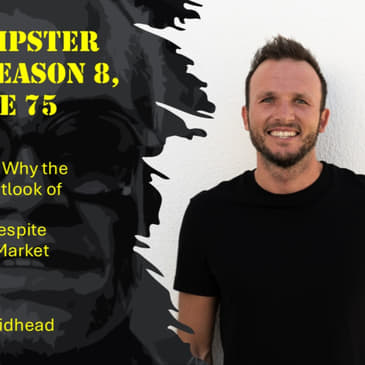

Kyle Reidhead is Co-Owner & Head of Research at Milk Road, a leading crypto investing media company and Founder of Impact3, a crypto-native marketing agency helping top protocols and brands in crypto grow.
[00:00:03] Hello, everybody, and welcome to the Crypto Hipster Podcast. This is your host, Jamil Hasan, the Crypto Hipster, where I interview founders, entrepreneurs, executives, thought leaders, amazing people all over the world of crypto and blockchain. And today I have another amazing guest. He is the owner of Milk Road and Impact 3. His name is Kyle Reidhead. Kyle, welcome to the show. Hey, thanks so much for having me. I'm excited to be here, hang out with the hipster.
[00:00:33] Sounds good to me. Thanks for hanging out. So let's kick things off. Ask everybody the same question and people give me all kinds of answers. Amazing answers. What is your background and is it a logical background for what you're doing now?
[00:00:51] It's definitely not a logical background, which I feel like happens a lot in the tech slash crypto space. I actually went to school for kinesiology and used to be a personal trainer and working in the... I actually did a lot of research on concussions. So I was actually working with a company that was training doctors and physiotherapists and chiropractors around the world on how to treat concussions. So that's where I started coming out of university.
[00:01:18] But for the last 15 years or so, I've been building in the creator economy. So building media businesses mainly and then also investing in sort of like new markets. So it was kind of early in the social craze and some of the internet companies, not internet companies because I was too young when the internet first started, but let's say social media. And then also being from Canada, when marijuana became legal, I was before marijuana came legal, I was kind of like early in that scene.
[00:01:46] And so I'd always been very interested in investing, mainly in these kind of like newer opportunities as I was like building businesses in the creator economy. And then finally, about five years ago or so, those got to merge together. So I had been building a marketing agency where we worked with a bunch of creators and a lot of those were in finance. Some of those started to be in crypto starting around 2020.
[00:02:10] We worked with Bankless, for example, and helped them grow from 15,000 subscribers to 400,000 or so that they are today. And we started moving more and more in the crypto space because it was an area that I was beginning to invest in and understand starting back in 2019. And so we started, you know, really working with a ton of different crypto brands like media companies and then into the protocols on the agency side. And then in 2022, we started our own media company in the crypto space called Web3 Academy.
[00:02:40] And that was kind of similar to what Milk Road is doing in terms of helping people understand the markets and kind of what's being built in terms of like what's the real substance being built in this space, not just like how to trade, etc. And then about a year ago, we had the opportunity to merge in with Milk Road and take ownership of Milk Road. And now we have both Milk Road, the media company with a podcast, newsletter, etc. And then we have Impact 3, which is our sort of crypto native marketing agency. And both are doing quite well here.
[00:03:10] So we're excited to be in the space. My next question is what Impact 3 and Milk Road are all about. What's your primary vision, your mission, your focus? What's your niche angle in this space? Yeah, absolutely. So on the Milk Road side, it's all about helping people invest in the space. Ultimately, we're trying to help people become financially free.
[00:03:39] We think crypto is one of the best ways to do that. However, naturally, humans are not very good investors, right? We really, really suck at controlling our emotions and rationalizing markets. And I think there's so much opportunity in this space because there's so much innovation and so much growth ahead of us here. And the reason why I actually started this was the first cycle that I went through two cycles ago. I got in, a bunch of my friends got in.
[00:04:06] And by the end of the cycle, they had all been basically washed out and had less money than they had when the cycle started. And I had made a bunch of money. And I was like, how does that happen? Like this industry literally did like a 10x in market cap over the last four years. And you guys have less money than previous. And so I kind of realized, okay, they weren't looking at the right information. They were rational in their investments. They didn't really understand how to do this properly. And I was like, okay, I think there's a problem here. There's a gap. And I really want to help solve it. So that's really what Milk Road is all about.
[00:04:36] Just trying to help newer kind of retail investors manage and just kind of like navigate this space. So that's one. And then the Impact 3 side, it's there's a big problem in marketing and crypto. And so we're there to kind of just help these brands really get their brands more known, right? Get out there. Try to figure out how to attract real users. Sustain those users. Retain those users. And then also just connect. We have a lot of connections through Milk Road. And we want to connect brands with media companies and vice versa.
[00:05:03] So whether they need marketing or they need sponsorship stuff or however it is, we kind of have a lot of those connections. And so our goal there with Impact 3 is really to help brands grow. Awesome. Awesome. So let's see. You do a lot of thinking because I can see concussions, weed, you know, that's exploring the mind. You know, my son got a concussion playing baseball a couple of years ago.
[00:05:32] So he switched from baseball to rowing crew. And he loves rowing in this very small chance of concussions. So he does, you know, that came out of it. It's good. So, yeah, I'm not here to talk about kinesiology. I'm here to talk about the current macro crypto environment. I want to find out your view, you know, on the current macro. What trends do you think will require further investigation? Where are we at right now? The market seems to be tanking. What do you think?
[00:06:02] Yeah, we're in a tough moment. But I come bearing good news to the listeners. So a lot of people on Twitter right now or in other media companies and stuff are calling for the top. We've hit the top. And, you know, we're kind of down only for here. And maybe this was the end of the cycle. And when I say cycle, it's kind of these four-year cycles that crypto has gone through. There's a lot of people calling for the top. I really don't see it.
[00:06:24] And the reason why is the way that we invest and the way that we teach at Milk Road is our investment thesis and our framework really revolves around the business cycle and the liquidity cycle. We think that crypto and really every financial asset globally, it follows the liquidity cycle and the business cycle. We live in this world where governments around the world have low interest rates for the most part and are printing a lot of money. And ultimately, that debases the fiat currencies and scarce assets like crypto or tech stocks or real estate or gold.
[00:06:52] They go up in price over the long term. Now, it's not exactly to the day of when they print money, etc. But ultimately, we have these kind of broader cycles that exist. And this has been the case for many, many years. This isn't something new. So when I look at the business cycle right now, although things look really bad both in crypto and macro in terms of price action, and even in macro, there's a lot of confusion because what Trump's doing with tariffs. There's some geopolitical concerns. There's what's going on with Doge and unemployment increasing because they're firing a bunch of people.
[00:07:22] But ultimately, when I look at the liquidity cycle, when I look at the business cycle, it looks like we're still in the somewhat, I don't want to say early days, but let's say maybe mid cycle. There's still a long ways to go here. And I think what's happening is we just have a growth scare right now. So the markets are overreacting because they're uncertain of what's happening here with Trump, the new administration and everything they're doing. Now, anytime you get a new administration that's trying to really radically change things, it's a bumpy ride for a little bit, right? They've got to get things changed up.
[00:07:49] They've got to pivot what they're trying to do with the markets and the economy. And so that brings uncertainty, and markets hate uncertainty. And I feel like that's where we're at right now. One of the things, though, that I'm seeing is the dollar is really beginning to basically bottom out, or not to bottom out, sorry, but to draw down. And I think that is really good to loosen financial conditions, right? It allows countries like China, et cetera, to start to print money. And I think soon we're going to start to see some rates getting lower in the US.
[00:08:19] So for me, it looks like the macro environment actually looks pretty good, let's say, three to six to nine months out. And that should be really, really bullish for crypto assets, for tech stocks, et cetera. And so I know a lot of people are calling the top. I'm not seeing that right now. I think we're just in a growth scare. This almost reminds me of 2021. 2021, if anyone remembers, that was here back then. That was kind of like the later stage of the bull market. I think it was in March or in May. We kind of rocketed up.
[00:08:47] Bitcoin hit close to, it was like 60,000-ish. And then it went down 50%. And it took a few months. And then by the end of the summer, all of a sudden, we were back up to all-time highs again. And then the cycle ended. And it feels like maybe we're in a similar situation right now. You know, we've had two years of price up only basically for Bitcoin and for a lot of crypto markets. Alt season and altcoins are a little bit different. Different story. But ultimately, like crypto has done really well over the last two years. I think we're going to have another good year this year.
[00:09:15] I just think a little bit of patience is needed. We've got to get through this uncertainty, which shouldn't take much longer. And then I think we're going to see liquidity start to increase. The business cycle starts to pick up. And ultimately, our risk asset should do quite well as a result of all that. So I'm quite bullish here. I would say this is a good accumulation phase, a good time to be buying rather than selling. Can we go lower? Sure. Of course, you always can. But in my opinion, the risk-reward right now is heavily skewed to the upside. Like we might go down a little bit more. But I think in terms of when we go up, it's going to be up a lot more.
[00:09:45] So I think there's a great risk-reward. I was telling people in December, this is not the time to be buying when Bitcoin was over 100K. And people were launching meme coins and crazy. It's like, this just seems too much. And again, I didn't think the cycle was over then. But I kind of was saying, this seems like a little bit of a local top here. I didn't think it was going to be this bad of a pullback. But hey, they should be expected. That's crypto, right? This is a very, very volatile space. If you want assets that go up 2, 3, 4, 5x in a number of years,
[00:10:14] you've got to expect 50% or more pullbacks. That's just part of the game. And so for me, I think this is just a pullback that fits within the broader, longer cycle. And so I'm not in the camp of the cycles over yet. I like that. You said earlier, people suck at investing. And I'm looking at it. I mean, I had Aave on Celsius. You know? So I'm like, all right.
[00:10:42] You know, I was doing it right. You know what I mean? And a lot of people aren't doing it right. You know? So people load up, you know, at this time. You know? So that's a good suggestion. But when she was selling on a tie. So something else happened in the U.S. You talked about Toronto early. You know, you said Trump strategic crypto stockpile, right?
[00:11:11] Why is that a big deal? Even though they're funding it with seized crypto. Yeah, I think, look, it's funny. The market really didn't like this decision of the Bitcoin strategic reserve and the crypto stockpile. At least when it was announced, markets went down. And for me, I sat there and was like, look, the market didn't like it because they weren't buying billions of dollars of Bitcoin and, you know, millions of dollars of ETH and whatever. And so the market really had expectations that were just too high, in my opinion.
[00:11:39] But when I sit back, if you kind of zoom out and you look at it and you're like, man, if you ask the question a year ago, is there any chance in the world that the U.S. would have Bitcoin as a strategic reserve? Even like, no, there's no way that's happening in 2025. And then all of a sudden, like that talk started happening as Trump started discussing it later last year and obviously took over presidency. But like this was unheard of in March of 2024.
[00:12:03] And so the fact that that exists, that's just a signal to the rest of the world that like, hey, this is a legit asset. Crypto is a legit industry. And, you know, it's so legit that the U.S. wants to actually reserve this stuff and not sell it. Right. And so to me, we already look at the effects of this. Brazil has already announced that they have a strategic reserve. They're buying it with their treasury. They announced that the same day the U.S. did. I think there's a few other countries that are now in discussions, China being one of them.
[00:12:29] So like ultimately to me, look, it didn't matter if the U.S. was going to buy more or not. They're not going to sell like what is it, 200,000 Bitcoin or whatever they have. So like that's pretty good news in itself. But the fact that this has now become a legitimate thing that the number one global power country has said, hey, we're putting kind of a stamp of approval on this. I think the ripple effects of what's going to happen here are massive and it might not be immediate. It's not like every country is going to go rush to buy Bitcoin today or tomorrow.
[00:12:55] But over time here, the amount of corporations that now have the green light to buy it if they wanted to, the amount of corporations that now have the green light to go and build on top of crypto if they want to, to use stable coins, to invest, to launch a token, to do whatever they want to do. That's huge. And then, of course, other countries around the world that aren't going to just let the U.S. be the only one to do this. Like I think that the ripple effects here are just massive. And I don't know if the market's missing that or if the market just doesn't care because there's too much uncertainty in the macro.
[00:13:25] I'm not really sure what's going on. But to me, this is just massive and makes me think that when the bull market continues, we're going to see a big upside here. Because what's funny is there's been so much good news, not even just about Trump, right? Like the SEC has dropped all of its cases against all the big players in crypto, you know, Kraken and Coinbase and Uniswap and et cetera, et cetera, et cetera. Like that is huge. They've just reversed the, I forget the name of the bill that was put in where banks couldn't like custody crypto assets.
[00:13:54] So like all these things are happening right now. We're about to see so much expansion in the ETF space for cryptos. Like we're basically unlocking everything. And innovation is about to be able to flourish finally for the first time in crypto, at least in the US. And I just think that that is such a massive move. And what's interesting is all this has happened over the last couple of months and yet prices have gone nothing but go down, right? And so I see a bit of a mix here. And it's the perfect kind of inflection point for me, which is the macro has gotten worse and scared people.
[00:14:24] So people wouldn't risk off. But as that happened, the fundamentals of crypto have just gone light years ahead over the last couple of months because of regulatory changes and what's going on with the strategic reserve and the SEC lawsuits getting dropped, et cetera. And so it's like whenever markets decide to turn and we go risk on again, I think crypto is just going to be the fastest horse in the race is the way I like to call it. Because remember, this isn't a crypto thing that we're seeing right now in terms of why prices are down. The NASDAQ is down. The S&P 500 is down. Like most assets are down right now.
[00:14:54] And that's just because, again, the globe right now is kind of uncertain in terms of markets because of Trump. Right. And so everyone has gone risk off. Everyone's on the sidelines. And so when everyone decides, OK, we're going to go risk on. It's time. A lot of that capital is going to come into crypto and even more than before because of the changes in the regulatory environment. And so I actually think we're at a really bullish setup here. Again, when that changes, I'm not sure. It might be weeks. It might be a few months. You know, if you think about last year, we ran up in March because of the ETF.
[00:15:24] Right. Really, really bullish news. And then we pulled back for like, what was it? Eight, nine months. Right. And then all of a sudden in October, November, like we took off. And this is how crypto really works. Right. Like it's these sort of we consolidate or we pull back and it might take months. And then all of a sudden we just like 2x in a number of like maybe like days or weeks. And so to be on the sidelines here seems like a bad idea to me. And it's really tough because when crypto moves, it moves really fast. And if you miss that, then you're kind of you're missing the big gains. Right.
[00:15:53] So, yeah, I think we're at a really good setup here. And I think this crypto or the Bitcoin reserve, the crypto stockpile is just another thing building the momentum. The best way to explain is it feels like crypto is that bottle of Coca-Cola where you put the Mentos in and you shake it up. And then it's like once you take the lid off, which is when liquidity and the macro environment kind of clears up, the thing is just going to shoot out like crazy. That's kind of what I'm seeing right now in the crypto world. I like what I like. I like your view. There's a couple of concerns that I have.
[00:16:23] One is, you know, they listed these five tokens as their, you know, they get them all from seizure. Right. But they want to make a made in America, you know, stockpile too. Right. I thought. And what about those coins that are really good coins made in the made in the U.S. that are not part of those five? Like, you know, I can name them, you know, I don't want to name them names, but like there's a bunch. There's like light coiners, avalanches, a whole bunch of that are made in the U.S. that have not been, you know, embraced yet.
[00:16:51] So how do you think that they factor into this made in America, you know, initiative and endeavor? Yeah, it's a good point. Like, so first of all, they actually didn't clarify. I said the crypto summit on Friday last week and all they said was there's a Bitcoin reserve. There will be a stockpile, but they don't know which ones yet. Even though I know Trump tweeted out some of the names, Sol and XRP and ADA. But they actually said they need to go into an audit of what the agencies actually hold.
[00:17:18] What have they actually taken from criminals, et cetera? And they don't even know what that is. And so whatever tokens those are, then they're going to put them in. And then they've given treasury the as the kind of the decision maker decides, should we swap that into ETH or into Bitcoin or what should we do with those tokens? So it's still a bit of an unknown. I think the reason Trump tweeted out Sol, ADA and XRP as kind of the America made thing is he's America first. He wants the U.S. to be the crypto capital of the world.
[00:17:45] And the other thing is I think he knows that a lot of Americans hold those three tokens. And so it's a little bit of market manipulation, to be completely honest, and a little bit weird. And I don't love that he's doing that. But he's trying to pump the bags of Americans and he's trying to pump the bags of American made businesses. Like, look, I don't love that he's doing that, but I see why he's doing that. But I think what was really nice is they announced that everyone was kind of up in arms on Twitter about this whole stockpile thing and including some of those tokens.
[00:18:15] And they've kind of backtracked a little bit. I think David Sachs, the guy that's kind of running it all, the crypto czar, I think he's got his good head on his shoulders and he's not going to let the grift make its way into these stockpiles. He's going to do a good job of this. So they're being very methodical about it. Ultimately, I think it's a net positive for the industry. They can't include every token. So I know everyone is like, well, what about my bags and what about my bags and my token, whatever? I mean, they're not going to include it all. And I'm sure they'll come up with a good strategy in the future. We just we still don't really know exactly what that's going to be.
[00:18:44] But, you know, Trump's going to try and do America first because that's his whole campaign, right? Like he's there to pump America. And so kind of made sense he did that. But we'll see where that stockpile goes. For now, it's bullish Bitcoin for sure. And then, I mean, the rest of the industry, it's still it's still really good news just because they want stable coin regulation. They want all the good regulations coming in. So I think it's a net positive no matter what. Yeah, I agree. I agree.
[00:19:09] So the other thing I'm concerned about is the I want to say it is the lack of innovation. What does that mean? Last cycle, we had created the creation of ZK, roll up ZK, pro. We had all this awesome ZK stuff and other innovations. OK, this time we just have millions of more coins. You know what? Most of our meme coins, but we have coins. But no new innovation. We need to have new innovation. Right.
[00:19:36] So where's the innovation going to come from? What is it? What's like? That's going to head the next the next bull cycle. Right. You need something. Yeah. Look, I think what this cycle is about. So there is innovation. It's mainly on, let's say, the AI and crypto world in terms of agents. Obviously, meme coins, not a huge innovation. And that's gotten a lot of the attention over the last, let's say, two years or maybe a year and a half. But I think so we have innovation happening in the AI crypto world.
[00:20:05] But more importantly, I think what this cycle really, the big deal of this cycle is, is not new innovations. It's the innovations of previous cycles that are finally able to be scaled and have better UX and actually gain adoption from real companies. So like for me, the most exciting thing is stable coins, which I know people don't care about because those the number doesn't go up for a stable coin. They're stable. But ultimately, we finally hit an inflection point for stable coins. We're at 227 billion in supply of stable coins. That's almost doubled in the last year, right?
[00:20:35] That's massive. And it's going up at about 5 billion a week right now. So the clip of dollars coming on chain is massive. And that in itself is actually a huge unlock for what blockchains and what crypto is enabling, right? If you're an American, it's not the most exciting thing in the world because you already have access to dollars. You can move them within your country pretty easily and it's cheap. The rest of the world who has currencies that are not as good as the dollar, they all want access to the dollar.
[00:21:04] And it's very costly or in a lot of places, it's prohibited for them to get it. Places like Argentina and Turkey, etc. Their currencies are inflating at ridiculous rates and they actually can't even get access to dollars. In some places, it's illegal. And if you want to send money, let's say from, you know, I'm in Canada. If I want to send money from Canada to Europe, we have a lot of employees in Europe that we pay. To do that from dollars is actually quite expensive and it takes multiple days, right?
[00:21:28] Like it's 2025 and somehow it costs me like $10, $15 to send, you know, let's say $1,000 or $2,000 and it takes like three days. It's like I could fly to Europe faster than I can send money. Like how, in what world does that make sense? Now stable coins do this where it removes all borders from dollars. And so now around the globe, you can move money anywhere and it's free essentially. And it happens immediately and you actually get to custody and hold it yourself. You have no issues around people blocking your payments, etc.
[00:21:58] And so that to me is a massive unlock. A massive unlock for people that want to move money to other people, whether it's families in different countries, but also for businesses. That's where I think the real adoption is coming. As I mentioned already around regulation, Trump's already given the green light now for corporations and countries even to start to use this stuff. And for example, we pay about 30% of our employees using stable coins because they're in different countries. And it's way, way, way easier and cheaper for us to do it. We want to get that to 100%.
[00:22:26] We're not the only company in this world that wants to do that. We're starting to see stable coins really pick up and become an integral part of the financial system. And I think both in terms of payments and in terms of paying employees, Robinhood is settling their transactions using stable coins on weekends. So it's becoming a really big deal. And I think that's not super innovative in terms of this year. We've had stable coins for what, five, six, seven years now. But we finally unlocked the regulatory uncertainty and the scale to be able to actually do this.
[00:22:55] And so another thing I think that's really big this cycle is DeFi. Again, DeFi was the innovation last cycle, as you said. But we're at a place where this stuff's been battle tested. It's working. We have better yields in crypto than we do in the TradFi world. And so I think, again, corporations can start to come in and use this stuff for their treasuries. Why wouldn't they? They can get better yield on their dollars. Why wouldn't they hold Maker's stable coin where they can make 6.5%, right? In U.S. treasuries, you can only make, I don't know, it's like 4% or something, 4.3%.
[00:23:25] So I think the adoption is coming from corporations finally being able to put their money and not just money, but start to build and integrate crypto and blockchain into their companies. And I think that's where we're going to get the next big leg up is from that unlock. And so it's not necessarily innovation, but it's finally being able to use it and integrate it into existing infrastructure. So that's the thing I'm most excited about. And then on the innovation side, I do think there is still a lot of innovation in terms of AI.
[00:23:55] AI agents, I think, is the biggest thing that people need to be paying attention to right now. If you've used them, they're not perfect yet. Like, don't get me wrong. I know there's a lot of AI agents on Twitter, and honestly, they kind of suck. But the speed at which AI is improving right now is incredible, right? Like every day or every week, you kind of get on Twitter and you see, oh, there's a new version of Grok, a new version of OpenAI, a new version of this and that. And they're just getting so much better, so much better, so fast.
[00:24:22] And one of the cool things about the AI agents that exist in crypto is they're just built on top of those rails. And so we don't need crypto AI to really continue to improve. So long as just the general AI improves, then our products improve as well. And what's cool about AI agents in the crypto space is they have native wallets and native tokens. And so they can do a lot more than the AI agents that OpenAI has launched. And so having AI agents go and transact on chain for you or go do things on chain for you,
[00:24:50] whether it's using DeFi or whatever, manage your portfolio, I think that's going to be a really big deal. And so when I actually look at the on-chain data and I'm looking at, okay, where is there going to be adoption? One, I think about corporations. What are they going to do? What tokens are they going to buy? What protocols are they going to use? And then I'm thinking about AI agents. What protocols are they going to use, right? I'm starting to go, I don't care what humans do. I want to know what AI agents are going to do, right?
[00:25:17] And they're going to look not for the best marketing or the nicest logo, right? They're going to look for the best yield or the best risk-adjusted thing, right? Like they're going to be much more critical thinking than humans are, right? We look and we go, we want the thing with the nice colors that has the nice message and the nice slogan. AI agents don't care about that. And so I think we've got to start to change our mindsets and our frameworks here because the demographics of who's going to use the blockchain is changing rapidly.
[00:25:43] And I would say even today, there's probably more AI agents and bots that use the blockchain than humans do, right? So it's a bit of a weird mindset change when you're analyzing projects because you really got to think about the next user. And I think that that's AI agents. So there is where I think the innovation will really come in in this space. And also maybe you could say that regulation is an innovation. Yeah, 100%. It could be the biggest unlock of all of it, to be completely fair.
[00:26:14] Interesting. So we're talking about the positives. Now I want to talk about the leggings a little bit. I was here in 2017. I was an ICO advisor. ICOs went away. 2021, you had artists making money for the very first time in their lives with NFTs. They went away. We had 13 Metaverse commercials in the Super Bowl a couple of years ago. They went away. Meme Coins, where are they going? Yeah, look, it's hard to say. I think Meme Coins are here to stay.
[00:26:42] Is it going to be the meme coins like we saw with Trump and the Argentinian president with the Libra token? I hope not. I think the US has already said that meme coins are not illegal. They are fine. They are not considered a security. But they did say they're going to start to put in rules of, of course, if you lie about your coin and you say it's going to go up in price for these reasons, then you don't do it. That's illegal. That's a crime. You should go to jail. Right? They haven't been able to do that yet. But I think that that is coming.
[00:27:11] That's part of regulation. And so I think meme coins is basically the ability to trade attention. And I think there is something there. Just like you mentioned NFTs are dead. They're actually not. People still use them. They're just not worth $6 million like they were last cycle. Right? Because that was expectations getting way blown out of proportion. And people just got too far ahead. Right? And so they became overvalued. Now, like NFTs exist on Lens Protocol in terms of like creating content that way. There's like music NFTs.
[00:27:41] There is still people using NFTs. They're just not worth a gajillion dollars, which made no sense. But they do have value and they do make sense in an integrated internet. And so like those still exist just in a different way. Meme coins, I think, will continue to exist. There was some really good innovation in the meme coin world. But like will they become worth what was Trump's like $70 billion in a matter of like 48 hours? Like probably not. And I think there'll be some more rules and hopefully some regulation around it.
[00:28:10] So I don't think meme coins are going away per se. I think the extreme value of them might. And in terms of like there was a time when a lot of them were getting a lot of value. I don't think that's going to be the case anymore. But I do think it is a game that can be fun for some people who want to trade and try to trade attention on the internet. It's not my thing. I don't do it. Our audience doesn't really do it. They don't love it. But I think it's a game for some people. And I think that will probably still exist.
[00:28:36] It's just these ones that come from celebrities and politicians that they really need some restrictions on because ultimately what we've seen over the last two months was just pure crime, right? There's no other way to put it. And so that needs to end. And we need some rules around that. But ultimately, I think meme coins are here to stay. Is it a spot that you should be investing in long term and trying to make money? I mean, up to you. I wouldn't be personally. But I think there is some sort of innovation there that will continue to stick around and be a part of this space. And more, I think we'll just continue to experiment with them.
[00:29:05] Like Zora, for example, which was kind of the spot for NFTs. It's like an L2 where anything could be an NFT. They have now launched like tokens around images. And it's almost like a meme coin for an image where you can sort of bet on the markets of that image. Again, I don't really want to buy those things, but there's an experiment there. And maybe there's something that comes out of it. Like meme coins kind of became a bit of a prediction market, right? And so like maybe there's something around that that can remain. Um, but I think what we think of and what we know of meme coins will change drastically
[00:29:35] over the, over the next year. I think so too. I think so. It'd be interesting to see where, where, what they turn into. They might turn into, into state run lotteries. We'll say, you know, it's basically what it is, but yeah. Yeah. So you, you said something else. You talked about DeFi and I want to talk about DeFi because we want DeFi to be adopted, right? You have some people who don't want DeFi to be adopted. One is the government because they offer, can only offer lower rates.
[00:30:04] Two is the banks who want to give you a 0.25% per year in your savings account. They don't want them, but what's it going to take to get DeFi over the hump, you know, and break through, um, and, and achieve that, I guess, balance or how, how do we get it, you know, over the, over the resistance? Yeah, yeah, absolutely. Absolutely. I think we're starting to see it already leading by Coinbase. So for those that weren't aware, I think one of the biggest things to happen this year
[00:30:31] in terms of innovation was Coinbase integrated Morpho, which is a lending protocol similar to like, let's say Aave into Coinbase app. And so the way that this works, and this is what you would call the DeFi mullet, something we've been talking about for many, many years. And we finally started to see it, which is going on chain and using a wallet. It's actually very difficult. And most people in the world probably will never do it. Right. Um, it's just like, most people don't care about their finances enough and they're not technical enough to do this. Like my mom's probably never going to use DeFi.
[00:30:57] Now, the interesting part though, is what Coinbase has done is said, Hey, instead of going on chain, getting a wallet, connecting it into this like app that you may or may not trust. And like getting a loan, we are going to do that hard work for you. And we're going to integrate Morpho, this lending app into the Coinbase app. And so what they did is effectively said, instead of bringing the users to DeFi, let's bring DeFi to the users, right? Coinbase already has more than 10 million users on their app. People use it all the time.
[00:31:24] The people that are using Coinbase, the exchange are not necessarily your like DeFi degens. They're not people that are really on chain. I'd say a lot of them actually don't even have a Web3 wallet. And so they never really had access to this. But so what Coinbase is, is, Hey, we'll just integrate Morpho into our app. And now you can take out a loan with your Bitcoin using Morpho, an on-chain app, right in the Coinbase app. You never actually have to get a Web3 wallet or think about self-custody or any of that kind of stuff. I think Coinbase is about to do a ton of that.
[00:31:50] They weren't really allowed to do this before because of, again, regulation and the previous administration. Now I think they're about to integrate a DEX probably, and they're going to integrate a bunch more DeFi projects right into their app. I could see Robinhood doing the same thing. And so what I think is going to happen here is fintech companies that have the users in banks are going to just start integrating into these apps. And they'll find ways to monetize that. How's Coinbase monetizing this, for example? One, they own part of Morpho.
[00:32:19] Two, Morpho exists on base. They're L2, right? So any transaction that happens, they get fees from that. So they found a new way of generating revenue while also offering the best rates to get a loan in your Bitcoin in the industry. Because on-chain generally has better rates and better rewards than off-chain, right? And much lower risk because it's transparent. And so when you can combine the two and say, hey, we'll just connect the on-chain stuff to where the users already are, that to me is what I think is going to drive the next adoption of DeFi.
[00:32:49] And if you look at Morpho already, previous to Morpho integrating into Coinbase, they had about $35 million in their USDC supply. So when you loan your Bitcoin, you get stablecoins. And about a month and a half after integrating with Coinbase, they're at $135 million, right? So they almost 3X'd in a matter of like a month and a half. And so I got a feeling that over the next year, this is going to be the big meta for crypto and specifically for DeFi. I think that Robinhood's probably going to do this very soon.
[00:33:18] They've already talked about tokenizing stocks. Will they actually do the tokenizing of the stocks or will they just integrate with a protocol that's already doing it on-chain? My guess is they'll integrate. And I think Coinbase is going to do the same. And then it's like, will the banks do it? Unsure. I think at some point they will, but they're going to be slow. So I think the fintechs are actually the ones that like the Revolutes of the world and the PayPals, Stripe, they're already all beginning to integrate crypto, mainly with stablecoins. But I think DeFi is next. And Coinbase will be probably the leader there.
[00:33:46] You'll see the other exchanges like Kraken, OKEx. I think they're going to start doing it too because they also have their own L2s. So they can do the same setup as Coinbase does. So I actually think that's probably the big driver of DeFi that kind of gets it through. The other one would be corporations, right? For example, we hold a lot of dollars in our, let's call it a treasury. And it was just sitting in a bank account for a while, basically making nothing, right? And for a while, we had it in a US treasury.
[00:34:15] So we were making like 5% or 5.5%. That went down. Now it's at like 4%. We're like, ah, this isn't as useful. But if we moved it on chain, we could put it into Maker, which is a DeFi protocol. And we could hold their stablecoin and generate, at the time, it was like 8.75%. At one point, it was 12% yield on it. And we're like, well, that's double or triple what we had before. So we moved a large portion of ours on chain.
[00:34:41] And now we have it in DeFi just sitting there in SUSDS, which is Sky or Maker's stablecoin. And it's generating yield using DeFi in a very low risk environment. And so when I think about that, it's like, well, if we did it, I would imagine more corporations are going to do it, right? So I think there's this world where when corporations come in to use crypto, they're probably going to use DeFi. And then I think the fintechs and maybe the banks, although they'll probably be years out, will integrate into DeFi.
[00:35:07] And so I think DeFi is coming to the user rather than we have to get the users to DeFi. Interesting. Makes sense to me. I think I'm going to the World Bank Summit in April. So I want to see what they have to say about stablecoins and DeFi. Well, the one thing I would say is the US is super, super bullish on stablecoins because they basically, and they said this at the crypto summit on Friday,
[00:35:35] Bassett, who's the head of the treasury, he said, hey, we want to make sure that the US dollar remains the global reserve currency. And the way we're going to do that is through stablecoins, right? What a perfect way to keep everyone using dollars than putting it on chain and allowing it to go anywhere in the world for free at the speed of light, right? That's a beautiful thing. So the US is going to be all for that. Now, the World Bank, I have no idea what they're going to, they probably don't like this stuff, but I think corporations will like this stuff because they have ways to monetize it and they can provide better rates and products to their customers.
[00:36:04] And so ultimately, that's what I think matters. And that's where I think this is all going to come from. Yeah, I agree. Well, I really enjoyed speaking with you today. I want to thank you very much for talking to me. This is a wonderful conversation. I have one last question. It's easy. How can people find out more information about Impact 3, about Milk Road, about you? How can they do that? Yeah, absolutely. So first, if you're an investor in crypto, go to milkroad.com. We've got podcasts. We've got a daily newsletter.
[00:36:31] We've got a research side all around helping kind of retail, learn how to invest. So make sure you go to milkroad.com. The other is just follow me on Twitter. You can get access to everything from there. I'm always sharing things going on. My Twitter is my name, at Kyle Readhead. And maybe you'll have it in the show notes and you can just go click there rather than me spelling it out. Awesome. Thank you very much for your time today. Thanks so much. This was great. Thank you.