
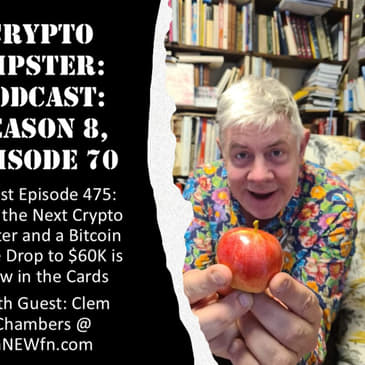

About Clem Chambers - https://www.clemchambers.com/
Clem Chambers is a leading technology innovator with a proven track record in the tech and financial services sectors. He has been involved in the software industry for over 40 years as a pioneer of computer games, multimedia, and the internet.
Chambers is CEO of Online Blockchain, an incubator of decentralized projects using blockchain technology. He is founder of Umbria Network, which operates an award-winning capital-efficient, multi-chain asset bridge, which lowers entry barriers for those engaging with Decentralized Finance (DeFi) applications.
Clem is founder of the upcoming finance site aNEWfn.com and is the founder and former CEO of global stocks, shares and crypto information website ADVFN where he was responsible for propelling the platform from likely dot.com failure to thriving market leader (36 million users worldwide).
He is a seasoned PLC CEO and NED with experience in governance of listed funds.
- Private investor champion and influencer
- Serial technology innovator
- Award winning financial author including Amazon number one Bestseller101 Ways to Pick Stock Market Winners and Trading Cryptocurrencies: A Beginner’s Guide - Bitcoin, Ethereum, Litecoin
- Prolific financial writer: columnist at Forbes, Seeking Alpha and Monaco Daily News where he enjoys a high level of reader engagement
- History of calling the markets early in crypto and stocks
- President of Cricket at the Carlton Club, St James’s.
- Liveryman of the Worshipful Company of Loriners
[00:00:03] Hello, everybody, and welcome to the Crypto Hipster Podcast. This is your host, Jamil Hasan, the Crypto Hipster, where I interview founders, entrepreneurs, executives, thought leaders, amazing people across the globe in crypto and blockchain. And today I have another amazing guest. Actually, he's done a lot in this space, and he's very well known. And I'm looking forward to the conversation. So his name is Clem Chambers.
[00:00:31] He is the founder of a new venture called, let me see if I get this right, anewfn.com. Clem, welcome to the show. Great to be on, Jamil. Yes, you got the name right, anewfn. So, you know, if people want to check out what I'm up to, we're building the latest, greatest financial platform. It's in close test at the moment. If I want to get on the guest list, it's all there. The idea is to plan to take, you know, if you go to Yahoo, you look at it,
[00:01:00] it's like 20 years old. It feels 20 years old. It is 20 years old. All that stuff out there, it's all 20 years old. So we've decided to see if we can't bring it up to date, at least only five years out of date, rather than 20. So that's what we're trying to do. And that's going to be hitting soon. But anyway, we're not here to talk about me and about what I'm up to, although we can. Let's talk about crypto. Awesome. Actually, Yahoo, I think, is 30 years old. Yes, yes. But they've upgraded it, but probably around 2004, you know.
[00:01:27] Okay. So I want to find out first, you know, you said it wasn't about you, but I want to, the first question is about you. Okay. What is your background and is it a logical background for what you're doing now? Well, I don't know. I can try to make it sound logical. When I was a child, I 17, I started one of the early computer game companies on the planet surface. And then after a decade or so of wading around in that morass,
[00:01:56] I then got involved in the multiplayer game arena. I was a pioneer of that, pioneer of computer games, pioneer of multiplayer games. And then I started some internet stuff just before 2000, started a financial network called, which, you know, in the US is called Investors Hub, even today. And then run that for 20 years. And, you know, obviously we got involved in crypto because that was a new, new thing.
[00:02:24] And I wrote a lot about that. I mean, I've been writing for Forbes since like 2000 and a bit. I've been writing for them so long. My contract is in Latin. And so I was, I started to get in to crypto around 2000. At 2015, I thought it was, you know, crazy, crazy rat poison squared. And then suddenly about 2016, the lights went on and I went, oh no. I mean, oh yes. Oh wow.
[00:02:51] Oh, and, and I made a bit of money in 2017 in crypto. I live in Monaco. So you can see crypto has been good to me. And then in 2020 cycle two, basically I called that 2018 one all the way up and then called it all the way down and then called the next cycle all the way up. And then I called it all the way down. Although it didn't go down quite as much as I thought. I kind of thought it'd go to 13. It went to 18. And then I called this one up and now I'm calling it down.
[00:03:20] So, you know, that's all in the public record because, you know, when I state what I think is going to happen, I don't, I don't predict the past. Like a lot of pundits. I tried to predict the future and, and my record up to today, when I've been calling down Bitcoin for about, oh, I don't know, 12 weeks, you know, since around Christmas, you read that all saying, oh, this is looking a bit scary. And here we are today and we are in crash mode. We are the crashes. It's on, it's on deck.
[00:03:50] And so, you know, that, that is my history in crypto. I love crypto. I think there's serious, serious problems with crypto as it's developed. But I think that we're now potentially in a massively exciting new phase because I think now that the American regulators have taken their boot off the neck of crypto, crypto, the real use case of crypto, the real applications of crypto, the real benefit of crypto will be unleashed.
[00:04:19] And that's the ability to have trustless systems where people can come and go. And there's no gatekeepers. There's no dogs in the manger getting in the way. There's no man in the middle slicing and dicing you and all sorts of applications that can't be done with old technology because they need too much infrastructure. That crypto change of the ability to have these infrastructureless,
[00:04:44] practically infrastructureless businesses, that is now going to flourish because people are going to be able to create them without getting arrested. I mean, you know, I mean, how many crypto people in the last few years have actually wanted to go to America because they don't know we're on a list. You know, what did I do? I didn't do anything, but I'm on a list. You know, can you come this way, sir? No. So, you know, all that, once that's behind us, people will be able to do things like just infinite quantities of applications
[00:05:13] that involve private sector money that will unleash all sorts of efficiencies. And now that the U.S. regulator and all that lot are not going to arrest you at the airport or ask you some silly questions or just basically let you do it, then that will unleash the Kraken and that's going to be great. Awesome. Awesome. So we have some things to talk about there. I'm glad you said that, you know, your contract was in Latin and not in Egyptian hieroglyphics.
[00:05:43] So you're not that old. All right. Awesome. Me either. OK, so I'll find out first of all, before we get into Bitcoin, just a little bit about your new venture, a new FN. What is that all about? Well, really, it was I mean, I built a site called ADVFN back in 2000. And and we purchased Investors Hub, which is a very large investor community.
[00:06:11] And I ran that for 20 years and then basically got to do other things, which is what I'm doing. And then it just dawned on us that that, you know, if you look at all the whole of the Internet, really, I mean, Google looks like it did 10 years ago. eBay. Well, that hasn't come a long way, has it? Amazon. It's kind of the same. It's all it's all 20 years out of date. The whole WWW has a look and feel that is 20 years out of date.
[00:06:39] Now, there are areas of the computer space, as you might want to call it, which are not that old, that are up to date and that are funky and modern. And and but that's mainly in computer games. And I come out of that literally. I was a kid. I was one of those whiz kids. I'm now a was kiddo. But, you know, I do understand the UI to an extent, even as an old man.
[00:07:04] And the the whole UI, the whole dynamic, the whole paradigm is so old that we suddenly went, oh, hold on a minute. We can make something that now I've said it's got our stuff is going to not look, you know, supersonically modern. But, you know, we are trying to put together an offering which is modern.
[00:07:26] Yeah. And and appeals to what people actually want rather than what people tell you they want. I mean, we built a fabulous platform, which is professional grade, absolutely professional grade. Nobody wants that stuff. They just don't want it. They don't really want to know what the ROC is of of NVIDIA. They don't want to know that.
[00:07:52] The the desires of of private investors are very different. And then we just decided, well, why don't we just cater to that? Why don't we just cater to to the to the desire of the customer and give them something that's that is new and a little bit unexpected? So that's what we're building. And, you know, as we're doing it, obviously Babylon is on fire now. And so, you know, it's kind of it's a very interesting time to do so.
[00:08:20] And again, although I might don't want to drone on, I'm not a perma bear. Right. A lot of pundits, all they talk about is, oh, it's going to go to nothing. It's in the world. The dollar is going to disappear. It's crash. I'm not like that. I will call crashes and have called crashes since 2004. I think was the first one I called and I called the credit crunch. But I also call the bottom. I also say, right, time to go long. It's going up now. It's going up. It's going up. And it was going up and up and up and up.
[00:08:50] And the Nasdaq, for example, was going to go into a bubble phase. Well, not anymore because the world's changed. Yeah. So, you know, now I'm calling a bear market at very least. And it's no good saying it's gone down 20 percent. We're in a bear market. You call a bear market when it's at the top. We're in a bear market now, which means it's going to go down, down, down, down, down, down. Not it's gone down, down, down, down, down. And now we're in a bear market. So, as I say, I like to try to predict the future, not predict the past.
[00:09:18] And so here we are. The American market is going to crash now. I mean, it might not crash. It might just go bear. It must have. But generally, you don't get that. Generally, you get, oh, no, everybody runs for the exit crunch. And I think we're in that. We've that has just kicked off. And, you know, crypto or cryptocurrency, which is not necessarily the same total crossover set.
[00:09:42] It is very dependent on things which in the financial markets you call flow, i.e. money flow. And you can't pump up crypto if fear is not flowing into crypto. And if crypto is flowing into fear, crypto is going down. Now, if you think about what's just happened, there's these tariffs. Well, people have got a little bit of a confusing idea of what a tariff is.
[00:10:11] They think the foreigners pay for it. No, no. The people that live in the country pay the tariff. So when you buy a, I don't know, a plastic toy from China and it's got 25 percent on it. Chinese aren't paying that 25 percent. You're paying it. So you just lost 25 percent of your money. Yeah. Now, if they don't print more money, it just means that those tariffs are going to cut 10 or 12 percent of the buying power of the average American out like that.
[00:10:41] So you're going to get a drop in consumption of in real terms of 10, 15 percent. Well, that's going to be catastrophic. Now, yes, the government going to earn 800 billion dollars of tariff fees, but the foreigners aren't paying that. It's the American people that can pay that. Yeah. So they're they're a trillion dollar short. Well, what's that going to do to the economy? Yeah. Oh, well, actually, I've got fixed for that. We'll print money. Oh, now we've got stagflation, haven't we?
[00:11:09] So we've got stag. We've got depression, not even a recession, stag depression or stag inflation. Oh, and then, by the way, let's sack a million government workers and cut the budget by a trillion dollars because we're spending too much. Oh, there's another trillion gone missing. So it's like two trillion's gone missing out of the spending power of the American state. Well, money ain't going to be flowing into crypto because of that, is it? People are going to be going, oh, my God, oh, my God, I can't afford it.
[00:11:38] Oh, I want to buy that car. It's now 20 percent more expensive because it's coming from Canada. Oh, OK, then. Oh, I've got the money. Oh, I've got that crypto. Oh, OK, let's sell the Bitcoin. Get the dollars, buy the car. Yeah, that's going to what's going to drive. It was going to happen anyway, right? Because that's the cycle of Bitcoin. But when they come to write, why did crypto crash in 2025? They're going to say it was that. But it's money flow.
[00:12:05] It's all about money flow and the money is going to be flowing in the opposite direction. Interesting. So so you and I are both round trippers, right? We made money in 2017, lost in 2018, made in 2021, lost in 2022. No, right now you're a round tripper. I made it in 2017, got out near the top. I made it in 20 and I got out in near the top. I made it this time in this time. Actually, I've got to tell you, I wasn't I didn't like it.
[00:12:35] This didn't like it one bit. So I got some and then I got out at 100,000. OK, so you did well then. Very good. Well, I don't live in Monaco by accident. Yeah, nice. That's my game. I'm a financial pundit. I'm a financial guru. I've written books on finance. I run a huge financial website. I'm actually good at it. And if you're good at it, you end up living in Monaco. If you're not good at it, you end up talking a good game and you don't live in Monaco.
[00:13:06] There are a lot of people. It does. It does. There are a lot of people talking good. There are a lot of influencers on social media that, you know, that will say, you know, the bear market's here. And then tomorrow they'll say the bull market's here. And the next day they'll say the bear market's here. How can people cut through the crap and come to it and rely on financial experts and pundits like you instead? Let me tell you. And this might be very interesting because it might tell different people different things.
[00:13:36] Just put in five names into ChatGPT and say who's the best, the most reliable financial pundit and who's the one whose advice would make more money. And it'll tell you. It can read. It's read everything already. And it can measure everybody and it can tell you. Awesome. And you could do that with me, actually. And then you can say, oh, look, he's called to ChatGPT. This guy's a joker. All right. Let's do that. Now, let's talk about the U.S.
[00:14:06] crypto reserve. You know, Trump announced five coins as a crypto reserve. It was Ethereum, Bitcoin, Cardano, XRP and Solana. Right. So, you know, how's that reserve going to play out? And are those going to be the best performing coins going forward? And wouldn't this help maintain the bull market or no?
[00:14:36] Well, I mean, America's had a pretty large gold reserve for quite a long time. How's it worked for gold? Yeah. America has a huge reserve. Used to have a huge reserve. Probably still is huge. I mean, it's going to be massive. Of oil. Yeah. And oil goes from $220 a barrel to minus $20 a barrel. So how's that worked out for oil? So, you know, I don't know. I have.
[00:15:05] My thought is this. Right. Everybody said, oh, as soon as it goes mainstream and Wall Street gets involved, it's going to be wonderful. Those guys, you don't want them. They're not your friend. Yeah. Yeah. Wall Street sticks its fangs in you and drains your blood to you. Why aren't you? So, you know, somehow crypto is going to resist that. You know, there's the financial military make their money out slaughtering the citizens. Yeah.
[00:15:34] And this citizen currency. Oh, we've adopted crypto now. Oh, yes. We could have an ETF. That's we're not going to steal any money from you via an ETF. No, we wouldn't do anything like that. No, we're not making money. Yes. We all the money we make, of course. We buy yachts and houses with it. Don't put it back in the market now, do we? No, no, no. Let's make money from crypto now. Oh, that's going to be so good for crypto. I mean, you know, really? It's like government. No, government's involved. Oh, great. That's really going to be great, that.
[00:16:04] I mean, they're so efficient. They're so smart. They do such a brilliant job. Oh, now they're going to make crypto great again. Yeah. I remember the retail crowd on X and was saying they're happy that institutions arrived in 2021, 2022. Institutions are going to come. They're going to come. Well, they're here, you know. And I remember being on calls, on institutional calls. And they're like, they weren't celebrated that they're here with retail.
[00:16:32] They're like, okay, we got to get rid of retail, you know. So you set on lease to crack it and usher in a new wave of real adoption. You still have meme coins that provide a lot more income to some people than, you know, investing in Wall Street companies. Well, I've got to say, I love meme coins. But it's just like, it's a casino. It's just, it has a use case.
[00:17:02] And it's a very potent use case. And if you're into it, it's a lovely, it's a wonderful one. And that's gambling. You know, Las Vegas is a massive city of happiness and joy built on people's desire to gamble. And the pleasure they get from it, whatever that pleasure, that SM feeling is. And that is a use case for crypto, meme coins, gambling, NFT, art collecting and gambling. It's no good saying it isn't gambling. It is gambling.
[00:17:32] Gambling is a bazillion dollar industry. And that is an example of crypto inventing a use case that is valid if you believe that gambling should be allowed. And that's what it is. But, you know, meme coins serve no other purpose than the ability for a group of people to play musical chairs or however you want to model that game.
[00:17:55] And it is a game because unless it has an actual use case outside of that, that's all it is. If it had a use case that you could, I don't know, pay your parking meter with it, then that would have an application and that would be a use case in addition to its gambling potential. But if it doesn't do anything but create entertainment for people in a money game, well, that's just what it is. It's a money game. It's a game of poker.
[00:18:25] It's a game of roulette. It's a game of peanut or whatever it is you gamble on. That's what that is. What going forward, I mean, these things have been created because the beast that is government, when it's like the dinosaur that had a brain in its tail as well as a brain in its head. And when the brain fired a neuron in its tail, it took like 30 seconds to get to the brain in its head. Fortunately, government is so, or unfortunately, so slow that meme coins could be invented.
[00:18:53] And by the time they get the dinosaur gets to say, stop, what? It's stupid. It's happened. It's happened. The cat is out of the bag. And there it is, right? And they were trying to put all these cats back in the bag. And now that the Democrats are out of power, they say they've given up. They're letting the cats jump back out of the bag, which is fair enough. Right. But what that really enables, it would enable somebody like me to come up with a token to pay your parking meter.
[00:19:23] And that would be crypto with a real application and a real added value and a real efficiency generation. If you go back, remember, you will remember, you look maybe perhaps old enough, American Express traveler's checks. Yeah. Well, that's a crypto. It's not because it hasn't got permissionless and it doesn't involve, you know, blockchains and all that stuff.
[00:19:49] But it's a private sector money, which when you bought with fear, you could go to a foreign country and use it as currency. It's a private sector currency, private sector money. Now, the history of private sector money is not a happy one. Yeah. And the people who believe crypto maximalists should look perhaps at the history of private sector money. And I was in a big panel with a load of serious bankers and serious government people. And I said, I've got a question for you guys.
[00:20:16] Is there a future for private sector money? Not one person would answer that question because that's what crypto is. Private sector money. OK, well, public sector don't like private sector money. And that's what the problem has been. And of course, what they will now do is embrace, extend, assimilate. Yeah. Which was Microsoft's strategy of destroying its competitors. Yeah.
[00:20:45] And now they've embraced it. They'll extend it. And then they'll assimilate it. Or at least they'll try. But forget that for a minute. Remember Pink Shield stamps. Was it called Pink Shield in America? I don't think so. There used to be, you go into a store and you buy a load of groceries and they print out a load of stamps. And you take. Yeah. It wasn't called Pink Stamp. It's called something else. But yeah, I remember that. So there you go. There's a crypto.
[00:21:15] Yeah. It was private sector money. And you tore it into books and you clicked the books up and then you went and bought a car with it if you got enough of them. And to do that, the capital layout that you had to put out to actually do that was astronomical, which is why there's not many private sector monies. There aren't many traveler's checks. I don't even know they exist anymore. The Green Shield, Pink Shield stamps in supermarkets. Why they went away. Because you had to have machines. You had to print stamps. You had to have a store. You had to have people.
[00:21:44] Oh, yeah. You had to talk a store into taking them, et cetera, et cetera, et cetera. Well, with crypto, all that infrastructure is not there. Gone. Yeah. And now you've got a digital world where there is a lot of value that can be unlocked with crypto. Lots and lots of IP, lots and lots of valuable illiquid assets in the digital zone. You can build cryptos with use cases and not have the SEC jump all over you.
[00:22:14] And that would just open that, crack that all open. I'm sure you've noticed that this loop of the crypto cycle, there's hardly anything new there. The one before last, it was coming out of the URIs. It was a new this and a new that and a here we are and there you go. And this is tomorrow and this is yesterday. This time around, it's, ooh, AI tokens. Yeah. There's nothing new.
[00:22:41] The next cycle is going to be anti-gravity machines and all sorts of wildly innovative stuff. And that's what will set off the next quick crypto wave in a couple of years. So I'm going to challenge a couple of things that you said. Sure, sure. Please.
[00:22:59] If I talk to a crypto optimist or enthusiast, right, they're going to argue that if you look at the Austrian economics versus Keynesian economics, that only Bitcoin is public currency and that all fiat is private. Well, fiat is made by governments. So it's public sector. And Bitcoin, you could say, is private sector.
[00:23:26] And you could even take it down to the far end of private sector, which is that it's almost anarchist money. Because there are the only rules are the rules in the code. So there's nobody in the private sector that owns it, apart from they own the actual money itself, if you want to call it money. But there's no corporate behind it, you know, as a middleman taking a slice. So, you know, although there are, but they are decentralized people and anybody can do it and anybody can join up.
[00:23:55] So you have that that far end of the political scale where it's a freefall. But it is nonetheless not part of the public sector. It's not part of the Treasury. It's not part of the of the mint. It's not coming out of the public sector. And it doesn't have the public sector hereby promised to give you another piece of paper in exchange for the piece of paper in your hand. Yeah. So, you know, a Treasury bond, that's that's public sector money. A dollar bill is public sector money.
[00:24:25] A quarter is public sector money, et cetera, et cetera, et cetera. Whereas if I print and bank account, well, I can't write bank claim. They arrest me for that. If I say I owe you $10 on a piece of paper, that's my private sector money. That's my currency literally is currency. And you can say it's not currency because I don't believe in it. But if I have any currency with you, this I owe you is worth what it's worth. And it operates very similar to public sector money in a more volatile manner.
[00:24:54] So that's that's the differentiation. The money generated by Bitcoin, the token money is after all token, is created by the private sector. Like the American Express and Traveller's Check, not by the government who say, if you copy this, Sonny, we'll bust you on Nick. You know, if you make a coin and you call it the Jamil dollar, they'll arrest you. That's a felony that is. Yeah.
[00:25:24] OK, got it. I understand. Thank you. And then my other my other part of my challenge, you want, is this. So there's nothing new this cycle. I see something new. It might not be new to everybody, but I see the use and application of A.I. agents. Right. And people are using those A.I. agents to do trades of crypto and Bitcoin. Right. So and it's kind of exploding, you know. So what's the role of A.I. agents?
[00:25:53] You know, and then how are they going to help maybe keep us out of a bear market? Well, first of all, there's a major problem with A.I. in financial markets. And that is their only work in inefficient ones. And of course, you could say that that crypto is a pretty inefficient market. And it has been incredibly inefficient. Do you remember the good old days when you could go on one exchange and buy on one exchange and sell it on another for a better price?
[00:26:22] Well, try that today. Yeah. So the way that markets work is is they make themselves more and more efficient because of things like A.I. agents. Now, those A.I. agents. So called. I mean, that's all over the stock market for the last 25 years. It's called algo trading. It's called high frequency trading, but actually it's high velocity trading. But that's just a split in atoms for you.
[00:26:49] And, you know, if you want to the the inefficiencies in the American stock market are so tiny. What the people who make money in that game do is they find like 30 inefficiencies. And if they put them all together, they make a little bit more money than the cost of transaction. But they don't do it with one because one is the only reason it's there in the first place is you can't trade it because you spend more money getting that inefficiency than you do from the inefficiency.
[00:27:16] So I can't trade this inefficiency because it's worth 10 cents and it costs me 30 cents to do it. Right. So what you have to do is you have to find four 10 cent inefficiencies because its cost of trading is 30 cents. So you're making 40, you cost you 30, you make 10. Right. That's how razor thin. I think actually they look for like 10 now. But how razor thin the inefficiencies are in the equity markets. And if you build all these wonderful AI agents that can make money.
[00:27:46] Well, funny enough, people can make a better one or an AI can learn from the AI and cut that guy out. It will preempt it unless you preempt it. So that disappears. I used to do this for a living and, you know, one of my several. And if you find an inefficiency over about nine months, you can just see it just slowly disappear. Yeah.
[00:28:12] And everybody's trying to find out what it is that you're doing, including your broker. Information flow. Inefficiency. Go on. Yeah. So AI agents for trading. First of all, if it's an efficient market, it won't work. Now, it will work half the time and it will fail half the time. So if you're an optimist, you'll only see the wins and you won't see the losses or you won't feel about losses.
[00:28:41] It's the same with gamblers in Vegas. Oh, another loads of gambling. Yes, you do. No, no, no. I went last time I made money. Did you? Oh, yes. Well, how much did you make? Oh, I lost 4,000. Ah, OK. But the time before. Yeah. And then you've got the situation where it's 50-50 black and red and there's no greens on there. But you keep having to pay a little bit to play. Your trading costs. So you've got the same amount of wins, the same amount of losses, but your trading costs. And ooh, your money goes. Right?
[00:29:11] So AI agents on the web, Web3 or whatever you want to call it, wherever you're doing it. Yeah. In trading, that's a hard, hard, hard old game. Getting it to book your hotel at the best possible price, which is highly valuable. Now, that is going to be a good application. All the other things that AI agents can do and be paid to do using crypto, that's a massive opportunity.
[00:29:40] But there tends to be this. I think it's a limiting feature of crypto. Everybody's looking to get rich quick on some financial transaction, whereas that's just the tip of the spear, actually. But there's everything else behind that that can add massive value. And, you know, rather than I mean, who up to very recently wouldn't make a ton of money out of crypto?
[00:30:10] I mean, certainly if you ride it all the way up and all the way down again, then and then you rode it all the way up, you're still making a load of money. And the hell that is the winter is replaced by the heaven that is the summer and the autumn and all that malarkey if you buy and hold forever. But at some point that forever rise ends has to. It's just mathematics.
[00:30:31] Yeah. And and nonetheless, in a market that has expanded so much, you know, there are a lot of people that are, you know, happily buying holders. But there's also a lot of people that have been less, you know, bleached bones in the sand trying to speculate. So, you know, it's speculation is an extremely hard game. If you want to get more than 30 percent a year, you better be a genius. Right. So all these people hunting 500 percent, it's probably they're probably doomed.
[00:31:01] Right. But anyway, that's by the by. Yeah. So so you make a good point. So that that rise all the way up where we're at now is where we're falling. Where do you see the next couple of years headed? Where you see the cycle headed and when do you think the next one or will there ever be a next one? What do you think? Gold is for war and Bitcoin is for flight.
[00:31:24] Yeah. Yeah. The application for Bitcoin, the one that really drives the price is, is there a load of really, really rich people that have to get out of dodge fast? So if you look at the previous double peak on Bitcoin, that second peak, that's Afghanistan. And all those Afghani people with their millions that they had to leave on the airport tarmac. Instead, you know, putting a lot of money into Bitcoin before they left.
[00:31:49] And that's what you see. And if you look at Bitcoin now, you go, oh, Ukraine's going to sign a deal with America and everything's going to be great. Down goes Bitcoin. Oh, no, they've had a big punch up with Donald Trump. Up it goes. Oh, no, Europe has stepped in. Down it goes. Right. That's a load of Ukrainians buying and selling their flight capital. Interesting. You can see it in the chart. Yes, there it is. Just put bars on the last few days. You can see it.
[00:32:17] Yeah. So where do you think? So. We're going to continue to fall. We're going to. I think we're on the way to 60,000. And then at the bottom would be around 40, maybe. I mean, sorry. That will bring that will bring Max Payne to a lot of people. Well, I mean, yeah. I mean, I wish people would just go out and buy some really old books on investing properly.
[00:32:47] And then they and they could actually just look at the basics. Now, when people go, oh, it's going to go to a billion, trillion, zillion, zillion, zillion. I mean, nothing ever does. Not in a straight line. Right. It goes up like a rocket and down like a rock. Now, if it's going to go to a million, it could go to a million. Do you know how long that takes? It takes to 2030 because it's 100 grand this time. Right. Next time. Next time, maybe it's a quarter of a million. The time after that is half a million. The time after that's a million. That's how many more cycles. That's another three.
[00:33:16] It's another 12 years, isn't it? Yeah. So, yeah. Another another three cycles. Not the day after tomorrow. And it's the mark. I mean, I spent my whole life in markets. So, I mean, I suppose I'm just a I'm just a boomer, you know, just a just an old sad old boomer. But Bitcoin's been incredibly good. I got a pair of Litecoin socks on right now, actually. I got Litecoin on like on logo. I got Bitcoin socks. I got 10 pairs. I give them to friends.
[00:33:46] Yeah. I love crypto. But there's there's no good imagining it some gift from the divine powers because it ain't. It's another asset. Just another asset. And what's the total upside market cap on it? Well, you know, have a think about that. Look at things like gold and things like real estate and all that. How many dollar bills? And you could come up with a sensible thing. 17. Yes.
[00:34:13] Bitcoin can be one million dollar a coin, but beer can also be ten thousand dollars a pint. So, you know. In real terms, this is something that somebody told me and I should have already known this, but this is kind of this is a bit sobering. You realize Bitcoin is no higher in real terms than it than it was last time around. Yes. It hasn't gone up at all. It hasn't gone up at all. Dollars halved in value since 2020 or whatever number you want to work out as being.
[00:34:42] You knock that off the value of Bitcoin now and you're back to where it was four years ago. So, you know, all this idea that somehow the dollar is going to fall and the Bitcoin is going to go up and everything like that. It's very hopeful.
[00:34:57] But people, if they want to if they want to really be able to ride this wave and not depend on luck and faith, they should read books on investing and how markets work and how bubbles are created and what happens to them next. I mean, you could even just go and have a look at the Bitcoin chart since 2010. It's out there and you can see crash. Crash. Crash.
[00:35:24] I mean, it's like eight times, I think, as if memory serves me well. I wrote an article for Forbes years ago saying here are all the Bitcoin boom crashes since 2010. And there they are all doing the same thing. And of course, yes, if you've hodled all the way from there, then then you're smiling. But, you know, there's been periods of great pain.
[00:35:47] And I prefer to buy near the bottom of a cycle and sell near the top and winch and repeat rather than, you know, be the richest 95 year old that never sold a Bitcoin. That sounds good. That sounds like a plan to me. So awesome. So I want to thank you very much for coming on my show today. This is this enjoyable conversation and people should listen to you. And actually, my last question is this. How can people find out more information about you?
[00:36:16] You know, read on what your takes are on your on your financial advice and suggestions. I just do my analysis. And let me let me tell you why I do it, because people say, oh, why do you why do you write all this opinion? Because if you were right, you'd be, you know, living in Monaco. And I do live in Monaco.
[00:36:36] But the reason I write it is it forces you to clarify your thinking or me anyway, crystallize it, because I've got to explain it in a way that I'm comfortable with it and that I believe to be logical. So it forces me in all these things to to to do that. So, for example, a few weeks ago, I wrote a piece about Intel was going to go up massively because the chips are going to have to come on shore because of all this agro that's going on in America. Blah, blah, blah, blah, blah.
[00:37:03] And then, of course, World War three is declared and the world changes. Now it's not true anymore. Right. Right. So. It would have been if if this whole situation stayed on the rails, then Intel would have been a great investment now. Who knows? Right. So you've got to be adaptable. You've got to constantly think through the what is and fold in what's occurring. OK, so that is the key thing. And that's why I write and I've been writing.
[00:37:33] I used to write wide money column back in 2000 when I was a dot com zillionaire. And I wrote for them for a couple of years and did loads of interesting stuff. So if you just Google me, you'll see just so much, so much many piles of stuff, piles and piles and piles and piles. And obviously you can go to Twitter and I'm there on Twitter and you can abuse me there like people like to do to people. And you can read my stuff for Forbes on Seeking Alpha. You know, there you go. So I'm pretty much all over.
[00:38:02] And you can go to an UFN and put your put your name down on the wait list and be part of a small group. Well, not that small anymore, but nonetheless, small in comparison of populations of countries as a group of people who are going to get early access to it. Awesome. Thank you very much for your time today. It's my pleasure, Jamil. And whenever you want me back on again to try to, you know, see into the future, I'm happy to come on. Awesome. Thank you.