
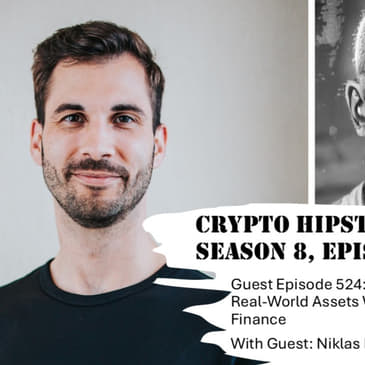

Niklas Kunkel began his crypto journey at IBM Research, where he worked on the Hyperledger blockchain and early supply chain finance applications. In 2017 he joined MakerDAO to create Dai, the first decentralized stablecoin on Ethereum. Nik is responsible for creating DSProxy, an industry-standard account abstraction primitive, OasisDEX, the first decentralized exchange on Ethereum with an order matching engine, and founding Chronicle Protocol which secures over $10B of assets locked in MakerDAO.
[00:00:02] Hello, everybody, and welcome to the Crypto Hipster Podcast. This is your host, Jamil Hasan, the Crypto Hipster, where I interview founders, entrepreneurs, executives, thought leaders, amazing people all around the world of crypto and blockchain. And today, I have another amazing guest. He is the founder of Chronicle Labs. His name is Niklas Kunkel. Niklas, welcome to the show. Niklas Kunkel Thank you for having me. Pleasure to be here.
[00:00:31] Niklas Kunkel You're very welcome. It's a pleasure to have you here today, and I'm looking forward to our conversation. So let's kick things off, and I'll ask you first, you know, what is your background? And is it a logical background for what you're doing now? Niklas Kunkel Yeah, I think it's actually relatively smooth. Started my journey into blockchain. My first job after university was at IBM Research.
[00:01:01] Niklas Kunkel Was working on mainframes, which despite being kind of 70s technology, are transaction-based type of systems, right? So they handle all of Visa, kind of credit card transactions. They handle all of the hotel reservations and management airlines. Niklas Kunkel So very similar use case to what kind of the way that like blockchains are architected and transact.
[00:01:33] Niklas Kunkel About a month into that, told my boss like, hey, you know, this is not really my thing. Niklas Kunkel You know, I kind of want to work on something else or, you know, otherwise I'm going to quit with the arrogance that only a 23-year-old can have. Niklas Kunkel A little bit embarrassed looking back on that. But I think my manager was very understanding.
[00:02:00] Niklas Kunkel And he was like, you know, you can, if you quit, you know, I can't hire a replacement. So let's negotiate. So if you work on this halftime, you can work on anything else that IBM Research is working on the other half of the time. Niklas Kunkel And so I think the cool things that they were working on were blockchain. So I was like, okay, let's go with that.
[00:02:30] Niklas Kunkel Didn't quite work out how I imagined because what effectively IBM was working on was like a permissioned ledger, right? It wasn't a public chain. And it was called a hyper ledger.
[00:02:45] Niklas Kunkel And when the Ethereum kind of, you know, white paper, you know, yellow paper came out, it was like, oh, you know, here's this, here's this public chain. And we've been thinking about this all wrong, right? And like, you know, we should be thinking about it in this way.
[00:03:03] Niklas Kunkel And you know, typical kind of corporate minded, like, no, no, no, no, no, no, no, no, it has to be permission. No institution will ever transact on a public ledger, right? In business, it's all about, you know, business privacy. Right?
[00:03:20] Niklas Kunkel So yeah, I did work about another year, and then Ethereum was actually released. And it was like, no, no, no, no, it's real, right? It's not vaporware, like the public chain that's happening, right? That this is how things are going to go.
[00:03:36] Niklas Kunkel And it was kind of just like, no, no, no, no, shut up. Right? So that's kind of when I kind of closed the loop, so to speak, I went to like, Ethereum land, and I was like, okay, who's, who's actually doing real stuff here? And that's how I kind of stumbled on MakerDAO.
[00:03:57] Niklas Kunkel So I was one of the first engineers at MakerDAO. You know, and we, I'd like to think we were, we were pretty successful.
[00:04:10] Niklas Kunkel I'd say so. I'd say very successful. You know, it's interesting, I have a, I have a comment regarding the IBM time. I had a conversation, I was a consultant back in 2017, ICO consultant. IBM had a conversation with me, I was like, wow, they're going to hire me for a job or for a project.
[00:04:29] Niklas Kunkel This would be awesome. And the whole entire conversation was like, how do we retain our people from going to Ethereum? And, you know, I'm like, I have some ideas, but like, I didn't know like the whole team was on a call. So I'm like, you know, so it's good to see we have some talented people go to Ethereum land. You know? So Chronicle, you know, what's it all about? What are you looking to solve?
[00:04:57] Niklas Yeah, so Chronicle is kind of the continuation of, of Maker. You know, at Maker, I was kind of in charge of, among other things, building out the Oracles. And actually, the MakerDAO Oracles were the first Oracle live in production on Ethereum. I think a lot of people don't know that. And throughout the years, Maker kind of continued using
[00:05:25] this in-house in-house in-house Maker oracle. And a number of years later, I was kind of like, you know, looking around and being like, you know, you know, there were obviously other Oracles in the market at that point. But we felt that we had something that was better than everyone else. And so it seemed a little bit foolish to, you know, spend all these resources building this only to use it internally.
[00:05:55] Right? And so it made a lot of sense to spin this out as a generalized product for everyone in DeFi. And I think that's kind of like the, this very like natural transition, right? From Maker kind of DAO-fying, splitting up into all of these different sub-DAOs.
[00:06:18] I think the timing was perfect for us. And so, um, what we've done with Chronicle is we've, um, kind of taken a look at, at where things are, you know, uh, where things are today.
[00:06:37] But I think more importantly, where things are going tomorrow, right? So, um, you know, we are one of the largest Oracles in DeFi today, right? I think we're the second largest with, uh, somewhere around 11 billion in TVL.
[00:06:53] Um, so, you know, that is our bread and butter. Uh, but when I look to the future, um, you know, yes, there are changes in the world, but specifically focusing on kind of crypto finance.
[00:07:09] Um, it's, um, it's going to radically transform in the next 12 to 18 months. Um, I think we've been very used to, um, a type of DeFi, uh, where, uh, the, primarily we're looking at, uh, very, you know, large amounts of like leverage rehypository.
[00:07:40] Right. Um, and I think that's, that's kind of about to change. Um, I think the size of, of DeFi right now is, is going to, um, like swell, uh, but it's going to swell in terms of tokenized asset, uh, kind of deposits, or you can, you think of it more as, as kind of a collateral base.
[00:08:05] Um, and, and that is going to really quickly outscale the, uh, let's call it the crypto native, um, kind of TVL and, and collateral. So, so that's, that's kind of where we're at right now is the influx of institutional capital is, is going to come in the form of these, uh, tokenized assets.
[00:08:30] Um, and DeFi is going to become the credit engine for these tokenized assets. Um, and like the, just the sheer scale and magnitude of like, uh, the amount of assets like sitting on the sidelines here that can be tokenized, that can be, um, uh, used in kind of generalized DeFi credit protocols. I mean, we're, we're talking about trillions of assets, right.
[00:09:00] And, and this is kind of what DeFi needs to kind of take that, that next step, right? Like, uh, I think a lot of people kind of say, you know, we're running, we're speed running, uh, traditional finance in, in DeFi. Right. Um, but, uh, I think in the, in the last couple of years, right, this, uh, idea of growth has always come from, um, oh, institutions are going to inject capital, right?
[00:09:28] Um, that's, what's going to grow DeFi is into institutions. Like the banks are going to inject capital. No, it's not injecting capital. They're going to inject their assets. Um, and actually that's even better for, for DeFi. Hey, last to unpack there. And I want to get into everything you said. Um, I do want to touch on, I usually touch on news, major news events first. So I want to do that first.
[00:09:57] And then I want to dive into everything. So absolutely. So you recently have been tapped as the Oracle provider for the spark 1 billion, right? How did that success come about? And what does it mean? So congratulations by the way. Oh, absolutely. Thank you. So, um, the spark tokenization Grand Prix is essentially, um, exactly what we were just talking about, right?
[00:10:23] It is, uh, DeFi starting to, um, uh, scale out, uh, the adoption of tokenized assets and generating credit against those tokenized assets. So traditionally, if you look at maker and spark, right, they have given out crypto loans, right? You, uh, against, you know, Lido staked ETH against, uh, wrap Bitcoin, right?
[00:10:50] Um, and now is the introduction of, um, giving out loans against tokenized assets, right? Or, uh, essentially re, uh, you can also think of it just as, uh, delegating credit into, you know, tokenized assets, particularly in the fixed income. And so the spark tokenization Grand Prix is this, uh, emblematic of this, you know, uh, crawl, walk, run, right?
[00:11:18] So, uh, they started off doing, uh, some one-off kind of, uh, tokenized asset opportunities to test the waters, to test like the, the structures, the flows, how, how everything kind of works. Um, and now it's time to run, right? And so they, they went big, right? They, they wanted to allocate a billion dollars worth of credit into, uh, tokenized assets.
[00:11:45] And, and in this case, particularly, uh, kind of money market funds and, and direct, uh, kind of treasury bill exposure. Sure. And, uh, this is kind of where, or Chronicle comes in. Um, because I think with crypto systems, we're used to by default, everything being transparent, right? It goes back to, right. We're talking about a public chain. It's completely open, right?
[00:12:14] You can see the code. You can see all of the transactions. You can see that a, um, unlike a bank, right? In a DeFi protocol, you can see all of the assets. You can see that there's more assets than liabilities. You can identify that this DeFi protocol is, is solvent, right? That it's, uh, healthily collateralized, um, right? You can do the same with, with on-chain stable coins like DAI.
[00:12:41] This is really difficult to do for tokenized assets, right? Because the actual assets are sitting in meat space, right? They're, they're sitting off chain somewhere. And so you are inherently by using as a DeFi protocol, by integrating and using a tokenized asset, you are inherently accepting this counterparty risk that what the issuer has claimed, you
[00:13:07] know, is sitting at a custodian somewhere relative to the amount of tokenized assets that's issued, right? That those are, you know, one-to-one, right? Or again, right? That the assets are more than the liabilities, right? The amount of traditional assets sitting at a custodian are greater than the amount of tokenized assets, uh, issued against those. Right. And this is where, uh, Chronicle comes in.
[00:13:34] So, um, this is what I meant earlier when I said, you know, we're, we're looking at where DeFi is today, but really we're looking at where DeFi is, is going and what the future is going to look like. And the future of DeFi is trillions of dollars of tokenized assets and, uh, Chronicle kind of sitting in between the meat space and the blockchain to give the same transparency
[00:14:01] around a tokenized asset that we do with the crypto native asset. Right. So what the Chronicle Oracle will do is it will tell, uh, you on chain exactly, you know, in the case of, let's talk about the spark tokenization Grand Prix, right? Uh, the winners were, I think, uh, centrifuge, super state and, uh, black rock securitize. Right.
[00:14:26] Uh, we will go and look exactly at how many, um, you know, underlying treasury bills there are. Uh, we can identify, uh, you know, what their purchase price was, when they're going to mature, what yield they have, what this kind of aggregated yield is, um, among the entire, uh, kind of balance sheet.
[00:14:51] Um, and this information is fed into an Oracle that a DeFi protocol like Spark and like MakerDAO can then leverage to, uh, manage these tokenized assets in a, uh, uh, in a responsible manner. Sounds exciting. I just want to, I want to get, I have first, the first thing I want to do, I want to get to the current state of
[00:15:20] Oracles, but like maybe that can be embedded in this next question. I want to find out, you know, you said that the market, the DeFi market is going to transform dramatically in the next 12 to 18 months. So I want to find out where we're at today, including the challenges of Oracles and where you think we will be in 18 months, including those solutions to how you, you, the challenges of Oracles.
[00:15:48] So I think, you know, more or less, right. You can kind of consider us in the, from an order of magnitude, right. We're, we're not at millions. We're not at billions. We're not at tens of billions, right. We're in the very low hundreds of billions, right. Um, doubling or tripling in size. That's not very exciting.
[00:16:13] And, and that's what kind of the, um, where, where we're kind of at, at the limit with, uh, in injection of, of kind of small institutional capital, um, with the introduction of traditional assets, right. We can unlock that trillion dollar order of magnitude. That's, that's what we're looking at here. Right. And, um, you can already see it now, right.
[00:16:41] With, uh, how big is the, the, the, I bit, uh, the, the BlackRock Bitcoin ETF. I think it's probably sitting at, I think last time I checked 80 ish billion dollars, maybe, maybe a little bit more. Um, right. That's from what, when, when, when was this created? Right.
[00:16:59] So there's, uh, like the ability to, uh, for an asset manager, like a, uh, you know, a BlackRock, a Fidelity, a, um, you know, an Apollo, right. Um, uh, a, uh, you know, think of, um, maybe like a state street, they have incredible amount of assets on their balance sheet. Right.
[00:17:28] And so, um, if they can tokenize these, right. Into a uniform kind of container like format. Right. And we get, uh, kind of a good regulatory framework around this, right. That gives people trust, uh, that gives agents kind of operating in, in the space, you know,
[00:17:53] trust in, in those assets and the quality of those assets in the legal standing of, of those assets. Right. Then, you know, uh, we're, we're cooking, right. This is, uh, and for the first time, and I think in many years, right. Uh, it, it seems like the stars are kind of aligning both from, uh, institutional appetite
[00:18:18] to, uh, public chain, you know, scalability to, you know, uh, the political appetite to create the appropriate regulatory frameworks. Um, everything is kind of coming together all at once. Right. And so this was never a question of if it will happen, right. For years now, um, this has always been clear that it's going to happen.
[00:18:48] The only question is when. And, uh, really now everything is going to, is, is coming into alignment. And, and now that it has, uh, these are going to scale fast. Right. Like right now we're talking about billion dollar tokenized asset issuances. Pretty soon we'll be talking about, uh, 10 billion. Right. And, and after that a hundred billion.
[00:19:15] So you see, so you're talking, you're talking a hundred X to a thousand X. Plus improvement or increase in volume and size best basically. Um, and you said that DeFi will be the credit engine that does that. How do you see, how do you see the Oracle landscape transforming along with it?
[00:19:41] Like these, the right now it's you guys and, and, and, uh, chain link and some others, you know, uh, how do you see, do you see more oracles? Do you see advancements in the oracles? How do you see the Oracle space playing a role? Cause it's supposed to, I thought it was made the centralized role, not centralized, the central, the central role in the decentralized finance. Yeah.
[00:20:05] So, you know, uh, I think not when you look at the Oracle landscape, I mean, one it's, uh, there's a lot of players, right. Uh, and I mean a lot, right. Uh, from back in the day when it was just, uh, you know, uh, Chronicle, you know, under the auspices of maker and, and, and chain link, right. It was just two. Uh, now I think we're up to like 10, right.
[00:20:30] Um, but I do think that, uh, the way they have positioned, uh, you know, there's technological differences, but there's also product differences. Um, and so a lot of them have kind of positioned themselves as kind of like, uh, uh, purely focused on, on DeFi. And, you know, I, I, I understand that, right. Uh, we've had a lot of success in DeFi, as I said before, right. Chronicle is the, is the second largest Oracle, uh, by, by TVL.
[00:21:01] Um, but I don't think, uh, enough of them are as, as future looking as, as Chronicle is. And so while a lot of them are talking about, you know, tokenized assets or, you know, maybe calling them RWAs, uh, Chronicle is like one of the very few that is actually like built a product around this, uh, that you can use today. And that is being used by, by DeFi protocols.
[00:21:29] Um, and I think that, uh, you know, in terms of like how that's going to play out, I mean, uh, I may be a bit biased, but, uh, uh, if I have a product out and, uh, it's, it's needed by the market to scale tokenized assets. And, uh, these other Oracle providers don't have a product out, uh, we're just gonna gain momentum and gobble up market share. Right. And, and especially, uh, if we can make the case right with, uh, these, uh, you know, some
[00:21:58] of the largest asset managers in the world that, Hey, you know, uh, we are, uh, we've, we've been live for this long. We have so much Lindy, you know, we're used to handling things at the scale of $10 billion. Right. Uh, we already work with X, Y, and Z, you know, who, you know, you know, very well, or who, you know, are your peers in industry, go talk to them. Um, I think that's going to work out very well for us.
[00:22:29] Yeah, I think so. That makes sense. Um, you also said something else you said, um, and it sounds exciting to me. I don't know what it means. I want to find out what it means. You said you're speed running TradFi. I'm like, yeah, you know, I like that. I like the sound of that. But how are you, how are you speed running TradFi? So, um, this is a double-edged sword type of thing.
[00:22:53] So in DeFi, um, I think part of what made it so successful and able to grow is that the people who joined DeFi had almost no financial knowledge. And I mean that with the utmost, like, respect.
[00:23:16] Like, uh, um, uh, effectively, we didn't know how difficult the problem was that we were trying to solve. And so we intuitively, you know, just followed where the, we intuitively just tried very many different things. And some of those things, you know, um, became very powerful kind of DeFi primitives, right?
[00:23:44] Um, and others, you know, we, maybe we thought we invented, but really we're just, you know, centuries-old financial primitives, right? That, that have existed for, uh, you know, for, for, for millennia almost, right? Uh, so, you know, debt, yield, but then we also have some interesting, you know, uh, unique, you know, constructs that we come up with ourselves that could never be recreated in, in traditional finance.
[00:24:14] It's like a flash loan, right? Um, anyone permissionlessly can go and get like a billion dollars of credit, um, right? And, you know, do whatever you want with those billion dollars, provided that at the end of the block where you took out this billion dollar, you know, flash loan, that you pay it back. Right. Right. So, um, this is amazing, right? Because, uh, think, think about how liquidations work in DeFi.
[00:24:45] Uh, in DeFi, you have, let's say the price of BTC or ETH kind of crashes. Um, you have a lot of leveraged positions using BTC and ETH as collateral, um, that would get liquidated.
[00:25:00] And so now you have, um, some liquidation mechanism, you know, sometimes it's auction, sometimes it's like a direct purchase of, uh, of these, what we call distressed assets. And so, you know, we want to be able to get, you know, a fair market price for these assets, right?
[00:25:22] If you're, you know, if you have a leveraged position and you get liquidated, you want to get back like the very highest price for your liquidated assets, right? That's more money for you. Um, but what we found before flash loans is that, well, if there's only like a fraction of all of DeFi being liquidated, then there's enough capital.
[00:25:45] You know, the, the players who are purchasing like these liquidations, who are purchasing this distressed capital, uh, there's enough kind of capital to go around that these fetch like a very fair price. The problem happens when all of a sudden you have like billions being liquidated at once, right? Like, uh, it's a dark, you know, it's like a black Thursday and, you know, everything has crashed like 30%, right?
[00:26:12] That now you're in trouble, uh, because now the players who are, uh, these institutional players may actually run out of capital. And so they're bidding lower and lower and lower. Um, and maybe there's not even competition left, right? For, uh, maybe the competition has like run out of capital. And so even if you have a lot of capital, if you realize you don't need to bid as high, uh, you're not going to bid as high, right? It's more money for you.
[00:26:42] So flash loans kind of solve this problem in a way by decoupling the effectiveness of liquidations from the amount of on hand capital. And like the way that this works, right. Is, um, let's say there's a billion dollars of ETH being sold.
[00:27:02] Well, you, maybe there's not a lot of players with a billion dollars of cash on hand, but anyone can take out a billion dollar flash loan, purchase the ETH and the liquidation, you know, auction. Um, and then go on a DEX and sell that ETH for, you know, 1.05 billion dollars. Right. Um, or, you know, offload some of it on centralized exchanges, whatever. Right.
[00:27:31] Uh, but the point is that after you've sold it, right, you've made more than a billion dollars in return and can then repay the original billion dollar flash loan. Right. And this is something that anyone can do. Right. And it's not just the big whale institutions. Right. And so this is a DeFi native innovation. Problem is not all of our innovations are good. Some of them are terrible.
[00:27:59] And if we had more, and this is what I mean by speed running TradFi, because, uh, you know, we've had, uh, recessions, depressions, you know, stock market collapses, right. Bond market collapses repeatedly throughout the history of finance.
[00:28:16] And, uh, that's because, you know, we thought we uncovered some new novel primitive that was, you know, a perpetual money making machine or, you know, we figured, yeah, this is a safe amount of leverage. Right. And then it blows up in our face and we learn, right.
[00:28:34] And we learn like, oh, you know, we have to cap the leverage here or we can't let, you know, banks who take deposits engage in this other kind of risky behavior. It needs to be, uh, a separate entity, right. That, that takes on those kinds of risks, right. Because otherwise you create systemic risks.
[00:28:59] And if the people working in DeFi were a little bit more historically grounded in, uh, kind of the, uh, even, even just the last hundred years of, of finance, right. We very much could have avoided, uh, a lot of the, the pitfalls, right. With, uh, with say like, you know, yield farming and, and, and the like. Um, and so that's what I mean by speed running is even today, right.
[00:29:28] We're just constantly trying new things. And I see some of these things and I go, we've already tried that in finance. We already know that doesn't work. Um, this is just a disaster waiting to happen. Um, and so it's a mix, it's a mixed bag, right. It's the good and the bad, but I'm, I'm a fervent believer that, uh, the good definitely outweighs the bad. Yeah, I believe, I believe that too.
[00:29:54] And I, and, um, yeah, it's interesting because, uh, I want to touch on one more thing. Um, you said we're shifting to institutions. Like I saw that and I made a mistake of day. I said, should I, I'm not going to say the name of the token, but I said, should I buy this thing at the $16 it is now? Or should I wait until August when it's $6?
[00:30:18] And I had hundreds of people lash out at me and I'm like, you know, um, I was, my question was more in line of, okay, is institutions, you know, going to take the summer off? Like they usually do. You know, uh, then come back in September. Um, but how do you see institutions, you know, gearing up for this, you know, RWA, you know, uh, DeFi run that we're going to be on very soon?
[00:30:43] Um, do you see them pulling back or you see them, what, what, what do you see their behavior being that has been different than in past years? Um, well, I think there, uh, you can just tell from the rhetoric, right. Um, even just, uh, a few years ago, right. You had, uh, you know, Jamie Dimon talking down on, you know, Bitcoin, like, oh, it's a cute toy, but it's gonna, it's gonna fail. It's gonna go to zero. Right.
[00:31:12] And look at today, uh, JP Morgan now, uh, sells Bitcoin to their institutional clients. Um, you know, uh, you, for a while, right. You had the, you know, blockchain, not Bitcoin kind of crowd, right? Like Bitcoin is the innovation, but like, you know, uh, you know, blockchain is the innovation, but Bitcoin is not going to go anywhere. Right. And by when, when they say Bitcoin, they meant all kinds of, of cryptocurrencies. Um, where is that now?
[00:31:42] Well, you have, uh, BlackRock, the largest asset manager in the world, right. Issuing, uh, a tokenized money market fund with, uh, the Biddle token. Right. So, uh, you have Larry Fink, right. The kind of, uh, chairman of, uh, of BlackRock, right. Uh, uh, going on Bloomberg and, and saying, you know, the, the tokenization of, of assets is, is going to change finance. Right.
[00:32:09] So it's, it's something that I think the crypto people have been espousing as, you know, uh, almost like gospel for years. Um, but now, uh, the institutional players are saying it as well. Right. And so, so that's right. That, that's what I meant earlier. Right. With, uh, this, this alignment of, of everything. Right. We have, we have the scalable blockchains now, right.
[00:32:38] We have the institutional interest, right. They, they see the potential, right. We have, uh, more, uh, accommodating kind of political and regular environments that, that will, um, look favorably on, on this experimentation and, and on making progress. Right. Uh, so really, right. We, we have all of the, the ingredients in our little cookbook, right.
[00:33:05] To, to start, uh, really, uh, cranking out kind of tokenized assets at scale. And I think what you were kind of leading at was, well, what is this going to look like? Right. Um, so I think what we've been seeing until now has been a lot of tokenized money market funds. Right. So, um, right. Monetary policy has been, uh, very kind of consistent, uh, the past couple of years.
[00:33:35] And I think people have gotten very used to, you know, 4.3 to, you know, 4.8% kind of, uh, uh, yield on short term, uh, treasuries. Right. Right. So, uh, I think that was a, I think a very obvious play, right. You have, uh, you know, defiant entities like, like maker and spark, right.
[00:33:59] Allocating billions, um, into these types of, uh, kind of treasure getting treasury bill exposure. And, and they're earning hundreds of millions of dollars annually in, in revenue from, from doing this. Um, I think, where do we kind of go from here? Um, I think the, well, first of all, I think monetary policy rates are, are going to, to go down.
[00:34:29] Um, it's, right. It's not a question of if, but just when. And then the question is what happens, uh, with all of this money that got really used to earning, you know, risk-free, you know, four and a half percent yield. Right. What do they do? Um, let's say treasury bills are only 3%, right. Um, are people happy earning 3%? Maybe, right.
[00:34:59] But some people won't. I think some people have gotten very drunk on, you know, uh, earning, you know, four and a half, uh, percent yield and may even be looking to, to juice it up even higher. Right. And so this is what I mean by like this, this little, uh, kind of sequence of, of operations. Um, I think the next thing we're looking at is other types of fixed income.
[00:35:26] So that, that's going to be the next kind of, uh, mountain of, of assets that are going to be tokenized. Right. So instead of just having, uh, U S treasuries, maybe we have other kinds of sovereign debt. Uh, maybe we have, we go a little more micro and we have, uh, municipal, uh, types of debt. Uh, maybe we look at, you know, corporate credit. Right.
[00:35:54] Uh, maybe there's a, you know, we're, uh, looking at a dramatic shift in the way the global economy is structured.
[00:36:06] Um, and, uh, you know, regardless of whether you think this is good or bad, uh, corporations are going to have to adjust where, um, where and how they do business, uh, protection, uh, particularly in the production of, of goods. Um, and that is going to require huge capital investments. Right. And so, um, right.
[00:36:32] We, uh, I think there's going to be, um, a lot of really high quality companies, right. Trying to raise debt through bond issuance. And I think tokenizing those bonds and, and leveraging DeFi as, as a credit engine, I think makes a lot of sense. Right. And I think the yields there will be very particularly attractive to, to DeFi. Right.
[00:36:56] I think you can, you know, look at that, uh, you know, six, seven, eight, nine percent kind of range. Um, and, and it just seems like a win, win, win all around. Right. So fixed income, you know, to me is just, uh, clearly that's the, the next step of where we go from here. Right. And whatever permutation, right. Whether it's municipal, you know, construction projects, whether it's, uh, you know, corporations trying to, uh, rebuild, you know, manufacturing capacity.
[00:37:25] Um, you know, building factories and warehouses and this entire kind of supply, uh, infrastructure. Um, then the question is, where do we go after that? Right. Is it tokenizing equities? Right. Is it tokenizing commodities? Right. Like, uh, you know, are we, do we want to trade oil and platinum and nickel and copper and, and, or lithium, you know, for, for car batteries. Right.
[00:37:53] Um, I think that's the more interesting question, right? Like we, we can always see just over the next hill. Um, but not like, you know, the hill that comes after that. And I think that's, that's kind of, um, I think where, where the winners and losers are going to be made is who can read what's, what's going to happen next, right. Before, before anyone else does. I think you're the first person who said those two magic words, um, fixed income.
[00:38:22] Cause I worked at AIG for many years. It was a fixed income shop. Your largest insurers in the world are fixed income shops, you know? So that to me makes a heck of a lot of sense. So, um, I want to thank you very much for your time today. I enjoyed speaking with you. This has been an insightful conversation. So, um, I have one last question. Um, how can people find out more information about you, about Chronicle? How can they use your protocol platform? How can they do that? Absolutely.
[00:38:51] So, um, you know, our website is chronicle labs.org. Um, and I think, uh, the most interesting thing to click on there is we have a dashboard. And I think this dashboard really kind of showcases our strengths, uh, because it's an end to end kind of transparent oracle. Uh, you can kind of, I kind of joke sometimes it's like a farm to table oracle where it takes
[00:39:18] away this, I think this, uh, fortune teller esque nature that people have of an oracle where it's just this black box and it just spits out a number, uh, at you and you have no context for where this number or this data came from or what, if this data is true or if it's false. And I think our dashboard really illustrates this in a, in a really transparent manner, right?
[00:39:44] Where you see not just the validators that are participating, you know, like, uh, like really good quality entities, like, you know, Gitcoin, like Infura, like, uh, uh, TYTX, uh, like Gnosis, like Maker, um, uh, even institutional entities like Bitcoin Suisse. Uh, but, uh, it goes a step further and even breaks down, well, where did this particular validator get their data from? Right.
[00:40:13] And like, what data did they get? Right. So, uh, if you look at like the ETH oracle, right, maybe it says it's $2,500. Well, why? Well, here's all these 20 validators that all said, you know, ETH is 2,500. And, you know, let's look at the Bitcoin Suisse validator. Why did it report that? It's like, well, it went to Coinbase and it got this. And it went to Uniswap and it got this. And it went to Binance and it got this, right?
[00:40:38] And it's shows you the entire, you know, from the raw data, from the, you know, direct source to, uh, how it was modeled and, and ended up on chain. And I think, uh, I think that one is very powerful, um, and, and necessary from a, uh, appropriate risk, like a responsible risk management point of view in, in DeFi.
[00:41:04] Um, but it's also, you know, going to, going to change the way that regulators, right. Uh, approach DeFi, right. What, what is the need to file, you know, quarterly filings or annual filings for a DeFi protocol when you can have an Oracle just telling you everything you need to know in real time. Right. Um, and, and so I think, uh, if, you know, check it out, play around with it.
[00:41:31] Um, but I think, um, your, your eyes will be, your eyes will be kind of like awakened after, after, uh, after experiencing that. Awesome. Awesome. Thank you very much for your time today. Likewise. Thank you so much for having me. This was great.