
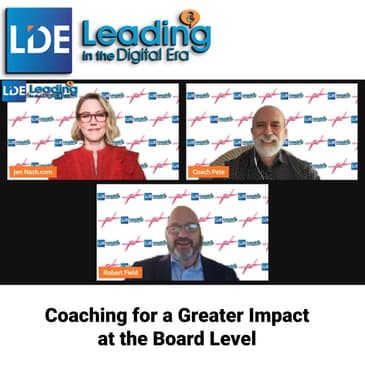

Coaching for a Greater Impact at the Board Level (S1 -E1 )
Host:
Guests:
What if there was an easier way for leaders to have greater impact and influence?
Gaining influence doesn’t have to be a mystery. In this session two executive coaches unpack the practical things you can do to gain more influence, respect, and make a bigger impact.
They’ll cover how getting clarity on your desired outcome can make all the difference, how to navigate work challenges and continue to show up powerfully. And they’ll show you how to build a powerful personal brand without making it all about you.
Part of the Digital Transformation Broadcast Network.
Powered by: Institute for Digital Transformation
Welcome to Leading in The Digital Era, the podcast series by the Institute for Digital Transformation, where we explore the art of leadership in today's fast-paced digital age. Join host Robert Field as we uncover practical strategies and thought provoking insights designed to help leaders excel in an ever-changing landscape. Whether you're on the move or relaxing, this episode offers valuable perspectives to refine your leadership approach and stay ahead in the digital transformation journey. Let's dive into today's discussion. Hi everyone. Thanks for joining. Before we start, I'd just like to express my heartfelt gratitude to the Institute for Digital Transformation for providing me this opportunity. I'm honored to be entrusted with the leadership role at the Institute. Thanks for the generosity and kindness of John and Frank. And additionally, I'm immensely grateful to the Fellows Institute for the Warm welcome unwavering support. Their wealth of knowledge has no bounds. And if there's one thing you can take away from the show, it's explore the resources they are for you. Your time spent with them will be worthwhile. With that, I hope you find additional value with the new show leading into digital era. If you go through life with a learning mindset, you'll never be bored. I've been blessed to have amazing people around me and continue to help me grow. And here we can dive deeper into some of our conversation, expand our network to reach further than we have been able to. As this is my inaugural show, I recognize that just like technology, there's always room for improvement and growth. So therefore, please send me your feedback. I really re I would really appreciate that tremendously. Don't hesitate to share your thoughts. How can enhance the show? Suggest topics you'd like to see, discuss and recommend. Guests we'd love to have featured, your input is in shaping the of this program and eager ideas. Gaining influence doesn't have to be a mystery. In this session, I have two executive coaches unpack the practical things you need to gain more influence, respect, and make a bigger impact. They'll cover getting clarity on your desire, outcome and how you can make all the difference, I'm sorry, on outcome, can make the difference how to navigate the work challenges and continue to show up powerfully, and they'll show you how to build a powerful brand without making it all about you. Our guests today are Pete. He is an ICF certified executive coach, podcaster consultant. He helped professionals maximize their talents, trust their goals, and live a life that's fully alive. And I believe that. I've been working with Pete for about, for over 10 years now. He's a critical part of my cabinet as a coach and a friend. People's one of those. Pete is one of those people that just make you better. Jen Nash is an award-winning author and ICF certified Executive Coach and a master connector. She empowers high performers to forge meaningful connections with themselves, their work, their lives, fueling elevated levels of joy and achievement. Why Pete and Jen? So I've been working with Pete for years. He's my coach. I did his emotional intelligence exercise early in my career, and it just changed me. And Jen, if you haven't read her book, go buy the Big Power of Tiny Connections. You'll get to immediately get why she's an important part of my life and the importance of building networks and expanding on your network. Jen has a solution for every situation. The depth and breadth of knowledge is exceptional. Compete Jen. Thank you, Rob. It's great to be here. Awesome. I like the shirt Jen. Having a coach in your life is especially, is important, especially this time when times a lean, it's when you double down, invest in yourself. Knowing where you're going and how you get there is key. Pete, Jen, I did a little bit of research before we get started and I surveyed more people than I probably should, but as you guys can see her on the screen, I don't want to go through all of these bullet points. But here's some feedback I got when I talked to some CIOs about their complaints on how to be heard in the boardroom. And then I talked to some other C-levels about their biggest complaints about CIOs in the boardroom. From our perspective, I think I have some rockstar leaders in my network. Some transcend all of these issues others might be developing, but to me the root of a lot of this might be a mismatch level of emotional intelligence, building a network. To you guys. How do I do that? How do I build my eq? How do I build my network? And I really need to learn how to work better with my peers at the C level to help create a better homogeneous environment. I love that. Pete, I've heard you say before what got you here won't get you there. So can you elaborate on that and get us going? Yeah. Yeah. Rob the majority of my clients are IT leaders at some level. A lot of executives, a lot of SVPs, a bunch of CIOs, and oftentimes they've come up through the ranks within technology and what's rewarded in the first stages of your career, which is tech knowhow and being able to get stuff done and be. A smart guy or gal when you hit a certain level leadership is really now the main thing that's required. And leadership isn't just about knowing all the facts you need to know about technology, but you don't have to be the most skilled the most skilled tech person in the room. Instead, it starts to become a lot more about leadership and there's not often a lot of training around that. And, emotional intelligence is a big part of that. We see I, I like to see it's not how much or it's not how smart you are, it's how are you smart? Okay. If again, first half of your career, it's probably rewarded how smart you are. But now when you start to move up the ranks and if you wanna have more influence, it starts to become. How are you smart? Are you learning emotional intelligence? Are you learning to speak the language of the other people? So it's getting translated into their world, not just what you wanna say, but for them to really understand it. Jen's gonna talk more about networking. Some of these other things. So that's our goal and to help advance people and be more effective is to ramp up those. It's a lot of times people call 'em soft skills. I don't exactly love that term, but that's really starts to become very important. I. And I wanna jump in there with I, I agree. Once you get past the doing phase of your life where people are coming to you and expecting you to be very executional, I think the next phase, and I think some people glaze over a little, when you say eq, they're like, yeah, I hear about that. And there's over eight 18 different modalities that go out and teach people eq. It's overwhelming. I like to dumb it down and say. Be a person, be a human. What does being a human in your work world look like? It actually looks like giving, I. A lot of time and energy into how you're showing up for other people and solving those problems. And I think as a CIO, that's like a huge part of what you're doing, but instead of doing it in a tech way, do it in a human bay. Ask questions all the time. What's going on for you? What walls are you hitting? What blocks are you having? How can I help? The most powerful words in the English language are I think, how can I help? Yeah. Yeah, so I think, yeah, and I think to your point Robert, like when you're trying to gain influence, that asking those questions and having those conversations starts to create like a flow for you with the people in your life. I think that how can you help is important, and if you have a high EQ and you ask that question, especially at the C level being authentically you to your peers. Is an important way, I think to gain trust and credibility with them. Pete, when you say it's not how smart you are, it's how you are smart. As I work through my career, I realize that I don't know everything and they keep the people around me that do know everything. It's, for me, it's not what you know, it's who you know. So building those relationships becomes more increasingly important to me because IT leaders, and I think Michael might have posted up a question here, IT leaders need to try drive business value here. Here was a comment that Michael put up there. Tech leaders need to make the value connection, showing others how to drive more business value from technology. But we need the business to embrace technology so we could transform or digitally transform business. By using technology as a disruptor, those relations become in increasingly more important. At that level because they know what we don't know. So it's, for me, it's not only how smart I am, but it's how smart everybody else around me is as well, and how well we work together. Yeah, Rob. That Michael, by the way thanks for for posting that the I find a lot of IT leaders, like they are on board with that concept. That's their desire. I want to help. I. The, our comp, our business succeed by leveraging technology strategically, and that's their desire. But there's still a disconnect if you will, on the mechanics of how to make that happen. And that's where coaching really can help a lot. I've helped a lot of my clients and what Jim was talking about being human. So how do you do that? Okay. And Jen also referenced that emotional intelligence can be an overwhelming topic. There are so many books on it, there's tons of webinars on it. LinkedIn learning, like lots of stuff. I like to make it really simple to get folks started. And part one is I would just call self-awareness. Develop self-awareness. How are you experiencing things? How are you feeling about things? Do you know really what your strengths are? What makes you exceptional? By the way, your exceptional strengths when they're overplayed are probably your be your biggest weaknesses as well. It's not the things you can't do that are your weaknesses. It's when you're showing up with your foot on the gas too hard and and you start to you start to possibly offend people. I'll give you a quick example. I have a client he is from a Middle Eastern background and his, the way he was raised was be very direct. And what we might consider argumentative to the, to them, to the way he was raised. It was just normal conversation and it's a real superpower for him because he could get into a meeting and if there's all this like chaos and confusion, he could get right to the point. He was really sharp critical thinking, bottom line things right away. When he hit about age 40, he realized he, he wasn't getting the promotions that he used to get when he was younger and. It came out, surfaced in some 360 evaluations that he was getting a reputation of being hard to work with and he didn't see it himself. And that's what, we call this a blind spot, right? It's part of you. It's normalized and it's hard to see. It's hard to, it's hard to see how you're actually coming across. I worked with him as a coach and we worked on some emotional intelligence exercises about self-awareness to understand his strengths, understand where he might overplay it. And the good news is I, it was amazing really in a, in about a year and a half, he had so turned things around that his 360 reviews were now coming back. Yusef is a great person to work with. I want to be on his team. I. Even though he's not my org chart I don't report to the org chart. I still, respect him. He made all these great advances in, in building up his emotional intelligence. So the reason I want to tell you that is sometimes depending on your background, we have this tendency to think, oh, I'm not a people person, or I'm not good at that. I'm not naturally good at it. I'm telling you. Emotional intelligence is something you can work at and you can get results if you apply yourself and get just into a nice, simple development program. I. Yeah, absolutely. I think that's critical and I love the way you said it can be very simple and start with knowing yourself. I have all my clients doing something called positive intelligence, which is actually backed by a book, by a shiza Charmine covered in the New York Times, and it's. Data backed by over 800,000 brain scans that were done at Stanford University and Harvard, where they literally study how your brain reacts when you shift into self-awareness. And by self-awareness, I mean you're having a super busy day, you're overwhelmed. You literally take two minutes to stop. To breathe, to notice your breath and to touch your hands, or you can touch your face and to actually feel what it feels like to be doing that. Just doing that switches us out of, the freak out mode that we're tend, we tend to be in, gets us away from the over responses that we lean into, and all of a sudden we're back in our, iguana brain, which is just being, and breathing and just that switch. It's incredibly powerful for my clients. I was facilitating a workshop at an investment bank and someone actually she knew I was coaching one of the managing directors and she said, I've noticed that she's a lot calmer in the last six months and she's handling stress in a very different way. She's just showing up with such presence. And I was like, yeah, that's the power of leaning into self-awareness as you say it. Or, positive intelligence and getting your PQ quotient up. As people on the inside call it, it's really powerful and there's so much data around how you're a better team player, especially if you do it with your team. You're a better leader, you're a better partner, a better parent, like every aspect of your life gets better. When you elevate your eq, so that's the awesome thing. And you get a raise. Yay. Go Yusef getting that promotion. Yeah. Yeah. He actually did, he got a big promotion. He act, he actually went to a different company, but he got a everything he was looking for in his career. Hey Rob, I know like you, you've mentioned, I've coached you before. Can you give an example like of where an area that you were just naturally strong in, but then you found you had to pull back just a little bit 'cause it was being overplayed. So for me, Pete you took me through a tremendous breakthrough on from me, from with my, and when you had me do the Clifton Straints. Where I scored high was an ideology and, but I wouldn't let it go. I wouldn't let my ideas go and you taught me this whole mic drop concept and let go of my ideas and let them be someone else's for a while. And that was a pivotal point in my leadership where letting my ideas go or letting someone else run with them was important to me because I could. I resonated with them too much and it took too much away from me. And recently I had a conversation with Jen, ironically, along the lines of emotional intelligence with, I think it was called emotional currency again, if I'm correct. Yeah. Tying those two together, letting those ideas go and not letting affect my emotional currency was very helpful to me in creating better energy towards what I'm trying to do and build. And those two things together when I, when I get coached from my coaches and able to figure out how that resonates with me. Tying that gives me more energy to move forward where I need to do in a more productive manner. Yeah. Yeah. That's awesome. It's great. It's powerful stuff. So we talked about making emotional intelligence simpler, and the first part we were just mentioning was self-awareness growing in that, the other part is others awareness. That's the other half of it. And it's, that's just being more aware of where other people are at or. And you can use the word empathy. Don't think soft and fuzzy. Don't think sympathy, don't think I'm gonna cry with you. That type of empathy. It's just what's it like to walk in that other person's shoes? Okay. And this is a huge factor if you want to have more influence especially at the C-suite, but really with any other department in any other coworker, even in your department, what is their world like? Okay. And then in tech. One of the biggest areas if Rob popped that screen up a little earlier. The number one thing is that the other C-suite executives, it's frustrating with them, with the tech guys and gals, is you talk tech too much. You're using all your acronyms, you're going really fast, you're overwhelming them with analytical kind of technical details, and you're not talking business. There you go. Speaking the language of business. Okay, speak the language of business. Learn that, okay, this is a great investment in your time. And by the way, just a little side note on emotional intelligence in general when you start, if you think you need to move into this, there's gonna be a voice in the back of your head saying, I don't have time for this. Okay. It's not efficient. I'm overwhelmed. Look at all this stuff. My, I have to get done, my group has to get done. This isn't always like what you would say, efficient use of time. But it's definitely effective use of time. Okay? In the short term, it's gonna seem oh, I'm studying and I'm like doing this, and I'm trying these other experiments outside of my comfort zone. The long term, it's going to get you more impact, influence. It's gonna get you the results that you're really looking for. Yeah, I agree. And it is interesting that you mentioned, empathy and having it be potentially fuzzy. In my work with people say at Deloitte, which is, one of the top companies in the world, they really prioritize. Design thinking, what's the number one pillar of design thinking, empathize. 'cause you have to understand where the other person is coming from so that you can then dig into that problem and yeah, sure. After that you're gonna define your, you're gonna ideate, you're gonna you're know, prototype and test. But the very first step is understanding where they're coming from. And without that step, you're gonna bulldoze straight through with your jargon. And not to say that people at, top consulting firms don't love their jargon, but I think in the end, it, the underlying thought for me often is, what are you trying to cover up? What insecurity is there? And maybe that's a really great conversation to have with your coach, with your boss, with other people in your team because, you're. You're overwhelmed in some aspect and you're showing up in a way that maybe isn't your power stance, right? So I think really coming in slower and asking where the other person is at is just gonna solve so many things. Jen and I you and I had a conversation a couple weeks ago as well, and oftentimes in, in, in it, people come to you already with a baked question. Like, how do I access this database? And. You wanna prove that you're technically smart. So you think you wanna jump into the answer, but just taking Jen's advice, ask more questions, peel it back. Keep asking those why's till you get to the business desire. What's the business outcome they find? And then, so many times if you unwind it, you find out, oh my gosh, no, you don't need access to that data database. I got a way simpler way for this to happen. Bam. You actually already have access. You just weren't looking in the right place. Whatever. What are they Pete? We, I think Pete, we're losing you a little bit. Am I? Yeah, he, no, he froze. Yeah. No, Jen, just wanna unpack that a tiny bit though, what you said because the design thinking, the human centered approach to that and getting to what the needs are and Pete's example of, I want to get access to the database, but what do you really want? What are their needs? What are they really asking for? Can you, Pete and I grew up in it, you did it, but how do we get to what people's intrinsic needs are or a better way to try to find out? I. What they're looking for rather than just what they're actually saying. Yeah. And I agree with Pete, if you peel back the layers and understand what they're trying to achieve and why they're under trying, like what is the motivation, you're gonna really get to the problem a lot faster. And I agree with what Pete was saying. You're probably gonna find. That maybe what they're asking for isn't what they want at all. They're just looking for a straight line, and they, being who they are with their background thinks that's the straight line. And you being, the wiser, technology leader is gonna have a better suggestion for them. But I think it all boils down to slowing down, taking time, being human, and understanding what's the person trying to achieve, yeah. One of the complaints were, complain. One of the opportunities for greatness or suggestions from other people. Oh my Michael, good thing. Asking three different ways, but was that it isn't always supportive of or isn't always. One of the things, complaints of the, I'm sorry, sales of sales is the others aren't willing to collaborate, but could it be that we're just not asking the right questions? Yeah, and I love that Michael just said ask why three times, because you're gonna come at it from different ways. And I think that's a great question and a great approach. I think, people in technology have always been gods within their own world. And to the rest of the world because technology is always it's evolving so quickly. Us lay people, we stand back and we go what's happening now? And we reach out to people like you in hopes for guidance, but at the same time, then you and you know your world, there is an element of, oh, I have all the answers. And you wanna show up, like you have all the answers. And so I think just. Slowing down and asking questions so you can give the right answer is going to really boost your eq. It's gonna boost your self-awareness and you know what, it's gonna lubricate your way forward into like your whole company support system. You know what I mean? Because people are gonna know, oh yeah, Rob asks great questions three different ways, and he's going to really dig into what we need and where we're going and why we're going and what we're doing. All the why's, all if we're all reporters, we'll get there. I wish we had more time. You and I talked the other day about so just so everyone knows the reason why we have the pink ribbons here is we're gonna do a session with our friends, Andrew Mark Sim and Michael Smith on check a pink. And Andrea and I talked about you doing her I Will event where you can join a workshop. So I wish we had more time for workshop, but as I read your book, it, for me, it was back to the, the Dummies book on technology, but how to be a better networker. So how can we be better about asking, I. The whys and the hows to other, to drive better insight with the business. Do you have any go-tos or fallbacks that we can use as a, remember we grew up in it as single contributors. We don't build IT skills. We grew up either networkers, developers, I grew up through starting as a network developer, then a project manager. We don't grow up with these soft skills that we haven't developed through our career. Can you give us any tools that we can use to be better at that, in asking those questions? Yeah. I love when you said a networker and then building my network skills. I'm pretty sure you didn't mean it in the way I build my network skills, so I was like, wait. Interesting duality there, right? Mine's tabling because it's yours is actually networking. It's interesting the other day I told someone, I said I use the word connection in my book a lot because the word network turns people off. And it's funny, I think the aspect of tech side is probably there, but also the word work is there. Network. It sounds like something you have to do. There's a gun to your head. Go out and network and it'll help your life. Nobody really wants to do anything where there's a gun to their head. But then I also remind people net work. If you think of a fisherman's net, what does it do? It catches, it can catch you. So your network is going to catch you, which is why it's so important. And while you're leading cables down that are gonna support whatever initiative you're going forward with, I think people. Are very well behooved to look at laying frameworks around the people that they're fostering in their lives. And I think you're incredible at this because I think you spark with people, you support people, you follow up with people, and that's the foundation probably of laying cable, but also with, building. Friendships. And I think the problem with networking as a word is it sounds cold, right? And I think people need to look at it more as building tiny little filaments of affinity. Who are you drawn to? Who is interested in you, and who are you interested in? And then just following up with some kind of cadence. And it's funny because in my book I have a chapter on how do you stay in touch with someone you just met. Because it's not actually very obvious. You had a great conversation with someone on a plane. You think they're cool, you don't live in the same city. How do you do that? And I actually co-wrote that section with a really good friend of mine who has more friends around the world than anyone. And one of his simple tricks was, get everybody's birthday in your calendar and on their actual birthday, send them a long note, not just a happy birthday on Facebook. Send 'em a text on whatever social you're using, LinkedIn, whatever. Or give them a call and actually sing them. Happy Birthday, which is one of my little special treats. But wait, I gotta hear this. Jen, what do You like, you call 'em and sing. Yeah, I call them and I sing. And I'll be honest, because I'm not gonna get them live. What I like to do is I do fun filters on Snapchat, and so I have, they're the Disney one where you have the Disney eyes, and believe it or not I can do a pretty good. Disney Princess, happy birthday. And people are literally so enchanted. Even if they don't know you that well, they like, you're willing to make a little bit of a fool of yourself for them. You're going above and beyond. It's funny, right? And at the end of us, I think we're all six and we love when people like call us up and do something silly on our birthday. It's a nice gift and it costs you absolutely nothing, but like a few minutes of your time. So doing something like that, exactly invest into that filament and all of a sudden you can go from there and it's just a nice starting point. That was a very long-winded answer, Rob, but like great answer to build that connection. I dunno how silly I want to get with the other peers at my at the C level, but I do wanna make that connection and remembering people's birthday is either, as a technologist, I do try my best to remember and, and log everyone's birthday or some sort of milestone to make sure it, connecting. Connecting is easy, but I feel the connection to me is connecting with someone for me and them is building that relationship. 'cause you never know who else you can help. Rob just, oh, I'm sorry. Go ahead. No, we were just supporting, we just continued your conversation as you follow up and had to, I'm so sorry. I'm on the road. I played you. It was great. Yeah. I'm I just tried to channel my Pete. I'm I'm on the road and I had a really weak internet connection, so I'm so sorry everyone. Hey just along those lines love practical tips and on networking. Another thing. Is within your organization, are you reaching out to the other department heads when you don't have to? Just as a simple thing, you can do schedule like every other week, a lunch with another a peer, somebody else outside of your organization. If you're at the C-level, you know some of the other people in the C-suite and just have lunch and just talk. Find out what is it like in their world. That's your goal. Not to inform them of tons of stuff, but Hey, what pressures are you under? What are the goals? That you're trying to hit for your department. And here's one I love to ask, what would be a personal win for you? Okay. Understanding people's self-interest is really important. It doesn't even mean you change everything. It does sometimes just help to repackage what you're already doing and that you can take the, some of the same results that you're going to achieve, but show them how this is gonna help advance what their personal win is. So I have two practical questions. It's who, who's on your calendar for your next lunch, and the second one is who's in, in? So that would be for two weeks. And the second question, who's in four weeks? So just go, just start reaching out and you don't have to have a great reason, just wanna catch up. I love that food is always a great equalizer from my perspective. Yeah. And I was gonna say, I was gonna say for people that don't wanna like sing, like reaching out on a birthday and just saying, Hey, I know it's your birthday, we haven't caught up in a while. You wanna do a walk, a coffee or a drink? I always try and do two healthy, one less healthy options. And you can do all of these things even if they're remote. I've scheduled walk and talks with people that I don't know. We both lace up our shoes and they think it's hilarious. They're, I'm like, are you out of the house? Are you ready to go? They're like, yeah, this is great. Thanks for getting me away from my computer. And I love your questions because I also, I think Pete people. Suddenly need something and then they hesitate to reach out because nobody wants to reach out when they need something. 'cause you feel like you're being too transactional. Yeah. You feel like you like a crop head. And I agree. Jason Menta Throw was sharing that he started asking people within a business relationship what are the challenges and opportunity, that technology is presenting. I love that. That's exactly right. Like, where are they at? And you're gonna have a really interesting conversation that's gonna unfold from, I think, an incredibly empathetic point of view. And you don't have to have all the answers. Okay. It's just getting the conversation started and like it might spark, what, can I go research for this person to help out their initiatives? Or who else on my team could I go deploy? Because they're stoked about that kind of thing. And they wanna share what they have to know. So yeah, don't be afraid of these things. Yeah. Jason and Michael, a lot of people having these conversations. What I've learned from both of you is to do that as well, and even for the teams that are remote, we, and Jen and I have done a remote walk. We've scheduled time throughout the day where we both get on the phone and we do remote walk midday, so we can find that to connect theirs. That connection, whether it's in person or remote, I think continues to drive that interpersonal skills one-on-one. So when you're in the boardroom, there's affinity with everybody else. And that's what I think it leaders have. The biggest problem doing is making those connections 'cause we're the newest, the CIO is the newest C level role in, in any organization. That's interesting. Honestly, all the more reason to be lunching coffee and walking, because you wanna get to know as many people as quickly as possible. And ha it's, it is interesting 'cause one of my clients was like, oh, I'm gonna start throwing lunches with four to six people. And I was like, don't do that. Because the thing is you're gonna, you're gonna check the box that you got four to six people to come to lunch. But did you actually connect. And how many people did you actually connect with at that lunch, and how did they feel leaving that lunch? Were they all just oh, we just had a casual work lunch. You want them to leave feeling, oh, that Rob dude, he's cool. I like him. He, he's gonna help me with X and I'm gonna help him with Y and or maybe we're gonna play golf something right. Yeah. And Jen Jen's book is excellent, by the way. Y'all should get it. I was listening to the audio version, and Jen, you talked about one thing that's super important and I think really empowering because let's face it, if you came up through tech ranks, you might not consider yourself to be socially smooth or whatever. Talk about the other person. Everybody wants to be talk about themselves, ask them questions, show interest in who they are. That does not take a lot of skill. You don't have to be super smooth about it, and you get 'em talking and just get back to 'em and say, oh, that's really interesting. Tell me more. And just that power of self-interest in learning about that. You don't have to be s smooth, you don't have to have, be clever in your conversation. Just get them talking about themselves. Yeah. Thank you for bringing that up. That's the ultimate goal. What? That, that, that's the ultimate goal. We need that from an IT leadership perspective. We need them to talk about themselves. Someone posted a statement earlier about it connects to business. I've heard It is the, aPI of the business. But if we're gonna work within the business, we have a choice. We can be the IT leader that put printers on desks, or we can learn the business to help disrupt the business by using technology. And we can't do that without that good relationship. Thus, these soft skills become increasingly more important to us. We have to learn the business in order to be a valuable resource to them. Yeah, a hundred percent. And I think you just hit on the nail on the head. In order to learn implies you're really listening to their answers. And this is a fun fact that I share in the book when they put people in MRI machines to study how the brain responds. When you're talking out loud about yourself, your brain lights up, but your brain lights up as though you've just, had a hit of cocaine or had some great sex. If the person knows while they're talking, someone's listening. It was like literally next level brain outcome. So when we really lean in to listening and, processing what that person's sharing, you're building unseen connections in a powerful way. Yes. As Dr. Frank Granito says, active listening. Indeed. If everybody's active listening, this might be the first institute. Video that had cocaine and sex on it in a positive way. But I do appreciate that connection because we wanna actively listen and fire up. That's what gets us engaged. And the whole study that I did before was all about engagement from both sides. The CIOs wanna be more engaged and the other c levels want us more engaged. The safety of it becomes the intrinsic problem for me, also, one of the biggest complaints of CIOs was people aren't willing to take risks. How do we get them comfortable with what we're doing as we're listening, that they can build that trust and the trust ultimately becomes the important part of that relationship. Absolutely. Hey, big picture. You guys signed up for this for this session because we talked about coaching and how to be more effective in the C-suite. And if you notice, we're not talking about technical skills here. Okay? And we're taking a step back and we're not saying get like to next level and try much, much, much harder at what you've already been doing. We're talking about rounding it out and easing, sometimes taking your foot off the gas a little bit and redirecting your energies in these other ways. When you build that, Rob was just talking about trust. When you can start to build it, okay, not, it's not gonna be absolute. You're still gonna have conflict and issues and personality things you gotta work through with people. But as you start to build that, you're going to find it when you're in those critical discussions and when you wanna be included, when big decisions are being made. You're gonna find, you're gonna set him more allies like because they know you and they trust you, and they know that you care and listened and understand their world, not firsthand. You don't have to know what it's like to be the chief marketing officer, but you do need you. You responded. You found out that their biggest challenges are whatever the competition is doing, or they're having a hard time retaining employees or whatever, but you understand that and you're on their side. Okay? Now they're gonna be on your side if you need backup. I think we should make a movement to replace the word networking with the, with something like ally focused. 'cause at the end of the day, we build up your network, you build up your allies and all of a sudden I feel like I'm in a video game and I've got an army behind me and we're gonna get 'em. I'm all in on that one. Who doesn't want just a bevy of allies supporting everything you wanna do? That sounds worth the initiative. I think. I hope John's listening because I just changed our third show, which was building relationship at the C level to building at building allies at the C level, and we renamed that one. So when I get Adrian, Lisa, and Jessica together to talk about building that relationship at the level, it's gonna be building allies at the C level going forward, John, we have to make that change to that show. That's fun. I like that. Yeah it's a, it's really nice perspective. Thanks, Pete. I love it. And it does become, it does need to become an ally because if it's a tumultuous relationship, it doesn't work, then maybe it's time to go find somewhere else to work, ultimately. But if it's not a if you can build allies, it makes it fun. We wanna learn, I, from an IT perspective, what they're doing, so we can be successful by making them successful. Ultimately. That's the goal. Everybody wins in that scenario. Yeah, I agree with that. Rob, do we it's about 20 up. Do we wanna start to take some questions and, I think we had one, two here. I have a couple. If anybody you want, they could throw questions down here. John and John will pop 'em up on the screen. We can run with them, but we're happy to address any question from the audience at any time. This is an open forum and if anyone has em, Jen and Pete have been so kind. And the reason, I picked Jen and Pete. Jen doesn't come from an IT background and have superpower. And you did mention that earlier, Pete. The superpower to me becomes important. What separates you from everyone else, but Jen superpower is not coming back from it and the impact she's had on. On me and those in, in, the IT leadership that I've been introducing it to, I think helps us get to the point where building allies, I have to reframe myself to do that all the time now, but building allies becomes a, an important thing we need to do regularly. Your allies become really critical to your life, and then ultimately having a coaching life, especially now from both your perspective when the economy might not be looking great, is the time to, to start engaging and building your skills to be able to take you to that next level. You gotta, do you have a, is this a question? What? I think you care, like an awesome suggestion, Eli. It's a cool idea though. Yeah. Talk about what I think you care about. Yeah. Like it's proving do I got this right? This is what I heard. Is it do I have it right? And it gives them an opportunity to adjust that a little bit. If you, they, if you didn't quite hear what they were saying. Yeah. For people who are only listening and not watching Eli Katz threw up an idea that he likes to go into presentations now with a slide that actually shows a photo of the person he's meeting with, and then a caption that just says what I think is important to you. And then there were some bullets, which is a really nice approach in terms of talk about design thinking upfront, like you've got the empathy right away. So we often suffer from the IT guy syndrome. How do we politely but firmly break this image? Are you wearing a blue shirt and brown khakis? Meanwhile, Rob's wearing a blue shirt. I nailed it. Khakis. See, and it's a great question, but like for me to. Pro properly answer it. I would actually have to use all the advice that we've shared in today's podcast and say, tell me more. How are you defining it? Guy Syndrome, it's, is it your stiff back? Are you stiff? Do you struggle talking with casualness? And you're always very formal. Are you really wearing a blue shirt and beige khakis and, do you make regrettable shoe choices? We can talk about all these things, but it's, sorry I'm entertaining. But when people talk about it, guy Syndrome, all of that is in that basket, right? It's all of these things. And so I would have to know more. Yeah. And I I think it's a great question. I get asked it a lot and let me I wanna change. The question, alright not break that image, let's say modify that image, okay? Because at the end of the day, you still need to do your job, right? You still need to be the IT resource. You do wanna be a go-to person. The thing is, you don't wanna be only the o the go-to person. You don't wanna be a commodity. All right, because that's and unfortunately a lot of it people do this to themselves is you're defining your, you've defined yourself by, oh I'll solve this problem, or I'll only do it thing. If you start talking in their language like, Hey, what are you trying to accomplish? What's what? What's the business that you're in? What's the business problem that you're trying to solve? Oh, let me work with it. Does anybody else on your team have an idea about that? Let me bring in some people from my team and talk about that. Now, you're not just the IT guy. You're like, you advanced my business as an IT guy. Okay? So we're gonna modify and expand so you stand out, okay? But avoid being coming a commodity. That's the thing you wanna really stay away from big. By the way, there's no advancement or raises for commodities. It actually, my, I always thought that it, you couldn't be a commodity and then be outsourced immediately, but the IT guy syndrome works both ways. We don't wanna be, and you touched on a little bit, Pete, but it'd be good to have some tools internally and that back to most intelligence a little bit. We sometimes internally suffer from the IT guy syndrome and fall back to what we're comfortable with and throw tech at a problem when it really should be a business conversation. It's the IT guy syndrome on both parts that we have to. Get away from, we don't wanna be perceived as that, but we also have to stop being the IT guy in the room and solving problems with technology when we should be having a business conversation. I love that. Yeah. And that, again, it goes back to asking great questions, multiple ways and Michael Pompe is asking, which was the most important talent that you had to put down to get to the next level? I don't fully understand that question, so I'm gonna let you guys handle it. Michael, actually I'm gonna build on question a little bit also because there, there are a lot of C CIOs I talked to now that want to get to that next level, attain a board position as well. So there's the, aspiring director, aspiring vp, aspiring, CIO, aspiring board member. And at each level the skill sets would change to get to that next level. What do you have, what talents do you have to develop to get there? We're not. I've trained in, when we do our education for those levels, hopefully we have mentors and peers that we can learn from. It depends on what level you jump to. But I'm sure there are people that are listening to this also that wanna know how to get to that board position and what do we need for that, what talents we need to get to there as well. And for me it always starts with learning the business. Being able to build allies and understand the business and have business conversations will keep you at that table with a voice at that table and not just a. Kirsten, they're calling for when to support questions, and I would actually, I'm flip that. Go ahead. Go ahead. I'm just gonna say, I think learning the people, then learning the business because you are there, because you know your stuff, but if you can actually build bonds with the people who are at the table, every bond you build cements your invitation deeper into that experience. Absolutely. I wanna go back to Michael's question. What talent did you feel like he said throw down? I think he meant lay aside. In order to advance and there's, in the first half of your career there's a really good book out on the market right now, by the way. It's called Strength From Strength to Strength. It's really good and it talks about. The first half of your career about getting stuff done and being, becoming a subject matter expert, and a phrase around that is fluid thinking. It's the way your brain works, it's creative, it's stitching together solutions. It's about speed and it's about being like really effective the second half of your career. First of all, your brain starts changing and you can't do that as well anymore as anybody over 40 probably can attest. Oh, I'm starting to slow down and don't play that same game anymore. I have to get tasks done and be a worker bee. It's the phrase then starts to shift in something called crystallized thinking. Where wisdom and judgment and seeing the big picture really start to play more and more into it. And that it's a huge value. Michael, if I was gonna ask, answer your question, I would say don't give up rolling up your sleeves and getting work done, but you wanna start deemphasizing things that other people could be doing. Like those kinds of talents, like it just super analytical. I'm gonna analyze this data I'm gonna, or getting tasks done. Some things that other people could be doing. And start to emphasize the things that really make you unique and that bring a level of wisdom, judgment business value, seeing the big picture, how, seeing how things stitch together across the across your organization. Those are the things you wanna start emphasizing more and will get the attention of the C-Suite more as well. So this is a good question and the reason why I like this question, how to connect digital, the transformation with sustainability, board director level, but I think the reason why I like this is it all comes with a strategic plan, right? At the end of the day, the. The board of directors is gonna drive the way the business runs and without being able to build a relationship, not only to C level, but with the board of directors, we can't do anything. Technology grows exponentially. If anyone read the singularities near, we know the rate of change and technology grows exponentially fast. And if the only good thing we got from Covid is the value of technology is continually to grow. But we need to build those levels even at the board of director levels. Not just with our PC level, but the people that are, determining the direction we grow from a complete sustainability perspective. How do we do that when we don't have direct access with the board members on a regular basis? We can't just say, Hey, Mr. Chairman of the board, let's go for lunch regularly. But we still need to build that level of trust and comradery as well. So with that we are running a little bit at a time and I do wanna just bring up though that, i, Jen and Pete will be coming back, so please follow us so we can make sure and that you see more of what they do. And I just want to poke that this is, we, while this, there are four shows coming up here in, in two weeks, we do have a show on AI that, the likes that I don't think you guys have ever heard or seen before, but I think it'll be great. And we do have the newly named show that we talked about coming up in a few weeks on building allies. And ultimately I just wanna let everyone know that we are supporting. Tech Day of Pink here for with Michael Smith and Estee Lauder. Tech Day of Pink is in is on October 12th. That show with Michael Smith and Andrew. Mark Sim is gonna be on September 21st. Please come back if you understand, but from Pete, Jen, if people want to work with you or get in touch with you besides buying Jen's book. And Pete's hopefully soon to come out book that. I know you're working on that. I just outed you in front of everybody. Sorry, with. I am jen@jennash.com. If you wanna email me or just check out my site, it's jen nash.com, J-E-N-N-A-S h.com. Pete, how do we find you? Yeah my website is pete coaching.com. And email pete@beatcoaching.com. And I, Jen, I can't speak for you, but I think this is the case. For any of you, if you're interested to learn more about what could coaching do for you, executive coaching to help take you to the next level. I. The, we're both ICF certified. That means it's the really, it's the highest standard. And we'll do a discovery call with you and just talk and learn. There's no obligation. And we're not a hard sell. We're gonna find out really, and what you want, and can we help you? And if the answer's yes, we can talk about how to move forward. Yeah. So take advantage of that. Yeah, I love that. And I think it's really interesting more people are realizing how powerful it is to have a coach as an ally because we're unbiased, we ask great questions, and there's no better way to get clear and laser focused on where you wanna go. And time is our most precious commodity. So if you have clarity and you know the steps to take, I don't know, but about you. But that to me is worth like. Everything. Yeah. I wanna thank you both for getting us through the first show here ever on leading the ra. I have to tell you, I've never heard Jen, this comment, tiny little filaments of affinity, I think you said I'm gonna use that. Brilliant. I appreciate you both. As every day as a part of my cabinet and my life you help my leadership. Gain heights that I've never thought I could. So having coaches like you in my life makes it easier to be, to do what I do every day. And I appreciate that and I want to thank you and I wanna thank everybody that joined us today or will join us in watching us on the YouTube channel. And again, please join us for our future show. Then if you need to get in touch with me, you go to find me on LinkedIn. I'm there pretty often and I'm getting better at the thanks to the people that teach me there. And richard Bli who gives me all those tools, I need to know how to get there better. But if you need us get in touch, please, then please follow and like our show. We're really looking forward to teaching you guys and helping and learning from you as well. So thank you for your time and have a great week everyone. Thanks Robert. You rock. Bye-bye. Thanks Rob. Thank you for tuning in to Leading in the Digital Era. New episodes stream live on LinkedIn on the second Tuesday of every month at noon Eastern time. You can find all the details and register for upcoming events on the Institute's LinkedIn event page. Miss the live show. Watch the replay anytime on our YouTube channel, or listen on your favorite podcast platform. Leadership in the digital age is ever evolving. Don't miss your chance to gain the insights and strategies you need to stay ahead. See you next time.