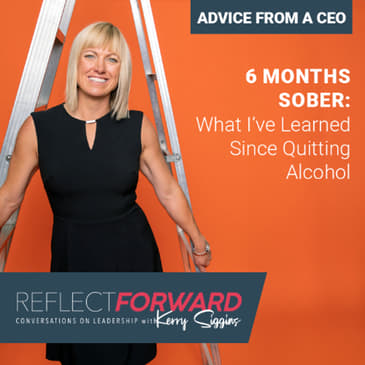

[00:00:10] Hi, and welcome back to Reflect Forward. I'm your host, Kerry Siggins, and I am so glad you are here today.
[00:00:16] Today, I want to talk about what I have learned after being sober for six months.
[00:00:22] I think I mentioned in a previous podcast that I had quit drinking. The podcast was not about quitting drinking.
[00:00:28] It was about doing hard things and giving you motivation and tips on how to do hard things in your life,
[00:00:34] because quitting drinking was certainly something that was difficult for me.
[00:00:37] And now here I am at my six months as of November 30th, and I really wanted to share some of the things that I've learned
[00:00:45] because it has been a profound six months for me in so many ways.
[00:00:51] So for years, I had told myself that I wanted to quit drinking.
[00:00:55] I wrote about it in my journal. I use a journal app called Dabble Me, and it sends you an email every day
[00:01:02] to prompt you to write in your journal, and it also shows you entries from previous dates.
[00:01:09] So for years, these would pop back up, and there were consistently entries that I wrote about wanting to quit drinking,
[00:01:16] how guilty I felt. Like I said, I wasn't going to drink a glass of wine last night, but I caved.
[00:01:21] And it was just really obvious to me that this is something that I had been trying to manifest for a long time,
[00:01:27] but just hadn't been able to do for whatever reason, just turned into a habit.
[00:01:32] And I had done things like dry January and sober October, feeling really proud of myself for quitting drinking for 30 days.
[00:01:39] I think one time I even went like 42 days.
[00:01:42] And then I would just fall back into my nightly ritual of unwinding with a glass or two of wine.
[00:01:49] I loved coming home from work and cooking dinner for my family and having a glass of wine,
[00:01:53] but it just got into this habit that it wasn't healthy and that I felt like I was having issues controlling.
[00:02:01] I would get to the end of the day, and I would look forward to having that glass of wine.
[00:02:06] And while it didn't overwhelm my thoughts, it certainly was in my thoughts.
[00:02:11] Even when I would go out to meet customers for dinner or friends for dinner, I was always like,
[00:02:15] oh, I can't wait until I can have a glass of wine.
[00:02:17] So I just realized like this is not healthy and I need to get it under control.
[00:02:22] So at the end of May 2024, something shifted for me.
[00:02:27] I was in St. George, Utah at a basketball camp with my son and his friends,
[00:02:34] and we were having this great time with all the moms.
[00:02:37] And I had a little bit too much wine, and I just woke up in the morning.
[00:02:42] I was like, that's it.
[00:02:43] I don't want to do this anymore.
[00:02:44] I can't do this anymore.
[00:02:46] It was almost like the universe was talking to me.
[00:02:49] Like now is the time.
[00:02:50] You have been talking about quitting drinking for such a long time.
[00:02:53] Today is the day.
[00:02:54] And that was on May 31st of this year.
[00:02:59] And so I said, that's it.
[00:03:00] I'm done.
[00:03:00] I'm going to quit drinking.
[00:03:01] Now, I knew that quitting drinking was a big commitment.
[00:03:06] It's so prevalent in everything that we do.
[00:03:09] And it is such a habit, something that I really enjoyed having that glass of good wine every night.
[00:03:15] So I didn't commit to complete sobriety.
[00:03:19] I just committed to 100 days.
[00:03:21] I said, OK, 100 days.
[00:03:22] I know that that allows me to truly break that habit, to really get all of the toxins out of my system and to see how I feel.
[00:03:31] So under no circumstance would I have alcohol for 100 days.
[00:03:35] And this was a really important commitment that I made to myself because there were times when I wanted to allow myself to have a glass of wine.
[00:03:43] And I said, no, I made this commitment.
[00:03:46] I am going to not drink for 100 days.
[00:03:49] Absolutely under no circumstances are you having alcohol for 100 days.
[00:03:53] This was not a trial run.
[00:03:55] This was not a half-hearted attempt.
[00:03:56] I wanted to change.
[00:03:59] And I knew that I had to do this.
[00:04:02] Now, as you know, I battled substance misuse issues in my 20s.
[00:04:06] And I successfully quit doing drugs without rehab.
[00:04:09] And so I know that I can do these things.
[00:04:12] I know I can quit substances.
[00:04:15] And while alcohol was never my issue in my 20s, it certainly crept into my 40s as a regular, almost mindless habit, especially during and after COVID.
[00:04:27] Like, I think that's when this really kicked off, when the whole rest of the world, right, was out like, oh, might as well have a cocktail.
[00:04:33] Might as well have a drink.
[00:04:34] I mean, I'm not traveling.
[00:04:35] We're sitting here on the back porch.
[00:04:36] Well, definitely got sucked into that.
[00:04:38] And that is when the nightly habit started.
[00:04:41] So these 100 days were absolutely transformational for me.
[00:04:47] By the end of those 100 days, when I had done my podcast and shared this with you, I had decided that I was going to be done with alcohol for good.
[00:04:55] I've done so much research about how bad it is for you.
[00:04:59] And I knew that my life was so much better without alcohol, even though it wasn't always easy and still isn't easy.
[00:05:08] I just can confidently say this was one of the best decisions that I've ever made.
[00:05:12] Sobriety has brought me so much clarity, courage and connection in my life that I never even imagined it was possible because I was just numbing myself with my nightly glass of wine or two glasses of wine.
[00:05:25] I mean, sometimes half of a bottle of wine, if I'm being honest.
[00:05:28] And so, yeah, it was just really profound.
[00:05:31] And so I wanted to share the five lessons that I've learned since quitting drinking as a way to inspire you.
[00:05:39] If you're thinking about doing something hard or even quitting drinking or if you have substance misuse issues or eating disorders or a shopping habit, which I know all about too.
[00:05:50] I am quitting my shopping habit as well.
[00:05:52] Or whatever you use to cope with your feelings.
[00:05:57] Hopefully this can inspire you to address it because life can be so much more fulfilling when you allow yourself to be the true you instead of masking your feelings with substances, alcohol, food, shopping, gambling, porn, whatever it is.
[00:06:17] Working too much, right?
[00:06:19] Working too much is absolutely a way that people cope, that they use it as a way to not have to deal with the things that are making them unhappy in life.
[00:06:31] I know all about these things too because I love to work, but it also allows me to not have to deal with some of the things I don't want to deal with.
[00:06:38] Oh, nope, got to work.
[00:06:39] So there's all kinds of things that we use in our lives to really numb ourselves, to avoid things.
[00:06:47] So hopefully this is just an inspiration for you to address that, whatever that might be in your life.
[00:06:53] And if you are one of those lucky people who don't have those things or who have done the work, I applaud you and I respect you.
[00:07:01] And I would love for you to share your tips and your stories because I think so many of us are just trying to get by the very best that we can.
[00:07:10] And we use things to help numb the hard feelings, the difficultness in life, because let's face it, that is life.
[00:07:20] Life is hard.
[00:07:20] It's hard for everybody.
[00:07:21] Harder for some people than others.
[00:07:23] But this life, this human existence, it's not meant to be easy.
[00:07:28] All right.
[00:07:29] So anyway, what did I learn?
[00:07:31] Number one, clarity.
[00:07:33] Clarity opened the door to courage and success for me.
[00:07:37] Without alcohol clouding my thoughts or numbing my emotions, I gained a level of clarity that has fundamentally changed my life.
[00:07:45] At 46, I feel like I am finally figuring out who I am and what I want in my life.
[00:07:52] And this is a really interesting thing for me to say because I have done so much work on myself over this past two decades to really understand who I am, what motivates me, what my triggers are, what the dark sides of my personality are.
[00:08:07] But this clarity that I have with no alcohol, I can see the nuanced areas of my life where I need to change.
[00:08:17] I have finally had the courage to make some of those decisions.
[00:08:20] Courage started with quitting drinking.
[00:08:22] But it has had a cascade effect in my life where it has really allowed me to say, okay, these things make me happy and I want to do more of these.
[00:08:30] And these things don't make me happy.
[00:08:32] And I want to do less of them.
[00:08:34] Or these relationships are serving me and I want to really cultivate them.
[00:08:39] Or these relationships are not healthy for me to have.
[00:08:42] And so I need to either set boundaries or end the relationships.
[00:08:47] And I never had that kind of clarity when I was drinking because it numbed my feelings.
[00:08:54] It just brings this kind of cloudiness that you just don't even realize.
[00:08:58] So what I really learned is that wine was numbing both the good and the bad feelings for me.
[00:09:04] Which allowed me to ignore the dissatisfaction that I had in my life and set aside the dreams, the things that I really wanted to go after.
[00:09:12] Because it felt too big or too daunting or, I don't know, I just was like stuck and I just didn't even know it.
[00:09:18] And now I just have so much more confidence about what I want in my life.
[00:09:22] And I am willing to make some of those really tough decisions because I have clarity of this is what I want and this is what I don't want.
[00:09:30] And I don't have, you know, that wine that just, I don't know, you know, it feels like it takes the edge off, but it really takes the clarity off.
[00:09:38] So I trust myself and I am more than ever aligned with my values and so excited about what the future is going to bring.
[00:09:47] The second thing is that sobriety really has strengthened my relationship with my son.
[00:09:51] Before I quit drinking, I was often just irritable or impatient with Jack, especially after a long day.
[00:10:00] And drinking wine while it seemed like good in the moment of like, okay, I can unwind.
[00:10:04] It definitely didn't help.
[00:10:05] It exasperated the moods that I had.
[00:10:08] And even though I'm not a super moody person and don't have mood swings, I could definitely find myself feeling more on edge with Jack.
[00:10:15] And I just thought it was the stress of my life.
[00:10:17] I have a big job.
[00:10:18] I have a podcast.
[00:10:19] I write a book.
[00:10:20] I speak.
[00:10:21] I have all of these big ambitions and I have a family to take care of.
[00:10:25] And even though I handle stress really well, it's like, you know, it's a lot.
[00:10:29] So feeling on edge was just what I thought was a normal feeling.
[00:10:32] And wine really helped take that edge off.
[00:10:34] But what I realized after quitting drinking is that it was only making me feel worse and that I was actually more crabby and more irritable because I was drinking.
[00:10:43] And there's all kinds of research out there that shows that, yes, that first glass of wine or that first cocktail, that first beer.
[00:10:48] Oh, I feel so much better because you get the dopamine hit.
[00:10:51] It actually adds to feelings of anxiety and depression.
[00:10:54] Some people find themselves to be suicidal, even though they're not suicidal because alcohol is a depressant.
[00:11:00] And it's so messes with your brain chemistry and your hormones.
[00:11:04] And so this is why I was irritable with my son.
[00:11:07] And now I am way more present.
[00:11:09] I'm less cranky with him.
[00:11:11] I don't get annoyed by all of the things he does.
[00:11:14] Like, I mean, he's 12 year old boy.
[00:11:17] So, of course, I get annoyed by all of the poop and penis talk because it seems like that's what 12 year old boys, all they want to talk about.
[00:11:24] And then this crazy language that they're using.
[00:11:26] But I just genuinely enjoy my time more with Jack than I ever have.
[00:11:31] And in the process, I've become a role model for him.
[00:11:33] He sees me kicking this habit that wasn't serving me anymore.
[00:11:37] And I am living such a much more happier, healthier life.
[00:11:41] And he notices me.
[00:11:42] And he noticed when I first quit drinking.
[00:11:44] He's like, Mom, why aren't you having a glass of wine?
[00:11:46] Mom, do you want me to get you a bottle of wine?
[00:11:48] Which is something that I was not always OK with, even though I was always like, yeah, sure.
[00:11:52] Jack thinks. Grab me a bottle of wine.
[00:11:53] I am just role modeling something so much healthier for him.
[00:11:57] And I'm showing him that you don't need alcohol to have fun or to unwind.
[00:12:01] And I believe that this is a gift for him.
[00:12:05] He is absolutely going to be faced with pressures to drink and do drugs.
[00:12:09] All kids are.
[00:12:10] And by me being open about my struggles with drugs back in my 20s, which I shared with him before my book came out because I wanted him to hear it from me and not from anyone else,
[00:12:22] even though he was just 10 years old when I had to tell him.
[00:12:26] I am showing him that you can do hard things and that you don't need substances and that if you do use substances, you're not a bad person and you can overcome it.
[00:12:37] You just have to decide and commit and have a strong support system around you to be able to do it.
[00:12:43] So hopefully he never faces the issues that I faced.
[00:12:46] I don't think that he will because he is such a rule follower and I am such not a rule follower.
[00:12:51] But I just know that I am teaching him.
[00:12:54] And this is a huge gift for him to be able to see what it's like to be able to do something hard and to have fun and unwind without having to have alcohol.
[00:13:04] The third thing is that I feel happier inside and out.
[00:13:09] The physical changes that have happened since I have quit drinking have been remarkable.
[00:13:13] So I've lost a little over 20 pounds, almost 25 pounds, which is amazing.
[00:13:18] And I believe that that is not all just from a glass or two of wine every night, although that is certainly part of it.
[00:13:24] It's pure sugar and empty calories and not good for you.
[00:13:28] But I believe it was disrupting my hormones going into my 40s.
[00:13:32] It's a time when hormones change.
[00:13:34] And so a lot of the things that were happening, like my skin breaking out, I just chalked up to, oh, you know, I'm periomenopausal.
[00:13:41] And this is just what happens.
[00:13:43] But what I realize now is that alcohol is a hormone disruptor for both men and women.
[00:13:48] And it causes you to deplete your testosterone, your estrogen, your progesterone, which both men and women have.
[00:13:56] And it's very difficult to have balanced hormones if you are drinking.
[00:13:59] And that's what happened to me.
[00:14:01] And so not that I was overweight, but I certainly had a little bit of body fat, which I always disliked.
[00:14:08] And quitting drinking really changed my body.
[00:14:12] It's amazing.
[00:14:13] I don't work out any differently.
[00:14:14] I don't eat any differently.
[00:14:16] But I definitely have seen my body composition change.
[00:14:20] My skin is clear.
[00:14:22] I just feel much more glowing and radiant because I'm not poisoning myself with alcohol.
[00:14:27] So that's been really profound.
[00:14:29] I don't know that that happens to everybody.
[00:14:31] I do know that some people have profound weight loss and some people don't.
[00:14:34] But for me, you know, I definitely lost a lot of weight.
[00:14:38] And I feel really, really, really good.
[00:14:40] It wasn't about losing weight for me.
[00:14:41] It was really about not feeling guilty every single morning when I promised myself I wasn't going to have a glass of wine.
[00:14:47] And I did.
[00:14:47] And I was so tired of having that conversation with myself.
[00:14:51] That's why I quit.
[00:14:52] But the benefits for my physical appearance have certainly been worthwhile.
[00:14:57] But even more than just the physical aspect, it's the energy that I'm feeling.
[00:15:02] Right?
[00:15:02] I am strong and vibrant.
[00:15:04] And what I realized is that alcohol was depleting my energy.
[00:15:08] And it was depleting my happiness.
[00:15:11] And now I am reclaiming both.
[00:15:13] So it's not about just those physical appearances.
[00:15:16] It's about waking up feeling good about yourself every morning.
[00:15:19] Feeling like I can take on the day with energy and happiness and to be of service to other people.
[00:15:24] Like I've never felt so strongly about this, even though those things have always been part of my ethos.
[00:15:30] But now it's just what's front and center instead of a little bit of that fuzz every morning and the guilty feelings that I had and the anxiety that drinking brought.
[00:15:40] Like it just has really made me healthier inside and out.
[00:15:43] The fourth thing that I've learned is that I can have fun without alcohol.
[00:15:47] And I'm more authentic doing it.
[00:15:49] So this was the biggest piece for me was how am I going to have fun without drinking?
[00:15:55] Am I going to be able to go to a restaurant and order a Pellegrino and not feel anxious because I'm not drinking?
[00:16:04] Can I go to social events and have fun?
[00:16:06] Like I hate small talk.
[00:16:07] Having a glass or two of wine absolutely made small talk bearable.
[00:16:12] And it just felt awkward to not have a drink in my hand.
[00:16:16] And you know what?
[00:16:17] At first it was all of those things.
[00:16:19] It wasn't easy to go to a restaurant and not have a glass of wine with friends or out with customers.
[00:16:27] My first party I went to and didn't drink.
[00:16:30] It didn't feel fun.
[00:16:32] It felt weird and awkward.
[00:16:35] And I didn't like it.
[00:16:38] But I knew I just had to get through those initial firsts because there's always going to be those firsts.
[00:16:45] The first time you go to a restaurant and not drink.
[00:16:47] The first time that you go to a party and not drink.
[00:16:51] The first time you go on vacation and not drink.
[00:16:53] So I knew I was going to have all of these things.
[00:16:55] I listened to a great podcast called Sober Powered and it's weekly.
[00:17:00] This woman is amazing.
[00:17:02] She gives all kinds of great tips about being sober and how to get through those early days.
[00:17:07] And I listened to those, oh gosh, multiple times a week to really help motivate me.
[00:17:13] One of the things that I learned is that once you get through those initial firsts and get over that anxiety,
[00:17:19] you actually can have more fun.
[00:17:21] And I have found that to be true.
[00:17:23] So now when I go out, I am enjoying myself because I am actually me, not me with a wine buzz,
[00:17:32] which is either masking my personality or amplifying my personality and just overall altering the experience.
[00:17:39] So whether I'm drinking water or a mocktail or an amazing glass of non-alcoholic sparkling rosé,
[00:17:45] which I have found, I've tried all the different mocktails.
[00:17:49] And so if you ever want any tips on things to try, I have found all kinds of great things.
[00:17:53] I just feel more myself.
[00:17:55] I feel like I'm engaged and I'm authentic and I'm genuinely happy.
[00:17:58] And I go home and I sleep and I wake up the next day and I feel great.
[00:18:02] And it makes me really happy.
[00:18:05] So yeah, you can have fun without drinking.
[00:18:07] It might take a little while.
[00:18:09] You might go through the, I don't like this.
[00:18:12] This is awkward.
[00:18:12] I don't want to talk to people.
[00:18:14] Ugh, people are looking at me.
[00:18:16] But you will get through that when you quit drinking.
[00:18:20] So anyway, that's what I have learned.
[00:18:22] You don't have to have alcohol to have fun.
[00:18:24] And I think I'm actually better to be around not having a glass of wine.
[00:18:30] And finally, number five, my productivity has absolutely skyrocketed.
[00:18:35] It is supercharged, which is crazy because I am a super productive person anyway.
[00:18:40] But what I realized is that with my nightly glass of wine,
[00:18:45] I didn't want to do anything after I had dinner.
[00:18:47] I was tired.
[00:18:48] I just wanted to go to bed.
[00:18:49] I'm not a TV watcher.
[00:18:50] I watch no TV, but I would scroll on my phone, get ready for bed,
[00:18:54] go to bed early because I get up so early to work out.
[00:18:56] And what I realized is like, hey, I don't feel tired.
[00:19:00] I don't have that like little wine haze or wine buzz.
[00:19:04] And so now I read after dinner or I write.
[00:19:09] Sometimes I work if I need to.
[00:19:11] Sometimes I just do yoga.
[00:19:13] That has made me feel so much better.
[00:19:15] And it's so much more productive than scrolling on social media,
[00:19:19] killing time before you go to bed because you're just tired and groggy
[00:19:22] from having a glass of wine.
[00:19:23] So the lethargy is gone.
[00:19:25] I wake up in the morning, which I never had that problem.
[00:19:28] Even when I did have my nightly glass or two of wine,
[00:19:31] I always got up early to work out.
[00:19:33] I've trained myself disciplined to be able to do that.
[00:19:35] But those mornings are no longer clouded by regret or lethargy
[00:19:40] from having my nightly glass of wine.
[00:19:43] I wake up feeling ready to tackle the day with lots of energy
[00:19:46] and a great mood and life is so much better.
[00:19:50] So this shift to no alcohol has made me more creative,
[00:19:53] more focused, more intentional about how I spend my time,
[00:19:57] who I spend my time with.
[00:19:58] And it's given me back the precious hours because let's face it,
[00:20:01] time is the only thing that we actually cannot get more of.
[00:20:06] And I didn't realize I was losing so much time because of my wine habit.
[00:20:11] So why am I sharing this with you?
[00:20:13] It is 100% not to judge anyone.
[00:20:16] It is 100% not to tell you that you need to quit drinking.
[00:20:19] Many people can drink without it becoming a habit or an issue.
[00:20:23] It's simply just to share this experience because it has been so profound for me.
[00:20:29] And so if you have ever wondered if alcohol might be diminishing your quality of life
[00:20:34] or some other habit that you have that is not bringing you joy and happiness,
[00:20:39] but instead making you feel anxious or bad about yourself,
[00:20:44] I hope that this podcast inspires you to explore this question.
[00:20:49] Why do I need this?
[00:20:51] Why is this a habit?
[00:20:53] How can I break this habit so that I can too feel better about myself,
[00:20:58] that I can live a happier, more fulfilled life,
[00:21:00] that I can have more time, I can be creative,
[00:21:04] I can have more energy,
[00:21:05] I can have better relationships because bad habits absolutely diminish the quality of our life.
[00:21:12] So for me, quitting drinking is a huge step to a happier, more fulfilling life.
[00:21:17] So if you are looking to make a change,
[00:21:20] here are three tips that helped me break my habit.
[00:21:24] First, commit to a specific goal.
[00:21:27] Set something that is absolutely non-negotiable for you,
[00:21:30] whether it's 30 days, 60 days, or 100 days or more.
[00:21:34] Setting this kind of specific time period allows it to feel really meaningful and doable.
[00:21:41] Like you can stick with it because it's only 30 days or 60 days or 100 days.
[00:21:46] And it gives you some structure and some momentum and doesn't feel completely overwhelming like,
[00:21:52] oh, I have to quit forever.
[00:21:53] I don't know if I would have done it if I would have started this journey and saying,
[00:21:57] oh, I'm quitting forever, even though that's what I plan to do.
[00:22:00] But I'm not even saying that.
[00:22:01] Now it's like, okay, I'm going to get to a year.
[00:22:03] And then we'll get to a year and then I'll decide,
[00:22:06] do I want to have a glass of wine or am I going to keep going?
[00:22:09] I'm going to keep going, but I'm not even putting that kind of pressure on myself.
[00:22:12] Now it's just like, okay, you made it six months.
[00:22:14] Now let's get to a year.
[00:22:15] So those specific goals really help give you that structure and momentum.
[00:22:20] Number two, identify your triggers and replace your rituals.
[00:22:23] Habits are often tied to very specific triggers.
[00:22:27] So for me, it was going home after work, starting to make dinner.
[00:22:31] That was a habit that I did that I wanted to have a glass of wine.
[00:22:34] It was my ritual.
[00:22:36] So all kinds of things can be triggering to you.
[00:22:39] It could be time of a day.
[00:22:40] It can be a place, emotions.
[00:22:42] It could be people.
[00:22:43] So pay attention to those triggers and find healthier alternatives.
[00:22:46] So for me, the biggest trigger that I found, which was very surprising to me, was traveling.
[00:22:52] Not having a glass of wine on the airplane or not having a glass of wine when I go into
[00:22:58] the United Club during my layover and drink a crappy glass of free wine.
[00:23:03] The first time I traveled and didn't drink, I was like, oh, I really would like a glass
[00:23:07] of wine.
[00:23:08] The first time I went into the United Club and didn't go get my free glass of wine,
[00:23:11] I was like, oh, I really want a glass of wine.
[00:23:13] And so I paid attention to that.
[00:23:15] I was like, okay, this is that ritual.
[00:23:18] This is a trigger.
[00:23:19] What do I need to do to make sure that I don't give in to that trigger?
[00:23:26] Well, it's easy.
[00:23:26] Just immediately on the plane, order a sparkling water.
[00:23:30] I avoided the United Club those first couple of months so that I didn't have that trigger.
[00:23:36] Now I can go in.
[00:23:37] It's not even a big deal.
[00:23:38] I don't even think about it anymore.
[00:23:39] But that was a very specific trigger for me.
[00:23:41] So instead, I was like, nope, I'm just going to walk around the airport.
[00:23:44] I can set up my laptop.
[00:23:45] At DIA, they have all kinds of places now that you can do your work and not have to be in
[00:23:50] a restaurant, bar or United Club.
[00:23:52] So I didn't have that trigger that would make me want to drink of it.
[00:23:55] I would have to overcome it and just kind of feel icky.
[00:23:59] So that was something that I noticed for me.
[00:24:01] And then replacing it with a different ritual.
[00:24:05] Like I love making a mocktail.
[00:24:06] My favorite mocktail is a glass of sparkling water with a splash of tart cherry juice and
[00:24:14] a squeeze of lime.
[00:24:14] So thank you to a couple of my fellow employee owners who told me about this great mocktail.
[00:24:20] It's cheap.
[00:24:21] It is easy and it is so good.
[00:24:24] And that's what I have.
[00:24:26] Like I said, I also found a great sparkling wine, non-alcoholic, that is amazing.
[00:24:31] And so I can pour myself a glass of that if I'm really feeling like I want a glass of wine or
[00:24:35] I'm out with friends.
[00:24:36] That's what I do because it really legitimately feels like you're drinking wine.
[00:24:40] And then I am doing yoga or I'm writing like right now.
[00:24:44] It's after dinner and I'm recording this podcast.
[00:24:46] It is much more creative and I've replaced those nightly rituals with new ones.
[00:24:52] So identify those triggers and then replace them with different rituals.
[00:24:56] And you will find that you won't get triggered as often and the triggers won't be as strong.
[00:25:04] And then finally, prioritize consistency over perfection.
[00:25:08] Being consistent really matters.
[00:25:10] And it takes time to break a habit.
[00:25:12] The often cited 21 days to break a habit is not actually accurate.
[00:25:17] Research shows that it can take anywhere from 18 to 254 days to break a habit.
[00:25:23] So that's an average of 66 days.
[00:25:25] And breaking a habit depends on all kinds of things like how long you have had the habit
[00:25:29] for, what your environment is, what your triggers are, what the habit is, your motivation to
[00:25:36] really kick the habit.
[00:25:39] So there's all kinds of things that will allow you to either move through it faster or longer.
[00:25:43] But the 21 days is not really accurate.
[00:25:46] I definitely found that hitting the 100 days was a really powerful thing for me.
[00:25:51] So be patient with yourself.
[00:25:53] Be consistent.
[00:25:54] Focus on progress rather than quick fixes.
[00:25:56] If you do fall off the wagon from whatever habit you're trying to kick, it's okay.
[00:26:01] Just get back on the next day.
[00:26:02] You do not have to let it spiral you and you do not have to say,
[00:26:05] Oh, see, it's not worth even trying because I can't kick this habit.
[00:26:11] Everybody falters.
[00:26:12] Everybody does.
[00:26:13] We all falter in life.
[00:26:15] I had tried to quit drinking for years and it took me this long to make it happen.
[00:26:20] Do not feel bad if you are trying hard to kick this habit and something happens to derail you.
[00:26:27] Just get back on track.
[00:26:27] Just start over.
[00:26:28] Just be consistent.
[00:26:29] Be patient with yourself and focus on your progress, how far you've come.
[00:26:34] So quitting alcohol has been one of the most transformative experiences of my life.
[00:26:40] It has not been easy.
[00:26:42] Lots of things have come out of quitting drinking.
[00:26:46] Some really good things and some things also that I just needed to deal with in my life that I wasn't dealing with.
[00:26:53] But the rewards have been worth every moment of discomfort.
[00:26:57] Every moment of having to look and say,
[00:26:59] Ooh, I don't like that.
[00:27:01] I need to change that.
[00:27:02] I was numbing myself to that.
[00:27:04] If you're ready to make a change in your life, whatever that change might be,
[00:27:09] know that it is possible.
[00:27:11] The life waiting for you on the other side might just be better than you ever imagined.
[00:27:19] Thanks for listening to this podcast.
[00:27:22] I appreciate you allowing me to share my story.
[00:27:25] I would love to hear from you if you have comments or would like to share your story to sobriety or kicking some other bad habit.
[00:27:33] We are all in this together and I'm here to support you in doing hard things.
[00:27:39] So feel free to reach out.
[00:27:41] And if you like this podcast, please share it with a friend, write a review, subscribe to the podcast on YouTube.
[00:27:47] It really helps get the word out.
[00:27:49] And I so appreciate you being on this journey with me.
[00:27:54] Have a great rest of your day and we will see you next week on Reflect Forward.