
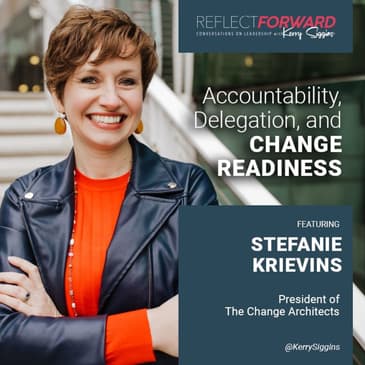

[00:00:10] [SPEAKER_00]: Hi everyone, and welcome back to Reflect Forward. I'm your host, Kerry Siggins, and I'm so glad you're here today.
[00:00:15] [SPEAKER_00]: Today my guest is Stephanie Krevins. She is the president of the Change Architects, which is about
[00:00:19] [SPEAKER_00]: teak integration firm dedicated to driving transformation and upscaling workers in mid-market
[00:00:25] [SPEAKER_00]: enterprise organizations. She is an expert in change management and conflict in accountability
[00:00:31] [SPEAKER_00]: and she uses a framework called the Change Architecture with her clients. She is also
[00:00:36] [SPEAKER_00]: the host of the Hot Mess Hotline, which is the podcast for ambitious leaders who want to drive
[00:00:41] [SPEAKER_00]: impactful change. I know you're going to enjoy this interview with Stephanie so hang tight, and I will
[00:00:46] [SPEAKER_00]: be right back. Hi everyone, welcome back. I have Stephanie Krevins with me, Stephanie. Thank you so much
[00:00:59] [SPEAKER_00]: for joining me on the show today.
[00:01:00] [SPEAKER_00]: How thanks for me. I'm so excited. Absolutely, we're going to have so much fun. So you are the
[00:01:06] [SPEAKER_00]: president of the Change Architects. So can you tell us a little bit about what the change
[00:01:10] [SPEAKER_02]: architects is and why you started it? Yeah. So we really focus on helping organizations figure
[00:01:16] [SPEAKER_02]: out how to optimize their tech people in process, and we do that by helping them create
[00:01:23] [SPEAKER_02]: cultures of change readiness, especially in small businesses, and in the mid-market too,
[00:01:28] [SPEAKER_02]: we're going to have to change the changes just coming out as constantly, and we feel like
[00:01:31] [SPEAKER_02]: we have to keep up. And we have to outpace and we have to know what's always coming up.
[00:01:35] [SPEAKER_02]: It can be exhausting or it can be exhilarating. And so instead we take the perspective that
[00:01:40] [SPEAKER_02]: let's get your people ready to figure out what's next and set the pace for change versus
[00:01:45] [SPEAKER_02]: always in reaction mode. And that looks like having really great leadership development programs,
[00:01:51] [SPEAKER_02]: really great change readiness program, really great talent experience and communication and
[00:01:56] [SPEAKER_02]: project management programs. But instead of all of them being disconnected, we have a
[00:02:01] [SPEAKER_02]: unifying strategy that connects the dots on all of those buckets and says, instead of having
[00:02:06] [SPEAKER_02]: all these different programs, let's have one program that implements all of that and make
[00:02:11] [SPEAKER_00]: sure strategic plan a reality. I love this. We're changed readiness. So can you tell a little bit more about
[00:02:16] [SPEAKER_00]: what you mean by that and how do you help somebody be ready for change? Yeah. So for a long time,
[00:02:23] [SPEAKER_02]: it's kind of been accepted practice in our organizations that changes hard and nobody likes
[00:02:28] [SPEAKER_02]: change. And that's really an up-skilling problem. A lot of leaders run into resistance and
[00:02:34] [SPEAKER_02]: perceive resistance when they're folks start questioning them or start asking questions
[00:02:39] [SPEAKER_02]: or start trying to make sense of it in their own head with the leaders communicating.
[00:02:44] [SPEAKER_02]: Leaders perceive that as resistance and my perspective is that's probably not always resistance.
[00:02:51] [SPEAKER_02]: It's probably them trying to make sense of it so they can enact your vision because they want to.
[00:02:57] [SPEAKER_02]: So that's an element of change readiness is perceiving the questioning as they're open to it.
[00:03:04] [SPEAKER_02]: They just need to make sense of it before they can move forward or instead of hearing an idea and
[00:03:10] [SPEAKER_02]: shutting down it's being curious about it and saying, I need to digest that. I need to make sense of
[00:03:17] [SPEAKER_02]: that for my role in my department. That's change readiness or understanding your relationship to change.
[00:03:23] [SPEAKER_02]: Plain and simple, right? I love change for change sake. A lot of leaders do. That's one way of
[00:03:29] [SPEAKER_02]: relating to change. Do you understand your relationship to change and how to leverage that for the organization?
[00:03:36] [SPEAKER_02]: So self-awareness, team awareness, organizational awareness around when do we accept change? Why do we accept it?
[00:03:43] [SPEAKER_02]: How do we put it to good use for our business and the industry that we're in?
[00:03:48] [SPEAKER_00]: Chained readiness. You know, I think at my experience at least it's easy to say people are resistance to change
[00:03:54] [SPEAKER_00]: or don't want to change but really it's not actually even about the idea or the direction or the strategy.
[00:03:59] [SPEAKER_00]: It really comes down to people saying, I only want to change if I want to change and so when they don't have control of that external world,
[00:04:07] [SPEAKER_00]: then they're going to be forced to change themselves. And I always go back to that idea that you got to talk about what
[00:04:15] [SPEAKER_00]: it means for that person and help them decide that they're ready to actually make that change because nobody wants
[00:04:21] [SPEAKER_00]: to be forced to change themselves. And that's what this all is. If you're going through some big organizational shift,
[00:04:27] [SPEAKER_00]: people's jobs are going to change. What does that mean to me? I'm comfortable. I don't really want to change what I do.
[00:04:32] [SPEAKER_00]: I don't want to go learn a new skill. I don't want to be forced to have to do that and that always helps me have more
[00:04:38] [SPEAKER_00]: compassion because even though I am a change agent myself and you know, I thrive on change, I thrive on disruption
[00:04:44] [SPEAKER_00]: because I'm a CEO. I get to do it on my own terms most of the time, not all the time, but most of the time versus on somebody else's terms.
[00:04:51] [SPEAKER_00]: But that's not always the case as an individual contributor where you feel like you might be at the whims of leadership's decisions.
[00:04:57] [SPEAKER_02]: Oh, I couldn't agree more. I connected to employee engagement models where they say that employees in order to be engaged in their work,
[00:05:04] [SPEAKER_02]: they want to be valued. They want to have autonomy and they want to have work that means something.
[00:05:08] [SPEAKER_02]: And to your point exactly when we are handing a decision to our people in that moment, it feels like there's an element of autonomy being taken away.
[00:05:18] [SPEAKER_02]: Because they signed up for an old job. They signed up for their old role, those duties and along the way things have course corrected but in that moment,
[00:05:27] [SPEAKER_02]: it feels like you taking away a decision from them and they need a minute to wrestle with that. They deserve to kind of cycle through that in their brains so that they can get themselves on board.
[00:05:38] [SPEAKER_02]: And find meaning in the new thing that you're asking them to do.
[00:05:42] [SPEAKER_00]: So I completely agree with you and I think that disability to be ready for change is such an important trait because things do change so fast now.
[00:05:50] [SPEAKER_00]: Things are always changing but the pace of change is so rapid, especially with the onslaught of technology and what's going to happen with AI.
[00:05:57] [SPEAKER_00]: Our roles are going to change so much. It's going to look very different five years from now then what it does today.
[00:06:03] [SPEAKER_00]: And so I really like this idea of change readiness and how do you help people prepare for it because we're all going to be forced to look at things differently because of how disruptive AI will eventually be to the way that we work.
[00:06:17] [SPEAKER_00]: And I don't even know if people are really having those conversations, if it's just like that.
[00:06:20] [SPEAKER_00]: Oh, we're about it later.
[00:06:21] [SPEAKER_00]: Fear about that's out there. Certainly for running a company, I think about it a lot.
[00:06:25] [SPEAKER_00]: Like, how is this going to change the way that we work? And I think it's hard for anybody to say exactly what it's going to look like. But we all know we're going to have to change.
[00:06:33] [SPEAKER_02]: Yeah and I think when we're stuck in the messy middle of change like that where as a leader, you're asking these questions you're being curious.
[00:06:42] [SPEAKER_02]: You don't have the answers. You want to go to your team and say, hey, help me answer these really big questions around AI digital transformation.
[00:06:50] [SPEAKER_02]: Whatever the next thing is, there is a large segment of people that are sitting there going, oh God, change is coming. And I don't know what it means.
[00:06:57] [SPEAKER_02]: And because I don't know what it means and it's uncertain they forget a little bit and they need support in understanding themselves so that they can be comfortable in the uncertainty.
[00:07:08] [SPEAKER_02]: That cannot be your responsibility to manage that for Sarah and accounting. That has to be Sarah's responsibility.
[00:07:15] [SPEAKER_02]: And that's why I do believe the work that we do is so important because I want to help Sarah engage yourself in the AI conversation, not Sarah sit there and ring her hands for two years and work herself out of a job because she couldn't engage in what's next. That's heartbreaking to me.
[00:07:34] [SPEAKER_00]: Yeah, I think it's such an important part of upscaling.
[00:07:36] [SPEAKER_00]: And I think a lot of people don't really understand what upscaling means and how to tackle it. Certainly as a country we're not doing it and we should be.
[00:07:44] [SPEAKER_00]: But organizations need to be looking at it as well and bringing people along for that journey so that it isn't so, but I think a lot of the years of course, you know, they don't know what it's going to look like either.
[00:07:55] [SPEAKER_00]: But can you talk just a little bit about this idea of upscaling and how important it is and how leaders can start to incorporate it more in these conversations as they're discussing the change and what the future is going to look like.
[00:08:05] [SPEAKER_02]: Yeah, thanks for opening the door. I think this is such an important conversation and I do think we can simplify it a bit so it's not so overwhelming.
[00:08:15] [SPEAKER_02]: The way I think about it is in order to design the skillset that you need for your organization in five or ten years.
[00:08:22] [SPEAKER_02]: The organization has to know where it's going to be in five or ten years or about we have to decide if we're going to try to travel to California together or Chicago together or.
[00:08:33] [SPEAKER_02]: Tuscaloosa, Alabama. Those are all three very different destinations as a company the company has to be able to articulate a vision who are the heroes inside of our organization what purpose are we serving in the world.
[00:08:47] [SPEAKER_02]: Then from there, we can extrapolate what skills we need in order to be successful in the future and of course, these are broad strokes because no one knows what the future holds unless you're a fortune teller.
[00:08:58] [SPEAKER_02]: And if that's the case, we need more of you but none of us that I know are fortune tellers and so in the future about where are we going to be about what do we need and you can articulate that in hard skills.
[00:09:11] [SPEAKER_02]: Fairly simply has a way to get something down on paper to get us towards something to work towards versus what we're going somewhere we're going to do some things yeah, we need some people in IT.
[00:09:21] [SPEAKER_02]: It's actually an IT we know that we want to maintain the CIO role we want to add on a chief AI officer and these are the strategies that that person will deploy so if these are the strategies these are the top 10 skills that we need.
[00:09:36] [SPEAKER_02]: What does that look like today what skills should we hire for.
[00:09:41] [SPEAKER_02]: Now let's hire for those roles and let's work a development plan so that in five years they're closer to being able to deliver on strategies and so it's just reverse engineering your organization of the future.
[00:09:54] [SPEAKER_02]: What makes it so hard is it's hard to decide what kind of organization do we want to be in 10 years.
[00:10:01] [SPEAKER_02]: It's a very creative question but it's also a very mind blowing question and I think that's what these times are calling leaders for is make some decisions about the future so that we can get our butts on that bus and start going.
[00:10:15] [SPEAKER_00]: I did this exercise and I guess it was probably 2018.
[00:10:20] [SPEAKER_00]: I could see how technology was going to change our industry we're in the we make industrial cleaning equipment really dirty old school industry you could start to see how technology was going to be needed from an efficiency standpoint a safety standpoint from a labor standpoint.
[00:10:33] [SPEAKER_00]: I wrote out this document the statement of what the future looks like and basically what our role was going to be in it but how are we going to drive it and it really helped.
[00:10:44] [SPEAKER_00]: All of my employees my team see when we make these decisions this is what it's going to be and it's a couple pages long.
[00:10:52] [SPEAKER_00]: We're going to talk about it.
[00:10:53] [SPEAKER_00]: Listen what our customers customers look like this is what our customers look like here's what we look like here's the technology that we're going to bring in here's how we need to think about structuring our go to market strategy and so every year now I go in and I update that with things that we've learned and how it's changed and things that we've done to advance it or places where we missed and now it's just living braving document of what the future looks like.
[00:11:13] [SPEAKER_00]: And then it's really clear driving our vision statement and a lot of leaders poo poo vision and mission statements, but then I would say that you weren't using them properly because they do need to be driving your activities.
[00:11:25] [SPEAKER_00]: So our vision for our core company, Stone Age tools is to have working industrial cleaning robotics and every heavy manufacturing facility in the world by 2040 there's a lot in that right working meaning people are using it.
[00:11:54] [SPEAKER_00]: So we're going to talk about the new business and how do we exploit the core business while thinking about the new business in a different way because it's not going to fit into the old business.
[00:12:09] [SPEAKER_00]: This model very well and so it really does strike those right kind of conversations I think that that just feeds in really well to what you just said if you are a leader listening to this.
[00:12:19] [SPEAKER_00]: Have that whether that's for your company, if you're CEO or you're leading your team try to imagine what three five ten years looks like and help point your team in that right direction because you're right if people are just like well why would we do something different than what's made us successful for the last 40 years.
[00:12:36] [SPEAKER_00]: That's not going to probably make you successful for the next 40 that's got to have a clear vision of where you want to go.
[00:12:41] [SPEAKER_02]: Oh my gosh, were we separated at birth like yes yes yes all of that the leaders that we work with we teach them to write the vision story which is exactly what you've articulated because we get so caught up in a vision statement and trying to boyly get down to two or three sentences full of jargon.
[00:12:58] [SPEAKER_00]: No, we need a full story to do justice to what you are articulated absolutely right and then one sentence right our vision is to have working industrial cleaning robotics and every major heavy manufacturing facility in the world.
[00:13:12] [SPEAKER_00]: Yes by 2040 yes it's super clear it's not a bunch of jargon it's very simple it absolutely drives the direction of our strategy.
[00:13:20] [SPEAKER_00]: But you have to go through that work I've writing out the story because otherwise it's hard to actually really distill it down to something that's impactful and meaningful and everybody gets can I ask you a question that goes along with that yeah.
[00:13:32] [SPEAKER_02]: How do you help yourself in your team stay in that frustrating spot of making the trade offs today that you know you have to make to be successful in a long term.
[00:13:41] [SPEAKER_00]: So we really talk about it through the lens of Ambidextrous thinking I love the book leading us rub to reading it again right now what we try to do is we look at.
[00:13:50] [SPEAKER_00]: Exploite the core business and the core business is what we always used to do doesn't mean that it's going away any time soon but what you do with that is very different the investment comes in cost reduction in efficiency.
[00:14:02] [SPEAKER_00]: And that's different and then you have this new business which we want to explore and so that is about looking at new business models and being open to lower margins or a different cost structure different price and structure because we're doing something that's very different.
[00:14:17] [SPEAKER_00]: So that's how I've done it is teaching my leaders and the extra is thinking but really looking at it that way this is the core business and these are the types of activities that we do to make sure that at least we maintain where we are.
[00:14:28] [SPEAKER_00]: Even though we're not necessarily going to invest heavily in new product development this is where all of the new product development's going to go and we are going to be an explore mode and go through our thought process very differently and kind of spell that out so.
[00:14:41] [SPEAKER_00]: That's how I do it just because leading just roughly resonated with me and I love the idea of Ambidextrous thinking I think leaders need to be able to have that ability to hold the posing truth and they're mindly and really being able to develop that skill set is hard to do.
[00:14:56] [SPEAKER_02]: But it gives kind of more clarity for my team of why we're doing different activities for the different types of businesses. Oh, that makes so much sense and probably going to borrow all of that from you because in today's modern culture saying notethings I think is very, very painful.
[00:15:10] [SPEAKER_02]: It's almost full model like it's almost business full, and it's stopping leaders for making those really tough strategic focus decisions.
[00:15:19] [SPEAKER_02]: And I think that both in mentality that Ambidextrous thinking is much more life-giving, much more creative.
[00:15:25] [SPEAKER_00]: I totally agree. I went through that same thing. I took on too many things because of fear and missing out.
[00:15:29] [SPEAKER_00]: Yep. And then when we decided that we were going to really go after the autonomous robots, I said we're going to pick one specific application and we're going to nail that first.
[00:15:37] [SPEAKER_00]: And so that means saying no to all of these other things that also do need our attention, but this how fast we're going to grow.
[00:15:44] [SPEAKER_00]: We're an employee on company. We don't get outside financing. This is the process that we're going to use to grow. So we have to say really really focus on this particular application.
[00:15:52] [SPEAKER_00]: And so that has made it easier because we put that kind of bounds on it of this is what we're going to nail first. And then we'll go after this next one, but if we haven't nailed this application, then we're not ready to move on.
[00:16:06] [SPEAKER_00]: And so that helps with that ability to say no we're going to pass on that for now. You know, we'll be on the road map, but until we really dialed this in, we're not going to work on anything outside of it.
[00:16:15] [SPEAKER_00]: And that's hard. That's a hard thing to do. I mean, I get wrapped up in like oh gosh, that's a great opportunity. Oh, I can see how that would fit in, but if you don't have the time of the resources to do it, then you're going to do things mediocre or actually fail rather than be known for something that you're really good at and have that dialed first. So that's how we've kind of tried to structure that, but it resonates what you say. I think a lot of leaders do have a fear of if I say no to this someone else is going to do it and what if that hurts my business.
[00:16:43] [SPEAKER_02]: Yeah, I was at a conference last week with a bunch of CIOs and this one gentleman and I were debating about what it means to be a strong leader in modern times and his perspective was.
[00:16:55] [SPEAKER_02]: We're seeing a lot of weak leadership in their inability to make the hard decisions and create the strategic focus and direction for us that we need as employees to really understand how to deliver value. And I wouldn't use the words weak per say those were his words, but I can definitely see how business history points to those companies willing to niche down focus and stay the course on something innovative and hard without.
[00:17:25] [SPEAKER_02]: All the shiny objects and I'm such a shiny objects person. So I especially in the view of people that can do it.
[00:17:34] [SPEAKER_00]: It has to take discipline does he does take discipline and I understand where leaders are when you don't want to make the calls like what if I make the wrong decisions.
[00:17:42] [SPEAKER_00]: And that's a tough one. No, what do you want to make the wrong decision? But I agree that you got to make a decision and invest in it and go for it. You're always going to be better off if you focus than if you don't focus.
[00:17:52] [SPEAKER_00]: And then if you get a wrong pivot, yes. That's what we have to do. Pivoting is a huge part of running business especially this day and age.
[00:18:00] [SPEAKER_00]: Just absolutely.
[00:18:01] [SPEAKER_00]: All right, so let's pivot to accountability because I know that you are big on any accountability, but you have a little bit of a different way of looking at it.
[00:18:10] [SPEAKER_00]: The added goes I have to hold people accountable, but you look at it a little bit differently. So can you share your thoughts on accountability and how leaders can really frame it to hold themselves accountable and others accountable.
[00:18:20] [SPEAKER_02]: Yeah, I love to talk about accountability and conflict because I do believe they are two competencies that really can drive change in our relationships and our lives and our workplaces.
[00:18:32] [SPEAKER_02]: I see them as fundamental skills to being successful as a human being.
[00:18:37] [SPEAKER_02]: And so accountability, I like to start with the definition because we tended to church it up and over complicated.
[00:18:42] [SPEAKER_02]: It's do what you say you will do when you say you will do it.
[00:18:50] [SPEAKER_02]: The conversation around accountability is not about holding people accountable. I don't know anyone that gets joy from holding people accountable because I think it feels like shit on both sides and where I learned this was my husband and I were foster parents and we had this content just relationship with our case manager.
[00:19:08] [SPEAKER_02]: Very different system. The child wear for our system has a definition of accountability that I do not comprehend and do not play well with.
[00:19:19] [SPEAKER_02]: And so my case manager didn't follow through on something as promised and I was sending this email to her to hold her accountable.
[00:19:27] [SPEAKER_02]: And I sent it and I just felt like junk. Like I just had that feeling that put in my stomach like, I'm going to get in trouble.
[00:19:35] [SPEAKER_02]: I didn't do something. Why isn't this done? I was so frustrated.
[00:19:39] [SPEAKER_02]: And my husband is an unbelievably effective people manager and I just said to him, I was like, this sucks.
[00:19:45] [SPEAKER_02]: Like holding people accountable feels terrible. He's like, it does. It just sucks. And I'm like, it does. It all the way is about lives. Why are we holding people accountable because it puts the pressure on the person to do something when it's the other person's job was supposed to be accountable.
[00:20:02] [SPEAKER_02]: So if that person is just accountable, then that's all that there is to it. Yeah. So let's like simplify it a little bit. And so I think that accountability creates freedom when we promise and deliver to somebody else.
[00:20:17] [SPEAKER_02]: We are making the promise we're holding discipline for ourselves to deliver on a time frame or at the very least holding discipline for ourselves to communicate, hey, I can't meet this result. I can't meet this task versus carry going.
[00:20:31] [SPEAKER_02]: You said that you would get this to me by last Friday and it's Tuesday. Like where is it? Why is that taking up your brain's brace? That is not fair. So instead, I would invite people to create freedom for themselves to promise and deliver which means you get to focus, which means that you get to say no to other things that doesn't help you uphold your promises, especially in today's working age as knowledge workers we spend our day turning out stuff and typing.
[00:20:58] [SPEAKER_02]: And it's really hard to feel accomplished and I want people to feel accomplished at the end of the day. The way you feel accomplished is you promise and deliver.
[00:21:07] [SPEAKER_02]: And that's what I think is inviting people into accountability.
[00:21:10] [SPEAKER_00]: Yeah, I agree with you. I hate that. I don't like that. It's like I now have to take the responsibility for somebody else that's doing their job.
[00:21:16] [SPEAKER_00]: I'm a record book called The Ownership Mindy. Yes. We were a play on company right?
[00:21:19] [SPEAKER_00]: And that's why I like this idea of personal responsibility because you're right. Accountability comes kind of after the fact did I do what I said I was going to do when I said I was going to do it.
[00:21:29] [SPEAKER_00]: I like that pure simple definition that you have, but the personal responsibility comes in to say I am that kind of person. I am going to be that kind of person who does what she says she's going to do.
[00:21:42] [SPEAKER_00]: And that's where that responsibility comes in. If you're trying to hold somebody accountable who doesn't have that personal responsibility, it doesn't feel good and it isn't your responsibility.
[00:21:53] [SPEAKER_00]: To make somebody else personally responsible that has to come from each of us and that's really the basis of their own relationship mindset.
[00:21:59] [SPEAKER_00]: I own everything that happens in my life. I own my decisions. I own my actions. I own my effort. It's not somebody else's fault.
[00:22:07] [SPEAKER_02]: Yes. Yes. Yes. Yes. I think too that gets connected to integrity. So many of us want to have integrity in our lives. We want our outside actions to match our internal feelings.
[00:22:18] [SPEAKER_02]: And when we don't promise and deliver, we're losing integrity with ourselves. We don't trust ourselves or confidence tanks.
[00:22:26] [SPEAKER_02]: It's a whole vicious circle that sends us spiraling into yuckyness.
[00:22:33] [SPEAKER_02]: When instead we could have a virtuous cycle of, let me do what I say. I'm going to do. Let me try. Let me put in the effort. Let me communicate. Let me show up with effort.
[00:22:43] [SPEAKER_02]: That is a much better way of being in this world than like, I suck. I can't deliver. I didn't do it. I have to go tell this person or I'm going to lie a little bit.
[00:22:52] [SPEAKER_00]: That takes too much energy. I'm too tired for that. I'm with you. All right. So let's talk a little bit because as leaders we do have to hold people accountable from time to time.
[00:23:02] [SPEAKER_00]: So how can you do that in a way that is assertive yet kind? So that it actually can bring that partnership up where you don't feel yucky about it and the person you're holding accountable doesn't feel yucky about it.
[00:23:13] [SPEAKER_02]: Yeah, so to me it starts in the conversation with that person and using coaching techniques in the moment to get that person to commit to the thing that they are willing and able to commit to in a time frame that makes sense.
[00:23:26] [SPEAKER_02]: So it's not hey, Kerry, I need that report by next Wednesday. It is, Kerry, I need something to present to the board and the board meeting is next Friday.
[00:23:38] [SPEAKER_02]: What kind of report can you get to me that you think will help me communicate effectively? So what does success look like and when can you get it to me.
[00:23:46] [SPEAKER_02]: We want them to offer up the definition of success first before we insert our definition because again, we're giving them autonomy and we're getting a sense of what their skill set is in the moment.
[00:23:56] [SPEAKER_02]: We're allowing them to set the deadline and those two things again, we're putting autonomy back where it belongs. So that conversation and of course if it's actually like super time mission critical you're going to manage it very closely because there's no negotiating on that you know a board meeting is a board meeting at a board meeting time you can have nothing less than perfection for that.
[00:24:17] [SPEAKER_02]: So if you have to manage that very closely, you will, the more often than not missing the deadline isn't going to take the business completely isn't going to blow anything up, but it does have its repercussions.
[00:24:29] [SPEAKER_02]: And so if that person does miss quality and in timeline expectations, it's a conversation hey you promised me this kind of report by Wednesday and on Thursday, this is what I received and it didn't meet my expectations help me understand what got you here.
[00:24:45] [SPEAKER_00]: It's like seek to understand. I think that's a really good way to approach it. Okay, yeah, this is what you committed to and didn't happen. Let's talk about what happened share that with me and then that allows the person to actually be able to take ownership of it and explain what happened versus you coming down and making those assumptions which doesn't feel good. So I like that approach if seek to understand as a man and I think that's where self leadership comes in.
[00:25:09] [SPEAKER_02]: You have to learn to manage your emotional response, your frustration, your why didn't this person do what I thought they were going to do.
[00:25:16] [SPEAKER_02]: Well, it's probably a skill level which means they need some upskilling, which as a manager you're in the perfect position to train and coach them.
[00:25:24] [SPEAKER_02]: The last thing you want to do is take it from them and not give them feedback.
[00:25:28] [SPEAKER_02]: I'm probably notorious in my organization in a good way. I'll just send a message this doesn't meet my expectations. I need this this and this take another step at it.
[00:25:38] [SPEAKER_00]: Yep, absolutely. I'm the same exact way. How does anybody learn if you just do it for them?
[00:25:44] [SPEAKER_00]: For control. Yeah, exactly. But I think a lot of people is like it's just going to take less time. It's going to be easier if I just do it myself in the short run.
[00:25:50] [SPEAKER_00]: But then guess what, you're always going to be doing it yourself. So how does this play into engagement?
[00:25:56] [SPEAKER_00]: There's so much just engagement inside of organizations we see all the Gallup reports. You know that we're barely moving the needle a little bit of positivity and then it goes backwards, right?
[00:26:04] [SPEAKER_00]: But it's always really low. How does accountability and pressure play into this? Does it make the situation worse? Does it make it better?
[00:26:12] [SPEAKER_00]: How can leaders think about disengagement through the lens of accountability?
[00:26:16] [SPEAKER_02]: Oh, good question. Oh my gosh. Let me approach it a couple different ways. The one that I hear most often is leaders saying, I'm afraid to press them too hard because I'm afraid they'll leave. I'm afraid to hold them to my high expectations because I'm afraid they can't do it.
[00:26:34] [SPEAKER_02]: Any time as a leader you're making a decision out of fear, it is absolutely 110% the wrong decision. Every single time. So as a leader you have to step into your bravery or your courage and invite them into something bigger.
[00:26:48] [SPEAKER_02]: Invite them into high expectations and invite them into their higher self. I'm going to go back to employees need meaning autonomy and to feel connected.
[00:27:00] [SPEAKER_02]: Accountability gives them autonomy. Accountability gives them meaning. Accountability gives them connection. Why wouldn't we use anything other than accountability?
[00:27:12] [SPEAKER_02]: Ultimately, if you have folks that are unwilling to step into their purpose, their autonomy and engage themselves in their job.
[00:27:20] [SPEAKER_02]: That's a choice that they're making. That means they need to choose to work somewhere else.
[00:27:24] [SPEAKER_02]: Where they can find meaning. Where they can find connection. Where they can find autonomy because as human beings, they deserve that.
[00:27:33] [SPEAKER_02]: So I would say use accountability to build engagement because you're using accountability conversations. You're using conflict conversations to build connections in the right ways.
[00:27:46] [SPEAKER_02]: That's what's going to build engagement. Not giving them more free reign less clear expectation that creates frustration.
[00:27:56] [SPEAKER_02]: So I think as a leader, the more meaning you can give and invite them into accountability, you're inviting them into engagement.
[00:28:04] [SPEAKER_02]: The language I use that's different than most HR leaders is that there's a lot of HR language it says is the leaders job to engage them is their leaders job to motivate them.
[00:28:12] [SPEAKER_02]: Absolutely not. It is the employees job to engage and motivate themselves in their own role to make themselves happy. No one else can do that for them.
[00:28:21] [SPEAKER_00]: You know, an interesting aspect to look at this through is through micro management because I think a lot of managers think that I am holding people accountable by micro managing every detail of this.
[00:28:31] [SPEAKER_00]: The extreme of like I'm giving less expectations and I'm letting them have free reign, but then I think that there's also this other side of things where it's I'm going to make sure that I don't just tell them what I want, but I'm also going to tell them how.
[00:28:42] [SPEAKER_00]: And you're doing their thinking for them or you're making them do it your way, which doesn't take that autonomy piece of it.
[00:28:50] [SPEAKER_00]: And so what advice would you have for those people who might tend to be micro managers to give up that little bit of control that they have to be able to create that accountability that accountability doesn't actually come through micro managing.
[00:29:03] [SPEAKER_01]: Yes, oh my gosh. So I am writing a delegation course on this right now and online learning experience on how to delegate effectively because it's such a missing skill and we just wrote the micro management piece on it.
[00:29:16] [SPEAKER_02]: I think the intent to micro manage is good.
[00:29:19] [SPEAKER_02]: If you want to over explain over explain the why it's important and the what not that how but over explain how does this fit into the business. Why is this important? Why do we do it this way?
[00:29:33] [SPEAKER_02]: I think working in a CRM is a perfect example. You don't need to sit down with somebody hopefully and say click on this cell and start typing the last name is how we enter in last names.
[00:29:43] [SPEAKER_02]: What you do need to explain is we chose the CRM because it's helping us deliver on our marketing and sales strategies in A, B, and C ways.
[00:29:52] [SPEAKER_02]: And order to prepare reports to manage the business effectively. We have to enter data consistently from field to field in in certain ways because we know that clean data in creates clean report out. So here are our standards and here's where you find the standards.
[00:30:08] [SPEAKER_02]: That's directing the work effectively versus micromanaging is well, click in the last names field now type in the last name make sure that the first letter of the last name is capitalized.
[00:30:21] [SPEAKER_02]: That's my grand managing if you wanted over explain over explain the why and the what and leave the how to your training manual.
[00:30:32] [SPEAKER_00]: Great great advice. Thank you so much.
[00:30:37] [SPEAKER_00]: Alright, as we wrap things up I have my signature question and I would like to ask you and then we'll dive into how people can find you the name of this podcast is reflect forward what does reflect forward mean to you.
[00:30:47] [SPEAKER_02]: Scott goosebumps when you asked that question. The coaching technique I use for myself is when I'm in a tough situation, a big situation.
[00:30:59] [SPEAKER_02]: I ask myself what's the story that I want to tell about this when it's over specifically about how I showed up.
[00:31:08] [SPEAKER_02]: Sometimes there's about what does success mean, what is winning look like? I think that's important but for me to show up in integrity in this world.
[00:31:14] [SPEAKER_02]: I want to be able to ask and answer myself what's the story that I want to tell about how I engage in this situation when it's over.
[00:31:23] [SPEAKER_00]: Oh my gosh, that has to be one of my favorite answers but it's so good.
[00:31:28] [SPEAKER_00]: It is a sense of it right? I am in this moment right now what do I want it to look like what do I want people to say about it what do I want to be able to say about it when I get through it that is I think the pure essence of reflecting forward.
[00:31:41] [SPEAKER_02]: All right Stephanie, where can people find you? Yes. I would love with folks would join us over at the changearchitects.com.
[00:31:48] [SPEAKER_02]: We've got a podcast called the hot mess hotline where we explore some of these hot mess stories with leaders like yourself and other resources for folks to learn more about our perspective and change readiness and the simplicity of upskilling.
[00:32:03] [SPEAKER_00]: Perfect. And are you active on LinkedIn or is there. Oh yeah, LinkedIn.
[00:32:07] [SPEAKER_02]: Yeah, you too. Yeah, please connect with me on LinkedIn. Yes, LinkedIn of course I love LinkedIn all my good friends come from LinkedIn.
[00:32:15] [SPEAKER_00]: Absolutely. Okay, well we'll include all of those in the show notes as well so people can just click on it and find you.
[00:32:20] [SPEAKER_00]: Thank you. Well Stephanie, this has been such a pleasure to spend the last half an hour with you.
[00:32:25] [SPEAKER_00]: I do agree with kindergarten soul. So this is a very fun interview. Thank you for spending half an hour of your time with me today.
[00:32:32] [SPEAKER_02]: Oh thank you, Gary, so much for the work that you do to bring these conversations to life. I appreciate it.
[00:32:36] [SPEAKER_00]: Thank you. All right, hang tight. Everyone, I'll be right back.
[00:32:46] [SPEAKER_00]: Alright everyone. Thank you so much for listening. I hope you enjoyed that interview with that.
[00:32:52] [SPEAKER_00]: I will leave you to your week. If you like this podcast, please write a review, subscribe to it on your favorite podcast platform on YouTube share with a friend.
[00:33:02] [SPEAKER_00]: So you can share these amazing stories out there with the world. All kinds of great advice for leaders.
[00:33:06] [SPEAKER_00]: I really appreciate it helps with the algorithms as well. So take care and we will see you next week.