
[00:00:00] .
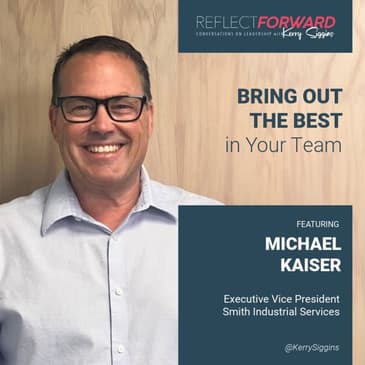
[00:00:10] Hi, everyone and welcome back to Reflect Forward. I'm your host Kerry Siggins and I'm so glad you're here today. Today my guest is Michael Kaiser. He is the executive vice president for Smith Industrial Services, otherwise known as SIS. So they are in Art My Industry. They're a customer of ours and known them for quite some time. And I was super excited to interview Michael because he has such a great philosophy on servant leadership.
[00:00:36] And SIS is doing so many interesting things in a blue collar industry to attract and retain employees and really build out that workforce. And we're all trying to figure that out. And so I thought it would just be a great conversation for you all to learn about some of the things that they're doing to really build this family like culture as they are a rapidly growing company. So hang tight and I'll be right back with Michael.
[00:01:01] All right, welcome back everyone. I have Michael Kaiser with me, who is the executive vice president at Smith Industrial Services or SIS as you can see on his shirt, which is a great customer of StoneAge. So I'm so excited to have you on the show, Michael. Thank you for joining me today.
[00:01:23] Thanks for having me. Awesome. So can you talk a little bit about what Smith Industrial Services does just to give some context and what your role as executive vice president is?
[00:01:36] Sure. Smith Industrial Services is what the name says. We are an industrial services, industrial cleaning company. So we offer a variety of industrial cleaning, municipal cleaning, chemical cleaning services that are either industrial vacuum truck, also hydroblasting equipment.
[00:01:58] We use a variety of automated equipment that includes robots that can clean tanks, nozzles that can clean pipes and tanks and other things.
[00:02:08] We've lately gotten into concrete cutting. Shout out to Chris Smith. He would love to hear that new plug for our concrete cutting service line, among other things. But that principally those are the things that we do and we operate a lot in the manufacturing industry.
[00:02:24] So much of our work is in factories and plants, kind of in the southeastern United States. And then we also do work for municipalities, cities, counties, states and things that consist of anything from line videoing to cleaning process sewers, unplugging drains and things like that as well.
[00:02:46] You're speaking my language. And have you always been in the industrial cleaning industry or is this your first experience when you came on with Smith?
[00:02:54] This was my first experience as an employee. And funny that you say, is it your first experience because I actually worked for International Paper. We were a customer of International Paper.
[00:03:08] So I worked at International Paper and I had friends at SIS that came in and did things for me as an employee of IP. So I got to know this industry through that experience and kind of seeing it firsthand because I had to have thing industrial clean from SIS.
[00:03:26] Not only did I interface with industrial cleaning, I got to interface with Smith Industrial Services. That's great. And so that's probably a big jump. What was that like going from a big corporate office to a family office?
[00:03:40] I had a really good experience at International Paper and I was a happy employee. I feel like what I was looking for at the time was I wanted to be positioned near where I grew up.
[00:03:50] I love my home and Smith Industrial Services is a mobile based company. So it was really close to my home. The jump was not necessarily, I want to do something different more so than it was. I want to stay close to home.
[00:04:05] But I'll tell you this, when I first met Chris Smith and we met a couple of times maybe very briefly, but when we met when I was a prospective employee, I fell in love with the company and Chris resonated with me so well that I felt like, wow, I think I have to try this.
[00:04:24] And it's very different in terms of how this company operated. Of course, family owned means I had a direct connection to Chris as an employee. So that to me was not something I was used to with the bigger company is you go through a pretty serious chain of command to get to different levels of where you may need help or where you have questions.
[00:04:44] So this was definitely different, but it was a welcome change. And as I got to know Chris and this company, I can't say enough about how much I like this environment, how much it resonates with me, how much it brings out the best in me. It brings out all the attributes that I want to be.
[00:05:04] And so it gives me the opportunity to really be myself, be honest with you.
[00:05:09] That's so good. That's what we all want. Feel like we belong in a company to find that home or we have purpose and meaning and where our job is aligned with our talents and our strengths. So it's so good for you to have found that.
[00:05:21] How do you help your employees feel the same way within the organization? Because of course, you're going to be working with a lot of blue collar workers and a lot of times people will say, oh, blue collar workers. That's not important to them or it's more difficult for them to find that. But I don't think that that's true.
[00:05:36] So tell me what you do and do you agree? Do you think that they can find purpose and meaning in their work?
[00:05:40] Absolutely, they can. And I'll say to Christmas credit, he's been an extraordinary teacher for me. I learned so many things from him on how to relate, what's the right way to relate to people, what makes them loyal, how do you create relationships that turns them into a powerful member of your team?
[00:06:00] And it's not just a person going to work every day. It's more of a family oriented thing where you're talking and getting to know and that getting to know creates a bond and the bond is where you start that, you know, here's where I get a lot out of employee.
[00:06:15] I'm kind of reading from our team vision here, but I want to read this and hopefully this is part of the answer to your question. But we're intentional in the value we place on employees by engaging and working united as a team.
[00:06:30] We learn from each other, help each other grow and limitlessly transfer knowledge to others. We cultivate a confident workforce is fully aware of their impact on customers and each other. We work safely, effectively and proactively to continuously drive positive business results.
[00:06:47] So Chris lives by this message. That was our team vision, but the very first principle is we believe in safety first and him being so close to employees, him being at that level where he's communicating not only with managers in the office, but he's out in the field some too.
[00:07:05] He can express that intent to those people and they hear it straight from him. He's connected to them and he's got that bond where they're listening and it's hard to listen over the phone. It's hard to listen to email, but that connection, that direct connection really allows them to communicate.
[00:07:23] What do we want? What do we need to do? How do we need to do it to employees directly? And then the backbone of everything really is that we're a family oriented workforce. We believe in teamwork and we enjoy work relationships.
[00:07:40] And that is the big difference between maybe a bigger company and the smaller company that we are. But wow, the amount of feedback that you get, the positive feedback and the energy that comes back to you when you've created that family environment, when people know they can come talk to you and share things.
[00:07:59] And it's a communication back and forth of what do I want? What do you want? We build what we want together. It's not just what I want or an employee wants. That sharing, that relationship building, that family oriented atmosphere is the strength of this company and has made us what we are right now.
[00:08:18] I love that. I literally just this morning gave a company wide training. We do quarterly what we call own it trainings since we're employee owned and the own it mindset is, which we're going to talk about because I know you share the own it mindset too.
[00:08:30] But we do these own it trainings and this quarter's topic was how to be a great teammate. And it's so important because we can't win unless we work well as a team and we can't excel as a company unless we work well as a team.
[00:08:45] But each of us individually have to show up and give our best and give feedback and take feedback well and be accountable and all of those things. And when you have a really, really strong team oriented environment and people buy into it and they own their teamwork, you can create something that is so different and so unique where people aren't just a number and they do actually enjoy working for each other.
[00:09:10] So I share a very similar philosophy and we talk about it constantly here at StoneAge to reinforce why teamwork is so important.
[00:09:20] Right now we do them quarterly but we meet face to face with our leadership team management and there's about 30 to 35 personnel in that group. And I literally pull this message out, they would probably laugh, but I pull this message out literally every meeting and read some of it because I want to keep reminding I don't want to lose.
[00:09:40] What this is because it's gotten us to where we're at and I never want to lose sight of here's where we came from. And so as we get bigger and we feel a little bit different now because we're bigger, I don't ever want to lose sight of that.
[00:09:53] I think it's really important to reinforce it and to role model it as a leader, as an executive vice president, Chris is the founder and owner of the company. You guys have to walk the walk, not just talk the talk. And if you can't state your leadership principles and your team purpose and you aren't role modeling the company values, then why would anybody else?
[00:10:12] So the fact that you live and breathe it and it's so important to you that you carry it around and talk about it in team meetings. Right? You're saying this is really important and we expect you to hold yourself accountable to our vision as a team, our purpose as a team and our values as a company.
[00:10:28] And have you seen that trickle down through the entire organization? I mean, you have about what 400 employees?
[00:10:34] Yeah, we're right at 425 right now. So yes, the repeated message helps. But for a period of time, I felt like we were struggling a little bit. We had a message and a management or a team meeting.
[00:10:47] And was the message always getting down to our deck plate level where we were reaching everyone in the company?
[00:10:55] And the answer was we weren't doing a good enough job with that at first. When it started to be impactful, when we started to get down to that level and start moving information from the top leadership level down into the groups of our workforce out in the field.
[00:11:11] That's when we could see the difference. We're better at that now, still working on it, but better at it. And as we get better, I can absolutely see the difference in the organization as a whole because our whole workforce believes the message. Now it's not just a group at the top.
[00:11:28] I call that line of sight. Everybody in the organization needs to understand how they're contributing to how the company makes money, the value you bring to your customers, how you're executing strategy and how you're tied to building the culture.
[00:11:42] And so having that line of sight and really understanding it and believing it and knowing how you can impact it, it just helps people reinforce, I'm here for more than just a paycheck.
[00:11:51] Yes, no doubt. Yeah, people don't really show up for just a paycheck. And I tell you, I feel like as we kind of move into the future from where we were maybe 10 or 15 years ago, pay used to be a really big thing.
[00:12:05] And not that it's not anymore, but I feel like the leadership and the management of the company is a bigger factor in retaining employees now than money even. So this is changing. This is really dynamic right now, but that is absolutely a necessity now.
[00:12:20] I've got to be able to have a team in place that others believe in. Otherwise, nothing would work.
[00:12:26] Yep, I agree. It is so important in this day where it is hard to find talent and keep talent. And I think for many leaders for many, many, many decades just took advantage of it.
[00:12:39] I pay you to do your job, so do your job. I'm not responsible for making sure you're happy. And while nobody is responsible for anybody's happy but that person, the place of employment certainly has a big impact to be able to improve overall well-being in people's lives.
[00:12:54] And ever since the pandemic, people are like, I don't want to work for crappy companies. I don't want to just be a number. I don't want to work for a boss who doesn't care about me.
[00:13:01] That's right. And so yeah, I think that companies like ours who are really trying to create that different kind of culture and do it differently, we're going to be far more successful with the talent shortages that's out there now and will continue to persist forever.
[00:13:20] You've got to be a great company to work for. Yeah. And I'll tell you, this is one of my missions in life. I like helping people.
[00:13:27] I enjoy contributing something to someone else that helps them be successful at work or in their family life or whatever. And I've really put a lot of focus on, you know, if someone's not happy at work or they don't seem to be enjoying, you know, coming to work every day.
[00:13:46] It doesn't mean that I want to see everyone have a party when they come in because we're so happy to be here, but I do want to look at certain individuals and say something maybe not quite right here.
[00:13:57] Now getting on a personal level is a little tricky, but I always want to check in with that person that I see and acknowledge and say, wait a minute, I want to see if there's something there that I can address.
[00:14:09] Maybe it's a work issue, maybe it's not. But doing that checking in will lead you to if there's an issue there, I can figure out what it is and potentially help.
[00:14:18] So I'm trying to do a really good job of helping our leadership team do that. And definitely because I'm so focused on it, I feel like others are picking up on that too.
[00:14:30] And we're able to snuff out some things that would otherwise be maybe, you know, an employee that leaves. But we've been able to maybe address on the front end to catch it before it happened.
[00:14:42] And we're doing a really good job of maybe catching those situations that would have been a lost person.
[00:14:48] And you know, if you think about it, so few of us actually get good management or leadership training. We learn from previous bosses, some I want to do that or I am definitely not going to do it that way.
[00:15:01] But most companies don't have good leadership training programs unless you're in a big, big company.
[00:15:06] And so is you bring people on to be people leaders and you don't have this commitment to bringing them along for the journey. You're missing out on it. And you do, you need to teach people like caring as a manager is really important at StoneAge.
[00:15:21] If you do not care about building relationships with your team, you are not going to be a successful manager here because we want our employees to know that their manager cares about them.
[00:15:30] You have to be curious. You have to train people how to ask questions so that you can dig into some of those personal things that are going on in people's lives, but do it in a way that doesn't feel intrusive or aggressive or puts people at ease.
[00:15:45] And so many people don't have that kind of training. And so for you to put such emphasis on it and then to really be helping your managers get better at it, you know, kudos to you because that will make people want to stay at your company.
[00:15:58] And it will help people with so many mental health issues that are going on. A lot of times somebody just needs somebody to ask them, are you OK? Do you need a little bit of help?
[00:16:09] And you can give a little bit of help and that little bit of help can go so far. Yeah, no doubt. I am 100% in alignment with that.
[00:16:17] Definitely some of the things that I've experienced in the last couple of years or so in this role is I'm thankful that I don't have some of the situations that come up, but I'm also taking the opportunity to say, how can I help? Is there something I can do? What can we do at work?
[00:16:31] It will facilitate you getting to a different place. And we just had an employee and, you know, I don't want to mention names, but had a son that passed away in a car accident.
[00:16:41] And it was such a difficult thing for him. The SIS family came together for this guy.
[00:16:47] And really, I think he felt a lot of love for just caring, just the people that reached out, the people that maybe helped him financially a little bit where he struggled a little bit with, I got to be away from work.
[00:16:58] I've got medical bills and a funeral to pay for, and this is a big deal. But the SIS family stepped up for him and that really makes a difference when you do that. And people see it too. It's not just we helped one person.
[00:17:12] The attitude and the feeling that you get from people that recognize it as something that pays dividends at will, people buy into that concept that we really care. I agree. So this helpfulness aspect to you, you know, you've talked about it a lot.
[00:17:26] Where did that come from? I know you grew up on a farm working hard, learning good, strong worth at Epic. How did your childhood and working at such a young age shape this view that you have on caring, on helping, on working hard and creating value?
[00:17:44] I'll start out with my dad and my mom because both of them were the same type of people. And as much as I've learned from Chris, it were, you know, some of that comes from him too.
[00:17:55] But back to my parents being those role models that, man, I'm sure that every kid in America would be jealous of both my mother and my father.
[00:18:06] Shout out to them. They instilled those traits in me and they were the ones that brought me up in a way that, you know, I cared for other people. I cared about what happened to others, not just myself.
[00:18:19] And I have to try at it sometimes, Carrie. It doesn't just come naturally all the time. Sometimes I have to tell myself and I want to make sure that I'm checking in now and then because you can lose sight when you get busy.
[00:18:31] You can lose sight when there's a lot of things going on. I mean, it's chaotic. But checking in always brings you back and put you in the roots that you grew up in. And that's where I got most of it from.
[00:18:43] And man, much love to those two people because they gave it to me. I earned it naturally through them, but they gave it to me. Yeah, that's great. And so when did you start working on the farm? I mean, how young were you?
[00:18:59] I could tell a funny story. Maybe I should. Maybe law enforcement would get involved, but yeah, I was probably not back then. No, maybe today.
[00:19:10] Right. Yeah, I was five or six years old, probably when I started maybe riding on tractors with my father, you know, doing small things, helping them out, bringing tools when he worked on things, stuff like that.
[00:19:22] And then I want to say probably I think I was 11 years old. I actually drove a tractor, not for the first time, but by myself for the first time.
[00:19:33] And this has been a story kind of my family for a long time, but 11 years and my dad was in the tractor with me was a cab tractor. So it had an air conditioner radio and I was dying to drive it on my own.
[00:19:44] He got in the cab with me, made one round around the field. He wanted to check to see if I was going to be OK. And after one round, he got out of the tractor and he looked at me and he said, you're going to be all right.
[00:19:56] You sure you're going to be OK? And I said, I'm good.
[00:20:00] And so we got out and I literally plowed a thousand acres of property with that tractor in a side bottom plow by myself and was driving on the highway, all of these places to get to different fields where we had property.
[00:20:15] And so I think it was the same year I followed my dad in a pickup truck and we were going from a field to the farm. It was probably two or three miles.
[00:20:26] And in that two or three miles, we passed a officer of the law and I was pretty short back then. And I'm still short now, but I'm thinking he could see about this much of my head. There was a steering wheel.
[00:20:40] And so he turned around and followed us in the yard. When he got to the yard, he saw me getting out of the truck and my dad was waving his hands like, get out of the truck. He asked how old I was and we said 11.
[00:20:53] And he kind of just shook his head and he asked my dad, is this the best you can do? And he said, I wouldn't have had him to help. I would have had to walk all the way back to the field. And this is 1980 or so, 1979.
[00:21:06] So the officer says you guys have a safe day and drove away. In which case, in this day and age, my father probably would have went to jail. But that was a really young Eddie.
[00:21:17] Fully engaged at 11 driving tractors, being right in the middle of all the activity in the fields at that point. What a great story. Thank you for sharing. Yeah, yeah, absolutely. Those are those are those are the things that shape who we are. Right. All right.
[00:21:35] So let's talk a little bit about the ownership mindset because I know that you have a deep appreciation for the ownership mindset and hold yourself accountable to having an ownership mindset. And I think you mentioned that you learned that in the military.
[00:21:47] So can you talk a little bit about your experience in the military and really how that helped you build an appreciation for ownership thinking? Yeah, the military was a lot of fun.
[00:21:57] And I, to be honest with you, the upbringing that I had taught me a lot of the ownership that I needed. But definitely the military, when people think of the military, they think of the structure and you're kind of forced to do things a certain way.
[00:22:10] And I was set up for that. But to see how productive it was, was very impactful for me to want to continue on that path of owning and having a really high level of accountability.
[00:22:24] And from a perspective of you fight wars in the military, it's a lot more important to own and do your job, be accountable to your job.
[00:22:33] Right. But just that sense of, like I said, anything from damage control and firefighting on the ship and you have certain responsibilities, they have to be done a certain way at a certain time with certain people. All of that structure there.
[00:22:47] And when you see how well oiled that machine is at the end of the day, it's really impactful on your brain to kind of go ahead and admit this was the right way to do it. This worked this way.
[00:23:00] It's extremely productive and you get to the endpoint the same way every single time. I think it trains your brain to believe that when you own something, have a high level of accountability and do it a certain way, you get results. Absolutely.
[00:23:17] And now that you took that into the corporate world, how was that different for you or the same? Did you experience the same sort of ownership thinking when you left the Navy and went into the corporate world? What was that like? The corporate world was a little similar.
[00:23:33] Of course, the structure is more rigid in the military. But for me, International Paper was a similar structure in terms of the organization itself. Policies, procedures and practices that were performed were all documented. So those things were really similar.
[00:23:50] And to me, I was a little maybe a little bit of a cut above in terms of the rigidity of it, but was able to really function well in that environment.
[00:23:59] The changes came when I came to SIS, of course, where we're a smaller company at the time and it's definitely a lot less rigidity for the structure.
[00:24:10] As position descriptions, we really did not have a lot of definition on all of the roles or things that were in place to have certain responsibilities.
[00:24:20] So those were eyebrow razors for me and made me think we might need to change some things or get a little bit more structured here. And it just worked so well at the time.
[00:24:31] And Chris had done such an amazing job of having a loyal workforce that all contributed in productive way that it wasn't really necessary.
[00:24:42] The growth of SIS, the rapid expansion and growth in the last few years is really what took us to this level where it was kind of like, uh oh, we got to put things down here and we got to get more structured and process oriented to really handle our business in a productive way.
[00:25:01] And so how have you been leading the company through that? Obviously, family owned. I think you've said that you've grown like 700% over the last couple of years, right? So really significantly rapid growth.
[00:25:12] How has the management team and Chris being the owner of the company taken your lead and how have you influenced them to build more process into the organization?
[00:25:24] Chris knew a lot about my history with the military and international paper because he was a customer of mine at one point in time.
[00:25:32] So I felt like at some point, Chris leaned back on the fact that he felt like I would be able to establish some processes and structure that would be helpful as we got bigger.
[00:25:42] And when I was a candidate for this role and Chris and I spoke, you know, that was a lot of the things that we talked about was how would you do? What do you think we need to do?
[00:25:52] What kind of things do we need to get in place that would help us as a company?
[00:25:57] So I would say it was a little bit of my vision and Chris's together to say we've got to install some things here and get this thing to where it's more structured.
[00:26:07] And, you know, he's been really good supporter of mine and man, he's just been amazing as a coach and teacher as well. So we've kind of been learning on the fly, to be honest with you.
[00:26:19] We are literally putting things in place every day documenting communication is one of those things where like, OK, what is that really low hanging for food that we need to go after that will make an immediate impact? And of course, it was communication.
[00:26:36] So we started to add policies and procedures. We started to add position descriptions that were more descriptive, that can help us define roles better, that could help us kind of line up and know what each other's responsibilities were so that we weren't double dipping in spots.
[00:26:54] So we all were able to assume some task and none of the tasks that we needed to do were left open ended somewhere. They were all assigned to someone.
[00:27:04] Those are just a few of the things, Carrie, but I definitely it's been sort of an improv act and we focused a lot on we want to have some structured processes in place. We want to have an organization that makes sense and has a reporting relationship as well.
[00:27:20] And those are the things that we've really focused on in addition to communication in the last year and a half. It sounds like you're really professionalizing the company. I think that's probably the best word to describe it. And it's what happens at this stage of the game.
[00:27:34] It sounds like you're having so much fun. I'm having a blast. I'll tell you, if I could have designed a career, I think it would have looked a lot like this.
[00:27:41] And the amount of productivity that we're seeing right now, we made some late changes at the beginning of this year to reposition some people because when we're trying to fill a position, we're trying to put somebody into a role.
[00:27:55] We want to fit their skills to the role instead of the other way around. I think we did a lot of picking someone and kind of jamming the square peg into a round hole. And it doesn't work so well that way.
[00:28:07] I think sort of in the same space as ergonomics, we're trying to fit a role for a person instead of the other way around. That way I can look at a person's skills. What's their skill set? Do they fit in this role?
[00:28:19] And if they don't, is it possible to redesign the role a little bit to fit their skills so that they're really productive doing the things they know how to do? Yep. Agreed. And what about the younger generation?
[00:28:31] We're all trying to figure out how do we bring Gen Z in and what do they need to be successful within the company? Obviously, you guys are in a place where you're using skilled labor or even some unskilled labor.
[00:28:43] What are you doing to appeal to that younger generation to get them to come in and choose? Our industry is a viable career choice. We have a mentorship initiative that we basically started it in January. So it's in the infant stages.
[00:29:00] But we believe that we wanted mentors in place to receive onboarded employees and new employees up to maybe 90 days because those are the ones that we're really experiencing the highest turnover with.
[00:29:15] They're the ones that really have to be focused on in terms of how do I make them part of the team? How do I give them value and make them feel like part of our family?
[00:29:25] And that mentor program really puts a person in touch with them directly so that they can ask questions, so that they have someone to go to if there is a problem, so that we can build these principles and indoctrinate them with the thing that here's what SIS is.
[00:29:43] Here's what we want you to become. And they don't know that if you don't spend time and talk to them. So that mentor program, I feel like we're already seeing results. We went from 26 percent, 2021, 36 percent, 2022, 38 percent gradual increase. Right? First quarter, 20, 24, 91 percent.
[00:30:05] You know, triple level increase in retention. And that's amazing that we did that. And I feel like that mentorship is definitely part of it along with some other things.
[00:30:15] But having someone directly connected to those new employees, onboard employees, is making all the difference right now and I believe is our future. That is a remarkable jump. And I know our industry is a tough industry to keep people, but that's amazing.
[00:30:33] That speaks really highly to the work that you're doing to make people feel like they belong. Well, shout out to Stan Shaw, a former colleague of mine at International Paper of all places.
[00:30:44] He helped us design a retention team that pointed out that here's the aspects of the company that we want to install that are going to help us with retention.
[00:30:54] The mentor program was one of them and all the credit to him for designing that and helping us come up with some answers that are really working right now.
[00:31:03] That's fantastic. Well, you have such a great story and SIS is such a shining example of caring about employees and really trying to do things differently, especially in a very difficult industry where it's hard to retain talent.
[00:31:17] So congratulations for the success of the company and your contributions to it. It's really been fun to chat with you today. Yeah, I've had fun too, Carrie, and I love SIS as a company. It really is offering a lot to the employees. And to me, that's what's important.
[00:31:32] I want to be able to help them with a career, with personal life too. And so I feel like I'm fulfilling my mission in life here and that makes me happy. And if I can make a lot of other people happy in the process, good twofold mission.
[00:31:46] You literally take the words out of my mouth. I feel the same exact way. It's great to be in positions of leadership where you can really truly make an impact. Yeah, it's a responsibility too.
[00:31:58] So I feel like it is it's great that I like doing I want to do it. And the fact that I have that own it mentality is like, okay, you can come full circle.
[00:32:08] It takes a lot of effort, but you can really come full circle and help a lot of people with those things in mind. I love it. Okay, final question before we wrap things up. The name of this podcast is Reflect Forward.
[00:32:20] In the context of leadership and life and all that we've been talking about, what does Reflect Forward mean to you? I definitely like to look at our team vision when I think about Reflect Forward and getting to that place where we limitlessly transfer knowledge to others.
[00:32:36] We got to get there as a team because that group that's here right now that they may be in their twilight years of working, if they don't transfer their knowledge, it's going to be lost.
[00:32:48] And what a disaster it would be to not take advantage of all that knowledge and put it in someone else's hand at some point before that knowledge exits the company.
[00:32:59] So that's Reflecting Forward means for me is making sure that you're staying in tune with your vision and you're going to make it happen. You speak it into the universe when you put it in front of people.
[00:33:11] And if we're doing that, then we're going to make this happen at some point, no doubt. I love it. I love it. Awesome. All right. If people want to learn more about you and SIS, where would they go?
[00:33:23] Smith IND is a great resource. I think you and I maybe talked about this before, but it was a work in progress. It's live now, so it's about 95%. We may have some touch ups here and there, but it's fully rebuilt, functional.
[00:33:38] All of the things that you want to know about our company are on that website, including our team. Check us out at smithind.com and you can learn pretty much anything about SIS there. Wonderful. I will include that in the show notes as well.
[00:33:52] Well, Michael, this has been such a fun conversation. Thank you so much for coming on the show today. It's been fantastic to learn more about you and the company.
[00:34:00] I appreciate you having us on and letting us have a little bit of a voice. Have a great day and a great rest of the week. Thanks so much. Hang tight, everybody. I'll be right back. All right, everyone. I'm back. I hope you enjoyed that interview.
[00:34:19] It's also fun to just get a little bit of a sneak peek of what it's like in the industrial cleaning industry. We don't do too many interviews with people in my industry, but there are so many great leaders and it was an honor to interview Michael.
[00:34:31] So with that, I will leave you for your week and look forward to hosting you on next week's episode of Reflect Forward. And if you like this podcast, please write a review, share it with a friend, subscribe to it on YouTube or on your favorite podcast platform.
[00:34:44] It helps with the algorithms and sharing it helps get these messages out to the world where you would meet these amazing people who you would never have the opportunity to meet. So I appreciate your help in getting the word out. Thanks so much. We'll see you next week.