
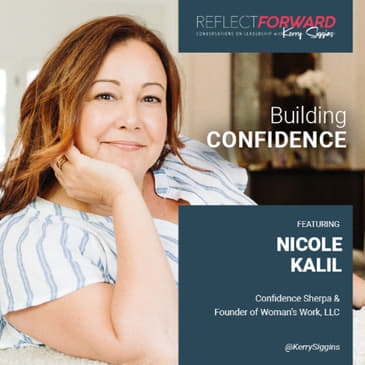

[00:00:10] Hi, everyone, and welcome back to Reflect Forward. I'm your host, Kerry Siggins, and I am so glad you are here today. Today, my guest is Nicole Kalil. She is the founder and confidence sherpa of Women's Work. She does a lot of coaching and speaking. She's got a podcast called This Is Women's Work. I was on the podcast, which is how I met her. And she really focuses on building confidence. How do you build your confidence? How do you create that confidence? Not wait for it to happen to you, but go out and do it.
[00:00:40] And make it happen. She has a book that's out called Validation is for Parking, and she is just a fabulous person. And I know you're going to enjoy this conversation with the confidence sherpa. So hang tight, and I'll be right back with Nicole.
[00:01:02] All right, everyone, I am back with Nicole Kalil. Nicole, thank you so much for joining me on the show today.
[00:01:09] It's absolutely my pleasure, and I can't even talk today, which is already starting out as a problem. Kerry, thanks for having me.
[00:01:17] Oh, no, no problem. I actually have had the same issue. I said, we were talking about a calendar, doing a calendar with all of our products on it. And I said, yes, we could do this for 11 months. I was like, 11 months? There's 12 months in a year. And my brain just short-circuited.
[00:01:35] We can't win them all.
[00:01:36] We've had the same issue.
[00:01:37] Yeah.
[00:01:38] All right. So tell us a little bit about women's work. So you are the founder, and I love Confidence Sherpa, which we're going to talk a lot about here today. But what exactly is women's work?
[00:01:49] Yeah. So it's sort of tongue-in-cheek, right? It's a playoff of an old terminology, which had us really, as women, confined to home care, household responsibilities, child rearing, the kitchen, you know, that type of thing.
[00:02:04] And so my personality, a little snarky, that we're redefining what women's work is today and really acknowledging the multifaceted experiences of women from boardrooms to kitchens, studios to coding dens, you know, really covering the whole gamut of anything that can be considered women's work today, which in my definition is really anything.
[00:02:30] Whatever lights you up from the inside, whatever feels authentically true and real and right for you, that is you doing women's work out in the world.
[00:02:40] Wonderful. And so talk a little bit about what are some of the things you do? How do you support women as they're going through their careers?
[00:02:47] Yeah. So I think my work can be broken down into just a few categories. First is the podcast.
[00:02:52] I have a podcast called This Is Woman's Work. And again, we just cover any and every topic that would feel relevant and supportive to anyone who identifies as a woman in today's day and age.
[00:03:05] I also do coaching, and that is something I've been doing for decades.
[00:03:10] And I've had the opportunity to coach so many women across so many different industries, mostly in management leadership positions or entrepreneurs.
[00:03:21] And so it's really given me some insight into general themes and challenges and things that we're kind of all experiencing at some point or at a certain level.
[00:03:33] And then I also do keynote speaking, though I am consciously trying to scale back on that to really hone in on the podcast and coaching, because like so many women and so many leaders,
[00:03:47] I found that I my funnel was too wide. I was doing too much and was feeling overwhelmed and stressed all the time.
[00:03:55] And I'm trying to subscribe to the idea of less is more and less is better.
[00:04:03] I totally hear you. I got out of several of my commitments going forward, which is like these are the things that aren't that important in my life.
[00:04:10] And even though I might find some joy in them, is it really helping me?
[00:04:14] I look at through the lens of 10 X in my life. Is this going to help me 10 X of my life?
[00:04:18] And if it isn't, then I'm done.
[00:04:20] It was hard to make some of those decisions because you feel like you're going to let people down or you do enjoy it or you have a fear that you're going to miss out on an opportunity.
[00:04:30] But I will tell you, since I did this, I started the process last spring.
[00:04:35] Some of the things I had to continue through and just get through.
[00:04:38] I'm so much happier. It's just like, oh my gosh, it's so much better to just be able to focus and not be just feeling so scattered all the time.
[00:04:46] Yeah. I mean, I had a similar time frame and it's really taken me some time to, you know, get it smaller and smaller because I was one of those that thought I had to be all things to all people all the time.
[00:04:57] Do more, be more, have more. And so it's been a parsing out over time.
[00:05:03] One thing I will add that makes it challenging too is taking something off your plate that also contributes to your revenue.
[00:05:11] That was really challenging for me as a speaker because that's where I get paid the most dollars for my time.
[00:05:20] And I do love it and I do get a great deal of enjoyment from it, but it also has me traveling all over the place.
[00:05:26] And I often say it doesn't make sense to me to advocate for leaders or for women at the expense of my daughter.
[00:05:33] And, you know, it's just, it's a lot. It's draining.
[00:05:36] I'm an extreme introvert also.
[00:05:38] So it requires a lot from me to go to these speaking engagements.
[00:05:43] And between you and I and everybody listening, I often find myself like, I wish something would happen and I break my leg and I can't go or I hope I get sick.
[00:05:52] Like you shouldn't be thinking about that or thinking that way about your work.
[00:05:56] And I love it when I'm there, but the lead up is always a little hard.
[00:06:01] I get it. I get it. I understand.
[00:06:03] All right. So let's talk about the confidence Sherpa part of your title.
[00:06:07] Where did that come from? I love it.
[00:06:09] Yeah. So I'm mildly obsessed with the topic of confidence and it really stemmed from a period of time in my life where I looked confident, but wasn't feeling or experiencing it at all internally.
[00:06:21] And it was a pretty painful period of time.
[00:06:24] I recognized at one point that I didn't know what confidence was, but I was certain I didn't have any of it.
[00:06:30] So I became a student of confidence and read and researched and interacted everything I could possibly get my hands on.
[00:06:39] And so at one point in time, I wrote a book on confidence.
[00:06:43] People started saying my area of expertise was confidence or I'm a confidence expert.
[00:06:49] And I don't know, it just never felt right for me because it's something that I don't know how you actually can become an expert about because it's so evolving and it's so personal.
[00:06:59] So I tried to come up with something that sent the message that I'm on the journey with you and a Google search or two.
[00:07:09] It was like confidence guide, confidence Sherpa just sounded good.
[00:07:14] I love it.
[00:07:15] And so how do you weave that into your practice?
[00:07:19] Is that an area of focus that you work with, with your clients and talk a little bit about what it's like to be on that journey with your clients?
[00:07:28] Yeah.
[00:07:28] So it is absolutely something that is woven into all of my coaching work and into the podcast.
[00:07:35] It's really in everything that I do.
[00:07:36] And I would tell you that I don't think anybody who you, if you saw my coaching roster there, you wouldn't think any of them need confidence coaching.
[00:07:49] They're all very successful in their own right.
[00:07:51] It demonstrates confidence at a really high level.
[00:07:53] But I think the reality is we all have areas of our lives or times in our lives where confidence feels a little bit harder to access.
[00:08:04] And it's not the only thing we talk about.
[00:08:07] We, you know, a lot of problem solving and communication and all the typical things we talk about in coaching business owners and business leaders.
[00:08:15] But that is an always ever present theme.
[00:08:20] Absolutely.
[00:08:20] I mean, it really resonates with me because for much of my younger adulthood, I had the same thing.
[00:08:26] Like there was a lot of things that I did feel confident in, but then there were some that I didn't.
[00:08:31] And it did not feel safe to not feel confident in those areas.
[00:08:34] And so for me, it caused me to overcompensate and just kind of like BS my way through anything because it was unacceptable.
[00:08:43] It felt so scary to me to say, I don't know how to do that or I'm not good at that and be vulnerable in that space.
[00:08:50] And, you know, it led me to some pretty dark places.
[00:08:52] How did that manifest for you?
[00:08:54] And how do you help them get over that need to fake it till you make it?
[00:08:58] Or is fake it till you make it always just sometimes part of things?
[00:09:01] So I love the question.
[00:09:03] And my experience with confidence or the lack thereof was I thought confidence was something I needed to earn or to prove.
[00:09:12] And I thought I would achieve confidence alongside of something else.
[00:09:18] I call it the false equation of confidence.
[00:09:19] And it basically looks like this.
[00:09:21] If X happens, then I'll feel confident.
[00:09:24] And you can fill in the blank of X with whatever you want.
[00:09:27] If I get that promotion, then I'll feel confident.
[00:09:28] If I earn a certain level of income, if I have perfectly behaved children, if I see a certain number on the scale,
[00:09:34] if I fit into a certain size, if I get a certain amount of social media followers or likes or compliments or validation,
[00:09:40] then I'll feel confident.
[00:09:42] But what's problematic is, A, we're giving our confidence and our power away to something or someone else.
[00:09:49] And B, we actually end up becoming addicted to X.
[00:09:53] Because if that's what helps you feel confident, it'll be temporary when you feel it.
[00:10:00] And then you are going to need more of that thing because ultimately I believe we all want to feel confident.
[00:10:08] So as an example, I need external validation in order to feel confident.
[00:10:14] When I get it, it's going to feel real good.
[00:10:16] And it still feels real good even with confidence.
[00:10:19] But if I need it to feel confident, at some point in time, the experience and the feeling wears off.
[00:10:25] And then I'm out there like needing, craving, seeking external validation is absolutely not what confidence is.
[00:10:34] So that was my personal experience.
[00:10:36] It was really in this like needing to prove it.
[00:10:38] To answer the second part of your question, I am not a big fan of the fake it till you make it expression.
[00:10:44] And I have to say that I did coach people to do that for a very long period of time.
[00:10:48] But I've since replaced it with choose it until you become it.
[00:10:52] Yeah.
[00:10:53] Choose confidence second by second if you have to until the feeling catches up.
[00:10:59] And it will inevitably.
[00:11:02] But really making the distinction that confidence is a choice more than it's a feeling.
[00:11:07] And it's a choice any one of us can make anytime we want.
[00:11:10] Yeah.
[00:11:11] I totally agree with you.
[00:11:12] I love it.
[00:11:13] I don't like to fake it till you make it either because I don't think it actually like gives you confidence.
[00:11:17] At least not in my experience.
[00:11:19] And I think for me, what I had to get over was the fear of failing.
[00:11:24] And oftentimes I was like, oh, I don't know if I'm going to be successful at this.
[00:11:27] So I'm not going to try.
[00:11:28] And what I learned was that the more things that I try, the more capable I became, the more capable I became, the more confident I got.
[00:11:38] And so I think that's where a lot of us go wrong is that we don't even do something, try something because we're scared that we're not going to be good at it or succeed at it.
[00:11:49] So why even bother?
[00:11:51] But that's how we grow.
[00:11:52] That's how we learn.
[00:11:53] That's how we actually become more capable and confident.
[00:11:55] And I learned like putting yourself out there and doing hard things.
[00:11:58] Like, oh, that actually made me a lot more confident.
[00:12:01] But that was a hard lesson to learn.
[00:12:03] The research supports it.
[00:12:05] It is very clear that action builds confidence.
[00:12:09] You can't think or hope or fingers and toes cross your way into confidence.
[00:12:13] It's through action that it gets built and reinforced.
[00:12:16] And interestingly enough, it's during our hardest seasons or challenges, during the times where we experience failure or fear or doubt or make mistakes, those are our greatest opportunities to build the highest level of confidence.
[00:12:34] Because it's easy to trust ourselves.
[00:12:36] And that's what confidence is.
[00:12:37] It's firm and bold trust in self.
[00:12:39] It's easy to trust ourselves when we're winning, when we're achieving, when everything's going according to plan.
[00:12:44] But to choose to trust yourself when you're afraid or when the doubt is at a high level, that's where you actually build intimate, deep, and lasting confidence with yourself.
[00:12:57] Yes, I totally agree.
[00:12:59] I was actually just sharing a story on another podcast about a difficult time that I went through earlier this year.
[00:13:05] And I went into problem-solving mode.
[00:13:07] Let's just fix this.
[00:13:08] Get everything done.
[00:13:09] And then I got on a plane by myself.
[00:13:11] I get it.
[00:13:12] I was feeling with all of the chaos around me.
[00:13:15] And I actually was listening to Taylor Swift's new album, which, of course, is so depressing.
[00:13:20] And all of a sudden, I'll just start bawling.
[00:13:23] And it was such a cathartic release.
[00:13:25] But I realized that I had covered up this feeling of overwhelm and like, gosh, can I really do this?
[00:13:32] Or, you know, are all these things happening because I'm a bad leader or I don't deserve this?
[00:13:39] And those aren't thoughts that I have very commonly anymore.
[00:13:42] But I just had to let myself really feel it.
[00:13:45] And I was actually on my way to give a keynote in Florida and was really grateful that I had a couple of days by myself just to let myself feel it.
[00:13:53] And actually, honestly, wallow for a day.
[00:13:56] And I was like, OK, how are you going to fix this?
[00:13:58] You don't want to feel like this.
[00:13:59] And yes, this sucks right now.
[00:14:02] But you know from history that time heals everything and action heals everything.
[00:14:08] And staying cool, calm and collected is such a much better way to show up.
[00:14:12] So after I just let myself feel that and wallow in it for a little bit, then I went into action.
[00:14:18] I look back on it now three or four months later.
[00:14:21] And so many good things have happened because of that messiness back then.
[00:14:27] And you can look back and say, gosh, even though it wasn't great to be there and I had some doubts and I had a confidence issue because I let myself feel it.
[00:14:36] And then because I took action, now look at how far we've come.
[00:14:40] I think that a lot of times when you're in it, when you have that self-doubt and are lacking confidence, it's hard to see that by taking action and leaning into it, really great things can happen.
[00:14:51] Carrie, thank you for sharing that story because I think it points out two really important things.
[00:14:57] First, we all experience this fear and doubt and imposter syndrome and questioning our value.
[00:15:04] I mean, there isn't a person who's immune from that.
[00:15:07] Maybe narcissists, but outside of that, which is obviously not something any of us are striving toward,
[00:15:13] we are all having those feelings in those moments, no matter how successful it looks from the outside in.
[00:15:20] And what I tell myself when I'm having those times and those periods is the only thing that's missing is the benefit of hindsight.
[00:15:28] Yeah.
[00:15:29] I don't yet know what purpose this serves or what lesson I'm going to learn or if this is a redirect or a gift or when you're in it, it sucks.
[00:15:41] No doubt, right?
[00:15:42] Like there's no way to pretend that it doesn't suck when you are in your fear or when you've experienced failure.
[00:15:49] But what I tell myself is the only thing that's missing for me from this situation is the benefit of hindsight.
[00:15:56] I don't yet know.
[00:15:57] And that gives me some hope that A, there is another side and there always is, and B, that it's serving some purpose.
[00:16:05] Absolutely.
[00:16:05] And it can help you reframe to say, how am I going to make sure that when I do have hindsight, that I did learn the lesson in it, that I did turn it into something that's really good.
[00:16:17] Because that's what we do, right?
[00:16:18] I mean, things happen in life.
[00:16:20] And whether we see it as a negative or positive is simply based on the meaning that we attach to it.
[00:16:26] We can take a really negative experience and attach positive meaning to it because we can look at how we grew or how much more resilient we became.
[00:16:34] Those are all choices that we get to make every day.
[00:16:37] So I think that your mindset is such a powerful aspect in there.
[00:16:40] So I love the way that you framed that with, I don't have the benefit of hindsight, but I can also make sure that when I'm looking back at this, that I really got something out of it.
[00:16:51] That's such a powerful way to build confidence.
[00:16:53] A hundred percent.
[00:16:54] Yeah.
[00:16:55] I mean, you end up collecting evidence that you are going to be okay no matter what and that you can trust yourself.
[00:17:03] Yep.
[00:17:04] I agree.
[00:17:04] All right.
[00:17:05] So you talk about head trash and I love this because we all have head trash and that's a little bit of what we've been talking about in this conversation.
[00:17:11] But can you talk about how you look at head trash and how you got yourself out of saying so many negative things to yourself?
[00:17:20] Yeah.
[00:17:21] Yeah.
[00:17:21] So I call it head trash.
[00:17:23] You might've heard it called inner critic or negative thoughts.
[00:17:26] I call it head trash because I want it to sound as dirty and disgusting as it actually is.
[00:17:31] And ultimately it's the things we say to ourselves about ourselves that are never kind and very rarely true, like very rarely based in fact.
[00:17:41] And what I think is really problematic is that we would never say out loud to someone we love the things we say to ourselves.
[00:17:51] We would never say those things to our partner or our best friend or our child.
[00:17:58] Like there's just no way.
[00:17:59] And so I believe we should first and foremost be somebody that we love.
[00:18:04] And so we really need to practice the same grace we do with others.
[00:18:09] And practice, I think, is a big component.
[00:18:12] Carrie, do we have time for a little story?
[00:18:14] I have a story.
[00:18:15] Yeah, yes.
[00:18:16] Absolutely.
[00:18:17] So I don't know, eight years ago or so now, my family and I moved from California to just outside of Boston.
[00:18:24] And it was a very fast move.
[00:18:26] My husband got a job opportunity.
[00:18:28] I can do my work from anywhere.
[00:18:30] So within less than two months, we sold our house in California, bought a house that my husband had never even seen before.
[00:18:35] And I flew out one day and like looked at 23 houses and was like, okay, that one.
[00:18:39] Long story short, I didn't have a chance to research the town we moved to.
[00:18:45] Well, I didn't know until we got there that Winchester, Massachusetts doesn't provide trash service.
[00:18:51] Like the town doesn't provide somebody who comes by your house once a week and picks up your bins.
[00:18:58] You have to take your trash to something called the transfer station, which is a very nice way of saying the dump.
[00:19:04] Now, I learned a lot about our head trash from having to deal with my actual trash.
[00:19:10] And here are a few things that I've learned.
[00:19:12] First, we are not the only contributors of our trash.
[00:19:17] So my husband, Jay, throws things away.
[00:19:20] My daughter, JJ, if we have family or friends visiting, if we have dinner parties, other people contribute to our trash.
[00:19:27] But it's still my chore.
[00:19:28] It's still my responsibility to discard and dispose of it.
[00:19:33] And the same is true for our head trash.
[00:19:35] Other people have and will continue to contribute to it, whether it's well-intentioned family and friends or bullies or exes or bosses.
[00:19:44] Other people have contributed to the thoughts in our heads.
[00:19:47] And it is still only ever our responsibility to discard and dispose of the things that aren't working for us.
[00:19:56] So it's our chore.
[00:19:58] And before anybody feels sorry for me with having to deal with the trash, my husband does 100% of the grocery shopping and cooking in our household.
[00:20:04] So the trash being my chore is no big deal.
[00:20:07] The second thing I learned is that not all trash is created equal.
[00:20:11] Some things can be recycled.
[00:20:14] They can be brought back for another purpose or another use.
[00:20:16] Some things can be composted.
[00:20:18] They can be used for growth.
[00:20:20] And some things are just straight trash, like they need to be thrown away, never to be seen or thought of again.
[00:20:25] And the same is true for our head trash.
[00:20:27] There are definitely things that can be brought back for another use or purpose.
[00:20:31] I use the example in my life.
[00:20:33] I got the feedback early and often that I'm fairly loud and opinionated.
[00:20:37] And so I recycled that as any good loud and opinionated person would do.
[00:20:41] And I launched a podcast.
[00:20:43] There are definitely things that can be composted.
[00:20:45] I got the feedback in my career that I can be somewhat unapproachable.
[00:20:50] I'm very task oriented and move really quickly.
[00:20:52] And so people were kind of like, I don't know how to approach you.
[00:20:55] And I wanted to use that for my growth and betterment and development because that was important to me.
[00:21:01] So I composted that.
[00:21:02] And then some things are just straight trash.
[00:21:06] Like I had an ex-boyfriend tell me once that I would never find somebody who would want to spend their lives with me if I didn't tone down my ambition.
[00:21:15] Now, we all know what that was.
[00:21:17] That was trash.
[00:21:17] I needed to throw it away.
[00:21:19] And so was he.
[00:21:20] It just needed to not take up space in my brain anymore.
[00:21:24] And then the last thing I learned from my actual trash that correlates with our head trash is it gets disgusting when it's hot out.
[00:21:32] New England summers can be really humid.
[00:21:34] And if I don't take our trash on a regular and consistent and committed basis, it gets gross.
[00:21:42] I mean, not just the smell, but like maggots and all of that stuff.
[00:21:46] And so similar to our head trash, when it gets hot out, and by that I mean when we're under pressure or overwhelmed or feeling stressed, it is imperative that we be committed and consistent about disposing and discarding our trash.
[00:22:02] Or we will get mind maggots and it will get disgusting up there.
[00:22:06] And so that's what I've learned about head trash.
[00:22:09] Now, how do we actually manage it?
[00:22:11] Well, first, I think it's important to say I don't think we can eliminate it altogether.
[00:22:16] There's a quote I love that says you can't prevent a bird from flying over your head, but you can prevent it from building a nest in your hair.
[00:22:23] And I think that's true with head trash.
[00:22:25] We can't prevent the thought from coming into our head, but we can prevent it from taking up space and residence in our brain.
[00:22:34] So how do we get rid of it faster?
[00:22:37] First, I think it's important that we name it.
[00:22:39] Call it what it is.
[00:22:40] This isn't my inner knowing.
[00:22:42] This isn't my gut instinct.
[00:22:43] This isn't fact or truth.
[00:22:45] This is head trash.
[00:22:46] If you feel like you're bullying yourself, if you know it's not something you would say to somebody you love, then it's head trash.
[00:22:52] So name it, I think, is step number one.
[00:22:55] Step number two is sort it.
[00:22:58] What do I want to do with this?
[00:22:59] Do I want to throw it away?
[00:23:01] Do I want to compost it?
[00:23:03] Do I want to recycle it?
[00:23:04] What is my choice?
[00:23:05] Because as you said earlier, our mindset, our choice.
[00:23:09] And then I think the third thing we can do is reframe it.
[00:23:14] Come up with something you would say to someone you love.
[00:23:18] Come up with a different, more productive, more empowered perspective of that head trash.
[00:23:25] So a good example could be, you know, maybe I'm beating myself up because I didn't get as many sales on an offering that I thought I would.
[00:23:36] And I'm like, oh, I suck.
[00:23:38] Nobody finds value in what I'm doing.
[00:23:40] Blah, blah, blah.
[00:23:41] A way to reframe it that, by the way, this is not about lying or toxic positivity.
[00:23:45] It has to feel true.
[00:23:47] But the way I might reframe it is this is the first time I ever put this offering out into the world.
[00:23:54] I had an opportunity to learn what worked and what didn't work.
[00:24:00] Let's acknowledge that I did make some sales.
[00:24:03] So you go through and you basically recreate a more productive, more empowered interpretation.
[00:24:09] And it just serves, as we circle back to something we talked about earlier, serves to get us back into action towards what matters most faster than we would if we get stuck in our head trash.
[00:24:21] So that was a long answer to your question, but there you go.
[00:24:23] I totally agree with you.
[00:24:25] And I love that because that really is building resiliency.
[00:24:28] It doesn't change what happened, but you can frame it in a way that says, great, I learned something from this and this is what I'm going to do different instead of I'm a failure.
[00:24:37] I'm giving up.
[00:24:38] I'm not doing it anymore.
[00:24:39] I just had dinner with one of my best friends from high school.
[00:24:42] I was down in Scottsdale giving a keynote and she's thinking about starting a new business.
[00:24:48] And she was like, I have all of this stuff to do and I need to have the website done and I need to have the Instagram stuff done and it's all online.
[00:24:56] And I just I need to hire someone to help me.
[00:24:59] And I said, you already have like a pretty decent thing that you've got going on here.
[00:25:03] Like, why don't you just start?
[00:25:05] What I've learned is that when we say that we have to have all of this stuff done, it is really just a way to deflect actually doing it.
[00:25:14] Because the reality is that you're going to go do all that.
[00:25:17] It's going to be a big investment and you're not going to make it because it's overwhelming and you don't have the money to do it.
[00:25:21] But if you just start small and try things, then it'll build over time.
[00:25:27] And I think that we have this idea that things have to happen so fast.
[00:25:30] And if they don't, again, it's a failure.
[00:25:32] She was like, God, you're so right.
[00:25:34] And I was like, yeah, just take one step.
[00:25:36] Just build it.
[00:25:37] And I think that's really a lot of where this idea of confidence comes from is that we overwhelm ourselves with the way that we think that it should be and how far we have to go to get it.
[00:25:49] And therefore, we lose the confidence to make it happen.
[00:25:52] When really, if we just started bite-sized chunking it out, we learned, we grow, we don't overwhelm ourselves.
[00:25:59] And it's in that small, consistent action that we can really impact a really big change in our lives.
[00:26:05] And so you sharing your story just reminded me so much of this conversation that I have of like, just put something out and try it and see what happens.
[00:26:14] Well, and again, you're exactly on track.
[00:26:17] Two things that we know chips away, confidence derailers, are perfectionism and overthinking.
[00:26:23] And that story with your friend is a perfect example.
[00:26:26] We think we need to have all the ducks in a row, all the I's dotted and the T's crossed before we can move forward.
[00:26:32] We think we need to get ready before we can get into action.
[00:26:35] And that's not true.
[00:26:37] Overthinking is problematic because it leads to inaction.
[00:26:40] And inaction is what creates our biggest regrets.
[00:26:43] We don't regret most of the things we do.
[00:26:46] We regret most of the things we didn't do.
[00:26:48] The conversations we didn't have, the risks we didn't take, the dreams we didn't chase.
[00:26:52] And back to your earliest question about why I call myself a confidence Sherpa, it's also because of exactly what you said.
[00:27:00] We think about these things we want to do and they seem so big and so insurmountable.
[00:27:05] And I asked the question at one point, how do we climb Mount Everest?
[00:27:09] And the answer is one step at a time, right?
[00:27:12] And so we're all on this climb.
[00:27:15] We're all putting one foot in front of the other towards what matters most.
[00:27:19] And it's so important that we don't get stuck in perfectionism and overthinking.
[00:27:25] So you said there were five.
[00:27:26] What are the other three?
[00:27:28] Yeah.
[00:27:28] So perfectionism, head trash, we talked about.
[00:27:32] Comparison, overthinking, and seeking confidence externally.
[00:27:36] It's basically all the things that we do, that kind of false equation.
[00:27:41] If X happens, then I'll feel confident.
[00:27:43] So we ended up talking about all of them except for comparison, which, I mean, we all know that one.
[00:27:50] In 10 seconds on social media, we can easily fall into the comparison trap.
[00:27:54] And I think what's really important as it relates to confidence, the distinction to make is confidence isn't comparing yourself to someone else and feeling good or feeling better.
[00:28:05] Confidence is not needing to compare yourself to anyone at all because confidence is about the trust you have with and for yourself.
[00:28:15] I am so with you.
[00:28:16] That was such a hard lesson for me to learn.
[00:28:19] I was having a conversation with my husband the other day, and he was like, there's nobody else who has a life like us.
[00:28:25] Like, you know, I'm super driven and ambitious, too, and do a lot of different things.
[00:28:28] And he's an entrepreneur and growing a business.
[00:28:31] And he was like, I know nobody who has a life like us.
[00:28:34] And I was like, who cares?
[00:28:35] I was like, you know, that is just such an uncompelling argument to me because I'm not living anybody else's life.
[00:28:41] I don't care what anybody else is doing.
[00:28:43] I'm sorry, that is just not a valid argument to me that what we're trying to do is so much more difficult or different or, you know, whatever, good or bad, because that's not what other people do.
[00:28:56] And so he's like, I know.
[00:28:57] I know you don't care about stuff like that, but I just don't see it.
[00:29:00] I just don't see how you can't look around.
[00:29:01] I was like, why?
[00:29:03] What good does it do to compare yourself to anybody?
[00:29:06] You're living your life.
[00:29:08] If you're not happy to live your life, then that's great.
[00:29:10] Change it, but don't do it because nobody else is living the life that you're living.
[00:29:16] Absolutely.
[00:29:17] And we only see what people want us to see of their lives, too.
[00:29:23] So we don't even have a real comparison, if you will.
[00:29:27] And everybody has their pain and their challenges and their things they wish they could change.
[00:29:33] So what's the point?
[00:29:36] Exactly.
[00:29:37] All right.
[00:29:38] So two more questions to wrap things up.
[00:29:39] So you offer advice on questions to be able to ask yourself when you're experiencing fear, doubt, failure, and you really feel like you need to connect with your confidence.
[00:29:50] So what are those four questions that people can ask themselves when they are like, I need a confidence boost?
[00:29:55] Yeah.
[00:29:56] So if fear or doubt is running rampant, I often ask my coaching clients and myself these four questions.
[00:30:02] The first is, what are the facts?
[00:30:04] So the facts are, I am launching this product on this day and it costs this.
[00:30:12] Or the facts are, I'm in this position.
[00:30:15] I have four people on my team.
[00:30:18] We have this goal, right?
[00:30:21] So just the facts and purely the facts.
[00:30:24] And as crazy as it sounds, this question is actually one of the more challenging ones because it forces us to see how often we're interacting with our interpretations and our perceptions as if they're a fact.
[00:30:37] And so just parsing out, what are the facts?
[00:30:40] So that's step number one.
[00:30:41] Then step number two is to ask yourself, what am I making up about the facts?
[00:30:46] I'm making up that it's hard.
[00:30:48] I'm making up that I'm not ready.
[00:30:49] I'm making up that I suck.
[00:30:51] I'm making up that people won't respect me as a leader.
[00:30:53] I'm making up that I don't have this done or this talent or I'm not like this person or whatever.
[00:30:59] What am I making up about the facts?
[00:31:01] It's, again, just separating the two because we often treat our interpretations as if they're fact and they're not.
[00:31:09] Then the third question is, what is a more productive, empowered way to see it?
[00:31:15] So same set of facts, same set of circumstances.
[00:31:17] What is a more productive, more empowered way to see it?
[00:31:21] I am new, but it is okay for me to be vulnerable about that or to share that.
[00:31:27] It'll rally people or, you know, I'm learning or I got this position for a reason and I'm not perfect,
[00:31:35] but I am growth oriented and willing to learn and I care about my people.
[00:31:39] And that is a good start as a leader or however you reframe it, right?
[00:31:43] But it's what is the more productive and more empowered interpretation of the facts?
[00:31:47] Sometimes it can be helpful to get somebody you trust to help you see it a different way.
[00:31:53] I often say it's hard to read the label from inside the bottle.
[00:31:56] And what I mean is when you're in it, it's really hard to see clearly.
[00:32:00] So getting somebody you trust involved can help in that third question.
[00:32:04] And then the fourth question is, where do I go from here?
[00:32:09] What's next?
[00:32:10] How do I get into action based on that new, more productive, empowered interpretation?
[00:32:16] So it's having a conversation or putting something out that's not perfect, but it's done.
[00:32:25] Reframing the fear and the doubt.
[00:32:27] And actually I had a guest on my podcast who said this and it's making the fear less than the faith.
[00:32:33] We don't ever lose fear.
[00:32:36] That's an important part of the human experience.
[00:32:38] But creating a situation where your belief in self or your trust in self or your confidence is even just a little bit greater than the fear is the opportunity we all have.
[00:32:50] And then that gets us into action.
[00:32:52] Yeah.
[00:32:53] Love it.
[00:32:53] Love it.
[00:32:54] Those are great.
[00:32:54] That's great actionable advice.
[00:32:56] Thank you so much.
[00:32:57] My pleasure.
[00:32:58] Last question.
[00:32:59] Then we'll dive into how people can find you and a little bit more about your book.
[00:33:02] So name of this podcast is Reflect Forward.
[00:33:04] What does Reflect Forward mean to you?
[00:33:06] Yeah.
[00:33:07] So I actually love the name of it because Reflect often has us thinking backward, right?
[00:33:13] We think about what we've accomplished or achieved or experienced.
[00:33:18] And I just think we are a collection of experiences and connections and all of that.
[00:33:26] And just the opportunity to take who we are and what we've become and bring it forward into the future.
[00:33:33] And I can't not tie it into confidence because we have so much evidence that we can.
[00:33:38] We have so much evidence that we will.
[00:33:40] We have so much evidence of overcoming hard things.
[00:33:44] And so that Reflect to Move Forward is integral.
[00:33:50] And I just love it.
[00:33:51] It means a lot to me.
[00:33:52] I love it.
[00:33:53] That's such a fantastic answer.
[00:33:54] Thank you so much.
[00:33:55] My pleasure.
[00:33:56] Okay.
[00:33:56] So how can people find you?
[00:33:58] And so all about you, your podcast, your book.
[00:34:01] Share all that.
[00:34:02] Okay.
[00:34:03] So the best way to find anything and everything is the website.
[00:34:06] It's NicoleKhalil.com.
[00:34:08] This is Woman's Work is the podcast.
[00:34:10] It's available anywhere you listen to podcasts.
[00:34:12] And the book is called Validation is for Parking, How Women Can Beat the Confidence Con.
[00:34:17] Anyone of any gender can read it.
[00:34:19] But it was very much written with the working woman in mind.
[00:34:23] I'll include all that in the show notes.
[00:34:25] And Nicole, thank you so much for coming on the podcast.
[00:34:28] This was just a fantastic conversation.
[00:34:30] And I really, really appreciate the work that you're doing here.
[00:34:34] Gaining confidence is life-changing.
[00:34:36] And I hope it for everybody because it does make your life so much better.
[00:34:40] So you're doing great woman's work.
[00:34:43] Thanks, Keri.
[00:34:44] Thanks for having me on.
[00:34:45] And thank you to the listener for tuning in.
[00:34:47] And it was a great conversation.
[00:34:49] Thanks so much.
[00:34:50] Thank you.
[00:34:51] All right.
[00:34:51] Hang tight.
[00:34:51] I'll be right back.
[00:35:00] All right, everyone.
[00:35:00] I hope you enjoyed that podcast.
[00:35:02] Be sure to check out her book.
[00:35:03] Everything is in the show notes.
[00:35:04] So check it out when you have time.
[00:35:06] Thanks so much for joining.
[00:35:07] And if you like this podcast, please write a review, subscribe to it, share it with a
[00:35:11] friend, go to YouTube, subscribe to it.
[00:35:13] It always helps get these amazing stories out to the world.
[00:35:16] Thanks so much.
[00:35:17] We'll see you next week.